- Product Description Description
- Table of Contents TOC
- List of Table & Figure LOT
- Get Free Sample PDF Sample PDF
Market Size, 2025
$23.69 BnMarket Estimate, 2026
$25.68 BnMarket Forecast, 2034
$46.25 BnCAGR, 2026–2034
8.41%UK Enterprise Resource Planning Market Report Summary
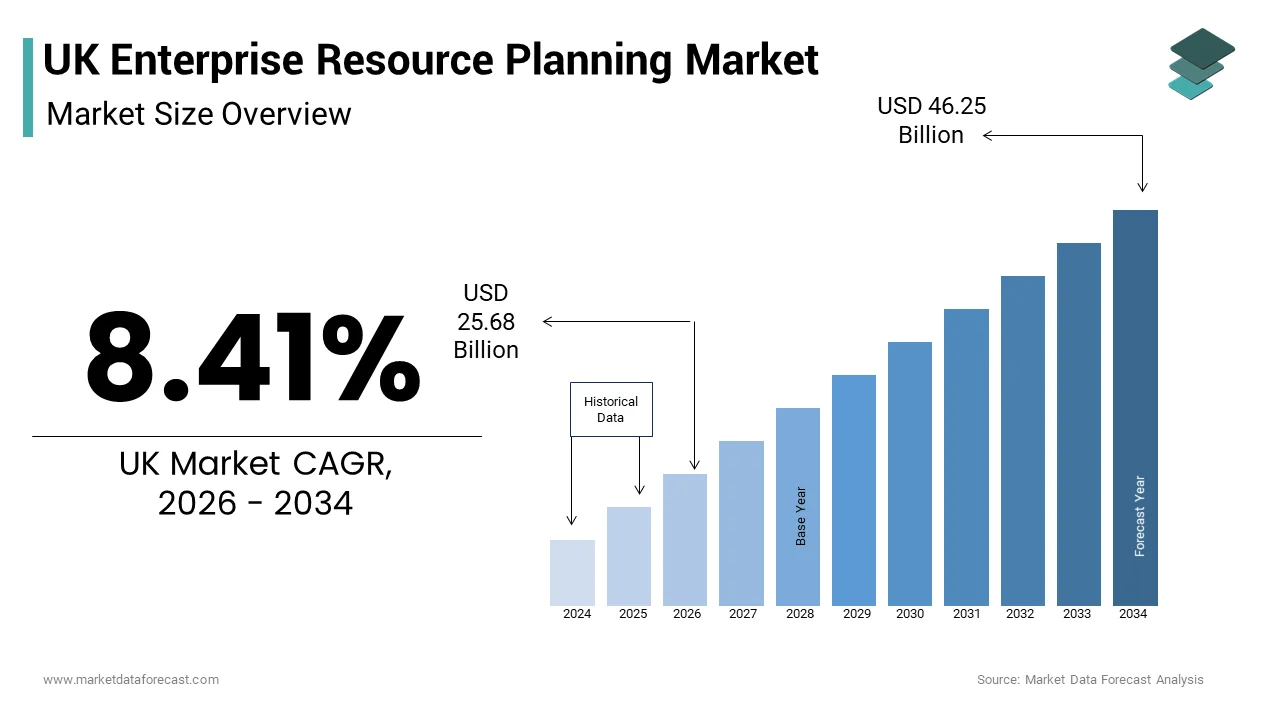
The UK enterprise resource planning (ERP) market was valued at USD 23.69 billion in 2025 and is anticipated to reach USD 25.68 billion in 2026 and further expand to USD 46.25 billion by 2034, growing at a CAGR of 8.41% during the forecast period from 2026 to 2034. The growth of the UK enterprise resource planning market is driven by increasing digital transformation initiatives, growing demand for integrated business management solutions, and the widespread adoption of cloud-based enterprise software. Organizations across industries are increasingly investing in ERP platforms to streamline operations, improve data visibility, enhance decision-making, and optimize resource utilization. Additionally, advancements in artificial intelligence, automation, analytics, and cloud computing are further accelerating ERP adoption across the United Kingdom.
Key Market Trends
- Growing adoption of cloud-based ERP solutions due to their scalability, flexibility, and lower infrastructure costs.
- Increasing integration of artificial intelligence, machine learning, and advanced analytics into ERP platforms to improve operational efficiency and business intelligence.
- Rising demand for industry-specific ERP solutions tailored to the unique requirements of manufacturing, retail, healthcare, and professional services sectors.
- Expansion of remote and hybrid work models driving the need for centralized and accessible enterprise management systems.
- Increasing focus on automation, real-time reporting, and data-driven decision-making to enhance organizational productivity and competitiveness.
Segmental Insights
- Based on offering, the solutions segment dominated the UK enterprise resource planning market and accounted for 51.2% of the market share in 2025. The segment’s leadership is attributed to increasing demand for comprehensive ERP software platforms that integrate finance, supply chain management, procurement, human resources, and customer relationship management functions.
- Based on deployment, the cloud deployment model held a significant share of the UK enterprise resource planning market in 2025. The growth of this segment is driven by its cost-effectiveness, scalability, ease of implementation, and ability to support remote access and business continuity requirements.
- Based on enterprise size, the large enterprises segment accounted for 58.2% of the UK enterprise resource planning market share in 2024. The segment’s dominance is supported by substantial IT budgets, complex operational structures, and the need for advanced enterprise-wide management solutions across multiple business units and locations.
- Based on end-user industry, the manufacturing sector led the market and captured 32.1% of the UK enterprise resource planning market share in 2025. The segment's leadership is driven by increasing adoption of ERP systems to improve production planning, inventory management, supply chain visibility, quality control, and operational efficiency.
Competitive Landscape
The UK enterprise resource planning market is highly competitive, with leading software vendors focusing on cloud innovation, artificial intelligence integration, industry-specific functionality, and enhanced user experiences. Companies are investing in advanced analytics, automation capabilities, cybersecurity features, and scalable cloud architectures to strengthen their market positions. Strategic partnerships, product enhancements, acquisitions, and expansion of software-as-a-service (SaaS) offerings continue to shape the competitive environment and support long-term market growth.
Prominent players in the UK enterprise resource planning market include SAP SE, Oracle Corporation, Microsoft Corporation, Infor Inc., Sage Group plc, Epicor Software Corporation, IFS AB, Unit4 NV, Acumatica, Inc., Odoo SA, QAD Inc., Plex Systems, Inc., Deltek, Inc., Priority Software Ltd., Ramco Systems, Syspro, TOTVS, Yonyou, and HashMicro.
UK Enterprise Resource Planning Market Size
The UK enterprise resource planning market size was valued at USD 23.69 billion in 2025 and is anticipated to reach USD 25.68 billion in 2026 to reach USD 46.25 billion by 2034, growing at a CAGR of 8.41% during the forecast period from 2026 to 2034.
MARKET OVERVIEW AND DEFINITION
The enterprise resource planning is integrated software solutions designed to streamline business operations, across finance human resources supply chain and customer relationship management. The adoption of these systems has become increasingly as British businesses navigate complex regulatory environments and evolving consumer expectations. The digital transformation agenda accelerated significantly following global disruptions with many organizations recognizing the necessity of robust information systems. As per UK Government Digital Service data, over 78% of medium sized enterprises have initiated comprehensive digitalization projects since 2022 reflecting a fundamental shift in operational philosophy. The integration of cloud based architectures has further transformed accessibility enabling smaller firms to leverage capabilities previously reserved for multinational corporations. Current economic conditions have intensified the focus on cost optimization and process automation driving renewed interest in modernizing legacy systems.
MARKET DRIVERS
Accelerating Digital Transformation Initiatives Across Industries
The rapid acceleration of digital transformation initiatives stands is accelerating the growth of the United Kingdom enterprise resource planning market. Organizations, across diverse sectors are fundamentally reimagining their operational frameworks to remain competitive in an increasingly digital economy. The financial services sector demonstrates similar momentum where 71% of institutions have prioritized core system modernization to enhance regulatory compliance and customer service capabilities. Retail enterprises are leveraging integrated platforms to unify omnichannel experiences with 58% adopting real time inventory tracking systems to meet evolving consumer demands for transparency and speed as indicated by British Retail Consortium findings. Healthcare organizations are also investing heavily with National Health Service trusts allocating substantial budgets toward integrated care management systems that connect patient records billing and supply chain operations. The urgency stems from competitive pressures requiring faster decision-making enhanced visibility and improved collaboration across distributed teams. Cloud migration projects further amplify this driver as organizations seek scalable flexible solutions that support remote work arrangements and business continuity planning. This widespread commitment to digital maturity ensures sustained demand for sophisticated enterprise resource planning capabilities that can adapt to changing business models and technological advancements.
Stringent Regulatory Compliance Requirements Driving System Upgrades
The stringent regulatory compliance requirements to invest in modern enterprise resource planning solutions is additionally escalating the growth of the United Kingdom enterprise resource planning market. The complex regulatory landscape encompassing data protection financial reporting environmental standards and industry specific mandates necessitates robust systems capable of ensuring adherence while minimizing operational disruption. According to Information Commissioner Office, statistics organizations faced over 12000 data protection investigations in 2024 with non-compliant entities risking fines up to 4% of global annual turnover under General Data Protection Regulation provisions. This regulatory pressure has prompted 82% of United Kingdom businesses to upgrade their data management capabilities within existing enterprise systems as per Chartered Institute of Management Accountants survey data. The introduction of Making Tax Digital initiative by HM Revenue and Customs requires businesses to maintain digital records and submit returns using compatible software affecting approximately 3 million enterprises across the country. Financial reporting standards continue to evolve with International Financial Reporting Standards updates requiring enhanced audit trails and real time financial consolidation capabilities that legacy systems often cannot provide. Supply chain due diligence regulations require greater transparency into vendor relationships and material sourcing driving demand for procurement modules with advanced tracking features. These multifaceted compliance demands create continuous pressure for system enhancements ensuring that enterprise resource planning platforms remain central to organizational risk management strategies and legal obligation fulfillment.
MARKET RESTRAINTS
High Implementation Costs and Extended Deployment Timelines
The high implementation costs coupled with extended deployment timelines with the broader adoption of enterprise resource planning solutions is hampering the growth of the United Kingdom enterprise resource planning market. The financial burden associated with these comprehensive systems extends far beyond initial licensing fees encompassing customization integration training and ongoing maintenance expenses that can strain organizational budgets particularly for small and medium enterprises. Small businesses face disproportionate challenges, as cite upfront investment costs as the primary barrier to adopting integrated management systems. The complexity of migrating from legacy infrastructure adds substantial expense with data cleansing format conversion and system testing requiring specialized technical expertise that commands premium consulting rates. Change management initiatives essential for successful adoption further inflate costs as organizations must allocate resources for comprehensive staff training and workflow redesign. Extended timelines disrupt normal business operations creating productivity losses during transition periods that impact revenue generation. The prolonged implementation cycles also delay realization of anticipated benefits causing stakeholder frustration and potential project abandonment.
Shortage of Skilled Technical Personnel and Change Resistance
The shortage of skilled technical personnel combined with organizational change resistance is impeding the growth of the United Kingdom enterprise resource planning market. The specialized nature of these systems demands professionals possessing expertise in configuration customization integration and ongoing administration, yet the talent pool remains insufficient to meet escalating demand. Beyond technical capability gaps internal resistance to new systems presents equally challenging obstacles as employees accustomed to established workflows often perceive automation and standardization as threats to job security or professional autonomy. Legacy mindset prevalence within traditional industries exacerbates this challenge with senior leadership sometimes lacking digital literacy necessary to champion transformation efforts effectively. Training programs designed to bridge knowledge gaps require substantial time investment that competes with daily operational responsibilities creating additional friction. The combination of external talent shortages and internal cultural barriers creates implementation risks that deter organizations from committing to comprehensive system overhauls.
MARKET OPPORTUNITIES
Integration of Artificial Intelligence and Machine Learning Capabilities
The integration of artificial intelligence and machine learning capabilities into enterprise resource planning platforms is certainly ascribed to create new opportunities for the growth of the United Kingdom enterprise resource planning market. These advanced technologies enable predictive analytics automated decision making and intelligent process optimization that transform traditional transactional systems into strategic business partners. Financial departments utilize machine learning algorithms for anomaly detection fraud prevention and cash flow forecasting with 68% of finance leaders reporting enhanced visibility into financial risks, according to a study. Human resources functions benefit from intelligent talent acquisition tools that screen candidates match skills to roles and predict employee retention probabilities improving hiring quality by 37% as indicated by Chartered Institute of Personnel and Development research. Supply chain optimization becomes increasingly sophisticated through demand sensing algorithms that incorporate external factors such as weather patterns social trends and economic indicators enabling more accurate inventory planning. Customer relationship modules employ natural language processing to analyze communication patterns sentiment and purchase behavior generating personalized engagement strategies that boost conversion rates. Organizations recognizing these capabilities view artificial intelligence integration not merely as technological enhancement but as competitive imperative driving renewed investment interest.
Expansion of Cloud Based Subscription Models for SMEs
The expansion of cloud-based subscription models specifically tailored for small and medium enterprises is also promoting the growth of the United Kingdom enterprise resource planning market. Traditional on-premise deployments required substantial capital expenditure and dedicated IT infrastructure that placed comprehensive systems beyond reach of smaller organizations however cloud architecture fundamentally alters this dynamic by offering scalable pay as you go arrangements. The subscription model reduces upfront financial barriers with monthly fees ranging from 50 to 500 pounds per user making sophisticated functionality economically viable for organizations with constrained budgets, as per the study. Automatic updates ensure users always access latest features security patches and compliance enhancements without costly upgrade projects addressing one of traditional systems persistent pain points. Industry specific cloud offerings are proliferating with vertical solutions for construction hospitality professional services and retail providing pre-configured workflows that accelerate implementation timelines from months to weeks. Partner ecosystems surrounding major cloud providers offer extensive integration marketplaces connecting enterprise resource planning cores with specialized applications for e commerce marketing automation and business intelligence creating modular extensible environments.
MARKET CHALLENGES
Complexity of Legacy System Migration and Data Integrity Issues
The complexity of legacy system migration coupled with persistent data integrity issues that complicate enterprise resource planning implementations is a challenge for the growth of the United Kingdom enterprise resource planning market. Many organizations operate with decades old infrastructure containing fragmented siloed data accumulated through numerous acquisitions mergers and incremental technology additions creating intricate webs of interdependencies that resist straightforward extraction. Historical records often contain inconsistencies duplicate entries missing fields and formatting variations that require extensive cleansing validation and transformation before becoming usable within modern systems. The financial services sector faces particular difficulties with legacy mainframe systems storing transaction histories in proprietary formats that lack contemporary application programming interfaces necessitating custom development work that escalates costs and timelines, as per the study. Manufacturing companies struggle with bill of materials configurations engineering change orders and supplier master data that have evolved organically without governance frameworks resulting in inaccurate cost calculations and procurement errors post migration. Healthcare organizations confront additional complexities related to patient record confidentiality requiring meticulous attention to data anonymization and access control preservation during transfer processes. According to NHS Digital reports 38% of health care trust system upgrades encountered data integrity complications affecting clinical decision support capabilities temporarily. The absence of comprehensive data dictionaries and documentation for older systems forces implementation teams to reverse engineer business logic consuming valuable project resources. Organizations frequently underestimate these challenges leading to budget overruns timeline extensions and compromised go live dates that damage stakeholder confidence and organizational morale throughout the transformation journey.
Cybersecurity Vulnerabilities and Data Privacy Concerns
The cybersecurity vulnerabilities and escalating data privacy concerns is another factor to impede the growth of the United Kingdom enterprise resource planning market. These integrated systems consolidate vast quantities of sensitive information including financial records employee personal data intellectual property and customer details making them attractive targets for malicious actors seeking high value payloads. Ransomware incidents specifically targeting enterprise resource planning platforms rose by 34%, as per Action Fraud reports with attackers exploiting known vulnerabilities in outdated components or misconfigured access controls to encrypt critical business data demanding substantial ransom payments. The interconnected nature of modern enterprise ecosystems amplifies risk exposure as third party integrations cloud connections and mobile access points create multiple entry vectors that security teams must continuously monitor and protect. Organizations face difficult balancing acts between enabling broad system accessibility for operational efficiency and implementing restrictive security protocols that may impede user productivity. The reputational damage associated with data breaches compounds financial losses eroding customer trust and potentially triggering contractual penalties with business partners. These persistent security challenges require ongoing vigilance regular penetration testing employee awareness training and substantial technology investments that strain organizational resources and complicate enterprise resource planning value propositions.
REPORT COVERAGE
| REPORT METRIC | DETAILS |
| Market Size Available | 2025 to 2034 |
| Base Year | 2025 |
| Forecast Period | 2026 to 2034 |
| CAGR | 8.41% |
| Segments Covered | By Offering, Deployment, Enterprise Size, Country |
| Various Analyses Covered | Global, Regional, and Country Level Analysis, Segment-Level Analysis; DROC, PESTLE Analysis; Porter’s Five Forces Analysis; Competitive Landscape; Analyst Overview of Investment Opportunities. |
| Regions Covered | London, South East, North West, East of England, South West, Scotland, West Midlands, Yorkshire and The Humber, East Midlands, Others |
| Market Leaders Profiled | SAP SE, Oracle Corporation, Microsoft Corporation, Infor Inc., Sage Group plc, Epicor Software Corporation, IFS AB, Infor Inc., Unit4 NV, Acumatica, Inc., Odoo SA, QAD Inc., Plex Systems, Inc., Deltek, Inc., Priority Software Ltd., Ramco Systems, Syspro, TOTVS, Yonyou, HashMicro |
SEGMENTAL ANALYSIS
By Offering Insights
The solutions segment was the largest by accounting for 51.2% of the United Kingdom enterprise resource planning market share in 2025 owing to the fundamental requirement for integrated data management across finance supply chain human resources and customer relationship functions which cannot be achieved through disparate tools. According to International Data Corporation, analysis software licensing and subscription revenues accounted for 68% of total enterprise resource planning spending in the United Kingdom during 2024 reflecting the primary value allocation toward core platform capabilities. Large enterprises particularly drive this trend with 89% maintaining comprehensive solution suites to manage complex multi-national operations as per Confederation of British Industry technology surveys. The shift toward modular architectures allows businesses to purchase specific functional modules such as financial management or inventory control without committing to monolithic systems thereby increasing adoption rates among mid-tier organizations. Regulatory compliance requirements further cement solution dominance since automated reporting features embedded within software platforms reduce manual error risks and ensure adherence to Making Tax Digital and General Data Protection Regulation mandates. The continuous evolution of solution capabilities including real time analytics dashboard visualization and mobile accessibility ensures that software remains the primary investment focus rather than ancillary services. Organizations view these solutions as strategic assets that provide competitive advantage through improved decision-making speed and operational transparency justifying substantial budget allocations toward license acquisitions and subscription renewals.
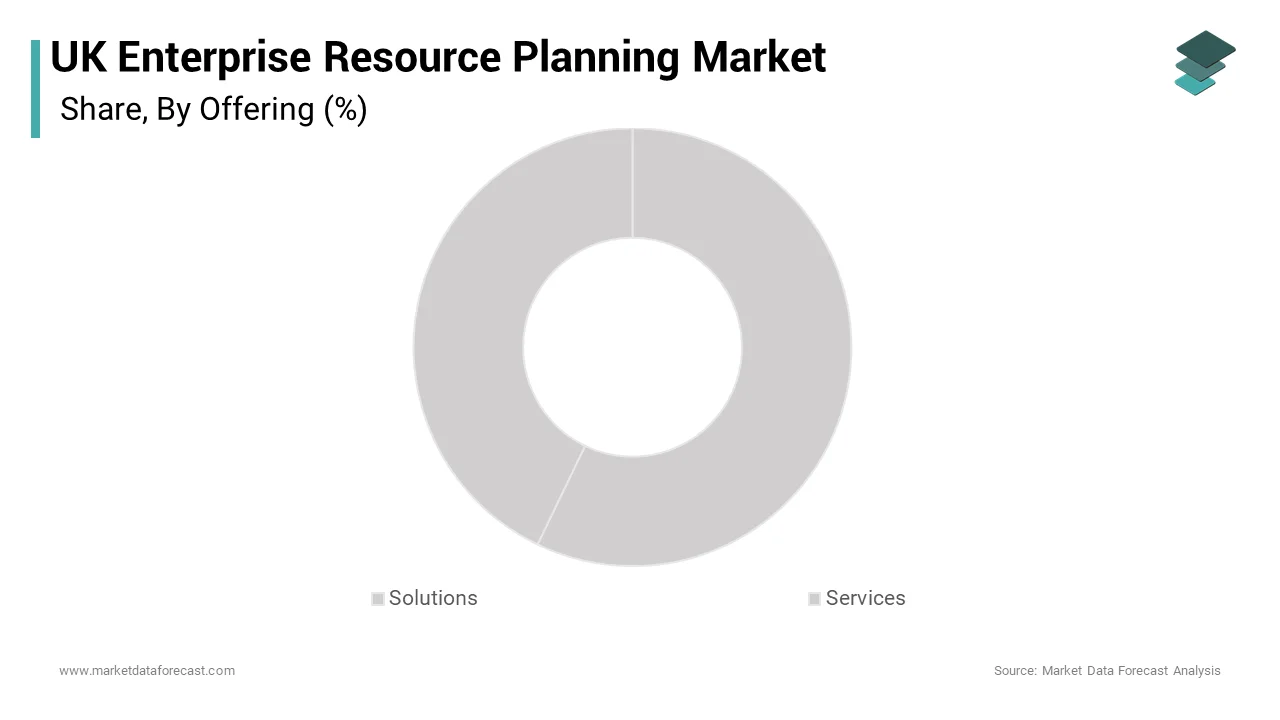
The services segment is lucratively growing at a fastest CAGR of 11.4% throughout the forecast period owing to the intricate nature of modern implementations which require specialized consulting integration training and ongoing support to realize anticipated benefits. The shortage of internal technical talent exacerbates this trend with Tech Nation reporting a deficit of 178000 skilled technology professionals forcing companies to outsource configuration customization and maintenance activities. Post implementation support constitutes another significant growth driver since continuous optimization security patching and user training require dedicated resources that internal IT departments often lack capacity to provide. The emergence of industry specific consulting practices offering pre-configured templates and best practice frameworks further accelerates service demand by reducing implementation timelines from months to weeks.
By Deployment Insights
The cloud deployment model segment held a significant share of the United Kingdom enterprise resource planning market in 2025 with the fundamental economic advantages of subscription based pricing which eliminates large upfront capital expenditures and converts technology costs into predictable operational expenses. The permanent shift toward hybrid and remote work arrangements following global disruptions has cemented cloud preference since these platforms enable seamless access from any location device or network without complex virtual private network configurations. Automatic updates and maintenance provided by cloud vendors ensure organizations always operate on latest secure versions without dedicating internal resources to patch management or version upgrades. Infrastructure resilience offered by major cloud providers with multiple United Kingdom data centers guarantees high availability and compliance with data sovereignty requirements. The ecosystem of integrated third party applications available through cloud marketplaces further enhances value propositions allowing businesses to extend functionality rapidly without custom development efforts.
The hybrid deployment model segment is likely to grow at a fastest CAGR of 13.2% during the forecast period owing to the inability of pure cloud or pure on premise models to address complex regulatory security and performance requirements faced by large enterprises and regulated industries. The National Cyber Security Centre guidelines emphasize defense in depth strategies encouraging organizations to segment data based on sensitivity levels, which naturally leads to hybrid architectures where classified information remains within controlled physical boundaries. Legacy system integration presents another powerful driver since many organizations possess substantial investments in mainframe or customized on premise applications that cannot be economically migrated to cloud environments. Data residency concerns related to General Data Protection Regulation compliance also influence hybrid adoption with organizations preferring to store European citizen data within United Kingdom borders, while utilizing global cloud resources for anonymized analytics.
By Enterprise Size Insights
The large enterprises segment was the largest by accounting for 58.2% of the United Kingdom enterprise resource planning market share in 2024. The sheer scale of their operations spanning multiple geographic locations business units product lines and supply chain networks creates coordination challenges that only sophisticated enterprise resource planning platforms can effectively address. According to Confederation of British Industry, annual surveys 94% of companies with more than 1000 employees utilize enterprise grade resource planning systems compared to 41% of smaller counterparts highlighting the correlation between organizational size and system adoption. Multinational corporations headquartered in the United Kingdom face additional complexities related to currency consolidation intercompany transactions transfer pricing and varying regulatory regimes across jurisdictions requiring advanced functionality that basic accounting software cannot provide. Large enterprises also possess dedicated information technology departments with budgets exceeding 50 million pounds annually enabling them to undertake multi year implementation projects customize extensively and integrate with numerous specialized applications. The average enterprise resource planning investments by large organizations reach 3.2 million pounds reflecting their commitment to digital infrastructure as competitive differentiators. The need for real time visibility into global operations supports executive decision making and investor reporting requirements further justifying substantial expenditures.
The small and medium sized enterprises segment is lucratively growing at a fastest CAGR of 12.8% during the forecast period, as technological democratization removes historical barriers that previously restricted sophisticated system access to large corporations. The competitive pressure exerted by larger rivals forces smaller organizations to enhance operational efficiency customer responsiveness and data driven decision making capabilities to maintain market relevance and profitability. Government initiatives, such as Making Tax Digital have created mandatory compliance requirements affecting approximately 3 million small businesses compelling them to adopt certified digital record keeping systems that often serve as entry points to broader enterprise resource planning functionalityasfunctionality, as per the study. Industry specific cloud solutions tailored for retail hospitality construction and professional services provide pre configured workflows that reduce implementation complexity from months to weeks making adoption feasible for organizations lacking dedicated information technology staff. According to the survey, small business subscribers increased by 34% year over year with average contract values rising as customers add payroll inventory and customer relationship management modules.
By End User Industry Insights
The manufacturing sector was the largest by capturing 32.1% of the United Kingdom enterprise resource planning market share in 2025 with the inherent complexity of modern manufacturing operations involving multi-tier supply chains just in time inventory management bill of materials configuration and regulatory compliance across diverse product categories. The Society of Motor Manufacturers and Traders reports that automotive suppliers specifically invest heavily in advanced planning modules to coordinate with original equipment manufacturers requiring real time visibility into component availability production status and logistics tracking. Quality management integration within enterprise resource planning platforms enables manufacturers to maintain rigorous standards required by aerospace defense and medical device sectors where traceability documentation and certification compliance are mandatory. Energy intensive industries leverage enterprise resource planning energy management modules to monitor consumption patterns optimize usage and meet Environmental Social and Governance reporting obligations increasingly demanded by investors and customers. The Brexit induced supply chain disruptions accelerated adoption as manufacturers sought greater resilience through diversified supplier databases alternative sourcing capabilities and inventory buffer optimization features embedded within modern platforms. Continued investment in Industry 4.0 technologies including Internet of Things sensors and predictive maintenance further cements manufacturing sector leadership as these innovations require robust enterprise resource planning backbones for data aggregation and analytical processing.
The healthcare sector is esteemed to grow at a fastest CAGR of 14.6% from 2026 to 2034, as hospitals clinics and care providers urgently modernize administrative clinical and financial systems to improve patient outcomes operational efficiency and regulatory compliance. This exceptional growth stems from the National Health Service long term plan mandating digital transformation across all trusts requiring integrated systems that connect electronic health records billing supply chain management and human resources into unified platforms. The integration of clinical and financial data enables healthcare providers to accurately track treatment costs identify inefficiencies and optimize resource allocation, particularly given persistent funding constraints and rising patient demand. Pharmaceutical and medical device manufacturers within the healthcare ecosystem also contribute to growth needing rigorous lot tracking serialization and regulatory compliance features to meet Medicines and Healthcare products Regulatory Agency requirements. The aging population demographic trends projecting 21% of United Kingdom residents will be over 65 by 2030, according to Office for National Statistics forecasts create sustained demand for efficient healthcare delivery -systems. Telemedicine integration remote patient monitoring and value-based care models further accelerate enterprise resource planning adoption as providers seek platforms capable of managing these evolving care delivery paradigms.
COMPETITIVE LANDSCAPE
The competition within the United Kingdom enterprise resource planning market is intense and characterized by the presence of global technology giants alongside innovative domestic providers specializing in niche sectors. Established multinational corporations leverage their extensive product portfolios global support networks and brand recognition to secure contracts with large enterprises and public sector entities requiring comprehensive and scalable solutions. These leaders continuously innovate by embedding advanced technologies such as artificial intelligence and blockchain to differentiate their offerings and address evolving business needs. Meanwhile agile local vendors compete effectively by offering highly customizable cost-effective cloud based solutions tailored specifically for small and medium sized enterprises that prioritize ease of use and rapid deployment. Differentiation increasingly depends on industry specific functionality regulatory compliance features and integration capabilities with existing business applications. Customer retention strategies focus on continuous product updates proactive support and training programs to ensure long term value realization.
KEY MARKET PLAYERS
A few of the market players that are dominating the UK enterprise resource planning market are
- SAP SE
- Oracle Corporation
- Microsoft Corporation
- Infor Inc.
- Sage Group plc
- Epicor Software Corporation
- IFS AB
- Infor Inc.
- Unit4 NV
- Acumatica, Inc.
- Odoo SA
- QAD Inc.
- Plex Systems, Inc.
- Deltek, Inc.
- Priority Software Ltd.
- Ramco Systems
- Syspro
- TOTVS
- Yonyou
- HashMicro
Top Players In The Market
- SAP SE maintains a formidable presence within the United Kingdom enterprise resource planning landscape by delivering comprehensive cloud-based solutions tailored for large enterprises and complex industrial operations. The company actively engages with British manufacturers financial institutions and public sector organizations to modernize legacy systems through its intelligent suite platform. Recent initiatives focus heavily on integrating artificial intelligence capabilities into core business processes enabling predictive analytics and automated decision making for clients. SAP has established significant partnerships with local consulting firms to enhance implementation support and ensure seamless migration from older architectures. The organization continues to invest in data center infrastructure within the region to address sovereignty concerns and improve latency performance for critical applications. Their commitment to sustainability reporting modules aligns with stringent environmental regulations affecting British corporations.
- Oracle Corporation strengthens its position in the United Kingdom market by leveraging its robust cloud infrastructure and autonomous database technologies to support mission critical enterprise resource planning deployments. The company focuses on providing integrated suites that combine financial management supply chain optimization and human capital management into unified platforms accessible via secure cloud environments. Oracle recently expanded its local technical support teams to assist British organizations with complex migrations and customization requirements ensuring minimal operational disruption during transitions. Strategic collaborations with leading system integrators enable tailored solutions for regulated industries, such as banking and telecommunications, where compliance and security are paramount. The introduction of advanced machine learning features within their applications helps clients automate routine tasks and gain deeper insights into operational performance.
- Microsoft Corporation drives significant adoption in the United Kingdom enterprise resource planning sector through its Dynamics 365 platform which seamlessly integrates with widely used productivity tools like Office 365 and Teams. This deep ecosystem connectivity appeals strongly to small and medium sized enterprises seeking familiar interfaces and reduced training overheads during implementation. The company actively promotes low code development capabilities enabling business users to customize workflows without extensive programming knowledge thus accelerating digital transformation initiatives. Microsoft has invested substantially in local partner networks to provide specialized industry expertise and implementation services across various regions. Recent enhancements focus on embedding artificial intelligence assistants that help users analyze data trends and automate customer interactions efficiently. The organization also prioritizes security and compliance certifications relevant to British regulatory standards ensuring trust among government and healthcare clients.
Top Strategies Used By Key Market Participants
Key players in the United Kingdom enterprise resource planning market predominantly employ product innovation and strategic partnerships to maintain competitive advantage and drive growth. Companies consistently invest in research and development to integrate artificial intelligence machine learning and advanced analytics into their platforms enabling clients to achieve greater operational efficiency and data driven insights. Developing industry specific solutions allows vendors to address unique regulatory and operational challenges faced by sectors, such as manufacturing healthcare and financial services thereby increasing relevance and adoption rates. Strategic acquisitions of niche technology firms provide access to specialized capabilities such as supply chain visibility or customer experience management which are then integrated into broader suites to offer comprehensive value propositions. Expanding partner ecosystems with local consulting firms and system integrators ensures robust implementation support and customized service delivery, which is crucial for successful deployments in complex organizational environments. Emphasizing cloud native architectures and subscription-based pricing models lowers entry barriers for small and medium enterprises while providing scalable solutions that grow with client needs. Continuous focus on user experience design and mobile accessibility enhances adoption rates by ensuring intuitive interfaces that require minimal training.
MARKET SEGMENTATION
This research report on the UK enterprise resource planning market is segmented and sub-segmented into the following categories.
By Offering
- Solutions
- Services
By Deployment
- On-premise
- Cloud
- Hybrid
By Function
- Human Resources
- Supply Chain
- Finance
- Marketing
- Other Functions
By Enterprise Size
- Large Enterprises
- Small and Medium-Sized Enterprises
By End-user Industry
- Manufacturing
- Retail and E-commerce
- BFSI
- IT and Telecom
- Government and Public Sector
- Energy and Utilities
- Healthcare
- Other End-user Industries