- Product Description Description
- Table of Contents TOC
- List of Table & Figure LOT
- Get Free Sample PDF Sample PDF
Market Size, 2025
$81.58 BnMarket Estimate, 2026
$83.91 BnMarket Forecast, 2034
$105.06 BnCAGR, 2026–2034
2.85%UK Facilities Management Market Report Summary
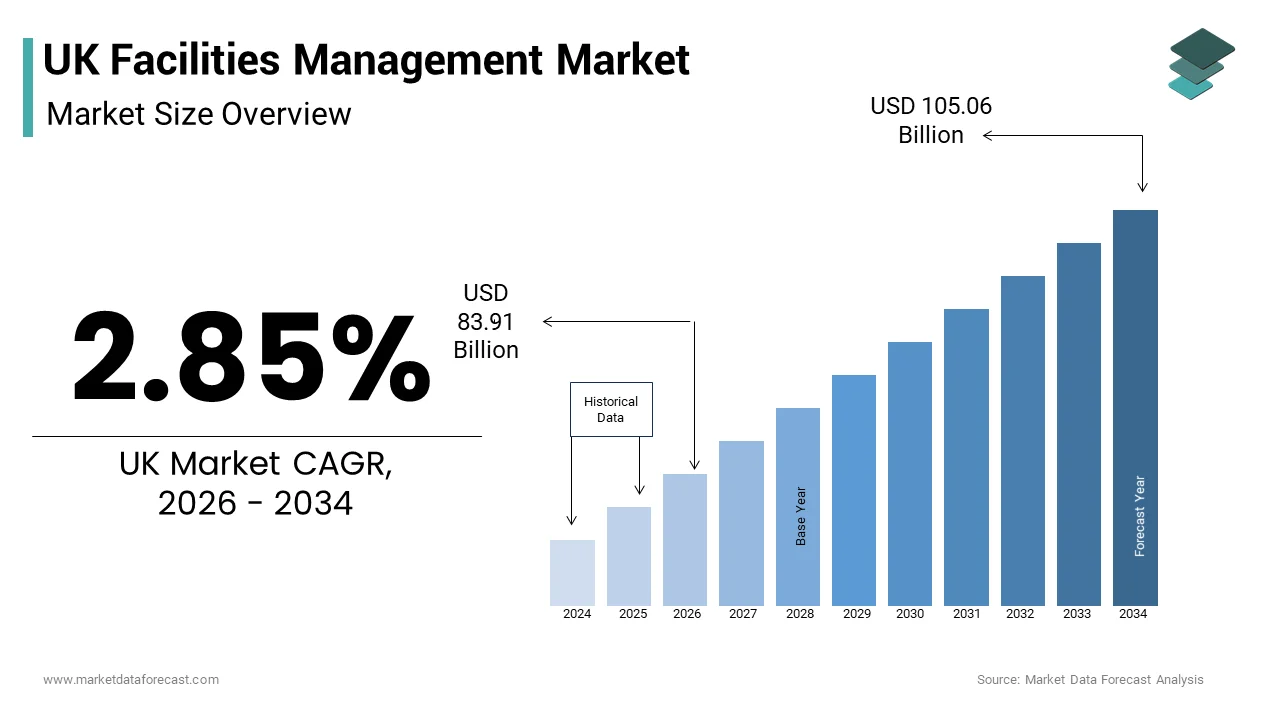
The UK facilities management market is estimated to be valued at USD 81.58 billion in 2025, is projected to reach USD 83.91 billion in 2026, and is forecast to grow to USD 105.06 billion by 2034, registering a CAGR of 2.85% during the forecast period from 2026 to 2034. The UK facilities management market continues to evolve as organizations prioritize operational efficiency, workplace optimization, and sustainable building management. Growing demand for integrated facility services, increasing adoption of smart building technologies, and heightened focus on regulatory compliance are driving market expansion across commercial, industrial, healthcare, and public sector facilities. Businesses are increasingly outsourcing facility operations to specialized service providers to reduce operating costs, improve service quality, and focus on core business activities. Additionally, advancements in digital facility management platforms, predictive maintenance solutions, energy-efficient infrastructure, and environmental sustainability initiatives are creating long-term growth opportunities throughout the United Kingdom.
Key Market Trends
- Smart building technologies, IoT-enabled monitoring systems, and AI-driven predictive maintenance are transforming modern facilities management operations.
- Organizations are increasingly adopting integrated facilities management (IFM) models to streamline service delivery and improve operational efficiency.
- Sustainability objectives are accelerating investments in energy-efficient buildings, carbon reduction strategies, and environmentally responsible facility operations.
- Data analytics and cloud-based facility management platforms are enhancing asset performance, workforce productivity, and real-time decision-making.
- Growing demand for flexible workplaces and hybrid office environments is encouraging providers to expand workplace management and occupant experience services.
Segmental Insights
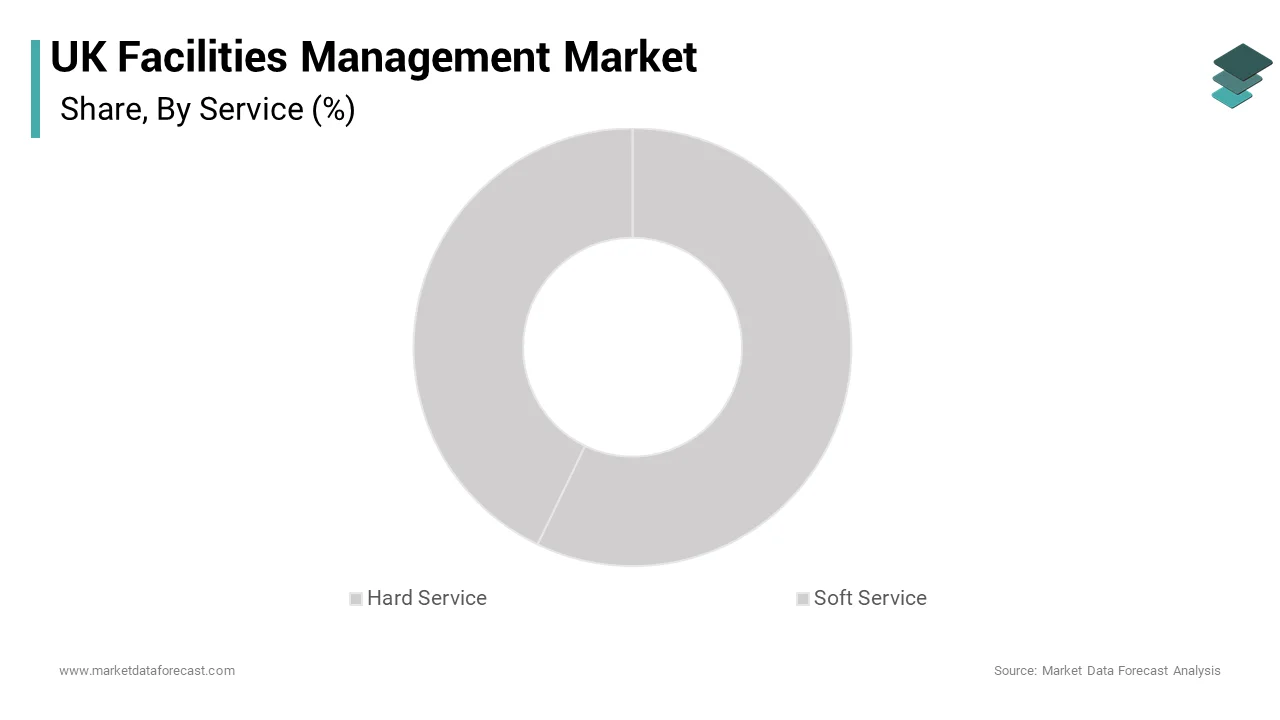
Based on service, the hard services segment accounted for 55.4% of the UK facilities management market share in 2025. The segment maintained its leading position due to the continuous need for mechanical, electrical, plumbing, HVAC, fire safety, and infrastructure maintenance services that ensure regulatory compliance and uninterrupted building operations.
Based on offering, the outsourced segment held a significant share of the UK facilities management market in 2025. Organizations continue to outsource facility operations to specialized providers to improve cost efficiency, access technical expertise, enhance service quality, and optimize resource allocation.
Based on end-user industry, the commercial sector captured 34.2% of the UK facilities management market share in 2025. Strong demand from office buildings, retail centers, mixed-use developments, and corporate campuses continues to support the segment's market leadership as businesses invest in efficient workplace management and sustainable building operations.
Regional Insights
England dominated the UK facilities management market by accounting for 86.5% of the market share in 2025, driven by its extensive commercial infrastructure, high concentration of corporate offices, healthcare facilities, educational institutions, and government buildings. Scotland held the second-largest share at 7.6%, supported by continued investments in commercial real estate, public infrastructure, and industrial facilities. Wales is expected to experience steady growth as modernization projects and sustainable building initiatives gain momentum, while Northern Ireland is witnessing increasing demand for professional facilities management services due to its strong public sector presence, expanding business community, and infrastructure development activities.
Competitive Landscape
The UK facilities management market is highly competitive, with established service providers competing through integrated solutions, digital innovation, and industry-specific expertise. Leading companies are investing in smart building technologies, automation, artificial intelligence, and predictive maintenance capabilities to improve operational performance and deliver greater value to clients. Strategic acquisitions, long-term outsourcing contracts, and partnerships with public and private organizations continue to strengthen market positioning. Sustainability remains a major competitive focus, with providers expanding energy management, carbon reduction, and green building services to support clients' environmental objectives. Companies are also enhancing cloud-based facility management platforms, workplace experience solutions, and data-driven asset management capabilities to address evolving customer requirements and maintain long-term competitiveness in the UK market.
Prominent players in the UK facilities management market include ISS UK, Mitie Group PLC, Carillion Services Limited (now part of Kier Group), Serco Group PLC, Kier Group PLC, G4S Facilities Management UK Limited, Sodexo Facilities Management Services, Compass Group, Equans, VINCI Facilities Limited, Aramark Facilities Services, Andron Facilities Management, CSM Facilities Management Group, Orton Group, Global Facilities, and BGIS.
UK Facilities Management Market Size
The UK facilities management market size will reach USD 81.58 billion in 2025 and is anticipated to reach USD 83.91 billion in 2026 to reach USD 105.06 billion by 2034, growing at a CAGR of 2.85% during the forecast period from 2026 to 2034.
The facilities management is suite of services designed to support the functionality safety and efficiency of built environments across commercial, residential, and public sectors. This industry integrates hard services, such as mechanical, electrical, and plumbing maintenance with soft services, including cleaning security catering and reception duties. As per data from the British Institute of Facilities Management, the industry supports millions of jobs and contributes significantly to the national economy by maintaining the operational integrity of hospitals schools offices and retail spaces. The modern definition has expanded beyond mere maintenance to include strategic asset management sustainability initiatives and workplace experience enhancement. Regulatory frameworks governing health and safety energy efficiency and environmental protection heavily influence service delivery standards. The increasing complexity of building systems driven by smart technology integration requires specialized expertise and continuous professional development. Organizations increasingly view facilities management as a strategic partner rather than a cost center recognizing its impact on employee productivity customer satisfaction and corporate reputation. The shift toward hybrid working models has further transformed service requirements necessitating flexible and adaptive management solutions.
MARKET DRIVERS
Stringent Regulatory Compliance and Health Safety Standards Drive Outsourcing Demand
The imperative to adhere to rigorous health safety and environmental regulations is fuelling the growth of the United Kingdom facilities management market. Legislation, such as the Health and Safety at Work Act and various environmental protection laws impose strict obligations on property owners and occupiers to maintain safe and compliant environments. Thousands of workplace inspections occur annually with non-compliance resulting in substantial fines and legal repercussions. This regulatory pressure compels organizations, particularly in healthcare education and hospitality sectors to engage specialized facilities management providers, who possess the technical expertise and certification necessary to ensure full compliance. These providers offer structured audit trails risk assessments and preventive maintenance schedules that mitigate liability and enhance operational safety. The complexity of managing asbestos fire safety systems and air quality monitoring requires dedicated resources that many internal teams lack. Consequently, businesses prefer outsourcing these critical functions to experts, who can navigate the evolving regulatory landscape efficiently. The recent emphasis on post pandemic hygiene standards has further intensified this demand with clients seeking certified cleaning protocols and sanitization services.
Rising Focus on Sustainability and Net Zero Targets Accelerates Service Innovation
The national commitment to achieving net zero carbon emissions by 2050 focused on energy efficiency and sustainable operations is additionally leveraging the growth of the United Kingdom facilities management market. The UK government has implemented stringent building regulations requiring new and existing structures to meet higher environmental performance standards. As per statistics from the Department for Business Energy and Industrial Strategy, buildings account for approximately 30% of the UK total carbon emissions necessitating urgent retrofitting and optimization efforts. Facilities management companies are increasingly tasked with implementing energy saving measures, such as LED lighting upgrades smart heating controls and renewable energy integration. Clients seek partners, who can provide detailed energy audits carbon footprint tracking and sustainability reporting to meet corporate social responsibility goals and regulatory mandates. The adoption of green building certifications like BREEAM encourages organizations to invest in professional management services that ensure ongoing compliance with environmental criteria. This shift transforms facilities management from a reactive maintenance function into a proactive strategic role centered on resource conservation and ecological stewardship. Providers who offer innovative solutions such as waste reduction programs water conservation techniques and sustainable supply chain management gain a competitive advantage. The financial benefits of reduced energy consumption combined with regulatory incentives create a compelling business case for investing in specialized sustainability focused facilities management services.
MARKET RESTRAINTS
Acute Labor Shortages and Skills Gaps Impede Service Delivery Capacity
The facilities management sector faces significant constraints due to persistent labor shortages and a widening skills gap among the workforce, which is limiting the growth of the United Kingdom facilties management market. The industry relies heavily on skilled technicians engineers and cleaning staff , yet struggles to attract and retain qualified personnel. The construction and maintenance sectors report some of the highest vacancy rates by an aging workforce and insufficient training pipelines. This scarcity leads to increased wage pressures and higher operational costs for service providers who must compete fiercely for limited talent. The lack of skilled professionals delays project completion times and compromises service quality affecting client satisfaction and contract retention. Training new employees requires substantial time and investment which strains resources particularly for smaller firms. The perception of facilities management as a low status career path discourages young people from entering the field creating a long-term sustainability challenge for the industry.
Economic Volatility and Inflationary Pressures Squeeze Profit Margins
The economic instability and rising inflation is increasing operational costs and compressing profit margins, which is another factor limiting the growth of the United States facilities management market. The surge in energy prices raw material costs and wages has significantly impacted the expense structure of service providers. The inflation rates have reached multi decade highs forcing companies to absorb higher costs for fuel cleaning supplies and equipment maintenance. Many facilities management contracts are fixed price or subject to limited adjustment clauses preventing providers from passing these increased costs fully onto clients. This mismatch between rising expenses and static revenue streams erodes profitability and threatens the financial viability of many firms particularly small and medium sized enterprises. Clients facing their own budget constraints often resist price increases leading to renegotiations or contract terminations. The uncertainty surrounding economic forecasts makes long term planning difficult discouraging investment in new technologies or workforce development. Additionally, fluctuating currency values affect the cost of imported equipment and spare parts further complicating financial management. These economic headwinds force companies to prioritize cost cutting measures which may compromise service quality and employee welfare.
MARKET OPPORTUNITIES
Integration of Internet of Things and Smart Building Technologies Creates Efficiency Gains
The rapid advancement of Internet of Things technology and smart building systems to enhance service efficiency and value proposition is substantially to create new opportunities for the growth of the United Kingdom facilities management market. Sensors and connected devices enable real time monitoring of building systems, such as HVAC lighting and security by allowing for predictive maintenance and optimized resource usage. The adoption of smart building technologies in the UK is accelerating with organizations seeking to reduce operational costs and improve occupant comfort. Facilities management providers can leverage these technologies to offer data driven insights that help clients make informed decisions about asset utilization and energy consumption. Predictive analytics can identify potential equipment failures before they occur minimizing downtime and repair costs. This shift from reactive to proactive management enhances service reliability and extends asset lifespan. Providers, who invest in digital platforms and analytics capabilities can differentiate themselves in a competitive market by offering superior visibility and control over building operations. The integration of mobile applications enables seamless communication between staff tenants and managers improving response times and service transparency. As buildings become more intelligent, the demand for tech savvy facilities management partners will grow creating new revenue streams through software licensing data analysis and system integration services.
Expansion into Integrated Facility Services Models Enhances Client Value
The trend toward integrated facility services models to consolidate multiple service lines under single contracts, thereby enhancing client value and operational synergy. The expansion into integrated facility services is also to leverage the growth of the United Kingdom facilities management market. Instead of managing separate vendors for cleaning security maintenance and catering organizations increasingly prefer single source providers, who can deliver comprehensive solutions. This approach simplifies procurement reduces administrative burden and improves coordination across different service areas. Facilities management companies can expand their service portfolios through organic growth or strategic acquisitions to offer end to end solutions that cover all aspects of building management. This holistic approach allows providers to optimize workflows share data across teams and implement unified sustainability strategies. Clients benefit from a single point of accountability and streamlined communication, which enhances overall satisfaction. The ability to cross sell services within existing accounts drives revenue growth and strengthens customer loyalty. Providers who successfully execute integrated models can achieve higher margins and greater market share by becoming indispensable strategic partners.
MARKET CHALLENGES
Cybersecurity Risks Associated with Digital Transformation Threaten Operational Integrity
The increasing reliance on digital technologies and connected systems introduces significant cybersecurity risks that threaten operational integrity and data privacy, which is a significant challenge for the growth of the United Kingdom facilities management market. As buildings become smarter and more interconnected, they become vulnerable to cyberattacks that can disrupt critical services such as heating ventilation and access control. The number of cyber incidents targeting infrastructure and service providers has risen sharply amplifying the need for robust security measures. Facilities management companies must invest in advanced cybersecurity protocols encryption and staff training to protect sensitive client data and ensure system reliability. A successful breach can lead to severe financial penalties reputational damage and loss of client trust. The complexity of managing security across multiple devices and platforms requires specialized expertise that many traditional facilities management firms lack. Integrating security into the core service offering adds cost and complexity to operations. Clients are increasingly demanding assurances regarding data protection and system resilience making cybersecurity a critical factor in contract negotiations. Failure to address these risks adequately can result in contract termination and legal liabilities. The evolving nature of cyber threats requires continuous vigilance and adaptation posing a persistent challenge for the industry. Providers must balance the benefits of digital innovation with the imperative of maintaining secure and resilient operations.
Fragmented Supply Chain and Vendor Management Complexities Hinder Efficiency
Managing a fragmented supply chain and coordinating multiple subcontractors for operational efficiency is also to decline the growth of the United Kingdom facilities management market. The industry relies on a vast network of suppliers for equipment spare parts and specialized services which can lead to inconsistencies in quality and delivery times. The disruptions caused by geopolitical tensions logistics hurdles and supplier insolvencies have increased volatility in the sector. Coordinating these diverse entities requires sophisticated vendor management systems and strong contractual frameworks to ensure compliance with service level agreements. Inefficiencies in the supply chain can delay maintenance activities increase costs and negatively impact client satisfaction. The lack of standardization among suppliers complicates procurement processes and makes it difficult to achieve economies of scale. Facilities management providers must constantly monitor supplier performance and mitigate risks associated with dependency on single sources. Building resilient supply chains involves diversifying suppliers and establishing contingency plans, which require significant administrative effort and resources. The complexity of managing global and local suppliers simultaneously adds another layer of difficulty particularly for large multinational contracts.
REPORT COVERAGE
| REPORT METRIC | DETAILS |
| Market Size Available | 2025 to 2034 |
| Base Year | 2025 |
| Forecast Period | 2026 to 2034 |
| CAGR | 2.85% |
| Segments Covered | By Service, Offering, End-user, Country |
| Various Analyses Covered | Global, Regional, and Country Level Analysis, Segment-Level Analysis; DROC, PESTLE Analysis; Porter’s Five Forces Analysis; Competitive Landscape; Analyst Overview of Investment Opportunities. |
| Regions Covered | London, South East, North West, East of England, South West, Scotland, West Midlands, Yorkshire and The Humber, East Midlands, Others |
| Market Leaders Profiled | ISS UK, Mitie Group PLC, Carillion Services Limited (Now part of Kier Group), Serco Group PLC, Kier Group PLC, G4S Facilities Management UK Limited, Sodexo Facilities Management Services, Compass Group, Equans, VINCI Facilities Limited, Aramark Facilities Services, Andron Facilities Management, CSM Facilities Management Group, Orton Group, Global Facilities, BGIS |
SEGMENTAL ANALYSIS
By Service Insights
The hard services segment was the largest by holding 55.4% of the United Kingdom facilities management market share in 2025 owing to the encompass essential technical maintenance required for building functionality safety and regulatory compliance. The failure to maintain these critical systems can result in severe penalties operational shutdowns and significant liability risks for property owners. The complexity of modern building infrastructure requires specialized engineering expertise that internal teams often lack necessitating reliance on professional service providers. Regulatory frameworks, such as the Building Safety Act impose stringent obligations on duty holders to ensure structural integrity and system reliability driving consistent demand for hard services. The high cost of equipment failure further incentivizes organizations to invest in preventive maintenance contracts rather than reactive repairs. The hard services typically account for over 60% of total facilities management expenditure reflecting their capital intensive nature and importance. The aging building stock in the UK, particularly in public sector and healthcare facilities requires continuous upgrading and repair sustaining long term demand.
The soft services segment is anticipated to witness a fastest CAGR of 5.2% during the forecast period with the increasing emphasis on workplace experience and employee well-being. They recognize that clean comfortable and secure environments, significantly impact productivity and retention. The employee satisfaction is closely linked to the quality of soft services, such as cleaning, catering, reception, and security. The shift toward hybrid working models has heightened expectations for office spaces to be inviting and hygienic when employees do choose to attend. This trend drives demand for premium cleaning protocols enhanced concierge services and flexible catering options that create a hotel like atmosphere. Companies are investing more in these areas to differentiate their workplaces and foster a sense of community. Providers who offer integrated technology solutions for booking desks managing visitors and monitoring cleanliness gain a competitive edge.
By Offering Insights
The outsourced segment held a significant share of the United Kingdom facilities management market in 2025 due to the compelling economic benefits and access to specialized expertise it offers organizations. This efficiency stems from the ability of specialized providers to leverage economies of scale bulk purchasing power and optimized workforce management. Outsourcing also grants access to a broader pool of skilled professionals and advanced technologies that would be prohibitively expensive for individual companies to develop internally. Providers bring best practices from diverse industries ensuring high service standards and continuous improvement. The complexity of managing multiple service lines, such as security, cleaning, and maintenance that requires dedicated management resources that outsourced partners provide. This allows client organizations to focus on their core business activities while leaving facility operations to experts. The risk transfer associated with outsourcing including compliance liabilities and employment responsibilities that further enhances its appeal.
The in-house segment is swiftly emerging at a fastest CAGR of 6.2% during the forecast period owing to the desire for greater control over operations and enhanced data security. Organizations handling sensitive information or operating in highly regulated environments, such as defense finance and healthcare increasingly prefer to keep facility operations internal to mitigate risks. The integration of smart building technologies has raised concerns about data privacy and potential vulnerabilities associated with third party access. This approach also allows for tighter alignment between facility operations and corporate culture ensuring that service delivery reflects organizational values. The ability to respond immediately to internal requests without navigating external contract procedures enhances operational agility. Some large corporations have developed sophisticated internal facilities teams equipped with advanced technology and training to match the capabilities of external providers.
By End-User Industry Insights
The commercial sector segment was accounted in holding United Kingdom facilities management market of 34.2% of share in 2025 due to its extensive real estate portfolio comprising offices retail spaces and mixed-use developments that require continuous maintenance and management. London and other major cities host millions of square meters of commercial property that must operate efficiently to support business activities. The commercial property sector represents a significant portion of the UK total rateable value indicating its substantial economic footprint. High occupancy rates in prime locations drive consistent demand for cleaning security and maintenance services to ensure tenant satisfaction and retention. Corporate tenants increasingly expect premium facility services as part of their lease agreements pushing landlords to invest in high quality management. The competitive nature of the commercial real estate market means that building owners use superior facilities management as a differentiator to attract and retain high profile tenants. Regular refurbishments and upgrades to keep properties modern and compliant with energy standards further fuels the growth of the segment.
The healthcare sector is expected to register a fastest CAGR of 8.6% during the forecast period with the aging population and significant government investment in healthcare infrastructure. The demand for medical services is rising steadily requiring expansion and modernization of hospitals clinics and care homes. These facilities require specialized facilities management services that adhere to strict hygiene and safety standards. The complexity of medical equipment and critical systems such as oxygen supply and sterile environments demands highly trained technical staff. Facilities management providers in this sector must ensure uninterrupted service delivery to support patient care and safety. The introduction of new healthcare technologies and digital health records also requires robust IT infrastructure management within facilities. This combination of demographic trends and infrastructure investment creates a sustained growth trajectory for facilities management services in the healthcare sector.
COUNTRY LEVEL ANALYSIS
England Facilities Management Market Analysis
England was the top performer in the United Kingdom facilities management market by accounting for 86.5% of share in 2025 due to its large population dense urban centers and concentration of commercial and public sector organizations. London serves as the primary hub hosting headquarters of multinational corporations and major government institutions that drive high demand for premium facilities services. England contains over 56 million people and the majority of the UK GDP generating substantial need for office retail and industrial space management, according to the study. The presence of extensive healthcare networks, including numerous NHS trusts and private hospitals creates a robust demand for specialized medical facilities management. Educational institutions ranging from universities to schools, also contribute significantly to market’s growth. Regulatory enforcement is strict ensuring high compliance levels which favors professional facilities management providers. The concentration of skilled labor and service providers in England creates a competitive ecosystem that drives innovation and service quality. Major infrastructure projects such as HS2 and urban regeneration schemes, further stimulate demand for construction related facilities services.
Scotland Facilities Management Market Analysis
Scotland facilities management market was next by capturing 7.6% of the share in 2025. Edinburgh and Glasgow serve as the main commercial centers, where financial services and tourism drive demand for office and hospitality facilities management. The devolved administration manages substantial property portfolios requiring dedicated management and maintenance services. Scotland strong commitment to renewable energy has led to growth in facilities management for wind farms and hydroelectric plants which require specialized technical support. The rugged geography and dispersed population in some areas present logistical challenges for service delivery requiring innovative solutions. The Scottish government emphasis on sustainability and net zero targets drives investment in green building practices and energy efficient retrofits. Local facilities management providers often collaborate with international firms to deliver complex projects.
Wales Facilities Management Market Analysis
Wales facilities management market growth is steadily growing in coming years. Cardiff and Swansea are the primary urban centers where government offices universities and healthcare facilities drive consistent demand for facilities services. The Welsh government commitment to well-being and sustainability shapes procurement criteria favoring providers, who demonstrate social responsibility and environmental stewardship. Industrial facilities in South Wales require specialized maintenance services supporting manufacturing and logistics operations. Wales active promotion of bilingual services sometimes influences contractual requirements for customer facing roles within facilities teams. The compact size of the country facilitates efficient service delivery but also limits the scale of individual contracts compared to larger regions. Recent investments in infrastructure and digital connectivity aim to boost economic activity potentially increasing demand for commercial facilities management.
Northern Ireland Facilities Management Market Analysis
Northern Ireland facilities management market growth is driven by the close knit business communities and significant public sector involvement. Belfast serves as the central hub where financial legal and technology sectors drive demand for modern office facilities management. The peace process and subsequent economic development have led to increased investment in commercial real estate and infrastructure requiring professional management. Cross border trade with the Republic of Ireland introduces additional complexities and opportunities for facilities providers operating in both jurisdictions. The industrial base including manufacturing and agri food processing requires specialized technical maintenance services. Regulatory alignment with UK standards ensures consistency in service quality and compliance.
COMPETITIVE LANDSCAPE
The competition in the United Kingdom facilities management market is intense and characterized by the presence of large multinational corporations alongside specialized regional providers. Established players leverage their scale extensive service portfolios and strong brand recognition to secure large public and private sector contracts. They continuously invest in technology and innovation to differentiate their offerings and improve operational efficiency. Regional specialists compete by offering niche expertise and personalized service in specific sectors, such as healthcare or education. Price competition remains fierce particularly in commoditized services like cleaning and security prompting providers to add value through integrated solutions. Regulatory compliance and sustainability credentials have become key differentiators influencing procurement decisions.
KEY MARKET PLAYERS
A prominent market players that are in the UK facilities management market are
- ISS UK
- Mitie Group PLC
- Carillion Services Limited (Now part of Kier Group)
- Serco Group PLC
- Kier Group PLC
- G4S Facilities Management UK Limited
- Sodexo Facilities Management Services
- Compass Group
- Equans
- VINCI Facilities Limited
- Aramark Facilities Services
- Andron Facilities Management
- CSM Facilities Management Group
- Orton Group
- Global Facilities.
- BGIS
Top Players In The Market
- Mitie Group plc stands as a leading provider of technical and business services across the United Kingdom with a strong focus on integrated facilities management solutions. The company serves diverse sectors including healthcare education and commercial real estate by delivering essential hard and soft services. Recent actions, include significant investments in digital transformation initiatives to enhance operational efficiency and client reporting capabilities. Mitie has actively pursued sustainability goals by implementing energy saving technologies and carbon reduction strategies for its clients. The organization continues to strengthen its market position through strategic acquisitions that expand its technical expertise and geographic reach.
- Following the restructuring of Carillion its facilities management assets were acquired by Kier Group which has since integrated these operations to strengthen its service offerings. This integration has allowed Kier to expand its footprint in the UK facilities management sector particularly in public sector infrastructure and maintenance. The company focuses on delivering comprehensive hard services including mechanical electrical and plumbing maintenance for government buildings and hospitals. Recent efforts involve modernizing legacy systems and adopting new technologies to improve asset management and predictive maintenance capabilities. Kier has emphasized safety and compliance in its operations aligning with strict regulatory standards in the UK.
- Sodexo Ltd operates as a major player in the UK facilities management market providing a wide range of soft services, alongside technical maintenance. The company leverages its global expertise to deliver tailored solutions for corporate healthcare and education clients across the region. Recent actions include a strong emphasis on quality of life services that enhance employee well being and workplace experience. Sodexo has invested heavily in sustainable practices such as waste reduction and responsible sourcing to meet client environmental goals. The organization utilizes advanced digital platforms to streamline service delivery and improve transparency for stakeholders.
Top Strategies Used By Key Market Participants
Key players in the United Kingdom facilities management market employ several strategic approaches to maintain competitiveness and drive growth. Product innovation through digital transformation is central with companies investing in smart building technologies and data analytics to optimize operations. Brand differentiation is achieved by emphasizing sustainability and social value in service delivery aligning with corporate social responsibility goals. Expansion of service portfolios via strategic acquisitions allows firms to offer integrated solutions covering both hard and soft services. Sustainability initiatives, such as energy efficiency programs and carbon neutral commitments address regulatory pressures and client demands. Strategic partnerships with technology providers enhance digital capabilities and improve service transparency. Companies also focus on workforce development to address labor shortages and ensure high service quality.
MARKET SEGMENTATION
This research report on the UK facilities management market is segmented and sub-segmented into the following categories.
By Service Type
- Hard Services
- Asset Management
- MEP and HVAC Services
- Fire Systems and Safety
- Other Hard FM Services
- Soft Services
- Office Support and Security
- Cleaning Services
- Catering Services
- Other Soft FM Services
By Offering Type
- In-house
- Outsourced
- Single FM
- Bundled FM
- Integrated FM
By End-user Industry
- Commercial (IT and Telecom, Retail and Warehouses, etc.)
- Hospitality (Hotels, Eateries, Large-scale Restaurants)
- Institutional and Public Infrastructure (Govt, Education, Transportation)
- Healthcare (Public and Private Facilities)
- Industrial and Process (Manufacturing, Energy, Mining)
- Other End-user Industries (Multi-housing, Entertainment, Sports and Leisure)