- Product Description Description
- Table of Contents TOC
- List of Table & Figure LOT
- Get Free Sample PDF Sample PDF
Market Size, 2025
$501.39 MnMarket Estimate, 2026
$537.24 MnMarket Forecast, 2034
$933.48 MnCAGR, 2026–2034
7.15%UK Fuel Card Market Report Summary
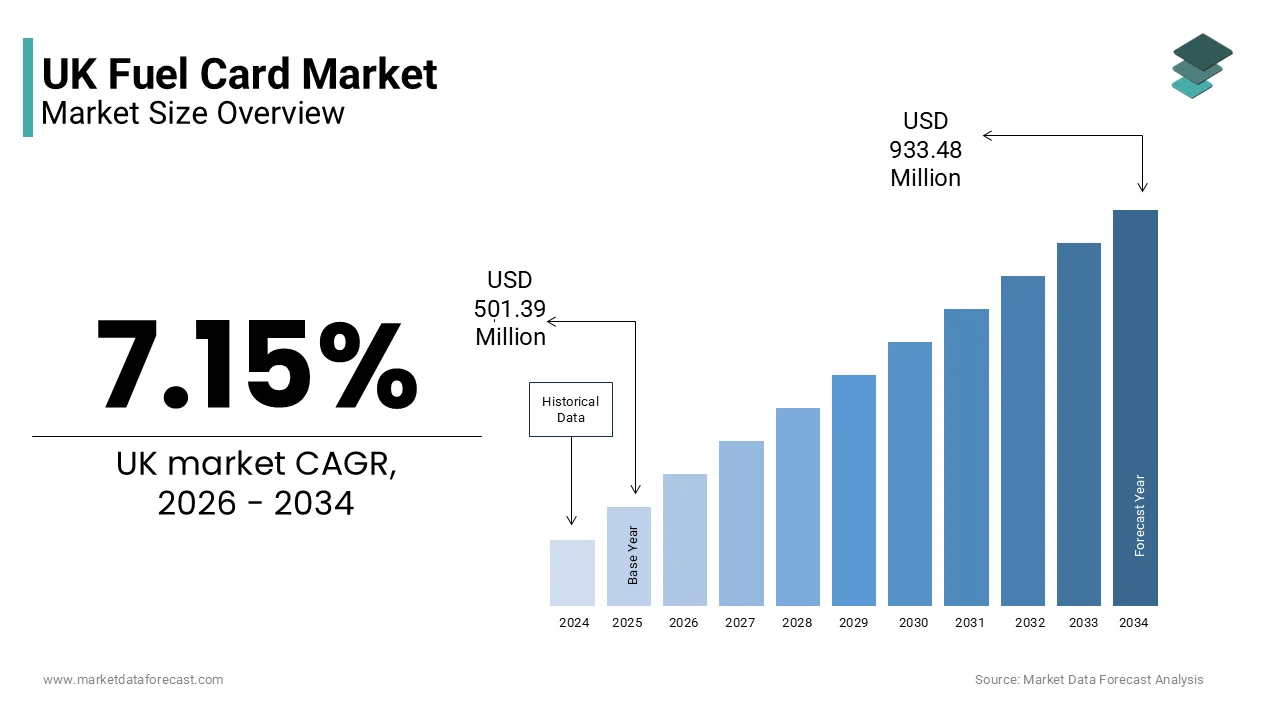
The UK fuel card market was valued at USD 501.39 million in 2025, is estimated to reach USD 537.24 million in 2026, and is projected to reach USD 933.48 million by 2034, growing at a CAGR of 7.15% during the forecast period from 2026 to 2034. The growth of the UK fuel card market is driven by increasing fleet management activities, rising fuel expenses among commercial vehicle operators, and growing demand for efficient fuel payment solutions. Fuel cards help businesses streamline fuel purchasing, improve expense tracking, and enhance operational efficiency through digital reporting and cost management tools. The increasing adoption of telematics, digital payment technologies, and integrated fleet management solutions is further supporting market growth across the United Kingdom.
Key Market Trends
-
Growing adoption of digital fleet management solutions is increasing demand for fuel cards among businesses of all sizes.
-
Rising fuel costs are encouraging fleet operators to utilize fuel cards for improved expense monitoring and cost control.
-
Increasing integration of fuel cards with telematics and fleet management platforms is enhancing operational efficiency.
-
Expansion of contactless and mobile payment technologies is improving the convenience and security of fuel card transactions.
-
Growing focus on fleet optimization and data-driven decision-making is driving the adoption of advanced fuel card services.
Segmental Insights
-
Based on type, the branded fuel cards segment dominated the UK fuel card market and accounted for 55.4% of the market share in 2025. The segment's leadership is attributed to extensive fuel station networks, brand loyalty benefits, competitive fuel pricing programs, and value-added services offered by major fuel providers.
-
Based on application, the fuel refill segment held the largest share of the UK fuel card market in 2025. The segment's dominance is driven by the widespread use of fuel cards for vehicle refueling, enabling businesses to simplify fuel purchases, monitor consumption patterns, and reduce administrative burdens.
Regional Insights
-
The UK fuel card market is witnessing steady growth due to increasing commercial vehicle operations, rising transportation activities, and the growing need for efficient fuel management solutions.
-
England represents the largest market, supported by a high concentration of commercial fleets, logistics companies, and extensive fuel station infrastructure.
-
Scotland is experiencing growing fuel card adoption among transportation, energy, and industrial sectors seeking improved fuel cost management.
-
Wales is witnessing increased use of fuel cards among small and medium-sized enterprises operating vehicle fleets across regional transportation networks.
-
Northern Ireland is emerging as a growing market due to expanding logistics operations and increasing awareness of fleet management technologies.
Competitive Landscape
The UK fuel card market is highly competitive, with providers focusing on digital innovation, expanded fuel station acceptance networks, integrated fleet management capabilities, and enhanced reporting tools. Companies are investing in mobile applications, telematics integration, and customized fuel management solutions to strengthen customer retention and improve operational efficiency for fleet operators. Key players operating in the UK fuel card market include Allstar Business Solutions, BP plc, Shell plc, UK Fuels Limited, WEX Inc., Radius Payment Solutions, Fuel Card Services Ltd, MOTIA Ltd, ExxonMobil Corporation, and Tesco Business Services.
UK Fuel Card Market Size
The UK fuel card market size was valued at USD 501.39 million in 2025, and is projected to reach USD 933.48 million by 2034 from USD 537.24 million in 2026, growing at a CAGR of 7.15%.
The fuel card is the payment solution designed for commercial fleet operators to manage refueling expenses vehicle maintenance and toll charges efficiently. These cards function as corporate credit instruments that provide detailed transaction data by enabling businesses to monitor driver behavior control costs and streamline administrative processes. As per data from the Department for Transport, there are approximately 5 million licensed heavy goods vehicles and light goods vehicles operating on UK roads creating a substantial base for fuel management services. The transition toward digitalization has transformed traditional plastic cards into integrated telematics platforms that offer real time visibility into fuel consumption patterns. Regulatory pressures regarding carbon emissions and driver working hours have increased the need for precise tracking and reporting capabilities which fuel card providers now supply through advanced software interfaces. Integration with accounting software allows for automated reconciliation reducing manual errors and administrative burden.
MARKET DRIVERS
Volatility in Global Oil Prices and Need for Cost Control
The persistent volatility in global crude oil prices for the adoption of fuel cards among fleet operators seeking to mitigate financial uncertainty is majorly fuelling the growth of the United Kingdom fuel card market. Fluctuations in Brent Crude prices directly impact pump prices making budgeting difficult for businesses with large fuel expenditures. Fuel cards offer fixed price options or volume based rebates that help stabilize costs and protect margins against sudden spikes. Fleet managers utilize the detailed analytics provided by these cards to identify inefficient driving behaviors, such as idling or speeding, which can increase fuel consumption by up to 20%, as per engineering studies. The ability to set spending limits and restrict purchases to fuel only prevents fraud and unauthorized use further enhancing cost control. In an environment, where fuel constitutes nearly 30% of total operating costs for logistics companies even minor savings translate into substantial financial benefits. The transparency offered by monthly consolidated invoices simplifies cash flow management and reduces the administrative time spent processing individual receipts. This financial predictability is for small and medium enterprises that operate on tight margins.
Regulatory Compliance and Digital Reporting Requirements
The stringent regulatory frameworks governing transport operations and environmental standards that offer robust data capture and reporting capabilities, which is additionally promoting the growth of the United Kingdom fuel card market. The UK government has implemented rigorous rules regarding driver hours tachograph usage and carbon emissions reporting under the Net Zero strategy. Fuel cards integrated with telematics systems provide the necessary data to demonstrate compliance with these regulations automatically reducing the risk of penalties. Modern fuel cards track location time and volume of every transaction creating an immutable digital trail that satisfies legal requirements. The introduction of Clean Air Zones in cities like London Birmingham and Bristol requires operators to monitor vehicle emissions closely which fuel management platforms facilitate through mileage and fuel type tracking. Additionally, the Making Tax Digital initiative mandates digital record keeping for VAT purposes making the automated invoicing features of fuel cards highly attractive to finance departments. The ability to generate instant reports on carbon footprints supports corporate social responsibility goals and tender applications for public sector contracts. This regulatory pressure ensures that fuel cards remain indispensable tools for modern fleet management rather than optional conveniences.
MARKET RESTRAINTS
Rapid Adoption of Electric Vehicles and Alternative Fuels
The accelerating transition toward electric vehicles and alternative fuels, which is predominantly designed for internal combustion engines is limiting the growth of the United Kingdom fuel card market. As per the Society of Motor Manufacturers and Traders, sales of battery electric vans and trucks in the UK have grown by over 40% year on year reflecting a structural shift in fleet composition. While some providers are adapting by offering charging network access the fragmentation of charging providers and lack of standardized payment protocols create complexity. Unlike the unified fuel station network, the EV charging landscape involves multiple apps memberships and pricing models, which dilutes the convenience advantage of single card solutions. The lower running costs of electric vehicles also reduce the overall spend on energy per mile decreasing the value proposition of volume-based rebates offered by fuel cards. Fleet operators investing heavily in electrification may seek specialized energy management software instead of traditional fuel cards leading to a potential decline in core product demand. The uncertainty surrounding the pace of this transition makes long term investment in legacy fuel card infrastructure risky for providers.
High Transaction Fees and Margin Pressure for Small Fleets
The cost structure associated with fuel cards including transaction fees and administration charges is also inhibiting the growth of the United Kingdom fuel card market. Small operators typically lack the bargaining power to negotiate favorable terms leaving them exposed to standard pricing models that erode thin profit margins. The complexity of fee structures, including monthly service charges and cancellation fees further discourages adoption among micro businesses that prefer simple pay at pump methods. Cash flow constraints also make the credit aspect of fuel cards less appealing if repayment terms are rigid. Many small fleet owners rely on personal credit cards or cash which despite lacking detailed analytics avoid recurring service fees. The perceived lack of customization for small scale needs means that many potential customers remain underserved by mainstream providers. This limitation restricts market growth in the fragmented long tail of the transport sector, which comprises thousands of small enterprises. The economic sensitivity of small operators makes them highly churn prone during periods of low fuel price volatility.
MARKET OPPORTUNITIES
Integration of Telematics and Holistic Fleet Management Platforms
The integration of fuel cards with advanced telematics and holistic fleet management software to expand their value proposition beyond simple payment processing is one of the major factors to create new opportunities for the growth of the United kingdom fuel card market. Providers can leverage artificial intelligence to predict maintenance needs based on fuel consumption anomalies preventing costly breakdowns and extending vehicle life. This convergence creates stickier customer relationships as clients become dependent on the ecosystem rather than just the payment instrument. The data generated can be sold as anonymized insights to urban planners and energy companies creating new revenue streams. Partnerships with insurance companies allow for usage based insurance models where safe driving rewarded by fuel card data leads to lower premiums. The demand for single pane of glass visibility drives enterprises to consolidate vendors favoring providers who offer end to end solutions. Cloud based platforms enable real time alerts for unusual activity enhancing security and fraud prevention. This technological evolution transforms fuel card companies into tech enabled logistics partners commanding higher margins and deeper engagement.
Expansion into Non Fuel Services and Lifestyle Benefits
Expanding fuel card utility to cover non fuel services, such as vehicle maintenance, washing parking, and driver lifestyle benefits is additional factor to promote the growth of the United Kingdom fuel card market in coming years. Fleet operators increasingly seek to consolidate all vehicle related expenditures onto a single platform to simplify accounting and procurement. Many fleet managers express interest in single invoice solutions that cover repairs tires and roadside assistance. Fuel card providers can partner with service networks to offer discounted rates on these ancillary services increasing the card's attractiveness and usage frequency. The integration of toll payments and congestion charge settlements further enhances convenience for operators navigating urban environments. The data from non-fuel transactions provides additional insights into total cost of ownership enabling more strategic decision making for clients. White label partnerships with retail chains allow for broader acceptance networks enhancing the card's utility for mixed use vehicles. This diversification mitigates the risk associated with declining liquid fuel demand by anchoring the card in broader mobility spending.
MARKET CHALLENGES
Cybersecurity Threats and Data Privacy Concerns
The increasing digitization of fuel card systems exposes providers and clients to significant cybersecurity threats and data privacy challenges that require substantial investment in protection measures. The cybersecurity threats and data privacy concerns is one of the challenges for the growth of the United Kingdom fuel card market. Fuel cards store sensitive financial and operational data making them attractive targets for cybercriminals seeking to commit fraud or steal proprietary information. A breach can compromise entire fleet accounts leading to unauthorized fuel purchases and significant financial losses before detection. Compliance with General Data Protection Regulation requires strict handling of driver location and behavior data adding legal complexity and liability risks. Any failure to protect user data can result in hefty fines and irreparable reputational damage eroding trust in the provider. The integration of third party APIs for telematics and accounting expands the attack surface requiring rigorous vendor risk management. Small and medium providers may lack the resources to implement state of the art security protocols putting them at a disadvantage. Customers are becoming more discerning about data sovereignty and encryption standards demanding transparency in how their information is used. The constant evolution of threat vectors necessitates continuous monitoring and updates which strain operational budgets. Balancing ease of use with robust security remains a delicate task.
Fragmentation of Payment Networks and Acceptance Issues
The fragmentation of fuel station networks and inconsistent acceptance of specific fuel cards to user experience and operational reliability is another factor to restrict the growth of the United Kingdom fuel card market. Not all fuel cards are accepted at every service station, particularly in remote rural areas or independent forecourts, which limits flexibility for drivers on long haul routes. The limited network coverage is cited as a top frustration leading to inefficiencies and detours that increase fuel consumption and delay deliveries. The lack of interoperability between different card schemes means fleets often need to carry multiple cards to ensure coverage complicating administration and reconciliation. Independent garages may hesitate to join specific networks due to high commission fees or technical integration costs resulting in gaps in the acceptance map. International travel within Europe also presents challenges as domestic UK cards may not offer competitive rates or wide acceptance abroad requiring separate solutions. The rise of supermarket fuel stations, which often do not participate in traditional fuel card networks further restricts options for cost conscious drivers. Providers struggle to expand their networks rapidly enough to keep pace with changing retail landscapes. This fragmentation undermines the core promise of convenience and universality that fuel cards are supposed to deliver. Resolving these acceptance issues requires significant negotiation and investment in infrastructure, which may not yield immediate returns.
REPORT COVERAGE
| REPORT METRIC | DETAILS |
| Market Size Available | 2025 to 2034 |
| Base Year | 2025 |
| Forecast Period | 2026 to 2034 |
| CAGR | 7.15% |
| Segments Covered | By Type, Application, and Region. |
| Various Analyses Covered | Global, Regional and Country-Level Analysis, Segment-Level Analysis, Drivers, Restraints, Opportunities, Challenges; PESTLE Analysis; Porter’s Five Forces Analysis, Competitive Landscape, Analyst Overview of Investment Opportunities |
| Market Leaders Profiled | Allstar Business Solutions, BP plc, Shell plc, UK Fuels Limited, WEX Inc., Radius Payment Solutions, Fuel Card Services Ltd, MOTIA Ltd, ExxonMobil Corporation, and Tesco Business Services |
SEGMENTAL ANALYSIS
By Type Insights
The branded fuel cards segment was accounted in holding 55.4% of the United Kingdom fuel card market share in 2025 owing to the extensive network coverage and strong brand recognition associated with major oil companies, such as BP Shell and Esso. Fleet operators prioritize these cards because they guarantee acceptance at a vast number of service stations, across the UK, including remote rural locations where independent networks may be sparse. The trust associated with established energy brands provides reassurance regarding transaction security and reliable customer support services. Branded cards often come with integrated loyalty programs that offer points or discounts on convenience store items, which appeals to drivers and fleet managers alike. The stability of supply chains managed by major oil companies ensures consistent fuel availability even during periods of global market disruption. Many large corporate fleets have longstanding relationships with specific fuel suppliers making branded cards a natural extension of their procurement strategies. The ability to negotiate bulk fuel discounts directly with the supplier enhances cost savings for high volume users.
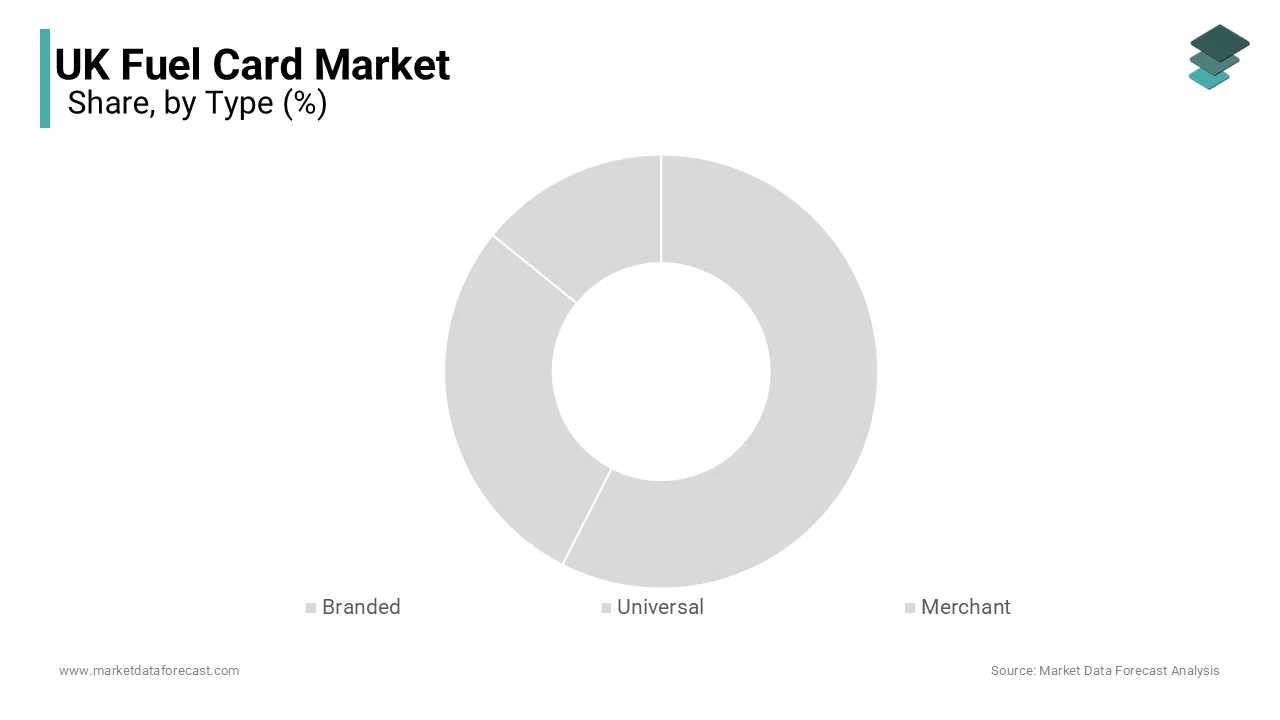
The universal fuel cards segment is esteemed to witness a fastest CAGR of 7.2% from 2026 to 2034 owing to the demand for flexibility and multi network access that allows fleets to refuel at any participating station regardless of the underlying oil brand. Universal cards aggregate multiple fuel networks into a single payment solution simplifying administration and providing drivers with maximum choice. The rise of small and medium sized enterprises with diverse vehicle types and routes has increased demand for agnostic payment solutions that do not lock them into a single supplier. Universal providers often offer competitive pricing through aggregated buying power passing savings on to customers, who may not have the volume to negotiate directly with oil majors. The integration of advanced digital platforms by universal providers offers superior data analytics and real time monitoring capabilities compared to traditional branded options. These cards also facilitate easier management of mixed fleets including those transitioning to electric vehicles by incorporating charging network access.
By Application Insights
The fuel refill applications segment was the largest by holding a prominent share of the United Kingdom fuel card market in 2025 with the fundamental necessity of liquid fuel for the vast majority of commercial vehicles currently operating on UK roads. The internal combustion engines remain the primary power source for heavy goods vehicles and light commercial vans due to their range and refueling speed. Fuel cards are specifically designed to streamline this high frequency high value expenditure by offering automated VAT reclamation and detailed consumption reporting. The sheer volume of refueling events generates the mass of data that makes fuel cards valuable for fleet management and fraud prevention. Discounts on fuel prices are the primary incentive for adoption with even small per liter savings accumulating to significant annual reductions in operating costs. The infrastructure for liquid fuel is mature and ubiquitous ensuring that fuel refill remains the core use case for these financial instruments. Fleet budgets are predominantly allocated to fuel making it the primary focus of cost control measures.
The vehicle service applications segment is likely to witness a fastest CAGR of 9.5% during the forecast period owing to the increasing integration of maintenance and repair payments into fuel card platforms to create holistic fleet management solutions. Fleet operators seek to consolidate all vehicle related expenditures onto a single invoice to simplify accounting and improve cash flow visibility. The ability to pre authorize service costs and track maintenance history through the card platform enhances operational planning and reduces unexpected breakdowns. Partnerships between fuel card providers and national garage networks have expanded the acceptance base making it convenient for drivers to access approved service centers. This trend is supported by the rising complexity of modern vehicles which require specialized diagnostic tools and certified technicians that affiliated networks provide. Preventive maintenance funded through fuel cards helps extend vehicle lifespan and maintain resale value, which is crucial for leasing companies.
COMPETITIVE LANDSCAPE
The competition in the United Kingdom fuel card market is intense and characterized by a mix of oil major branded providers independent specialists and financial institutions. Major players compete on network coverage price competitiveness technological innovation and customer service quality rather than solely on transaction fees. Differentiation is achieved through integrated telematics platforms that offer holistic fleet management capabilities beyond simple payment processing. Independent providers often compete by offering greater flexibility and personalized support compared to larger standardized offerings. The transition to electric vehicles has introduced new competitors from the energy and technology sectors who specialize in charging infrastructure management. Regulatory pressures regarding emissions and tax compliance create barriers to entry but also drive consolidation as smaller firms struggle with investment costs. Customer loyalty is influenced by the ease of use and reliability of digital tools.
KEY MARKET PLAYERS
Some of the companies that are playing a dominating role in the UK fuel card market are
- Allstar Business Solutions
- BP plc
- Shell plc
- UK Fuels Limited
- WEX Inc.
- Radius Payment Solutions
- Fuel Card Services Ltd
- MOTIA Ltd
- ExxonMobil Corporation
- Tesco Business Services
Top Players in the Market
- Allstar is a leading independent fuel card provider in the United Kingdom that serves a diverse range of fleet sizes from small businesses to large enterprises. The company contributes to the market by offering extensive network coverage and advanced telematics integration that helps operators optimize fuel efficiency and reduce costs. Allstar has expanded its service offerings to include electric vehicle charging solutions ensuring relevance in the evolving mobility landscape. Strategic partnerships with major fuel retailers and maintenance providers allow for consolidated billing and simplified administration. The company invests heavily in customer support and fraud prevention technologies to build trust and reliability. These initiatives reinforce its reputation as a comprehensive fleet management partner rather than just a payment processor.
- BP Business leverages the extensive retail network of BP service stations to provide robust fuel card solutions for commercial fleets, across the United Kingdom. The company contributes significantly by ensuring high availability and consistent fuel quality at thousands of locations nationwide. Recent actions to strengthen its market position include the integration of bp pulse charging networks into its fuel card ecosystem supporting the transition to electric vehicles. BP has introduced dynamic pricing models and loyalty rewards that offer tangible savings for high volume users. The development of mobile apps enables drivers to locate stations and manage transactions seamlessly enhancing user experience. Investment in sustainable fuel options such as renewable diesel aligns with corporate environmental goals. These efforts ensure BP remains a preferred choice for fleets prioritizing network reliability and green energy solutions.
- Shell Card utilizes the widespread presence of Shell service stations to deliver efficient fuel management services to UK commercial operators. The company contributes to the market by providing detailed transaction reporting and VAT reclamation tools that streamline financial processes for businesses. Recent actions to strengthen its position include the expansion of its acceptance network through partnerships with independent forecourts and non fuel service providers. Shell has enhanced its digital interface to offer predictive maintenance alerts and carbon footprint tracking capabilities. The introduction of flexible payment terms and customized discount structures caters to the specific needs of different fleet segments. Investment in driver welfare amenities at service stations improves the overall travel experience. These strategic enhancements solidify Shell Card as a versatile and technologically advanced solution for modern fleet operations.
Major Strategies Used by Key Market Participants
Key players in the United Kingdom fuel card market prioritize digital transformation by integrating artificial intelligence and telematics to provide actionable insights for fleet optimization. Companies expand their acceptance networks through strategic partnerships with independent forecourts and electric vehicle charging providers to ensure comprehensive coverage. Sustainability initiatives are central to strategy with providers offering carbon tracking tools and access to renewable fuels to meet regulatory requirements. Customer retention is enhanced through personalized pricing models and loyalty programs that reward high volume usage and safe driving behaviors. Consolidation of ancillary services such as maintenance parking and toll payments onto single platforms simplifies administration for clients. Investment in cybersecurity measures protects sensitive financial and operational data from emerging threats. Mobile application development focuses on user friendly interfaces that enable real time monitoring and control for drivers and managers. These strategies collectively drive value creation and competitive differentiation in a mature market.
MARKET SEGMENTATION
This research report on the UK fuel card market is segmented and sub-segmented into the following categories.
By Type
- Branded
- Universal
- Merchant
By Application
- Fuel Refill
- Parking
- Vehicle Service
- Toll Charge
- Others