- Product Description Description
- Table of Contents TOC
- List of Table & Figure LOT
- Get Free Sample PDF Sample PDF
Market Size, 2025
$5.03 BnMarket Estimate, 2026
$5.60 BnMarket Forecast, 2034
$13.31 BnCAGR, 2026–2034
11.42%UK Heat Pump Market Report Summary
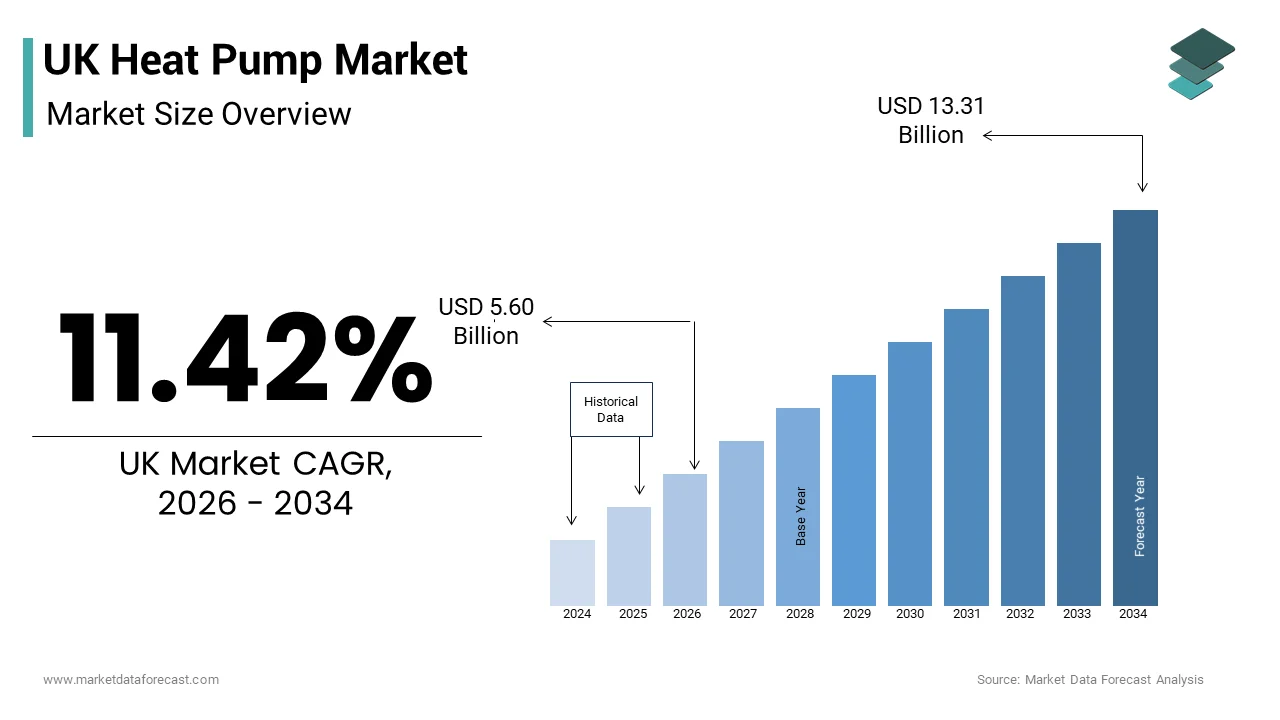
The UK heat pump market was valued at USD 5.03 billion in 2025 and is anticipated to reach USD 5.60 billion in 2026 and further expand to USD 13.31 billion by 2034, growing at a CAGR of 11.42% during the forecast period from 2026 to 2034. The growth of the UK heat pump market is driven by increasing government support for low-carbon heating technologies, rising energy efficiency requirements, and the country's commitment to achieving net-zero carbon emissions. Growing consumer awareness regarding sustainable heating solutions, favorable incentive programs, and advancements in heat pump technologies are further accelerating market growth across the United Kingdom.
Key Market Trends
- Rising adoption of air source heat pumps due to their cost-effectiveness, ease of installation, and suitability for residential applications.
- Increasing government initiatives and financial incentives encouraging homeowners and businesses to transition from conventional heating systems to low-carbon alternatives.
- Growing demand for energy-efficient heating solutions amid rising energy costs and sustainability concerns.
- Technological advancements improving heat pump performance, efficiency, and compatibility with smart home energy management systems.
- Expanding investments in renewable energy infrastructure and building decarbonization projects supporting long-term market growth.
Segmental Insights
- Based on source, the air source heat pumps segment dominated the UK heat pump market in 2025. The segment’s leadership is attributed to lower installation costs, high energy efficiency, and growing adoption in both new residential developments and retrofit projects.
- Based on rated capacity, the up to 10 KW segment accounted for 54.1% of the UK heat pump market share in 2025. The dominance of this segment is driven by its widespread use in residential properties, where compact and energy-efficient heating systems are increasingly preferred.
- Based on end user, the residential segment held the largest share of 55.8% of the UK heat pump market in 2025. The segment's growth is supported by rising demand for sustainable home heating solutions, government subsidy programs, and increasing awareness of energy-saving technologies among homeowners.
Regional Insights
The United Kingdom remained the fastest-growing country in the European heat pump market and accounted for 10.2% of the regional market share in 2025. Market growth is supported by ambitious climate targets, strong policy support for renewable heating technologies, and increasing investments in residential and commercial energy-efficiency upgrades. The country's ongoing transition toward low-carbon heating systems continues to create substantial opportunities for heat pump manufacturers and service providers.
Competitive Landscape
The UK heat pump market is characterized by the presence of established domestic and international manufacturers competing through product innovation, energy-efficiency improvements, and expansion of distribution networks. Companies are focusing on developing advanced heat pump solutions, strengthening installation and service capabilities, and collaborating with energy providers to support the growing adoption of renewable heating technologies. Strategic investments in research and development and smart heating solutions are further enhancing market competitiveness.
Prominent players in the UK heat pump market include IMS Heat Pumps, Vaillant Group, Baxi Heating UK, Viessmann Group, Worcester Bosch Group, Ideal Heating, Zehnder Group, Daikin Airconditioning UK, Danfoss, Kensa Heat Pumps, Mitsubishi Electric UK, NIBE Energy Systems, Panasonic Climate Solutions UK, LG Electronics UK, Samsung Climate Solutions UK, Grant Engineering UK, Glen Dimplex Heating and Ventilation, Octopus Energy (Home Energy Tech), Midea UK, and Stiebel Eltron UK.
UK Heat Pump Market Size
The UK heat pump market size was valued at USD 5.03 billion in 2025 and is anticipated to reach USD 5.60 billion in 2026 to reach USD 13.31 billion by 2034, growing at a CAGR of 11.42% during the forecast period from 2026 to 2034.
MARKET OVERVIEW AND DEFINITION
The heat pump is a pivotal component of the national strategy to decarbonize residential and commercial heating, which transitions away from fossil fuel dependency towards electrified thermal solutions. This market includes air source and ground source technologies that extract ambient heat from the environment to warm buildings efficiently. As per the Department for Energy Security and Net Zero, the government's target is for the UK low-carbon heating market to achieve a installation capacity of 600,000 heat pumps annually by 2028. Currently, greenhouse gas emissions from heating and energy use across all UK residential and commercial buildings account for approximately 17% of the UK's total emissions. According to national energy industry data and the Climate Change Committee, roughly 85% of homes across Great Britain currently rely on natural gas boilers for heating. The Boiler Upgrade Scheme provides financial incentives to offset higher upfront costs, encouraging early adoption among homeowners. The Committee on Climate Change emphasizes that widespread heat pump deployment is essential for reducing carbon intensity in the building sector. Technological advancements have improved the coefficient of performance for these units, allowing them to operate effectively even in colder climates. The integration of smart controls and hybrid systems further enhances efficiency, aligning with modern energy management practices. This market evolution is supported by rigorous training programs for installers to ensure quality and safety standards are met across the industry.
MARKET DRIVERS
Government Financial Incentives and Subsidy Schemes
The implementation of robust financial incentive programs is greatly contributing to the growth of the United Kingdom heat pump market. This significantly reduces the economic barrier to entry for homeowners and businesses. The Boiler Upgrade Scheme offers flat grants of £7,500 for both air source and ground source heat pumps, improving their cost-competitiveness against traditional gas boilers. lthough the Boiler Upgrade Scheme originally allocated funding for up to 30,000 installations annually, fewer than 15,000 vouchers were actually issued in its first year due to a slow initial uptake. However, these subsidies directly address high upfront capital costs, which frequently exceed £10,000 without assistance. The government has also extended eligibility to include more property types, broadening the potential customer base. According to data from the Energy Saving Trust, the effective payback period for heat pumps has improved due to the increased £7,500 grant and fluctuating gas prices, though the transition speed is still influenced by the price gap between electricity and gas. Local authorities are increasingly complementing national schemes with additional regional funding, creating a layered support structure that accelerates adoption. The clarity and accessibility of these incentives provide consumers with the confidence to invest in long term sustainable heating solutions. Furthermore, the alignment of these subsidies with broader energy efficiency retrofit programs ensures that homes are better insulated, maximizing the performance of the installed heat pumps. This comprehensive financial framework is crucial for stimulating demand and achieving national installation targets.
Rising Fossil Fuel Prices and Energy Security Concerns
Escalating costs of natural gas and heightened concerns over energy security also fuel the expansion of the United Kingdom heat pump market. This prompts consumers to seek stable and independent heating alternatives. The volatility of global energy markets has led to sharp increases in household utility bills, making the operational efficiency of heat pumps increasingly attractive. According to Ofgem, the energy price cap reached record levels in recent years, causing many households to reconsider their heating options to mitigate future cost shocks. Heat pumps offer a higher coefficient of performance, typically generating three to four units of heat for every unit of electricity consumed, which translates to lower running costs compared to gas boilers when electricity prices are managed effectively. As per the Committee on Climate Change, shifting to electric heating reduces the UK’s reliance on imported fossil fuels, enhancing national energy resilience. The geopolitical instability affecting gas supplies has further underscored the strategic importance of domestic renewable energy sources. Consumers are increasingly aware that electrifying heat aligns with long term economic stability, especially as the grid becomes greener and cheaper. The narrative of energy independence resonates strongly with homeowners who wish to protect themselves from external market fluctuations. This economic imperative, combined with environmental awareness, creates a compelling case for switching to heat pumps, driving sustained demand despite broader economic uncertainties.
MARKET RESTRAINTS
High Upfront Installation Costs and Capital Barriers
The substantial initial investment required for its installation remains a major obstacle for the United Kingdom heat pump market. This financial burden deters many potential adopters despite long term savings. The total gross cost of purchasing and installing a standard air source heat pump system frequently ranges from £10,000 to £15,000. However, the UK's £7,500 government grant brings the net cost to households down to between £2,500 and £7,500, which remains higher than or near-parity with a like-for-like gas boiler replacement. According to national financial resilience indicators from the Money and Pensions Service, a large proportion of UK households lack the disposable savings necessary to cover emergency capital costs, highlighting a major affordability hurdle during a cost-of-living crisis. The need for additional upgrades, such as enhanced insulation or larger radiators, further inflates the total project cost, creating financial uncertainty for homeowners. As per sources, high upfront capital cost remains the primary reason preventing the majority of surveyed UK homeowners from considering a heat pump installation. Financing options are not always readily available or well understood by consumers, adding complexity to the decision making process. The perceived risk of investing in new technology without guaranteed immediate returns causes hesitation among risk averse buyers. For landlords and social housing providers, budget constraints limit the ability to undertake large scale retrofits without substantial external funding. Until financing models become more accessible and upfront costs decrease through economies of scale, this financial barrier will continue to slow the rate of mass market adoption.
Shortage of Skilled Installers and Technical Expertise
A critical shortage of qualified installers is a significant hurdle for the United Kingdom heat pump market. This limits the capacity to meet growing demand and ensure quality installations. The transition to low carbon heating requires a workforce with specialized skills in electrical systems, refrigeration, and hydraulic engineering, which are distinct from traditional gas fitting competencies. According to studies, the UK needs to rapidly scale its low-carbon workforce to train and upskill thousands of engineers annually to meet 2028 installation targets, a pace that current training pipelines are struggling to match. This skills gap leads to long waiting times for customers, delaying projects and frustrating early adopters. As per data from the Heat Pump Association, inconsistent installation quality due to inexperienced technicians can result in poor system performance, damaging the reputation of the technology. The lack of standardized training pathways and accreditation processes further complicates the recruitment and retention of skilled labor. Many existing heating engineers are reluctant to retrain due to the time and cost involved, exacerbating the shortage. Without a sufficient pool of competent professionals, the industry cannot scale effectively, leading to bottlenecks in supply and service delivery. Addressing this human capital challenge requires coordinated efforts between government, educational institutions, and industry bodies to expand training capacity and incentivize career transitions into the sector.
MARKET OPPORTUNITIES
Integration with Smart Grid and Renewable Energy Systems
The convergence of these pumps with smart grid technologies and renewable energy generation unlocks potential for the United Kingdom heat pump market. This enables optimized energy usage and cost savings. Smart heat pumps can communicate with the electricity grid to adjust operation times based on real time pricing and renewable availability, reducing strain on the network during peak hours. According to the National Energy System Operator (NESO), flexible demand from smart electric heating can provide significant grid-balancing services, supporting the integration of intermittent wind and solar power. Homeowners with solar photovoltaic panels can use excess generated electricity to power their heat pumps, maximizing self consumption and minimizing grid dependence. Regulated by Ofgem, market-wide smart settlement structures enable energy providers to develop retail tariffs that financially reward consumers for shifting their heating loads to off-peak periods. The development of home energy management systems allows users to monitor and control their heating remotely, improving convenience and efficiency. This synergy between heating and power sectors creates new value propositions for utilities and technology providers. The ability to store thermal energy in buffers or building fabric further enhances flexibility. Manufacturers can differentiate their products by positioning heat pumps as key components of a smart, decentralized energy ecosystem. Doing so allows them to appeal to tech-savvy consumers interested in holistic sustainability solutions.
Expansion into New Build and Retrofit Housing Segments
The mandatory inclusion of these pumps in new build properties and the growing focus on retrofitting existing housing stock offer significant growth possibilities for the United Kingdom heat pump market. Building regulations have been updated to require lower carbon heating solutions in new constructions, effectively phasing out gas boilers in these developments. According to the Ministry of Housing, Communities and Local Government's Future Homes Standard framework, upcoming building regulations will mandate that new homes adhere to strict carbon-reduction targets, effectively making heat pumps the default low-carbon heating technology. This regulatory shift guarantees a steady baseline demand from the construction sector. Simultaneously, the retrofit market represents a vast untapped potential, with millions of older homes requiring heating upgrades to meet net zero goals. Programs aimed at improving social housing and private rental sectors provide structured avenues for large scale deployments. As per the Climate Change Committee, retrofitting the UK's existing building stock is critical to achieving national net-zero targets, though the committee notes that clearer policy consistency is required to secure a reliable, long-term commercial pipeline for installers and manufacturers. Innovations in low temperature heat emitters and compact heat pump designs are making retrofits more feasible in properties with limited space or existing radiator systems. Collaborative initiatives between local councils, housing associations, and technology providers are streamlining the retrofit process. This dual track approach ensures sustained market growth across both new and existing building segments.
MARKET CHALLENGES
Complexity of Property Suitability and Retrofit Requirements
Determining the suitability of existing properties for installation is a major challenge to the United Kingdom heat pump market. This is because many UK homes require significant modifications to achieve optimal performance. Older buildings often lack adequate insulation, leading to heat loss that necessitates larger and more expensive heat pump systems to maintain comfort levels. Assessing each property individually requires detailed surveys and expertise, increasing the time and cost involved in the sales process. Misjudging the heat demand can result in undersized systems that struggle to warm the home or oversized units that cycle inefficiently. As per sources, consumer confusion regarding the technical requirements and necessary upgrades often leads to decision paralysis. The variability in building construction and layout across the UK makes standardized solutions difficult to implement. Homeowners may face unexpected costs for upgrading radiators, pipework, or electrical supplies, which are not always covered by initial quotes. This complexity creates friction in the customer journey and can lead to dissatisfaction if expectations are not managed properly. Simplifying the assessment process and providing clear guidance on necessary preparatory works are essential to overcoming this hurdle.
Consumer Awareness and Misconceptions About Technology
Low levels of consumer awareness and persistent misconceptions about its performance are serious barriers to the expansion in the United Kingdom heat pump market. Many homeowners remain unfamiliar with how heat pumps work, often confusing them with less efficient electric resistance heaters or believing they do not function well in cold weather. According to historical government public attitudes tracking initiated under BEIS and continued by DESNZ, baseline awareness of low-carbon systems has increased, but a substantial knowledge gap remains, with only a small minority of UK adults reporting a deep understanding of how heat pump technology works. Myths regarding noise levels, reliability, and compatibility with existing radiators deter potential buyers who rely on anecdotal evidence rather than factual data. The historical perception of heat pumps as complex and maintenance intensive persists despite technological advancements that have simplified their operation. As per the Heat Pump Association, historical installation failures from early legacy projects contributed to public skepticism. However, recent consumer data indicates that modern heat pump adopters report high levels of system satisfaction that align closely with traditional boiler users. Overcoming these barriers requires extensive education campaigns and transparent communication from manufacturers and installers. Demonstrating real world performance through case studies and testimonials can help build trust. However, the fragmented nature of the industry makes consistent messaging difficult. The market will struggle to move beyond early adopters to the mainstream majority. This shift cannot happen without a concerted effort to improve public literacy and address common fears, as the mainstream audience requires greater reassurance before making such a significant investment.
REPORT COVERAGE
| REPORT METRIC | DETAILS |
| Market Size Available | 2025 to 2034 |
| Base Year | 2025 |
| Forecast Period | 2026 to 2034 |
| CAGR | 11.42% |
| Segments Covered | By Source, Rated Capacity, System Design, End-User, Application Country |
| Various Analyses Covered | Global, Regional, and Country Level Analysis, Segment-Level Analysis; DROC, PESTLE Analysis; Porter’s Five Forces Analysis; Competitive Landscape; Analyst Overview of Investment Opportunities. |
| Regions Covered | London, South East, North West, East of England, South West, Scotland, West Midlands, Yorkshire and The Humber, East Midlands, Others |
| Market Leaders Profiled | IMS Heat Pumps, Vaillant Group, Baxi Heating UK, Viessmann Group, Worcestor Bosch Group, Ideal Heating, Zehnder Group, Daikin Airconditioning UK, Danfoss, Kensa Heat Pumps, Mitsubishi Electric UK, NIBE Energy Systems, Panasonic Climate Solutions UK, LG Electronics UK, Samsung Climate Solutions UK, Grant Engineering UK, Glen Dimplex Heating and Ventilation, Octopus Energy (Home Energy Tech), Midea UK, Stiebel Eltron UK |
SEGMENTAL ANALYSIS
By Source Insights
The air source heat pumps segment dominated the United Kingdom market and accounted for a substantial share in 2025. Its lower installation complexity and cost effectiveness compared to other technologies drive the dominance of this segment. This substantial share is further propelled by the ease of retrofitting into existing residential properties without extensive groundworks. According to industry data from the Heat Pump Association, air source units are significantly less expensive to install than ground source systems, with average gross installation costs ranging from £8,000 to £12,000 before government grants are applied. The versatility of air source technology allows it to be deployed in both urban and rural settings, requiring only external wall or garden space for the outdoor unit. As per the Department for Energy Security and Net Zero, the majority of Boiler Upgrade Scheme vouchers have been claimed for air source systems, reflecting consumer preference for simpler solutions. Technological advancements have improved the efficiency of these units in colder climates, addressing previous concerns about performance during winter months. The widespread availability of qualified installers for air source systems further supports its dominance, as training requirements are less intensive than for geothermal alternatives. Manufacturers continue to innovate with quieter and more compact models, enhancing aesthetic appeal and reducing noise pollution complaints. This combination of affordability, accessibility, and improving performance ensures that air source heat pumps remain the default choice for mass market decarbonization efforts in the UK housing stock.
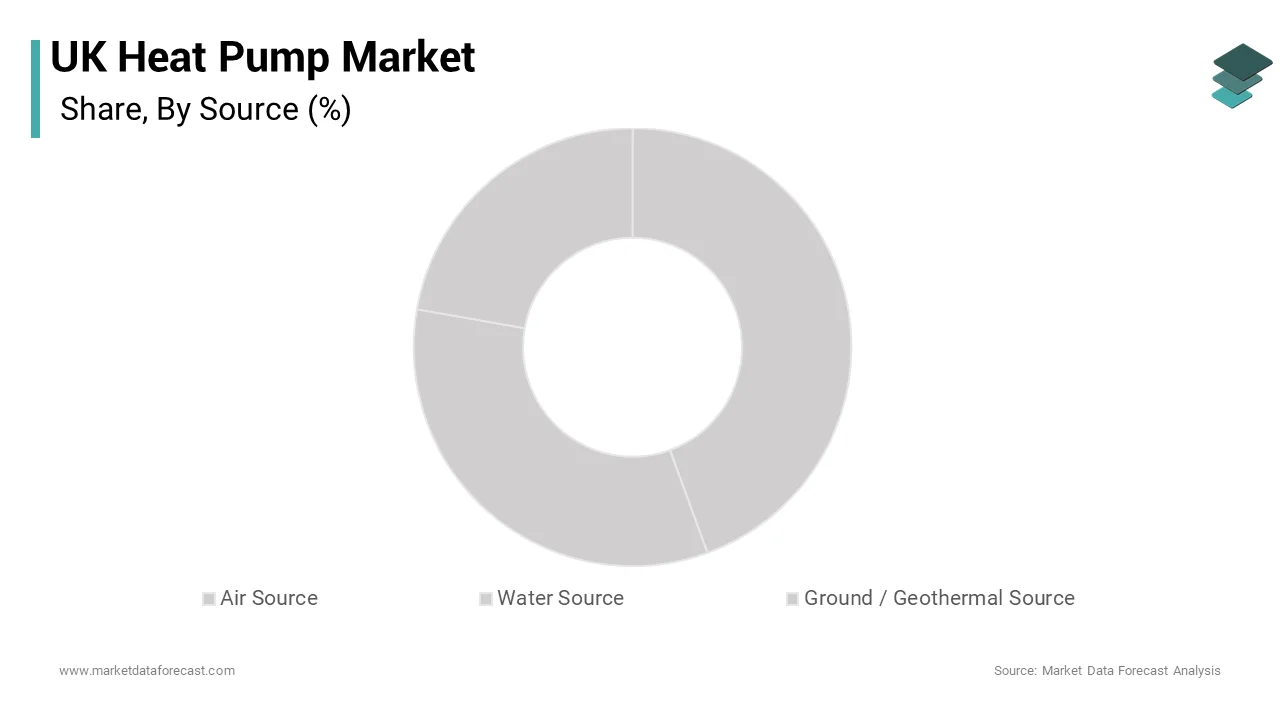
On the contrary, the ground source heat pumps segment is estimated to register the fastest CAGR of 12.5% from 2026 to 2034 due to increasing demand for high performance heating solutions in new build developments and large commercial projects where land availability permits excavation. According to the Ground Source Heat Pump Association, these systems offer exceptional efficiency due to stable underground temperatures, with peak coefficients of performance (COP) frequently exceeding 4.0 under optimal operating conditions. The stability of ground temperatures ensures consistent efficiency year round, unlike air source units which fluctuate with ambient weather conditions. As per sustainable building registries and the Passivhaus Trust, ground source systems are increasingly specified in Passivhaus and net-zero carbon building developments due to their superior long-term seasonal efficiency. Government incentives for renewable heat generation favor technologies with higher efficiency ratings, making ground source options attractive for institutional buyers. Advances in horizontal trenching techniques have reduced installation disruption and costs, broadening applicability to suburban properties with larger gardens. The integration of ground source loops with district heating networks in urban regeneration projects also contributes to this growth. As energy prices remain volatile, the predictability of ground source performance appeals to facilities managers seeking budget certainty. This segment’s expansion is supported by specialized training programs that address the technical complexities of geological assessments and loop design.
By Rated Capacity Insights
The up to 10 KW segment led the United Kingdom market and captured a 54.1% share in 2025. This segment leads the market because most residential properties in the country have heating demands that fall within this range, particularly when combined with moderate energy efficiency improvements. It caters primarily to the vast majority of detached, semi detached, and terraced houses. According to microgeneration design standards supported by the Energy Saving Trust, an average three-bedroom semi-detached home frequently requires a heat pump output between 6kW and 8kW, though the precise system sizing must be determined by building-specific heat loss calculations. The Boiler Upgrade Scheme is specifically designed to support these smaller scale domestic installations, driving high volumes of sales in this category. As per sources, standardised units in this capacity range benefit from economies of scale, resulting in lower unit costs and wider availability through merchant networks. Installers are more familiar with sizing and configuring systems in this bracket, reducing the risk of performance issues and customer dissatisfaction. The compatibility of up to 10 kilowatt units with existing radiator systems, provided they are adequately sized, simplifies the retrofit process for homeowners. This segment’s dominance is reinforced by the fact that the majority of the UK housing stock consists of properties built before 1990, which typically have moderate heat loss profiles suitable for mid range capacity units. The focus on mass market adoption ensures that product development and marketing efforts are concentrated on this optimal capacity range.
However, the more than 10 KW segment is anticipated to witness the fastest CAGR of 14.8% during the forecast period owing to the need to replace large gas boilers in schools, hospitals, and office blocks. According to the Carbon Trust, non-domestic and commercial buildings represent a major portion of built-environment footprint, necessitating a deployment of cascading, high-capacity, or communal low-carbon heating systems to hit decarbonisation targets. Large capacity heat pumps are increasingly used in cascade configurations to provide redundant and scalable heating for complex facilities. Managed under the Department for Energy Security and Net Zero's funding frameworks, public sector procurement policies mandate the prioritisation of low-carbon technologies, driving a consistent deployment pipeline for commercial and industrial-grade heating units. The development of high temperature heat pumps capable of delivering flow temperatures above 60 degrees Celsius allows these larger units to integrate seamlessly with legacy radiators and domestic hot water systems without extensive modifications. District heating projects in urban areas rely on multi megawatt installations to serve hundreds of homes from a central plant, driving volume in this higher capacity tier. Innovations in compressor technology have improved the part load efficiency of large units, making them economically viable for varied demand profiles. This segment’s growth is critical for achieving net zero in the non domestic sector, where energy consumption is concentrated and impact is significant.
By End User Insights
In 2025, the residential segment held the majority share of 55.8% of the UK heat pump market. This supremacy was supported by government mandates and consumer desire to reduce household energy bills. With approximately 28 million homes in the United Kingdom, the potential addressable market is immense, particularly as the targeted 2035 phase-out of new fossil fuel boiler installations approaches. According to national greenhouse gas inventory data compiled by the government, domestic housing accounts for approximately 14% of the UK’s total carbon emissions, making residential heating a primary target for policy intervention. The Boiler Upgrade Scheme has successfully stimulated demand among homeowners, with tens of thousands of installations completed annually in recent years. As noted by the Energy Saving Trust, historically high electricity prices relative to gas have presented a challenge for the running-cost appeal of electric heating solutions, compounding the existing upfront capital cost barrier. Social housing providers are also accelerating adoption to meet environmental, social, and governance criteria and improve tenant comfort. The proliferation of smart home technologies has made heat pumps more appealing to tech savvy residents who value remote control and energy monitoring capabilities. Mortgage lenders are beginning to offer green mortgages with preferential rates for energy efficient homes, further incentivizing residential upgrades. The sheer volume of individual transactions in this segment dwarfs commercial activity, ensuring it remains the primary revenue driver for manufacturers and installers. Consumer education campaigns focused on comfort and reliability are gradually shifting perceptions, supporting sustained growth in the residential sphere.
On the other hand, the commercial end user segment is likely to experience the fastest CAGR of 16.2% between 2026 and 2034. This acceleration is fuelled by corporate sustainability commitments and stricter regulatory requirements for non domestic buildings. According to corporate disclosures registered with the Science Based Targets initiative and CDP, an increasing number of UK companies are setting verified emission reduction goals, driving the replacement of fossil fuel heating systems across commercial, retail, and industrial portfolios. The Streamlined Energy and Carbon Reporting framework mandates large businesses to disclose energy usage, creating transparency and pressure to adopt cleaner technologies. As per the British Property Federation, commercial landlords are investing heavily in building retrofits to maintain asset value and attract environmentally conscious tenants. Heat pumps offer a viable solution for meeting Minimum Energy Efficiency Standards, which are becoming progressively tighter. The hospitality and leisure sectors are also adopting heat pumps to enhance brand image and reduce operational costs in hotels and swimming pools. Government grants for public sector buildings, such as schools and hospitals, further boost commercial installations. The scalability of commercial heat pump systems allows for phased implementation, minimizing disruption to business operations. Generating heat domestically using electricity offers a compelling risk mitigation strategy for businesses navigating modern energy security priorities. This critical advantage is driving robust growth in the segment.
COUNTRY ANALYSIS
The United Kingdom remained the fastest growing country in the European heat pump market and occupied a 10.2% share in 2025. This growth was driven by ambitious policy targets and a rapidly evolving regulatory landscape aimed at decarbonizing heating. The country’s market shows its strong commitment to transitioning away from natural gas dependency. Also, the market status is defined by aggressive government intervention, including the Boiler Upgrade Scheme and the Future Homes Standard, which mandate low carbon heating in new builds. The UK government has set a target for the UK market to reach a deployment capacity of at least 600,000 hydronic heat pump installations annually by 2028. In addition, the UK government aims to phase out the installation of new fossil fuel boilers by 2035, while exempting roughly a fifth of existing homes from having to transition to low-carbon heating alternatives. According to the Climate Change Committee, while domestic heating has established technological pathways to net zero like heat pumps, it remains one of the most significant structural and infrastructure deployment challenges to decarbonise. The UK’s unique housing stock, with a high proportion of older, poorly insulated properties, presents specific technical challenges that drive innovation in high temperature and hybrid systems. Strong collaboration between industry bodies, such as the Heat Pump Association, and policymakers ensures that regulations are practical and supportive. The presence of major global manufacturers establishing local production facilities underscores the strategic importance of the UK market. This combination of regulatory certainty, financial incentives, and technological adaptation positions the United Kingdom as a dynamic and influential hub for heat pump adoption in the region.
COMPETITIVE LANDSCAPE
The competition in the United Kingdom heat pump market is intensifying as traditional boiler manufacturers pivot towards low carbon technologies while specialized heat pump brands expand their reach. Established players leverage their existing dealer networks and brand recognition to retain customers during the transition from gas to electric heating. New entrants and Asian manufacturers compete on price and technological innovation, offering advanced features such as smart connectivity and high temperature outputs. The market is fragmented with numerous small and medium sized installers competing for domestic contracts, leading to variability in service quality. Regulatory requirements like the Microgeneration Certification Scheme create barriers to entry but also standardize quality across the industry. Price competition is fierce particularly for standard air source units, prompting companies to differentiate through superior after sales support and extended warranties. Government incentives drive demand but also attract opportunistic providers, necessitating strict oversight. Collaboration between manufacturers and installers is crucial for success as proper commissioning determines system performance. This dynamic landscape encourages continuous improvement in product efficiency and installation practices benefiting the overall adoption rate.
KEY MARKET PLAYERS
A few of the market players that are dominating the UK heat pump market are
- IMS Heat Pumps
- Vaillant Group
- Baxi Heating UK
- Viessmann Group
- Worcestor Bosch Group
- Ideal Heating
- Zehnder Group
- Daikin Airconditioning UK
- Danfoss
- Kensa Heat Pumps
- Mitsubishi Electric UK
- NIBE Energy Systems
- Panasonic Climate Solutions UK
- LG Electronics UK
- Samsung Climate Solutions UK
- Grant Engineering UK
- Glen Dimplex Heating and Ventilation
- Octopus Energy (Home Energy Tech)
- Midea UK
- Stiebel Eltron UK
Top Players In The Market
- Mitsubishi Electric maintains a strong presence in the United Kingdom heat pump market through its advanced Ecodan range of air source and ground source units. The company focuses on high efficiency and reliability, catering to both residential retrofits and new build projects. Recent actions include expanding its training academy to upskill installers and ensuring compliance with MCS standards. Mitsubishi Electric has also introduced smart control interfaces that allow users to optimize energy usage remotely. Its commitment to research and development has led to quieter outdoor units that address noise concerns in urban areas. By partnering with major merchants and providing technical support, the company ensures widespread availability and professional installation. These efforts reinforce its reputation for quality and performance in the low carbon heating sector.
- Vaillant plays a significant role in the UK heat pump market by leveraging its established brand trust and extensive distribution network. The company offers a comprehensive portfolio of aroTHERM air source heat pumps designed for seamless integration with existing heating systems. Recent initiatives involve launching hybrid solutions that combine heat pumps with gas boilers for transitional periods. Vaillant has invested heavily in digital tools that assist engineers with sizing and commissioning, reducing installation errors. The firm actively participates in government schemes to promote consumer awareness and adoption. Its focus on after sales service and spare parts availability ensures long term customer satisfaction. By aligning product development with UK specific housing characteristics, Vaillant strengthens its position as a reliable partner for decarbonization.
- Daikin contributes significantly to the UK heat pump market through its innovative Altherma series which offers flexible heating and cooling capabilities. The company emphasizes sustainability by using refrigerants with low global warming potential in its latest models. Recent actions include opening new manufacturing and logistics facilities in Europe to improve supply chain resilience for the UK market. Daikin collaborates with housing associations to deliver large scale retrofit projects efficiently. It provides extensive technical documentation and online resources to support installers during the transition from fossil fuels. The brand’s focus on modular designs allows for easier maintenance and scalability. By prioritizing energy efficiency and environmental responsibility, Daikin appeals to environmentally conscious consumers and commercial clients seeking robust climate control solutions.
Top Strategies Used By Key Market Participants
Key players in the United Kingdom heat pump market primarily employ strategies focused on installer training and certification to ensure high quality installations and build consumer trust. Companies invest in dedicated academies and partnerships with educational institutions to address the skills gap in the industry. Developing user friendly digital tools for system sizing and remote monitoring enhances customer experience and operational efficiency. Manufacturers are increasingly localizing supply chains to mitigate disruption risks and reduce lead times for critical components. Product innovation centers on improving cold weather performance and reducing noise levels to suit UK housing conditions. Strategic collaborations with housing developers and government bodies help secure large scale contracts and influence policy frameworks. Marketing efforts emphasize total cost of ownership and environmental benefits to overcome upfront cost barriers. These multifaceted approaches enable firms to navigate regulatory complexities and drive sustainable growth in the transitioning heating sector.
RECENT MARKET NEWS
- In March 2024, Mitsubishi Electric expanded its UK training facility to certify five hundred additional heat pump installers annually. This expansion is anticipated to allow Mitsubishi Electric to address skills shortages and strengthen the Uk heat pump market presence
- In May 2024, Vaillant launched a new hybrid heating system combining air source heat pumps with condensing boilers for efficient retrofits. This launch is anticipated to allow Vaillant to offer flexible solutions and strengthen the Uk heat pump market presence
- In January 2024, Daikin opened a new logistics hub in the Midlands to reduce delivery times for heat pump components across the region. This opening is anticipated to allow Daikin to improve supply chain efficiency and strengthen the Uk heat pump market presence
- In February 2024, Samsung introduced a new range of quiet operation air source heat pumps designed specifically for dense urban housing estates. This introduction is anticipated to allow Samsung to address noise concerns and strengthen the Uk heat pump market presence
- In June 2024, Nibe partnered with a leading UK housing association to install thousands of ground source heat pumps in social homes. This partnership is anticipated to allow Nibe to secure large contracts and strengthen the Uk heat pump market presence.
MARKET SEGMENTATION
This research report on the UK heat pump market is segmented and sub-segmented into the following categories.
By Source Type
- Air-Source
- Air-to-Air
- Air-to-Water
- Water-Source
- Surface Water
- Open Loop
- Ground / Geothermal Source
- Closed Loop Vertical
- Closed Loop Horizontal
- Direct Expansion
By Rated Capacity
- Up to 10 kW
- 10-20 kW
- 20-30 kW
- Above 30 kW
By System Design
- Split System
- Monobloc
- Hybrid Heat Pump
By End-User
- Residential
- Commercial
- Industrial
- Institutional
By Application
- Space Heating and Cooling
- Water Heating
- District Heating
- Process and Industrial Heating