- Product Description Description
- Table of Contents TOC
- List of Table & Figure LOT
- Get Free Sample PDF Sample PDF
Market Size, 2025
$19.17 BnMarket Estimate, 2026
$22.74 BnMarket Forecast, 2034
$89.08 BnCAGR, 2026–2034
18.61%United Kingdom Higher Education Market Report Summary
The United Kingdom higher education market was valued at USD 19.17 billion in 2025 and is anticipated to reach USD 22.74 billion in 2026 from USD 89.08 billion by 2034, growing at a CAGR of 18.61% during the forecast period from 2026 to 2034. The growth of the United Kingdom higher education market is driven by the global reputation of UK universities, increasing international student enrolments, and growing demand for advanced academic qualifications. Expanding government initiatives supporting lifelong learning, rising demand for workforce upskilling, and increasing adoption of flexible learning pathways are further accelerating market growth. Moreover, advancements in digital learning technologies, expansion of transnational education programs, and increasing focus on research commercialization are supporting the expansion of the United Kingdom higher education market.
Key Market Trends
-
Rising international student enrolment driven by the global prestige of UK universities.
-
Increasing adoption of hybrid and digital learning models across higher education institutions.
-
Growing emphasis on lifelong learning, professional development, and skills-based education.
-
Strong focus on research commercialization and university-industry collaborations.
-
Expansion of transnational education and online degree programs targeting global learners.
Segmental Insights
- Based on learning method, the offline learning segment dominated the United Kingdom higher education market and held the largest share in 2025. The segment’s dominance is attributed to strong preference for traditional campus experiences, access to academic facilities, enhanced student engagement, and the prestige associated with on-campus education.
- The hybrid learning segment is projected to witness the fastest CAGR during the forecast period owing to increasing demand for flexible learning options, advancements in educational technologies, growing participation from working professionals, and expanding adoption of blended learning approaches.
- Based on end-user, the state universities segment accounted for the leading share of the United Kingdom higher education market in 2025. The dominance of this segment is driven by strong government support, established academic reputations, extensive research capabilities, and broad program offerings across multiple disciplines.
- The private colleges segment is anticipated to register the fastest CAGR during the forecast period due to increasing demand for industry-focused education, specialized training programs, flexible course structures, and stronger alignment with emerging workforce requirements.
- Based on courses, the undergraduate segment held the major share of the United Kingdom higher education market in 2025 owing to high enrolment volumes, widespread availability of degree programs, government-backed student finance support, and strong demand for foundational higher education qualifications.
- The masters segment is expected to witness rapid growth during the forecast period because of increasing demand for advanced specialization, rising workforce competition, growing interest in professional development, and expanding opportunities in high-growth industries such as technology, healthcare, and finance.
Regional Insights
England dominated the United Kingdom higher education market in 2025 due to its concentration of globally recognized universities, extensive research infrastructure, and strong international student appeal. Scotland maintains a highly competitive position supported by prestigious institutions, strong research capabilities, and favorable domestic tuition policies. Wales continues to strengthen its contribution through widening participation initiatives, regional skills development programs, and growing investments in higher education accessibility. Together, these regions support the United Kingdom’s position as one of the world's leading higher education destinations.
Competitive Landscape
The United Kingdom higher education market is highly competitive and characterized by the presence of globally ranked universities, research-intensive institutions, specialized colleges, and private education providers competing through academic excellence, research output, student experience, and employability outcomes. Leading institutions are focusing on expanding international recruitment, investing in digital learning infrastructure, strengthening industry partnerships, and enhancing research commercialization initiatives. Strategic collaborations, global academic partnerships, and investments in innovation are further strengthening market positioning across the higher education ecosystem. Prominent players in the United Kingdom higher education market include University of Oxford, University of Cambridge, Imperial College London, University College London (UCL), London School of Economics and Political Science (LSE), King's College London, The University of Edinburgh, The University of Manchester, University of Warwick, University of Bristol, University of Glasgow, University of Southampton, University of Birmingham, Durham University, Queen Mary University of London, University of Leeds, University of Sheffield, University of Nottingham, Newcastle University, and University of York.
 Download Free Sample Report
UK Higher Education Market Size
The UK higher education market size was valued at USD 19.17 billion in 2025 and is anticipated to reach USD 22.74 billion in 2026 from USD 89.08 billion by 2034, growing at a CAGR of 18.61% during the forecast period from 2026 to 2034.
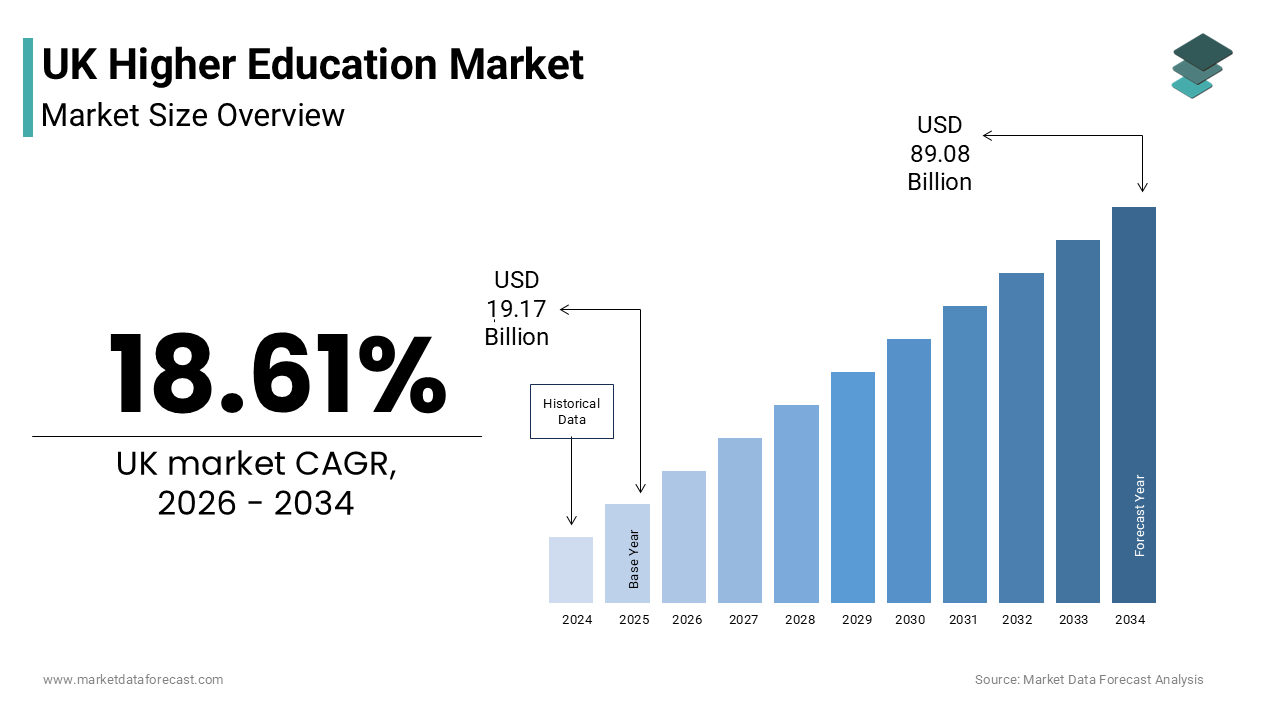
Higher education comprises a diverse ecosystem of universities colleges and specialized institutions that provide undergraduate postgraduate and research degree programs to domestic and international students. This sector is globally renowned for its academic excellence historical prestige and rigorous quality assurance frameworks managed by bodies such as the Office for Students. The market serves as a critical engine for knowledge creation economic development and social mobility within the nation. As per data from the Higher Education Statistics Agency, the sector supports over 244,000 academic staff jobs and contributes significantly to the national gross domestic product through research innovation and student expenditure. The demographic landscape is shifting with an increasing proportion of mature learners and part time students seeking flexible learning pathways alongside traditional school leavers. International mobility remains a defining characteristic with the UK hosting a substantial number of overseas students who bring cultural diversity and financial resources to institutions. Regulatory changes regarding visa policies and immigration rules heavily influence enrolment trends and institutional strategies. The integration of digital technologies has transformed pedagogical approaches enabling hybrid learning models that extend reach beyond physical campuses. This evolving environment requires institutions to balance financial sustainability with educational quality while navigating complex geopolitical and economic pressures that shape the future of tertiary education in Britain.
MARKET DRIVERS
Global Reputation and Academic Excellence Attract International Student Enrolment
The enduring global reputation of UK universities for academic excellence and research output is a key factor driving the growth of the UK higher education market. Institutions in the UK consistently rank highly in international league tables such as the QS World University Rankings and Times Higher Education which enhances their appeal to prospective students worldwide. According to data from Universities UK, international students constitute approximately 26% of the total student population, contributing substantially to tuition revenue and cultural diversity on campus. The perception of UK degrees as prestigious and recognized by employers globally drives students from countries such as China India and Nigeria to choose British institutions over other destinations. The shorter duration of undergraduate and postgraduate programs in the UK compared to other major education hubs offers a cost effective and time efficient pathway to qualification. This efficiency appeals to students seeking rapid entry into the workforce or further academic pursuits. The robust alumni networks and strong industry links facilitated by these institutions further enhance employability prospects making them attractive investments for families prioritizing career outcomes. This combination of prestige efficiency and global recognition ensures a steady flow of international applications sustaining the financial health and vibrancy of the sector.
Government Policy Initiatives Supporting Lifelong Learning and Skills Development
Government policy initiatives aimed at promoting lifelong learning and addressing skills gaps in the economy are further promoting the expansion of the UK higher education market. The introduction of the Lifelong Loan Entitlement allows individuals to access student finance for modular courses and technical qualifications throughout their lives encouraging continuous professional development. According to the Department for Education this policy aims to create a more flexible and responsive education system that aligns with the changing needs of the labor market. Employers are increasingly seeking workers with up to date skills in areas such as digital technology healthcare and green energy prompting adults to return to education for retraining and upskilling. The emphasis on apprenticeships and degree apprenticeships provides alternative pathways that combine academic study with practical work experience attracting a broader demographic of learners. These initiatives reduce the financial barriers to entry for mature students who may have previously been deterred by the cost of full time study. By supporting diverse learning modes and recognizing prior experience the government fosters an inclusive environment that expands the total addressable market for higher education providers. This strategic alignment with economic priorities ensures sustained demand for vocational and academic programs alike.
MARKET RESTRAINTS
Rising Tuition Fees and Cost of Living Crisis Deter Domestic Applicants
The escalating cost of tuition fees combined with the ongoing cost of living crisis is impeding the expansion of the UK higher education market particularly for domestic students. Although tuition fees have been capped for several years the real term value has eroded while living expenses including accommodation food and transport have risen sharply. According to the Office for National Statistics inflation rates have reached historic highs placing significant financial pressure on households and reducing disposable income available for education related expenditures. Many prospective students from lower income backgrounds are deterred by the prospect of accumulating substantial debt without guaranteed high earning prospects upon graduation. The removal of maintenance grants and the shift towards loan based support systems have exacerbated concerns about affordability and long term financial stability. Some students are opting to enter the workforce directly after secondary education or choosing cheaper alternatives such as online certifications to avoid the burden of student loans. This financial hesitation leads to deferred enrollments or dropout rates among current students who struggle to balance work and study. The perceived lack of value for money compared to the rising costs undermines the attractiveness of traditional degree programs for price sensitive demographics.
Stringent Immigration Policies and Visa Restrictions Impact International Recruitment
Stringent immigration policies and frequent changes to visa regulations create uncertainty and act as a significant restraint on the recruitment of international students in the UK higher education market. Recent government measures including restrictions on dependents accompanying international students and increased salary thresholds for graduate visas have altered the calculus for many prospective applicants. According to the Migration Advisory Committee these policy shifts aim to reduce net migration but have inadvertently signaled a less welcoming environment to global talent. Countries such as Canada and Australia have responded with more aggressive recruitment strategies offering clearer pathways to residency which diverts potential students away from the UK. The administrative burden and complexity of the visa application process further discourage applicants who seek smoother and more predictable entry routes. Universities report increased difficulty in attracting students from key markets due to these regulatory hurdles which threaten the financial viability of many institutions reliant on international tuition fees. The perception of political instability regarding immigration policy damages the UK brand as a stable and open destination for education. This regulatory volatility forces institutions to constantly adapt their recruitment strategies while facing declining interest from certain regions.
MARKET OPPORTUNITIES
Expansion of Transnational Education and Online Learning Platforms
The expansion of transnational education and online learning platforms is a significant opportunity for UK higher education institutions to reach global audiences without the constraints of physical capacity. Digital technologies enable universities to deliver high quality courses to students in emerging markets where demand for Western qualifications is growing but local supply is limited. According to industry analysis the global e learning market is experiencing robust growth with increasing acceptance of online degrees by employers and accreditation bodies. UK institutions can leverage their brand equity to offer joint degrees dual awards and fully online programs that cater to working professionals and remote learners. This model reduces infrastructure costs and allows for scalability while maintaining academic standards. Partnerships with local educational providers in countries such as Vietnam Malaysia and Nigeria facilitate market entry and cultural adaptation of curricula. The flexibility of online learning appeals to non-traditional students who require balance between work family and study. By diversifying delivery modes institutions can mitigate risks associated with fluctuations in physical student mobility and visa policies. This digital transformation opens new revenue streams and enhances global influence ensuring long term sustainability in a competitive international education landscape.
Growth in Research Commercialization and Industry Partnerships
The growing emphasis on research commercialization and strategic partnerships with industry offers substantial opportunities for UK higher education institutions to diversify revenue sources and enhance societal impact. Universities are increasingly focusing on translating academic research into tangible products services and startups that address real world challenges. According to data from the National Centre for Universities and Business investment in university business collaborations has increased reflecting a stronger alignment between academic expertise and industrial needs. Spin out companies and licensing agreements generate significant income while fostering innovation ecosystems around campus hubs. Sectors such as life sciences artificial intelligence and renewable energy offer lucrative opportunities for collaboration with private sector partners seeking cutting edge solutions. Government funding initiatives such as the UK Research and Innovation grants support these endeavors encouraging institutions to prioritize applied research with commercial potential. By embedding entrepreneurship into the curriculum and providing incubation support universities cultivate a culture of innovation that attracts talent and investment. This shift towards knowledge transfer strengthens the economic contribution of higher education and builds resilient financial models less dependent on tuition fees alone.
MARKET CHALLENGES
Severe Financial Pressures and Funding Shortfalls Threaten Institutional Sustainability
UK higher education institutions face severe financial pressures due to frozen domestic tuition fees, rising operational costs and reduced government funding that threaten their long term sustainability, which is a significant challenge to the growth of the UK higher education market. The real term value of tuition fees has declined significantly over the past decade while costs for energy staff salaries and infrastructure maintenance have surged. According to the Universities and Colleges Employers Association many universities are operating at a deficit forcing them to implement cost cutting measures such as hiring freezes and program closures. The reliance on cross subsidization where profits from international students offset losses from domestic teaching creates vulnerability to external shocks such as policy changes or global crises. Infrastructure deficits require substantial capital investment which is difficult to secure in a constrained financial environment. Smaller institutions with less diversified income streams are particularly at risk of insolvency or merger. The inability to invest adequately in faculty development and student services compromises educational quality and competitiveness. This financial precarity limits the capacity for innovation and strategic planning creating a challenging operating environment where survival often takes precedence over growth. Addressing this structural funding gap remains a critical challenge for the sector.
Workforce Shortages and Staff Retention Issues Impede Operational Capacity
Workforce shortages and difficulties in retaining academic and professional services staff are further challenging the higher education market expansion in the UK. The sector faces intense competition for talent from industry sectors that offer higher salaries and better working conditions particularly in fields such as computer science engineering and healthcare. According to surveys by the University and College Union staff morale has declined due to workload pressures pay disputes and job insecurity leading to increased turnover and industrial action. The loss of experienced faculty disrupts continuity in teaching and research while recruiting replacements is time consuming and costly. Mental health issues among staff are prevalent due to the high demands of the academic environment exacerbating retention problems. The reliance on casual and fixed term contracts creates instability and reduces commitment among employees. Institutions struggle to maintain consistent service levels and student support when facing chronic staffing gaps. This human resource crisis affects the overall student experience and institutional reputation making it harder to attract and retain both students and top tier academics. Resolving these workforce challenges requires fundamental changes to employment practices and compensation structures.
REPORT COVERAGE
| REPORT METRIC | DETAILS |
| Market Size Available | 2025 to 2034 |
| Base Year | 2025 |
| Forecast Period | 2026 to 2034 |
| CAGR | 18.61% |
| Segments Covered | By Learning Method, End-User, Courses and Region. |
| Various Analyses Covered | Global, Regional & Country Level Analysis, Segment-Level Analysis, DROC, PESTLE Analysis, Porter’s Five Forces Analysis, Competitive Landscape, Analyst Overview of Investment Opportunities |
| Market Leaders Profiled | University of Oxford, University of Cambridge, Imperial College London, University College London (UCL), London School of Economics and Political Science (LSE), King's College London, The University of Edinburgh, The University of Manchester, University of Warwick, University of Bristol, University of Glasgow, University of Southampton, University of Birmingham, Durham University, and Queen Mary University of London. |
SEGMENTAL ANALYSIS
By Learning Method Insights
The offline learning segment dominated the market in 2025 and remains the leading segment in the UK higher education market due to the entrenched value placed on the traditional campus experience and face to face interaction. The physical university environment offers social integration networking opportunities and access to specialized facilities such as laboratories libraries and sports centers that are difficult to replicate digitally. According to data from the Higher Education Statistics Agency the vast majority of full time undergraduate students continue to enroll in on campus programs reflecting a strong cultural preference for immersive academic life. The prestige associated with attending historic institutions like Oxford Cambridge and Imperial College London is intrinsically linked to their physical presence and heritage. Students perceive offline learning as providing superior mentorship from academics and peer collaboration which enhances critical thinking and soft skills development. Employers often view degrees obtained through traditional modes as rigorous and comprehensive reinforcing the demand for offline education. The infrastructure investment by universities in state of the art campuses further cements this dominance by creating attractive environments that support holistic student development. This tangible experience fosters a sense of belonging and identity that is crucial for personal growth during young adulthood ensuring that offline learning retains its primary position in the market.

On the other side, the hybrid learning segment represents the fastest growing segment in the UK higher education market and is predicted to register a promising CAGR in the UK market during the forecast period owing to the rising demand for flexibility and rapid advancements in educational technology. This model combines the benefits of face to face interaction with the convenience of online access allowing students to balance study with work and personal commitments. According to industry observations the adoption of hybrid models has surged post pandemic as institutions invest in digital platforms that seamlessly integrate virtual lectures with onsite seminars. The compound annual growth rate for hybrid learning is projected to be significantly higher than other segments as it appeals to a broader demographic including mature learners and working professionals. Technologies such as learning management systems video conferencing tools and virtual reality simulations enhance the quality of remote participation making it a viable alternative to full time attendance. Students appreciate the ability to review recorded content at their own pace while still engaging in live discussions and group projects on campus. This blended approach caters to diverse learning styles and reduces barriers related to geography and scheduling. As universities refine their hybrid offerings to ensure parity of experience between remote and present students the segment continues to expand rapidly capturing market share from traditional offline models.
By End-User Insights
The state universities segment captured the leading share of the UK market in 2025 due to their substantial public funding historical prestige and broad program offerings. Institutions such as the University of Manchester University of Edinburgh and University College London are publicly funded and enjoy a reputation for academic excellence that attracts both domestic and international students. According to data from the Higher Education Statistics Agency state universities enroll the majority of higher education students in the UK reflecting their capacity and central role in the national education system. These institutions benefit from government grants research funding and established alumni networks that enhance their global standing. The diversity of courses available ranging from humanities to STEM fields ensures they cater to a wide array of academic interests and career aspirations. Their large campus facilities and comprehensive student support services create an attractive environment for learners seeking a holistic university experience. The perception of state universities as pillars of knowledge and social mobility reinforces their dominance. Additionally their ability to conduct cutting edge research contributes to national innovation and economic growth securing ongoing political and financial support. This combination of scale reputation and resource availability ensures that state universities remain the primary choice for most higher education applicants.
On the other end, the private colleges segment is anticipated to showcase a prominent CAGR in the UK market during the forecast period owing to their ability to offer niche specialization and industry aligned curricula. Unlike large state universities private colleges often focus on specific sectors such as business arts technology or healthcare allowing them to tailor programs to current market demands. According to sector analysis the agility of private institutions enables them to update courses rapidly in response to technological changes and employer needs attracting students seeking relevant and practical skills. These colleges frequently partner with industry leaders to provide real world experience and networking opportunities which enhance graduate employability. The smaller class sizes and personalized attention offered by private colleges appeal to students who prefer a more supportive and interactive learning environment. This focused approach differentiates them from the broader offerings of state universities and attracts a dedicated student base. The growth of the creative and digital industries has particularly benefited private colleges that specialize in these fields. By delivering targeted education that leads directly to career opportunities private colleges are gaining traction among students who prioritize practical outcomes over traditional academic prestige.
By Courses Insights
The undergraduate courses segment held the major share of the UK market in 2025 as they form the foundational entry point for most students pursuing tertiary education. The majority of school leavers view a bachelor degree as a essential prerequisite for professional careers and social mobility. According to data from the Higher Education Statistics Agency undergraduate enrollments account for the largest proportion of total student numbers reflecting the broad base of the education pyramid. The three year duration of most UK undergraduate programs offers a time efficient route to qualification compared to other countries making it an attractive option for domestic and international students. Government funding through student loans is primarily structured to support undergraduate study reducing financial barriers for first time learners. The wide variety of subjects available ensures that undergraduate courses cater to diverse interests and aptitudes. Employers typically require a degree as a minimum credential for graduate roles reinforcing the demand for undergraduate education. This structural necessity combined with cultural expectations ensures that undergraduate courses remain the dominant segment in terms of volume and institutional focus.
On the other hand, the masters courses segment is predicted to record a healthy CAGR in the UK market during the forecast period owing to the growing need for upskilling and the competitive nature of the modern job market. As industries become more specialized and technologically advanced employers are seeking candidates with advanced qualifications and deeper expertise. According to data from the Graduate Outcomes survey a growing percentage of graduates are pursuing postgraduate study immediately after their bachelor degree to enhance their employability and earning potential. The one year duration of most UK Masters programs offers a cost effective and time efficient way to gain specialized knowledge without the long term commitment of a PhD. Professional Masters degrees in fields such as data science finance and public health are particularly popular as they align with high demand sectors. The rise of the knowledge economy has made advanced skills a prerequisite for career progression in many fields. Students view Masters degrees as a strategic investment to differentiate themselves in a crowded labor market. This demand for specialized expertise drives the rapid growth of the Masters segment as individuals seek to stay competitive and relevant.
COUNTRY ANALYSIS
England held the leading share of the UK higher education market in 2025 and is expected to sustain its highly dominant and robust presence in the higher education space over the next few years due to its continuous high concentration of globally ranked academic hubs and deep corporate integrations. London serves as a global hub for education hosting institutions such as Imperial College London and the London School of Economics which attract thousands of international students annually. According to data from the Office for National Statistics, England is home to a population projected to exceed 58 million people, with a significant proportion of young adults pursuing tertiary education. The dense network of research intensive universities in cities like Oxford Cambridge Manchester and Birmingham drives innovation and economic growth. The presence of major industries and corporate headquarters in England creates strong demand for skilled graduates fostering close ties between universities and employers. Government funding and policy initiatives are often centered in England influencing national trends in higher education. The diverse cultural landscape of English cities enhances the appeal for international students seeking a vibrant and multicultural experience. This combination of academic prestige economic opportunity and demographic scale ensures England remains the central engine of the UK higher education market.
Scotland is projected to maintain a highly stable and distinctively competitive position in the higher education market over the coming years as its unique multi year academic model continues to draw a diverse global and domestic student cohort. Institutions such as the University of Edinburgh University of Glasgow and University of St Andrews are globally recognized for their academic excellence and historical significance. According to statistics from the Scottish Funding Council, the Scottish government covers full tuition fees for eligible Scottish domiciled undergraduate students, which influences enrollment patterns and accessibility. This policy attracts a high number of domestic applicants while maintaining strong international recruitment through competitive postgraduate programs. The strong emphasis on research and innovation in sectors such as life sciences and renewable energy drives collaboration between universities and industry. The scenic beauty and cultural heritage of Scotland also serve as drawcards for international students seeking a unique study abroad experience. The compact size of the higher education sector allows for close collaboration among institutions and policymakers fostering a cohesive and supportive environment. This distinct regulatory and cultural framework ensures Scotland maintains a prestigious and influential position in the UK higher education landscape.
Wales is anticipated to bolster its essential and deeply community centric contribution to the broader tertiary market over the upcoming years by focusing intently on regional upskilling and expanding educational access. Institutions such as Cardiff University Swansea University and Aberystwyth University play a crucial role in providing accessible higher education to the Welsh population. According to data from the Higher Education Funding Council for Wales there is a strong emphasis on widening participation and supporting students from disadvantaged backgrounds. The Welsh government offers specific grants and bursaries to reduce financial barriers for local students encouraging higher enrollment rates. Universities in Wales are increasingly focusing on sectors relevant to the regional economy such as clean energy creative industries and healthcare. The bilingual nature of some institutions adds a unique cultural dimension to the educational experience. The close knit community feel of Welsh universities fosters strong student support networks and high satisfaction rates. While smaller in scale compared to England and Scotland the Welsh higher education sector is resilient and committed to serving its local population while attracting international talent through niche strengths.
COMPETITIVE LANDSCAPE
The competition in the UK higher education market is intense and characterized by the presence of prestigious research intensive universities alongside specialized institutions and private colleges. Established universities leverage their global rankings historical reputation and extensive alumni networks to attract top domestic and international students. They continuously invest in research infrastructure and faculty recruitment to maintain academic superiority and secure funding. Specialized institutions compete by offering niche programs in areas such as arts business and technology that align closely with industry needs. Private colleges are gaining traction by providing flexible accelerated and vocational courses that appeal to non traditional learners. The market sees increasing competition for international students who contribute significantly to tuition revenue prompting aggressive marketing and scholarship offers. Regulatory changes regarding visas and tuition fees influence institutional strategies and student choices. Digital capabilities have become a key differentiator with universities investing in online platforms to reach wider audiences. This dynamic environment drives continuous improvement in teaching quality student experience and employability outcomes ensuring a robust and evolving sector.
KEY MARKET PLAYERS
Some of the promising companies that are playing a dominating role in the UK Higher Education Market include
- University of Oxford
- University of Cambridge
- Imperial College London
- University College London (UCL)
- London School of Economics and Political Science (LSE)
- King's College London
- The University of Edinburgh
- The University of Manchester
- University of Warwick
- University of Bristol
- University of Glasgow
- University of Southampton
- University of Birmingham
- Durham University
- Queen Mary University of London
- University of Leeds
- University of Sheffield
- University of Nottingham
- Newcastle University
- University of York
Top Players in the UK Higher Education Market
University of Oxford
The University of Oxford stands as a preeminent institution in the UK higher education market renowned for its centuries old tradition of academic excellence and groundbreaking research. The university attracts top tier talent globally through its rigorous admission standards and collegiate system which fosters close knit academic communities. Recent actions include significant investments in digital infrastructure to support hybrid learning models and expanded online course offerings. Oxford has strengthened its position by launching new interdisciplinary research centers focused on artificial intelligence and climate change. These initiatives enhance its reputation for innovation while addressing global challenges. The university actively engages with industry partners to commercialize research outputs ensuring societal impact. Its robust alumni network and endowment fund provide financial stability allowing for continuous improvement in facilities and student support services maintaining its status as a world leader.
University of Cambridge
The University of Cambridge contributes significantly to the UK higher education landscape through its exceptional research output and influential role in scientific and technological advancement. The institution is characterized by its collegiate structure and tutorial based teaching method which ensures personalized academic guidance. Recent strategies involve expanding international partnerships and establishing joint degree programs with leading global universities to broaden its reach. Cambridge has invested heavily in sustainability initiatives aiming to achieve net zero carbon emissions across its estates. The university also focuses on widening participation by offering scholarships and outreach programs for underrepresented groups. By integrating cutting edge technology into its curriculum and research facilities Cambridge maintains its competitive edge. Its strong connections with the tech sector in the surrounding region further enhance employability prospects for graduates reinforcing its market leadership.
Imperial College London
Imperial College London plays a pivotal role in the UK higher education market by specializing in science engineering medicine and business education. The institution is known for its strong emphasis on practical application and industry collaboration which drives innovation and economic growth. Recent actions include the development of new campuses and research hubs dedicated to data science and public health. Imperial has strengthened its market position by enhancing its digital learning platforms to offer flexible study options for working professionals. The college actively promotes entrepreneurship through incubators and startup support programs fostering a culture of innovation. Strategic partnerships with healthcare providers and technology firms ensure that curricula remain relevant to industry needs. By focusing on high impact research and global challenges Imperial continues to attract top students and faculty solidifying its reputation as a leading technical university.
Top Strategies Used by Key Market Participants
Key players in the UK higher education market employ several strategic approaches to maintain competitiveness and drive growth. International recruitment remains a priority with institutions expanding marketing efforts in key markets such as Asia and Africa. Digital transformation is central to strategy with universities investing in online learning platforms and hybrid delivery models to enhance accessibility. Research commercialization is emphasized through partnerships with industry and government bodies to generate additional revenue streams. Diversification of income sources includes executive education programs and consultancy services targeting professional learners. Sustainability initiatives are integrated into campus operations and curricula to align with environmental goals and attract ethically conscious students. Strategic mergers and collaborations allow institutions to share resources and expand program offerings. These combined strategies enable universities to adapt to changing demographic trends regulatory requirements and financial pressures while sustaining academic excellence and institutional relevance
MARKET SEGMENTATION
This research report on the UK Higher Education Market has been segmented based on the following categories.
By Learning method
- Online
- Offline
- Hybrid
By End-user
- Private colleges
- State universities
- Community colleges
By Courses
- Undergraduate
- Masters
- PhD
By Country
- U.K