UK Online Travel Market Size, Share, Trends & Growth Forecast Report Segmented By Service Type (Travel Accommodation, Transportation, Others), Booking Type, Platform Type, Traveler Type and Country – Industry Analysis From 2026 to 2034
Market Size, 2025
$30.99 BnMarket Estimate, 2026
$32.81 BnMarket Forecast, 2034
$51.74 BnCAGR, 2026–2034
5.86%United Kingdom Online Travel Market Report Summary
The United Kingdom online travel market was valued at USD 30.99 billion in 2025, is estimated to reach USD 32.81 billion in 2026, and is projected to reach USD 51.74 billion by 2034, growing at a CAGR of 5.86% during the forecast period from 2026 to 2034. The growth of the United Kingdom online travel market is driven by high internet and smartphone penetration, increasing consumer preference for digital booking platforms, and a strong culture of international leisure travel. Rising adoption of mobile-first booking applications, advancements in artificial intelligence for personalized travel experiences, and growing demand for seamless digital travel planning are further accelerating market growth. Moreover, increasing investments in sustainable tourism, enhanced digital payment infrastructure, and continuous innovation in online travel platforms are supporting the expansion of the United Kingdom online travel market.
Key Market Trends
-
Rising adoption of mobile-first travel booking platforms driven by widespread smartphone usage.
-
Increasing integration of artificial intelligence to deliver personalized travel recommendations and itinerary planning.
-
Growing consumer preference for sustainable and eco-friendly travel options with carbon footprint transparency.
-
Rising demand for dynamic travel packages combining accommodation, transportation, and local experiences.
-
Increasing use of digital wallets, biometric authentication, and contactless technologies to enhance the online travel booking experience.
Segmental Insights
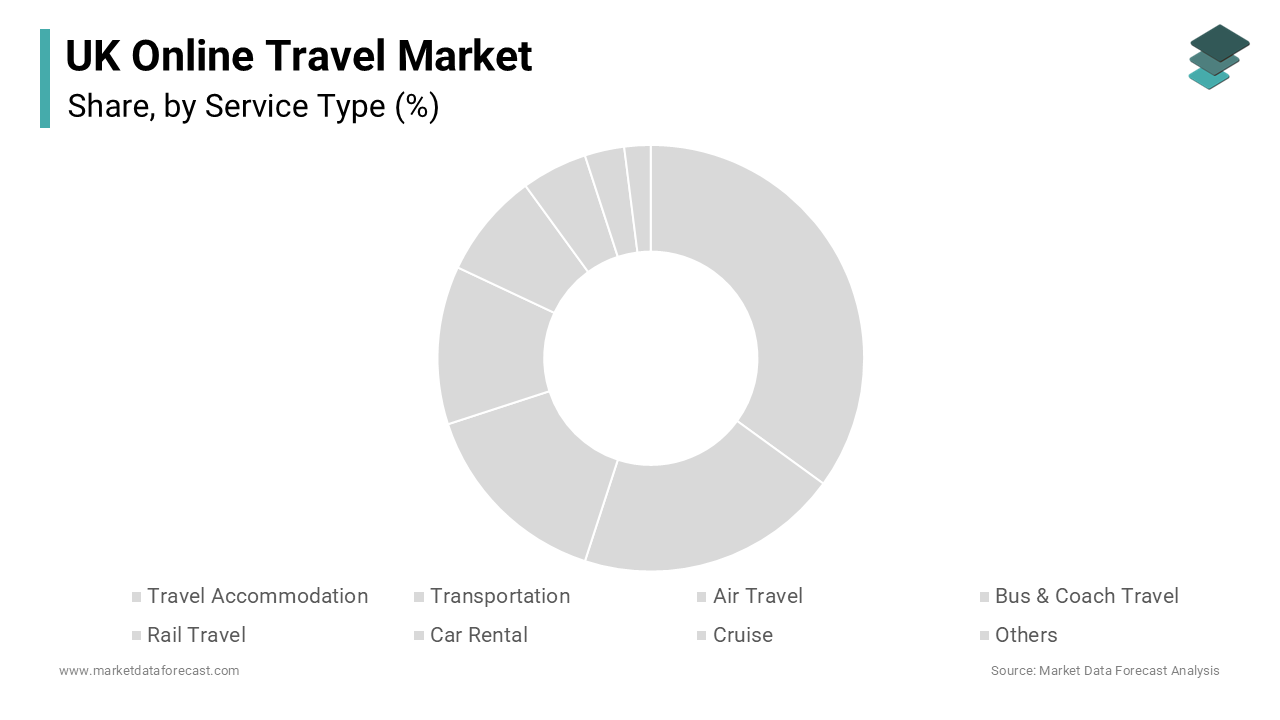
- Based on service type, the travel accommodation segment dominated the United Kingdom online travel market and accounted for 40.8% of the market share in 2025. The dominance of the segment is attributed to accommodation being the largest component of travel expenditure, growing consumer preference for online hotel bookings, increasing availability of alternative accommodations, widespread use of dynamic pricing technologies, and integration of loyalty programs across major booking platforms.
- The transportation segment is projected to witness the fastest CAGR of 11.5% during the forecast period owing to increasing digital airline and rail bookings, expanding low-cost carrier networks, growing adoption of multimodal transportation booking platforms, biometric boarding technologies, and rising consumer preference for seamless end-to-end travel planning.
- Based on booking type, the mobile booking segment dominated the United Kingdom online travel market in 2025. The growth of the segment is driven by high smartphone penetration, increasing use of travel mobile applications, instant booking capabilities, secure digital payment solutions, location-based travel services, and continuous improvements in mobile user experience.
- The desktop and laptop segment is expected to register the fastest CAGR of 6.5% during the forecast period due to increasing demand for planning complex international itineraries, business travel management, enhanced security features, larger display interfaces for travel comparison, and growing preference for desktop bookings involving higher-value travel purchases.
- Based on platform type, the online travel agencies (OTAs) segment dominated the United Kingdom online travel market and accounted for 65.1% of the market share in 2025. The segment’s leadership is supported by extensive travel inventory, competitive pricing, bundled travel packages, customer reviews, loyalty rewards, and the convenience of comparing multiple travel providers through a single platform.
- The direct supplier websites segment is anticipated to witness the fastest CAGR of 9.8% during the forecast period owing to increasing airline and hotel efforts to promote direct bookings, exclusive customer benefits, stronger loyalty programs, personalized marketing, and improved supplier-owned digital booking platforms.
- Based on traveler type, the leisure traveler segment dominated the United Kingdom online travel market and accounted for 64.6% of the market share in 2025. The dominance of the segment is attributed to strong outbound tourism, increasing consumer preference for experiential travel, growing influence of social media, expanding holiday travel, and increasing demand for customized leisure travel experiences.
- The business traveler segment is projected to register the fastest CAGR of 12.2% during the forecast period owing to the recovery of corporate travel, increasing adoption of digital corporate booking platforms, rising business events and conferences, integration of travel expense management solutions, and growing demand for flexible business travel arrangements.
Regional Insights
The United Kingdom accounted for 22.5% of the European online travel market share in 2025. The country's leadership is driven by its highly developed digital infrastructure, strong outbound travel culture, widespread adoption of online booking platforms, advanced mobile connectivity, favorable consumer protection regulations, and increasing investments in travel technology innovation. Growing adoption of artificial intelligence, digital payment solutions, and sustainable tourism initiatives continues to strengthen the country's position as one of Europe's leading online travel markets.
Competitive Landscape
The United Kingdom online travel market is highly competitive and characterized by the presence of global online travel agencies, domestic travel specialists, metasearch platforms, and direct supplier booking channels competing through technological innovation, personalized customer experiences, and competitive pricing strategies. Leading companies are focusing on integrating artificial intelligence, expanding mobile booking capabilities, strengthening sustainability initiatives, enhancing loyalty programs, and forming strategic partnerships with travel suppliers to improve customer engagement. Continuous investments in digital transformation, user experience optimization, and personalized travel services continue to strengthen competitive positioning across the United Kingdom online travel market.The prominent players operating in the United Kingdom online travel market include Booking.com, Expedia Group, Airbnb, TUI UK, On the Beach Group, Loveholidays, Lastminute.com, eDreams, Opodo, Skyscanner, Trip.com Group, Kayak, Hays Travel, Trainline, and Jet2holidays.
UK Online Travel Market Size
The UK online travel market size was valued at USD 30.99 billion in 2025 and is anticipated to reach USD 32.81 billion in 2026 from USD 51.74 billion by 2034, growing at a CAGR of 5.86% during the forecast period from 2026 to 2034.
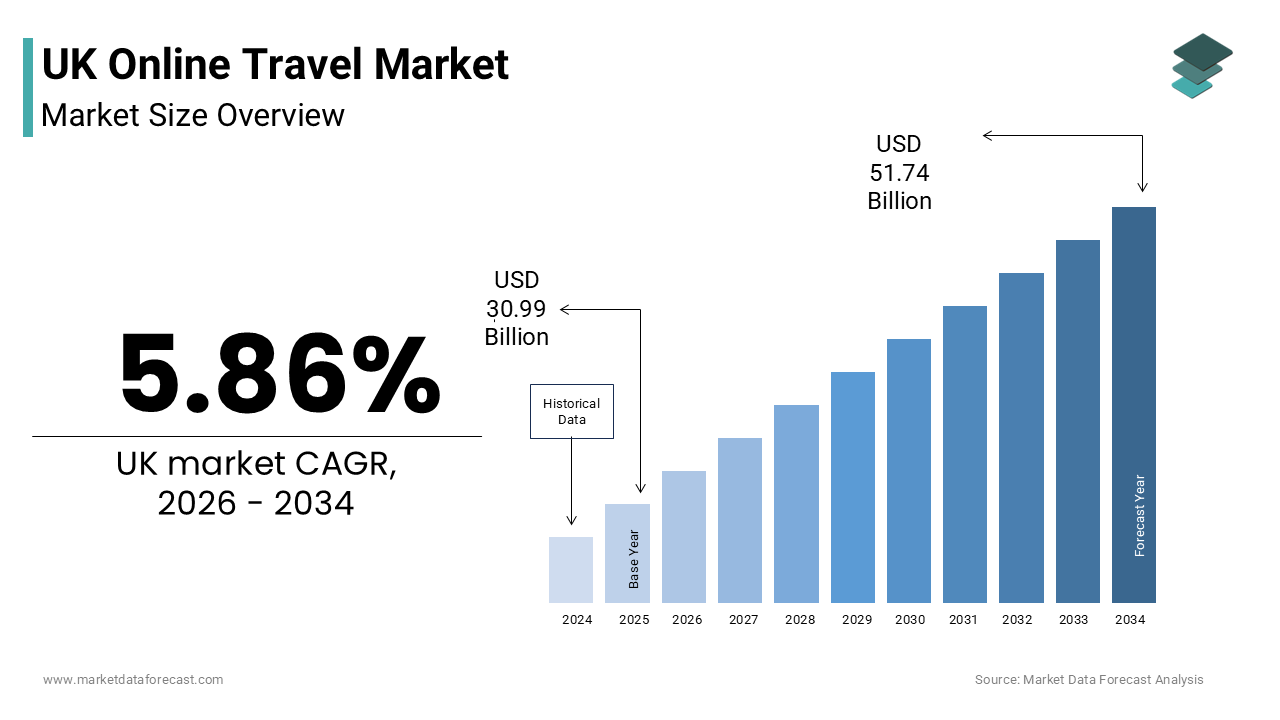
Online Travel refers to the consumer process of researching, comparing, and booking travel services (flights, hotels, tours, and packages) through digital platforms. This market has evolved from a supplementary booking channel into the primary method for travel planning driven by high digital literacy and the convenience of instant confirmation. The market is characterized by intense competition among global online travel agencies domestic specialists and direct supplier websites all vying for consumer attention through price transparency and user experience innovation. Ofcom reveals that 95% of adults in the United Kingdom had internet access at home, securing the extensive digital infrastructure required for seamless, widespread digital travel planning and booking adoption. According to communication market and consumer tracking data, smartphone ownership among UK adults sits at over 92%, providing a ubiquitous mobile environment that enables travelers to seamlessly book and manage itineraries on the go. The cultural propensity for international travel remains strong with millions of UK residents traveling abroad annually for leisure and business purposes. Regulatory frameworks such as the Package Travel Regulations ensure consumer protection and financial security fostering trust in online transactions. The market faces evolving dynamics related to sustainability data privacy and economic volatility requiring platforms to adapt continuously. This dynamic landscape supports a diverse array of players from aggregators to niche providers contributing to a vibrant and competitive digital travel economy that drives significant economic activity across the tourism sector.
MARKET DRIVERS
High Smartphone Penetration and Mobile First Booking Behavior
High smartphone penetration and the shift toward mobile first booking behavior fuel the growth of the United Kingdom online travel market. This ensures that travel services are accessible to the vast majority of the population. The convenience of browsing comparing prices and booking trips from any location has transformed travel planning from a desktop based activity to an instantaneous mobile experience. According to Ofcom communications market report 92 percent of UK adults owned a smartphone in 2024 creating a massive installed base for mobile travel applications. Mobile devices drive the dominant share of online travel research and traffic. However, desktop browsing continues to play a significant role in high-value final checkouts within the UK market. Mobile apps offer features such as biometric login push notifications for price drops and digital boarding passes which reduce friction and enhance the travel journey. The integration of digital wallets simplifies the transaction process enhancing security and speed. High speed 5G networks further improve the user experience by enabling fast loading times for high resolution images and virtual tours. This technological accessibility ensures that travel providers can reach consumers during key moments such as commuting or leisure time. The ease of access combined with sophisticated user interfaces makes mobile platforms the dominant channel for customer acquisition and revenue generation in the UK online travel sector.
Strong Cultural Propensity for International Leisure Travel
The strong cultural propensity for international leisure travel further boosts the expansion of the United Kingdom online travel market. British consumers have a deep seated tradition of taking annual holidays abroad with sunny destinations and city breaks being particularly popular. According to the Office for National Statistics (ONS), UK outbound travel fully rebounded past pre-pandemic levels in 2024, with residents logging a record-breaking 94.6 million overseas trips. As per Visit Britain surveys the desire to explore new cultures and escape domestic weather patterns drives consistent booking activity throughout the year. The weakening of the pound against certain currencies occasionally boosts outbound travel to affordable destinations while strong purchasing power in others encourages luxury trips. Social media platforms play a significant role in inspiring travel choices with influencers showcasing exotic locations driving immediate booking intent. The availability of low cost carriers and competitive accommodation options online makes international travel accessible to a broad demographic. Seasonal peaks such as summer holidays and winter sun escapes create predictable demand surges that online platforms capitalize on through targeted marketing. This entrenched cultural habit ensures that the online travel market remains resilient and continues to grow as consumers prioritize experiences and memories over material goods.
MARKET RESTRAINTS
Economic Volatility and Reduced Disposable Income
Economic volatility and reduced disposable income restrict the growth of the United Kingdom online travel market. Inflationary pressures rising interest rates and cost of living increases have forced households to prioritize essential expenses over discretionary travel purchases. The erosion of purchasing power limits the ability of travelers to afford premium experiences forcing them to opt for budget friendly options or staycations. Currency fluctuations impact the affordability of overseas destinations making some popular spots prohibitively expensive for UK tourists. Airlines and hotels face pressure to lower prices which squeezes margins and reduces investment in service quality. Consumers are increasingly turning to alternative accommodation options such as home swaps or camping to reduce costs. The uncertainty of future economic conditions makes long term travel planning difficult discouraging early bookings. These financial constraints create a challenging environment where growth is limited by the wallet share available to consumers after meeting basic needs impacting the overall value of the online travel market.
Cybersecurity Threats and Data Privacy Concerns
Cybersecurity threats and escalating data privacy concerns also slow down the expansion of the United Kingdom online travel market. This affects consumer trust and willingness to engage in online travel transactions within the country. High profile data breaches and phishing attacks targeting travel accounts have made shoppers wary of sharing personal and financial information with digital platforms. National Cyber Security Centre data highlights that corporate data breaches remain pervasive, with phishing and identity fraud presenting serious vulnerabilities across digital consumer networks. As per Information Commissioner Office reports fines for data protection violations have risen prompting stricter compliance requirements under the General Data Protection Regulation. Consumers are increasingly selective about which platforms they trust with their passport details and payment data preferring established brands with robust security measures. The complexity of managing passwords and verifying identities across multiple travel sites can create friction in the booking process leading to cart abandonment. Travel providers must invest heavily in encryption multi factor authentication and continuous monitoring to protect customer data which increases operational costs. Negative publicity surrounding security failures can damage brand reputation irreparably leading to loss of customers. The balance between seamless user experience and rigorous security protocols is difficult to maintain. These concerns deter some potential users from adopting new or lesser known travel platforms particularly among older demographics who may be less technologically confident.
MARKET OPPORTUNITIES
Integration of Artificial Intelligence and Personalized Itineraries
The integration of artificial intelligence and personalized itineraries provides a clear path for differentiation and revenue growth within the United Kingdom online travel market. AI technologies enable platforms to analyze vast amounts of user data to deliver tailored destination recommendations dynamic packaging and customized travel advice that enhance customer satisfaction and loyalty. According to sources personalized travel recommendations can increase conversion rates by up to 20 percent by presenting relevant options at the right time. As per Salesforce research travelers are more likely to book with platforms that offer seamless end to end planning experiences indicating strong potential for retention. Machine learning algorithms predict future travel preferences allowing providers to proactively suggest trips based on past behavior and seasonal trends. Chatbots powered by natural language processing provide instant customer support resolving queries efficiently and improving user experience. Virtual reality previews allow customers to visualize hotels and attractions before booking reducing uncertainty and increasing confidence. The ability to create unique and engaging travel journeys distinguishes platforms in a crowded market. Operators that leverage AI effectively can create a more immersive and relevant experience that drives long term profitability and sustainable growth in the competitive online travel landscape.
Expansion of Sustainable and Eco-Friendly Travel Options
The expansion of sustainable and eco-friendly travel options offers significant opportunities for online travel platforms to align with environmental values and attract conscientious consumers in the country, which is anticipated to drive the expansion of the United Kingdom online travel market. Travelers are increasingly aware of their carbon footprint and prefer brands that demonstrate genuine commitment to sustainability through green certifications carbon offsetting and ethical tourism practices. As per research, sustainability survey travelers who see clear sustainability information are more likely to book and recommend those options to others. Opportunities exist in promoting rail travel over short haul flights highlighting eco certified accommodations and supporting local community based tourism initiatives. Platforms that integrate carbon calculators into the booking process empower users to make informed choices. Partnerships with green transport providers and sustainable tour operators enhance credibility and differentiate brands from competitors. Marketing sustainability efforts authentically builds trust and attracts a growing segment of values driven shoppers. This shift toward responsible tourism not only benefits the environment but also creates unique selling propositions that drive competitive advantage and long term viability in the online travel market.
MARKET CHALLENGES
Complex Regulatory Landscape and Consumer Protection Compliance
Complex regulatory landscape and stringent consumer protection compliance hold back the growth of the United Kingdom online travel market. These are critical challenges to online travel platforms operating in the country. The Package Travel Regulations impose strict liabilities on organizers regarding refunds repatriation and information transparency requiring robust legal and operational frameworks. According to the Civil Aviation Authority ATOL scheme requirements mandate financial protection for flight inclusive packages adding administrative burden and cost to online providers. As per Competition and Markets Authority guidelines platforms must clearly distinguish between acting as agents versus principals to avoid misleading consumers about their liability. Non compliance can result in severe fines legal action and reputational damage deterring customers. The post Brexit regulatory divergence adds complexity for platforms serving both UK and EU markets requiring separate compliance strategies. Changes in visa rules health regulations and entry requirements necessitate real time updates to booking systems to prevent traveler disruptions. Keeping pace with evolving laws demands dedicated legal resources and continuous system upgrades which strain smaller operators. The need to provide clear and accurate information about cancellation policies and rights enhances transparency but complicates the user interface. Balancing regulatory obligations with a seamless user experience remains a complex challenge that impacts operational efficiency and strategic planning for online travel businesses.
Intense Price Competition and Margin Erosion
Intense price competition and margin erosion are a major hurdle for platforms in the United Kingdom online travel market. This difficulty is largely driven by an increasingly saturated market. The transparency of pricing facilitated by comparison engines and metasearch sites forces providers to compete aggressively on cost often sacrificing profit margins. According to studies, commission rates for online travel agencies have compressed due to direct booking strategies by airlines and hotel chains. As per sources, loyalty is low in the online travel sector with consumers frequently switching between platforms based on minor price differences. This price sensitivity forces companies into continuous discounting cycles which erode profitability and devalue the brand. Suppliers increasingly invest in their own direct channels offering exclusive perks to bypass intermediaries reducing the volume available to third party platforms. Affiliate marketers and metasearch engines demand higher fees for leads reducing net revenue for booking sites. The need to constantly innovate with new features and content to retain attention adds to development costs. Smaller operators struggle to compete with large incumbents who have deeper pockets for marketing spend. Achieving sustainable growth requires balancing acquisition spend with lifetime value which becomes increasingly difficult in a mature and highly competitive market where price is the primary differentiator.
REPORT COVERAGE
| REPORT METRIC | DETAILS |
| Market Size Available | 2025 to 2034 |
| Base Year | 2025 |
| Forecast Period | 2026 to 2034 |
| CAGR | 5.86% |
| Segments Covered | By Service Type, Booking Type, Platform Type, Traveler Type and Region. |
| Various Analyses Covered | Global, Regional & Country Level Analysis, Segment-Level Analysis, DROC, PESTLE Analysis, Porter’s Five Forces Analysis, Competitive Landscape, Analyst Overview of Investment Opportunities |
| Market Leaders Profiled | Booking.com, Expedia Group, Airbnb, TUI UK, On the Beach Group, Loveholidays, Lastminute.com, eDreams, Opodo, Skyscanner, Trip.com Group, Kayak, Hays Travel, Trainline, and Jet2holidays. |
SEGMENTAL ANALYSIS
By Service Type Insights
The travel accommodation segment dominated the United Kingdom online travel market and accounted for a 40.8% share in 2025. This dominance occurs because lodging is a fundamental and high-value component of every trip, whether for leisure or business purposes. Unlike ancillary services such as car rentals or activities accommodation is a non negotiable expense that commands a significant portion of the total travel budget. According to research, accommodation bookings account for approximately 45 percent of the total gross merchandise value in the UK online travel sector reflecting its financial dominance. As per Office for National Statistics reports overnight stays constitute the core metric for tourism impact with millions of room nights booked annually through digital channels. The diversity of accommodation options ranging from luxury hotels to budget hostels and short term rentals caters to all demographic segments ensuring broad market participation. Consumers often book accommodation first when planning trips making it the anchor product around which other services are added. The rise of alternative accommodations has further expanded this segment attracting travelers seeking unique local experiences. High average order values compared to other travel components ensure that accommodation remains the primary revenue driver for online travel agencies and direct suppliers alike sustaining its leadership in the market.
Dynamic pricing algorithms and real-time availability systems solidify this segment's leadership. Together, they optimize revenue and boost user experience. Online platforms leverage artificial intelligence to adjust room rates based on demand seasonality and competitor pricing ensuring competitive offers for consumers while maximizing yield for providers. According to Duetto hospitality technology reports hotels using dynamic pricing see a 10 percent increase in revenue per available room compared to static pricing models. Mobile apps provide instant confirmation and digital check in options reducing friction and enhancing convenience for guests. The ability to filter by amenities location and guest ratings allows users to find precise matches quickly improving satisfaction. Loyalty programs integrated into booking platforms encourage repeat business by offering exclusive rates and perks. These technological advancements create a seamless and efficient booking environment that drives volume and sustains the dominance of the accommodation segment in the online travel landscape.
The transportation segment is on the rise and is expected to be the fastest growing segment in the market by witnessing a CAGR of 11.5% between 2026 and 2034. This expansion is driven by the increasing accessibility and digital integration of air and rail travel. The proliferation of low cost carriers has democratized air travel making flights affordable for a broader demographic and driving frequent online bookings. According to Civil Aviation Authority data passenger numbers at UK airports have surpassed pre pandemic levels with domestic and European routes seeing significant growth. The convenience of comparing flight times and prices across multiple airlines on metasearch engines encourages frequent usage. Government initiatives promoting rail travel over short haul flights for environmental reasons also boost digital rail bookings. The integration of multi modal transport options allowing users to book flights trains and buses in a single itinerary enhances appeal. This ease of access and affordability drives rapid adoption and makes transportation the fastest growing service type in the online travel sector.
The rapid expansion of this segment is further fueled by the adoption of biometric boarding technologies and seamless connectivity features that streamline the travel journey. Airports and rail stations are implementing facial recognition and digital identity solutions to reduce queue times and enhance security efficiency. According to International Air Transport Association reports biometric boarding can reduce processing time by 30 percent improving the overall passenger experience. Online platforms integrate real time flight status updates gate changes and delay notifications keeping travelers informed and reducing anxiety. The ability to manage bookings change seats and purchase extras via mobile apps adds convenience and control. Partnerships between transport providers and tech companies enable personalized travel alerts and offer recommendations based on location. These innovations make transportation booking not just a transaction but an integral part of a connected travel ecosystem driving sustained high growth in this segment.
By Booking Type Insights
The mobile booking segment led the United Kingdom online travel market and captured a substantial share in 2025. This is because smartphones have become the primary device for researching and purchasing travel services due to their portability and constant connectivity. Consumers prefer booking on mobile devices during commutes breaks or while traveling allowing for spontaneous decisions and immediate confirmations. According to Ofcom communications market report 92 percent of UK adults owned a smartphone in 2024 providing a massive installed base for mobile travel applications. Mobile apps offer features such as GPS based location services for nearby hotels push notifications for price drops and digital wallets for secure payments. The intuitive interface and streamlined checkout processes reduce friction encouraging impulse bookings. Last minute deals are frequently accessed via mobile enabling travelers to capitalize on discounted rates. The integration of social media sharing allows users to seek advice and inspiration directly within the app. This convenience and accessibility ensure that mobile remains the central hub for online travel transactions driving the majority of volume and engagement.
The dominance of this segment is further strengthened by the integration of augmented reality and voice search technologies that enhance the discovery and booking process. Augmented reality features allow users to visualize hotel rooms or destination landmarks through their phone cameras providing a richer understanding of the product before purchase. Mobile apps leverage these technologies to provide interactive and immersive experiences that differentiate them from desktop sites. Personalized alerts based on user location and behavior drive relevant offers at the right moment. The ability to scan QR codes for tickets and keys simplifies the travel experience reducing physical contact and wait times. These advanced features make mobile booking not just convenient but also engaging and informative sustaining its leadership in the market.
The desktop and laptop segment is expected to exhibit a noteworthy CAGR of 6.5% over the forecast period. While overall volume is lower than mobile desktops remain preferred for detailed research multi city itineraries and business travel management where screen real estate and multitasking capabilities are essential. According to research 40 percent of complex international trips involving multiple stops are still planned and booked on desktop computers due to the need for comprehensive comparison tools. The larger screen allows users to view maps calendars and detailed policy information simultaneously reducing errors and enhancing decision making. Business travelers often require detailed invoices and customization options that are easier to manage on a keyboard and mouse. This niche but high value segment drives steady growth as complexity in travel planning increases ensuring desktops remain relevant for sophisticated users.
The swift growth of this segment in high value contexts is also driven by enhanced security features and robust data management capabilities that appeal to cautious and professional users. Desktop browsers offer advanced privacy controls password managers and secure connection indicators that build trust for high value transactions. According to Norton Cyber Safety Insights Report 60 percent of users feel more secure entering payment details on a trusted desktop computer compared to public Wi Fi networks used by mobiles. As per Expedia partner data desktop bookings have higher average order values as users take time to review terms and conditions thoroughly. The ability to save multiple profiles and payment methods securely facilitates quick repeat bookings for frequent travelers. Enterprise level security protocols are easier to implement and monitor on managed desktop devices in corporate environments. The stability and reliability of desktop connections reduce the risk of transaction failures during critical booking moments. These factors ensure that desktops continue to grow in importance for secure and complex travel arrangements despite the dominance of mobile for simple transactions.
By Platform Type Insights
The Online Travel Agencies (OTA) segment held the majority share of 65.1% of the United Kingdom online travel market in 2025. These platforms aggregate supply from multiple providers, allowing consumers to compare prices and options in one place. OTAs offer unparalleled convenience by displaying flights hotels and cars side by side enabling users to find the best deals efficiently. The ability to bundle services creates additional value and savings appealing to budget conscious travelers. Customer reviews and ratings provided on OTAs build trust and help users make informed decisions. Loyalty programs and exclusive member discounts further incentivize usage. The brand recognition of major OTAs ensures they are the first point of call for many travelers. This aggregation model reduces search costs and time making OTAs the dominant channel for online travel procurement.
The leadership of the online travel agencies segment is further reinforced by their immense marketing power and global reach which drive significant traffic and conversions. OTAs invest heavily in digital advertising search engine optimization and affiliate partnerships ensuring high visibility across all consumer touchpoints. Their global scale allows them to negotiate better rates with suppliers which are passed on to consumers enhancing competitiveness. Multi language and multi currency support make OTAs accessible to international travelers visiting or departing from the UK. The ability to offer 24/7 customer support in multiple languages builds trust and resolves issues quickly. These advantages create a powerful network effect that attracts both suppliers and consumers sustaining the dominance of OTAs in the market.
The direct supplier websites segment is predicted to witness the highest CAGR of 9.8% from 2026 to 2034 due to airlines and hotel chains prioritizing direct relationships with customers. Suppliers are incentivizing direct bookings through exclusive perks such as free Wi Fi room upgrades flexible cancellation policies and bonus loyalty points. The desire for guaranteed service quality and direct communication in case of disruptions drives travelers to book directly. Suppliers invest in user friendly websites and apps that match OTA functionality removing previous friction points. Price parity clauses and best rate guarantees assure customers they are not paying more by booking direct. This strategic focus on retention and value addition drives rapid growth in direct channel usage.
The quick surge of this segment is further propelled by the ability of suppliers to own customer data and deliver highly personalized engagement without intermediary restrictions. Direct bookings provide suppliers with complete visibility into customer preferences behavior and spending patterns enabling tailored marketing and service delivery. Suppliers can communicate directly with guests via email or app notifications offering relevant upsells and local experiences. The elimination of commission fees paid to OTAs improves profit margins allowing suppliers to reinvest in customer experience improvements. Direct feedback loops enable faster resolution of issues and continuous service enhancement. This control over the customer journey and data creates a sustainable competitive advantage driving sustained growth in the direct supplier segment.
By Traveler Type Insights
The leisure traveler segment was the largest in the United Kingdom Online Travel Market and occupied a 64.6% share in 2025 because of the fact that recreational travel accounts for the vast majority of trip volume and consumer spending. Families couples and solo travelers book holidays for relaxation exploration and cultural experiences driving consistent demand throughout the year. The diversity of leisure interests from beach holidays to city breaks ensures broad market appeal. Social media influence and peer recommendations play a crucial role in destination selection and booking decisions. Seasonal peaks such as summer and school holidays create predictable surges in demand that online platforms optimize through dynamic pricing. The emotional nature of leisure travel encourages investment in premium experiences and upgrades. This high volume and spending power ensure that leisure remains the dominant force in the online travel landscape.
Shifted consumer behaviors continue to reinforce the leadership of the leisure segment. Today's travelers actively seek out flexibility and prioritize high-value, memorable experiences. Unlike business travelers bound by strict schedules leisure travelers often book in advance or last minute depending on deals and inspiration. The ability to customize itineraries with local tours dining and activities appeals to this segment. Online platforms offer flexible booking options and travel insurance to mitigate risks encouraging experimentation. The rise of bleisure travel where leisure is added to business trips further expands this segment. Marketing campaigns focusing on emotional benefits and escape resonate strongly with leisure audiences. This focus on enjoyment and discovery sustains the dominance of the leisure traveler segment.
The business traveler segment is estimated to register the fastest CAGR of 12.2% during the forecast period. This growth is driven by a rebound in corporate travel that increasingly blends with leisure. Companies are resuming face to face meetings conferences and client visits driving increased demand for efficient booking tools and flexible policies. Business travelers require seamless integration with expense management systems and priority customer support which online platforms are enhancing. The need for reliable Wi Fi central locations and quick check in drives preference for specific hotel chains and airlines. Corporate booking tools are becoming more user friendly mimicking consumer experiences to improve adoption. This combination of necessity and evolving work culture drives rapid growth in the business segment.
The rapid expansion of the business segment is also supported by the demand for efficiency and strict adherence to corporate travel policies which online platforms facilitate through automated tools. Businesses require transparent pricing approval workflows and reporting capabilities to manage costs and ensure compliance. The ability to book multi modal transport and manage changes easily saves time for busy professionals. Dedicated account managers and support teams resolve issues quickly minimizing disruption. Data analytics provide insights into spending patterns helping companies negotiate better rates with suppliers. These efficiency gains and control mechanisms make online booking indispensable for modern business travel driving sustained high growth in this segment.
COUNTRY ANALYSIS
The United Kingdom led online travel market in Europe and captured a 22.5% share in 2025. This position of the country’s market was propelled by high digital adoption strong outbound travel culture and sophisticated consumer expectations. The market status reveals a robust ecosystem of global online travel agencies domestic specialists and direct supplier platforms competing for a discerning audience. According to Office for National Statistics (ONS) data, UK residents made an estimated 94.6 million overseas visits in 2024, surpassing pre-pandemic levels and demonstrating robust outbound demand. London serves as a global hub for travel technology innovation hosting numerous startups and headquarters of major travel companies. The Department for Transport (DfT) actively promotes strategies to improve multi-modal travel, such as the Digital Railway Strategy and proposals for integrated ticketing. However, current reports identify the fragmentation between air and rail booking systems as a key challenge rather than a statistically integrated reality. The regulatory framework including ATOL protection builds consumer trust in online transactions. High smartphone penetration and broadband access facilitate widespread use of mobile travel apps. The market is highly competitive with price transparency driving efficiency and value for consumers. Sustainability concerns are increasingly influencing booking choices prompting platforms to highlight green options. The UK leads in setting trends for mobile booking and personalized travel experiences influencing broader European markets. This combination of infrastructure culture and innovation maintains the UK's leadership position in the regional online travel landscape
COMPETITIVE LANDSCAPE
The competition within the United Kingdom online travel market is intense and characterized by the rivalry between global online travel agencies specialized niche providers and direct supplier channels. Major multinational corporations leverage their extensive inventories advanced technology platforms and strong brand recognition to attract a broad customer base. These leaders continuously innovate by integrating artificial intelligence for personalized recommendations and improving mobile user interfaces to enhance convenience. Meanwhile smaller agile firms compete by offering curated experiences exceptional customer service and expertise in specific destinations or travel styles. Direct booking channels from airlines and hotel chains are gaining traction as they offer exclusive perks and loyalty benefits to bypass intermediary fees. Price transparency facilitated by metasearch engines forces all participants to remain competitive on cost while adding value through superior service. Regulatory compliance and consumer protection standards level the playing field but increase operational complexity. Customer retention relies heavily on loyalty schemes personalized communication and reliable support during travel disruptions. This dynamic environment requires constant adaptation to technological trends and shifting consumer behaviors to maintain relevance and profitability in a saturated landscape.
KEY MARKET PLAYERS
Some of the promising companies that are playing a dominating role in the United Kingdom online travel market include
- Booking.com
- Expedia Group
- Airbnb
- TUI UK
- On the Beach Group
- Loveholidays
- Lastminute.com
- eDreams
- Opodo
- Skyscanner
- Trip.com Group
- Kayak
- Hays Travel
- Trainline
- Jet2holidays
Top Players in the United Kingdom Market
Expedia Group
Expedia Group maintains a significant presence in the United Kingdom online travel sector through its portfolio of brands including Expedia.co.uk and Hotels.com. The company provides comprehensive booking services for flights accommodations car rentals and activities catering to diverse traveler needs. Recent strategic initiatives include enhancing its mobile application with artificial intelligence driven personalization features to improve user experience and conversion rates. Expedia has also expanded its partnership network with local UK suppliers to offer unique regional experiences that appeal to both domestic and international tourists. By investing in sustainable travel options and flexible cancellation policies the group aims to build trust and loyalty among consumers. These efforts reinforce its position as a leading global platform while adapting to the specific preferences and regulatory requirements of the British market.
Booking Holdings Inc
Booking Holdings Inc plays a pivotal role in the United Kingdom online travel market primarily through its flagship brand Booking.com which is widely recognized for its extensive accommodation inventory. The company focuses on connecting travelers with a vast array of lodging options ranging from hotels to private homes across the UK. Recent actions involve integrating advanced machine learning algorithms to provide more accurate price predictions and tailored recommendations for users. Booking Holdings has also strengthened its commitment to sustainable travel by highlighting eco certified properties and promoting responsible tourism practices. The platform continues to invest in customer support infrastructure to ensure seamless service during disruptions. Booking Holdings About Booking Holdings secures its competitive edge through constant technology innovation and reliable supplier relationships Supplier Code of Conduct. As a result, the company consistently delivers value to millions of UK travelers searching for convenience and choice UK Travel Firms Focus on AI as OTA Growth Slows
WEX Travel (Corporate Traveller)
WEX Travel contributes significantly to the United Kingdom online travel market by specializing in corporate travel management solutions for businesses of all sizes. The company offers end to end services including online booking tools policy compliance monitoring and expense management integration. Recent developments include the launch of enhanced self service portals that allow employees to book trips efficiently while adhering to company guidelines. WEX Travel has also expanded its consultancy services to help organizations optimize their travel spend and improve duty of care protocols. By leveraging data analytics the company provides actionable insights that drive cost savings and operational efficiency for corporate clients. These strategic enhancements strengthen its reputation as a trusted partner for business travel management in the UK ensuring high levels of client retention and satisfaction.
Top Strategies Used by Key Market Participants
Key players in the United Kingdom online travel market predominantly employ digital innovation and personalized customer experiences to maintain competitive advantage and drive growth. Companies invest heavily in artificial intelligence and machine learning technologies to analyze user behavior and deliver tailored recommendations for flights hotels and activities. Developing robust mobile applications ensures seamless booking processes and real time updates which are critical for modern travelers. Strategic partnerships with local suppliers and tourism boards help expand inventory and offer unique experiences that differentiate platforms from competitors. Implementing flexible cancellation policies and transparent pricing builds trust and encourages bookings in an uncertain economic climate. Enhancing sustainability initiatives by promoting eco friendly options appeals to environmentally conscious consumers. Loyalty programs that reward frequent travelers with exclusive benefits and discounts foster long term engagement and retention. These combined strategies enable participants to adapt to changing consumer preferences and sustain profitability in a dynamic marketplace.
MARKET SEGMENTATION
This research report on the United Kingdom online travel market has been segmented based on the following categories.
By Service Type
- Travel Accommodation
- Transportation
- Others
By Booking Type
- Desktop & Laptop
- Mobile (Smartphone & Tablet)
By Platform Type
- Online Travel Agencies (OTAs)
- Direct Supplier Websites
- Meta-search Engines
By Traveler Type
- Leisure
- Business
- Visiting Friends & Relatives (VFR)
By Age Group
- Generation Z (18-24)
- Millennials (25-40)
- Generation X (41-56)
- Baby Boomers (57-75)
By Country
- U.K
Access the study in MULTIPLE FORMATS
Purchase options starting from
$ 1200
Didn’t find what you’re looking for?
TALK TO OUR ANALYST TEAM
Need something within your budget?
NO WORRIES! WE GOT YOU COVERED!
Call us on: +1 888 702 9696 (U.S Toll Free)
Write to us: sales@marketdataforecast.com