UK Outsourcing Market Size, Share, Trends & Growth Forecast Report - Segmented By Service, End-User, Organization, and By Country - Industry Analysis and Forecast, 2026 to 2034
Market Size, 2025
$990 BnMarket Estimate, 2026
$1048.91 BnMarket Forecast, 2034
$1665 BnCAGR, 2026–2034
5.95%UK Outsourcing Market Report Summary
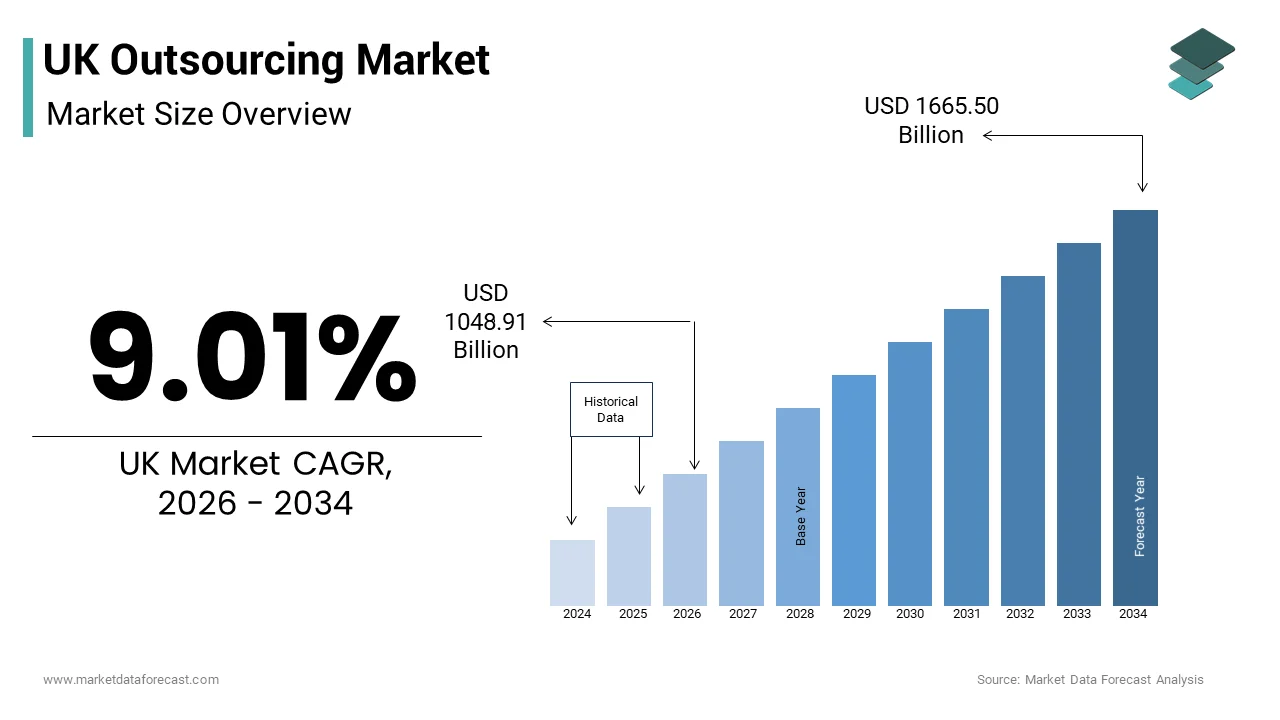
The UK outsourcing market was valued at USD 990.00 billion in 2025 and is anticipated to reach USD 1,048.91 billion in 2026 and further expand to USD 1,665.50 billion by 2034, growing at a CAGR of 5.95% during the forecast period from 2026 to 2034. The growth of the UK outsourcing market is driven by increasing demand for cost optimization, operational efficiency, and access to specialized expertise across industries. Organizations are increasingly outsourcing non-core business functions to focus on strategic priorities, improve scalability, and accelerate digital transformation initiatives. The growing adoption of cloud computing, automation, artificial intelligence, and business process management solutions is further supporting market expansion. Additionally, the need for enhanced customer experience, regulatory compliance, and business continuity is creating significant opportunities for outsourcing service providers.
Key Market Trends
- Rising demand for information technology outsourcing services to support digital transformation, cloud migration, cybersecurity, and software development initiatives.
- Increasing adoption of automation, artificial intelligence, and robotic process automation (RPA) to improve operational efficiency and reduce costs.
- Growing preference for managed services models that provide predictable costs, enhanced service quality, and long-term operational support.
- Expansion of outsourcing partnerships within highly regulated industries such as banking, financial services, and insurance.
- Increasing focus on customer experience management, data analytics, and business process optimization to drive competitive advantage.
Segmental Insights
- Based on service, the information technology outsourcing segment dominated the UK outsourcing market and accounted for 59.5% of the market share in 2025. The segment’s leadership is attributed to growing enterprise investments in digital infrastructure, cloud services, cybersecurity solutions, application management, and IT modernization initiatives.
- Based on end-user industry, the banking, financial services, and insurance (BFSI) segment held the largest share of the UK outsourcing market, capturing 31.3% in 2025. The dominance of this segment is driven by increasing demand for process automation, regulatory compliance support, customer service management, and technology-driven operational efficiency improvements.
- Based on organization size, the large enterprises segment accounted for a substantial share of the UK outsourcing market in 2025. The segment's leadership is supported by complex operational requirements, large-scale digital transformation programs, and the need for specialized outsourcing partners capable of managing extensive business processes.
- Based on contract type, the managed services segment occupied 45.7% of the UK outsourcing market share in 2025. The segment’s growth is fueled by increasing demand for end-to-end service management, long-term operational support, predictable cost structures, and enhanced business agility.
Competitive Landscape
The UK outsourcing market is highly competitive, with global and regional service providers focusing on digital innovation, automation capabilities, industry specialization, and strategic partnerships to strengthen their market positions. Companies are investing in artificial intelligence, cloud technologies, advanced analytics, and customer experience solutions to deliver greater value to clients. Expansion of managed services portfolios, acquisition strategies, and investments in next-generation technologies continue to shape the competitive environment and support long-term market growth.
Prominent players in the UK outsourcing market include Accenture plc, Tata Consultancy Services Limited, Cognizant Technology Solutions Corporation, Capgemini SE, HCL Technologies Limited, Teleperformance SE, IBM Corporation, Infosys Limited (including Infosys BPM), Genpact Limited, Wipro Limited, Tech Mahindra Limited, Capita plc, Fujitsu Limited, NTT DATA Corporation, Concentrix Corporation, Alorica Inc., EXL Service Holdings Inc., Sitel Group (Majorel Group Luxembourg SA), Amdocs Limited, Automatic Data Processing Inc. (ADP), Thomson Reuters Corporation, CGI Inc., DXC Technology Company, Sutherland Global Holdings Inc., and TaskUs Inc.
UK Outsourcing Market Size
The UK outsourcing market size was valued at USD 990 billion in 2025 and is anticipated to reach USD 1048.91 billion in 2026 to reach USD 1665.50 billion by 2034, growing at a CAGR 5.95% during the forecast period from 2026 to 2034.
MARKET OVERVIEW
Outsourcing is the business practice of hiring an external third party to perform services or handle operations that were traditionally managed in-house by the company's own staff. This market covers a broad spectrum of services including information technology human resources finance and accounting customer support and legal process outsourcing. The market is characterized by a mature infrastructure highly skilled workforce and a regulatory environment that supports complex contractual arrangements. According to the Office for National Statistics the service sector accounts for approximately 80 percent of the UK economy providing a robust foundation for business process outsourcing activities. As per the Department for Business and Trade's business population metrics, the professional, scientific, and technical activities sector supported nearly 2.5 million jobs in 2024, highlighting an extensive and deeply technical talent pool suited for highly specialized outsourcing and consulting functions. The adoption of cloud computing and artificial intelligence has transformed traditional outsourcing models into value driven partnerships focused on innovation and digital transformation. Regulatory frameworks such as the General Data Protection Regulation ensure strict data privacy standards influencing how cross border outsourcing is structured. The market faces evolving dynamics related to geopolitical shifts labor availability and technological disruption requiring providers to adapt continuously. This dynamic landscape supports a diverse array of players from global giants to niche specialists contributing to a competitive and resilient digital economy.
MARKET DRIVERS
Need for Operational Efficiency and Cost Optimization
The need for operational efficiency accelerates the growth of the United Kingdom's outsourcing market. As organizations navigate a highly competitive landscape, they increasingly rely on these external partnerships to reduce overheads, optimize costs, and improve overall profitability. Companies are increasingly turning to external providers to leverage economies of scale access specialized expertise and convert fixed labor costs into variable expenses. According to sources, cost reduction remains a primary catalyst for traditional outsourcing, with 57% of executives citing it as the top driver for optimizing transactional and non-core workloads. Sources indicate that top-performing organizations deploy strategic managed services partnerships to offload administrative tasks, unlocking talent pipelines and technologies to accelerate business innovation. The ability to scale resources up or down based on demand fluctuations provides financial flexibility that is difficult to achieve with in house teams. Outsourcing partners often invest in advanced automation tools and best practices that individual companies may not afford independently leading to higher quality outputs at lower costs. The pressure to maintain margins amidst inflationary pressures makes outsourcing an attractive strategy for sustaining competitiveness. This financial imperative ensures sustained demand for outsourcing services across various industry verticals.
Access to Specialized Skills and Technology Expertise
Access to specialized skills and technology is a powerful force driving the organizations in the country to outsource, which further boosts the expansion of the United Kingdom outsourcing market. As a result, they hire partners who possess niche capabilities and advanced technological infrastructure. The rapid pace of digital transformation requires competencies in areas such as cybersecurity data analytics cloud architecture and artificial intelligence which are often scarce in the local labor market. According to Tech Nation workforce analysis the UK technology sector faces a deficit of approximately 178000 skilled professionals making it challenging for companies to recruit and retain top talent internally. Outsourcing providers maintain large pools of certified professionals who stay updated with the latest industry trends and tools ensuring clients benefit from state of the art solutions. This arrangement allows organizations to accelerate project timelines and implement complex systems more effectively than if they relied solely on internal resources. The ability to tap into global talent networks further enhances the quality and diversity of skills available. This strategic access to expertise drives significant growth in the outsourcing market particularly in high value sectors like finance and healthcare.
MARKET RESTRAINTS
Data Security Concerns and Regulatory Compliance Complexity
Data security concerns and the complexity of regulatory compliance are significant restraints hindering the expansion of certain outsourcing arrangements within the United Kingdom market. Organizations are increasingly wary of sharing sensitive customer and proprietary data with third party providers due to the rising frequency of cyber attacks and data breaches. The National Cyber Security Centre (NCSC) emphasizes that supply chain vulnerabilities serve as critical, opportunistic entry points for threat actors, making third-party digital dependencies a primary corporate security threat. As per Information Commissioner Office guidelines strict adherence to the General Data Protection Regulation requires rigorous due diligence and continuous monitoring of vendor security practices which can be resource intensive. Non compliance can result in severe fines and reputational damage eroding trust in outsourcing relationships. The complexity of managing data sovereignty issues particularly when outsourcing to offshore locations adds layers of legal and operational difficulty. Companies must implement robust encryption access controls and audit mechanisms to mitigate risks which increases the total cost of ownership. These security and compliance burdens deter some organizations from outsourcing critical functions limiting the scope of potential engagements. The fear of losing control over data integrity remains a persistent barrier to deeper integration with external providers.
Loss of Control and Quality Management Issues
Loss of control and quality management issues are major constraints for the United Kingdom outsourcing market. These hindrances affect the willingness of businesses in the country to fully embrace outsourcing models particularly for customer facing and core operational functions. When processes are delegated to external providers organizations may struggle to maintain consistent service standards brand alignment and immediate responsiveness to changing business needs. Research demonstrates that traditional, rigid outsourcing structures frequently degrade due to misaligned expectations, advising firms to adopt flexible, 'relational contracts' centered on shared outcomes rather than strictly transactional SLAs. As per sources, research companies often underestimate the effort required to manage vendor performance resulting in hidden costs and operational disruptions. The physical and cultural distance between client and provider can hinder effective communication and collaboration leading to misunderstandings and errors. Monitoring quality requires sophisticated tracking systems and regular audits which divert management attention from core strategic goals. Inconsistent employee training and high turnover rates among outsourcing staff further exacerbate quality variability. The inability to directly influence workplace culture and employee engagement at the vendor site limits the ability to drive continuous improvement. These control issues create hesitation among leaders who prioritize direct oversight and accountability making them reluctant to outsource critical business processes despite potential cost benefits.
MARKET OPPORTUNITIES
Integration of Artificial Intelligence and Automation Services
The integration of artificial intelligence and automation services is a key growth area for the United Kingdom outsourcing market. This evolution occurs as providers shift from basic labor arbitrage to becoming technology-enabled partners. Outsourcing firms are increasingly embedding AI driven tools such as robotic process automation chatbots and predictive analytics into their service offerings to enhance efficiency and accuracy. According to sources, integrating AI-driven systems into core business processing pipelines fundamentally enhances workflow speed while reducing operational manual errors. As per studies, the market for intelligent automation services is expected to grow significantly as companies seek to streamline complex workflows and gain real time insights from data. Providers that offer these advanced capabilities can command higher margins and deepen client relationships by delivering tangible business outcomes rather than just task completion. The ability to scale automation rapidly allows clients to handle volume spikes without proportional increases in headcount. This technological evolution transforms outsourcing into a strategic enabler of digital transformation opening new revenue streams for providers. Companies that invest early in AI infrastructure will gain a competitive advantage in attracting sophisticated clients seeking innovation and efficiency.
Expansion of Nearshoring and Regional Partnerships
The expansion of nearshoring and regional partnerships offers significant opportunities for providers to capitalize on geographic proximity, cultural affinity, and time zone alignment, which is anticipated to propel the expansion of the United Kingdom outsourcing market. As geopolitical tensions and supply chain disruptions raise concerns about offshore dependencies many UK organizations are looking to nearby European countries for outsourcing services. According to Tholons global services index Eastern European nations such as Poland Romania and Ukraine have emerged as preferred nearshore destinations due to their strong technical education systems and competitive cost structures. The similarity in work cultures and legal frameworks facilitates smoother integration and communication compared to distant offshore locations. Providers establishing delivery centers in these regions can offer high quality services with greater agility and responsiveness. The ability to conduct face to face meetings and visit sites easily enhances trust and partnership strength. This trend towards regionalization creates opportunities for UK based outsourcing firms to expand their footprint and offer hybrid models that combine local oversight with regional delivery capabilities driving sustainable growth.
MARKET CHALLENGES
Talent Shortage and Retention Difficulties
Talent shortages and retention difficulties are critical barriers for providers in the United Kingdom outsourcing market. These issues arise as the demand for skilled professionals drastically outstrips available supply. The competition for expertise in digital technologies data science and cybersecurity is intense not only from other outsourcing firms but also from end user companies offering attractive salaries and benefits. According to Office for National Statistics labor market data vacancy rates in the professional and technical sectors remain elevated indicating a tight labor market. High attrition rates among outsourced staff disrupt service continuity and increase recruitment and training costs for providers. Clients expect seamless service delivery and any disruption due to staff turnover can lead to penalties and contract termination. The challenge is compounded by the need for continuous upskilling to keep pace with technological advancements. Providers must invest heavily in employee engagement career development and flexible working arrangements to retain top talent. Failure to address this human capital crisis threatens the operational stability and growth potential of outsourcing firms.
Geopolitical Instability and Economic Uncertainty
Geopolitical instability and economic uncertainty further challenge the expansion of the United Kingdom outsourcing market. This affects long term planning and investment decisions. Changes in trade policies immigration rules and international relations can disrupt established outsourcing models particularly those relying on cross border talent and data flows. According to Confederation of British Industry reports economic volatility and inflationary pressures have led many businesses to freeze hiring and delay major outsourcing contracts until market conditions stabilize. Political tensions in key sourcing regions can pose risks to service continuity and data security prompting companies to reconsider their vendor strategies. The uncertainty surrounding future regulatory changes such as data localization laws adds complexity to contract negotiations and compliance management. Providers must navigate these unpredictable factors while maintaining service quality and cost efficiency. The lack of visibility into long term economic trends makes it difficult to commit to multi year agreements. This environment of uncertainty requires providers to be agile and resilient adapting quickly to changing circumstances to sustain client confidence and business viability.
REPORT COVERAGE
| REPORT METRIC | DETAILS |
| Market Size Available | 2025 to 2034 |
| Base Year | 2025 |
| Forecast Period | 2026 to 2034 |
| CAGR | 5.95% |
| Segments Covered | By Service, End-User, Organization, Country |
| Various Analyses Covered | Global, Regional, and Country Level Analysis, Segment-Level Analysis; DROC, PESTLE Analysis; Porter’s Five Forces Analysis; Competitive Landscape; Analyst Overview of Investment Opportunities. |
| Regions Covered | London, South East, North West, East of England, South West, Scotland, West Midlands, Yorkshire and The Humber, East Midlands, Others |
| Market Leaders Profiled | Accenture plc, Tata Consultancy Services Limited, Cognizant Technology Solutions Corporation, Capgemini SE, HCL Technologies Limited, Teleperformance SE, IBM Corporation, Infosys Limited (incl. Infosys BPM), Genpact Limited, Wipro Limited, Tech Mahindra Limited, Capita plc, Fujitsu Limited, NTT DATA Corporation, Concentrix Corporation, Alorica Inc., EXL Service Holdings Inc., Sitel Group (Majorel Group Luxembourg SA), Amdocs Limited, Automatic Data Processing Inc. (ADP), Thomson Reuters Corporation, CGI Inc., DXC Technology Company, Sutherland Global Holdings Inc., TaskUs Inc. |
SEGMENTAL ANALYSIS
By Service Insights
Information Technology Outsourcing
The information technology outsourcing segment held the majority share of the United Kingdom outsourcing market and occupied a 59.5% share in 2025. This supremacy of the segment was credited to organizations urgently requiring specialized technical expertise to navigate complex digital transformation initiatives. Companies are increasingly migrating legacy systems to cloud environments adopting cybersecurity measures and implementing data analytics solutions which demand skills that are scarce in the domestic labor market. According to Tech Nation workforce analysis the UK technology sector faces a deficit of approximately 178000 skilled professionals making it difficult for firms to recruit internally. The rapid evolution of artificial intelligence machine learning and Internet of Things technologies requires constant upskilling which outsourcing providers manage efficiently. By partnering with external IT specialists organizations can accelerate project timelines reduce time to market and ensure robust infrastructure security. This strategic reliance on external tech talent ensures that IT outsourcing remains the largest and most critical component of the UK outsourcing landscape supporting the backbone of modern business operations.
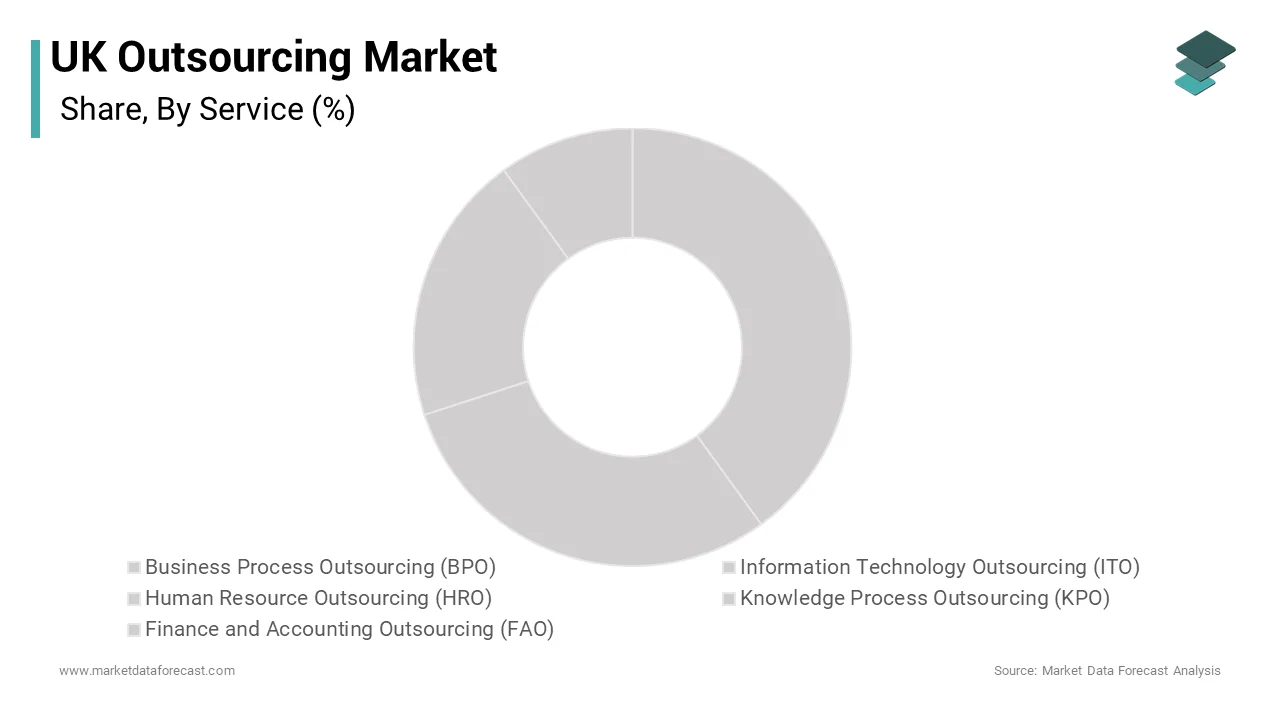
The leadership of the information technology outsourcing segment is further reinforced by the significant cost efficiency and scalability it offers allowing businesses to adjust their technical resources based on project demands. Maintaining an in house team of highly specialized developers and engineers involves substantial fixed costs including salaries benefits and infrastructure investments. According to studies, companies that outsource IT development report a 25 percent reduction in operational costs due to the ability to leverage global talent pools with competitive labor rates. As per research outsourcing enables organizations to scale their technical teams up or down rapidly in response to fluctuating workloads avoiding the risks associated with overstaffing or understaffing. This flexibility is particularly valuable for startups and growing enterprises that experience variable demand for software development and maintenance. Outsourcing providers also absorb the costs of tool licenses and hardware upgrades further reducing the financial burden on clients. The ability to access top tier talent on demand without long term commitments makes IT outsourcing an attractive strategy for optimizing budgets while maintaining high quality technical output.
Business Process Outsourcing
The business process outsourcing segment is on the rise and is expected to be the fastest growing segment in the market by witnessing a CAGR of 9.5% from 2026 to 2034. This swift growth is largely propelled by providers integrating automation and artificial intelligence into traditional administrative functions. Tasks such as customer support payroll processing and data entry are increasingly being handled by intelligent bots and automated workflows which improve accuracy and speed. According to sources, businesses implementing robotic process automation within their outsourced processes report a 40 percent increase in efficiency and a significant reduction in error rates. As per studies, the adoption of AI driven chatbots and virtual assistants in customer service outsourcing has grown by 30 percent annually enhancing user experience while lowering costs. This technological evolution transforms BPO from a labor arbitrage model to a value added service that provides strategic insights and operational excellence. Clients are seeking partners who can offer end to end process optimization rather than just task execution. The ability to handle large volumes of transactions with minimal human intervention drives rapid adoption and growth in this segment.
The rapid expansion of the business process outsourcing segment is further fueled by the strategic imperative for organizations to focus on core competencies while delegating non essential administrative tasks to external experts. By outsourcing routine functions such as human resources finance and accounting companies can redirect internal resources toward innovation product development and customer engagement. Outsourcing providers bring best practices and standardized processes that enhance compliance and reduce operational risks. The availability of specialized knowledge in areas such as tax regulation and employment law ensures that businesses remain compliant without dedicating internal legal teams. This strategic delegation empowers organizations to operate more leanly and effectively driving sustained growth in the BPO sector as companies seek to maximize their strategic potential.
By End-User Industry Insights
Banking Financial Services and Insurance
The banking financial services and insurance segment led the United Kingdom outsourcing market and captured a 31.3% share in 2025. This leading position of the segment was attributed to the stringent regulatory requirements and complex operational needs inherent to the sector. Financial institutions must adhere to strict guidelines such as the General Data Protection Regulation and anti money laundering laws which require specialized compliance expertise and robust security infrastructure. The need for high level data security and fraud detection capabilities drives demand for IT outsourcing partners with advanced cybersecurity certifications. Outsourcing allows these institutions to manage vast amounts of transactional data efficiently while maintaining strict confidentiality. The scale of operations in the BFSI sector necessitates reliable and scalable support services making it the largest consumer of outsourcing solutions in the UK.
The dominance of the BFSI segment is further reinforced by the intense focus on digital transformation and enhancing customer experience through innovative technology solutions. Banks and insurance companies are investing heavily in mobile applications online portals and personalized financial advisory services which require sophisticated software development and maintenance. According to survey 75 percent of financial institutions prioritize digital channels to engage customers driving demand for IT outsourcing partners with expertise in user experience design and app development. As per research outsourcing enables faster deployment of new digital features allowing banks to stay competitive in a rapidly evolving market. Customer support outsourcing has also evolved with the integration of AI driven chatbots and omnichannel support systems that provide seamless assistance. The ability to offer 24/7 support and quick resolution of queries enhances customer satisfaction and loyalty. This continuous push for innovation and superior service delivery ensures that the BFSI sector remains the primary driver of outsourcing demand in the United Kingdom.
Healthcare and Life Sciences
The healthcare and life sciences segment is expected to exhibit a noteworthy CAGR of 11.2% during the forecast period. This surge occurs as providers look to reduce administrative workloads and implement new digital health technologies. Hospitals and clinics are overwhelmed with paperwork billing coding and patient scheduling tasks which divert attention from clinical care. As per sources, the adoption of electronic health records and telemedicine platforms requires specialized IT support and data management which outsourcing partners provide efficiently. The need for accurate and timely billing ensures steady cash flow and reduces claim denials. Outsourcing allows healthcare providers to focus on patient outcomes while experts handle complex administrative processes. The growing emphasis on data analytics for population health management also drives demand for specialized outsourcing services. This combination of operational necessity and technological adoption fuels rapid growth in the healthcare outsourcing sector.
The swift expansion of the healthcare segment is further fueled by the critical need for regulatory compliance and strict adherence to patient data privacy standards. Healthcare organizations must comply with rigorous regulations regarding the handling of sensitive medical information requiring robust security measures and audit trails. According to Information Commissioner Office guidelines healthcare providers face severe penalties for data breaches making secure outsourcing partnerships essential. Outsourcing providers specialize in managing protected health information with certified security protocols reducing the liability for healthcare organizations. The complexity of international clinical trials and drug development also drives outsourcing of regulatory affairs and data management to specialized firms. These services ensure that life sciences companies can navigate global regulatory landscapes efficiently. The increasing focus on data integrity and patient safety ensures that healthcare outsourcing continues to grow at a rapid pace.
By Organisation Size Insights
Large Enterprises
The large enterprises segment dominated the United Kingdom outsourcing market and accounted for a substantial share in 2025. These organizations possess complex operational structures and significant budgets that benefit from economies of scale. Large corporations often have multiple business units and global operations requiring standardized and efficient support services across various functions. As per research large organizations outsource to achieve consistency in service delivery and to leverage the specialized expertise of global providers. The scale of their operations allows them to bundle multiple services such as IT HR and finance into comprehensive managed service agreements. This approach simplifies vendor management and reduces administrative overhead. Large enterprises also have the resources to invest in long term strategic partnerships that drive innovation and continuous improvement. Their dominant market position ensures that they remain the primary clients for major outsourcing providers.
The leadership of the large enterprises segment is further reinforced by their strategic focus on core competencies and innovation which drives the decision to outsource non critical functions. By delegating routine and administrative tasks to external partners large companies can redirect internal resources toward research and development market expansion and customer engagement. As per survey large firms use outsourcing to access niche skills and technologies that are not available internally accelerating innovation cycles. The ability to scale operations quickly in response to market opportunities is another key benefit. Outsourcing provides the flexibility to expand or contract services without the constraints of internal hiring and firing. This strategic agility allows large enterprises to maintain competitiveness in dynamic markets. The continuous pursuit of efficiency and innovation ensures that large enterprises remain the dominant force in the outsourcing market.
Small and Medium Enterprises
The small and medium enterprises segment is predicted to witness the highest CAGR of 10.8% between 2026 and 2034 due to smaller businesses seeking to access specialized expertise without the high costs of internal hiring. SMEs often lack the resources to employ full time specialists in areas such as IT marketing and finance making outsourcing an attractive alternative. As per studies outsourcing accounting and payroll services is the most common practice allowing business owners to focus on growth and customer service. The availability of flexible and scalable outsourcing solutions tailored to SME needs has lowered barriers to entry. Cloud based tools and remote work trends have made it easier for SMEs to collaborate with external providers. This democratization of access to professional services drives rapid adoption and growth in the SME outsourcing segment.
The rapid expansion of the SME segment is further fueled by the agility and competitive advantage that outsourcing provides to smaller businesses. By leveraging external partners SMEs can compete with larger rivals by offering high quality services and rapid response times. The ability to scale services up during peak periods and down during slow times helps SMEs manage cash flow effectively. Outsourcing also provides access to latest technologies and best practices that would otherwise be unaffordable. This level playing field enables SMEs to innovate and grow more rapidly. The strategic use of outsourcing as a tool for competitiveness ensures sustained high growth in this segment.
By Contract Insights
Managed Services
The managed services segment was the largest in the United Kingdom outsourcing market and occupied a 45.7% share in 2025. It offers clients predictable monthly costs and comprehensive end-to-end support for specific business functions. Unlike staff augmentation where clients manage individual contractors managed services involve the provider taking full responsibility for delivering defined outcomes and service levels. As per research managed services provide greater stability and risk mitigation as providers are incentivized to maintain high performance standards. The fixed fee structure allows clients to budget accurately and avoid unexpected expenses related to staffing fluctuations. Providers bring standardized processes and best practices ensuring consistent quality and efficiency. This model reduces the management burden on clients allowing them to focus on strategic objectives. The reliability and comprehensiveness of managed services make them the preferred choice for critical business functions.
The top position of this segment is further reinforced by the proactive maintenance and continuous improvement initiatives that providers implement to optimize client operations. Managed service providers continuously monitor systems and processes to identify and resolve issues before they impact business operations. According to IBM United Kingdom data proactive monitoring reduces downtime by 30 percent and improves overall system reliability. The commitment to continuous improvement ensures that services remain relevant and efficient over time. Providers also offer regular performance reviews and strategic recommendations helping clients align outsourcing activities with business goals. The partnership approach fosters long term relationships and mutual success. This value-added service model distinguishes managed services from transactional outsourcing arrangements sustaining its market dominance.
Staff Augmentation
The staff augmentation segment is estimated to register the fastest CAGR of 8.5% over the forecast period owing to organizations seeking flexible staffing solutions for short term projects and skill gaps. Companies often face temporary spikes in workload or need specific expertise for limited durations making permanent hiring impractical. According to Robert Half technology survey 50 percent of UK firms use staff augmentation to fill immediate skill shortages in software development and data analytics. As per research the flexibility to scale teams up or down quickly allows businesses to respond agilely to market demands without long term employment commitments. Staff augmentation provides immediate access to pre vetted professionals who can integrate seamlessly into existing teams. This model reduces recruitment time and costs enabling faster project initiation. The rise of remote work has facilitated easier integration of augmented staff into distributed teams. This adaptability drives rapid growth in the staff augmentation segment.
The quick surge of the staff augmentation segment is further fueled by the access it provides to niche skills and the reduction of recruitment burdens for employers. Finding specialized talent in fields such as cybersecurity blockchain and artificial intelligence is challenging and time consuming. According to Tech Nation reports the average time to hire for specialized tech roles exceeds 60 days prompting companies to turn to staffing agencies for quicker solutions. As per sources, staff augmentation allows companies to bypass lengthy recruitment processes and onboard experts immediately. This speed is crucial for meeting tight project deadlines and maintaining competitive advantage. Staffing providers handle all administrative aspects including payroll and benefits reducing the administrative load on clients. The ability to test candidates on real projects before considering permanent hires also reduces hiring risks. This efficient access to talent ensures sustained growth in the staff augmentation market.
COUNTRY ANALYSIS
The United Kingdom remained a major player in the European outsourcing market and accounted for a 27.6% share in 2025. This growth of the UK market was driven by a strong legal framework highly skilled workforce and a culture of strategic partnership. The market is pivoting from cost-focused outsourcing toward value-driven partnerships centered on digital transformation and innovation. According to Department for Business and Trade data the professional services sector contributes significantly to the UK economy with outsourcing playing a key role in enhancing productivity and competitiveness. London serves as a global hub for financial and IT outsourcing attracting multinational corporations seeking high quality services. As per Office for National Statistics the service sector employs over 80 percent of the workforce providing a deep pool of talent for various outsourcing functions. The regulatory environment including GDPR compliance ensures high standards of data protection and privacy building trust with global clients. The UK is a leader in nearshoring trends leveraging its proximity to European talent pools. Strong intellectual property laws and contract enforcement mechanisms further enhance the attractiveness of the UK as an outsourcing destination. The market continues to evolve with increasing adoption of AI and automation driving new opportunities for growth and innovation.
COMPETITIVE LANDSCAPE
The competition within the United Kingdom outsourcing market is intense and characterized by the presence of global technology giants specialized boutique firms and domestic service providers vying for enterprise contracts. Established multinational corporations leverage their extensive resources global delivery networks and brand recognition to secure large scale deals with major industries. These leaders continuously innovate by embedding advanced technologies such as machine learning and robotic process automation into their service offerings to differentiate themselves. Meanwhile agile local firms compete effectively by offering personalized customer service deep domain expertise and flexible engagement models that appeal to mid sized enterprises. The market sees frequent strategic collaborations between technology vendors and service providers to create integrated solutions that simplify procurement for clients. Price competition remains significant but differentiation increasingly depends on innovation speed security compliance and proven return on investment. Talent acquisition is a key battleground with firms competing for skilled professionals in data science and cybersecurity. Customer retention strategies focus on long term partnerships outcome based pricing and continuous improvement to ensure sustained value delivery in a rapidly changing technological environment.
KEY MARKET PLAYERS
A few of the market players that are dominating the UK outsourcing market are
- Accenture plc
- Tata Consultancy Services Limited
- Cognizant Technology Solutions Corporation
- Capgemini SE
- HCL Technologies Limited
- Teleperformance SE
- IBM Corporation
- Infosys Limited (incl. Infosys BPM)
- Genpact Limited
- Wipro Limited
- Tech Mahindra Limited
- Capita plc
- Fujitsu Limited
- NTT DATA Corporation
- Concentrix Corporation
- Alorica Inc.
- EXL Service Holdings Inc.
- Sitel Group (Majorel Group Luxembourg SA)
- Amdocs Limited
- Automatic Data Processing Inc. (ADP)
- Thomson Reuters Corporation
- CGI Inc.
- DXC Technology Company
- Sutherland Global Holdings Inc.
- TaskUs Inc.
Top Players In The Market
- Capgemini UK maintains a significant presence in the United Kingdom outsourcing sector by providing comprehensive technology consulting and digital transformation services to major enterprises across various industries. The company focuses on leveraging cloud computing artificial intelligence and data analytics to help clients optimize their operations and drive innovation. Recent strategic initiatives include expanding its sustainable technology offerings and investing in local talent development programs to address the skills gap. Capgemini has also strengthened its partnerships with leading software vendors to deliver integrated solutions that enhance business agility. The firm prioritizes responsible business practices and client-centric innovation. By doing so, it reinforces its reputation as a trusted partner for complex outsourcing needs in the UK market.
- Accenture UK plays a pivotal role in the United Kingdom outsourcing market by delivering end to end services that span strategy consulting technology implementation and managed operations. The organization is deeply involved in helping businesses navigate digital disruption through advanced automation and intelligent process optimization. Recent actions involve significant investments in cybersecurity capabilities and the establishment of innovation hubs focused on emerging technologies such as blockchain and quantum computing. Accenture has also expanded its workforce training initiatives to ensure employees are equipped with future ready skills. The company drives operational excellence and sustainable growth for UK clients. It achieves this by combining deep industry expertise with cutting-edge technology.
- Tata Consultancy Services UK contributes significantly to the United Kingdom outsourcing landscape by offering robust IT services business process outsourcing and consulting solutions tailored to diverse sector needs. The company leverages its global delivery model to provide scalable and cost effective services while maintaining high quality standards. Recent developments include the expansion of its cognitive business operations services which integrate artificial intelligence into traditional outsourcing tasks. TCS has also enhanced its focus on sustainability by helping clients achieve their environmental goals through green IT solutions. The company fosters strong client relationships and continuously innovates its service portfolio. Through these efforts, it solidifies its standing as a key enabler of digital transformation and operational efficiency in the UK.
Top Strategies Used By Key Market Participants
Key players in the United Kingdom outsourcing market predominantly employ digital transformation and strategic partnership models to maintain competitive advantage and deliver enhanced value. Companies invest heavily in artificial intelligence automation and cloud technologies to streamline processes reduce costs and improve service accuracy for clients. Developing specialized industry solutions allows vendors to address unique regulatory and operational challenges faced by sectors such as finance healthcare and retail thereby increasing relevance. Strategic acquisitions of niche technology firms enable providers to expand their capabilities and offer more comprehensive service portfolios. Emphasizing sustainability and ethical practices helps firms align with corporate social responsibility goals of clients and attract environmentally conscious talent. Continuous upskilling of workforce ensures that employees remain proficient in latest technologies and methodologies. These combined strategies enable participants to adapt to evolving market demands and sustain long term growth.
MARKET SEGMENTATION
This research report on the UK outsourcing market is segmented and sub-segmented into the following categories.
By Service Type
- Business Process Outsourcing (BPO)
- Information Technology Outsourcing (ITO)
- Human Resource Outsourcing (HRO)
- Knowledge Process Outsourcing (KPO)
- Finance and Accounting Outsourcing (FAO)
By End-User Industry
- Banking, Financial Services and Insurance (BFSI)
- Healthcare
- IT and Telecom
- 4 Retail and E-commerce
- Other End-User Industries
By Organisation Size
- Large Enterprises
- Small and Medium Enterprises (SME)
By Contract Type
- Staff Augmentation
- Managed Services
- Project-Based Outsourcing
Frequently Asked Questions
What is driving the expansion of the UK outsourcing market?
Businesses are increasingly seeking cost optimization, operational efficiency, and access to specialized expertise, which is driving market expansion.
What does the UK outsourcing market encompass?
The market encompasses IT outsourcing, business process outsourcing (BPO), customer support services, finance and accounting outsourcing, HR outsourcing, and procurement services.
Which outsourcing service segment holds the largest market share in the UK?
IT outsourcing holds the largest market share due to growing demand for cloud services, cybersecurity, software development, and digital transformation projects.
Why are organizations turning to outsourcing providers in the UK?
Organizations leverage outsourcing to reduce operational costs, improve service quality, accelerate innovation, and focus on core business activities.
Who are the major end users of outsourcing services in the UK?
Financial institutions, healthcare organizations, government agencies, retailers, telecom companies, and manufacturing enterprises are major end users.
How does outsourcing support business competitiveness?
Outsourcing enables companies to access skilled talent, streamline operations, improve scalability, and enhance productivity.
What market trends are influencing the UK outsourcing industry?
Cloud-based outsourcing, automation, AI-driven service delivery, hybrid workforce models, and outcome-based contracts are influencing industry growth.
What challenges are impacting the UK outsourcing market?
Data security concerns, regulatory compliance requirements, talent shortages, and geopolitical uncertainties can impact market growth.
How are outsourcing providers adapting to changing client expectations?
Providers are investing in digital technologies, advanced analytics, cybersecurity solutions, and industry-specific expertise to deliver greater value.
What opportunities are expected to shape the future of the UK outsourcing market?
Increasing digital transformation initiatives, demand for managed services, growth in AI adoption, and expanding business process automation are expected to create substantial growth opportunities.
Access the study in MULTIPLE FORMATS
Purchase options starting from
$ 1200
Didn’t find what you’re looking for?
TALK TO OUR ANALYST TEAM
Need something within your budget?
NO WORRIES! WE GOT YOU COVERED!
Call us on: +1 888 702 9696 (U.S Toll Free)
Write to us: sales@marketdataforecast.com