- Product Description Description
- Table of Contents TOC
- List of Table & Figure LOT
- Get Free Sample PDF Sample PDF
Market Size, 2025
$29.19 BnMarket Estimate, 2026
$33.42 BnMarket Forecast, 2034
$98.80 BnCAGR, 2026–2034
14.51%UK Personal Loans Market Report Summary
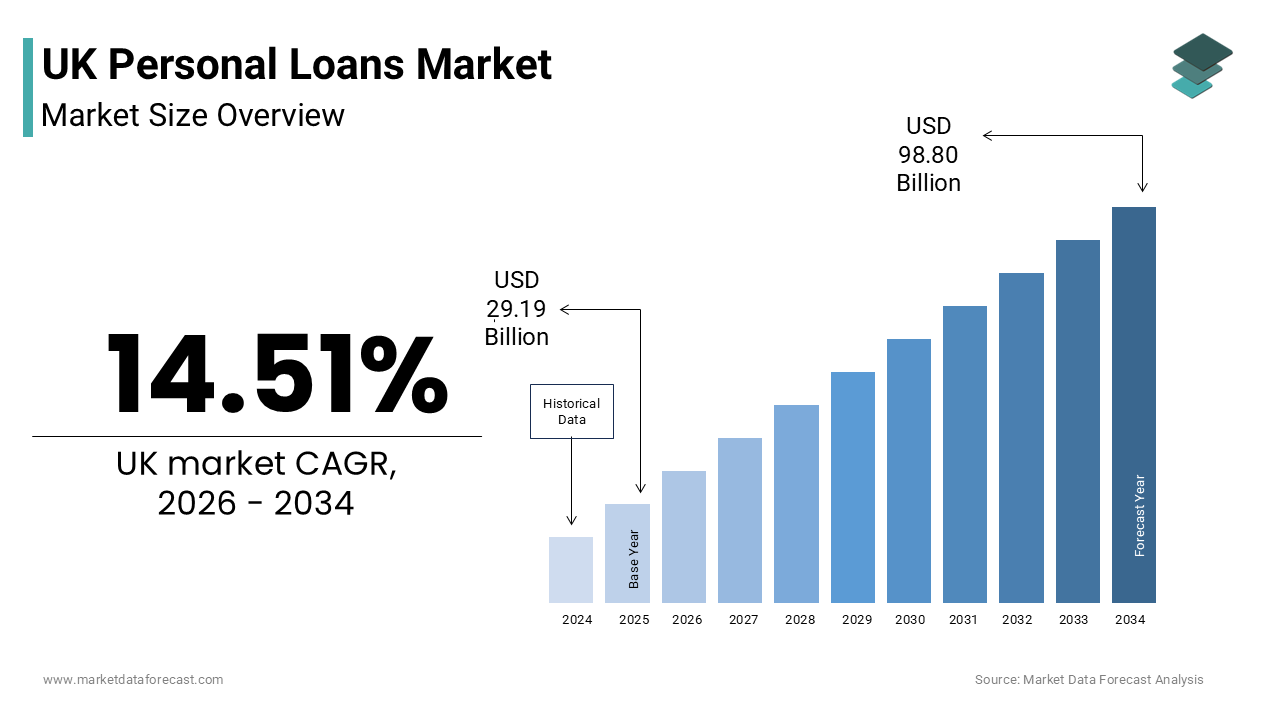
The United Kingdom personal loans market was valued at USD 29.19 billion in 2025 and is anticipated to reach USD 33.42 billion in 2026 from USD 98.80 billion by 2034, growing at a CAGR of 14.51% during the forecast period from 2026 to 2034. The growth of the United Kingdom personal loans market is driven by rising living costs, increasing demand for debt consolidation solutions, and growing consumer reliance on unsecured credit products. Expanding adoption of digital lending platforms, increasing fintech innovation, and growing accessibility through online loan application processes are further accelerating market growth. Moreover, advancements in open banking technologies, expansion of alternative credit assessment models, and increasing demand for green financing solutions are supporting the expansion of the United Kingdom personal loans market.
Key Market Trends
-
Rising demand for debt consolidation loans as consumers seek structured repayment solutions.
-
Increasing adoption of digital lending platforms powered by artificial intelligence and automated underwriting.
-
Growing integration of open banking technologies for personalized lending and improved credit assessment.
-
Strong focus on responsible lending practices and regulatory compliance.
-
Expansion of green loan products supporting sustainable home improvements and environmentally friendly investments.
Segmental Insights
- Based on lender type, the traditional banks segment dominated the United Kingdom personal loans market and held the largest share in 2025. The segment’s dominance is attributed to strong consumer trust, extensive branch networks, competitive interest rates, established customer relationships, and comprehensive financial service offerings.
- The online lenders segment is projected to witness the fastest CAGR during the forecast period owing to rapid digital transformation, increasing fintech innovation, faster loan approval processes, expanding financial inclusion initiatives, and growing consumer preference for convenient digital lending experiences.
- Based on loan purpose, the debt consolidation segment accounted for the leading share of the United Kingdom personal loans market in 2025. The dominance of this segment is driven by increasing household debt levels, growing consumer focus on financial stability, simplified repayment structures, and the ability to replace multiple high-interest debts with a single fixed-rate loan.
- The home improvement segment is anticipated to register the fastest CAGR during the forecast period due to increasing investments in property renovations, rising demand for energy-efficient home upgrades, growing adoption of sustainable housing improvements, and supportive government initiatives promoting environmental sustainability.
Regional Insights
The United Kingdom accounted for a significant share of the European personal loans market in 2025 and held approximately 38.3% of the regional market. The country benefits from advanced financial infrastructure, high digital banking penetration, strong regulatory oversight, and widespread consumer acceptance of unsecured lending products. The presence of established banking institutions, rapidly growing fintech companies, and continuous innovation in digital lending technologies continues to strengthen the market across the United Kingdom.
Competitive Landscape
The United Kingdom personal loans market is highly competitive and characterized by the presence of traditional banking institutions, challenger banks, fintech lenders, and digital lending platforms competing through pricing strategies, digital innovation, customer experience, and responsible lending practices. Leading companies are focusing on expanding artificial intelligence-driven underwriting capabilities, integrating open banking technologies, enhancing digital customer journeys, and developing specialized lending products. Strategic partnerships, personalized financial solutions, and investments in sustainable finance initiatives are further strengthening market positioning across the personal lending ecosystem. Prominent players in the United Kingdom personal loans market include HSBC Holdings plc, Lloyds Banking Group plc, Barclays plc, NatWest Group plc, Santander UK plc, Nationwide Building Society, Virgin Money UK plc, Tesco Bank, The Co-operative Bank plc, Metro Bank plc, Shawbrook Bank Ltd., Paragon Banking Group plc, Vanquis Banking Group plc, Zopa Bank Limited, Funding Circle Holdings plc, Starling Bank Limited, Monzo Bank Ltd., Chetwood Financial Limited, Sainsbury's Bank plc, and Royal Bank of Scotland plc.
UK Personal Loans Market Size
The UK personal loans market size was valued at USD 29.19 billion in 2025 and is anticipated to reach USD 33.42 billion in 2026 from USD 98.80 billion by 2034, growing at a CAGR of 14.51% during the forecast period from 2026 to 2034.
A personal loan is a type of unsecured credit where a financial institution lends you a fixed lump sum, which you pay back in monthly instalments over a set period with interest. This market operates within a stringent regulatory framework overseen by the Financial Conduct Authority ensuring responsible lending practices and consumer protection. Personal loans provide individuals with fixed interest rates and structured repayment schedules offering predictability compared to revolving credit facilities. The market serves a broad demographic including young professionals seeking capital for career development and established households managing large expenditures. According to the Office for National Statistics (ONS), the UK household debt-to-disposable income ratio fell to 117.5% in Q4 2025, continuing a downward trend from early 2022 levels. Bank of England data shows that outstanding consumer credit (excluding student loans) had already surpassed the claimed figure, reaching £239.1 billion by June 2025 and continuing to grow at an annual rate of over 8% throughout the year. The digital transformation of financial services has streamlined application processes enabling rapid approval and disbursement of funds. Lenders utilize advanced algorithms for credit assessment allowing for more nuanced risk evaluation beyond traditional scoring models. Consumer confidence levels significantly influence borrowing behavior with economic stability encouraging larger loan acquisitions. The market features a mix of traditional banks building societies and agile fintech competitors driving innovation in product offerings. Transparency in pricing and terms remains a key focus area as regulators mandate clear disclosure of annual percentage rates. This ecosystem supports economic activity by enabling consumption and investment while requiring careful management of default risks.
MARKET DRIVERS
Rising Cost Of Living And Need For Debt Consolidation Solutions
Households across the country are facing mounting living costs, which leads to increased demand for these loans, and thereby drives the growth of the United Kingdom personal loans market. Borrowers are using these funds to manage financial pressure and consolidate high-interest debts. Inflationary pressures have eroded purchasing power prompting consumers to utilize unsecured credit for essential expenditures and bill payments. According to the Office for National Statistics (ONS), the consumer prices index including owner occupiers' housing costs (CPIH) rose to 3.6% by December 2025, keeping cost-of-living challenges sustained for families, though it hovered closer to 2.8% to 3.5% in early 2025. Personal loans offer a structured approach to debt management by allowing borrowers to combine multiple high interest credit card balances into a single payment with a lower fixed rate. The Money and Pensions Service emphasize extensive reliance on consumer credit across the UK, highlighting debt consolidation as a critical mechanism for families looking to lower high interest rates. Fixed repayment terms provide psychological comfort and budgeting clarity helping individuals regain control over their finances. Lenders have responded by marketing consolidation loans prominently emphasizing potential savings and simplified monthly obligations. The ability to access lump sums enables borrowers to address immediate financial gaps without resorting to overdrafts which often carry higher variable charges. Economic uncertainty encourages prudent financial planning where predictable loan repayments are preferred over fluctuating credit limits. This trend sustains loan volumes even during periods of restrained discretionary spending as consumers prioritize financial stability and debt reduction. The structural nature of personal loans aligns with long term financial health goals fostering steady market demand.
Digital Transformation And Enhanced Accessibility Through Fintech Innovation
The rapid adoption of digital technologies by fintech companies and traditional banks also accelerates the expansion of the United Kingdom personal loans market. This simplifies access and improves the user experience. Online platforms enable seamless application processes with instant decisioning capabilities reducing waiting times from days to minutes. A study shows that digital and fintech applications handled over 60% of volume requests for entry-level personal loans, reflecting a major transition to online lending ecosystems. Advanced data analytics and artificial intelligence allow lenders to assess creditworthiness more accurately using alternative data sources such as banking transaction history and utility payments. This technological advancement expands access to credit for individuals with thin credit files who might be rejected by traditional scoring models. The Competition and Markets Authority notes that increased transparency in online comparison tools empowers consumers to find competitive rates easily. Mobile banking integration facilitates direct disbursement of funds and automated repayments enhancing convenience for tech savvy users. Fintech lenders often operate with lower overhead costs enabling them to offer competitive interest rates and flexible terms. The ease of comparing multiple offers online fosters competition driving down costs for borrowers. Digital verification methods reduce fraud risks while speeding up identity checks. This accessibility democratizes credit access allowing broader segments of the population to secure financing for various needs. The continuous improvement of digital interfaces ensures high customer satisfaction and retention in a competitive marketplace.
MARKET RESTRAINTS
Stringent Regulatory Compliance And Responsible Lending Requirements
Strict regulatory oversight by the Financial Conduct Authority imposes rigorous standards on lenders in the United Kingdom personal loans market. This is a restraint on aggressive expansion and volume growth. Lenders must conduct thorough affordability assessments to ensure borrowers can sustain repayments without experiencing financial hardship. Regulatory enforcement reports show that the Financial Conduct Authority issued individual penalties exceeding £10 million to specific banking firms for failing to appropriately assess repayment affordability and protect vulnerable borrowers. These compliance requirements increase operational costs and lengthen processing times as institutions invest in robust verification systems and staff training. The responsibility to identify vulnerable customers adds complexity to the lending process requiring sensitive handling and potential referral to support services. Limits on high cost short term credit principles extend to personal loans restricting fees and interest charges that can be applied. The Consumer Duty regulation mandates that firms deliver good outcomes for retail customers forcing continuous review of product design and communication clarity. Non compliance risks severe reputational damage and legal penalties discouraging risky lending practices. While these measures protect consumers they also reduce the pool of eligible borrowers as lenders adopt conservative underwriting criteria. Smaller lenders may struggle with the resource intensity of compliance potentially leading to market consolidation. The balance between consumer protection and credit availability remains a delicate operational challenge for all market participants.
Economic Uncertainty and Rising Interest Rate Environment
The prevailing economic uncertainty and elevated interest rate environment constrain demand for these loans in the country, which in turn impedes the expansion of the United Kingdom personal loans market. This increases borrowing costs and dampens consumer confidence. The Bank of England maintained base rates at 4.5 percent in early 2025 to combat persistent inflation directly influencing the cost of unsecured credit. Higher interest rates translate to increased monthly repayments for new loans making them less affordable for average households. Financial forecasts from the Office for Budget Responsibility project that real household disposable income will grow by an average of just 0.5% annually over the medium term, tightening financial breathing room for consumer debt repayment. Consumers become cautious about taking on new financial commitments when future income stability is uncertain due to potential job market fluctuations. Lenders respond by tightening credit criteria and raising interest rates to mitigate default risks further reducing accessibility. The Psychological impact of economic volatility leads to precautionary saving rather than borrowing for non essential purposes. Major purchases such as home renovations or vehicles are often deferred until economic conditions improve. The cost of living crisis prioritizes essential spending leaving little room for discretionary loan funded expenditures. Default rates tend to rise during economic downturns prompting lenders to restrict supply to higher risk segments. This contraction in both demand and supply creates a challenging environment for market growth. Borrowers increasingly seek fixed rate products to hedge against further rate hikes but face higher initial costs.
MARKET OPPORTUNITIES
Integration Of Open Banking And Alternative Data Assessment
The integration of open banking technologies offers a substantial opportunity for lenders in the United Kingdom personal loans market. This allows them to enhance risk assessment and expand customer reach. By accessing real time financial data with consumer consent lenders can gain a holistic view of an applicant’s financial health beyond traditional credit scores. According to data from Open Banking Limited, open banking adoption in the United Kingdom surpassed 7 million active users, offering lenders deeper consumer data insights to refine personalized credit and underwriting models. This technology enables more accurate affordability checks reducing default risks and allowing for competitive pricing for low risk borrowers. Lenders can identify stable income patterns and responsible spending behaviors that traditional models might overlook. This approach supports financial inclusion by offering credit to individuals with limited credit history but strong cash flow management. Automated analysis reduces manual processing costs enabling faster approvals and improved customer experience. Personalized loan offers based on actual financial behavior increase conversion rates and customer satisfaction. The regulatory framework supporting open banking ensures data security and consumer control fostering trust in digital lending platforms. Lenders leveraging this technology can differentiate themselves through superior service and tailored products. The ability to monitor ongoing financial health allows for proactive support and flexible repayment options. This data driven approach optimizes portfolio performance and unlocks new market segments previously deemed too risky.
Expansion Into Green Financing And Sustainable Loan Products
The growing consumer emphasis on sustainability creates a significant prospect for lenders in the United Kingdom personal loans market. This helps to develop specialized green personal loan products. These loans incentivize environmentally friendly expenditures such as home energy efficiency upgrades electric vehicle purchases and solar panel installations. The UK Government originally established a target via the Department for Energy Security and Net Zero to reach 600,000 heat pump installations annually by 2028, an initiative heavily driving the market for targeted consumer green finance solutions. Lenders can offer preferential interest rates for green projects aligning with national climate goals and consumer values. Marketing these products appeals to environmentally conscious demographics willing to invest in sustainable lifestyles. Partnerships with green technology providers can streamline the application process and verify eligible expenditures. Government grants and subsidies often complement green loans enhancing affordability for borrowers. Financial institutions benefit from positive brand association and compliance with environmental social and governance criteria. The green finance strategy outlined by HM Treasury encourages private sector participation in achieving net zero targets. Differentiating through sustainability attracts loyal customers and enhances corporate reputation. As awareness of climate change impacts grows demand for eco friendly financing solutions will likely increase. Lenders who pioneer this segment can capture early mover advantages and establish leadership in sustainable finance. This niche offers higher margins and lower default risks due to the asset backed nature of many green improvements.
MARKET CHALLENGES
Increasing Default Rates And Credit Risk Management
Rising default rates are a critical barrier for lenders in the United Kingdom personal loans market. This necessitates enhanced credit risk management strategies. Economic pressures and high interest rates strain household budgets leading to missed payments and insolvencies. Lenders must balance profitability with prudent risk assessment to avoid excessive exposure to high risk segments. Collection processes become more complex and costly as delinquency rates rise impacting operational efficiency. Regulatory requirements mandate fair treatment of customers in financial difficulty requiring empathetic and supportive approaches. Writing off bad debts directly affects bottom line performance and capital reserves. Predictive modeling helps identify early warning signs but cannot entirely eliminate risk in volatile economic conditions. The need for robust provisioning reduces funds available for new lending initiatives. Reputational damage from aggressive collection practices can deter potential customers and attract regulatory scrutiny. Lenders must invest in advanced analytics and customer support systems to manage defaults effectively. The challenge lies in maintaining access to credit for deserving borrowers while protecting the institution from unsustainable losses. Economic recovery timelines remain uncertain prolonging the period of heightened credit risk.
Intense Competition From Buy Now Pay Later Services
The proliferation of buy now pay later services is a formidable challenge to the traditional segment within the United Kingdom personal loans market. This captures share of wallet for smaller purchases. These services offer interest free short term financing with minimal eligibility checks appealing to younger consumers and impulse buyers. Studies highlight that the UK’s alternative lending sector saw Buy Now, Pay Later (BNPL) transactions surpass £10 billion, creating a highly competitive substitute for traditional short-term personal loans and prompting major regulatory attention from the Financial Conduct Authority. The seamless integration of buy now pay later options at checkout points reduces friction compared to separate loan applications. Consumers perceive these services as more manageable and less committing than formal loan agreements. This shift fragments borrowing behavior reducing the average loan size and frequency for traditional lenders. Traditional banks struggle to match the speed and convenience of digital first buy now pay later providers. The lack of interest charges makes buy now pay later appear cheaper although late fees can accumulate. Regulatory scrutiny is increasing but the sector remains more flexible than regulated lending. Lenders must innovate to remain relevant for mid tier financing needs that fall between credit cards and large loans. The erosion of the lower end of the personal loan market forces institutions to focus on larger consolidated debts. Adapting product structures to compete with the agility of fintech rivals requires significant investment and strategic realignment.
REPORT COVERAGE
| REPORT METRIC | DETAILS |
| Market Size Available | 2025 to 2034 |
| Base Year | 2025 |
| Forecast Period | 2026 to 2034 |
| CAGR | 14.51% |
| Segments Covered | By Lender Type, Loan Purpose and Region. |
| Various Analyses Covered | Global, Regional & Country Level Analysis, Segment-Level Analysis, DROC, PESTLE Analysis, Porter’s Five Forces Analysis, Competitive Landscape, Analyst Overview of Investment Opportunities |
| Market Leaders Profiled | HSBC Holdings plc, Lloyds Banking Group plc, Barclays plc, NatWest Group plc, Santander UK plc, Nationwide Building Society, Virgin Money UK plc, Tesco Bank, The Co-operative Bank plc, Metro Bank plc, Shawbrook Bank Ltd., Paragon Banking Group plc, Vanquis Banking Group plc, Zopa Bank Limited, Funding Circle Holdings plc, Starling Bank Limited, Monzo Bank Ltd., Chetwood Financial Limited, Sainsbury's Bank plc, and Royal Bank of Scotland plc. |
SEGMENTAL ANALYSIS
By Lender Type Insights
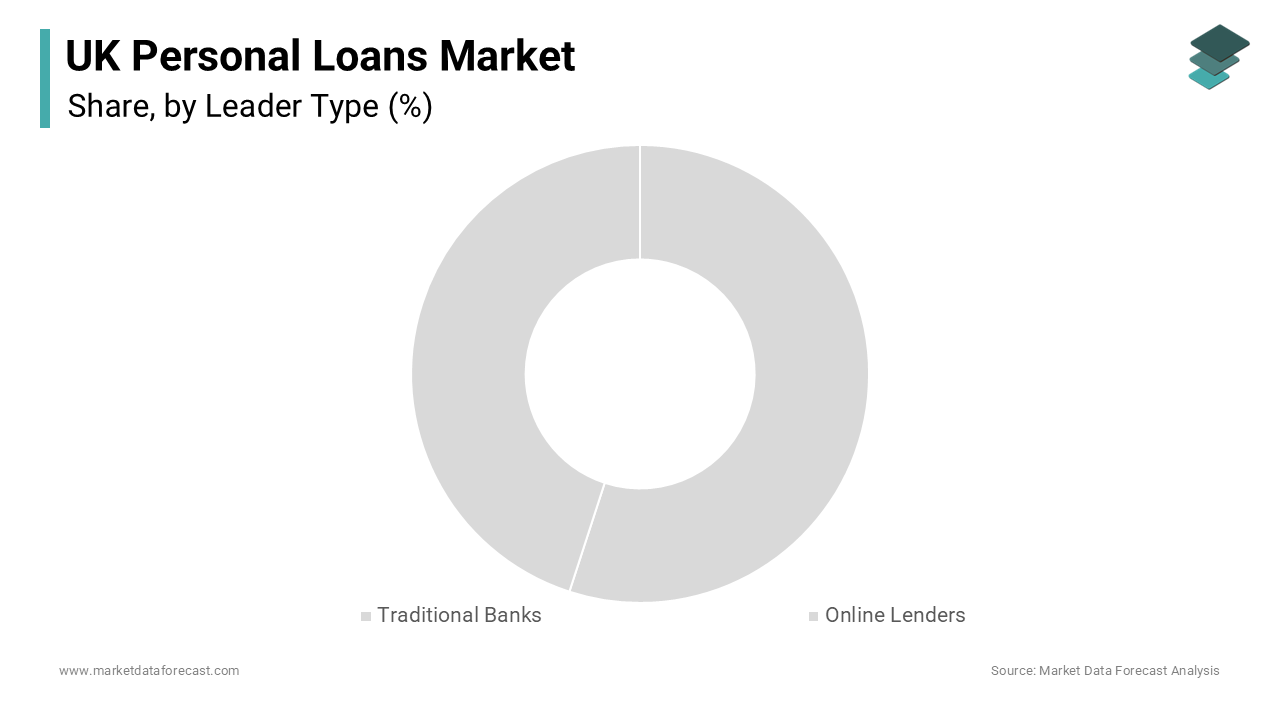
The traditional banks segment maintained dominance in the United Kingdom personal loans market and accounted for a 50.2% share in 2025. This dominance of the segment was driven by deep seated consumer trust and extensive branch networks. Customers prefer established institutions for significant financial commitments because of perceived stability and regulatory oversight. Also, the Bank of England demonstrates that traditional high-street banks maintain a strong majority hold over the UK's unsecured consumer credit market, anchoring the bulk of the nation’s credit cards and personal bank loans. The integration of personal loans with existing current accounts and savings products creates a seamless banking experience that encourages customer loyalty. Branch availability allows for face to face consultations which remain important for complex financial decisions particularly among older demographics. Consumer surveys published by financial inclusion bodies reveal that while brand trust remains an essential secondary variable, the Annual Percentage Rate (APR) and overall cost of borrowing remain the primary deciding factors for UK applicants seeking personal loans. Banks leverage their vast customer data to offer pre approved loan offers reducing friction in the application process. This ecosystem approach enables cross selling opportunities where loan customers are more likely to adopt other financial products. Regulatory compliance infrastructure is already in place for banks allowing them to adapt quickly to new rules without significant additional costs. The perception of safety during economic uncertainty drives borrowers toward large capitalized institutions rather than newer entrants. Long standing relationships facilitate better negotiation of terms for existing customers enhancing retention rates. The comprehensive nature of bank services ensures that personal loans are viewed as part of a broader financial strategy rather than an isolated transaction.
Traditional banks benefit from a lower cost of funds compared to non bank lenders enabling them to offer more competitive interest rates on personal loans. Access to cheap retail deposits provides banks with a stable and inexpensive source of capital for lending activities. Following macroeconomic interest rate tightening cycles, typical market interest rates for tier-one bank personal loans trended noticeably higher than historic baselines, though they still remained lower than the rates associated with subprime alternative lending providers. This pricing advantage attracts price sensitive borrowers who compare total repayment costs across different providers. Banks can absorb thinner margins due to economies of scale and diversified revenue streams from other banking services. The ability to offer relationship discounts further enhances affordability for customers who maintain multiple accounts with the same institution. Lower funding costs allow banks to withstand economic volatility better than specialized lenders who rely on wholesale funding markets. This financial resilience ensures consistent lending capacity even during credit crunches when liquidity tightens. Borrowers perceive bank loans as more transparent with fewer hidden fees compared to some online competitors. The stability of bank funding models supports long term loan offerings with fixed rates that appeal to risk averse consumers. This structural advantage sustains the dominance of traditional banks in the personal loans sector despite digital disruption.
The online lenders segment is estimated to register the fastest CAGR of 14.2% over the forecast period. These lenders leverage advanced technology to provide superior user experiences characterized by speed convenience and accessibility. Digital platforms enable fully automated application processes with decisions delivered in minutes rather than days. Various sources confirm that smartphone and mobile device interfaces process a significant majority of all non-bank online loan applications, emphasizing a systemic consumer migration toward mobile-first lending channels. The absence of physical branches reduces operational costs allowing online lenders to invest heavily in user interface design and customer support tools. Artificial intelligence algorithms analyze vast amounts of data to provide instant credit decisions expanding access to underserved segments. Driven by competition framework models, digital lending operations across the UK have scaled up instant automated underwriting infrastructure, decreasing consumer waiting times from days down to minutes. Seamless integration with open banking APIs allows for real time income verification eliminating the need for manual document submission. This technological efficiency appeals to younger demographics who value speed and digital native interactions. Online lenders continuously update their platforms based on user feedback ensuring relevance and ease of use. The ability to operate 24 hours a day seven days a week meets the needs of modern consumers who seek financial solutions outside traditional banking hours. This agility drives rapid adoption and market share gains.
Online lenders drive growth by adopting inclusive lending practices that utilize alternative data sources to assess creditworthiness beyond traditional credit scores. This approach expands access to credit for individuals with thin files or limited credit history who are often rejected by traditional banks. Online lenders analyze cash flow patterns utility payment history and employment stability to create a holistic view of financial health. This method supports financial inclusion by providing opportunities for gig economy workers and self employed individuals who lack conventional proof of income. Flexible underwriting criteria allow for personalized loan terms that match individual repayment capacities reducing default risks. Transparent communication through digital channels builds trust with borrowers who may feel intimidated by formal banking environments. Online lenders often provide educational resources and budgeting tools alongside loans fostering responsible borrowing behavior. The focus on customer centricity differentiates these lenders in a crowded market attracting users seeking empathy and understanding. Regulatory sandboxes allow innovation in lending models while ensuring consumer protection standards are met. This inclusive approach unlocks new market segments driving sustained growth in the online lending sector.
By Loan Purpose Insights
The debt consolidation segment remained in the lead by capturing a 35.3% share of the United Kingdom personal loans market in 2025. This leading position of the segment was credited to high levels of consumer credit card debt and financial stress. Borrowers utilize personal loans to combine multiple high interest debts into a single manageable payment with a lower fixed interest rate. The structured nature of personal loans provides psychological relief and budgeting clarity for individuals struggling with multiple monthly payments. Fixed repayment schedules help borrowers visualize the path to becoming debt free enhancing motivation and financial discipline. Lenders actively market consolidation loans emphasizing potential savings and simplified financial management. The rising cost of living exacerbates debt burdens making consolidation an attractive option for regaining control over finances. Economic uncertainty prompts consumers to prioritize debt reduction over new discretionary spending. Personal loans offer a clear exit strategy from revolving credit traps where minimum payments barely cover interest charges. The prevalence of buy now pay later schemes has also contributed to fragmented debt profiles that require consolidation. This segment benefits from persistent structural issues in consumer credit management ensuring steady demand. Lenders view consolidation borrowers as lower risk due to their proactive approach to financial stability.
Regulatory support and increased consumer awareness campaigns significantly drive the dominance of debt consolidation loans in the United Kingdom market. The Financial Conduct Authority mandates clear disclosure of loan terms and promotes responsible lending practices that favor sustainable debt management solutions. Also, the campaigns highlight the dangers of minimum credit card payments and the long term savings achievable through fixed rate loans. Free debt advice services often recommend consolidation as a viable step for individuals with manageable but fragmented debts. The transparency required by regulations ensures that borrowers can easily compare consolidation offers and understand total repayment costs. Consumer groups advocate for fair treatment and affordable options increasing trust in formal lending channels over informal alternatives. The introduction of breathing space schemes provides temporary protection from creditor action allowing individuals time to arrange consolidation loans. This supportive environment encourages borrowers to seek professional help and structured solutions. Lenders align their products with regulatory expectations offering flexible terms and hardship support. The emphasis on financial wellbeing positions debt consolidation as a responsible choice rather than a sign of failure. This positive framing reduces stigma and increases uptake among those needing financial restructuring. Regulatory clarity ensures market integrity fostering confidence in consolidation products.
The home improvement segment is anticipated to witness the fastest CAGR of 9.5% from 2026 to 2034. Government initiatives promoting energy efficiency drive significant demand for financing home upgrades such as insulation heat pumps and solar panels. Personal loans provide the necessary capital for these improvements especially when government grants do not cover full costs. The Green Homes Grant scheme although discontinued highlighted the scale of demand for eco friendly renovations. Lenders have responded by offering green loans with preferential rates for certified energy efficient upgrades. Rising energy bills motivate homeowners to invest in long term savings through property enhancements. Environmental awareness encourages sustainable living practices supported by accessible financing options. The housing stock in the United Kingdom is aging requiring regular maintenance and modernization to meet current standards. Personal loans offer flexibility in fund usage allowing borrowers to tackle multiple improvement projects simultaneously. This segment benefits from policy tailwinds and consumer desire for comfortable efficient homes.
The trend toward property ownership and renovation fueled by remote work arrangements drives the rapid growth of home improvement loans in the United Kingdom. The shift to hybrid working models has led homeowners to invest in dedicated office spaces and enhanced living areas. Personal loans enable homeowners to fund renovations without tapping into home equity which can be complex and costly to access. Social media platforms showcase renovation projects inspiring homeowners to undertake similar upgrades. The desire to increase property value before selling or refinancing motivates investment in kitchens bathrooms and extensions. Personal loans offer quick access to funds allowing projects to commence without lengthy approval processes associated with secured lending. The flexibility of unsecured loans appeals to renters who may wish to improve temporary accommodations with landlord permission. DIY culture and television programs promote home improvement as a rewarding endeavor supported by accessible finance. Lenders capitalize on this trend by partnering with retailers and contractors to offer seamless financing at point of sale. This cultural shift ensures sustained growth in home improvement lending.
COUNTRY ANALYSIS
The United Kingdom was positioned second in the European personal leans market and captured a 38.3% share in 2025 because of high financial literacy and sophisticated lending infrastructure. This shows its advanced credit culture. High urbanization rates and a service oriented economy drive demand for unsecured credit for various personal and household needs. Analysis by the Trades Union Congress (TUC), based on Office for National Statistics (ONS) and Bank of England data, estimated that average unsecured debt per UK household reached approximately £12,887 in late 2016 (rising to over £15,000 by 2018). Significantly, this figure includes student loans, meaning it does not solely reflect the widespread utilization of commercial personal loans or credit cards. The presence of major global banks alongside innovative fintech companies creates a competitive landscape that fosters product diversity and customer centric services. Regulatory standards enforced by the Financial Conduct Authority ensure high levels of consumer protection and market integrity building trust in lending institutions. The well developed digital infrastructure facilitates seamless online applications and instant approvals meeting modern consumer expectations. Cultural acceptance of credit as a financial management tool supports consistent demand across demographic groups. Economic stability although subject to inflationary pressures provides a reliable base for lending activities. The United Kingdom serves as a testing ground for new lending technologies and models before wider European adoption due to its receptive regulatory environment. Strong consumer rights frameworks encourage responsible borrowing and lending practices. The market benefits from high internet penetration enabling effective digital marketing and customer engagement. Sustainability and ethical lending considerations are increasingly influencing product development and consumer choices. The United Kingdom remains a key driver of innovation and best practices shaping the broader European personal loans landscape.
COMPETITIVE LANDSCAPE
The competition in the United Kingdom personal loans market is characterized by intense rivalry between established traditional banks and agile digital lenders. Major banks leverage their extensive customer bases and low cost of funds to offer competitive rates while fintech companies differentiate through speed convenience and superior user experience. The market sees continuous innovation in credit assessment models with alternative data sources enabling broader financial inclusion. Regulatory pressure from the Financial Conduct Authority ensures high standards of consumer protection forcing all players to prioritize responsible lending practices. Price transparency has become a key battleground as comparison websites empower consumers to find the best deals easily. Traditional institutions are rapidly digitizing their operations to counter the threat from online only lenders who operate with lower overheads. Niche players focus on specific segments such as green financing or debt consolidation to capture specialized demand. The entry of buy now pay later providers further fragments the market for smaller ticket loans. Brand trust remains a critical differentiator with consumers favoring reputable names during economic uncertainty. This dynamic environment requires constant adaptation and strategic agility to retain market relevance and profitability.
KEY MARKET PLAYERS
Some of the promising companies that are playing a dominating role in the UK Personal Loans Market include
- HSBC Holdings plc
- Lloyds Banking Group plc
- Barclays plc
- NatWest Group plc
- Santander UK plc
- Nationwide Building Society
- Virgin Money UK plc
- Tesco Bank
- The Co-operative Bank plc
- Metro Bank plc
- Shawbrook Bank Ltd.
- Paragon Banking Group plc
- Vanquis Banking Group plc
- Zopa Bank Limited
- Funding Circle Holdings plc
- Starling Bank Limited
- Monzo Bank Ltd.
- Chetwood Financial Limited
- Sainsbury's Bank plc
- Royal Bank of Scotland plc
Top Players in the United Kingdom Personal Loans Market
Barclays plc
Barclays plc maintains a robust presence in the United Kingdom personal loans market by leveraging its extensive retail banking network and digital capabilities. The bank focuses on providing flexible unsecured credit solutions tailored to diverse customer needs ranging from debt consolidation to major purchases. Recent actions include enhancing its mobile application with AI driven pre approval features that simplify the borrowing process for existing clients. Barclays has also integrated open banking data to offer more accurate affordability assessments ensuring responsible lending practices. The institution actively promotes financial literacy resources helping customers make informed decisions about credit management. By investing in cybersecurity measures Barclays ensures secure transactions building trust among digital users. Their commitment to sustainability is reflected in green loan initiatives supporting eco friendly home improvements. These strategic efforts reinforce their reputation as a reliable and innovative lender in the competitive British financial landscape.
Lloyds Banking Group
Lloyds Banking Group plays a pivotal role in the United Kingdom personal loans sector through its strong brand recognition and widespread branch accessibility. The group emphasizes customer centric products with transparent terms and competitive interest rates to attract risk averse borrowers. Recent actions involve launching specialized loan products for key life events such as weddings and education funded through streamlined digital channels. Lloyds has partnered with fintech firms to accelerate loan processing times while maintaining rigorous compliance standards. The bank utilizes advanced analytics to personalize offers for its large customer base increasing conversion rates. Initiatives to support vulnerable customers include flexible repayment options and dedicated support teams during financial hardship. Lloyds also invests heavily in staff training to ensure high quality advisory services both online and in branches. These measures strengthen customer loyalty and position the group as a trusted partner in personal financial management across the nation.
NatWest Group
NatWest Group contributes significantly to the United Kingdom personal loans market by combining traditional banking strength with modern digital innovation. The group focuses on delivering seamless omnichannel experiences allowing customers to apply and manage loans via mobile apps or branches. Recent actions include the introduction of real time decisioning tools that provide instant feedback on loan applications enhancing user satisfaction. NatWest has expanded its portfolio to include green personal loans encouraging sustainable consumer behavior through preferential rates for energy efficient upgrades. The bank actively engages in community programs promoting financial wellbeing and responsible credit usage. Investments in cloud computing infrastructure have improved operational efficiency enabling faster service delivery. NatWest also collaborates with third party platforms to reach younger demographics who prefer digital first interactions. These strategic initiatives demonstrate a commitment to innovation and customer care solidifying its position as a leading provider of unsecured credit in the United Kingdom.
Top Strategies Used by Key Market Participants
Key players in the United Kingdom personal loans market employ several strategic approaches to maintain competitiveness and drive growth. Digital transformation remains central with companies investing in AI driven underwriting and seamless mobile applications to enhance user experience. Personalization strategies leverage big data analytics to offer tailored loan products and dynamic pricing based on individual risk profiles. Strategic partnerships with fintech firms enable traditional banks to access innovative technologies and reach younger demographics effectively. Sustainability initiatives are increasingly prominent with lenders introducing green loans for eco friendly projects to align with consumer values. Responsible lending practices are prioritized to comply with strict regulatory requirements and build long term customer trust. Competitive pricing models focus on transparency and flexibility to attract price sensitive borrowers in a high interest rate environment. Customer retention efforts include loyalty rewards and bundled financial services that increase switching costs. These combined strategies allow market participants to navigate economic uncertainties while capitalizing on emerging opportunities in the dynamic British lending landscape.
MARKET SEGMENTATION
This research report on the UK Personal Loans Market has been segmented based on the following categories.
By Lender Type
- Traditional Banks
- Online Lenders
By Loan Purpose
- Debt Consolidation
- Home Improvement
By Country
- U.K