- Product Description Description
- Table of Contents TOC
- List of Table & Figure LOT
- Get Free Sample PDF Sample PDF
Market Size, 2025
$4.44 BnMarket Estimate, 2026
$5.32 BnMarket Forecast, 2034
$19.21 BnCAGR, 2026–2034
19.74%UK Platform Market Report Summary
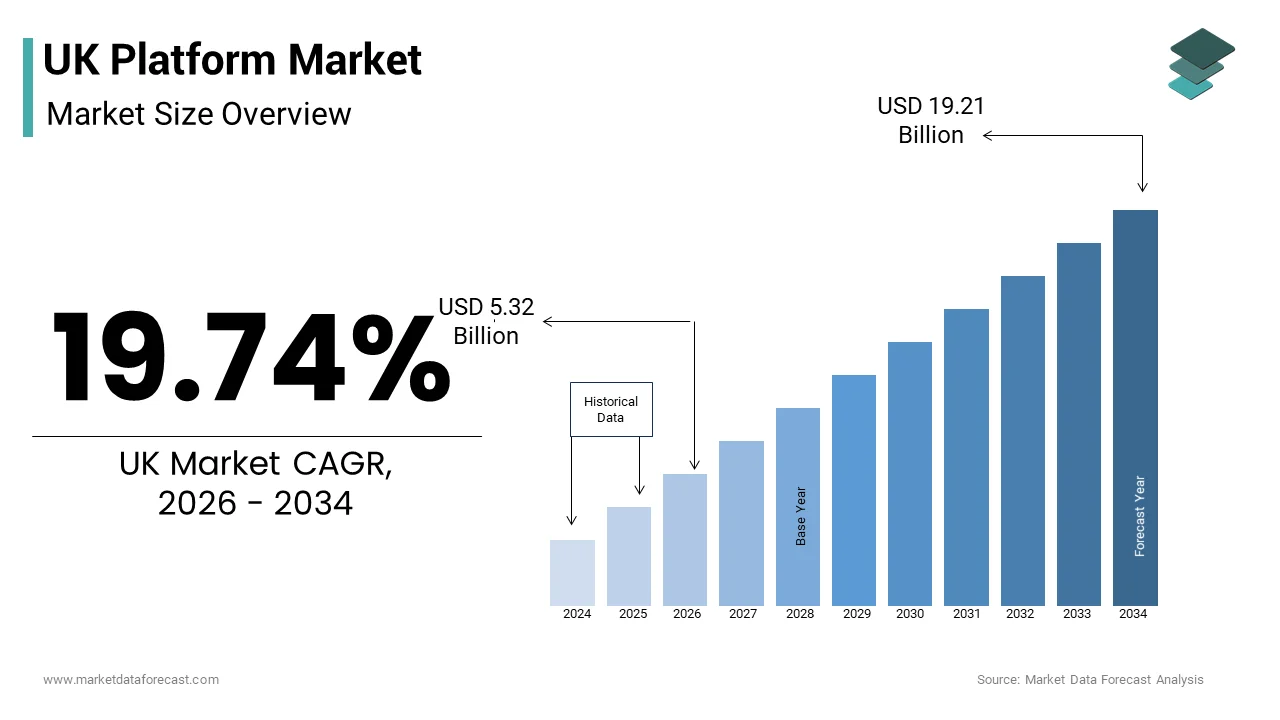
The UK platform market was valued at USD 4.44 billion in 2025 and is anticipated to reach USD 5.32 billion in 2026 and further expand to USD 19.21 billion by 2034, growing at a CAGR of 19.74% during the forecast period from 2026 to 2034. The growth of the UK platform market is driven by the rapid adoption of digital business models, increasing penetration of e-commerce, and growing reliance on cloud-based technologies. Businesses across industries are leveraging digital platforms to enhance customer engagement, streamline operations, and improve scalability. The increasing integration of artificial intelligence, data analytics, digital payments, and automation technologies is further accelerating market growth. Additionally, the expansion of online marketplaces, platform ecosystems, and mobile commerce solutions is creating significant opportunities across the United Kingdom.
Key Market Trends
- Growing adoption of platform-based business models that facilitate seamless interactions between businesses, consumers, and service providers.
- Increasing deployment of cloud-based platforms due to their scalability, flexibility, lower operational costs, and ease of integration.
- Rising demand for digital commerce solutions that support online transactions, customer engagement, and omnichannel experiences.
- Expansion of mobile-first platforms and digital applications driven by increasing smartphone penetration and changing consumer behavior.
- Greater integration of artificial intelligence, machine learning, and analytics to enhance personalization, operational efficiency, and platform performance.
Segmental Insights
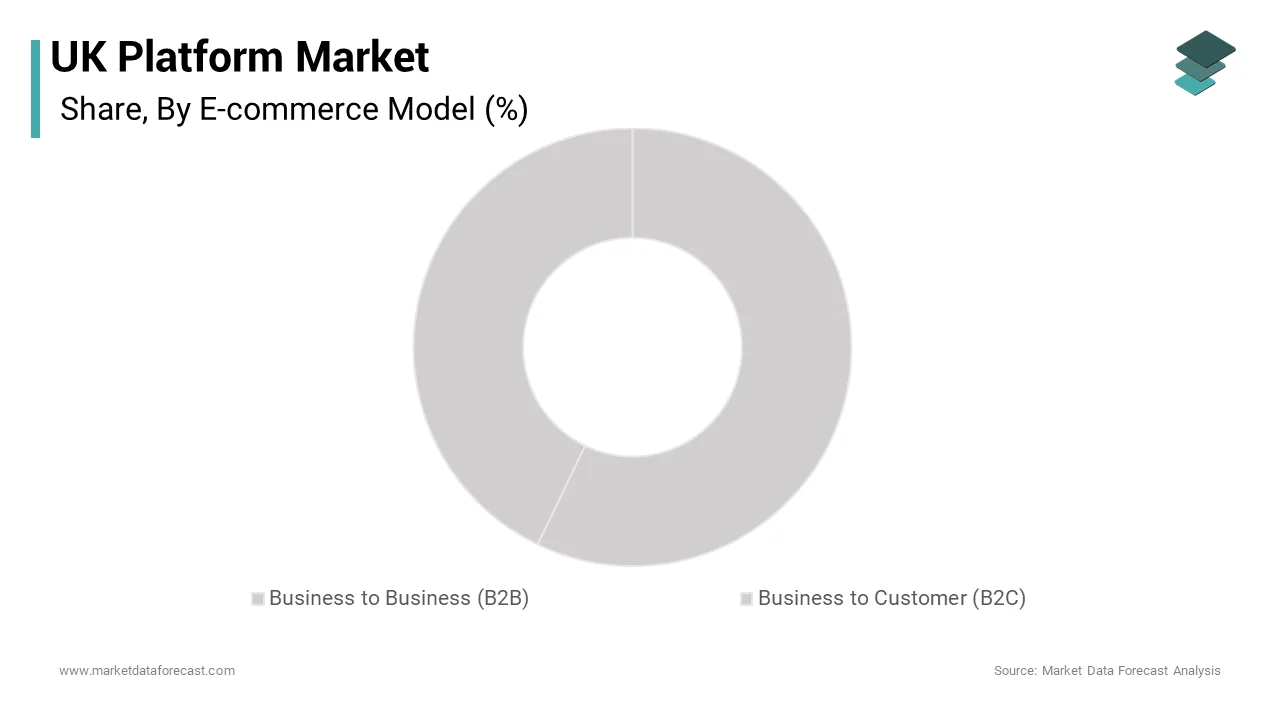
- Based on e-commerce model, the Business-to-Customer (B2C) segment held the largest share of the UK platform market in 2025. The segment’s dominance is attributed to strong consumer adoption of digital platforms, increasing online shopping activity, and high transaction volumes across various consumer-facing services.
- Based on deployment, the cloud-based deployment segment accounted for a substantial share of the UK platform market in 2025. The segment’s growth is driven by increasing demand for scalable, cost-effective, and flexible platform solutions that enable real-time access, faster deployment, and seamless updates.
- Based on industry, the food and beverage segment was the largest contributor to the UK platform market in 2025. The segment’s leadership is supported by the rapid expansion of online food ordering, delivery platforms, digital restaurant services, and increasing consumer preference for convenience-oriented digital experiences.
Competitive Landscape
The UK platform market is highly competitive, with leading companies focusing on innovation, cloud technologies, digital commerce capabilities, and customer experience enhancement. Market participants are investing in advanced analytics, artificial intelligence, integrated payment systems, and scalable platform architectures to strengthen their market positions. Strategic partnerships, acquisitions, and product enhancements continue to drive competition and support the development of comprehensive digital ecosystems.
Prominent players in the UK platform market include Shopify, eBay, Just Eat Takeaway, Etsy, Amazon Web Services, Square, Deliveroo, BigCommerce, Adobe, Wix, Oracle Corporation, Squarespace, WooCommerce, SAP SE, Salesforce, StoreHippo, Trade Me, Ecwid, and OpenCart.
UK Platform Market Size
The UK platform market size was valued at USD 4.44 billion in 2025 and is anticipated to reach USD 5.32 billion in 2026 to reach USD 19.21 billion by 2034, growing at a CAGR of 19.74% during the forecast period from 2026 to 2034.
MARKET OVERVIEW
Platform are digital intermediaries that facilitate transactions interactions and data exchange between distinct user groups. This market has become foundational to the modern British economy enabling seamless connectivity in commerce transportation hospitality and professional services. The proliferation of high speed internet infrastructure supports this growth with 98 percent of UK households having access to superfast broadband according to data published by Ofcom. This ubiquitous connectivity ensures that platform services are accessible to nearly the entire population fostering widespread adoption across urban and rural demographics. Regulatory frameworks such as the Digital Markets Unit aim to ensure fair competition while protecting consumer rights creating a structured environment for sustainable growth. The integration of artificial intelligence and machine learning enhances personalization allowing platforms to tailor experiences to individual preferences efficiently. Current consumer telemetry indicates that mobile device adoption among UK adults has reached between 95% and 98%, with digital oversight now spearheaded by DSIT and Ofcom. This technological readiness combined with a sophisticated consumer base creates a fertile ground for innovation. The market is characterized by rapid evolution where new business models emerge continuously challenging established players. Understanding this dynamic landscape requires examining the interplay between technological advancement regulatory oversight and changing consumer expectations that collectively shape the trajectory of the platform economy in the United Kingdom.
MARKET DRIVERS
Widespread Smartphone Penetration Enables Constant Connectivity
The extensive adoption of smartphones acts as a fundamental driver for the United Kingdom platform market. This growth is fueled by ensuring users enjoy continuous access to digital services regardless of their location. Telecommunications tracking from Ofcom reveals that while total mobile device penetration among United Kingdom adults sits between 95% and 98%, specific smartphone ownership is slightly lower, though it still provides platform operators with access to the vast majority of the population. This high penetration rate allows platforms to engage users through mobile applications providing instant notifications and seamless transaction capabilities. The convenience of accessing services such as food delivery ride hailing and financial management from a handheld device significantly increases usage frequency. As detailed in Ofcom data, national consumer infrastructure demands are expanding dynamically, with overall UK mobile data utilization increasing by roughly 18% annually to keep pace with digital ecosystem consumption. Younger demographics particularly those aged 18 to 34 exhibit near universal smartphone ownership driving early adoption of emerging platform services. The availability of affordable data plans further removes barriers to entry enabling lower income households to participate in the platform economy. Platform developers optimize their interfaces for mobile first experiences recognizing that the majority of interactions occur on smaller screens. This focus on mobile usability enhances customer satisfaction and retention rates. The integration of biometric authentication and mobile payment systems simplifies security protocols encouraging users to conduct sensitive transactions confidently. The constant connectivity provided by smartphones transforms passive consumers into active participants who rely on platforms for daily necessities. This behavioral shift sustains demand and encourages platforms to innovate features that leverage mobile specific capabilities such as location based services and augmented reality.
Consumer Preference for Convenience and On Demand Services
The growing consumer preference for convenience and immediate gratification fundamentally fuels the expansion of the United Kingdom platform market. Modern lifestyles characterized by busy schedules and dual income households create a strong demand for services that save time and reduce effort. Platform businesses capitalize on this trend by offering on demand solutions for tasks ranging from grocery shopping to home cleaning. The ability to compare options read reviews and complete transactions within minutes appeals to time constrained individuals. As per data from the British Retail Consortium online sales accounted for 27 percent of total retail spending reflecting the shift toward digital procurement. The expectation of same day or next day delivery has become standard pushing platforms to optimize logistics and supply chain operations. Subscription models offered by many platforms provide predictable access to services reducing the cognitive load of repeated decision making. Consumers value the transparency provided by platform ratings and feedback systems which mitigate perceived risks associated with unfamiliar service providers. This trust mechanism encourages experimentation with new platforms expanding the overall market size. The psychological reward of immediate service fulfillment reinforces habitual usage creating loyal customer bases. Platforms that consistently deliver on their promise of convenience gain competitive advantages that are difficult for traditional businesses to replicate without significant digital transformation.
MARKET RESTRAINTS
Stringent Regulatory Compliance Increases Operational Costs
The implementation of stringent regulatory frameworks is a significant restraint to the United Kingdom platform market. This increases compliance burdens and operational costs for providers. The Digital Markets Competition and Consumers Bill introduces rigorous requirements for designated strategic market status firms mandating fair trading practices and data interoperability. Studies highlight that adhering to the DMCCA requires substantial investments in tech architecture and specialized internal compliance monitoring to safely align with the CMA's elevated regulatory expectations. Smaller platform operators struggle to absorb these costs potentially stifling innovation and limiting market entry for new competitors. The General Data Protection Regulation continues to impose strict guidelines on data handling requiring platforms to implement robust security measures and transparent consent mechanisms. Under the Digital Markets, Competition and Consumers Act, a failure to comply with established digital market conduct guidelines can result in severe financial penalties administered by the CMA reaching up to 10% of global annual turnover. These financial penalties create uncertainty and risk aversion among investors hesitant to fund platform ventures with complex regulatory exposures. The need for regular audits and reporting diverts resources away from product development and customer acquisition initiatives. Regulatory changes often occur with limited notice periods forcing rapid adaptation that disrupts business continuity. As per sources overlapping requirements from multiple regulatory bodies create redundancies and inefficiencies. This regulatory weight slows down the launch of new features and services reducing the agility that characterizes successful platform businesses. The cumulative effect of these compliance demands raises barriers to entry and consolidation pressures favoring larger incumbents with deeper pockets.
Data Privacy Concerns Erode Consumer Trust
Growing concerns regarding data privacy and security greatly constrain the expansion of the United Kingdom platform market. This erodes consumer trust and limits data sharing willingness. High profile data breaches and misuse scandals have heightened public awareness about the risks associated with digital platforms. According to a survey by the Information Commissioners Office 60 percent of UK consumers express concern about how their personal data is collected and used by online services. This skepticism leads users to restrict permissions disable tracking features or abandon platforms perceived as intrusive. The requirement for explicit consent under privacy laws reduces the volume of usable data available for personalization and targeted advertising impacting revenue models. As per research from the Royal Society for the Encouragement of Arts Manufactures and Commerce consumers are increasingly adopting privacy enhancing tools such as ad blockers and virtual private networks. These technologies hinder the ability of platforms to gather comprehensive user insights necessary for optimizing services and marketing campaigns. The fear of identity theft and financial fraud discourages older demographics from fully engaging with platform economies limiting market expansion. Platforms must invest heavily in cybersecurity infrastructure and transparent communication to rebuild trust but these efforts often yield diminishing returns. The tension between personalized experiences and privacy protection creates a delicate balance that is difficult to maintain. Platforms face higher churn rates and increased customer acquisition costs without robust trust mechanisms. Consequently, users are becoming more selective about the services they engage with regularly.
MARKET OPPORTUNITIES
Integration of Artificial Intelligence Enhances Personalization
The integration of artificial intelligence offers a significant opportunity for platform operators to enhance personalization and improve user engagement across the United Kingdom platform market. Advanced machine learning algorithms enable platforms to analyze vast amounts of user data to predict preferences and recommend relevant services with high accuracy. Deloitte Digital point out that consumer expectations for hyper-tailored content have grown by 20%, presenting a significant scaling opportunity for digital platforms implementing AI optimization. Platforms leveraging AI can automate customer support through chatbots providing instant responses to inquiries and resolving issues efficiently. This automation reduces operational costs while improving satisfaction levels for users who value immediate assistance. Predictive analytics allow platforms to anticipate demand fluctuations optimizing resource allocation and inventory management in real time. Tech Nation shows a strong investor preference for the AI sector, which anchors the UK's high-growth landscape and represents a major share of total capital infusions. The ability to detect fraudulent activities using pattern recognition enhances security building trust among users conducting financial transactions. AI also facilitates dynamic pricing strategies that adjust rates based on real time supply and demand conditions maximizing revenue potential. Platforms that successfully embed AI into their core operations gain competitive advantages through superior user experiences and operational efficiency. The continuous improvement of AI models ensures that personalization becomes increasingly accurate over time fostering deeper loyalty. This technological synergy transforms platforms from static intermediaries into intelligent assistants that proactively meet user needs.
Expansion into Underserved Rural and Semi Urban Areas
Expanding platform services into underserved rural and semi urban areas provides a clear path for growth as digital infrastructure improvements reach wider geographies, which is likely to accelerate the growth of the United Kingdom platform market. The rollout of full fiber broadband networks across the United Kingdom is bridging the digital divide enabling residents in remote locations to access platform services reliably. Residents in these areas often face limited choices for local services such as retail dining and transportation making platform solutions particularly valuable. Platforms offering delivery logistics and remote professional services can tap into this pent up demand establishing first mover advantages in less saturated markets. According to surveys by the National Farmers Union rural communities show high interest in online marketplaces for agricultural supplies and local produce distribution. The lower competition in these regions allows platforms to achieve higher margins compared to fiercely contested urban centers. Marketing efforts focused on community engagement and local partnerships can build strong brand loyalty among rural consumers who value reliability and trust. The aging population in rural areas also presents opportunities for platforms offering healthcare coordination and home care services. By addressing the specific needs of these demographics platforms can create sustainable revenue streams while contributing to regional economic development. This geographic expansion diversifies risk and reduces dependence on volatile urban markets.
MARKET CHALLENGES
Intense Price Competition Compresses Profit Margins
Intense price competition among platform operators compresses profit margins and threatens long term sustainability in the overall United Kingdom platform market. The low barriers to entry in many platform segments lead to market saturation where numerous players vie for the same customer base. According to analysis by the Competition and Markets Authority price wars are common in sectors such as food delivery and ride hailing where subsidies are used to attract users. This race to the bottom forces platforms to operate at losses for extended periods relying on external funding to survive. The expectation of free or low cost services among consumers makes it difficult to raise prices without triggering significant churn. Platforms struggle to differentiate themselves beyond price leading to commoditization of services and reduced brand loyalty. The need to constantly invest in marketing and promotions to maintain visibility further strains financial resources. Smaller platforms lacking economies of scale find it increasingly difficult to compete with well funded incumbents who can absorb short term losses. This environment discourages innovation as resources are diverted toward survival rather than product development. The pressure to deliver shareholder value conflicts with the need for sustainable pricing models creating strategic dilemmas. Without clear paths to profitability many platform ventures face consolidation or exit reducing market diversity. This competitive intensity requires operators to find alternative revenue streams such as advertising or data monetization to offset thin transaction margins.
Workforce Classification Disputes Create Legal Uncertainty
Ongoing disputes regarding the classification of platform workers create significant legal uncertainty and operational issues for companies in the United Kingdom market. The distinction between independent contractors and employees remains a contentious issue with courts frequently ruling in favor of worker rights. As per landmark judgments by the Supreme Court certain platform drivers and deliverers are entitled to minimum wage holiday pay and pension contributions. These rulings necessitate substantial restructuring of business models increasing labor costs. Platforms face the dilemma of maintaining flexibility for workers while complying with employment laws that mandate greater protections. The lack of clear legislative guidance leads to inconsistent interpretations and frequent litigation draining managerial attention and financial resources. As per reports from the Trades Union Congress organized labor movements are intensifying campaigns to secure better conditions for gig economy workers. This pressure forces platforms to negotiate collective agreements or face reputational damage and regulatory scrutiny. The uncertainty discourages long term investment in workforce training and development as companies hesitate to commit to permanent employment structures. Operational flexibility which is a key value proposition of platform models is compromised by rigid employment requirements. Balancing regulatory compliance with business viability requires innovative approaches to workforce management that are still evolving. This legal ambiguity creates a volatile operating environment where sudden policy changes can disrupt established practices and financial projections.
REPORT COVERAGE
| REPORT METRIC | DETAILS |
| Market Size Available | 2025 to 2034 |
| Base Year | 2025 |
| Forecast Period | 2026 to 2034 |
| CAGR | 19.74% |
| Segments Covered | By E-commerce Model, Deployment, Industry, Country |
| Various Analyses Covered | Global, Regional, and Country Level Analysis, Segment-Level Analysis; DROC, PESTLE Analysis; Porter’s Five Forces Analysis; Competitive Landscape; Analyst Overview of Investment Opportunities. |
| Regions Covered | London, South East, North West, East of England, South West, Scotland, West Midlands, Yorkshire and The Humber, East Midlands, Others |
| Market Leaders Profiled | Shopify, EBay, Just Eat Takeaway, Etsy, Amazon Web Services, Square, Deliveroo, BigCommerce, Adobe, Wix, Oracle Corporation, Squarespace, WooCommerce, SAP SE, Salesforce, StoreHippo, Trade Me, Ecwid, OpenCart. |
SEGMENTAL ANALYSIS
By E-commerce Model Insights
Business to Customer
In 2025, the Business to Customer segment held the majority share of the United Kingdom platform market because of high consumer adoption and frequent transaction volumes. This model connects digital platforms directly with individual end users facilitating retail dining and personal service transactions. Ofcom reveals that while total mobile device penetration among United Kingdom adults sits between 95% and 98%, specific smartphone ownership is slightly lower, though it still provides platform operators with access to the vast majority of the population. This accessibility ensures that consumers can engage with platforms at any time driving consistent revenue streams. The convenience factor is paramount as modern lifestyles prioritize time saving solutions for daily needs. The variety of choices available on B2C platforms allows users to compare prices and read reviews enhancing decision making confidence. Subscription models offered by many B2C platforms create recurring revenue and foster loyalty among users who value predictable access. The integration of secure payment gateways reduces friction during checkout encouraging higher conversion rates. Marketing efforts focused on personalized recommendations further drive engagement by tailoring offers to individual preferences. The emotional satisfaction derived from immediate gratification reinforces habitual usage patterns. Regulatory protections for consumers such as return policies and dispute resolution mechanisms build trust in the digital ecosystem. This combination of convenience choice and security solidifies the leadership of the B2C segment in the platform economy.
High levels of digital literacy among the UK population serve as a primary driver for the dominance of this segment. Consumers are increasingly comfortable navigating digital interfaces managing online accounts and conducting financial transactions electronically. The proficiency reduces barriers to entry for new platform users enabling rapid scaling of customer bases. Younger demographics particularly those aged 18 to 34 exhibit near universal digital competence driving early adoption of emerging platform services. The broadening demographic base expands the total addressable market for B2C platforms. Educational initiatives and public library programs have contributed to closing the digital divide ensuring inclusive access. Platforms benefit from this literate user base by offering sophisticated features such as augmented reality try ons and AI driven recommendations without fearing usability issues. The confidence to explore new digital services encourages experimentation with diverse platform offerings. Social media influence further accelerates adoption as peers share experiences and recommendations online. This cultural normalization of digital interactions sustains robust demand for B2C platform services across all age groups and socioeconomic segments.
The strong consumer preference for convenience and time saving solutions greatly fuels the dominance of this segment. Modern lifestyles characterized by busy schedules and dual income households create a urgent need for services that reduce effort and streamline daily tasks. The ability to browse purchase and schedule deliveries from home eliminates travel time and parking hassles associated with traditional shopping. Platform operators capitalize on this trend by offering same day or next day delivery options that meet expectations for immediacy. The integration of saved payment details and address books simplifies the checkout process reducing friction and abandonment rates. Subscription services provided by many platforms offer automatic replenishment of essential items further enhancing convenience. Consumers value the transparency of real time tracking which allows them to plan their day around delivery windows. The psychological reward of having tasks completed efficiently reinforces habitual usage and brand loyalty. Platforms that consistently deliver on their promise of convenience gain competitive advantages that are difficult for traditional businesses to replicate. This behavioral shift ensures sustained growth for the B2C segment as users prioritize efficiency in their consumption habits.
Business to Business
The Business to Business segment is predicted to witness the highest CAGR of 12.5% over the forecast period. This rapid expansion of the segment is fueled by the digital transformation of supply chains and the increasing need for efficient procurement processes among enterprises. Companies are shifting away from manual ordering systems toward automated platforms that integrate with enterprise resource planning software. The B2B model facilitates bulk transactions and long term contracts providing stable revenue streams for platform operators. Small and medium sized enterprises benefit from access to wider supplier networks and competitive pricing through these digital marketplaces. The complexity of B2B transactions requires specialized features such as invoice management credit terms and customized catalogs which platforms are increasingly offering. Cloud based infrastructure enables scalability allowing businesses to adjust their usage based on demand fluctuations. The rise of remote work has accelerated the adoption of digital collaboration tools within B2B platforms enhancing productivity. Regulatory requirements for transparency and audit trails also drive adoption as digital records provide better compliance capabilities. This convergence of operational efficiency cost savings and technological advancement positions the B2B segment as the most dynamic area of growth in the platform economy.
The ongoing digital transformation of supply chains serves as a critical catalyst for the rapid growth of this segment. Enterprises are increasingly recognizing the need to modernize their procurement and logistics operations to remain competitive in a globalized economy. Platform based solutions enable real time tracking of inventory shipments and supplier performance reducing delays and stockouts. The integration of Internet of Things devices provides granular data on asset conditions allowing for predictive maintenance and optimized routing. Businesses leverage these platforms to identify alternative suppliers mitigating risks associated with geopolitical disruptions or natural disasters. The ability to analyze spending patterns helps organizations negotiate better contracts and identify cost saving opportunities. Cloud based platforms offer the flexibility to scale operations up or down based on seasonal demand without significant capital expenditure. This agility is crucial for businesses facing volatile market conditions. The standardization of data formats across platforms facilitates smoother interactions between different stakeholders in the supply chain. This technological evolution transforms traditional linear supply chains into interconnected digital ecosystems driving sustained adoption of B2B platform services.
The pressing need for operational efficiency and cost reduction propels enterprises to adopt Business to Business platforms as essential tools for strategic management. In a competitive economic environment companies must minimize overheads while maximizing output to maintain profitability. Platform solutions automate repetitive tasks such as order processing invoice generation and payment reconciliation freeing up staff for higher value activities. B2B platforms provide centralized dashboards that offer comprehensive views of spending enabling better budget control and forecasting. The transparency of pricing on these marketplaces allows buyers to compare multiple suppliers instantly ensuring they secure the best possible deals. Bulk purchasing options and volume discounts further contribute to cost savings for large organizations. The reduction of errors associated with manual data entry improves accuracy and reduces the need for costly corrections. The ability to track key performance indicators in real time supports data driven decision making. These efficiency gains translate directly to the bottom line making B2B platforms an attractive investment for businesses of all sizes. The cumulative effect of these benefits sustains the high growth trajectory of the B2B segment.
By Deployment Insights
Cloud Based Deployment
Cloud based deployment segment dominated the United Kingdom platform market and accounted for a substantial share in 2025. This dominance of the segment was driven by its scalability flexibility and lower upfront costs compared to on premise solutions. Organizations of all sizes prefer cloud infrastructure because it eliminates the need for substantial capital investment in hardware and maintenance. The widespread adoption is driven by the ability to scale resources up or down based on demand ensuring optimal performance during peak periods. Cloud platforms offer automatic updates and security patches reducing the burden on internal IT teams. The accessibility of cloud services from any location supports remote work arrangements which have become standard in many industries. Also, the reliability of major cloud providers ensures high availability and disaster recovery capabilities that are difficult to achieve with on premise systems. Integration with other digital tools such as customer relationship management and analytics software is seamless in cloud environments. This interoperability enhances overall business efficiency and data consistency. The pay as you go pricing model aligns costs with usage making it financially attractive for small and medium enterprises. The continuous innovation in cloud technologies including artificial intelligence and machine learning further strengthens its position as the preferred deployment method for modern platforms.
The inherent scalability and flexibility of cloud based deployment are the main drivers for its dominance. Businesses experience fluctuating demand patterns requiring infrastructure that can adapt quickly without significant lead times or capital expenditure. Cloud platforms allow organizations to provision additional computing storage and network resources instantly during peak traffic periods. The agility enables businesses to launch new products and services rapidly responding to market opportunities. The flexibility to choose from various service models such as Infrastructure as a Service Platform as a Service and Software as a Service allows companies to tailor solutions to their specific needs. Startups benefit from low entry barriers as they can begin with minimal resources and expand as they grow. The elimination of hardware constraints means that technical limitations do not hinder business expansion. Global reach is another advantage as cloud providers have data centers worldwide enabling low latency access for international customers. This global infrastructure supports UK businesses in expanding their footprint without establishing physical presence in every market. The ability to experiment with new technologies without long term commitments fosters a culture of innovation and continuous improvement.
The lower total cost of ownership associated with cloud based deployment significantly enhances its appeal to businesses in the United Kingdom platform market. Traditional on premise solutions require substantial upfront investment in servers networking equipment and cooling systems along with ongoing maintenance costs. Cloud models operate on a subscription basis converting capital expenditure into predictable operational expenditure. The elimination of hardware refresh cycles and energy consumption further contributes to savings. Cloud providers manage security compliance and backups reducing the need for specialized internal staff and associated training costs. The pay per use model ensures that businesses only pay for the resources they actually consume avoiding waste from over provisioned capacity. Automatic updates included in cloud subscriptions ensure that software remains current without additional licensing fees. The reduced need for physical space and facilities management also lowers overheads. These financial advantages make cloud deployment accessible to small and medium enterprises that previously could not afford advanced IT infrastructure. The ability to redirect saved funds toward core business activities such as product development and marketing drives competitive advantage. This economic efficiency sustains the dominance of cloud based solutions in the platform ecosystem.
Cloud Based
The Cloud based segment also exhibits the strongest growth trajectory in the United Kingdom platform market, with a CAGR of 18.2% from 2026 to 2034 due to the accelerating migration of legacy systems to cloud environments as businesses seek to modernize their IT infrastructure. The urgency of digital transformation initiatives has intensified following recent global disruptions that highlighted the vulnerabilities of on premise systems. The integration of advanced technologies such as artificial intelligence and big data analytics is only feasible at scale through cloud infrastructure. Enterprises are leveraging cloud platforms to gain actionable insights from large datasets improving decision making and customer personalization. The rise of edge computing complements cloud growth by processing data closer to the source while relying on central cloud resources for heavy lifting. Also, the availability of industry specific cloud solutions tailored for finance healthcare and retail further drives adoption. Security enhancements in cloud platforms including encryption and identity management have alleviated previous concerns about data protection. The collaborative nature of cloud tools supports distributed workforces enhancing productivity. This multifaceted value proposition ensures that cloud based deployment continues to outpace all other segments in growth rate.
The accelerated migration from legacy on premise systems to cloud platforms is the main reason behind the rapid growth of the cloud based segment. Many organizations operate on outdated infrastructure that is costly to maintain and incompatible with modern applications. The risk of security breaches and system failures in legacy environments prompts urgent modernization efforts. In addition, the complexity of these migrations is being simplified by automated tools and professional services offered by cloud providers. Businesses recognize that staying on legacy systems hinders innovation and slows time to market for new products. The inability of on premise systems to support remote work effectively was a critical lesson learned during recent global events prompting swift action. Cloud platforms offer the connectivity and accessibility required for distributed teams to collaborate seamlessly. The availability of skilled cloud architects and consultants has increased reducing the technical barriers to migration. Government incentives and grants for digital transformation further encourage businesses to upgrade their infrastructure. This widespread shift away from legacy systems creates a sustained pipeline of demand for cloud services ensuring robust growth for the segment.
The integration of advanced technologies such as artificial intelligence machine learning and Internet of Things necessitates cloud based infrastructure driving swift growth in this segment. These technologies require vast computational power and storage capabilities that are impractical to maintain on premise for most organizations. Cloud platforms provide access to high performance computing resources on demand enabling businesses to run complex algorithms and process large datasets efficiently. The scalability of cloud infrastructure allows businesses to experiment with new technologies without significant upfront investment. Moreover, the availability of pre built AI models and APIs on cloud platforms lowers the barrier to entry for businesses lacking deep technical expertise. Internet of Things devices generate continuous streams of data that require real time processing and storage which cloud platforms handle effectively. The integration of these technologies enhances operational efficiency predictive maintenance and customer personalization. Businesses that leverage cloud based advanced technologies gain competitive advantages through innovation and agility. The continuous development of new cloud native tools further expands the possibilities for technological integration. This synergy between advanced tech and cloud infrastructure ensures sustained high growth rates for the segment.
By Industry Insights
Food and Beverage
The Food and Beverage segment was the largest in the United Kingdom platform market and occupied a significant share in 2025. This prominence of the segment was supported by high frequency of transactions and widespread consumer adoption. Online food delivery and grocery shopping have become integral parts of daily life for millions of UK residents. The convenience of having meals and groceries delivered to doorsteps appeals to busy households and individuals. The proliferation of food delivery apps has expanded choices beyond traditional restaurants to include cloud kitchens and specialty retailers. The pandemic accelerated this trend habituating consumers to digital ordering even as restrictions eased. Platform operators invest heavily in logistics networks ensuring fast and reliable delivery which reinforces customer loyalty. The integration of restaurant menus and grocery inventories onto single platforms simplifies the shopping experience. Promotional offers and loyalty programs further drive engagement and repeat purchases. The social aspect of sharing food experiences online through reviews and photos enhances platform visibility. The diversity of cuisines and dietary options available on platforms caters to varied consumer preferences. This combination of convenience choice and reliability solidifies the leadership of the Food and Beverage segment in the platform economy.
The high frequency of daily transactions in the Food and Beverage sector is a key reason for its dominance. Unlike durable goods which are purchased infrequently food and beverages are consumed daily creating a constant stream of demand. This regularity ensures steady revenue flows for platform operators and high engagement metrics. The habit of ordering lunch or dinner through apps becomes ingrained in daily routines particularly among urban professionals. The immediacy of food consumption means that decisions are made quickly often influenced by promotions or cravings. Platforms leverage this behavior by sending targeted notifications at meal times to stimulate demand. The ability to reorder previous purchases with a single click reduces friction and encourages frequent usage. Subscription services for coffee snacks or meal kits further lock in regular transactions. The social nature of dining out extends to delivery where groups order together increasing basket sizes. This consistent transaction volume provides a stable foundation for platform growth and attracts significant investment in logistics and technology. The recurring nature of food spending ensures that this segment remains the largest by transaction count and user activity.
The rapid expansion of cloud kitchens significantly increases the supply options available on food and beverage platforms driving their market dominance. Cloud kitchens are delivery only establishments that operate without dine in facilities allowing for lower overheads and greater flexibility. These facilities enable restaurants to expand their reach into new neighborhoods without the cost of physical storefronts. Platform operators partner with cloud kitchens to offer exclusive brands and diverse cuisines that may not be available locally. In addition, the ability to test new concepts quickly allows for rapid innovation in food offerings. Consumers benefit from wider choices and often faster delivery times as cloud kitchens are strategically located in high demand areas. The lower operational costs of cloud kitchens allow for competitive pricing which attracts price sensitive customers. Platforms leverage data from these kitchens to identify trending foods and optimize menus for maximum appeal. This symbiotic relationship between platforms and cloud kitchens enhances the overall value proposition for consumers. The continuous addition of new virtual brands keeps the platform experience fresh and engaging. This dynamic supply side growth sustains the leadership of the Food and Beverage segment.
Health and Wellness
The Health and Wellness segment is estimated to register the fastest CAGR of 15.8% between 2026 and 2034 owing to increasing health consciousness among consumers and the rising prevalence of chronic conditions requiring ongoing management. The integration of telemedicine fitness tracking and mental health services onto digital platforms has created a holistic ecosystem for wellbeing. Also, the aging population drives demand for remote patient monitoring and medication delivery services which platforms facilitate efficiently. The stigma around mental health is decreasing encouraging more people to seek online therapy and counseling services. Wearable devices connected to platforms provide real time data that enables personalized health recommendations. Insurance companies are partnering with wellness platforms to offer incentives for healthy behaviors further driving adoption. The corporate wellness market is also expanding as employers invest in digital health solutions for their staff. This convergence of technology healthcare and consumer demand positions Health and Wellness as the most dynamic growth area in the platform economy.
Rising health consciousness among UK consumers fuels the rapid growth of the health and wellness segment. Individuals are increasingly prioritizing preventive care and healthy lifestyles leading to greater engagement with digital health tools. Platforms offering nutrition tracking fitness coaching and mindfulness meditation cater to this growing demand. The availability of expert advice and personalized plans on these platforms makes healthy living more accessible and manageable. Users share progress and achievements creating communities that motivate sustained engagement. The integration of wearable technology allows for precise monitoring of vital signs enabling early detection of potential issues. Platforms leverage this data to provide actionable insights and recommendations. The trend toward holistic health encompassing physical mental and emotional wellbeing expands the scope of services offered. Consumers are willing to pay premium prices for high quality digital health interventions that deliver tangible results. This shift in consumer values ensures sustained growth for the Health and Wellness segment as it aligns with broader societal trends toward self care and longevity.
The aging population in the United Kingdom drives significant demand for remote care services offered through health and wellness platforms accelerating segment growth. With life expectancy increasing the number of individuals managing chronic conditions such as diabetes and heart disease is rising. Older adults often face mobility challenges making regular visits to healthcare facilities difficult. Platform based solutions enable remote consultations medication delivery and monitoring of vital signs from the comfort of home. Family members also utilize these platforms to coordinate care and stay informed about their relatives health status. The integration of emergency alert systems provides peace of mind for both seniors and their caregivers. Healthcare providers benefit from reduced hospital admissions and more efficient resource allocation. Government initiatives supporting digital inclusion for older adults further facilitate adoption. The ability to maintain independence and quality of life through technology is a powerful motivator for this demographic. This demographic shift ensures a growing and loyal customer base for Health and Wellness platforms.
COUNTRY ANALYSIS
The United Kingdom led the European platform market and captured a 22.6% share in 2025. This leading position is driven by advanced digital infrastructure high internet penetration and a culturally receptive consumer base. The UK serves as a hub for fintech and e commerce innovation attracting significant venture capital investment. According to British venture capital reports, UK tech startups previously secured a record-breaking £15 billion in investment funding, reflecting enduring investor confidence in the region's digital ecosystem. The regulatory environment although stringent provides clarity which encourages long term investment. London acts as a global financial center facilitating cross border platform operations and payments. The high level of English proficiency aids in the export of UK platform services to other markets. Consumer trust in digital transactions is higher in the UK compared to many other European countries. The mature logistics network supports efficient delivery for e commerce platforms. The presence of major global platform headquarters in the UK creates a cluster effect fostering talent and innovation. This combination of financial strength technological readiness and market sophistication cements the UKs position as the primary driver of the European platform economy.
The advanced digital infrastructure in the United Kingdom provides a robust foundation for the growth of the platform market exceeding many European counterparts. Based on data from Ofcom, the UK is projected to reach 98% nationwide coverage for ultra-fast gigabit broadband infrastructure, while 4G mobile data availability already reaches over 98% of the population. The rollout of 5G networks further enhances mobile connectivity enabling richer and more responsive platform experiences. Statistics from the Department for Science, Innovation and Technology highlight that the UK excels globally in digital sector scaling, maintaining its rank among the top countries for technology sector value and venture investment. This infrastructure supports data intensive applications such as video streaming gaming and real time collaboration tools. The reliability of internet services minimizes downtime and ensures consistent user experiences which are critical for platform retention. Cloud data centers located within the UK provide low latency access for domestic users while complying with data sovereignty requirements. The government commitment to digital inclusion ensures that rural areas are not left behind expanding the total addressable market. Investment in cyber security infrastructure protects platform operations and user data building trust. The integration of smart city technologies in urban areas creates new opportunities for platform based services in transportation and utilities. This technological backbone enables UK platforms to innovate rapidly and scale efficiently. The continuous upgrade of digital infrastructure ensures that the UK remains competitive in the global platform landscape.
The strong venture capital ecosystem in the United Kingdom fuels innovation and expansion in the platform market attracting talent and resources from around the world. London is recognized as the leading tech hub in Europe with a dense network of investors accelerators and incubators. According to venture capital tracking data from PitchBook, the UK technology ecosystem commands a leading market position, accounting for approximately 30% of the total venture capital deployed across Europe. This abundance of capital allows platform companies to invest in research and development marketing and talent acquisition. The presence of experienced entrepreneurs and mentors creates a supportive environment for new ventures. The availability of specialized legal and financial services tailored to tech businesses reduces operational friction. Government initiatives such as tax reliefs for investors further stimulate funding activity. The success of earlier platform exits creates a virtuous cycle of reinvestment and knowledge transfer. International investors view the UK as a safe and promising market for platform investments due to its stable regulatory framework. This financial vitality enables UK platforms to compete globally and acquire foreign competitors. The dynamic interaction between capital and innovation sustains the UKs leadership in the European platform market.
COMPETITIVE LANDSCAPE
The United Kingdom platform market features intense competition characterized by established global giants and agile local challengers vying for dominance across various sectors. Major players leverage extensive resources and brand recognition to maintain strong positions while niche operators differentiate through specialized services and superior customer experiences. The competitive landscape is shaped by continuous innovation in technology with companies investing heavily in artificial intelligence and automation to enhance efficiency. Price competition remains fierce particularly in food delivery and e commerce where margins are thin and customer loyalty is fragile. Regulatory scrutiny from bodies such as the Competition and Markets Authority adds complexity requiring strict adherence to fair trading practices. Data privacy concerns influence consumer choices prompting platforms to prioritize transparency and security in their operations. Partnerships with traditional industries create new battlegrounds as digital and physical worlds converge. The entry of new technologies such as blockchain and augmented reality offers opportunities for differentiation but requires significant investment. Success depends on balancing growth with profitability while delivering consistent value to both users and partners. This dynamic environment drives constant improvement in service quality and operational efficiency benefiting the broader digital economy.
KEY MARKET PLAYERS
A few of the market players that are dominating the UK platform market are
- Shopify
- EBay
- Just Eat Takeaway
- Etsy
- Amazon Web Services
- Square
- Deliveroo
- BigCommerce
- Adobe
- Wix
- Oracle Corporation
- Squarespace
- WooCommerce
- SAP SE
- Salesforce
- StoreHippo
- Trade Me
- Ecwid
- OpenCart
Top Players In The Market
- Just Eat Takeaway operates as a dominant force in the UK food delivery sector connecting millions of users with local restaurants and grocery stores. The company strengthens its position by investing heavily in logistics infrastructure and proprietary technology to enhance delivery speed and reliability. Recent initiatives include expanding its fleet of electric vehicles to support sustainability goals and improve urban accessibility. Just Eat Takeaway has also integrated advanced artificial intelligence tools to optimize route planning and reduce operational costs. The firm collaborates with major retail chains to offer rapid grocery delivery services catering to evolving consumer demands. Their focus on user experience is evident through continuous app updates that simplify ordering and payment processes. By prioritizing merchant partnerships the company ensures a diverse selection of dining options for customers. These strategic moves reinforce its leadership in the competitive digital food marketplace while addressing environmental and efficiency challenges.
- Amazon Web Services provides essential cloud computing infrastructure that powers a vast array of digital platforms across the United Kingdom. The company supports businesses of all sizes by offering scalable secure and flexible IT resources without the need for physical hardware investment. AWS recently expanded its data center presence in the UK to meet growing demand for low latency services and data sovereignty compliance. The provider introduces new machine learning and analytics tools enabling platforms to derive deeper insights from user data. AWS actively partners with UK startups through accelerator programs fostering innovation and technological advancement. Their commitment to sustainability includes powering operations with renewable energy sources appealing to environmentally conscious enterprises. By maintaining high availability standards AWS ensures critical platform services remain operational during peak traffic periods. This robust infrastructure backbone enables UK companies to innovate rapidly and compete globally in the digital economy.
- Deliveroo focuses exclusively on high quality food and grocery delivery leveraging a sophisticated logistics network to serve urban centers efficiently. The company distinguishes itself through strong relationships with premium restaurant partners and independent eateries enhancing its brand appeal. Deliveroo recently launched enhanced subscription models offering unlimited free deliveries to increase customer retention and lifetime value. The platform has expanded into convenience retail allowing users to order everyday essentials alongside meals for greater convenience. Investment in rider welfare programs and safety equipment demonstrates commitment to sustainable workforce practices. Deliveroo utilizes real time data analytics to predict demand patterns ensuring optimal rider allocation and reduced wait times. The introduction of dark kitchens under its own brands provides exclusive menu options not available elsewhere. These strategic enhancements solidify Deliveroo reputation as a preferred choice for consumers seeking quality and speed in the on demand delivery sector.
Major Strategies Used By Key Market Participants
Key players in the United Kingdom platform market employ diversification as a primary strategy to expand their service offerings and reduce dependency on single revenue streams. Companies integrate adjacent services such as grocery delivery financial products and advertising into their core platforms creating comprehensive ecosystems. This approach increases user engagement and frequency of interaction driving higher overall value per customer. Strategic partnerships with traditional businesses enable platforms to leverage existing infrastructure and customer bases for rapid expansion. Investment in artificial intelligence and machine learning enhances personalization allowing firms to tailor recommendations and pricing to individual preferences. Sustainability initiatives including electric vehicle fleets and carbon neutral commitments appeal to environmentally conscious consumers and regulators. Data security remains a focal point with substantial resources allocated to cybersecurity measures to build trust. Customer retention strategies involve loyalty programs and subscription models that encourage long term commitment. These multifaceted approaches enable participants to maintain competitive advantages while adapting to evolving regulatory and consumer landscapes in the dynamic UK market.
MARKET SEGMENTATION
This research report on the UK platform market is segmented and sub-segmented into the following categories.
By E-commerce Model
- Business to Business (B2B)
- Business to Customer (B2C)
By Deployment
- On-premise
- Cloud-based
By Industry
- Beauty & Personal Care
- Consumer Electronics
- Fashion & Apparel
- Food & Beverage
- Home Decor
- Health & Wellness
- Household Consumables
- Others