- Product Description Description
- Table of Contents TOC
- List of Table & Figure LOT
- Get Free Sample PDF Sample PDF
Market Size, 2025
$159.10 BnMarket Estimate, 2026
$169.67 BnMarket Forecast, 2034
$271.01 BnCAGR, 2026–2034
6.62%UK Poultry Market Report Summary
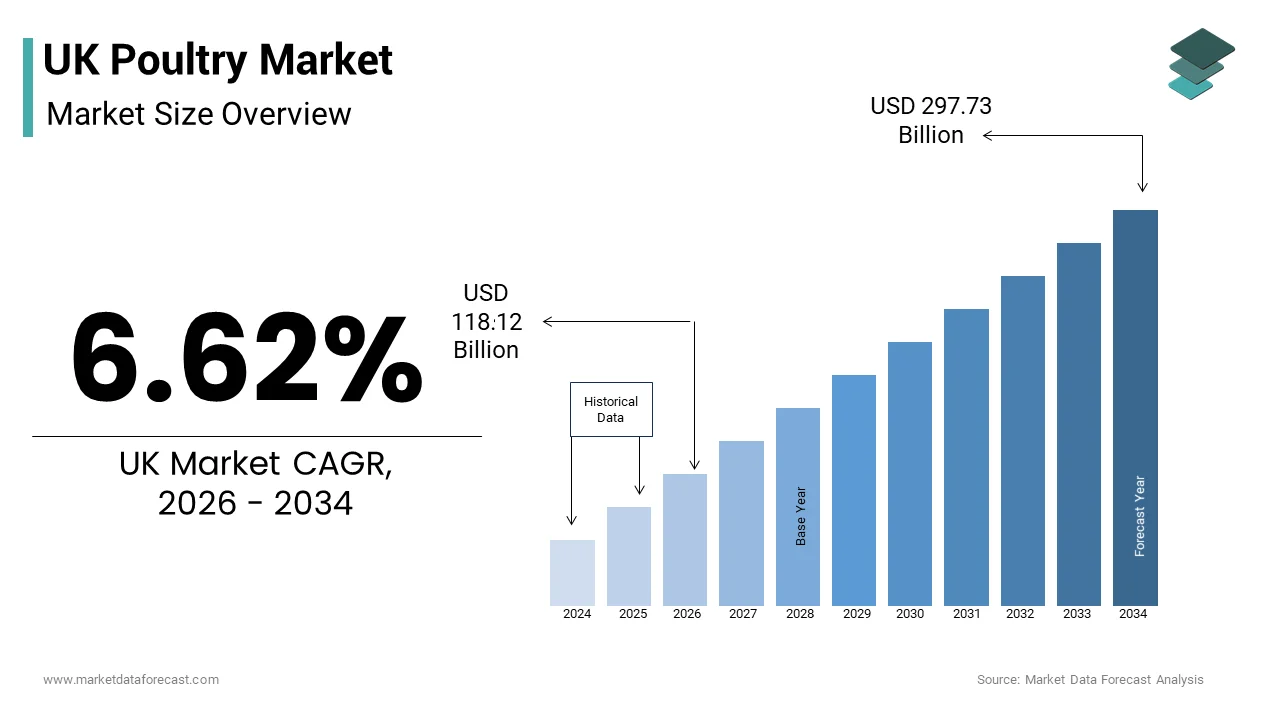
The UK poultry market was valued at USD 159.10 billion in 2025 and is anticipated to reach USD 169.67 billion in 2026 and further expand to USD 271.01 billion by 2034, growing at a CAGR of 6.62% during the forecast period from 2026 to 2034. The growth of the UK poultry market is driven by increasing consumer demand for affordable and protein-rich food products, changing dietary preferences, and rising consumption of poultry meat as a healthier alternative to red meat. Expanding foodservice demand, advancements in poultry farming practices, and improvements in processing and supply chain infrastructure are further supporting market growth. Additionally, growing focus on animal welfare, sustainable production methods, and product innovation is creating new opportunities across the poultry industry.
Key Market Trends
- Rising consumer preference for poultry products due to their affordability, nutritional value, and versatility in meal preparation.
- Increasing demand for fresh, chilled, and minimally processed poultry products driven by health-conscious consumers.
- Growing adoption of sustainable farming practices and enhanced animal welfare standards across poultry production operations.
- Expansion of value-added and ready-to-cook poultry products catering to changing consumer lifestyles and convenience needs.
- Advancements in poultry breeding, feed optimization, and processing technologies improving productivity and product quality.
Segmental Insights
- Based on species, the chicken segment dominated the UK poultry market and accounted for 44.6% of the market share in 2025. The segment’s leadership is attributed to widespread consumer acceptance, affordability, high protein content, and extensive use across household, retail, and foodservice applications.
- Based on product, the fresh and chilled poultry meat segment held a significant share of 31.2% of the UK poultry market in 2025. The segment's growth is driven by increasing consumer preference for fresh food products, superior taste perception, and rising demand from supermarkets, restaurants, and foodservice establishments.
- Based on distribution channel, business-to-consumer supermarkets and hypermarkets represented the leading distribution channel in the UK poultry market. The dominance of this segment is supported by extensive product availability, strong consumer trust, convenient shopping experiences, and the central role of supermarkets and hypermarkets in household grocery purchasing.
Regional Insights
The United Kingdom continues to represent a significant poultry market in Europe, supported by strong domestic consumption, an established food processing industry, and a well-developed retail infrastructure. Rising demand for protein-rich diets, increasing foodservice activity, and ongoing investments in poultry production efficiency are contributing to market expansion. Furthermore, the growing emphasis on food safety, traceability, and sustainable poultry production practices is expected to support long-term industry growth.
Competitive Landscape
The UK poultry market is highly competitive, with both domestic and international companies focusing on production efficiency, product diversification, supply chain optimization, and sustainability initiatives. Market participants are investing in advanced poultry farming technologies, processing capabilities, and animal welfare programs to enhance product quality and operational performance. Strategic partnerships, capacity expansions, and investments in value-added poultry products continue to shape the competitive landscape and strengthen market positions.
Prominent players in the UK poultry market include Tyson Foods, Inc., JBS S.A., Sisters Food Group, Faccenda Group, Moy Park, BRF S.A., WH Group Limited, Sanderson Farms, Pilgrim’s Pride Corporation, Perdue Farms Inc., Charoen Pokphand Foods Public Company Limited, Marfrig Global Foods S.A., and Industrias Bachoco S.A.B. de C.V.
UK Poultry Market Size
The UK poultry market size was valued at USD 159.10 billion in 2025 and is anticipated to reach USD 169.67 billion in 2026 to reach USD 271.01 billion by 2034, growing at a CAGR of 6.62% during the forecast period from 2026 to 2034.
The poultry is the national food security framework characterized by high levels of self-sufficiency and robust domestic production capabilities. British consumers have increasingly favored poultry due to its versatility affordability and perceived health benefits compared to red meat alternatives. The shift toward convenient ready to cook and ready to eat products has transformed supply chain dynamics requiring advanced logistics and packaging solutions. Furthermore, the rise of free range and organic certifications reflects changing consumer preferences for ethically produced food. The sector also plays a vital role in rural employment providing thousands of jobs across farming processing and distribution networks.
MARKET DRIVERS
Health Consciousness and Dietary Shifts Away from Red Meat
The growing emphasis on health consciousness and dietary shifts away from red meat by positioning chicken and turkey as preferred lean protein sources, which is fuelling the growth of the United Kingdom poultry market. Public health campaigns and nutritional guidelines consistently recommend reducing saturated fat intake, which is typically higher in beef and lamb compared to poultry. The cardiovascular diseases remain a leading cause of mortality in the United Kingdom prompting individuals to adopt heart healthy diets that prioritize white meat. Poultry offers a versatile canvas for various culinary preparations, while providing essential nutrients such as niacin selenium and vitamin B6 without the high cholesterol levels associated with some red meats. The rise of fitness culture and weight management trends has further accelerated this transition with gym goers and health enthusiasts incorporating grilled or baked chicken into their daily meal plans. This behavioral change is supported by the availability of low fat and skinless options in supermarkets which cater to calorie conscious shoppers. Additionally, the perception of poultry as a family friendly food that appeals to children and adults alike ensures consistent household demand.
Affordability and Value Perception in Economic Uncertainty
Affordability and strong value perception act, particularly during periods of economic uncertainty and rising living costs is additionally elevating the growth of the United Kingdom poultry market. Compared to beef pork and lamb poultry remains the most cost-effective meat option for British families allowing them to maintain protein intake without exceeding tight budgets. The inflationary pressures on household essentials have led consumers to trade down from premium meats to more affordable alternatives with chicken breasts and thighs seeing sustained sales volumes. The efficient feed conversion ratio of broiler chickens enables producers to keep retail prices competitive even when input costs fluctuate providing a stable price point for shoppers. Retailers frequently promote poultry through multi buy offers and discount schemes which further enhance its appeal to price sensitive demographics. The average price per kilogram of chicken is significantly lower than that of beef making it an accessible luxury for lower income households. The versatility of poultry allows it to stretch further in meals such as curries stews and stir fries where it can be combined with vegetables and grains to feed larger groups economically. This economic advantage is crucial in a market where disposable income is under pressure ensuring that poultry retains its position as the default meat choice for everyday cooking.
MARKET RESTRAINTS
Avian Influenza Outbreaks and Biosecurity Concerns
The recurring outbreaks of avian influenza by disrupting production cycles and necessitating costly biosecurity measures, which is impeding the growth of the United Kingdom poultry market. The highly pathogenic nature of the virus requires immediate culling of infected flocks to prevent spread leading to sudden drops in supply and increased operational risks for farmers. These incidents not only result in direct financial losses for producers but also trigger trade restrictions that limit export opportunities and complicate supply chain planning. The mandatory housing orders imposed during high-risk periods increase stress on birds and raise feeding costs as outdoor access is restricted affecting welfare credentials and production efficiency. The industry spends millions annually on enhanced biosecurity protocols, including disinfection stations protective clothing and surveillance systems to mitigate infection risks. These additional costs are often passed on to consumers or absorbed by producers squeezing profit margins. The psychological impact on farmers who face the potential loss of entire flocks creates uncertainty that discourages expansion investments. Furthermore, consumer confidence can be temporarily shaken by media coverage of outbreaks although proper cooking eliminates health risks.
Rising Feed Costs and Input Price Volatility
The rising feed costs and input price volatility is eroding producer profitability and creating pricing instability, which is another factor declining the growth of the United Kingdom poultry market. Poultry farming is heavily dependent on imported feed ingredients, such as soybean meal and wheat, which are subject to global commodity fluctuations and geopolitical tensions. Conflicts in major grain producing regions and adverse weather conditions affecting harvests have led to significant increases in raw material prices in recent years. These cost pressures force producers to either absorb the losses or raise retail prices which can dampen consumer demand if alternatives become relatively cheaper. The margin for error in poultry farming is narrow meaning that even small increases in energy or feed costs can render operations unviable for smaller independent farmers. The reliance on imported soy also raises sustainability concerns prompting calls for local alternatives which are currently less available or more expensive. Energy costs for heating and lighting poultry houses have also surged adding to the financial burden. This volatility makes long term planning difficult and discourages investment in new infrastructure or technology upgrades.
MARKET OPPORTUNITIES
Expansion of Premium and Ethical Product Segments
The expansion of premium and ethical products is catering to consumers, who prioritize animal welfare and sustainability is majorly ascribed to create new opportunities for the growth of the United Kingdom poultry market. There is growing demand for free range organic and air chilled chicken which command higher price points and offer better margins for producers willing to invest in higher welfare standards. Producers can differentiate their brands by obtaining certifications, such as RSPCA Assured or Red Tractor, which provide visible trust signals on packaging. The trend toward slow grown breeds that offer superior flavor and texture also appeals to foodies and gourmet markets creating niche opportunities for specialized farmers. Additionally, the rise of regenerative agriculture practices offers a narrative of environmental stewardship that resonates with eco conscious buyers. This opportunity enables the industry to move up the value chain reducing reliance on volume driven low margin sales and fostering a more sustainable and profitable business model aligned with modern consumer expectations.
Innovation in Value Added and Convenience Products
Innovation in value added and convenience products, which is addressing the time poor lifestyles of modern consumers is also to enhance the growth of the United Kingdom poultry market. Ready to cook marinated joints pre seasoned fillets and fully prepared meals save preparation time and reduce food waste appealing to busy households and younger demographics. The convenience food sector continues to grow with poultry being a key ingredient due to its quick cooking time and versatility. Manufacturers can leverage advanced marinading technologies and clean label ingredients to create flavorful products that mimic home cooked quality without the effort. The development of plant-based hybrid products that combine poultry with vegetables or legumes, also opens new avenues for health conscious shoppers seeking balanced meals. The single serve portions and microwaveable options are gaining traction in urban areas, where kitchen space and cooking time are limited. Retail partnerships allow for exclusive product launches that drive footfall and brand loyalty. Furthermore, the integration of smart packaging that indicates freshness or provides cooking instructions enhances user experience and reduces returns. This opportunity enables processors to capture higher margins by transforming raw commodities into differentiated branded goods.
MARKET CHALLENGES
Labor Shortages and Workforce Retention Issues
The labor shortages and workforce retention issues, which is disrupting processing operations and increasing operational costs. This factor is one of the major challenges for the growth of the United Kingdom poultry market. As per reports from the National Farmers Union, the departure of European workers following Brexit has left significant gaps in the workforce that domestic recruitment has struggled to fill. This shortage leads to slower processing speeds increased overtime payments and higher wages, which strain already tight profit margins. The physical nature of the work and early morning shifts that make it challenging to attract and retain local staff leading to high turnover rates. Many processing plants are operating below capacity due to lack of staff resulting in inefficiencies and potential delays in supply to retailers. The need to invest in automation is urgent but requires substantial capital expenditure and time to implement effectively. Training new employees takes time and resources further impacting productivity during transition periods. The scarcity of skilled veterinarians and farm managers also affects animal health and welfare monitoring. This labor crisis threatens the competitiveness of the UK poultry sector against imports from countries with lower labor costs.
Environmental Regulations and Sustainability Pressures
The environmental regulations and sustainability pressures by imposing strict requirements on waste management emissions and resource usage is also to impede the growth of the United States poultry market. Government targets for net zero carbon emissions require poultry producers to reduce their environmental footprint through energy efficiency improvements and renewable energy adoption. As per guidelines from the Environment Agency farms must manage manure and litter carefully to prevent water pollution and ammonia emissions, which can harm local ecosystems. Compliance with these regulations often involves costly infrastructure upgrades, such as improved ventilation systems waste treatment facilities and solar panel installations. The scrutiny on plastic packaging used for poultry products also forces manufacturers to redesign packaging solutions using recyclable or biodegradable materials which can be more expensive and technically challenging. Failure to meet these standards can result in fines reputational damage and loss of retailer contracts. The complexity of navigating evolving environmental laws requires dedicated compliance teams and continuous monitoring. Balancing economic viability with environmental responsibility is a delicate act that strains resources particularly for smaller producers. term.
REPORT COVERAGE
| REPORT METRIC | DETAILS |
| Market Size Available | 2025 to 2034 |
| Base Year | 2025 |
| Forecast Period | 2026 to 2034 |
| CAGR | 6.62% |
| Segments Covered | By Species, Product, Distribution Channel, Country |
| Various Analyses Covered | Global, Regional, and Country Level Analysis, Segment-Level Analysis; DROC, PESTLE Analysis; Porter’s Five Forces Analysis; Competitive Landscape; Analyst Overview of Investment Opportunities. |
| Regions Covered | London, South East, North West, East of England, South West, Scotland, West Midlands, Yorkshire and The Humber, East Midlands, Others |
| Market Leaders Profiled | Tyson Foods, Inc. (U.S.), JBS S.A. (Brazil), Sisters Food Group, Faccenda Group, Moy Park, BRF S.A. (Brazil), WH Group Limited (China), Sanderson Farms (U.S.), Pilgrim’s Pride Corporation (U.S.), Perdue Farms Inc. (U.S.), Charoen Pokphand Foods Public Company Limited (Thailand), Marfrig Global Foods S.A. (Brazil), Industrias Bachoco S.A.B. de C.V. (Mexico) |
SEGMENTAL ANALYSIS
By Species Insights
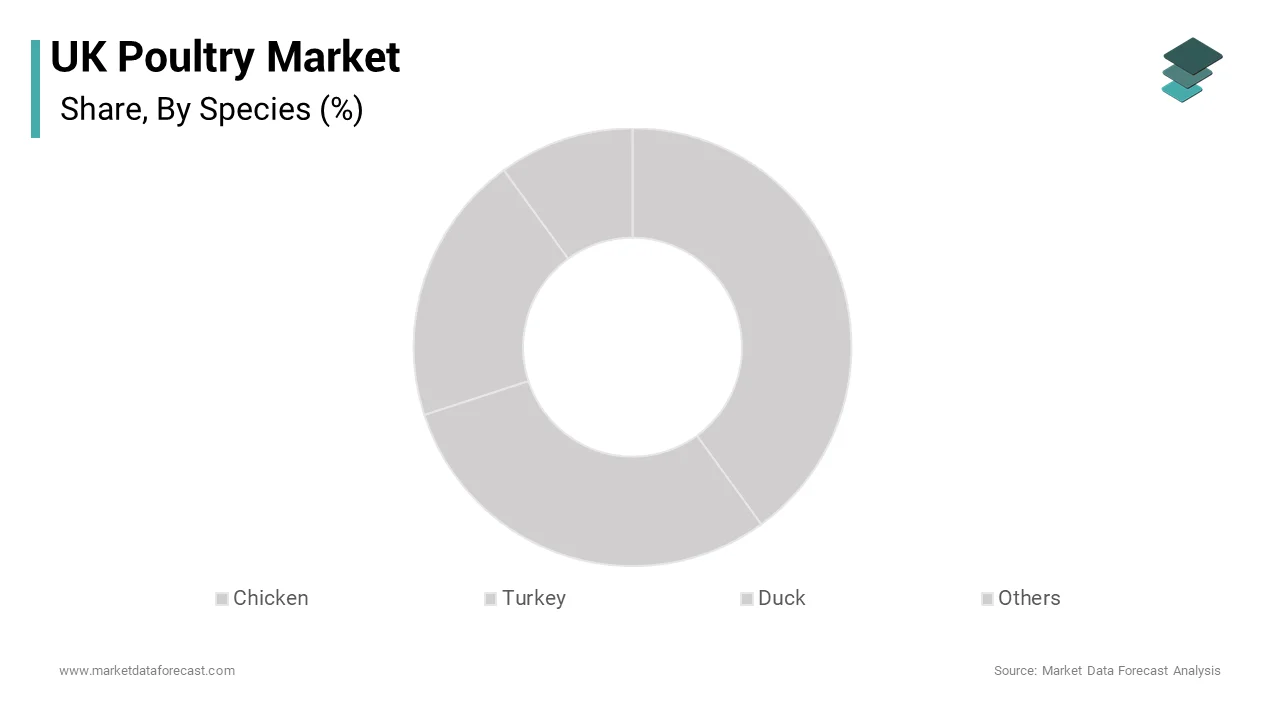
The chicken was the dominant segment by holding 44.6% of the United Kingdom poultry market share in 2025 due to its unparalleled versatility in culinary applications and deep integration into British dietary habits. The mild flavor profile of chicken allows it to absorb spices and marinades effectively appealing to a broad demographic range including children and adults. This adaptability ensures consistent demand across all meal occasions from quick weekday dinners to festive gatherings. The widespread availability of chicken in various forms, such as whole birds, breasts thighs, and wings, further supports its dominance by catering to different budget levels and preparation preferences. Retailers prioritize chicken in their promotions and shelf space allocation recognizing its role as a traffic driver.
The duck segment is likely to expand at a CAGR of 3.5% during the forecast period with the rising popularity of gourmet dining and ethnic cuisines. British consumers are increasingly adventurous in their food choices seeking rich and distinct flavors that differ from standard chicken offerings. Duck meat with its robust taste and tender texture has become a favorite in high end restaurants and home cooking inspired by French Chinese and Southeast Asian culinary traditions. The perception of duck as a premium product appeals to food enthusiasts who view it as a special occasion meat or a way to elevate everyday meals. Social media and cooking shows have played a significant role in demystifying duck preparation encouraging home cooks to experiment with recipes, such as duck confit and roasted duck breast. The association of duck with luxury and indulgence allows producers to command higher margins, while attracting a niche but loyal customer base. This trend is supported by the availability of ready to cook duck products that simplify preparation for time poor consumers.
By Product Insights
The fresh and chilled poultry meat segment was accounted in holding 31.2% of the United Kingdom poultry market share in 2025 due to strong consumer preference for freshness and the culinary flexibility it offers for home cooking. British shoppers traditionally favor buying raw meat to prepare meals from scratch allowing them to control ingredients seasoning and cooking methods. The perception of fresh meat as healthier and more natural compared to processed alternatives drives this dominance. Supermarkets invest heavily in cold chain logistics to ensure that fresh poultry remains safe and high quality from farm to fork maintaining consumer trust. The availability of various cuts such as breasts thighs wings and whole birds caters to diverse recipe requirements ensuring broad appeal. The rise of meal planning and batch cooking trends also supports fresh meat sales as consumers buy larger quantities to prepare multiple meals. Retailers promote fresh poultry through prominent display and competitive pricing reinforcing its status as a staple item. The ability to inspect the quality of fresh meat before purchase provides reassurance to buyers.
The processed poultry segment is esteemed to grow at a fastest CAGR of 4.2% from 2026 to 2034 owing to the increasing demand for convenience and time saving solutions. Modern lifestyles characterized by busy work schedules and limited cooking time have led consumers to seek ready to eat and ready to cook options that minimize preparation effort. Products such as marinated kebabs breaded nuggets sausages and pre-cooked strips offer immediate usability and consistent results. The improvement in formulation techniques has enhanced the taste and texture of processed items, making them more appealing to health conscious consumers who previously avoided them. Clean label processed products with fewer artificial additives are gaining traction addressing previous concerns about ingredient quality. The variety of flavored and seasoned processed poultry options has expanded catering to diverse palates and culinary interests. The availability of these products in convenient packaging sizes suits single person households and small families. The ease of storage and longer shelf life compared to fresh meat also adds to their appeal.
By Distribution Channel Insights
The business to consumer supermarkets and hypermarkets constitute the leading distribution channel for the UK poultry market due to their central role in household grocery procurement. These retail formats offer a one stop shop experience where consumers can purchase poultry alongside other daily necessities ensuring convenience and efficiency. As per data from Nielsen IQ supermarkets account for the vast majority of poultry sales in the United Kingdom reflecting their dominance in the food retail landscape. The extensive network of stores across urban and rural areas ensures wide accessibility for consumers regardless of location. Supermarkets leverage their buying power to offer competitive prices and regular promotions on poultry products which drives high volume sales. The presence of dedicated meat counters and well stocked chillers allows shoppers to select from a wide variety of cuts and brands. According to industry observations the trust in supermarket supply chains for food safety and quality assurance reinforces consumer loyalty. The ability to compare prices and brands easily within the store environment influences purchasing decisions. Supermarkets also invest in private label poultry ranges which offer good quality at lower prices appealing to budget conscious shoppers. The integration of loyalty programs and digital coupons further incentivizes repeat purchases. This channel’s leadership is sustained by its convenience variety and competitive pricing, which align with the shopping habits of the majority of British households.
The online retail segment is ascribed to grow at a fastest CAGR of 8.5% from 2026 to 2034 with the structural shift toward digital grocery shopping and home delivery services. The convenience of ordering poultry online and having it delivered to the doorstep appeals to busy consumers and those with limited mobility. Major supermarkets and specialized online retailers have invested heavily in cold chain logistics to ensure that fresh and frozen poultry arrives in optimal condition. The ability to browse a wider range of products including specialty and organic options online enhances the shopping experience. Subscription services for regular poultry deliveries are gaining popularity among families seeking predictability and convenience. The integration of click and collect services also bridges the gap between online and offline shopping offering flexibility. The expansion of delivery slots and faster turnaround times has improved service reliability encouraging more consumers to switch to online channels.
COMPETITIVE LANDSCAPE
The competition in the UK poultry market is intense and characterized by a high degree of consolidation among a few large integrated producers who dominate the supply chain. These major players leverage economies of scale to offer competitive pricing and consistent quality to large retail chains which hold significant bargaining power. The barrier to entry is high due to substantial capital requirements for farming infrastructure processing facilities and compliance with stringent animal welfare and food safety regulations. Smaller independent producers compete by differentiating themselves through niche offerings such as organic free range or heritage breeds that appeal to ethically conscious consumers. Price competition remains fierce particularly for standard commodity chicken where margins are thin and volatility in feed costs impacts profitability. Innovation in product development such as ready to cook meals and sustainable packaging serves as a key differentiator beyond price. Retailers often use private label poultry to drive footfall forcing branded suppliers to continuously improve value propositions. Collaboration on industry standards coexists with rivalry as all participants work to maintain consumer confidence in British poultry. Success depends on operational efficiency supply chain resilience and the ability to adapt to changing consumer preferences for health convenience and sustainability in a tightly regulated environment.
KEY MARKET PLAYERS
A few of the market players that are dominating the UK poultry market are
- Tyson Foods, Inc. (U.S.)
- JBS S.A. (Brazil)
- 2 Sisters Food Group
- Faccenda Group
- Moy Park
- BRF S.A. (Brazil)
- WH Group Limited (China)
- Sanderson Farms (U.S.)
- Pilgrim’s Pride Corporation (U.S.)
- Perdue Farms Inc. (U.S.)
- Charoen Pokphand Foods Public Company Limited (Thailand)
- Marfrig Global Foods S.A. (Brazil)
- Industrias Bachoco S.A.B. de C.V. (Mexico)
Top Players In The Market
- 2 Sisters Food Group stands as a leading integrated poultry producer in the United Kingdom with extensive operations spanning breeding farming and processing. The company supplies major retailers and food service providers with a wide range of fresh and frozen chicken products. Recently, 2 Sisters has invested heavily in automation technologies to enhance efficiency and reduce labor dependency within its processing facilities. The group has also focused on improving animal welfare standards by upgrading housing systems and implementing advanced health monitoring protocols. Their commitment to sustainability is evident through initiatives aimed at reducing carbon emissions and water usage across the supply chain.
- Faccenda Group operates as a significant independent poultry producer known for its strong focus on vertical integration and high welfare standards. The company manages every stage of the supply chain from hatcheries to processing plants ensuring consistent quality and traceability. Faccenda has recently expanded its free range and organic production capabilities to meet the growing demand for premium poultry products. The group has invested in renewable energy sources such as solar panels and biomass boilers to power its facilities reducing environmental impact. Their strategic partnerships with local farmers support rural economies while securing a reliable supply of raw materials. Faccenda, also emphasizes innovation in packaging solutions to extend shelf life and reduce plastic waste.
- Moy Park is a major poultry processor in the United Kingdom renowned for its large scale operations and export capabilities. The company supplies a significant portion of the UK with fresh chilled and frozen chicken products catering to retail food service and industrial customers. Moy Park has recently implemented advanced data analytics and artificial intelligence tools to optimize production planning and minimize waste. The firm has also strengthened its biosecurity measures to protect flocks from disease outbreaks ensuring business continuity. Investment in employee training and development programs has improved operational safety and productivity, across its sites. Moy Park actively engages in community initiatives and supports local suppliers fostering positive relationships within its operating regions.
Top Strategies Used By Key Market Participants
Key players in the UK poultry market primarily focus on vertical integration to control costs and ensure supply chain stability from farm to fork. Companies invest heavily in automation and robotics to address labor shortages and improve processing efficiency while maintaining high hygiene standards. Sustainability initiatives are central to strategic planning with firms adopting renewable energy sources and reducing plastic packaging to meet environmental targets. Enhancing animal welfare standards through better housing and health management builds consumer trust and complies with strict regulatory requirements. Product innovation drives growth as manufacturers develop value added convenience foods and clean label options to appeal to health conscious shoppers. Strategic partnerships with retailers and food service providers secure long term contracts and stabilize revenue streams.
MARKET SEGMENTATION
This research report on the UK poultry market is segmented and sub-segmented into the following categories.
By Species
- Chicken
- Turkey
- Duck
- Others
By Product Type
- Meat
- Fresh/Chilled
- Processed
- Egg
By Distribution Channel
- B2B
- B2C
- Supermarkets & Hypermarkets
- Convenience Stores
- Online Retail
- Others