- Product Description Description
- Table of Contents TOC
- List of Table & Figure LOT
- Get Free Sample PDF Sample PDF
Market Size, 2025
$1.75 BnMarket Estimate, 2026
$1.83 BnMarket Forecast, 2034
$2.54 BnCAGR, 2026–2034
4.43%UK Projector Market Size, Growth, Trends & Forecast (2026–2034)
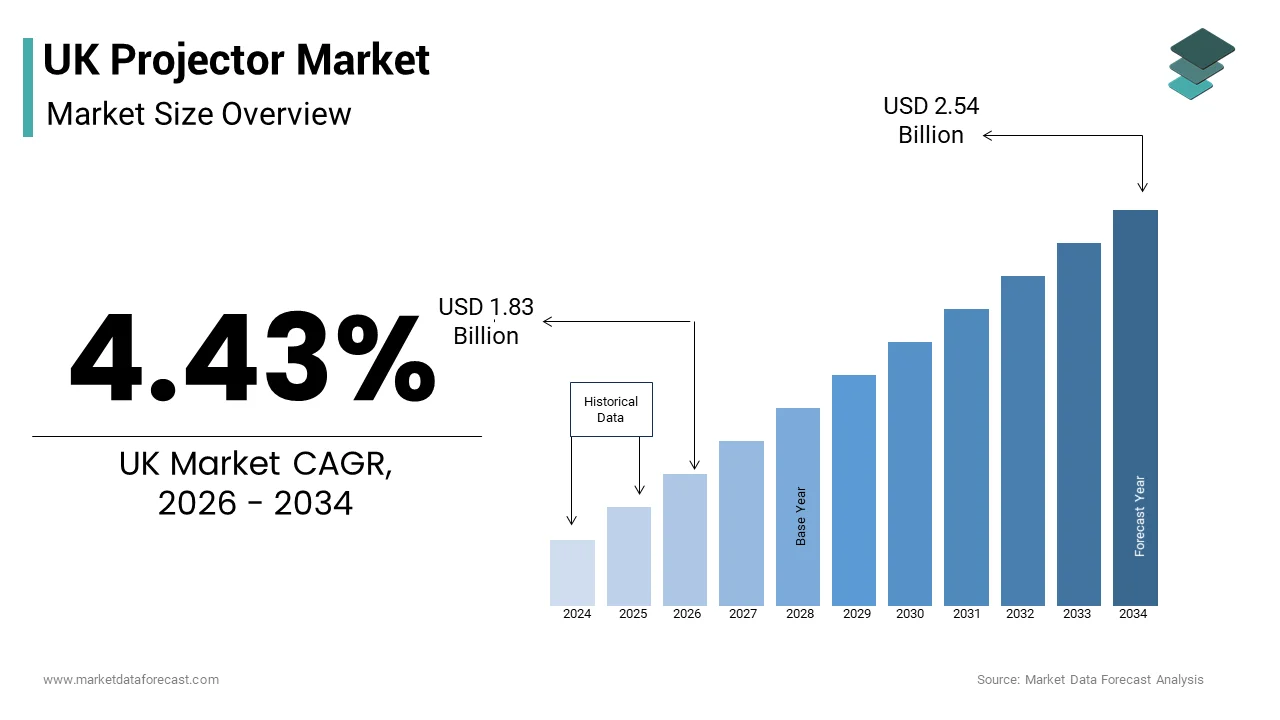
The UK projector market size was valued at USD 1.75 billion in 2025, reached USD 1.83 billion in 2026, and is projected to scale up to USD 2.54 billion by 2034, registering a compound annual growth rate (CAGR) of 4.43% during the forecast period from 2026 to 2034. Driven by the surge in home entertainment, hybrid workplace adoption, and technological shifts toward smart and laser-based portable projection models, the market continues to expand across the United Kingdom.
Key Executive Metrics (At-a-Glance)
- 2025 Base Valuation: USD 1.75 Billion
- 2026 Current Valuation: USD 1.83 Billion
- 2034 Forecast Valuation: USD 2.54 Billion
- Compound Annual Growth Rate (CAGR): 4.43% (2026–2034)
- Dominant Technology Segment: Digital Light Processing (DLP) (45.4% share in 2025)
- Fastest-Growing Technology Segment: Liquid Crystal on Silicon (LCoS) (9.4% CAGR)
- Dominant Type Segment: Normal Throw (65.1% share in 2025)
- Fastest-Growing Type Segment: Ultra Short Throw (11.2% CAGR)
- Dominant Application Segment: Business Application (40.7% share in 2025)
- Fastest-Growing Application Segment: Home Entertainment (8.7% CAGR)
Core Market Drivers
- Home Entertainment Demand: Consumers seeking large-format cinematic experiences (>100 inches) for streaming and gaming without traditional TV spatial limits.
- Hybrid Working & EdTech: Structural shifts toward split office/home workflows and digitalization frameworks across British schools and universities.
Primary Market Restraints & Challenges
- Flat Panel Competition: Rapid price drops and performance gains in large-format smart TVs (55-inch and above) capturing casual viewing share.
- Financial & Logistical Hurdles: High initial investment costs for premium laser systems, recurring lamp maintenance, and global supply chain vulnerabilities.
UK Projector Market Segmentation Highlights
| Segment Category | Leading / Dominant Sub-Segment | Fastest-Growing Sub-Segment |
|---|---|---|
| By Technology | Digital Light Processing (DLP) (45.4% share) | Liquid Crystal on Silicon (LCoS) (9.4% CAGR) |
| By Type | Normal Throw (65.1% share) | Ultra Short Throw (11.2% CAGR) |
| By Application | Business Application (40.7% share) | Home Entertainment (8.7% CAGR) |
Major Industry Players Profiled
Key tech providers and market leaders shaping the UK sector include Acer Inc., Barco NV, BenQ Corp., Canon Inc., Epson United Kingdom Limited, CASIO Computer Co. Ltd., Christie Digital Systems Inc., Hisense International Co. Ltd., InFocus, JVCKENWOOD Corp., LG Electronics Inc., Optoma Corp., Panasonic Holdings Corp., Ricoh Co. Ltd., Samsung Electronics Co. Ltd., Seiko Epson Corp., Sharp Corp., Sony Group Corp., ViewSonic Corp., Vivitek Corp., and XGIMI Technology Co. Ltd.
UK Projector Market Size
The UK project market size was valued at USD 1.75 billion in 2025 and is anticipated to reach USD 1.83 billion in 2026 to reach USD 2.54 billion by 2034, growing at a CAGR of 4.43% during the forecast period from 2026 to 2034.
A projector is an external hardware output device that takes images or video signals generated by a computer, media player, or gaming console and recreates them onto a large, flat surface like a wall or a dedicated projection screen. This market includes a diverse range of devices including portable pico projectors high lumens business units and ultra short throw laser models designed for residential cinemas. The market evolution is driven by technological advancements in light source efficiency resolution standards and connectivity options that enhance user experience across various applications. According to historical data from the Office for National Statistics (ONS), household internet access in Great Britain had already reached 96% by 2020, establishing a broad digital baseline that expanded further by 2024 as gigabit-capable and full-fibre broadband networks rolled out nationwide. As per the Government’s Creative Industries Sector Vision, supported by economic estimates from the Department for Culture, Media and Sport (DCMS), the UK's creative industries generated £126 billion in GVA in 2022, outperforming several traditional manufacturing sectors combined. The shift towards remote and hybrid working models has further integrated projectors into home office setups for collaborative meetings and presentations. Regulatory standards regarding energy efficiency enforced by the Department for Energy Security and Net Zero influence product design encouraging manufacturers to adopt low power consumption technologies. The cultural preference for home entertainment during colder months also sustains seasonal demand spikes. This market reflects broader trends towards immersive experiences flexibility and space optimization as consumers and businesses seek alternatives to fixed flat panel displays.
MARKET DRIVERS
Surge in Home Entertainment and Immersive Viewing Experiences
The growing consumer preference for cinematic experiences within the home environment is a primary driver for the United Kingdom projector market. This is because individuals seek larger screen sizes without the spatial constraints of traditional televisions. According to data from Ofcom, the average person in the United Kingdom spent 4 hours and 30 minutes daily consuming TV and video content at home, driven by significant increases in video-sharing and streaming platform usage. Projectors offer screen sizes exceeding 100 inches at a fraction of the cost of equivalent flat panel displays making them an attractive option for movie enthusiasts and sports fans. The adoption of 4K resolution and High Dynamic Range technologies in modern projectors has significantly improved image quality addressing previous concerns about brightness and clarity. Retailers report increased sales of ultra short throw models which can be placed close to walls reducing installation complexity and shadow interference. The rise of streaming services offering high bitrate content further supports this trend as users seek devices capable of delivering premium visual fidelity. Social gatherings and family movie nights have become central to domestic leisure activities driving investment in home theater setups. Additionally the aesthetic appeal of retractable screens and ceiling mounted units allows for seamless integration into living spaces. This desire for scalable and flexible entertainment solutions ensures sustained growth in the residential segment as consumers prioritize experiential value over conventional hardware.
Expansion of Hybrid Work Models and Educational Digitalization
The widespread adoption of hybrid working arrangements and the digital transformation of educational institutions also contribute to the expansion of the United Kingdom projector market. This significantly boosts demand for professional and portable projectors in the country. According to the Office for National Statistics (ONS), more than a quarter of working adults (28%) engaged in hybrid working patterns, cementing a permanent structural shift toward split home and office environments. Portable projectors with wireless connectivity and auto keystone correction features enable seamless presentations and video conferencing in diverse settings. Schools and universities are increasingly integrating interactive projectors into classrooms to facilitate dynamic learning experiences and remote instruction capabilities. Backed by funding and guidance from the Department for Education, UK schools continue to scale up their integrated educational technology frameworks to enhance teaching delivery and streamline hybrid student communication. The need for flexible meeting spaces in corporate offices drives procurement of compact and high brightness units that can be easily moved between rooms. Government initiatives promoting digital literacy and infrastructure upgrades in public sector institutions further stimulate institutional purchases. The ability to project large formats enhances visibility and engagement during training sessions and workshops. The demand for reliable and high-performance projection solutions remains robust as organizations continue to invest in agile workspaces. Consequently, this trend supports steady growth in the commercial and educational segments.
MARKET RESTRAINTS
Competition from Large Format Flat Panel Displays
The increasing affordability and availability of large format flat panel displays are major restraints to the United Kingdom projector market. Such displays offer convenient alternatives with superior brightness and ease of use. Research indicates a growing global consumer preference shifting toward 55-inch and larger smart TVs, as manufacturing efficiencies lower retail prices for Ultra High Definition displays. Flat panels provide consistent image quality regardless of ambient lighting conditions eliminating the need for controlled environments required by most projectors. The simplicity of plug and play installation appeals to users who lack technical expertise or desire minimal setup effort. Modern OLED and QLED technologies deliver exceptional contrast ratios and color accuracy that challenge the visual performance of mid range projectors. The slim profile of flat screens fits seamlessly into contemporary interior designs without requiring additional mounting infrastructure or screen surfaces. Consumers often perceive televisions as more versatile for general viewing including news gaming and casual browsing whereas projectors are seen as specialized devices for specific occasions. This perception limits the frequency of use and justifies the higher initial investment for many households. Additionally the longevity and lower maintenance requirements of solid state panels reduce long term ownership costs compared to projector lamps or laser modules. These factors collectively constrain market expansion as buyers opt for the convenience and reliability of traditional display technologies.
High Initial Costs and Maintenance Requirements
Significant initial investment costs and ongoing maintenance requirements are substantial barriers to entry for potential customers in the United Kingdom projector market. This limits widespread adoption among price sensitive segments. High performance projectors featuring 4K resolution laser light sources and advanced lens shift capabilities often command premium prices exceeding 2000 pounds placing them out of reach for average consumers. According to the Office for National Statistics (ONS), median household disposable income in the UK remained largely stagnant, posting a statistically non-significant real-terms increase of 0.8%. Traditional lamp based projectors require periodic bulb replacements every 2000 to 5000 hours adding to the total cost of ownership and operational inconvenience. Laser models while longer lasting involve complex cooling systems that may require professional servicing if failures occur. The need for additional accessories such as motorized screens mounting brackets and high quality HDMI cables further increases the overall expenditure. Installation complexities including ceiling wiring and calibration deter DIY enthusiasts who prefer straightforward solutions. Small businesses and educational institutions with tight budgets often delay upgrades due to these financial burdens opting instead to extend the lifecycle of existing equipment. The perceived risk of technological obsolescence also discourages early adoption as consumers wait for prices to stabilize. These economic and logistical hurdles suppress demand particularly in the entry level and mid tier segments where value for money is paramount.
MARKET OPPORTUNITIES
Integration of Smart Features and Internet of Things Connectivity
Smart operating systems and Internet of Things connectivity offer a lucrative opportunity to capture tech-savvy consumers in the country, which is expected to fuel the growth of the United Kingdom projector market. By utilizing these technologies, projector manufacturers can easily differentiate their products in a competitive market. According to infrastructure reports from Ofcom, fixed gigabit-capable broadband networks expanded rapidly to reach 83% of all UK households, driven by the accelerated commercial rollout of full-fibre connectivity. Modern projectors equipped with Android TV or proprietary smart platforms allow users to access popular streaming services directly without external media players enhancing convenience and user experience. Voice control compatibility with assistants such as Amazon Alexa and Google Home enables hands free operation appealing to users seeking integrated smart home ecosystems. The ability to cast content wirelessly from smartphones and laptops facilitates spontaneous presentations and entertainment sharing. Manufacturers can leverage software updates to introduce new features and improve performance over time extending product relevance and customer satisfaction. Partnerships with content providers and app developers create exclusive bundles that add value to hardware purchases. The rise of gaming projectors with low latency modes opens new revenue streams by targeting the extensive gaming community in the United Kingdom. Data analytics from connected devices offer insights into usage patterns enabling personalized recommendations and targeted marketing. This technological convergence transforms projectors from passive display units into interactive hubs driving innovation and fostering brand loyalty in a competitive landscape.
Growth in Outdoor and Portable Projection Solutions
The rising popularity of outdoor events and mobile entertainment sets the stage for the development and sale of portable and ruggedized projector solutions, which is likely to accelerate the expansion of the United Kingdom projector market. VisitBritain indicate a steady post-pandemic stabilization in domestic holiday planning, with British travelers demonstrating a strong preference for localized, community-driven event experiences and outdoor entertainment. Compact pico projectors with built in batteries and speakers cater to consumers seeking flexibility for camping trips garden parties and impromptu gatherings. The trend towards experiential leisure drives demand for durable units that can withstand varying weather conditions and provide adequate brightness in semi lit environments. Retailers can capitalize on this by offering bundled packages including portable screens and carrying cases. Corporate events and pop up marketing activations also utilize portable projectors for dynamic displays in non traditional venues. Advances in LED technology have improved the brightness and battery life of small form factor devices making them viable for daytime use in shaded areas. The social media appeal of unique outdoor viewing experiences encourages word of mouth promotion and viral marketing. Manufacturers focusing on rugged design and ease of setup can capture this niche market segment. Consumers now prioritize memorable experiences over material possessions. As a result, the demand for versatile projection tools that enable shared moments continues to grow, offering a distinct avenue for market expansion.
MARKET CHALLENGES
Supply Chain Disruptions and Component Shortages
Global supply chain disruptions and shortages of critical electronic components are a persistent challenge to the United Kingdom projector market. These hindrances are affecting production timelines and inventory availability. According to manufacturing data compiled by the Office for National Statistics (ONS), the UK's industrial input and output producer price indices fluctuated due to shifts in global supply chains, logistical bottlenecks, and energy costs. Projectors rely heavily on specialized chips for image processing and light source control which face prolonged lead times from Asian manufacturers. Delays in shipping containers and port congestion exacerbate these issues causing stockouts of popular models during peak demand periods such as holiday seasons. Small and medium sized distributors lack the bargaining power to secure priority allocation leaving them vulnerable to supply gaps. The unpredictability of component availability hinders long term planning and forces companies to hold higher inventory levels increasing working capital requirements. Currency fluctuations between the pound sterling and major trading currencies further complicate procurement costs affecting profit margins. Manufacturers struggle to pass on sudden cost increases to retailers resulting in compressed profitability. Diversifying supplier bases is a slow process requiring rigorous quality validation and compliance checks. These operational uncertainties disrupt market stability and limit the ability of companies to meet consumer demand consistently forcing them to prioritize high margin products over volume growth.
Rapid Technological Obsolescence and Consumer Hesitancy
The rapid pace of technological advancement in display technologies leads to frequent product obsolescence creating consumer hesitancy and reducing replacement cycles in the United Kingdom projector market. Data compiled by environmental monitors indicates that the United Kingdom generates approximately 1.6 million tonnes of electronic waste annually, highlighting an urgent public and corporate need for sustainable tech life cycles, second-hand reuse markets, and circular economy practices. Buyers often delay purchases anticipating better specifications or lower prices in the near future leading to extended lifecycles for existing devices. The emergence of new standards such as 8K resolution and High Refresh Rates renders current 4K models less appealing despite their adequate performance for most applications. Marketing claims regarding brightness and contrast ratios can be misleading causing confusion and dissatisfaction among non technical consumers. The lack of standardized metrics for comparing different projection technologies makes informed decision making difficult. Retailers face challenges in managing inventory as older models lose value quickly upon the release of newer versions. This dynamic pressures manufacturers to continuously innovate while balancing cost efficiency and sustainability goals. Consumer trust erodes if perceived value diminishes rapidly after purchase leading to brand switching. The market must address these concerns through transparent communication and modular designs that allow for incremental upgrades rather than complete replacements to sustain long term engagement.
REPORT COVERAGE
| REPORT METRIC | DETAILS |
| Market Size Available | 2025 to 2034 |
| Base Year | 2025 |
| Forecast Period | 2026 to 2034 |
| CAGR | 4.43% |
| Segments Covered | By Technology, Type, Application, Country |
| Various Analyses Covered | Global, Regional, and Country Level Analysis, Segment-Level Analysis; DROC, PESTLE Analysis; Porter’s Five Forces Analysis; Competitive Landscape; Analyst Overview of Investment Opportunities. |
| Regions Covered | London, South East, North West, East of England, South West, Scotland, West Midlands, Yorkshire and The Humber, East Midlands, Others |
| Market Leaders Profiled | Acer Inc., Barco NV, BenQ Corp., Canon Inc., Epson United Kingdom Limited, CASIO Computer Co. Ltd., Christie Digital Systems Inc., Hisense International Co. Ltd., InFocus, JVCKENWOOD Corp., LG Electronics Inc., Optoma Corp., Panasonic Holdings Corp., Ricoh Co. Ltd., Samsung Electronics Co. Ltd., Seiko Epson Corp., Sharp Corp., Sony Group Corp., ViewSonic Corp., Vivitek Corp, XGIMI Technology Co. Ltd. |
SEGMENTAL ANALYSIS
By Technology Insights
The digital Light Processing (DPL) technology segment dominated the United Kingdom projector market and accounted for a 45.4% share in 2025. Its superior contrast ratios compact design and reliability in diverse lighting conditions drive the dominance of this segment. Research indicates that Digital Light Processing (DLP) technology remains the leading architecture for mainstream projectors in the United Kingdom, driven by widespread adoption in enterprise meeting rooms, classrooms, and entry-to-mid-tier home cinemas. The dominance of this segment is also supported by the sealed optical engine design which prevents dust accumulation and ensures consistent image quality over time reducing maintenance costs for users. This feature is particularly valued in educational institutions and corporate environments where devices are used frequently and require minimal downtime. The high native contrast ratio of DLP chips delivers deep blacks and vibrant colors enhancing the viewing experience for movies and presentations alike. Manufacturers leverage the small form factor of DLP chips to create portable pico projectors that appeal to mobile professionals and travelers. The technology supports high refresh rates making it suitable for gaming applications which represent a growing niche within the consumer market. Additionally the absence of liquid crystals eliminates issues such as image retention or burn in ensuring longevity. The established supply chain and economies of scale allow manufacturers to offer competitive pricing across various performance tiers. This combination of durability visual fidelity and versatility ensures that DLP remains the preferred choice for a broad spectrum of users seeking dependable projection solutions.
On the other hand, the liquid Crystal on Silicon technology segment is predicted to witness the highest CAGR of 9.4% between 2026 and 2034. This swift growth of the segment is fueled by increasing demand for premium home cinema experiences where image smoothness and color accuracy are paramount. Studies indicate that LCoS-based projection systems continue to hold a dedicated niche in the premium UK home cinema market, favored by home theater enthusiasts for their superior contrast and native high-resolution capabilities. LCoS technology combines the benefits of LCD and DLP by offering high resolution without the screen door effect often associated with other technologies. This results in exceptionally sharp and natural images that closely mimic film projection appealing to cinephiles and professional calibrators. The adoption of laser light sources in LCoS models has further enhanced brightness and color gamut coverage meeting the standards for High Dynamic Range content. Retailers report strong interest in ultra short throw LCoS units which fit seamlessly into modern living rooms without requiring ceiling mounts. The decline in manufacturing costs due to improved yield rates has made these previously niche products more accessible to upper middle class households. Marketing campaigns emphasizing cinematic authenticity and technical superiority resonate with discerning buyers who prioritize visual perfection. As streaming services offer higher bitrate content the capability of LCoS projectors to render fine details becomes increasingly valuable driving sustained adoption in the premium residential segment.
By Type Insights
The normal throw segment led the United Kingdom projector market and captured a 65.1% share in 2025. This leading position of the segment was attributed to its versatility and cost effectiveness across various applications. Procurement data shows that standard and short-throw projection systems remain widely utilized in UK educational institutions, balancing legacy classroom infrastructures with cost-effective display scalability. These projectors offer a wide range of lens options allowing installers to customize throw ratios for different venue sizes from small meeting rooms to large lecture halls. The mature technology behind normal throw designs ensures competitive pricing making them accessible for budget constrained public sector procurement. Businesses favor these units for conference rooms where ceiling mounting provides a clean aesthetic and unobstructed walkways. The availability of high brightness models enables usage in well lit environments without significant image degradation. Consumers also prefer normal throw projectors for dedicated home theater rooms where space allows for optimal placement behind seating areas. The extensive ecosystem of compatible screens and mounting hardware simplifies installation and upgrades. Manufacturers continue to innovate in this segment by integrating smart features and wireless connectivity while maintaining affordability. The familiarity of users with setup procedures reduces support costs and enhances satisfaction. This broad applicability across education business and residential sectors ensures that normal throw projectors remain the backbone of the UK projection infrastructure.
However, the ultra short throw segment is estimated to register the fastest CAGR of 11.2% during the forecast period due to space saving benefits and ease of installation in urban homes. These projectors can be placed just inches from the wall eliminating shadows cast by presenters or viewers and reducing cable clutter. The integration of laser light sources in many ultra short throw units provides instant on off capabilities and long lifespan appealing to convenience focused users. Interactive features in educational and business models transform walls into collaborative whiteboards enhancing engagement in hybrid learning and working environments. Retailers promote these devices as television replacements highlighting their ability to deliver 100 inch images in compact footprints. The aesthetic appeal of sleek designs that blend with modern interior decor drives adoption among style conscious consumers. Government initiatives promoting digital classrooms have also boosted institutional purchases of interactive ultra short throw systems. As urbanization continues and living spaces shrink the demand for efficient display solutions will sustain the rapid expansion of this segment offering significant opportunities for innovation in optics and software integration.
By Application Insights
In 2025, the business application segment held the majority share of 40.7% of the United Kingdom projector market because of the persistent need for effective communication and collaboration tools in corporate environments. According to corporate data from the Office for National Statistics (ONS), the United Kingdom's enterprise landscape comprises approximately 5.6 million active business entities, forming a large market for commercial infrastructure and communication technologies. Despite the rise of digital screens projectors remain preferred for large group settings where visibility and impact are crucial. Conference rooms boardrooms and training facilities rely on high brightness and high resolution projectors to ensure clarity in well lit conditions. The shift towards hybrid work models has increased demand for versatile units that support wireless casting and video conferencing integration. Companies invest in durable and low maintenance models to minimize operational disruptions and total cost of ownership. Professional installation services and managed print solutions often bundle projectors as part of comprehensive office technology packages. The financial sector legal firms and consultancies drive premium sales by seeking high end models with advanced security features and seamless connectivity. Regular replacement cycles due to technological upgrades and wear contribute to steady revenue streams. The emphasis on professional image and effective storytelling in business contexts ensures that projectors remain indispensable tools for corporate communication sustaining their dominance in the application landscape.
On the contrary, the home entertainment segment is anticipated to witness the fastest CAGR of 8.7% from 2026 to 2034 owing to the desire for immersive cinematic experiences within domestic settings. Consumers are increasingly converting spare rooms basements and gardens into dedicated viewing areas equipped with high fidelity audio and visual systems. The availability of affordable 4K laser projectors has lowered the barrier to entry enabling middle income families to achieve theater quality results. Streaming services offering exclusive high definition content encourage users to upgrade their hardware to fully appreciate visual details. Social trends such as movie nights and sports viewing parties foster communal experiences that benefit from large screen formats. Retailers support this growth by offering bundled packages including screens speakers and calibration services. The aesthetic flexibility of projectors allows them to be hidden when not in use preserving living space aesthetics unlike permanent television installations. Gaming enthusiasts also contribute to this surge by seeking low latency models for immersive gameplay. As home becomes the primary center for leisure the demand for premium projection systems continues to accelerate offering robust opportunities for specialized consumer electronics brands.
COUNTRY ANALYSIS
The United Kingdom was positioned second in the European projector market and occupied a 15.6% share in 2025. This position of the UK market was driven by high adoption rates in both professional and residential sectors. The market shows a strong emphasis on quality innovation and sustainability reflecting the discerning nature of British consumers and stringent regulatory standards. This market share exhibits its economic strength and technological readiness. According to provisional economic estimates by the Department for Culture, Media and Sport (DCMS), its covered sectors, driven primarily by the creative industries, contributed an estimated £247.6 billion to the UK economy, accounting for 9.4% of the nation's total Gross Value Added (GVA). High broadband penetration and early adoption of streaming services create a favorable environment for connected projection devices. The education sector remains a key driver with government funding supporting digital classroom initiatives across state schools. Corporate investment in agile workspaces fuels demand for portable and interactive solutions. The presence of major global distributors and specialized AV integrators ensures wide product availability and expert support. Regulatory frameworks promoting energy efficiency encourage the shift towards laser and LED light sources reducing environmental impact. The cultural appreciation for cinema and live sports sustains residential demand for large format displays. Post Brexit trade adjustments have led to diversified sourcing strategies enhancing supply chain resilience. The United Kingdom serves as a trendsetter for premium home cinema and smart office solutions influencing broader European consumption patterns and setting benchmarks for product quality and user experience.
COMPETITIVE LANDSCAPE
The competition within the United Kingdom projector market is intense characterized by established global brands and agile niche players vying for dominance across residential and commercial sectors. Large multinational corporations leverage economies of scale and extensive distribution networks to maintain visibility in retail and business channels. Specialized manufacturers differentiate through superior image quality innovative features and targeted marketing towards enthusiasts and professionals. Price competition remains fierce in the entry level segment while premium markets focus on performance and brand prestige. The rise of large format televisions poses a significant threat forcing projector makers to emphasize unique value propositions such as screen size flexibility and portability. Rapid technological advancements require continuous investment in research and development to stay ahead of obsolescence. Supply chain efficiency and component availability are critical competitive advantages affecting delivery times and cost structures. Customer service and after sales support play pivotal roles in retaining institutional clients who prioritize reliability. The market demands agility and strategic foresight to navigate changing consumer preferences and regulatory landscapes effectively.
KEY MARKET PLAYERS
A powerful dominating market players that are in the UK projector market are
- Acer Inc.
- Barco NV
- BenQ Corp.
- Canon Inc.
- Epson United Kingdom Limited
- CASIO Computer Co. Ltd.
- Christie Digital Systems Inc.
- Hisense International Co. Ltd.
- InFocus
- JVCKENWOOD Corp.
- LG Electronics Inc.
- Optoma Corp.
- Panasonic Holdings Corp.
- Ricoh Co. Ltd.
- Samsung Electronics Co. Ltd.
- Seiko Epson Corp.
- Sharp Corp.
- Sony Group Corp.
- ViewSonic Corp.
- Vivitek Corp
- XGIMI Technology Co. Ltd.
Top Players In The Market
- Epson maintains a dominant presence in the United Kingdom projector market through its innovative 3LCD technology and strong commitment to sustainability. The company offers a diverse portfolio ranging from compact home cinema models to high brightness business units. Recent initiatives include launching laser based projectors with reduced energy consumption aligning with environmental regulations. Epson has strengthened its position by partnering with educational institutions to provide interactive learning solutions. The brand emphasizes reliability and low maintenance which appeals to corporate clients seeking long term value. Investment in local customer support and technical training ensures superior service quality. Epson continues to innovate in ultra short throw technology catering to space constrained urban homes. These efforts reinforce its reputation as a trusted provider of high quality visual display solutions for diverse sectors.
- BenQ operates as a key player in the United Kingdom focusing on specialized segments such as gaming home entertainment and professional design. The company leverages its expertise in color accuracy to attract creative professionals and cinephiles who demand precise image reproduction. Recent actions involve expanding its range of smart projectors with integrated Android TV systems for seamless streaming experiences. BenQ has introduced low latency models specifically designed for console gaming capturing a growing niche market. Marketing campaigns highlight eye care technologies that reduce strain during prolonged use appealing to health conscious consumers. Partnerships with local retailers ensure wide availability and competitive pricing strategies. The brand actively engages with online communities to gather feedback and drive product improvements. This customer centric approach strengthens brand loyalty and differentiates BenQ in a crowded marketplace.
- Optoma contributes significantly to the United Kingdom projector market by offering robust and versatile solutions for business education and residential use. The company is known for its durable DLP projectors that deliver high contrast and reliable performance in various lighting conditions. Recent strategies include enhancing its portfolio of ultra short throw lasers for interactive classrooms and modern living rooms. Optoma has invested in wireless presentation technologies facilitating easier connectivity for hybrid work environments. The firm collaborates with system integrators to provide tailored solutions for large venues and conference centers. Focus on user friendly interfaces and quick setup features appeals to non technical users. Optoma also prioritizes after sales support and warranty services to build trust with institutional buyers. These measures ensure sustained growth and relevance in the evolving projection landscape.
Top Strategies Used By Key Market Participants
Key players in the United Kingdom projector market employ product differentiation strategies by focusing on specific niches such as gaming education or home cinema to capture targeted demographics. Innovation in light source technology particularly the shift towards laser and LED systems drives competitiveness by offering longer lifespans and lower maintenance. Strategic partnerships with content providers and smart home platforms enhance ecosystem integration and user convenience. Sustainability initiatives including energy efficient designs and recyclable packaging align with regulatory requirements and consumer values. Digital marketing and direct to consumer sales channels expand reach and improve margin control. Customer service excellence through extended warranties and technical support builds brand loyalty and trust. Continuous research and development ensure rapid adaptation to emerging standards such as 4K and High Dynamic Range. These combined approaches enable companies to maintain relevance and profitability in a dynamic and technology driven market environment.
MARKET SEGMENTATION
This research report on the UK projector market is segmented and sub-segmented into the following categories.
By Technology
- LCD
- DLP
- LCoS
By Type
- Short
- Ultra short
- Normal
By Application
- Business
- Education
- Home
- Cinema