- Product Description Description
- Table of Contents TOC
- List of Table & Figure LOT
- Get Free Sample PDF Sample PDF
Market Size, 2025
$46.02 BnMarket Estimate, 2026
$49.31 BnMarket Forecast, 2034
$85.69 BnCAGR, 2026–2034
3.84%UK Software Market Report Summary
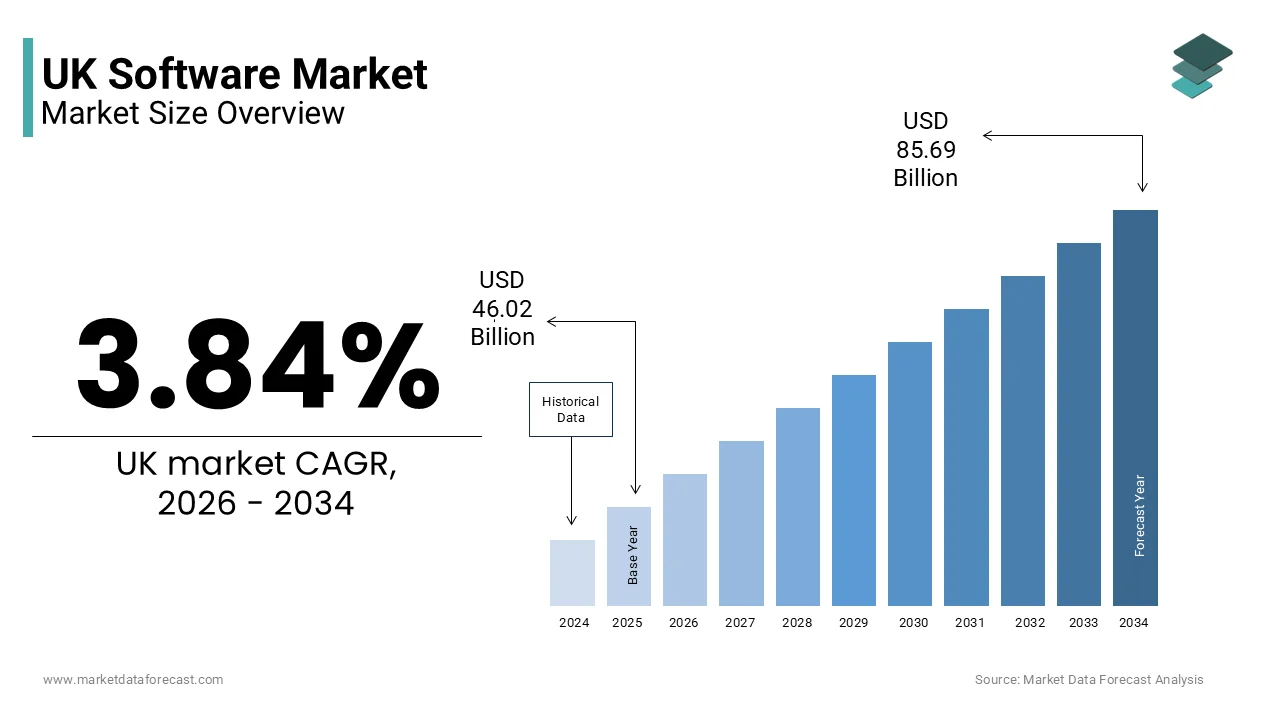
The UK software market was valued at USD 46.02 billion in 2025 and is estimated to reach USD 49.31 billion in 2026. The market is projected to reach USD 85.69 billion by 2034, growing at a CAGR of 3.84% during the forecast period from 2026 to 2034. The growth of the UK software market is driven by accelerating digital transformation initiatives across industries, increasing adoption of cloud-based solutions, and rising demand for automation and data analytics tools. The growing integration of artificial intelligence, cybersecurity solutions, and enterprise software platforms is further supporting market expansion. Additionally, increasing investments in digital infrastructure and the rapid adoption of remote and hybrid work models are creating significant opportunities for software vendors across the United Kingdom.
Key Market Trends
-
Growing adoption of cloud-based software solutions to improve scalability, flexibility, and operational efficiency.
-
Increasing integration of artificial intelligence and machine learning technologies into enterprise software platforms.
-
Rising demand for cybersecurity software driven by growing concerns over data privacy and cyber threats.
-
Expansion of software-as-a-service (SaaS) business models across organizations of all sizes.
-
Increasing investment in automation, business intelligence, and customer experience management solutions.
Segmental Insights
- Based on type, the office software segment was the largest and held 54.2% of the UK software market share in 2025. The segment’s dominance is attributed to the widespread use of productivity applications, collaboration tools, document management solutions, and communication platforms across businesses, educational institutions, and government organizations.
- Based on enterprise type, the customer relationship management (CRM) software segment accounted for 44.7% of the market share in 2025. The segment's leadership is driven by the growing need for businesses to enhance customer engagement, streamline sales processes, improve customer retention, and leverage data-driven decision-making.
- Based on industry, the Banking, Financial Services, and Insurance (BFSI) sector was the dominant segment in the UK software market, accounting for 35.4% of the market share in 2025. The segment's growth is supported by increasing investments in digital banking platforms, cybersecurity solutions, regulatory compliance software, and advanced analytics technologies.
Regional Insights
The UK software market is experiencing strong growth across the country, supported by widespread digitalization, increasing technology investments, and the growing adoption of cloud and enterprise software solutions.
-
England remains the largest contributor to the UK software market, driven by the concentration of technology companies, financial institutions, multinational corporations, and innovation hubs.
-
London serves as the primary software and technology center, supported by a strong startup ecosystem, venture capital investments, and high demand for enterprise software solutions.
-
Scotland is witnessing increasing software adoption across financial services, healthcare, and public sector organizations.
-
Wales and Northern Ireland are emerging as important markets due to growing digital transformation initiatives and increasing investments in technology infrastructure.
Competitive Landscape
The UK software market is highly competitive and characterized by the presence of global technology leaders and established domestic software providers. Companies are focusing on cloud computing, artificial intelligence, cybersecurity, data analytics, and industry-specific software solutions to strengthen their market positions. Strategic partnerships, acquisitions, product innovation, and investments in SaaS platforms remain key competitive strategies across the market. Prominent players in the UK software market include Microsoft, Oracle, SAP, IBM, Adobe, Intuit, VMware, The Sage Group plc, Darktrace plc, Softcat plc, Kainos Group plc, Endava plc, Salesforce, ServiceNow, Workday, and Cisco Systems.
UK Software Market Size
The UK software market size was valued at USD 46.02 billion in 2025, and is projected to reach USD 85.69 billion by 2034 from USD 49.31 billion in 2026, growing at a CAGR of 3.84%.
The software is the national digital economy encompassing enterprise resource planning customer relationship management cybersecurity solutions and specialized industry applications. The robust ecosystem of global technology giants innovative startups and specialized independent software vendors catering to both domestic and international clients. As per the study, the digital sector contributed 12.4% to the UK gross value added in 2023 with its economic significance. Consumer and enterprise reliance on digital tools has intensified following widespread adoption of remote work models and cloud computing architectures. Many UK households had access to fixed broadband services in 2024, facilitating seamless deployment of software solutions. The government’s digital strategy emphasizes technological sovereignty and innovation driving investment in artificial intelligence and data analytics capabilities. The prevalence of high-speed connectivity supports real time collaboration and complex computational tasks essential for modern software functionality. Regulatory frameworks such as the Data Protection Act ensure secure handling of information fostering trust in digital transactions. The integration of software into everyday business practices reflects a broader societal shift toward digitization, where efficiency and scalability are paramount considerations for organizational success and competitive advantage in a globalized marketplace.
MARKET DRIVERS
Accelerated Digital Transformation Across Enterprise Sectors
The imperative for operational efficiency and competitive agility has compelled organizations to prioritize comprehensive digital transformation initiatives driving substantial demand for enterprise software solutions. The accelerated digital transformation across enterprise sectors is driving the growth of the United Kingdom software market. Companies are increasingly replacing legacy systems with modern cloud based platforms that offer scalability flexibility and enhanced data accessibility. The manufacturing sector has seen significant adoption of industrial internet of things software which enables predictive maintenance and real time monitoring of production lines. Financial services firms are leveraging advanced software for regulatory compliance fraud detection and personalized customer experiences maintaining their position as leading adopters. The retail industry utilizes inventory management and customer engagement platforms to optimize supply chains and enhance shopper loyalty. Small and medium enterprises are also participating in this trend utilizing affordable software as a service models to access enterprise grade capabilities without heavy upfront capital expenditure. This widespread modernization effort creates sustained demand for implementation consulting and ongoing support services further stimulating market growth.
Rising Adoption Of Artificial Intelligence And Machine Learning Technologies
The integration of artificial intelligence and machine learning capabilities into software applications is another factor boosting the growth of the United Kingdom software market. Organizations are seeking intelligent solutions that can automate complex decision-making processes analyze large datasets and provide predictive insights to enhance strategic planning. Customer service sectors are deploying chatbots and virtual assistants powered by natural language processing to handle inquiries efficiently and reduce operational costs. The healthcare industry utilizes diagnostic software enhanced by machine learning algorithms to improve accuracy in medical imaging and patient risk assessment. According to the study, over 400 artificial intelligence technologies were approved for use in clinical settings by 2024, demonstrating regulatory acceptance and practical utility. Marketing teams leverage predictive analytics software to personalize campaigns and optimize return on investment by targeting specific consumer segments with precision. The financial sector employs algorithmic trading platforms and credit scoring models that rely on sophisticated machine learning techniques to manage risk and identify opportunities. This technological evolution requires continuous updates and specialized training creating opportunities for software vendors to offer premium features and support services.
MARKET RESTRAINTS
Acute Shortage Of Skilled Technical Talent And Workforce Constraints
The persistent shortage of skilled professionals capable of developing implementing and maintaining complex systems is majorly hindering the growth of the United Kingdom software market. The rapid pace of technological advancement has outstripped the supply of qualified developers data scientists and cybersecurity experts creating hurdles in project delivery and innovation. Recruitment challenges force companies to compete aggressively for limited talent pools driving up salary expectations and increasing operational costs. Small and medium enterprises often struggle to attract top tier professionals, who prefer opportunities with larger corporations offering better benefits and career progression. This constraint delays software deployment timelines and compromises the quality of implementations as organizations rely on less experienced staff or external consultants. The reliance on international recruitment has been complicated by post Brexit immigration policies adding administrative burdens and uncertainty to hiring processes. Educational institutions are working to align curricula with industry needs but the lag time means immediate demands remain unmet.
Complex Regulatory Compliance And Data Sovereignty Requirements
The complex regulatory compliance and data sovereignty laws is also attributed in degrading the growth of the United Kingdom software market. The General Data Protection Regulation alongside domestic legislation, such as the Data Protection Act imposes strict requirements on how personal data is collected stored and processed. Software providers must invest heavily in security infrastructure encryption protocols and audit mechanisms to ensure adherence to these standards increasing development costs and time. Cross border data transfers have become particularly complex following changes in international agreements requiring additional legal safeguards and technical measures. Many legal firms reported increased complexity in advising clients on data compliance issues in 2024. These regulatory burdens disproportionately affect smaller vendors, who lack the resources to maintain dedicated compliance teams. Furthermore, evolving regulations regarding artificial intelligence ethics and algorithmic transparency introduce new layers of uncertainty requiring continuous adaptation of software architectures. The fear of penalties and reputational damage leads some organizations to delay adoption of innovative solutions until regulatory clarity is achieved.
MARKET OPPORTUNITIES
Expansion Of Cloud Native Solutions And Hybrid Infrastructure Models
The transition toward cloud native architectures and hybrid infrastructure models, as organizations seek greater flexibility and resilience is creating new opportunities for the growth of the United Kingdon software market. Businesses are moving away from monolithic on-premise systems toward modular microservices that can be deployed and scaled independently across multiple cloud environments. This shift creates demand for software tools that facilitate containerization orchestration and seamless integration between public and private clouds. Vendors offering platform as a service solutions enable developers to build and deploy applications rapidly without managing underlying infrastructure complexities. The healthcare and financial sectors are particularly interested in hybrid models that allow sensitive data to remain on premise while leveraging cloud computing power for analytics and non critical workloads. Disaster recovery and business continuity planning also drive adoption as hybrid setups provide redundancy against localized failures. Software companies that offer robust management consoles and security features tailored for hybrid environments can capture significant market share. This trend encourages innovation in edge computing solutions where processing occurs closer to data sources reducing latency for real time applications. The ongoing modernization of IT estates ensures long term demand for cloud compatible software tools and services.
Growth In Cybersecurity Software Due To Escalating Threat Landscapes
The escalating frequency and sophistication of cyber attacks, as organizations prioritize digital defense mechanisms is also to enhance the growth of the United Kingdom software market. Ransomware phishing and supply chain attacks have become prevalent threats compelling businesses to invest in advanced protection solutions. Endpoint detection and response software identity access management systems and network monitoring tools are seeing increased adoption across all sectors. The financial services industry leads this trend due to strict regulatory requirements and high value targets but retail and manufacturing sectors are rapidly catching up. Zero trust architecture principles are driving demand for software that verifies every user and device before granting access regardless of location. Managed security service providers are partnering with software vendors to offer comprehensive packages that include threat intelligence and incident response capabilities. The rise of remote work has expanded the attack surface making cloud security software essential for protecting distributed workforces. Innovations in artificial intelligence driven threat detection allow for real time identification and mitigation of anomalies providing a competitive edge for vendors, who can demonstrate superior efficacy.
MARKET CHALLENGES
Integration Complexities With Legacy Systems And Technical Debt
The organizations are integrating modern software solutions with existing legacy systems that form the backbone of their operations, which is likely to act as a barrier for the expansion of the United Kingdom software market. Many established enterprises rely on outdated infrastructure that lacks application programming interfaces or compatibility with contemporary cloud based applications. This technical debt requires extensive customization and middleware development to ensure data flows seamlessly between old and new systems increasing project costs and timelines. The risk of data inconsistency and system failures during migration phases discourages some organizations from pursuing necessary upgrades. Financial institutions and government bodies often operate on mainframe systems that are difficult to replace due to dependencies and regulatory constraints. The scarcity of professionals skilled in maintaining legacy technologies further complicates these efforts creating knowledge gaps. Poorly executed integrations can lead to operational disruptions and data loss damaging business continuity and customer trust. Vendors must invest in robust connectors and migration tools but complete compatibility remains elusive.
Economic Uncertainty And Budgetary Constraints On IT Spending
The economic volatility and inflationary pressures, as organizations reassess and often reduce their information technology expenditures, which is another factor to decline the growth of the United Kingdom software market. Rising operational costs and uncertain economic forecasts compel businesses to prioritize essential spending over discretionary software investments. Companies are extending the lifecycle of existing software licenses and delaying upgrades to conserve cash flow impacting revenue projections for vendors. Subscription based models face churn risks as customers downgrade plans or cancel services to cut costs. Small and medium enterprises are particularly vulnerable lacking the financial buffers to sustain long term software contracts during downturns. This environment intensifies competition among software providers forcing them to offer deeper discounts and flexible payment terms that compress profit margins. Venture capital funding for software startups has also tightened limiting innovation and market entry for new players. The pressure to demonstrate immediate return on investment makes it difficult to sell transformative solutions that require longer adoption periods. Vendors must navigate this constrained landscape by emphasizing cost savings and efficiency gains to justify expenditures amidst broader fiscal prudence.
REPORT COVERAGE
| REPORT METRIC | DETAILS |
| Market Size Available | 2025 to 2034 |
| Base Year | 2025 |
| Forecast Period | 2026 to 2034 |
| CAGR | 7.15% |
| Segments Covered | By Type, Enterprise Type, Industry, and Region. |
| Various Analyses Covered | Global, Regional and Country-Level Analysis, Segment-Level Analysis, Drivers, Restraints, Opportunities, Challenges; PESTLE Analysis; Porter’s Five Forces Analysis, Competitive Landscape, Analyst Overview of Investment Opportunities |
| Market Leaders Profiled | Microsoft, Oracle, SAP, IBM, Adobe, Intuit, VMware, The Sage Group plc, Darktrace plc, Softcat plc, Kainos Group plc, Endava plc, Salesforce, ServiceNow, Workday, and Cisco Systems |
SEGMENTAL ANALYSIS
By Type Insights
The office software segment was the largest by accounting for 54.2% of the United Kingdom software market share in 2025 due to its fundamental role in daily business operations and universal adoption across all organizational sizes. Word processing spreadsheet and presentation tools are indispensable for communication documentation and data analysis making them essential infrastructure rather than optional utilities. Many large enterprises in the UK utilize comprehensive office suites as their primary productivity platform ensuring consistent revenue streams through subscription models. The standardization of file formats and collaborative features facilitates seamless interaction between employees clients and partners reducing friction in business processes. The transition from perpetual licenses to cloud based subscriptions has further solidified this leadership by ensuring continuous updates and accessibility from any device. This model reduces upfront costs for businesses while guaranteeing vendors recurring revenue. The integration of basic artificial intelligence features, such as grammar checking and data insights adds value without requiring specialized training.
The creative software segment is esteemed to grow at a fastest CAGR of 9.2% during the forecast period. Businesses and individuals require sophisticated tools for graphic design video editing audio production and animation to engage audiences in an increasingly visual digital landscape. The rise of influencer marketing and short form video platforms has democratized content creation prompting millions of users to invest in professional grade software. Freelancers and agencies alike seek tools that offer advanced capabilities, such as three dimensional rendering and artificial intelligence assisted editing to maintain competitive quality standards. The gaming industry also drives demand for asset creation tools supporting the development of immersive experiences. Educational programs in media and design further expand the user base by introducing students to industry standard applications early in their careers.
By Enterprise Type Insights
The customer relationship management software segment was accounted in holding 44.7% of the share in 2025, as organizations prioritize customer retention and personalized engagement in a competitive landscape. Businesses utilize these platforms to centralize customer data track interactions and automate sales processes ensuring consistent and high-quality service delivery. The ability to analyze customer behavior and predict future needs allows firms to tailor offerings and improve satisfaction levels. Integration with marketing automation tools enables targeted campaigns that resonate with specific segments increasing conversion rates. The shift toward subscription-based models has made advanced CRM capabilities accessible to small and medium enterprises expanding the user base beyond large corporations. Mobile accessibility ensures that sales teams can update records and access information in real time, while on the move enhancing productivity. The accumulation of historical data provides valuable insights for strategic planning and resource allocation.
The enterprise resource planning software segment is to exhibit a fastest CAGR of 8.6% during the forecast period with the integrated systems manage core functions providing a unified source of truth for decision making. The complexity of modern supply chains necessitates advanced planning and scheduling capabilities that only robust ERP platforms can provide. The shift from on premise to cloud deployments has lowered implementation costs and reduced maintenance burdens making ERP accessible to mid sized enterprises. Real time analytics enable managers to identify bottlenecks and adjust strategies promptly enhancing agility. The integration of internet of things devices with ERP systems allows for automated data collection from machinery and inventory further streamlining operations. This drive for digital transformation and process optimization ensures sustained high growth rates for ERP vendors who offer scalable and flexible solutions.
The system infrastructure software segment was the largest by capturing 38.3% of the leading United Kingdom software market share in 2025. The widespread migration to cloud computing has intensified demand for infrastructure software that manages resources ensures security and maintains performance across hybrid environments. UK enterprises rely on virtualization technologies to optimize server utilization and reduce hardware costs. Database management systems are critical for storing and retrieving the vast amounts of data generated by business applications requiring robust and scalable infrastructure solutions. The need for high availability and disaster recovery capabilities drives investment in redundant infrastructure configurations. Security features embedded within infrastructure software protect against cyber threats at the system level providing a first line of defense. The complexity of managing distributed IT environments necessitates advanced monitoring and automation tools that simplify administration tasks.
The application development software segment is expected to have a fastest CAGRthe emergence of low code and no code platforms that enable rapid application creation without extensive programming knowledge. These tools empower citizen developers and business users to build custom applications addressing specific operational needs quickly and cost effectively. The ability to drag and drop components and use visual interfaces significantly reduces development time allowing businesses to respond swiftly to changing market conditions. This democratization of development expands the pool of creators beyond professional programmers fostering innovation at the departmental level. Integration with existing enterprise systems ensures that these custom applications fit seamlessly into broader IT architectures. The flexibility to iterate and modify applications easily encourages experimentation and continuous improvement.
By Industry Insights
The Banking Financial Services and Insurance sector segment was the dominant in the United Kingdom software market with 35.4% of share in 2025 due to its heavy reliance on technology for regulatory compliance transaction processing and customer service. Financial institutions invest heavily in software solutions to meet strict anti-money laundering know your customer and data protection requirements mandated by regulators. The shift toward digital banking has necessitated robust core banking systems mobile applications and online portals that provide seamless user experiences. Cybersecurity software is paramount in this sector to protect sensitive financial data and maintain customer trust. The complexity of financial products requires sophisticated analytics and risk management tools that leverage big data and artificial intelligence. Insurance companies utilize claims processing and underwriting software to improve accuracy and speed.
The healthcare and life sciences segment is esteemed to witness a fastest CAGR of 6.4% during the forecast period with the government led digital health initiatives and the widespread adoption of electronic health records. The National Health Service has prioritized the digitization of patient data to improve care coordination and operational efficiency. Telemedicine platforms have seen explosive growth allowing patients to consult doctors remotely reducing pressure on physical facilities. Software solutions for patient scheduling billing and inventory management help healthcare providers optimize resources and reduce administrative burdens. The integration of wearable device data with health records enables proactive monitoring of chronic conditions improving patient outcomes. Regulatory support for interoperability standards ensures that different software systems can communicate effectively creating a cohesive digital health ecosystem.
COMPETITIVE LANDSCAPE
The competition in the United Kingdom software market is characterized by intense rivalry among global technology giants and agile domestic specialists. Established players leverage extensive resources and brand recognition to offer comprehensive suites while niche vendors differentiate through specialized functionality and superior customer service. The shift toward cloud computing has lowered entry barriers enabling startups to challenge incumbents with innovative and cost effective solutions. Price competition is moderated by the value derived from integration capabilities and ecosystem lock in effects. Companies compete aggressively on security features and compliance certifications to win contracts in regulated sectors , such as finance and healthcare. Talent acquisition remains a critical battleground as skilled developers and data scientists are scarce resources. Strategic partnerships with hardware providers and telecommunications companies create bundled offerings that enhance stickiness. Customer experience and support quality significantly influence purchasing decisions as organizations seek reliable long term partners. The rapid pace of technological change requires continuous investment in research and development to stay ahead.
KEY MARKET PLAYERS
Some of the companies that are playing a dominating role in the UK software market are
- Microsoft
- Oracle
- SAP
- IBM
- Adobe
- Intuit
- VMware
- The Sage Group plc
- Darktrace plc
- Softcat plc
- Kainos Group plc
- Endava plc
- Salesforce
- ServiceNow
- Workday
- Cisco Systems
Top Players in the Market
- Sage Group plc stands as a pivotal entity in the United Kingdom software landscape specializing in cloud based accounting and enterprise resource planning solutions for small and medium enterprises. The company has significantly contributed to digitalizing financial operations across various sectors by offering intuitive platforms that simplify compliance and reporting. Recent strategic initiatives include the expansion of its Sage Business Cloud suite with advanced artificial intelligence features that automate routine tasks and provide predictive insights. Sage has strengthened its market position by investing heavily in customer success programs and partner ecosystems to ensure seamless adoption and retention. The organization actively collaborates with banks and regulatory bodies to integrate real time payment capabilities and tax compliance tools directly into its software.
- Microsoft Corporation maintains a dominant presence in the United Kingdom software market through its comprehensive portfolio including Azure cloud services Office 365 and Dynamics business applications. The company plays an important role in enabling digital transformation for government agencies healthcare providers and large enterprises by providing secure and scalable infrastructure. Recent actions to strengthen its position include significant investments in UK data centers to ensure data sovereignty and low latency access for local customers. Microsoft has launched specialized industry clouds for finance and retail addressing unique sector needs with tailored solutions. The integration of Copilot artificial intelligence across its productivity suite has enhanced user efficiency and driven subscription growth. Strategic partnerships with local technology firms and educational institutions further embed its technologies within the national digital ecosystem.
- Oracle Corporation contributes substantially to the United Kingdom software market by delivering robust database management systems and enterprise resource planning solutions tailored for large scale organizations. The company supports critical infrastructure in telecommunications financial services and public sector entities through high performance and secure software architectures. Recent efforts to bolster its market position include the expansion of its cloud infrastructure regions in London and Newport providing localized data storage and processing capabilities. Oracle has introduced autonomous database technologies that reduce administrative overhead and enhance security for UK clients handling sensitive information. The company actively engages in strategic alliances with system integrators and consulting firms to facilitate complex migrations to cloud environments. Continuous innovation in machine learning and analytics within its platform enables customers to derive actionable insights driving operational excellence and reinforcing Oracle’s reputation as a trusted technology partner in the UK.
Top Strategies Used By Key Market Participants
Key players in the United Kingdom software market employ diverse strategies to maintain competitive advantage and drive sustainable growth. Product innovation remains central as companies integrate artificial intelligence and machine learning capabilities to enhance functionality and user experience. Strategic acquisitions allow established vendors to expand their portfolios and acquire niche technologies rapidly. Partnerships with local system integrators and consulting firms facilitate broader market reach and effective implementation of complex solutions. Investment in cloud infrastructure ensures data sovereignty and low latency access for domestic clients. Customer success initiatives focus on training and support to improve retention and maximize value realization. Regulatory compliance is prioritized to build trust and meet strict data protection standards. Pricing models increasingly shift toward subscription-based services providing predictable revenue streams and flexibility for users. Marketing efforts emphasize industry specific solutions to address unique sector challenges effectively. These combined approaches enable vendors to navigate market dynamics and sustain long term relevance.
MARKET SEGMENTATION
This research report on the UK software market is segmented and sub-segmented into the following categories.
By Type
- Productivity Software
- Administrative Software
- Collaboration Software
- Office Software
- Creative Software
- Construction and Design Software
- Enterprise Software
- Enterprise Resource Planning (ERP) Software
- Customer Relationship Management (CRM) Software
- Application Development Software
- System Infrastructure Software
By Enterprise Type
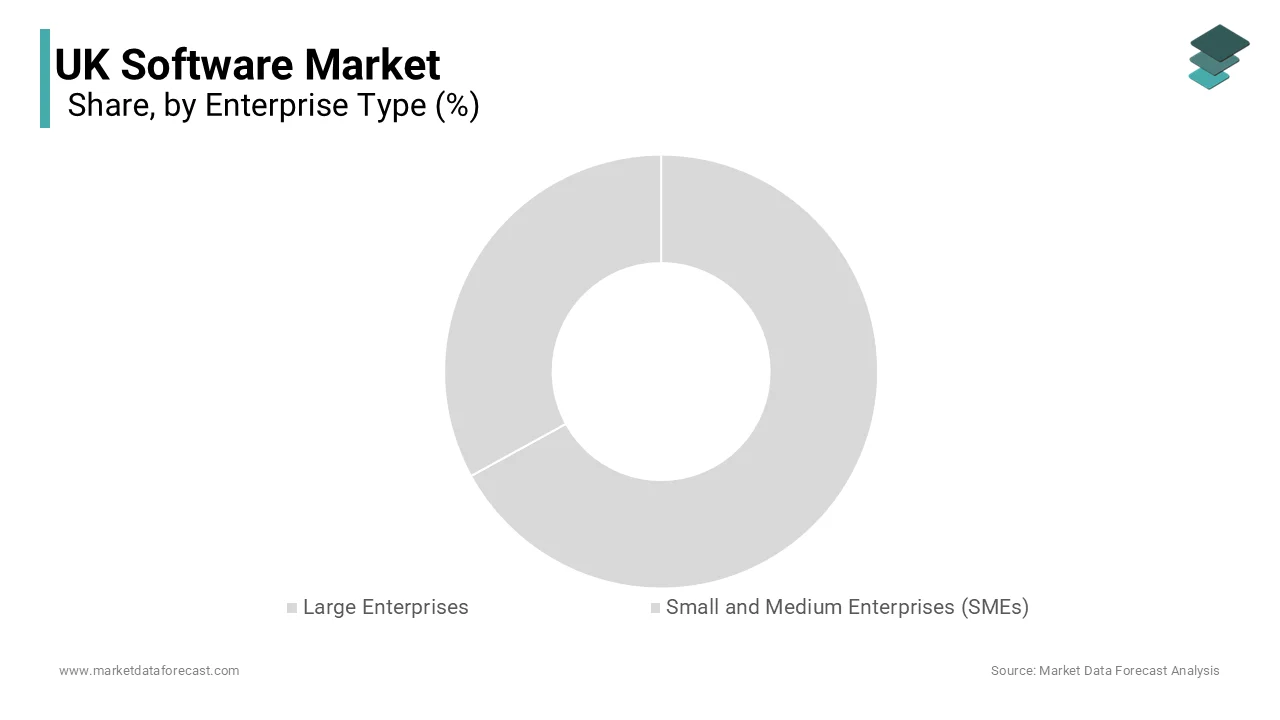
- Large Enterprises
- Small and Medium Enterprises (SMEs)
By Industry
- IT and Telecom
- BFSI
- Healthcare and Life Sciences
- Retail and E-commerce
- Others