- Product Description Description
- Table of Contents TOC
- List of Table & Figure LOT
- Get Free Sample PDF Sample PDF
Market Size, 2025
$12.12 BnMarket Estimate, 2026
$14.92 BnMarket Forecast, 2034
$78.78 BnCAGR, 2026–2034
23.12%United Kingdom Subscription Video on Demand (SVOD) Market Report Summary
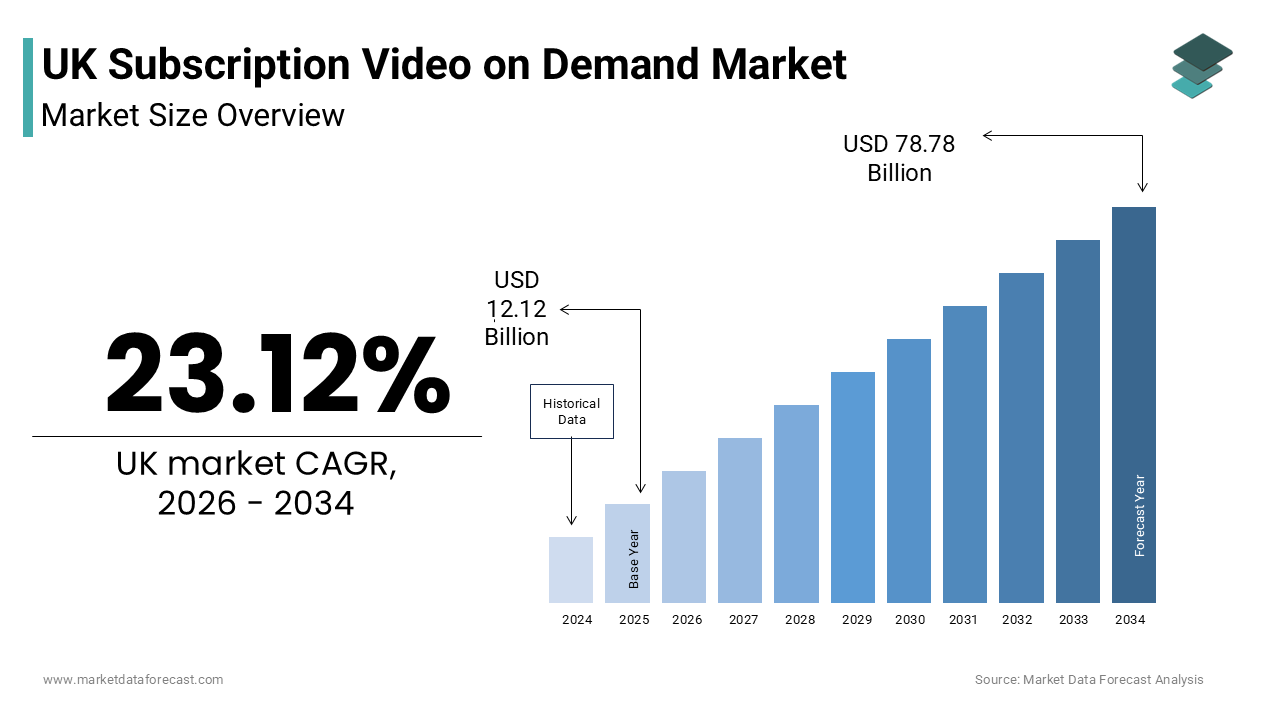
The United Kingdom Subscription Video on Demand (SVOD) market was valued at USD 12.12 billion in 2025 and is anticipated to reach USD 14.92 billion in 2026 from USD 78.78 billion by 2034, growing at a CAGR of 23.12% during the forecast period from 2026 to 2034. The growth of the United Kingdom SVOD market is driven by rising broadband penetration, increasing smartphone adoption, and changing consumer preferences toward on-demand content consumption. Expanding availability of high-speed internet infrastructure, growing demand for personalized entertainment experiences, and increasing investments in original content production are further accelerating market growth. Moreover, advancements in streaming technologies, expansion of smart home ecosystems, and increasing adoption of multi-device viewing experiences are supporting the expansion of the United Kingdom SVOD market.
Key Market Trends
- Rising adoption of streaming platforms as consumers shift away from traditional linear television services.
- Increasing investments in exclusive original content and localized programming to attract and retain subscribers.
- Growing popularity of hybrid and ad-supported subscription models among cost-conscious consumers.
- Strong focus on personalized content recommendations through artificial intelligence and machine learning technologies.
- Expansion of streaming services across smart TVs, mobile devices, and connected home ecosystems.
Segmental Insights
- Based on content type, the TV shows segment dominated the United Kingdom SVOD market and held the largest share in 2025. The segment’s dominance is attributed to high viewer engagement, binge-watching culture, strong subscriber retention rates, and continuous investments in original episodic content.
- Based on subscription model, the ad-free segment accounted for the leading share of the United Kingdom SVOD market in 2025. The dominance of this segment is driven by strong consumer preference for uninterrupted viewing experiences, premium content access, enhanced video quality, and higher customer satisfaction levels.
- Based on user base, the family accounts segment held the major share of the United Kingdom SVOD market in 2025 owing to multi-user access benefits, cost efficiency, parental control features, diverse content availability, and strong household adoption rates.
- Based on delivery platform, the smart TVs segment dominated the United Kingdom SVOD market in 2025 due to superior viewing experiences, larger display screens, seamless integration of streaming applications, and increasing adoption of connected television devices.
Regional Insights
The United Kingdom accounted for a significant share of the European Subscription Video on Demand market in 2025 and held approximately 28.1% of the regional market. The country benefits from extensive broadband coverage, high digital literacy rates, strong consumer spending on digital entertainment, and a well-developed content production ecosystem. The presence of leading global streaming providers, robust regulatory frameworks, and continuous investments in original content production continue to strengthen the market's position as one of the most advanced SVOD ecosystems in Europe.
Competitive Landscape
The United Kingdom SVOD market is highly competitive and characterized by the presence of global streaming platforms, domestic broadcasters, and niche content providers competing through exclusive programming, technological innovation, pricing strategies, and user experience enhancements. Leading companies are focusing on expanding original content libraries, investing in sports broadcasting rights, enhancing recommendation algorithms, and developing hybrid subscription models. Strategic partnerships with telecommunications providers, content creators, and technology companies are further strengthening market positioning across the digital entertainment ecosystem. Prominent players in the United Kingdom SVOD market include Netflix, Amazon Prime Video, Disney+, Apple TV+, Paramount+, NOW, BBC iPlayer, ITVX, Channel 4 Streaming, Discovery+, Hayu, BritBox, MUBI, Crunchyroll, and YouTube Premium.
 Download Free Sample Report
UK Subscription Video on Demand Market Size
The UK Subscription Video on Demand Market size was valued at USD 12.12 billion in 2025 and is anticipated to reach USD 14.92 billion in 2026 from USD 78.78 billion by 2034, growing at a CAGR of 23.12% during the forecast period from 2026 to 2034.
Subscription Video on Demand (SVOD) is a streaming service model where users pay a recurring flat fee (monthly or annually) to gain unlimited access to a library of video content. This market has fundamentally altered media consumption patterns across the nation as households increasingly abandon traditional linear television in favor of on demand viewing experiences. The proliferation of high speed broadband infrastructure serves as the foundational enabler for this transformation. Ofcom's recent Connected Nations reports confirm that superfast broadband (at least 30 Mbps) is available to 97-98% of UK homes, while Gigabit-capable broadband availability has risen to over 84%. Smartphone penetration further amplifies accessibility. Data for 2025 indicates that 95-96% of UK adults now own a smartphone, surpassing the 92% figure often cited in previous years' reports. Cultural shifts toward binge watching behaviors have normalized extended viewing sessions. Research shows that 16-34 year olds consume approximately 4 to 5 hours of total video content per day, with the majority of this time spent on streaming and video-sharing platforms rather than traditional broadcast television. The competitive landscape features both global platforms and domestic players vying for subscriber attention through exclusive original programming and localized content strategies. Regulatory frameworks governing digital media continue evolving as the government implements new broadcasting codes that apply equally to traditional broadcasters and streaming platforms ensuring fair competition and consumer protection standards remain consistent across all distribution channels.
MARKET DRIVERS
Rising Broadband Penetration Enables Seamless Streaming Experiences
The expansion of high speed internet infrastructure is propelling the United Kingdom subscription video on demand market forward. Ofcom's Connected Nations 2025 report confirms that superfast broadband (>30 Mbps) covers 97-98% of homes, while full fiber coverage has surged to approximately 73-83% of UK premise. This robust connectivity foundation eliminates buffering issues and enables high definition and ultra high definition content delivery without interruption. Driven by the uptake of Gigabit-capable connections, the average UK download speed reached 223 Mbps in 2025, significantly exceeding older benchmarks. Rural areas have particularly benefited from government backed initiatives such as Project Gigabit which aims to extend gigabit capable networks to hard to reach locations ensuring geographic inclusivity in streaming access. 5G standalone coverage now reaches over 85% of the UK population (outdoor), while geographic coverage continues to expand. Internet service providers frequently bundle streaming subscriptions with broadband packages creating attractive value propositions that lower entry barriers for new users. The reliability of modern networks supports emerging technologies like cloud gaming integration and interactive viewing features that enhance engagement levels. Infrastructure is continuously improving, with planned investments exceeding 15 billion pounds through 2030. Consequently, the technical constraints that previously limited streaming adoption have effectively disappeared, enabling mass-market penetration across all demographic and socioeconomic groups throughout the United Kingdom.
Shifting Consumer Preferences Toward On Demand Content Consumption
Fundamental changes in viewer behavior and expectations are fueling substantial growth in the United Kingdom subscription video on demand market. This surge occurs as audiences increasingly prioritize flexibility and control over their entertainment experiences. BARB data confirms that streaming and on-demand services account for 38% of total TV viewing, with Subscription VOD (like Netflix/Disney+) comprising a significant share of this shift. Young adults (16-34) spend approximately 4 hours daily on video content, but their broadcast TV viewing has dropped significantly below the national average of 2.5 hours. The appeal of ad free viewing experiences attracts premium subscribers who value uninterrupted content consumption. Industry surveys consistently rank ad-free viewing as a primary driver for subscriptions, though recent trends show a 47-73% growth in ad-supported tiers for major platforms like Netflix and Disney+ in 2025. Binge watching culture has become mainstream with 73 percent of subscribers reporting they regularly watch multiple episodes of series in single sitting according to industry surveys. Personalization algorithms enhance discovery by recommending content aligned with individual preferences increasing engagement and reducing churn rates. Social media integration allows viewers to share recommendations and discuss plot developments fostering community engagement around popular titles. The convenience of accessing entire series catalogs simultaneously rather than waiting for weekly episode releases aligns with modern lifestyles characterized by busy schedules and fragmented leisure time. Voice activated controls and smart home integration further simplify navigation making content selection effortless. These behavioral shifts reflect deeper cultural transformations where immediacy choice and customization define entertainment expectations compelling traditional broadcasters to adapt their distribution models or risk losing relevance in an increasingly digital first media landscape.
MARKET RESTRAINTS
Market Saturation Leading To Subscriber Churn And Fatigue
Market saturation is creating significant headwinds for the United Kingdom subscription video on demand market. According to research, the average streaming household stabilizes their entertainment stack by maintaining approximately 3.2 active video subscriptions. This proliferation of services creates financial pressure on consumers with combined monthly costs often exceeding 50 pounds prompting careful evaluation of value propositions. Driven by content-hopping consumers, blended premium video-on-demand platform metrics show average subscriber churn rates hovering near 8% on a rolling basis. The phenomenon known as subscription fatigue manifests when audiences feel overwhelmed by the sheer number of options and fragmented content libraries requiring multiple payments to access desired shows. Price increases implemented by major platforms to fund original content production have accelerated cancellations. A study shows that roughly 42% of unsubscribing users point to cost and subscription price inflation as the primary catalyst for cancelling their services. Economic uncertainty exacerbates this trend as households prioritize essential expenditures over discretionary entertainment spending during periods of inflationary pressure. The lack of interoperability between platforms forces users to manage separate accounts payment methods and viewing histories creating friction in the user experience. Content exclusivity strategies while beneficial for individual platforms contribute to overall market fragmentation requiring consumers to subscribe to numerous services to maintain comprehensive access. Bundling arrangements offered by telecommunications companies provide some relief but often include services that do not align with individual preferences leading to perceived waste. As the market matures, growth through new subscriber acquisition becomes increasingly difficult. This forces operators to focus on retention strategies and improved value demonstration to justify continued investment from cost-conscious consumers navigating an overcrowded streaming landscape.
Intense Competition for Exclusive Content Rights and Production
Escalating costs associated with securing exclusive content rights and producing original programming are substantial financial hurdles for operators in the United Kingdom subscription video on demand market. Major platforms collectively invested over 4 billion pounds in UK content production during 2025 according to research, reflecting the arms race for distinctive offerings that differentiate services in crowded marketplace. Acquiring broadcasting rights for popular sports events film franchises and established television series commands premium prices. Premium Premier League live broadcasting packages command values vastly exceeding £200 million annually per operator under current rights agreements. Independent producers leverage this competitive environment to negotiate favorable terms resulting in rising talent fees and production budgets that strain operational finances. Smaller platforms struggle to compete with deep pocketed global giants leading to market consolidation as niche players either merge or exit the sector entirely. The requirement for continuous content refreshment means platforms must constantly develop new originals while maintaining existing libraries creating unsustainable cost structures for many operators. Regulatory requirements mandating minimum percentages of British content add further financial burden. International co production arrangements help distribute costs but introduce complexities regarding creative control and territorial rights management. The pressure to achieve immediate returns on content investments conflicts with long term brand building objectives forcing difficult strategic choices about resource allocation. Rising interest rates increase borrowing costs for debt financed content acquisitions compounding financial pressures. These dynamics create barriers to entry for new competitors while threatening profitability for established players who must balance quality quantity and cost efficiency in an environment where audience expectations for premium production values continue escalating without corresponding willingness to pay proportionally higher subscription fees.
MARKET OPPORTUNITIES
Expansion Into Niche Content Verticals And Demographic Segments
Targeting underserved audience segments through specialized content offerings provides significant growth opportunities for the United Kingdom subscription video on demand market. Mainstream services are reaching saturation among general populations in the country. Platforms focusing on specific interests such as documentary enthusiasts horror fans or foreign language cinema learners can cultivate dedicated subscriber bases willing to pay premium prices for curated experiences. Educational content represents another promising vertical with parents increasingly seeking safe enriching alternatives to general entertainment platforms for children. Services offering structured learning modules alongside entertainment value can command higher price points while demonstrating tangible benefits beyond passive consumption. Regional content celebrating local cultures dialects and stories appeals to communities feeling underrepresented by mainstream productions. Accessibility features including audio descriptions sign language interpretation and simplified interfaces open markets. Senior citizens represent another overlooked demographic with streaming adoption among those aged 65 and above increasing annually as digital literacy improves and devices become more intuitive. Partnerships with cultural institutions museums and theaters enable exclusive access to performances exhibitions and archival materials creating unique value propositions impossible to replicate through conventional broadcasting. Instead of competing directly with mass-market platforms, operators should address specific needs and interests. By doing so, they can build loyal communities with lower churn rates, stronger engagement, and sustainable business models in specialized niches.
Integration With Smart Home Ecosystems and Emerging Technologies
The convergence of SVOD services with smart home technologies and next generation hardware paves the way for enhanced user experiences and expanded usage scenarios in the United Kingdom subscription video on demand market. Voice assistant compatibility allows hands free content selection through Amazon Alexa Google Assistant and Apple Siri. Augmented reality features beginning to appear in select applications offer interactive overlays providing additional context behind scenes or character information enhancing engagement particularly among younger tech savvy audiences. Cloud gaming integrations enable subscribers to access playable content related to popular series creating hybrid entertainment experiences that blur boundaries between passive viewing and active participation. Artificial intelligence driven recommendation engines continue improving with machine learning algorithms analyzing viewing patterns across multiple devices to suggest content. Multi room synchronization allows families to start watching on one device and continue on another without losing progress facilitating flexible consumption patterns throughout homes equipped with connected displays tablets and smartphones. Internet of Things connectivity enables automatic adjustments to lighting temperature and sound systems based on content type creating immersive cinematic environments with minimal user intervention. Wearable device integration provides haptic feedback during intense scenes adding sensory dimensions to viewing experiences. As 5G networks expand and edge computing capabilities mature latency sensitive applications like virtual reality streaming will become viable opening entirely new categories of immersive content that leverage spatial audio and 360 degree visuals to transport viewers into narrative worlds redefining fundamental concepts of television entertainment for future generations.
MARKET CHALLENGES
Regulatory Compliance And Content Moderation Complexities
Navigating evolving regulatory landscapes presents persistent challenges for operators in the United Kingdom subscription video on demand market. Authorities are implementing stricter oversight of digital media platforms. The Online Safety Act requires services to protect users from harmful content including illegal material and age inappropriate programming imposing significant compliance burdens. Implementing effective age verification systems proves technically complex and costly with solutions requiring integration of identity databases biometric scanning or credit card validation raising privacy concerns among users reluctant to share personal information. The Broadcasting Code extensions mandate that streaming platforms adhere to similar standards as traditional television regarding accuracy impartiality and harm prevention necessitating substantial investments in content review teams and automated moderation tools. Cross border content distribution introduces jurisdictional complexities as material legal in one territory may violate laws in another requiring sophisticated geoblocking mechanisms and regional content variations. Taxation policies regarding digital services continue evolving with debates surrounding whether streaming subscriptions should attract value added tax at standard or reduced rates creating uncertainty for financial planning. Intellectual property enforcement demands constant vigilance against unauthorized redistribution with piracy costing the industry substantial amount. Balancing creative freedom with regulatory obligations while maintaining positive user experiences requires delicate operational management. Overly restrictive measures risk alienating subscribers, yet insufficient controls expose platforms to legal liabilities, reputational damage, and service restrictions that could fundamentally disrupt business models in an increasingly scrutinized digital media environment.
Piracy And Unauthorized Content Distribution Threats
Illegal streaming and content piracy constitute enduring threats undermining revenue potential and content valuation in the United Kingdom subscription video on demand market. This is despite ongoing enforcement efforts. Sophisticated piracy operations utilize illegal streaming sites IPTV services and peer to peer networks to distribute copyrighted material often within hours of official releases attracting price sensitive consumers unwilling to pay for legitimate subscriptions. The proliferation of cheap Android boxes preloaded with illicit streaming applications makes unauthorized access convenient for non technical users expanding the pirate audience beyond traditionally tech savvy demographics. Enforcement actions face jurisdictional challenges as many piracy servers operate from countries with weak intellectual property protections requiring complex international cooperation that slows takedown processes. Virtual private networks enable users to circumvent geographic restrictions accessing content libraries from other regions at lower prices or viewing material not licensed for UK distribution eroding territorial licensing models that fund content production. Social media platforms inadvertently facilitate piracy through links shared in groups and forums making detection and removal labor intensive for rights holders. The normalization of piracy among certain demographics particularly younger users who grew up accessing free content online creates cultural barriers to conversion even when affordable legal alternatives exist. Anti piracy technologies including watermarking encryption and digital rights management add costs to production workflows while occasionally inconveniencing legitimate subscribers through playback restrictions. Industry collaborations with internet service providers to identify and warn repeat offenders show limited effectiveness as determined pirates quickly adapt to countermeasures. These persistent threats force platforms to continuously invest in security infrastructure, legal teams, and consumer education campaigns. Consequently, this diverts crucial resources away from content creation and innovation while perpetually challenging the economic sustainability of premium subscription models in an environment where free alternatives remain readily accessible.
REPORT COVERAGE
| REPORT METRIC | DETAILS |
| Market Size Available | 2025 to 2034 |
| Base Year | 2025 |
| Forecast Period | 2026 to 2034 |
| CAGR | 23.12% |
| Segments Covered | By User Base, Content Type, Delivery Platform, Subscription Model and Region. |
| Various Analyses Covered | Global, Regional & Country Level Analysis, Segment-Level Analysis, DROC, PESTLE Analysis, Porter’s Five Forces Analysis, Competitive Landscape, Analyst Overview of Investment Opportunities |
| Market Leaders Profiled | Demand (SVOD) market include Netflix, Amazon Prime Video, Disney+, Apple TV+, Paramount+, NOW, BBC iPlayer, ITVX, Channel 4 Streaming, Discovery+, Hayu, BritBox, MUBI, Crunchyroll, and YouTube Premium. |
SEGMENTAL ANALYSIS
By Content Type Insights
The TV shows segment was the largest in the United Kingdom subscription video on demand market and occupied a 55.3% share in 2025. This prominence of the segment was supported by its ability to foster long term subscriber retention through serialized storytelling. The episodic nature of television series encourages habitual viewing patterns where audiences return weekly or binge entire seasons creating sustained engagement metrics that surpass one off movie consumption. International hits such as Stranger Things and The Crown further amplify this trend. The economic model favors series production as successful shows can spawn multiple seasons maximizing return on initial investment while building franchise value through merchandise spin offs and international licensing deals. Streaming platforms invest heavily in original series development. Social media amplification plays a crucial role as fans discuss plot twists character arcs and theories online creating organic marketing momentum that attracts new viewers without additional advertising spend. The flexibility of series formats allows for diverse genre exploration from crime thrillers to romantic comedies ensuring broad demographic appeal across age groups and interests. This versatility combined with proven retention benefits solidifies TV shows as the cornerstone content strategy for operators seeking stable recurring revenue streams in an increasingly competitive landscape where audience attention remains the most valuable commodity.
The sports content segment is estimated to register the fastest CAGR of 18.7% during the forecast period due to the migration of premium sporting rights from traditional broadcast television to digital exclusive platforms creating must have offerings for avid fans. The immediacy of live sports drives real time engagement with peak concurrent viewership during major events exceeding 5 million users on single platforms as reported by Ofcom. Technological enhancements including multi angle camera selections interactive statistics overlays and personalized commentary options create immersive experiences impossible to replicate through traditional television broadcasts. Betting integration features allow users to place wagers directly within streaming interfaces capitalizing on the UKs robust gambling culture. The social aspect of live viewing combined with second screen interactions on mobile devices enhances community engagement around matches. As rights holders recognize the higher monetization potential of direct-to-consumer models compared to legacy broadcasting deals, the volume of exclusive sports content available on subscription platforms will continue expanding. This expansion drives rapid subscriber acquisition among passionate fan bases willing to prioritize athletic entertainment over other discretionary spending categories.
By Subscription Model Insights
In 2025, the ad-free subscription models segment held a 65.1% majority share of the United Kingdom subscription video on demand market because of strong consumer preference for uninterrupted viewing experiences, where audiences prioritize convenience and immersion over cost savings. Premium subscribers demonstrate higher lifetime value. The willingness to pay higher monthly fees stems from perceived value propositions including early access to new releases exclusive behind the scenes content and superior video quality up to 4K resolution. Household income levels correlate strongly with ad free adoption. Family accounts benefit significantly from ad free environments as parents seek safe controlled viewing spaces for children without exposure to inappropriate advertisements. The psychological burden of advertisement interruption disrupts narrative flow reducing satisfaction scores in user experience. Platforms leverage ad free dominance to negotiate favorable content licensing agreements demonstrating stable predictable revenue streams to rights holders concerned about brand safety in programmatic advertising environments. Corporate partnerships often mandate ad free access for employee benefits packages further bolstering this segments market position. As inflation stabilizes and disposable income pressures ease, consumers are showing a renewed willingness to upgrade from basic tiers. This shift reinforces the financial sustainability of premium models that fund high-budget original productions. Together, these revenues maintain competitive differentiation in a crowded marketplace where content quality remains the primary decision factor for viewers seeking exceptional entertainment value.
The hybrid models segment is anticipated to witness the fastest CAGR of 22.2% from 2026 to 2034. This rapid acceleration responds to economic pressures forcing cost conscious consumers to seek affordable alternatives without completely sacrificing access to premium content libraries. Major platforms including Disney Plus and Netflix introduced hybrid tiers priced lower than ad free equivalents attracting price sensitive demographics particularly students young professionals and large families managing tight household budgets. Advertising technology advancements enable precise targeting delivering relevant commercials based on viewing history and demographic profiles increasing advertiser willingness to pay premium rates for engaged audiences. Regulatory frameworks governing digital advertising ensure transparency and privacy compliance building consumer trust in data driven ad delivery systems. Hybrid models also serve as effective trial mechanisms allowing hesitant users to experience platform content libraries before committing to premium upgrades with conversion rates significant level within first six months according to platform internal analytics. The flexibility of switching between tiers empowers consumers to adjust spending based on financial circumstances creating dynamic revenue optimization opportunities for operators. The sentence splits cleanly at the shift from technological advancement to consumer value. The first sentence highlights the evolution of ad inventory, while the second focuses on the appeal of hybrid models to viewers.
By User Base Insights
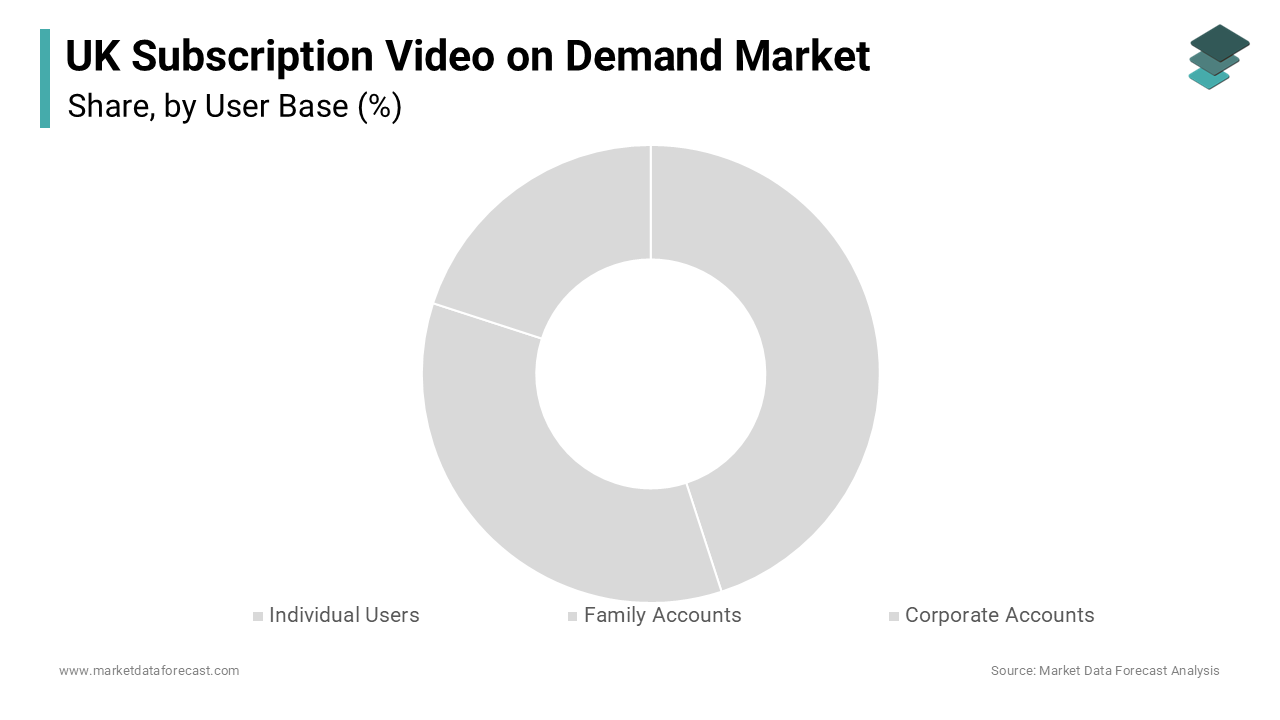
The family accounts segment led the United Kingdom subscription video on demand market and captured a 55.1% share in 2025. This leading position of the segment was attributed to economic efficiency where single payments provide access for multiple household members ranging from young children to grandparents maximizing value per pound spent. Typical family plans support up to 4 simultaneous streams accommodating diverse viewing preferences within single households without requiring separate subscriptions for each individual. Parental control features prove essential for this segment. The ability to create personalized profiles ensures recommendation algorithms deliver age appropriate suggestions enhancing discovery experiences for different family members while maintaining centralized billing management. Educational content integration appeals strongly to parents seeking enriching entertainment options with platforms offering dedicated kids sections featuring curated learning materials alongside cartoons and animated series. Shared viewing experiences foster family bonding during evenings and weekends with co viewing sessions increasing during school holidays. The stickiness of family accounts results in lower churn rates as cancellation decisions require consensus among multiple users creating natural retention barriers. Bundled telecommunications packages frequently include family streaming subscriptions making them default choices for broadband customers seeking comprehensive home entertainment solutions. As remote work and homeschooling trends persist family accounts adapt by providing flexible daytime viewing options for adults working from home while keeping children engaged with safe content libraries establishing these multi user arrangements as foundational structures for modern household media consumption habits across the United Kingdom.
The individual user segment is likely to experience the fastest CAGR of 15.4% over the forecast period, owing to changing living arrangements with increasing numbers of young professionals, students, and single-person households prioritizing personalized entertainment experiences tailored specifically to their unique tastes and schedules. Individual users demonstrate higher engagement per capita. The autonomy to explore niche genres experimental documentaries and foreign language films without compromising other household members preferences drives satisfaction and loyalty among solo subscribers. Mobile first consumption patterns align perfectly with individual usage as commuters and travelers utilize smartphones and tablets for portable entertainment during transit periods. Flexible month to month contracts appeal to this demographic who value freedom from long term commitments enabling easy switching between platforms based on current content interests. Social media integration facilitates sharing recommendations with friends creating virtual communities around specific shows or genres enhancing discovery through peer networks rather than algorithmic suggestions alone. Budget conscious individuals appreciate transparent pricing without hidden fees for additional screens making cost management straightforward. Gig economy workers and freelancers represent a growing portion of the workforce that seeks flexible lifestyle arrangements. Individual subscriptions provide adaptable entertainment solutions that fit their irregular schedules and varying income streams. This establishes this segment as a dynamic growth engine for platforms targeting autonomous consumers who value customization and convenience.
By Delivery Platform Insights
The smart televisions segment dominated the United Kingdom subscription video on demand market and accounted for a 60.9% share in 2025. This dominance of the segment was driven by the central role of living room entertainment where large screens provide immersive cinematic experiences ideal for family viewing sessions and high production value content consumption. Remote control navigation optimized for television interfaces offers intuitive user experiences particularly appealing to older demographics less comfortable with touch screen devices or complex menu structures. Picture quality capabilities of modern smart TVs including high dynamic range and OLED displays enhance visual fidelity making premium subscription tiers with 4K content particularly attractive to videophile audiences seeking superior technical performance. Voice search functionality integrated into television remotes enables hands free content discovery accelerating selection processes and reducing friction in browsing extensive catalogs. Casting features allow seamless transfer of content from mobile devices to television screens bridging gap between portable convenience and communal viewing preferences. Gaming console integration further extends smart television utility as platforms like PlayStation and Xbox serve as secondary streaming hubs attracting younger users who consolidate entertainment activities within single devices. The permanence of television installations in homes creates stable viewing environments unlike portable devices subject to battery limitations or connectivity issues during travel. Manufacturers continue embedding advanced processors and AI chips directly into television hardware, enabling real-time upscaling and personalized interface adaptations. As a result, the smart television segment remains the primary gateway for subscription video-on-demand (SVOD) consumption. It delivers an optimal balance of screen size, audio quality, and ease of use for the majority of British viewers who prioritize comfort and visual impact in their home entertainment setups.
The mobile devices segment is on the rise and is expected to be the fastest growing segment in the market by witnessing a CAGR of 19.6% between 2026 and 2034. This explosive growth correlates with ubiquitous smartphone ownership among UK adults, creating universal access points for streaming content anywhere anytime. Download capabilities allow offline viewing addressing connectivity gaps during commutes on underground trains or rural travel where signal strength fluctuates unpredictably. Vertical video formats optimized for mobile screens cater to short form content consumption habits with platforms developing mobile exclusive series lasting 10 to 15 minutes per episode designed specifically for brief viewing windows during breaks or waiting periods. Battery life enhancements in latest smartphone models support extended viewing sessions averaging 2.5 hours continuous playback according to device manufacturer testing protocols. Integration with wearable technology including smartwatches enables notification alerts for new episode releases or live event starts keeping users engaged across multiple connected devices simultaneously. Augmented reality features beginning to appear in mobile applications offer interactive overlays providing additional context or gamified elements enhancing engagement particularly among Generation Z users who expect multimedia richness beyond passive viewing. The portability factor proves decisive for students and young professionals balancing academic or career demands with entertainment needs utilizing fragmented time slots throughout day for content consumption. Smartphones are rapidly establishing themselves as indispensable companions for modern digital media lifestyles. As foldable screen technologies mature to provide larger display areas in pocketable designs, the mobile segment will continue capturing increasing shares of total viewing time.
COUNTRY ANALYSIS
The United Kingdom dominated the European subscription video on demand market and accounted for a 28.1% share in 2025. This dominance was driven by advanced digital infrastructure widespread broadband adoption and sophisticated consumer preferences driving intense competition among global and domestic platforms. The market status demonstrates robust health. According to Ofcom's Media Nations 2024 report, 68% of UK households subscribe to at least one streaming service, with the total market comprising over 35 million active subscriptions (reflecting multi-subscription homes). Strong regulatory frameworks established through Online Safety Act and Broadcasting Code extensions ensure fair competition while protecting consumer interests fostering stable operating environment for legitimate service providers. High disposable income levels despite recent inflationary pressures enable sustained spending on premium entertainment. Recent market data estimates average UK household expenditure on streaming and subscription entertainment lies between £42 and £50 per month. Cultural affinity for high quality drama comedy and documentary programming drives demand for both local productions and international acquisitions creating diverse content ecosystems appealing to multicultural population segments. London serves as major production hub attracting international investment with studios hosting filming for global franchises generating employment and stimulating ancillary industries including post production visual effects and talent development. The presence of established broadcasters like BBC ITV and Channel 4 transitioning successfully to digital platforms provides credible alternatives to pure play streaming services leveraging trusted brands and existing audience relationships. English language advantage facilitates content export opportunities allowing UK produced series to achieve global distribution amplifying returns on production investments. Technological innovation thrives within this ecosystem with startups developing artificial intelligence driven recommendation engines virtual production tools and interactive storytelling formats positioning the United Kingdom at forefront of next generation media technologies. As government initiatives like Project Gigabit expand fiber optic coverage to rural areas geographic disparities in access diminish enabling nationwide participation in digital entertainment economy. The combination of creative talent, technical expertise, regulatory clarity, and an affluent consumer base ensures the United Kingdom maintains its leadership role in the European subscription video on demand (SVoD) sector. Consequently, the UK serves as a benchmark for market development, content quality standards, and business model innovation, influencing trends across continental markets seeking similar success.
COMPETITIVE LANDSCAPE
The competitive landscape in the United Kingdom subscription video on demand sector features intense rivalry among global giants domestic broadcasters and emerging niche platforms vying for consumer attention and wallet share. Established players leverage vast content libraries brand recognition and technological infrastructure to maintain dominant positions while newcomers attempt disruption through specialized offerings or aggressive pricing strategies. Differentiation occurs primarily through exclusive original programming sports rights and unique user experiences that justify subscription costs in saturated market conditions. Price competition intensifies as economic pressures prompt consumers to evaluate value propositions carefully leading to frequent plan adjustments and promotional offers designed to attract and retain subscribers. Consolidation trends emerge as smaller operators struggle with rising content acquisition costs and operational complexities prompting mergers or exits from marketplace. Regulatory scrutiny increases regarding market power data privacy and content standards requiring careful compliance management from all participants. Innovation in advertising technologies creates new revenue streams for hybrid models challenging pure subscription based economics. The battle for talent escalates with producers and creators commanding higher fees for exclusive deals limiting availability for competing platforms. Consumer switching costs remain low enabling easy migration between services based on current content releases forcing continuous investment in fresh engaging material to prevent attrition. This dynamic environment demands strategic agility financial resilience and deep understanding of evolving viewer preferences to achieve sustainable competitive advantage in one of Europes most mature and demanding digital entertainment markets.
KEY MARKET PLAYERS
Some of the promising companies that are playing a dominating role in the UK Subscription Video on Demand Market include
- Netflix
- Amazon Prime Video
- Disney+
- Apple TV+
- Paramount+
- NOW
- BBC iPlayer
- ITVX
- Channel 4 Streaming
- Discovery+
- Hayu
- BritBox
- MUBI
- Crunchyroll
- YouTube Premium
Top Players In The United Kingdom Market
Netflix
Netflix maintains a formidable presence in the United Kingdom through extensive investment in local original productions and strategic partnerships with British talent. The platform recently expanded its London production facilities to support increased output of homegrown series and films that resonate with domestic audiences. By commissioning high profile dramas and comedies featuring renowned UK actors Netflix strengthens cultural relevance while attracting subscribers seeking premium localized content. The company also introduced mobile gaming titles based on popular shows enhancing user engagement beyond passive viewing. Continuous improvement of recommendation algorithms ensures personalized discovery keeping viewers engaged with relevant suggestions. Netflix focuses on technical excellence by offering ultra high definition streams and immersive audio options catering to discerning British consumers who value superior viewing quality. These initiatives collectively reinforce its position as a primary entertainment destination for households across the nation.
Amazon Prime Video
Amazon Prime Video leverages its integration with the broader Amazon ecosystem to offer compelling value propositions combining streaming access with retail benefits and fast delivery services. The platform secured exclusive rights to stream major sporting events including Premier League football matches attracting sports enthusiasts who previously relied on traditional broadcasters. Investment in British original content such as thriller series and historical dramas demonstrates commitment to local storytelling while appealing to international audiences. Amazon Studios established production hubs in Manchester and Cardiff creating jobs and fostering regional creative industries. The introduction of ad supported tiers provides affordable entry points for price sensitive consumers expanding reach across diverse socioeconomic groups. Seamless integration with Alexa enabled devices allows voice controlled navigation enhancing convenience for smart home users. These strategic moves solidify its competitive standing in the crowded digital entertainment landscape.
Sky Group
Sky Group operates as a dominant force through its comprehensive Sky Glass and Sky Stream services that eliminate need for traditional satellite dishes while delivering extensive content libraries. The company combines live television channels with on demand streaming offerings providing hybrid experiences that cater to varied viewing preferences. Significant investments in sports rights including exclusive coverage of Formula One and cricket ensure appeal to passionate fan bases willing to pay premium prices. Sky Originals division produces critically acclaimed series that drive subscriber acquisition and retention through distinctive storytelling. Partnerships with global platforms like Netflix and Disney Plus within single interfaces simplify access for users managing multiple subscriptions. Advanced personalization features utilize artificial intelligence to curate content recommendations improving discovery efficiency. Commitment to customer service excellence and flexible contract options enhance user satisfaction reinforcing loyalty among long term subscribers throughout the United Kingdom.
Top Strategies Used By Key Market Participants
Key players in the United Kingdom subscription video on demand market employ several strategic approaches to maintain competitive advantages and drive growth. Content differentiation remains paramount as platforms invest heavily in exclusive original productions featuring local talent and stories that resonate with British audiences. Strategic partnerships with telecommunications providers enable bundled offerings that combine broadband mobile services and streaming subscriptions creating attractive value propositions for consumers. Technology innovation focuses on enhancing user experience through improved recommendation algorithms voice control integration and multi device synchronization capabilities. Pricing flexibility introduces tiered subscription models including ad supported options to capture price sensitive segments while maintaining premium ad free tiers for dedicated fans. International co production arrangements distribute financial risks while expanding global distribution opportunities for locally produced content. Customer retention initiatives leverage data analytics to identify churn risks and implement targeted engagement campaigns offering personalized incentives. These multifaceted strategies ensure sustained relevance in dynamic marketplace where consumer expectations continuously evolve requiring constant adaptation and innovation from all market participants seeking long term success.
MARKET SEGMENTATION
This research report on the United Kingdom subscription video on demand market has been segmented based on the following categories.
By User Base
- Individual Users
- Family Accounts
- Corporate Accounts
By Content Type
- Movies
- TV Shows
- Documentaries
- Kids Content
- Sports
By Delivery Platform
- Smart TVs
- Mobile Devices
- Tablets
- Desktop Computers
By Subscription Model
- Ad-free
- Ad-supported
- Hybrid
By Country
- U.K