- Product Description Description
- Table of Contents TOC
- List of Table & Figure LOT
- Get Free Sample PDF Sample PDF
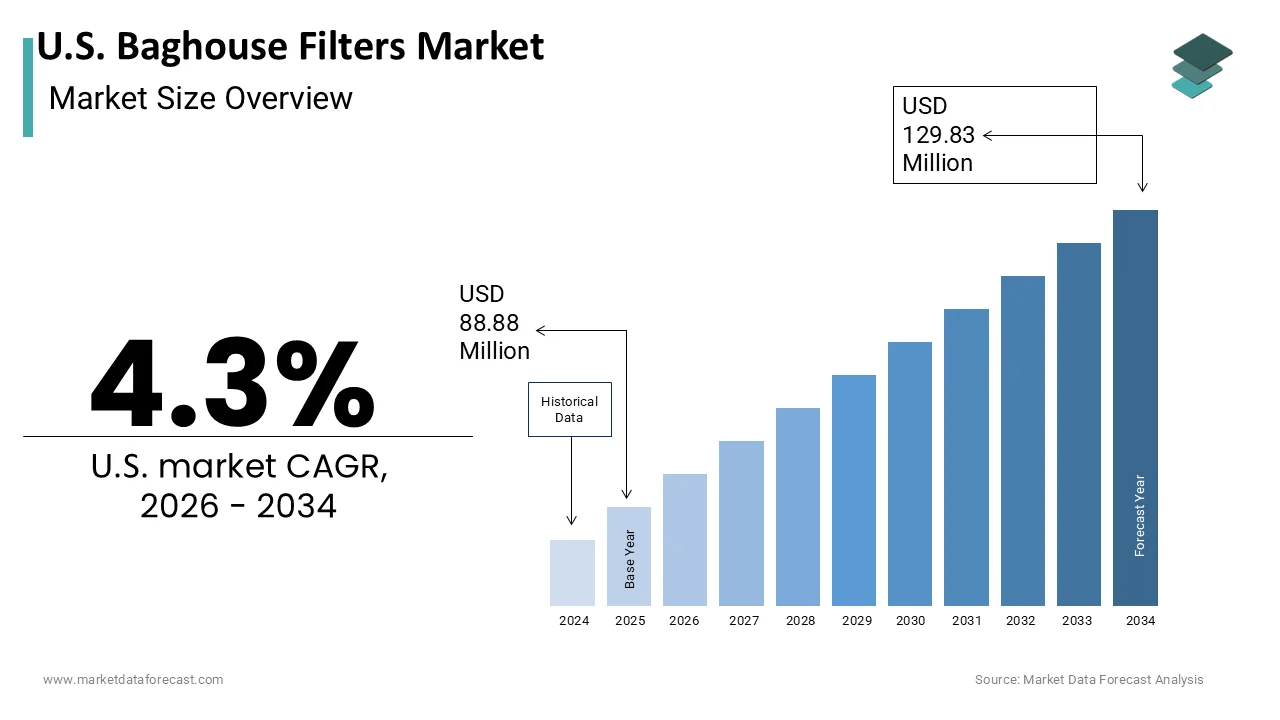
Market Size, 2025
$88.88 MnMarket Estimate, 2026
$92.71 MnMarket Forecast, 2034
$129.83 MnCAGR, 2026–2034
4.3%U.S. Baghouse Filters Market Size
The U.S. Baghouse Filters Market is projected to grow from USD 88.88 million in 2025 to USD 92.71 million in 2026 and reach USD 129.83 million by 2034, registering a CAGR of 4.3% during the forecast period from 2026 to 2034.
The baghouse filter is the industrial air pollution control landscape, specifically designed to capture particulate matter from gas streams in heavy manufacturing and processing facilities. These systems utilize fabric filter bags to separate dust and other solid particles from exhaust gases, ensuring compliance with stringent environmental regulations. The operational integrity of these filtration units is paramount for industries such as cement production, steel manufacturing, and power generation, where particulate emissions pose significant health and environmental risks. The technological evolution of filter media, including the integration of polytetrafluoroethylene membranes, has enhanced the durability and filtration efficiency of these systems. The maintenance and replacement cycle of filter bags significantly impacts operational costs by driving demand for longer-lasting materials. As per the Occupational Safety and Health Administration, exposure limits for respirable crystalline silica have been tightened, necessitating advanced filtration solutions in construction and mining activities.
MARKET DRIVERS
Stringent Environmental Regulations Drive Compliance Investments
The rigorous enforcement of environmental protection laws that mandate lower particulate matter emissions from industrial sources is driving the growth of the United States baghouse filters market. The Clean Air Act, administered by the Environmental Protection Agency, sets national ambient air quality standards that require facilities to install best available control technology. The agency has finalized stricter limits on mercury and air toxics standards for coal-fired power plants, which necessitate the upgrade or installation of advanced filtration systems. Industrial operators must comply with these mandates to avoid substantial penalties and legal repercussions, thereby driving consistent demand for high-performance baghouse filters. This regulatory framework compels manufacturers to invest in sophisticated filtration technologies that can achieve such low emission levels consistently. The state has implemented some of the most stringent air quality regulations in the nation, influencing procurement decisions for industrial equipment across the region.
Industrial Expansion in Cement and Steel Sectors Boosts Demand
The robust growth of heavy industries is propelling the growth of the United States baghouse filters market. These sectors are inherently associated with high levels of particulate emissions during raw material handling, crushing, and processing stages. As per the United States Geological Survey, domestic cement production reached approximately 90 million metric tons in recent years, reflecting a steady demand for construction materials that necessitates efficient pollution control measures. Each cement plant requires multiple baghouse units to manage dust generated at various points in the production line, from quarrying to packaging. Similarly, the steel industry relies heavily on baghouse filters to capture fumes and dust from electric arc furnaces and basic oxygen furnaces. According to the American Iron and Steel Institute, the United States produced around 80 million metric tons of raw steel annually, indicating a substantial industrial base that requires continuous filtration support. The expansion of infrastructure projects under federal legislation further amplifies the demand for cement and steel, indirectly boosting the need for associated air pollution control equipment. The billions of dollars are allocated annually for highway and bridge construction, which is driving up the output of cement plants. This industrial activity creates a direct correlation between production volumes and the installation of baghouse filters, as manufacturers seek to optimize their operations while adhering to environmental norms.
MARKET RESTRAINTS
High Initial Capital Expenditure Restricts Small-Scale Adoption
The substantial initial capital investment required for the procurement and installation of these complex systems is limiting the growth of the United States baghouse filters market. Baghouse filters are not off-the-shelf products but engineered solutions that must be customized to fit specific industrial processes and spatial constraints. The cost components include the structural steel framework, filter bags, cage assemblies, cleaning mechanisms, and integration with existing ductwork and fans. The cost of industrial equipment has seen a steady increase due to inflation and supply chain disruptions, making large-scale filtration projects more expensive. For small and medium-sized enterprises, this high upfront cost can be prohibitive, leading them to delay upgrades or opt for less efficient alternative technologies. The financial burden is further exacerbated by the need for specialized engineering services and labor for installation, which adds to the total project cost. Additionally, the complexity of the system requires skilled personnel for operation and maintenance, adding to the long-term financial commitment. The employment of environmental science and protection technicians is growing, but the shortage of skilled labor can drive up wages and maintenance costs.
Operational Maintenance Complexity and Filter Replacement Costs
The ongoing operational complexity and the recurring costs associated with filter replacement are hindering the growth of the United States baghouse filters market. Unlike some other pollution control devices, baghouse filters require regular maintenance to ensure optimal performance and prevent premature failure. The filter bags, which are the core component of the system, have a finite lifespan and must be replaced periodically, typically every three to five years, depending on the operating conditions and the nature of the particulate matter. The cost of replacement bags can constitute a significant portion of the annual operating budget for an industrial facility. The process of replacing thousands of filter bags is labor-intensive and often requires shutting down the production line, leading to lost revenue and productivity. Furthermore, improper maintenance can lead to bag blinding, where the fabric pores become clogged, increasing pressure drop and energy consumption. The need for continuous monitoring and predictive maintenance adds another layer of complexity, requiring specialized instruments and trained personnel. The integration of smart sensors for real-time monitoring is becoming common, but the initial investment and technical expertise required can be daunting for some operators.
MARKET OPPORTUNITIES
Retrofitting Opportunities in Aging Industrial Infrastructure
The vast inventory of aging industrial facilities through retrofitting and upgrading existing pollution control systems is creating new opportunities for the growth of the United States baghouse filters market. Many manufacturing plants in the Rust Belt states were constructed decades ago and operate with outdated or inefficient filtration technologies that no longer meet current environmental standards. Retrofitting these facilities with modern baghouse filters offers a cost-effective solution compared to building new plants by allowing operators to extend the life of their assets while improving environmental performance. The modular design of contemporary baghouse systems facilitates easier integration into existing structures, minimizing downtime during installation. The industrial energy efficiency improvements can yield significant cost savings, and upgrading filtration systems often results in reduced energy consumption due to lower pressure drops. Additionally, the Inflation Reduction Act provides tax incentives for industrial decarbonization and efficiency improvements by encouraging companies to invest in cleaner technologies. The businesses can claim credits for installing qualified pollution control equipment by reducing the net cost of such projects. This financial support, combined with the regulatory push that creates a favorable environment for retrofitting projects.
Integration of Smart Monitoring and Predictive Maintenance Technologies
The integration of Internet of Things (IoT) and smart monitoring technologies by enhancing operational efficiency and reducing maintenance costs is another attribute to the growth of the United States baghouse filters market. Traditional maintenance schedules are often based on fixed intervals, which can lead to either premature replacement of filter bags or unexpected failures. Smart sensors can monitor key parameters, such as pressure drop, temperature, and opacity in real time, enabling predictive maintenance strategies. The adoption of connected industrial assets is expected to grow significantly by allowing for data-driven decision-making in maintenance operations. The operators can identify trends and anomalies that indicate impending issues by allowing for timely interventions that prevent costly downtime. This technological advancement not only improves the reliability of baghouse filters but also reduces the total cost of ownership, making them more appealing to industrial buyers. Furthermore, the data collected can be used to optimize the cleaning cycles of the filters, reducing compressed air usage and energy consumption. As per the Environmental Protection Agency, energy efficiency improvements in industrial processes contribute to overall emission reductions, aligning with sustainability goals. The ability to demonstrate improved performance and cost savings through digital tools provides a competitive advantage for manufacturers offering smart baghouse solutions.
MARKET CHALLENGES
Volatility in Raw Material Prices Impacts Manufacturing Costs
The volatility in the prices of raw materials used in the production of filter bags and baghouse components is likely to impede the growth of the United States baghouse filters market. Filter bags are typically made from synthetic fibers, such as polyester, polypropylene, and polytetrafluoroethylene, which are derived from petroleum-based chemicals. As per the United States Energy Information Administration, fluctuations in crude oil prices directly impact the cost of these polymers, leading to unpredictable manufacturing costs for filter media suppliers. Additionally, the structural components of baghouses, including steel frames and cages, are subject to price variations in the global steel market. The steel prices have experienced significant swings due to supply chain disruptions and changes in global demand, by affecting the overall cost structure of baghouse systems. For end users, the uncertainty in pricing can complicate budget planning and investment decisions, potentially delaying the procurement of necessary filtration equipment. Manufacturers must navigate these challenges by implementing hedging strategies or passing on costs to customers, which can affect their competitiveness.
Supply Chain Disruptions and Lead Time Extensions
The supply chain disruptions have emerged by affecting the timely delivery of components and finished systems, which is another attribute to impede the growth of the United States baghouse filters market. The global nature of the supply chain for industrial equipment means that delays in one region can have cascading effects on production schedules in the United States. As per the Institute for Supply Management, the manufacturing sector has faced ongoing challenges related to supplier deliveries, with lead times extending significantly for critical components such as motors, fans, and specialized filter media. The shortage of semiconductors, which are increasingly used in the control systems of modern baghouses, has further exacerbated these delays. According to the Semiconductor Industry Association, the global chip shortage has impacted various industries, including industrial automation, leading to longer wait times for equipped systems. These extended lead times can delay the commissioning of new industrial plants or the upgrading of existing facilities, resulting in lost productivity and potential regulatory non-compliance for operators. Additionally, transportation bottlenecks and port congestion have increased logistics costs and further complicated the supply chain. Manufacturers must contend with these logistical hurdles by diversifying their supplier base and holding higher inventory levels, which increases working capital requirements.
REPORT COVERAGE
| REPORT METRIC | DETAILS |
| Market Size Available | 2025 to 2034 |
| Base Year | 2025 |
| Forecast Period | 2026 to 2034 |
| Segments Covered | By Type, Application, Material, and Region. |
| Various Analyses Covered | Global, Regional and Country-Level Analysis, Segment-Level Analysis, Drivers, Restraints, Opportunities, Challenges; PESTLE Analysis; Porter’s Five Forces Analysis, Competitive Landscape, Analyst Overview of Investment Opportunities |
| Countries Covered | California, Texas, Florida, New York, and the rest of the United States |
| Market Leaders Profiled | Donaldson Company, Inc., Parker Hannifin Corporation, Camfil AB, Babcock & Wilcox Enterprises, Inc., GEA Group AG, Nederman Holding AB, FLSmidth & Co. A/S, Lydall, Inc., Clarcor Inc., American Air Filter Company, Inc. (AAF International), Mikropul LLC, Imperial Systems, Inc. |
SEGMENTAL ANALYSIS
By Type Insights
The pulse jet baghouse filters segment held a significant share of the United States baghouse filters market in 2025 due to their superior cleaning efficiency and ability to operate continuously without shutdowns. The pulse jet baghouse filters is their ability to maintain consistent airflow and filtration efficiency while the system remains online. Unlike shaker or reverse air systems that often require compartmentalization and temporary offline status for cleaning, pulse jet systems clean individual rows of bags sequentially. This online cleaning capability ensures uninterrupted industrial processes, which are required for continuous operation in industries such as cement and power generation. The high-pressure pulses effectively dislodge dust cakes from the filter media by maintaining a low pressure drop across the system. Maintaining optimal pressure drop is essential for energy efficiency, as every inch of water gauge increase in pressure drop can raise fan energy consumption by approximately 1%. Pulse jet systems typically operate at pressure drops between 3 and 6 inches of water gauge, ensuring lower operational costs. Furthermore, the compact footprint of pulse jet collectors allows for easier installation in space-constrained facilities. As per the Fabric Filter Industry Group, the modular design of pulse jet units facilitates scalability by enabling plants to expand capacity without significant structural modifications.
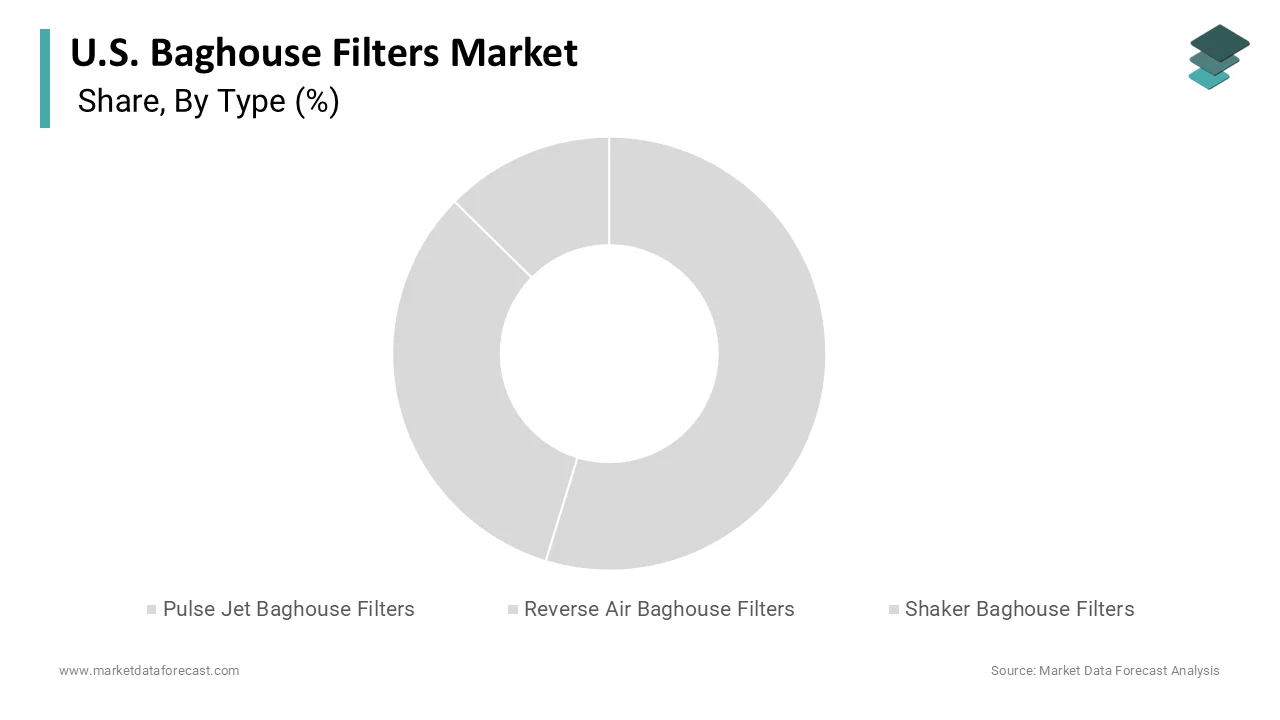
The pulse segment is likely to witness the fastest CAGR of 4.2% during the forecast period, with its suitability for large-scale utility applications, such as coal-fired power plants, where gentle cleaning action is required to preserve the integrity of fragile filter media. Reverse air systems use low-pressure air flowing in the opposite direction of the filtration flow to clean the bags, which causes less mechanical stress compared to the high-pressure pulses of pulse jet systems. The longevity of filter bags is an economic factor in power generation, and reverse air cleaning can extend bag life by up to 30% compared to more aggressive cleaning methods. This extended lifespan reduces the frequency of bag replacements and associated maintenance costs, making reverse air systems attractive for large installations with thousands of filter bags. Although coal consumption is declining, existing power plants are required to maintain strict emission controls, necessitating reliable and durable filtration systems. The ability of reverse air systems to handle large gas volumes efficiently makes them ideal for retrofitting older power plants.
By Application Insights
The cement industry segment was the largest by capturing 32.1% of the United States baghouse filters market, with the intensive dust generation inherent in cement production processes. The stringent emission standards imposed by regulatory bodies mandate extremely low levels of particulate matter emissions from cement plants. As per the Environmental Protection Agency, the New Source Performance Standards for the cement industry limit particulate matter emissions to 0.015 pounds per ton of clinker produced, a threshold that requires highly efficient filtration technologies. Baghouse filters are capable of achieving emission levels well below this limit, often capturing 99.9% of particulate matter. The industry has invested billions of dollars in pollution control technologies over the past few decades to meet these rigorous standards. The adoption of advanced baghouse systems with membrane filter bags has become standard practice in new cement plants and retrofits of existing facilities. As per the California Air Resources Board, state-level regulations often impose even stricter limits, pushing manufacturers to adopt the most effective filtration solutions available. The inability to comply with these standards results in severe penalties and potential shutdowns by making baghouse filters a non-negotiable investment for cement producers.
The pharmaceuticals application segment is swiftly emerging at an expected CAGR of 5.8% from 2026 to 2034, with the stringent regulatory requirements for air quality and containment within manufacturing facilities. Agencies, such as the Food and Drug Administration,n mandate strict controls on airborne contaminants to prevent cross-contamination and ensure product purity. The current Good Manufacturing Practices require pharmaceutical facilities to maintain controlled environments with specific air filtration standards. Baghouse filters, particularly those equipped with High Efficiency Particulate Air or Ultra Low Penetration Air filters, are essential for capturing fine powder particles generated during drug formulation and tablet pressing. The containment of potent compounds is a critical safety concern, and advanced filtration systems are necessary to protect workers and the environment. The increasing production of biologics and specialized drugs, which often involve handling fine powders, further amplifies the need for precise air filtration. As per the Pharmaceutical Research and Manufacturers of America, the United States pharmaceutical industry continues to expand, with new facilities being built to meet global demand. These new constructions incorporate state-of-the-art baghouse filtration systems to comply with regulatory standards.
By Material Insights
The woven fabrics segment was the largest by holding 44.3% of the United States baghouse filters market share in 2025 due to their exceptional durability and resistance to abrasive conditions, which are common in heavy industries, such as mining and cement production. Woven fabrics, typically made from materials like fiberglass, aramid, or polyester, can withstand the physical stress of continuous operation and frequent cleaning cycles. The robust structure of woven fabrics prevents premature wear and tear by extending the service life of the filter bags. The longevity of filter media is a factor in reducing total ownership costs, and woven fabrics offer a favorable balance between performance and lifespan. In abrasive environments, such as coal handling or mineral processing, the strength of woven fabrics minimizes the risk of bag failure and subsequent emission spikes. The proven track record of woven fabrics in harsh industrial settings reinforces their position as the leading material choice, ensuring steady demand from sectors that prioritize reliability and durability.
The non-woven felts segment is projected to register the fastest CAGR of 6.1% during the forecast period due to their superior filtration efficiency in capturing fine particulate matter that poses health and environmental risks. Non-woven felts are created by bonding fibers together through mechanical, thermal, or chemical processes, resulting in a dense matrix that traps smaller particles more effectively than woven fabrics. Non-woven felts, especially when treated with polytetrafluoroethylene membranes, can achieve emission levels below 0.01 grams per normal cubic meter. The surface filtration mechanism of membrane-laminated non-woven felts prevents particle penetration into the fabric structure by ensuring consistent performance and easy cake release. This capability is crucial for industries such as steel manufacturing and chemical processing, where fine dusts are prevalent.
COMPETITIVE LANDSCAPE
The competition in the United States baghouse filters market is characterized by a mix of established global corporations and specialized regional manufacturers. This fragmented landscape drives intense rivalry as companies strive to differentiate themselves through technological innovation and service quality. Leading firms compete based on product performance,y and compliance with strict environmental standards. Price competition remains significant,nt particularly in standard industrial segments where cost sensitivity is high. However, many players focus on value-added services, such as custom engineering and predictive maintenance, to justify premium pricing. Strategic alliances and collaborations are common as companies seek to expand their reach and enhance their technical capabilities. The entry of new players with niche technologies adds further complexity to the competitive environment. Established brands leverage their reputation and extensive distribution networks to maintain customer loyalty. Meanwhile, smaller firms often target specific industries or applications where they can offer specialized expertise.
KEY MARKET PLAYERS
Some of the companies that are playing a dominating role in the U.S. Baghouse Filters Market include
- Donaldson Company, Inc.
- Parker Hannifin Corporation
- Camfil AB
- Babcock & Wilcox Enterprises, Inc.
- GEA Group AG
- Nederman Holding AB
- FLSmidth & Co. A/S
- Lydall, Inc.
- Clarcor Inc.
- American Air Filter Company, Inc. (AAF International)
- Mikropul LLC
- Imperial Systems, Inc.
TOP LEADING PLAYERS IN THE MARKET
- Donaldson Company Inc stands as a prominent entity in the United States baghouse filters market by leveraging its extensive expertise in filtration solutions. The company focuses on developing advanced filter media that enhance efficiency and longevity for industrial applications. Donaldson actively engages in expanding its product portfolio through continuous research and development initiatives aimed at addressing stringent environmental regulations. Recent actions include the introduction of high-performance synthetic filter bags designed to withstand harsh operating conditions while reducing energy consumption. The company strengthens its market position by providing comprehensive technical support and customized solutions to diverse industries such as cement and power generation. Donaldson also emphasizes sustainability by offering products that help customers achieve their environmental goals. Their strategic partnerships with local distributors ensure widespread availability and timely service delivery across the nation.
- Camfil APC contributes significantly to the United States baghouse filters market through its commitment to clean air solutions and sustainable manufacturing practices. The company specializes in designing and manufacturing high-quality dust collection systems that meet rigorous industry standards. Camfil APC strengthens its position by integrating smart monitoring technologies into its baghouse units, enabling real-time performance tracking and predictive maintenance. Recent initiatives involve launching energy-efficient filter cartridges that reduce operational costs for industrial clients. The company actively collaborates with engineering firms to provide tailored solutions for complex industrial processes. Camfil APC also invests in training programs for technicians to ensure optimal installation and maintenance of their systems. Their focus on customer-centric innovation drives adoption across various sectors, including pharmaceuticals and food processing.
- Parker Hannifin Corporation plays a vital role in the United States baghouse filters market by offering a broad range of motion and control technologies. The company provides robust filtration solutions that cater to heavy industrial applications requiring durable and efficient particulate capture. Parker Hannifin strengthens its market presence through strategic acquisitions and internal development of advanced filtration materials. Recent actions include the expansion of its industrial filtration division to include specialized baghouse components designed for high-temperature environments. The company leverages its global supply chain network to ensure consistent product availability and competitive pricing. Parker Hannifin also focuses on digital integration by incorporating IoT capabilities into its filtration systems for enhanced monitoring and control. Their commitment to innovation is evident in the continuous improvement of filter media technologies that offer superior dust release and lower pressure drops.
TOP STRATEGIES USED BY KEY MARKET PARTICIPANTS
Key players in the United States baghouse filters market primarily employ product innovation and strategic partnerships to maintain a competitive advantage. Companies invest heavily in research and development to create advanced filter media that offer higher efficiency and longer lifespan. This focus on technological advancement allows them to meet evolving environmental regulations and customer demands for sustainable solutions. Another major strategy involves expanding service offerings to include comprehensive maintenance and monitoring packages. By providing end-to-end support, firms enhance customer loyalty and generate recurring revenue streams. Strategic acquisitions are also common as companies seek to broaden their product portfolios and enter new geographic regions. These mergers enable firms to integrate complementary technologies and access established distribution networks. Additionally, manufacturers emphasize digital transformation by integrating smart sensors and data analytics into their systems. This approach enables predictive maintenance and improves operational efficiency for clients. Collaborations with engineering consultants and industrial operators further strengthen market positioning by ensuring solutions are tailored to specific industry needs.
MARKET SEGMENTATION
This research report on the U.S. baghouse filters market is segmented and sub-segmented into the following categories.
By Type
- Pulse Jet Baghouse Filters
- Reverse Air Baghouse Filters
- Shaker Baghouse Filters
By Application
- Cement Industry
- Power Generation
- Pharmaceuticals
- Chemicals
- Food & Beverage
- Metals & Mining
- Others
By Material
- Woven Fabrics
- Non-Woven Felts
- Fiberglass
- Polyester
- Polypropylene
- Others
By Country
- California
- Texas
- Ohio
- Pennsylvania
- Rest of the United States