- Product Description Description
- Table of Contents TOC
- List of Table & Figure LOT
- Get Free Sample PDF Sample PDF
U.S. Biogas Market Size
The U.S. Biogas Market was valued at USD 6.43 billion in 2025 and is estimated to reach USD 6.60 billion in 2026, and is projected to reach USD 8.24 billion by 2034, growing at a CAGR of 2.8% from 2026 to 2034.
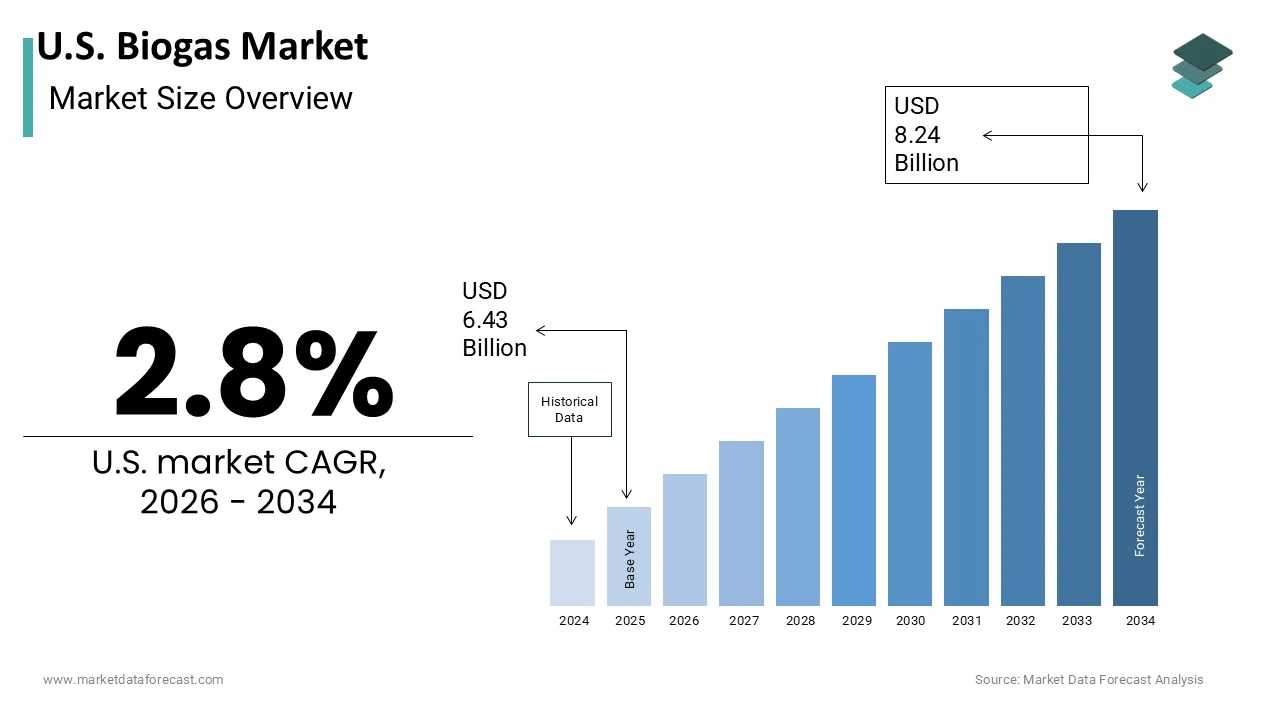
Biogas is a renewable, combustible gaseous fuel produced when organic waste, such as animal manure, sewage, food scraps, and agricultural residues, breaks down through anaerobic digestion (decomposition without oxygen). This market utilizes anaerobic digestion technology to process agricultural residues, municipal solid waste, and wastewater sludge, thereby mitigating methane emissions while generating sustainable fuel. As per the Environmental Protection Agency, landfills constitute the largest human-related source of methane emissions in the United States, accounting for approximately 14% of total methane emissions in recent years. The conversion of this potent greenhouse gas into usable energy serves as a dual-purpose solution for climate mitigation and energy security. The American Biogas Council indicates that there are nearly 2,500 sites across the country currently producing biogas, including wastewater treatment facilities and livestock farms, while identifying over 17,000 additional sites as ripe for development. Despite this potential, only a fraction of these sites currently capture and utilize the gas for energy production. The regulatory landscape is increasingly supportive, with federal incentives such as the Inflation Reduction Act providing tax credits for clean hydrogen and carbon capture initiatives. These policy mechanisms encourage investment in upgrading infrastructure that converts raw biogas into renewable natural gas suitable for pipeline injection. The market definition extends beyond simple energy generation to includnutrient-richion of digestate, a nutrient-rich byproduct used as organic fertilizer. This holistic approach aligns with circular economy principles, reducing reliance on synthetic fertilizers and closing nutrient loops in agricultural systems.
MARKET DRIVERS
Federal Tax Incentives Accelerate Infrastructure Investment
The implementation of robust federal tax incentives is a key growth enabler for the expansion of the United States biogas market. This significantly improves the economic viability of anaerobic digestion projects. The Inflation Reduction Act introduced enhanced investment tax credits and production tax credits for renewable energy systems, including those that produce biogas and renewable natural gas. As per the Internal Revenue Service, eligible facilities can claim a base credit of 6 percent, which can increase to 30 percent if prevailing wage and apprenticeship requirements are met. This substantial financial support reduces the capital expenditure burden for developers and encourages the retrofitting of existing waste management facilities with gas capture technologies. The legislation also extends the duration of these credits, providing long-term certainty for investors who previously faced uncertainty regarding policy continuity. According to the American Clean Power Association, the extension of tax credits is projected to spur billions of dollars in new clean energy investments over the next decade. The availability of these funds allows project developers to secure financing more easily, as lenders view the guaranteed tax benefits as a stable revenue stream. Furthermore, the inclusion of carbon capture and storage provisions within the tax framework enables biogas producers to monetize the environmental attributes of their operations. This multi-layered incentive structure effectively lowers the levelized cost of energy for biogas projects, making them competitive with fossil fuel alternatives. The resulting surge in project pipelines demonstrates the profound impact of fiscal policy on market dynamics, driving rapid adoption of biogas technologies across diverse sectors.
Stringent Methane Emission Regulations Drive Compliance Adoption
Increasingly stringent regulations targeting methane emissions from agricultural and waste management sectors are compelling facility operators to adopt biogas capture systems as a compliance mechanism, which propels the expansion of the United States biogas market. The Environmental Protection Agency has proposed new standards under the Clean Air Act that require larger landfills and oil and gas facilities to monitor and reduce methane leaks more aggressively. As per the Environmental Protection Agency, the agency aims to cut methane emissions from the oil and gas sector by 80% below 2005 levels by 2030. While this target primarily focuses on fossil fuel operations, the regulatory scrutiny extends to all major sources of methane, including livestock operations and landfills. State-level initiatives, such as California’s Short-Lived Climate Pollutant Reduction Strategy, mandate specific reductions in organic waste disposal in landfills, forcing municipalities to invest in anaerobic digestion infrastructure. According to the California Department of Resources Recycling and Recovery, the state requires a 75 percent reduction in organic waste disposal by 2025 compared to 2014 levels. These mandates create a forced demand for biogas technologies, as operators seek to avoid penalties and meet legal obligations. The regulatory pressure is not limited to California, with other states like New York and Vermont implementing similar organic waste bans. This legislative trend transforms biogas from an optional green initiative into an operational necessity for waste managers and large-scale agricultural producers. The threat of non-compliance costs outweighs the initial investment in digestion technology, accelerating market penetration and ensuring sustained growth driven by regulatory compulsion rather than voluntary adoption.
MARKET RESTRAINTS
High Initial Capital Expenditure Limits Market Entry
The substantial upfront capital required for the construction and installation of anaerobic digestion systems is a major barrier to the widespread adoption of biogas technology in the country, which is likely to boost the growth of the United States biogas market. Building a commercial-scale biogas facility involves complex engineering, specialized equipment, and extensive civil works, leading to high initial costs that can deter small and medium-sized enterprises. As per the United States Department of Agriculture, the cost of installing an anaerobic digester on a farm can range from 1 million to 5 million dollars, depending on the size and complexity of the system. This financial barrier is particularly prohibitive for family-owned farms and smaller municipal waste facilities that lack access to large pools of capital or favorable financing terms. The permitting and setup timeline for a new biogas facility can extend from 18 to 36 months, during which project costs may escalate due to regulatory bottlenecks and market shifts, according to industry development standards. According to the American Biogas Council, many potential projects fail to reach financial close due to the inability to secure debt financing at acceptable interest rates. The volatility of energy prices also introduces revenue uncertainty, making it difficult to predict long-term returns on investment. Unlike solar or wind projects, biogas systems require continuous feedstock supply and maintenance, adding to operational expenditures. The lack of standardized modular designs means that each project often requires custom engineering, preventing economies of scale that could lower costs. High capital intensity will continue to restrict market growth to larger entities with substantial balance sheets. This trend will persist until financing mechanisms become more accessible or technology costs decrease significantly.
Complex Permitting and Regulatory Hurdles Delay Project Deployment
The intricate and fragmented permitting process for biogas projects in the country creates significant delays and administrative burdens that hinder the United States biogas market expansion. Developers must navigate a maze of local, state, and federal regulations involving environmental protection, zoning, water quality, and air emissions. As per the National Renewable Energy Laboratory, the permitting timeline for a new biogas facility can extend from 18 to 36 months, during which time project costs escalate, and market conditions may change. Each jurisdiction has its own specific requirements and interpretation of rules, leading to inconsistency and unpredictability in the approval process. The need to obtain separate permits for construction, operation, and grid interconnection adds layers of complexity that require specialized legal and technical expertise. According to the Environmental Law Institute, the lack of a unified federal framework for renewable natural gas injection into pipelines results in varying state-level standards for gas quality and safety. This regulatory fragmentation increases compliance costs and creates uncertainty for developers operating in multiple states. Additionally, community opposition based on concerns about odor, traffic, and industrialization of rural areas can lead to prolonged public hearings and legal challenges. These social license issues often result in project cancellations or significant design modifications that increase costs. The cumulative effect of these bureaucratic and social hurdles slows down the rate of new project commissions, preventing the market from reaching its full potential promptly. Streamlining these processes remains a critical need for industry stakeholders to accelerate deployment.
MARKET OPPORTUNITIES
Expansion of the Renewable Natural Gas Vehicle Fuel Market
The growing demand for renewable natural gas as a transportation fuel offers a strong opening for the United States biogas market. This is driven by federal and state low-carbon fuel standards. Renewable natural gas derived from biogas can be upgraded to pipeline quality and used as a substitute for diesel and gasoline in heavy-duty vehicles. As per the California Air Resources Board, the Low Carbon Fuel Standard has created a robust market for carbon intensity credits, allowing renewable natural gas producers to generate significant additional revenue beyond the sale of the fuel itself. This credit trading mechanism incentivizes the production of biogas from high-carbon-intensity feedstocks such as dairy manure and landfills, which offer greater carbon reduction benefits. According to the Coalition for Renewable Natural Gas, the number of heavy-duty vehicles powered by renewable natural gas has increased substantially, with major logistics companies committing to fleet electrification and alternative fuel adoption. The federal Renewable Fuel Standard also categorizes renewable natural gas from certain feedstocks as cellulosic biofuel, qualifying it for higher value renewable identification numbers. This regulatory recognition enhances the economic attractiveness of biogas projects focused on transportation fuel. The expansion of refueling infrastructure across major highway corridors further supports the adoption of natural gas vehicles. By tapping into the transportation sector, biogas producers can diversify their revenue streams and reduce dependence on volatile electricity markets. This opportunity aligns with broader decarbonization goals in the hard-to-electrify transport sector, positioning biogas as a key enabler of sustainable logistics.
Integration of Digital Monitoring and Optimization Technologies
The integration of advanced digital monitoring and optimization technologies provides a clear path to enhance the efficiency and reliability of biogas production facilities in the country, which is expected to fuel the expansion of the United States biogas market. Internet of Things sensors, artificial intelligence, and machine learning algorithms can real-time monitor key parameters such as temperature, pH levels, and gas composition within anaerobic digesters. As per the Smart Water Magazine, the adoption of digital water management solutions is rising, with biogas facilities leveraging these tools to predict maintenance needs and optimize feedstock mixing ratios. This predictive capability reduces downtime and prevents process failures that can lead to costly repairs and production losses. The use of data analytics allows operators to maximize methane yield by adjusting operational conditions dynamically in response to changes in feedstock characteristics. According to the Water Environment Federation, utilities that implement smart monitoring systems report improvements in energy efficiency and reduced operational costs. The ability to remotely monitor facilities also enables centralized management of distributed biogas assets, reducing the need for on-site personnel and lowering labor costs. Furthermore, digital platforms facilitate better reporting and compliance with regulatory requirements by automating data collection and analysis. The transparency provided by these technologies enhances investor confidence and facilitates access to green financing. As the industry matures, the adoption of digital twins and advanced control systems will become standard practice, driving overall sector productivity and profitability. This technological evolution drives biogas as a modern, data-driven energy solution rather than a traditional waste management process.
MARKET CHALLENGES
Feedstock Supply Chain Instability Impacts Production Consistency
The inconsistency and logistical challenges associated with securing a reliable supply of organic feedstock are major challenges to the operational stability of biogas facilities in the country, which negatively impacts the growth of the United States biogas market. Anaerobic digesters require a continuous and balanced input of organic material to maintain microbial activity and gas production, yet feedstock availability can fluctuate due to seasonal variations, weather events, and competition from other uses. As per the United States Department of Agriculture, agricultural residues such as crop stalks and animal manure are subject to seasonal harvest cycles and changing farming practices, creating supply gaps that can disrupt digestion processes. Transportation costs for bulky and wet feedstocks are high, limiting the economic radius from which materials can be sourced. According to the Biomass Research and Development Initiative, the lack of established supply chains for dedicated energy crops means that facilities often rely on disparate sources with varying quality and composition. This variability requires sophisticated preprocessing and mixing capabilities, adding to operational complexity and cost. Contamination of feedstock with plastics, metals, or chemicals can also damage equipment and inhibit biological processes, leading to reduced efficiency. The competition for organic waste from composting facilities and animal feed markets further tightens supply and drives up prices. Without long-term contracts and coordinated logistics networks, biogas producers face constant uncertainty regarding input availability. This supply chain vulnerability undermines the financial predictability of projects and discourages investment in larger-scale facilities that require consistent high-volume inputs.
Public Perception and NIMBYism Hinder Facility Siting
Negative public perception and Not In My Backyard sentiments are an impediment to the siting and development of new biogas facilities, which constrains the expansion of the United States biogas market. Local communities often oppose the construction of anaerobic digestion plants due to concerns about unpleasant odors, increased truck traffic, and potential environmental hazards. As per the International Water Association, public acceptance is a critical factor in the success of waste-to-energy projects, yet misinformation and lack of engagement often lead to resistance. Residents may associate biogas facilities with landfills or sewage treatment plants, fearing a decline in property values and quality of life. According to the National League of Cities, municipal officials frequently face pressure from constituents to reject zoning changes or permits for industrial waste processing facilities. This opposition can result in prolonged legal battles and public hearings that delay projects indefinitely or force developers to abandon sites after incurring high costs. The lack of standardized odor control technologies and enforcement mechanisms exacerbates community fears, even when modern facilities operate with minimal emissions. Engaging with local stakeholders early in the planning process is essential but resource-intensive, requiring developers to invest in education and community benefit programs. Despite these efforts, entrenched opposition can prevail, limiting the available locations for new infrastructure. This social challenge restricts the geographic expansion of the biogas market and forces developers to seek less optimal sites with higher logistical costs. Overcoming this barrier requires transparent communication and demonstrable proof of environmental and economic benefits to the local community.
REPORT COVERAGE
| REPORT METRIC | DETAILS |
| Market Size Available | 2025 to 2034 |
| Base Year | 2025 |
| Forecast Period | 2026 to 2034 |
| Segments Covered | By Feedstock, Production Method, Application, and Region. |
| Various Analyses Covered | Global, Regional and Country-Level Analysis, Segment-Level Analysis, Drivers, Restraints, Opportunities, Challenges; PESTLE Analysis; Porter’s Five Forces Analysis, Competitive Landscape, Analyst Overview of Investment Opportunities |
| Countries Covered | California, Washington, Oregon, New York, and the rest of the United States |
| Market Leaders Profiled | Air Liquide, Bright Renewables, PlanET Biogas Group GmbH, TotalEnergies SE, Xebec Adsorption Inc., EnviTec Biogas AG, Waste Management, Inc., DMT Environmental Technology, Greenlane Renewables Inc., Clean Energy Fuels Corp., Vanguard Renewables, WELTEC BIOPOWER GmbH |
SEGMENTAL ANALYSIS
By Feedstock Insights
The organic residue and waste segment held the majority share of the United States biogas market in 2025. This supremacy of the segment was credited to the vast availability of feedstock from municipal solid waste, agricultural operations, and wastewater treatment facilities. This segment covers biowaste, sewage sludge, and agricultural residues, which are abundant byproducts of existing economic activities. As per the Environmental Protection Agency, food waste and yard trimmings account for more than 30 percent of what we throw away, representing a massive untapped resource for energy production. The dominance of this segment is reinforced by state-level landfill diversion mandates that require organic waste to be processed rather than disposed of in landfills. For instance, California’s Senate Bill 1383 mandates a 50 percent reduction in the disposal of organic waste in landfills by 2020 and 75 percent by 2025, forcing municipalities to channel these materials into anaerobic digestion facilities. According to the American Biogas Council, agricultural waste from livestock manure represents one of the largest potential sources of biogas in the country, with millions of tons produced annually. The economic incentive to manage waste responsibly while generating revenue from energy production makes this segment highly attractive. Furthermore, the use of waste-derived feedstocks often qualifies for higher-value renewable identification numbers under federal fuel standards, enhancing profitability. The established infrastructure for waste collection and transport further lowers logistical barriers compared to cultivating dedicated energy crops. This convergence of regulatory pressure, feedstock abundance, and economic incentives ensures that organic residue and waste remain the cornerstone of the US biogas industry.
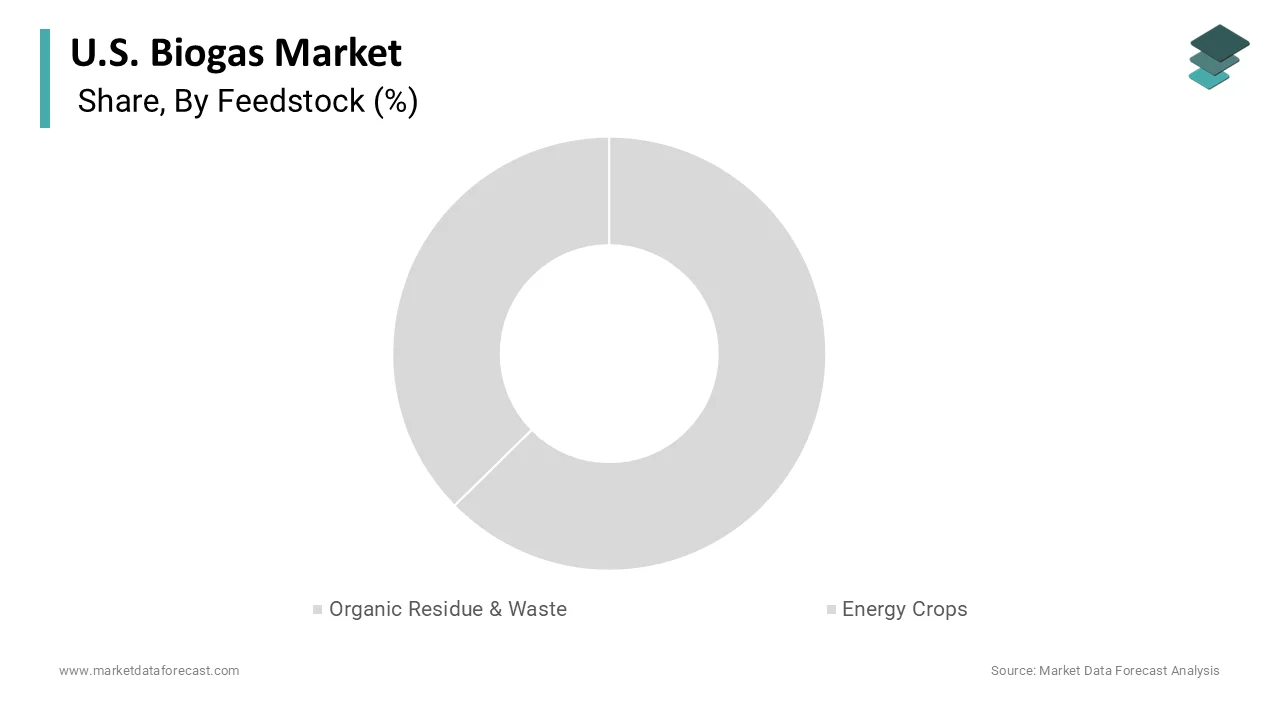
On the other hand, the energy crops segment is expected to exhibit a noteworthy CAGR of 6.5% over the forecast period. This accelerated growth of the segment is propelled by the superior methane yield potential of dedicated energy crops such as maize, sorghum, and algae compared to traditional waste streams. As per the United States Department of Agriculture, energy crops can produce significantly higher volumes of biogas per ton of input, making them economically viable for large-scale industrial facilities seeking consistent and high output. The ability to control the quality and composition of the feedstock allows for optimized digestion processes, reducing operational risks associated with variable waste streams. According to the National Renewable Energy Laboratory, the cultivation of high-yielding energy crops on marginal lands offers a sustainable pathway to increase biogas production without competing with food crops for arable land. Advances in agricultural technology have improved the resilience and productivity of these crops, lowering cultivation costs and enhancing supply chain reliability. The growing interest in co-digestion, where energy crops are mixed with waste materials to boost gas production, further drives demand for this segment. Farmers are increasingly viewing energy crop production as a diversified revenue stream, supported by federal conservation programs that incentivize sustainable farming practices. This strategic shift towards high-efficiency feedstocks positions energy crops as a critical component for scaling up biogas production to meet rising energy demands.
By Production Method Insights
The landfill gas recovery segment remained the largest by occupying a significant share of the United States biogas market in 2025. It achieved this by leveraging the extensive network of existing municipal solid waste landfills across the country. This method captures methane generated from the decomposition of organic waste in landfills, converting a potent greenhouse gas into usable energy. As per the Environmental Protection Agency, there are over 1200 active municipal solid waste landfills in the United States, many of which are required by federal regulations to install gas collection and control systems. The New Source Performance Standards mandate that large landfills collect and combust landfill gas, creating a regulatory baseline that supports widespread adoption of this technology. According to the American Gas Association, landfill gas currently accounts for a significant portion of renewable natural gas production in the country, benefiting from mature technology and established grid interconnection protocols. The capital costs for landfill gas projects are often lower than greenfield anaerobic digestion facilities because the waste containment infrastructure already exists. Furthermore, the long-term nature of landfill operations provides a stable and predictable supply of feedstock for decades, ensuring consistent energy generation. Many utilities and energy companies have established power purchase agreements with landfill operators, securing long-term revenue streams. The proven track record of landfill gas projects in reducing emissions and generating electricity has made them a preferred option for investors seeking lower-risk opportunities in the renewable energy sector. This entrenched infrastructure and regulatory support sustain the dominance of landfill gas recovery in the market.
But the biodigester technology segment is predicted to witness the highest CAGR of 7.2% from 2026 to 2034. This rapid expansion of the segment is propelled by increasing adoption of anaerobic digestion systems on farms and in industrial facilities to manage organic waste and produce renewable energy onsite. As per the United States Department of Agriculture, the number of installed anaerobic digesters on US farms has been steadily increasing, supported by grant programs and technical assistance initiatives aimed at reducing agricultural emissions. The versatility of biodigesters allows them to process a wide variety of feedstocks, including livestock manure, food processing waste, and energy crops, making them suitable for diverse applications. According to the American Biogas Council, industrial facilities such as food and beverage processors are increasingly installing biodigesters to reduce waste disposal costs and generate heat and power for their operations. The modular nature of modern biodigester designs enables scalable solutions that can be tailored to specific site requirements, facilitating easier deployment. Technological advancements in digester efficiency and maintenance requirements have lowered operational barriers, making the technology accessible to small and medium-sized enterprises. The ability to produce nutrient-rich electricity and nutrient-rich digestate for fertilizer adds multiple revenue streams, enhancing the economic case for investment. This combination of environmental benefits, cost savings, and technological maturity drives the robust growth of the biodigester segment.
By Application Insights
The electricity generation segment led the United States biogas market and captured a 51.1% share in 2025. This leading position of the segment was attributed to well-established mechanisms for selling power to the electrical grid. Biogas-fueled generators provide a reliable source of baseload renewable energy, complementing intermittent sources like wind and solar. As per the Energy Information Administration, renewable energy sources accounted for approximately 21 percent of utility-scale electricity generation in the United States, with biomass playing a consistent role in this mix. The availability of federal production tax credits and state-level renewable portfolio standards creates a favorable economic environment for biogas-to-electricity projects. According to the Database of State Incentives for Renewables and Efficiency, many states offer additional payments or credits for electricity generated from biomass sources, enhancing project revenues. The existing infrastructure for electrical transmission allows for relatively straightforward integration of biogas power plants into the grid, unlike transportation fuels, which require specialized refueling networks. Municipal wastewater treatment facilities frequently use biogas for on-site electricity generation to offset their significant energy consumption, self-consumption, and neutrality. This self-consumption model reduces operational costs and enhances sustainability credentials for public utilities. The reliability of biogas as a dispatchable energy source makes it valuable for grid stability, particularly in regions with high penetration of variable renewables. These factors collectively sustain the dominance of electricity generation as the primary outlet for biogas production in the United States.
The renewable natural gas for transportation segment is estimated to register the fastest CAGR of 8.s tate-level low-carbon34 owing to state-level low-carbon fuel standards that assign high value to the carbon intensity reductions achieved by replacing diesel with renewable natural gas. As per the California Air Resources Board, renewable natural gas derived from dairy manure can achieve deeply negative carbon intensity scores (e.g., -100 to -600 gCO2e/MJ), while landfill gas typically achieves low positive scores; both generate credits in the Low Carbon Fuel Standard market. These credits provide a significant revenue stream that often exceeds the value of the fuel itself, making transportation applications highly profitable. According to the Coalition for Renewable Gas, the number of heavy-duty trucks and buses powered by renewable natural gas has grown exponentially, supported by major logistics companies committing to sustainable fleet operations. The federal Renewable Fuel Standard also recognizes renewable natural gas as an advanced biofuel, qualifying it for valuable renewable identification numbers. The expansion of refueling infrastructure along major freight corridors facilitates the adoption of natural gas vehicles. The ability to inject upgraded biogas directly into existing natural gas pipelines allows for flexible distribution to refueling stations. This economic and regulatory alignment positions transportation fuel as the most dynamic growth area for the US biogas market.
COUNTRY LEVEL ANALYSIS
United States Biogas Market Analysis
The United States dominated the North American biogas market and accounted for a 90.5% share in 2025. This dominance of the US market was driven by its advanced waste management infrastructure and supportive policy framework. The country’s market status is characterized by a transition from simple electricity generation to the production of renewable natural gas for transportation and industrial use. As per the Environmental Protection Agency, the United States has one of the largest potentials for biogas production globally, with thousands of sites identified as viable for development. The driving factors behind this robust market include the Inflation Reduction Act, which provides enhanced tax credits for clean energy projects, and state-level mandates for organic waste diversion. According to the American Biogas Council, the industry is experiencing continuing strong growth, with investment in new biogas systems exceeding $2 billion in 2025 and 70 new projects coming online that year. The presence of a mature natural gas pipeline network facilitates the injection and distribution of renewable natural gas, providing a competitive advantage over other regions. Additionally, the strong agricultural sector provides a consistent supply of livestock manure, a key feedstock for high-value biogas production. The integration of biogas into corporate sustainability goals among major food and beverage companies further stimulates demand. Despite challenges related to permitting and capital costs, the United States remains a global leader in biogas innovation and deployment, driven by a combination of regulatory pressure, economic incentives, and technological advancement. This dynamic environment ensures continued growth and leadership in the global biogas sector.
COMPETITIVE LANDSCAPE
The competition in the United States biogas market is characterized by a diverse mix of established waste management corporations, specialized technology providers, and emerging renewable energy developers. Market participants compete based on technological innovation, project development expertise, and access to feedstock resources. Leading firms differentiate themselves through proprietary digestion technologies that offer higher efficiency and lower operational costs. The landscape is evolving as traditional landfill operators expand into renewable natural gas production, leveraging existing infrastructure to gain competitive advantages. Strategic alliances between agricultural cooperatives and energy companies are becoming increasingly common to secure supply chains and share risks. Regulatory incentives such as tax credits and carbon credits play a pivotal role in shaping competitive dynamics, favoring projects with high carbon intensity reduction potential. The entry of new players with innovative modular digestion systems adds pressure on established firms to continuously improve their offerings. Price competition is less intense than in commodity markets, with value derived from environmental attributes and reliability. Overall, the market demands adaptability and strategic foresight to succeed in this rapidly evolving sector.
KEY MARKET PLAYERS
Some of the companies that are playing a dominating role in the United States Biogas Market include
- Air Liquide
- Bright Renewables
- PlanET Biogas Group GmbH
- TotalEnergies SE
- Xebec Adsorption Inc.
- EnviTec Biogas AG
- Waste Management, Inc.
- DMT Environmental Technology
- Greenlane Renewables Inc.
- Clean Energy Fuels Corp.
- Vanguard Renewables
- WELTEC BIOPOWER GmbH
TOP LEADING PLAYERS IN THE MARKET
- Brightmark Energy LLC is a prominent developer of renewable energy facilities with a strong focus on anaerobic digestion and renewable natural gas production. The company specializes in converting organic waste from agricultural and municipal sources into clean fuel. Brightmark has recently expanded its portfolio by constructing several large-scale digesters across the Midwest to process dairy manure. Their strategic partnerships with farming cooperatives ensure a consistent supply of feedstock while providing farmers with additional revenue streams. The company actively invests in upgrading technology to enhance methane capture efficiency and reduce operational costs. Brightmark also engages in policy advocacy to support favorable regulations for renewable natural gas. By integrating vertical operations from waste collection to fuel distribution, Brightmark strengthens its position as a key contributor to the circular economy. This comprehensive approach allows the company to deliver sustainable energy solutions while addressing environmental challenges associated with waste management.
- Quasar Energy Group is a leading designer and builder of anaerobic digestion systems that serve municipal wastewater treatment plants and industrial facilities. The company provides comprehensive engineering services and operational support to optimize biogas production. Quasar has recently completed multiple projects that convert sewage sludge and food waste into renewable energy for local communities. Their innovative digester designs maximize gas yield and minimize maintenance requirements, offering cost-effective solutions for clients. The company collaborates with utilities to implement combined heat and power systems that enhance energy self-sufficiency. Quasar also focuses on nutrient recovery technologies that produce valuable fertilizers from digestate. By delivering turnkey solutions and long-term operational expertise, Quasar supports the growth of decentralized energy generation. Their commitment to technical excellence and customer service reinforces their reputation as a trusted partner in the biogas industry.
- Waste Management Inc is a major waste services provider that leverages its extensive landfill network to produce renewable natural gas. The company captures methane emissions from landfills and upgrades them to pipeline-quality fuel for transportation and industrial use. Waste Management has recently invested heavily in expanding its renewable natural gas infrastructure across multiple states. Their strategic initiatives include converting landfill gas into compressed natural gas for heavy-duty vehicles. The company partners with logistics firms to supply low-carbon fuel that reduces greenhouse gas emissions. Waste Management also explores co-digestion opportunities to increase gas production from organic waste. By utilizing existing assets and expertise in waste management, the company creates significant value from previously wasted resources. This integrated approach enhances sustainability performance and supports the transition to a low-carbon economy.
TOP STRATEGIES USED BY KEY MARKET PARTICIPANTS
Key players in the United States biogas market primarily employ strategies focused on vertical integration and strategic partnerships to secure feedstock supplies and expand distribution networks. Companies are increasingly investing in advanced anaerobic digestion technologies to improve methane yield and operational efficiency. Mergers and acquisitions are common as firms seek to consolidate market presence and acquire specialized technical capabilities. Developing renewable natural gas for transportation is a critical strategy driven by lucrative low-carbon fuel credits. Participants are also engaging in long-term off-take agreements with utilities and fleet operators to ensure stable revenue streams. Collaboration with agricultural producers helps secure consistent organic waste inputs while supporting rural economies. Regulatory advocacy remains essential to shape favorable policies and incentives for biogas development. These strategic actions enable companies to navigate complex market dynamics and capitalize on the growing demand for sustainable energy solutions.
MARKET SEGMENTATION
This research report on the U.S. biogas market is segmented and sub-segmented into the following categories.
By Feedstock
- Organic Residue & Waste
- Energy Crops
By Production Method
- Landfill Gas Recovery
- Biodigester Technology
By Application
- Electricity Generation
- Renewable Natural Gas (RNG) for Transportation
- Heat Generation
- Combined Heat & Power (CHP)
- Industrial Applications
By Country
- California
- Washington
- Oregon
- New York
- Rest of the United States