U.S. Cement Market Size, Share, Trends & Growth Forecast Report By Type (Portland, Blended and Others), Application, and Country (California, Washington, Oregon, New York & Rest of the United States) – Industry Analysis and Forecast, 2026 to 2034
Market Size, 2025
$16.94 BnMarket Estimate, 2026
$17.49 BnMarket Forecast, 2034
$22.62 BnCAGR, 2026–2034
3.27%U.S. Cement Market Report Summary
The U.S. cement market was valued at USD 16.94 billion in 2025, is estimated to reach USD 17.49 billion in 2026, and is projected to reach USD 22.62 billion by 2034, growing at a CAGR of 3.27% during the forecast period. Market growth is driven by increasing infrastructure development activities, rising investments in commercial construction projects, and growing demand for durable construction materials. Cement remains a critical component across residential, commercial, and infrastructure sectors due to its structural strength and broad construction applications. Government infrastructure investments and ongoing urban development initiatives are further supporting market expansion across the United States.
Key Market Trends
- Increasing infrastructure development projects are driving market growth.
- Rising commercial and industrial construction activities are boosting cement demand.
- Growing investments in transportation infrastructure modernization are supporting market expansion.
- Expansion of sustainable construction practices is enhancing demand for advanced cement solutions.
- Innovation in low carbon cement technologies and environmentally efficient production methods is influencing market development.
Segmental Insights
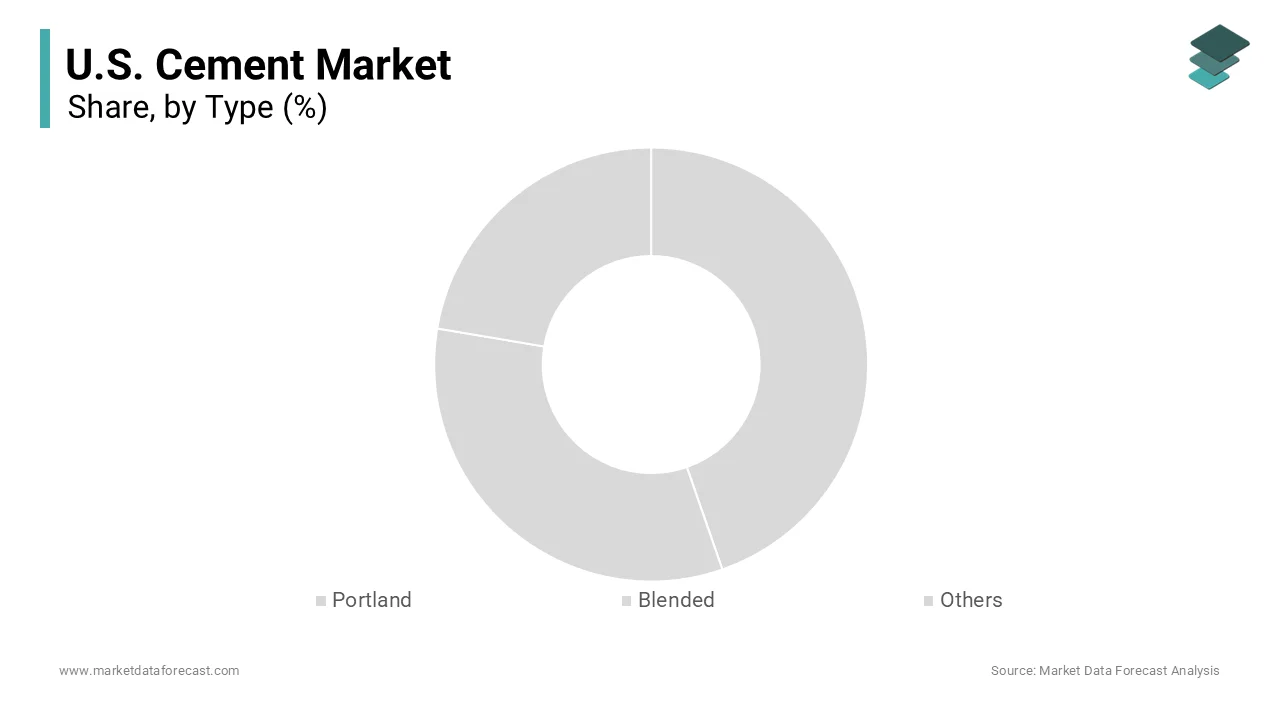
- Based on type, the portland cement segment accounted for 44.3% of the U.S. cement market share in 2025. This dominance is attributed to its widespread use across construction activities and strong structural performance characteristics.
- Based on application, the non residential construction segment held 34.2% of the U.S. cement market share in 2025, driven by increasing investments in commercial buildings, industrial facilities, and public infrastructure projects.
Regional Insights
- The U.S. cement market is experiencing steady growth supported by infrastructure modernization programs, expanding commercial development activities, and increasing construction investments. Rising demand from transportation, industrial, and institutional projects continues to strengthen market development.
Competitive Landscape
The U.S. cement market is highly competitive, with companies focusing on production efficiency improvements, sustainability initiatives, and capacity expansion strategies to strengthen their market position. Manufacturers are investing in environmentally efficient production technologies and supply chain optimization. Prominent players in the U.S. cement market include Holcim US, Heidelberg Materials, Cemex USA, CRH Americas, Eagle Materials, Buzzi Unicem, GCC (Grupo Cementos de Chihuahua), National Cement Company, and Marys Cement.
U.S. Cement Market Size
The U.S. cement market size was valued at USD 16.94 billion in 2025, is estimated to reach USD 17.49 billion in 2026, and is projected to reach USD 22.62 billion by 2034, growing at a CAGR of 3.27% from 2026 to 2034.
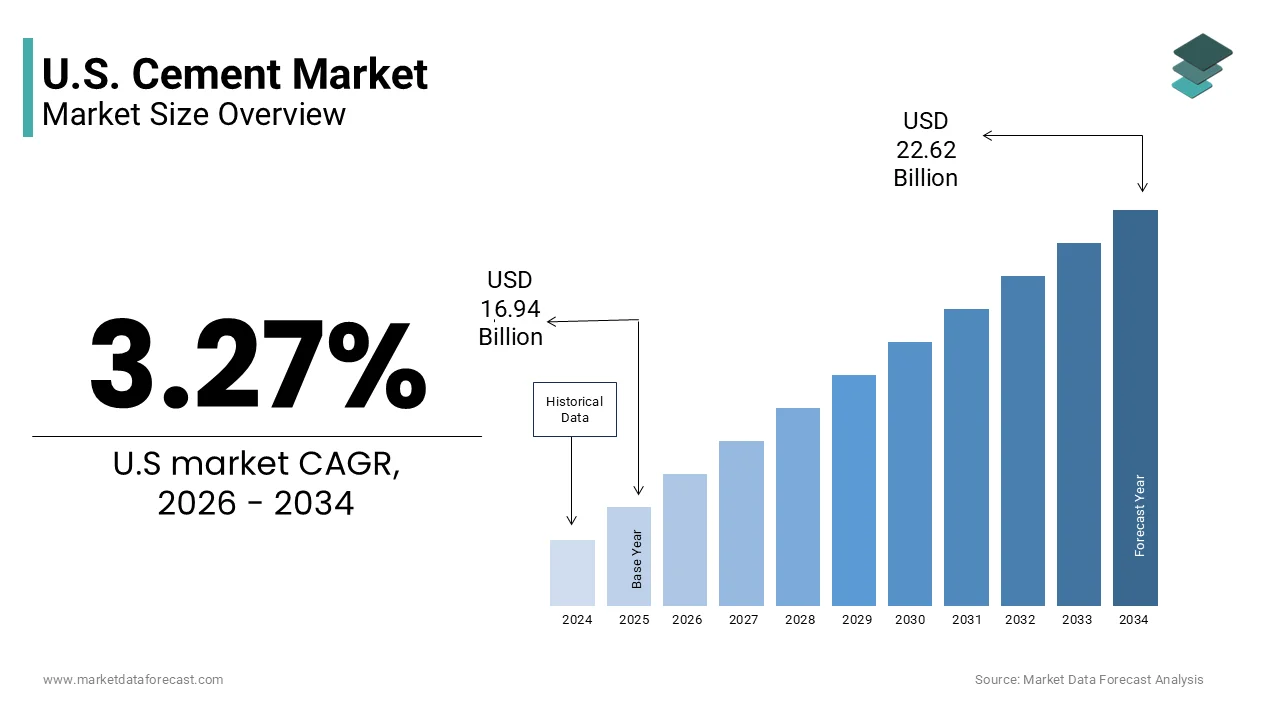
The cement is national infrastructure development characterized by the production and distribution of hydraulic cement, primarily used in concrete manufacturing. This essential binding material is critical for constructing residential commercial and industrial structures, as well as transportation networks, including highways bridges and airports. The network of integrated plants that combine raw material extraction with clinker production and final grinding processes. As per the US Geological Survey, the United States produced approximately 90 million metric tons of cement in recent years reflecting the steady demand driven by construction activities across various sectors. The geographic concentration of production facilities is heavily influenced by the availability of limestone deposits and proximity to major urban centers to minimize transportation costs. The total length of public roads in the United States exceeds 4 million miles requiring continuous maintenance and expansion that sustains cement consumption. Energy intensity remains a defining operational characteristic with fuel costs accounting for a significant portion of production expenses. Environmental regulations increasingly shape industry practices as manufacturers adopt technologies to reduce carbon dioxide emissions associated with calcination processes. The shift toward sustainable construction practices encourages the integration of supplementary cementitious materials such as fly ash and slag. Domestic consumption patterns are closely tied to government infrastructure spending and private sector investment cycles.
MARKET DRIVERS
Federal Infrastructure Investment Acts Stimulate Construction Demand
The enactment of comprehensive federal legislation, such as the Infrastructure Investment and Jobs Act by allocating substantial funds for the rehabilitation and expansion of national infrastructure, which is fuelling the growth of the United States cement market. This legislative framework directs billions of dollars toward modernizing transportation systems water utilities and broadband networks which directly increases the volume of concrete required for project execution. As per the White House, the legislation authorizes 550 billion dollars in new federal investment over five years targeting roads bridges rails and ports that rely heavily on cement based materials. State governments are accelerating project timelines to utilize these funds leading to a surge in procurement activities for construction materials. The focus on repairing deteriorating bridges and highways necessitates large quantities of high-performance concrete that meets stringent durability standards. Public transit expansions in urban areas further amplify demand as new stations and tracks require extensive foundational work. The long-term nature of these infrastructure projects ensures sustained consumption of cement over multiple years providing stability for producers. Additionally, the emphasis on resilient infrastructure designs encourages the use of specialized cement blends that offer enhanced resistance to environmental stressors. This guaranteed pipeline of public sector projects mitigates the volatility typically associated with private construction cycles.
Residential Housing Growth Fuels Material Consumption
The expansion of the residential housing sector by trends and the ongoing need for new housing stock is propelling the growth of the United States cement market. Population growth and household formation rates continue to create demand for single family homes multi family apartments and condominiums which all require substantial amounts of concrete for foundations slabs and structural elements. The shortage of existing housing inventory in many metropolitan areas encourages new developments that utilize cement extensively for durable and fire resistant structures. Urbanization trends lead to higher density living arrangements which often involve complex concrete frameworks for high rise buildings. The preference for concrete in residential construction is reinforced by its longevity low maintenance requirements and energy efficiency properties when used in insulated concrete forms. Regional variations in building codes also influence material selection with seismic zones favoring reinforced concrete structures for safety. The recovery of the housing market following economic disruptions has led to a backlog of projects that sustain production levels for cement manufacturers. Mortgage rate fluctuations impact the pace of construction but the fundamental need for housing ensures a baseline level of demand.
MARKET RESTRAINTS
High Energy Costs Impact Production Economics
The intense energy requirements of cement production constitute as the manufacturing process involves heating raw materials to extremely high temperatures in kilns. The high energy costs impact product economics is limiting the growth of the United States cement market. Fuel costs typically account for a significant portion of total production expenses making producers highly vulnerable to fluctuations in natural gas coal and petroleum coke prices. The industrial energy prices have experienced volatility due to global supply chain disruptions and shifts in energy policy by affecting operational margins. Cement manufacturers face challenges in passing these increased costs onto customers due to competitive pressures and fixed price contracts for large projects. The transition away from fossil fuels toward renewable energy sources requires substantial capital investment in new technologies and infrastructure which strains financial resources. Facilities located in regions with higher electricity rates face competitive disadvantages compared to those with access to cheaper power sources. The inability to quickly adjust production levels in response to energy price spikes leads to periods of reduced profitability or temporary plant closures. Hedging strategies against energy price risks add complexity to financial management and may not fully mitigate exposure. The reliance on consistent and affordable energy supplies limits the ability of producers to expand capacity or upgrade equipment.
Stringent Environmental Regulations Increase Compliance Burdens
The strict environmental regulations impose substantial compliance costs and operational constraints by affecting both production processes and emissions management, which is another factor hindering the growth of the United States cement market. Federal and state agencies enforce rigorous standards on carbon dioxide nitrogen oxides and particulate matter emissions to mitigate the environmental impact of cement manufacturing. Compliance with these norms necessitates significant capital expenditure for equipment upgrades and ongoing monitoring which elevates operational costs. The cement production process inherently generates carbon dioxide through the calcination of limestone making it difficult to achieve deep emission reductions without transformative technologies. Permitting processes for new facilities or expansions are lengthy and complex often facing opposition from local communities concerned about air quality and health impacts. The introduction of stricter carbon emission targets under climate action plans forces producers to invest in carbon capture utilization and storage solutions which are currently expensive and technologically challenging. Legacy sites with historical contamination require costly remediation efforts before they can be repurposed or closed safely.
MARKET OPPORTUNITIES
Adoption of Carbon Capture Technologies Opens New Avenues
The development and deployment of carbon capture utilization and storage technologies to address environmental concerns and maintain social license to operate is certainly to set up new opportunities for the growth of the United States cement market. These technologies enable producers to capture carbon dioxide emissions from kiln exhaust gases before they enter the atmosphere allowing for significant reduction in the carbon footprint of cement production. The several pilot projects and commercial scale initiatives are underway to integrate carbon capture systems into existing cement plants demonstrating technical feasibility. Government incentives, such as tax credits for carbon sequestration provide financial support that improves the economic viability of these investments. The captured carbon can be utilized in various applications including synthetic fuel production and mineralization in concrete curing enhancing the value proposition. Early adopters of carbon capture technology can differentiate their products as low carbon alternatives appealing to environmentally conscious customers and meeting green building certification requirements. Partnerships with technology providers and research institutions accelerate innovation and reduce implementation risks. The potential to generate carbon credits through verified emission reductions creates an additional revenue stream for producers. Regulatory frameworks are increasingly favoring facilities that demonstrate proactive measures to mitigate climate impact.
Growth in Green Building Certifications Drives Sustainable Product Demand
The increasing prevalence of green building certifications, such as LEED and WELL to develop and market sustainable product lines is additionally to leverage the growth of the United States cement market. Architects developers and property owners are prioritizing materials with lower environmental impacts to achieve certification levels that enhance property value and marketability. The thousands of new construction projects annually seek LEED certification driving demand for cement products with reduced embodied carbon and recycled content. Manufacturers can capitalize on this trend by producing blended cements that incorporate supplementary cementitious materials like fly ash, slag, and silica fume, which lower the clinker factor. The development of specialized low carbon cement formulations allows producers to meet specific sustainability criteria outlined in building standards. Corporate sustainability goals among major real estate firms that further amplify demand for transparent and verified eco-friendly materials. The ability to provide detailed environmental product declarations enhances trust and facilitates specification in high profile projects. Government mandates for green public buildings also contribute to this demand by requiring the use of sustainable materials in federally funded constructions.
MARKET CHALLENGES
Supply Chain Disruptions Impact Raw Material Availability
The persistent supply chain disruptions by creating uncertainties in the availability of raw materials and equipment components is a challenge for the growth of the United States cement market. The industry relies on a steady supply of limestone clay gypsum and other minerals, which can be affected by logistical hurdles labor shortages and transportation issues. The delays in the delivery of spare parts for kilns and grinding mills due to global manufacturing constraints have led to extended maintenance periods and reduced production capacity. The concentration of certain equipment suppliers in specific global regions increases vulnerability to localized disruptions such as geopolitical tensions or natural disasters. Shipping container shortages and port congestion further exacerbate delivery timelines for imported additives and fuels increasing inventory holding costs for manufacturers. The lack of vertical integration in some segments of the industry means that producers have limited control over upstream supply security. Diversifying supply sources is challenging due to the long lead times required to qualify new vendors and establish reliable logistics routes. These vulnerabilities were starkly evident during recent global crises when freight rates surged and availability dwindled. Companies must maintain larger safety stocks which ties up capital and reduces operational flexibility.
Intense Regional Competition Pressures Margins
The intense regional competition exerts downward pressure on prices and margins, who must contend with established local players and imported products is also to hamper the growth of the United States cement market. The imports of cement and clinker from countries, such as Canada, Mexico, and Turkey fluctuate based on tariff policies and exchange rates affecting domestic pricing strategies. Producers in coastal regions face direct competition from imported cement, which can be cheaper due to lower production costs in exporting countries. Anti-dumping duties and tariffs provide some protection, but they also invite retaliatory measures and complicate international trade relationships. The saturation of mature markets in certain regions limits growth opportunities forcing companies to compete aggressively on price and service quality. Consolidation of industry players through mergers and acquisitions creates larger entities with economies of scale that smaller independent producers struggle to match. Trade policy uncertainties create an unpredictable business environment where long term investment decisions are hindered by the risk of sudden tariff impositions or removals. Additionally, the strength of the US dollar can make exports less competitive while making imports cheaper further widening the trade deficit in cement products.
REPORT COVERAGE
| REPORT METRIC | DETAILS |
| Market Size Available | 2025 to 2034 |
| Base Year | 2025 |
| Forecast Period | 2026 to 2034 |
| CAGR | 3.27% |
| Segments Covered | By Type, Application, and Region. |
| Various Analyses Covered | Global, Regional and Country-Level Analysis, Segment-Level Analysis, Drivers, Restraints, Opportunities, Challenges; PESTLE Analysis; Porter’s Five Forces Analysis, Competitive Landscape, Analyst Overview of Investment Opportunities |
| Countries Covered | California, Washington, Oregon, New York, United States |
| Market Leaders Profiled | Holcim US (U.S.), Heidelberg Materials (U.S.), Cemex USA (U.S.), CRH Americas (U.S.), Eagle Materials (U.S.), Buzzi Unicem (U.S.), GCC (Grupo Cementos de Chihuahua) (U.S.), National Cement Company (U.S.), and Marys Cement (U.S.) |
SEGMENTAL ANALYSIS
By Type Insights
The portland cement segment was accounted in occupying 44.3% of the United States cement market share in 2025 due to its universal applicability as the primary binding agent in concrete for infrastructure and building construction. As per the Portland Cement Association, approximately 90% of all cement produced in the United States is Portland cement reflecting its entrenched position in construction codes and engineering standards. The widespread availability of raw materials, such as limestone and clay across the country supports consistent production volumes that meet the demands of large scale projects. Federal and state transportation departments specify Portland cement for highway bridges and pavements ensuring a steady baseline demand from public sector infrastructure spending. The familiarity of contractors and engineers with Portland cement mix designs reduces the risk associated with material substitution encouraging its continued use in critical structural elements. Its compatibility with a wide range of aggregates and admixtures allows for customization to meet specific project requirements without altering the fundamental material properties. The established supply chain and distribution networks for Portland cement ensure timely delivery to construction sites nationwide.
The blended cement segment is esteemed to witness a fastest CAGR of 8.2% from 2026 to 2034 owing to the increasing regulatory pressure to reduce carbon emissions and improve sustainability in construction. The production of one ton of Portland cement clinker generates approximately one ton of carbon dioxide, whereas blended cements can reduce these emissions by up to 40% depending on the replacement level. Government initiatives and green building certifications such as LEED incentivize the use of low carbon materials encouraging architects and developers to specify blended cements. Manufacturers are investing in production capabilities to create standardized blended cement products that meet ASTM specifications ensuring quality and performance parity with traditional Portland cement. The availability of industrial byproducts like fly ash from coal fired power plants provides a cost-effective source of supplementary materials although supply constraints are emerging. The shift toward circular economy principles promotes the utilization of waste materials in construction enhancing the appeal of blended cements.
By Application Insights
The non-residential construction segment was the largest by holding 34.2% of the United States cement market share in 2025 with the substantial government investment in infrastructure and commercial development projects. The construction spending on non-residential buildings and infrastructure reached record levels in recent years by reflecting the impact of federal funding programs. Public sector projects often involve large scale concrete applications, such as road paving and bridge decks, which utilize significant volumes of cement. The renovation and expansion of existing infrastructure to meet modern safety and capacity standards further contribute to demand. Commercial real estate development, including office buildings retail centers and warehouses also drives cement usage particularly in urban areas experiencing economic growth. The durability and fire resistance of concrete make it the preferred material for many non-residential structures ensuring long term value and safety. The scale of these projects requires reliable and high volume cement supplies favoring established producers with robust distribution networks.
The residential construction segment is expected to grow at a fastest CAGR of 6.4% during the forecast period with the persistent housing shortage and ongoing population. The need for new single-family homes and multi-family housing units creates substantial demand for concrete foundations slabs and driveways. The housing starts have shown consistent growth in recent years, as builders respond to strong buyer demand and limited inventory of existing homes. The shift toward suburban and exurban living patterns increases the construction of detached homes which typically utilize more concrete per unit than high rise apartments. Foundation systems such as slab on grade and basement walls require significant volumes of concrete providing a stable base for residential structures. The durability and low maintenance nature of concrete make it an attractive option for homeowners seeking long term value. Regional variations in building practices influence cement usage with some areas preferring concrete block construction for walls and foundations. The recovery of the housing market following economic disruptions has accelerated construction activity leading to increased material procurement. Mortgage rate fluctuations impact the pace of sales but the fundamental need for housing ensures a baseline level of construction activity.
COMPETITIVE LANDSCAPE
The competitive landscape of the United States cement market is characterized by intense rivalry among established multinational corporations and regional producers, who strive to differentiate through sustainability and service quality. Major companies compete on factors such as product innovation logistical efficiency and environmental performance rather than price alone due to the commoditized nature of basic cement products. The shift toward green building practices has intensified competition for low carbon materials and sustainable production methods. Firms are increasingly investing in research and development to create specialized blends that meet specific engineering and environmental standards. Regulatory pressures regarding carbon emissions and energy usage further shape competitive dynamics by favoring companies with robust sustainability practices and advanced technologies. Supply chain resilience has become a critical differentiator as disruptions highlight the importance of reliable raw material sourcing and localized production capabilities. Collaborative efforts between producers and construction firms are becoming more common to drive innovation and secure long-term contracts.
KEY MARKET PLAYERS
Some of the companies that are playing a dominating role in the U.S. cement market are
- Holcim US (U.S.)
- Heidelberg Materials (U.S.)
- Cemex USA (U.S.)
- CRH Americas (U.S.)
- Eagle Materials (U.S.)
- Buzzi Unicem (U.S.)
- GCC (Grupo Cementos de Chihuahua) (U.S.)
- National Cement Company (U.S.)
- Marys Cement (U.S.)
Top Players in the Market
- Holcim US Inc operates as a leading provider of building materials and solutions with a significant presence in the cement sector across the United States. The company focuses on sustainable construction practices by integrating advanced technologies to reduce carbon emissions during production. Recent actions include the expansion of its recycled content offerings and the development of low carbon cement products that meet stringent environmental standards. Holcim invests heavily in digitalization to optimize supply chain efficiency and enhance customer experience through innovative platforms. The company actively participates in infrastructure projects by supplying high performance concrete solutions tailored to specific regional needs. Strategic partnerships with local governments and private developers strengthen its market position by ensuring consistent demand for its products. Holcim’s commitment to circular economy principles drives initiatives in waste recovery and resource efficiency.
- Heidelberg Materials US is a major participant in the domestic cement industry leveraging extensive production capabilities and a robust distribution network to serve diverse construction sectors. The company emphasizes operational excellence and environmental stewardship by implementing energy efficient technologies in its manufacturing facilities. Recent initiatives focus on increasing the use of alternative fuels and raw materials to lower the carbon footprint of cement production. Heidelberg Materials actively engages in community development projects supporting infrastructure resilience and urban renewal efforts. The company invests in research and development to create innovative cement blends that offer enhanced durability and performance characteristics. Strategic acquisitions and plant upgrades expand its geographic reach and production capacity in key markets.
- Cemex USA contributes significantly to the US cement market through its integrated approach to production distribution and customer service. The company utilizes advanced logistics systems to ensure timely delivery of cement and concrete products to construction sites across the nation. Recent actions include the implementation of digital tools that allow customers to track orders and optimize project scheduling efficiently. Cemex focuses on sustainability by investing in carbon capture technologies and promoting the use of supplementary cementitious materials in its product lines. The company collaborates with industry stakeholders to develop standards for low carbon concrete enhancing its appeal to environmentally conscious clients. Strategic investments in plant modernization improve energy efficiency and reduce operational costs. Cemex also supports workforce development programs to address labor shortages in the construction sector.
Top Strategies Used by Key Market Participants
Key players in the United States cement market primarily employ strategies focused on sustainability and digital transformation to maintain competitive advantages. Companies are increasingly investing in carbon capture technologies and alternative fuel usage to reduce emissions and comply with environmental regulations. Strategic partnerships with technology firms enable the adoption of digital platforms for supply chain optimization and customer engagement. Expansion of product portfolios to include low carbon and specialized cement blends allows firms to meet diverse project requirements. Operational efficiency improvements through automation and predictive maintenance help reduce costs and enhance productivity. Geographic expansion through strategic acquisitions strengthens market presence in high growth regions. These strategic moves collectively strengthen market positions by addressing economic environmental and regulatory challenges inherent in the industry landscape today.
MARKET SEGMENTATION
This research report on the U.S. cement market is segmented and sub-segmented into the following categories.
By Type
- Portland
- Blended
- Others
By Application
- Residential
- Non-Residential
By Country
- California
- Washington
- Oregon
- New York
- Rest of the United States
Frequently Asked Questions
1.What is the U.S. cement market?
The U.S. cement market includes the production, distribution, and consumption of cement used in construction activities such as residential buildings, commercial infrastructure, roads, bridges, and industrial projects.
2.What factors are driving the growth of the U.S. cement market?
Rising infrastructure development, increasing residential construction activities, urbanization, and government investments in public projects are key growth drivers.
3.What are the major types of cement used in the U.S. market?
Common cement types include Portland cement, blended cement, white cement, and specialty cement products designed for specific construction needs.
4.Which industries are major consumers of cement in the United States?
Residential construction, commercial real estate, transportation infrastructure, and industrial development sectors are major cement consumers.
5.How does infrastructure development influence the U.S. cement market?
Growing investments in highways, bridges, airports, and public infrastructure projects increase cement demand across the country.
6.What role does sustainability play in the U.S. cement market?
Manufacturers are increasingly adopting low carbon cement technologies, energy efficient production methods, and alternative materials to improve sustainability.
7.How do raw material costs affect the cement industry?
Fluctuations in raw material and energy prices can influence cement production costs and market profitability.
8.What challenges affect the growth of the U.S. cement market?
Environmental regulations, energy costs, supply chain disruptions, and labor shortages can affect market growth.
9.How is technology impacting cement manufacturing?
Advanced manufacturing technologies and automation improve production efficiency, quality control, and environmental performance.
10.Who are the key companies operating in the U.S. cement market?
Major companies include Holcim US, Heidelberg Materials, Cemex USA, CRH Americas, Eagle Materials, and Buzzi Unicem.
Access the study in MULTIPLE FORMATS
Purchase options starting from
$ 1200
Didn’t find what you’re looking for?
TALK TO OUR ANALYST TEAM
Need something within your budget?
NO WORRIES! WE GOT YOU COVERED!
Call us on: +1 888 702 9696 (U.S Toll Free)
Write to us: sales@marketdataforecast.com