U.S Cloud Computing Market Size, Share, Trends & Growth Forecast Report Segmented By Deployment Type (Public Cloud, Private Cloud, Hybrid Cloud), Service Model, End User Vertical And Country (California, Washington, Oregon, New York & Rest Of The United States) – Industry Analysis And Forecast, 2026 To 2034
U.S. Cloud Computing Market Size
The U.S Cloud Computing market size was calculated to be USD 250.88 billion in 2025 and is anticipated to be worth USD 972.76 billion by 2034, from USD 291.65 billion in 2026, growing at a CAGR of 16.25% during the forecast period.

According to the US Census Bureau, approximately 95% of businesses in the U.S. use computers, indicating a mature technological base ready for cloud integration. As per the National Science Foundation, business expenditure on research and development reached over 400 billion dollars annually, reflecting a strong commitment to innovation that often relies on scalable cloud platforms. Furthermore, the Bureau of Labor Statistics reports that employment in computer and mathematical occupations has grown significantly, surpassing 5 million workers, which underscores the human capital driving cloud adoption. The Federal Communications Commission notes that broadband access continues to expand, with over 90% of Americans having access to high-speed internet, a critical requirement for reliable cloud connectivity. These structural elements create an environment where organizations can leverage external computing power to enhance efficiency and drive growth without the burden of maintaining physical hardware. The market is characterized by a shift from traditional on-premises data centers to flexible virtualized environments that support dynamic business needs.
MARKET DRIVERS
Accelerated Adoption of Artificial Intelligence and Machine Learning Workloads
The integration of AI and machine learning into business processes is a key factor propelling the expansion of the U.S. cloud computing market. Organizations increasingly rely on cloud platforms to access the massive computational power required for training and deploying sophisticated AI models. According to the National Institute of Standards and Technology, the development of advanced AI systems requires specialized hardware such as graphics processing units and tensor processing units, which are readily available through cloud service providers. This accessibility allows companies of all sizes to innovate without significant upfront capital investment in hardware. According to the Department of Commerce, private sector investment in AI technologies reached $67.2 billion in 2023, which reflects a massive financial commitment that necessitates robust cloud infrastructure to handle large datasets and complex algorithms. Furthermore, according to the National Science Foundation, federal agencies are also increasing their use of AI for research and operational efficiency, which further drives demand for secure and scalable cloud solutions. Cloud providers offer managed AI services that simplify the deployment process, enabling developers to build intelligent applications more quickly. As per the Bureau of Labor Statistics, the demand for data scientists and related roles continues to outpace supply, making cloud-based AI tools essential for leveraging existing talent effectively. This synergy between AI innovation and cloud capability creates a self-reinforcing cycle of adoption where enhanced computational resources lead to more advanced applications, which in turn require even greater cloud capacity.
Expansion of Remote Work and Hybrid Office Models
The widespread adoption of remote and hybrid work models has fundamentally altered the IT landscape, which is further driving significant demand for cloud computing services in the U.S. As employees operate from diverse locations, organizations must ensure seamless access to corporate data and applications regardless of physical presence. According to the Bureau of Labor Statistics, approximately 22% of employed individuals worked from home at least some of the time as of 2024, reflecting a permanent shift in work patterns. This decentralization requires robust cloud-based collaboration tools and secure access mechanisms to maintain productivity and data integrity. The General Services Administration has emphasized the importance of cloud-first policies for federal agencies to support telework capabilities, which sets a precedent for the private sector. Cloud platforms enable real-time collaboration, document sharing, and communication among distributed teams, which are essential for modern business operations. As per the Census Bureau, the number of businesses offering flexible work arrangements has increased substantially, leading to higher reliance on software as a service solutions hosted in the cloud. Additionally, the need for cybersecurity in a dispersed workforce has driven the adoption of cloud-based security services that protect endpoints and data in transit. The Federal Trade Commission notes that cyber threats targeting remote workers have risen, making cloud-based security solutions critical for risk mitigation. This structural change in work dynamics ensures sustained demand for cloud infrastructure that supports flexibility, scalability, and security for a mobile workforce.
MARKET RESTRAINTS
Stringent Data Privacy and Security Regulatory Compliance
Strict data privacy and security regulations are a significant restraint on the U.S. cloud computing market by imposing complex compliance requirements on service providers and users. Organizations must navigate a fragmented regulatory landscape that includes state-level laws such as the California Consumer Privacy Act and sector-specific mandates like the Health Insurance Portability and Accountability Act. According to the Federal Trade Commission, enforcement actions related to data privacy have increased, indicating heightened scrutiny of how companies handle personal information. This regulatory pressure forces cloud providers to invest heavily in compliance frameworks and security measures, which can increase operational costs and slow down service deployment. The National Institute of Standards and Technology provides guidelines for security and privacy controls, but implementing these standards across diverse cloud environments remains challenging for many organizations. Furthermore, concerns about data sovereignty and cross-border data transfers complicate the use of global cloud services. As per the Department of Commerce, international data flows are subject to varying legal regimes, creating uncertainty for multinational corporations using US-based cloud providers. The complexity of ensuring compliance with multiple overlapping regulations can deter some organizations from fully migrating to the cloud or limit the types of data they store externally. This regulatory burden requires continuous monitoring and adaptation, which can strain resources, particularly for small and medium-sized enterprises. Consequently, the fear of non-compliance and potential penalties acts as a brake on rapid cloud adoption in sensitive industries.
High Costs Associated with Data Migration and Integration
The high costs and technical complexities associated with migrating legacy systems to cloud environments are further impeding the growth of the U.S. cloud computing market. Many organizations possess extensive on-premises infrastructure that is deeply integrated with their core business processes, making migration a risky and expensive endeavor. According to the Government Accountability Office, federal agencies have faced significant challenges and cost overruns in their cloud migration efforts, highlighting the difficulties inherent in such transitions. Private sector firms face similar hurdles, including downtime during migration, compatibility issues with existing applications, and the need for specialized skills. The Bureau of Labor Statistics indicates that there is a shortage of workers with cloud architecture and migration expertise, which drives up labor costs for these projects. Furthermore, the process of refactoring applications to run efficiently in the cloud often requires substantial redevelopment efforts. As per the National Institute of Standards and Technology, interoperability challenges between different cloud providers and legacy systems can lead to vendor lock-in and reduced flexibility. These technical barriers discourage some organizations from moving beyond initial pilot projects to full-scale adoption. The financial burden of migration, combined with the risk of operational disruption, creates hesitation among decision makers. Additionally, the ongoing costs of managing hybrid environments, where some data remains on premises and other data is in the cloud, can be higher than anticipated. This economic and technical friction slows the pace of market expansion despite the long-term benefits of cloud computing.
MARKET OPPORTUNITIES
Integration of Edge Computing with Cloud Infrastructure
The convergence of edge computing and cloud infrastructure presents a significant opportunity for the U.S. cloud computing market by enabling faster data processing and reduced latency. As the Internet of Things devices proliferate, generating vast amounts of data at the network edge, there is a growing need for processing capabilities closer to the source. According to the National Telecommunications and Information Administration, the expansion of 5G networks facilitates this integration by providing high-speed, low-latency connectivity essential for edge applications. Cloud providers are extending their services to the edge, allowing organizations to analyze data in real time for applications such as autonomous vehicles, smart manufacturing, and healthcare monitoring. The Department of Transportation highlights the potential of connected vehicle technologies, which rely on edge cloud architectures to improve safety and efficiency. This hybrid model allows for immediate decision-making at the edge while leveraging the cloud for heavy lifting and long-term storage. As per the National Science Foundation, research into edge computing technologies is accelerating, driving innovation and new use cases. By offering edge solutions, cloud providers can capture value from industries that require instantaneous data processing. This expansion into edge computing opens new revenue streams and strengthens the strategic importance of cloud platforms in the digital ecosystem. It enables organizations to optimize performance and reduce bandwidth costs by processing only relevant data in the cloud.
Growth of Industry-Specific Cloud Solutions and Vertical SaaS
The development of industry-specific cloud solutions and vertical software as a service offerings creates a substantial opportunity for the U.S. cloud computing market. Generic cloud services are increasingly being supplemented by tailored platforms that address the unique regulatory, operational, and analytical needs of specific sectors such as healthcare, finance, and retail. According to the Office of the National Coordinator for Health Information Technology, the adoption of cloud-based health IT systems is rising, as providers seek to improve patient care and interoperability. These specialized solutions offer pre-configured compliance features and industry-specific analytics that accelerate deployment and value realization. The Federal Financial Institutions Examination Council notes that financial institutions are leveraging cloud technologies for risk management and fraud detection through specialized platforms. By focusing on vertical markets, cloud providers can differentiate themselves and build deeper customer relationships. As per the Census Bureau, sectors such as retail and wholesale trade are increasing their investment in digital tools to enhance supply chain visibility and customer engagement. Industry-specific clouds reduce the complexity of implementation and provide immediate relevance to business users. This trend allows providers to capture higher margins and reduce churn by delivering targeted value. The customization of cloud services for specific industries also fosters innovation within those sectors as vendors develop specialized tools and integrations. This strategic focus on verticals expands the total addressable market for cloud services beyond general-purpose computing.
MARKET CHALLENGES
Shortage of Skilled Cloud Computing Professionals
The persistent shortage of skilled professionals capable of designing, deploying, and managing cloud infrastructure is primarily challenging the growth of the U.S. cloud computing market. The rapid evolution of cloud technologies outpaces the ability of educational institutions and training programs to produce qualified workers. According to the Bureau of Labor Statistics, employment projections for computer and information technology occupations show an expected growth of 13% through 2032, which is much faster than the average for all occupations. This skills gap leads to increased competition for experienced engineers, driving up salaries and operational costs for organizations. The National Center for Education Statistics indicates that while degree completions in computer science are rising, they are not keeping pace with industry needs. Furthermore, the complexity of multi-cloud environments requires specialized knowledge in areas such as security, automation, and data analytics, which are scarce. As per the Department of Labor, apprenticeship and training programs are expanding, but there is a lag time before new entrants become fully productive. This talent shortage can delay cloud initiatives and limit the ability of organizations to fully leverage cloud capabilities. Companies often struggle to find personnel who can effectively manage cloud migrations and optimize resource usage. The lack of skilled workers also increases the risk of security misconfigurations and operational errors. Addressing this challenge requires sustained investment in education and workforce development, which is a long-term endeavor.
Concerns over Vendor Lock-in and Interoperability
Concerns regarding vendor lock-in and interoperability pose another significant challenge to the U.S. cloud computing market by limiting flexibility and increasing dependency on a single provider. Organizations that commit to a specific cloud ecosystem may face difficulties in migrating data and applications to alternative platforms due to proprietary technologies and incompatible formats. According to the National Institute of Standards and Technology, the lack of standardization in cloud interfaces and data formats exacerbates this issue, making it difficult to achieve true portability. This dependency can lead to increased costs as providers raise prices or change service terms, knowing that switching is costly and complex. The Federal Trade Commission has expressed concern about competitive practices in the tech industry that may contribute to lock-in effects. As per the Government Accountability Office, federal agencies have reported challenges in moving workloads between cloud providers due to technical and contractual barriers. Private sector firms face similar issues where proprietary APIs and services prevent seamless integration with other systems. This lack of interoperability hinders the ability of organizations to adopt multi-cloud strategies effectively. It also limits innovation by restricting the use of best-of-breed solutions from different vendors. The fear of being trapped in a single vendor ecosystem makes some organizations hesitant to fully commit to cloud migration. Addressing these concerns requires industry-wide efforts to promote open standards and portable solutions, which are still in early stages of adoption.
REPORT COVERAGE
| REPORT METRIC | DETAILS |
| Market Size Available | 2025 to 2034 |
| Base Year | 2025 |
| Forecast Period | 2026 to 2034 |
| CAGR | 16.25% |
| Segments Covered | By Deployment Type, Service Model, End User Vertical, And Region |
| Various Analyses Covered | Global, Regional & Country Level Analysis; Segment-Level Analysis; DROC, PESTLE Analysis; Porter’s Five Forces Analysis; Competitive Landscape; Analyst Overview of Investment Opportunities |
| Regions Covered | New York, Massachusetts, Pennsylvania, Illinois, Ohio, Michigan, Texas, Florida, Georgia, California, Washington, Colorado. |
| Market Leaders Profiled | Amazon Web Services (AWS), Microsoft Azure, Google Cloud, IBM Cloud, Oracle Cloud, Salesforce, Adobe, VMware, Rackspace Technology, DigitalOcean, Snowflake, ServiceNow, Cisco Systems, Datadog, Twilio, SAP, Workday, Verizon Cloud, Broadcom, Navisite |
SEGMENTAL ANALYSIS
By Deployment Type Insights
The public cloud segment dominated the market by holding the highest share of the U.S. cloud computing market in 2025. The dominance of the public cloud segment in the U.S. market is attributed to its cost efficiency and scalability for a wide range of enterprise applications. Organizations favor public cloud services because they eliminate the need for substantial capital expenditure on hardware and data center maintenance. According to the Bureau of Economic Analysis, business investment in software and information processing equipment has seen consistent growth, reflecting a shift toward operational expenditure models that public clouds facilitate. The ability to scale resources up or down based on demand allows companies to optimize costs and improve agility. The National Institute of Standards and Technology defines public cloud as a model where services are delivered over the internet and shared across multiple organizations, which maximizes resource utilization and reduces idle capacity. Furthermore, the General Services Administration mandates a cloud-first policy for federal agencies, encouraging the adoption of public cloud solutions for non-sensitive workloads to enhance efficiency and reduce taxpayer costs. As per the Census Bureau, small and medium-sized enterprises constitute a significant portion of the US business landscape, and these entities heavily rely on public cloud providers to access enterprise-grade technology without the burden of managing infrastructure. The widespread availability of high-speed internet, as reported by the Federal Communications Commission, ensures that businesses across the country can reliably access public cloud services. This accessibility, combined with the continuous innovation from major providers, makes public cloud the preferred choice for general-purpose computing, storage, and collaboration needs.
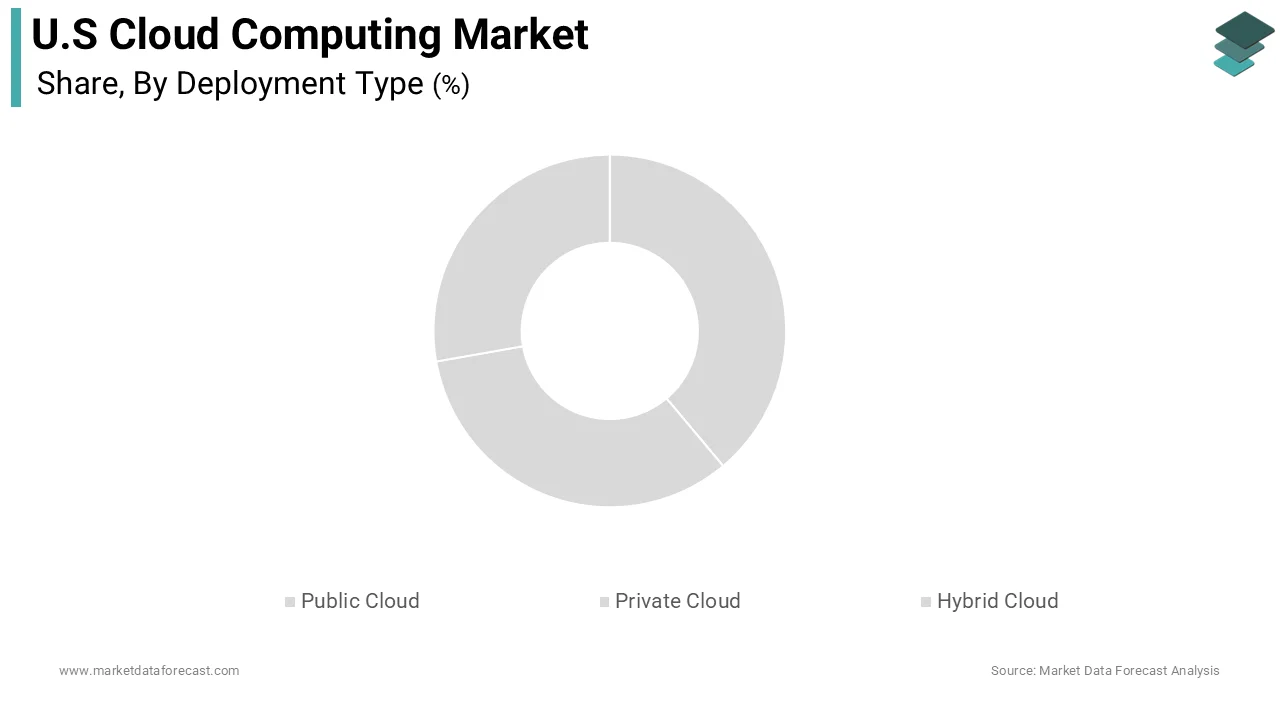
However, the hybrid cloud segment is a promising segment and is estimated to record a CAGR of 19.1% over the forecast period in the U.S. market, owing to the need for flexibility and regulatory compliance in data management. Enterprises are increasingly adopting hybrid architectures to balance the benefits of public cloud scalability with the security and control of private on-premises infrastructure. According to the National Institute of Standards and Technology, hybrid cloud enables data and applications to move between private and public clouds, offering greater flexibility and more deployment options. This model is particularly attractive to industries such as healthcare and finance, where sensitive data must remain on premises due to strict regulatory requirements, while less critical workloads can leverage the public cloud. The Department of Health and Human Services emphasizes the importance of securing protected health information, which drives healthcare providers to adopt hybrid solutions that keep patient data local while using cloud resources for analytics and backup. Furthermore, the Federal Financial Institutions Examination Council guidelines encourage financial institutions to maintain robust risk management frameworks, which hybrid clouds support by allowing granular control over data placement. As per the Government Accountability Office, many federal agencies are transitioning to hybrid environments to modernize legacy systems while maintaining security standards. This strategic approach allows organizations to innovate rapidly without compromising on compliance or security. The ability to burst into the public cloud during peak demand periods also enhances operational efficiency. These factors collectively drive the rapid adoption of hybrid cloud deployments across diverse sectors in the U.S.
By Service Model Insights
The Software as a Service segment led the market with the leading share of the U.S. market in 2025 due to its ease of adoption and broad applicability across business functions. SaaS solutions allow organizations to access software applications over the internet on a subscription basis, eliminating the need for local installation and maintenance. According to the Bureau of Labor Statistics, the proliferation of remote work has accelerated the demand for cloud-based collaboration and productivity tools, which are predominantly delivered via SaaS models. The convenience of automatic updates and seamless integration with other digital tools makes SaaS attractive to businesses of all sizes. The Census Bureau reports that service-providing industries account for a large majority of US economic activity, and these sectors heavily rely on SaaS applications for customer relationship management, human resources, and accounting. The low barrier to entry enables small businesses to access sophisticated software capabilities that were previously available only to large corporations. As per the Federal Trade Commission, the competitive landscape of the software industry has shifted toward subscription-based models, which provide predictable revenue streams for vendors and lower upfront costs for users. The widespread availability of broadband internet, as noted by the Federal Communications Commission, ensures reliable access to SaaS platforms. Additionally, the integration of artificial intelligence into SaaS applications enhances their value proposition by providing actionable insights and automation. This combination of accessibility, affordability, and functionality solidifies the dominance of the SaaS segment in the US market.
On the other hand, the infrastructure as a Service segment is experiencing the fastest growth and is predicted to expand at a CAGR of 15.5% over the forecast period, owing to the growing need for scalable computing power and storage resources. IaaS provides virtualized computing resources over the internet, allowing organizations to rent servers, storage, and networking components on demand. According to the National Science Foundation, the surge in data generation from Internet of Things devices and digital transactions requires robust infrastructure capable of handling massive volumes of information. IaaS offers the flexibility to scale infrastructure dynamically, which is essential for businesses dealing with fluctuating workloads. The Department of Commerce highlights that digital economy activities are expanding rapidly, necessitating flexible IT infrastructure to support innovation and growth. IaaS enables companies to avoid the capital expense of building and maintaining physical data centers. As per the Bureau of Economic Analysis, investment in digital assets, including software and databases, continues to rise, reflecting the growing reliance on external infrastructure providers. The ability to deploy resources quickly allows businesses to respond rapidly to market changes and launch new products faster. Furthermore, the integration of advanced security features by IaaS providers addresses concerns about data protection. According to the National Institute of Standards and Technology, IaaS forms the foundation for other cloud services, making it a critical component of the cloud ecosystem. This foundational role, combined with the demand for computational power for AI and big data analytics, drives the rapid expansion of the IaaS segment.
By End-User Vertical Insights
The BFSI segment held the major share of the U.S. cloud computing market in 2025. The growth of the BFSI segment in the European market is driven by the need for digital transformation and enhanced customer experiences. Financial institutions are leveraging cloud technologies to modernize legacy systems, improve operational efficiency, and develop innovative financial products. According to the Federal Financial Institutions Examination Council, banks are increasingly adopting cloud services to enhance their cybersecurity posture and manage risk more effectively. The ability to process large volumes of transactions in real time and provide personalized services to customers is a key driver for cloud adoption in this sector. The Office of the Comptroller of the Currency emphasizes the importance of third-party risk management, which includes cloud service providers, highlighting the strategic significance of these partnerships. As per the Bureau of Labor Statistics, the financial activities sector contributes significantly to the US GDP, and its continued growth relies on technological innovation. Cloud computing enables insurers to use advanced analytics for underwriting and claims processing, which is improving accuracy and speed. The Federal Reserve notes that fintech innovations are reshaping the financial landscape, and cloud infrastructure is essential for supporting these new business models. Security and compliance remain top priorities, but the benefits of scalability and agility outweigh the challenges. Financial institutions are investing heavily in cloud native applications to stay competitive. This sustained investment and the critical nature of financial services ensure that this vertical remains the largest consumer of cloud computing resources in the U.S.
On the other hand, the healthcare and life sciences segment is the fastest-growing end-user vertical and is predicted to record a promising CAGR in the U.S. market during the forecast period, owing to the adoption of telemedicine and electronic health records. The pandemic accelerated the shift toward digital health solutions, requiring robust cloud infrastructure to support remote patient monitoring and virtual consultations. According to the Office of the National Coordinator for Health Information Technology, the interoperability of health information is a key priority, and cloud platforms facilitate the secure exchange of patient data among providers. The Centers for Medicare and Medicaid Services have expanded reimbursement for telehealth services, further driving demand for cloud-based healthcare solutions. Cloud computing enables healthcare organizations to store and analyze large datasets for medical research and personalized medicine. As per the National Institutes of Health, precision medicine initiatives rely on cloud computing to process genomic data and identify targeted treatments. The ability to scale resources for intensive computational tasks, such as drug discovery, is another significant factor. The Department of Health and Human Services promotes the use of technology to improve patient outcomes and reduce costs. Cloud-based electronic health record systems offer greater accessibility and collaboration among care teams. Security and privacy protections provided by compliant cloud providers address regulatory concerns. The ongoing digital transformation in healthcare, combined with the aging population and increasing chronic diseases, ensures sustained growth in cloud adoption within this vital sector.
REGIONAL ANALYSIS
The U.S. captured the highest share of the global cloud computing market in 2025 and is likely to maintain its dominant position as the global leader in cloud computing for the next few years as hyperscale providers continue to innovate. A primary driving factor is the presence of hyperscale cloud providers such as Amazon Web Services, Microsoft Azure, and Google Cloud, which are headquartered in the US and drive continuous innovation. According to the Bureau of Economic Analysis, investment in intellectual property products, including software, has been a major contributor to US economic growth, reflecting the deep integration of cloud technologies in business operations. Another critical factor is the robust digital infrastructure, including high-speed broadband networks. The Federal Communications Commission reports that broadband availability continues to expand, enabling businesses and consumers across urban and rural areas to access cloud services reliably. The strong regulatory framework, although complex, provides clarity for data protection and security, which builds trust in cloud services. As per the National Science Foundation, the US leads in research and development expenditure, fostering an environment of technological advancement that supports cloud innovation. The large base of tech-savvy enterprises and startups further fuels demand for cloud solutions. The government’s cloud-first policy also stimulates adoption in the public sector. These elements combine to maintain the U.S. position as the largest and most dynamic cloud computing market globally.
COMPETITION OVERVIEW
The competition in the U.S. cloud computing market is characterized by the dominance of three major hyperscale providers who continuously innovate to maintain their leadership positions. These giants compete fiercely on price performance and the breadth of services offered, ranging from basic storage to complex artificial intelligence tools. The barrier to entry remains high due to the substantial capital investment required for building and maintaining global data center infrastructure. However, niche players and specialized providers find opportunities by focusing on specific industries or offering unique multi-cloud management solutions. The market sees frequent strategic acquisitions as larger companies seek to integrate advanced technologies and expand their service portfolios. Customer loyalty is driven by ecosystem integration, making it difficult for users to switch providers once deeply embedded. Regulatory scrutiny regarding data privacy and antitrust practices adds another layer of complexity to competitive dynamics. Providers must balance innovation with compliance to retain trust. The rapid evolution of technology ensures that competition remains dynamic with constant pressure to deliver faster, more secure, and cost-effective solutions. This environment fosters continuous improvement but also consolidates power among established leaders.
KEY MARKET PLAYERS
A few major players of the U.S. Cloud computing market include
- Amazon Web Services (AWS)
- Microsoft Azure
- Google Cloud
- IBM Cloud
- Oracle Cloud
- Salesforce
- Adobe
- VMware
- Rackspace Technology
- DigitalOcean
- Snowflake
- ServiceNow
- Cisco Systems
- Datadog
- Twilio
- SAP
- Workday
- Verizon Cloud
- Broadcom
- Navisite
Leading Players in the U.S. Cloud Computing Market
- Amazon Web Services maintains its position as a pioneer by offering an extensive suite of global cloud infrastructure services. The company continuously expands its data center footprint across various US regions to ensure low latency and high availability for enterprise clients. Recent initiatives include significant investments in custom silicon development, such as Graviton processors, to enhance performance and reduce costs for users. Amazon Web Services also focuses on sustainability by committing to renewable energy sources for its operations. These efforts reinforce its leadership in providing scalable and secure solutions for diverse industries. By integrating advanced machine learning capabilities into its core offerings, the company enables businesses to innovate rapidly. Its robust partner ecosystem further strengthens customer retention and drives adoption among small and medium enterprises. This comprehensive approach ensures sustained growth and relevance in the evolving digital landscape.
- Microsoft Azure leverages its strong integration with enterprise software to drive widespread adoption among corporate clients in the U.S. The company emphasizes hybrid cloud solutions that allow organizations to seamlessly connect on-premises infrastructure with public cloud resources. Recent actions include expanding its AI capabilities through strategic partnerships and internal developments to support generative AI workloads. Microsoft Azure also invests heavily in security features to address growing concerns about data privacy and compliance. The introduction of specialized clouds for government and healthcare sectors demonstrates its commitment to meeting specific industry needs. By offering consistent development tools across environments, the company simplifies the migration process for developers. These strategies enhance its appeal to large enterprises seeking reliable and integrated cloud platforms. The focus on productivity and collaboration tools further solidifies its position in the market.
- Google Cloud Platform distinguishes itself through superior data analytics and artificial intelligence capabilities that attract technology-forward organizations. The company focuses on open source technologies and multi-cloud solutions to provide flexibility and avoid vendor lock-in for its customers. Recent expansions include new cloud regions and zones within the U.S. to improve service delivery and redundancy. Google Cloud also emphasizes sustainability by operating on carbon-free energy for a significant portion of its usage. The integration of TensorFlow and other machine learning frameworks enables developers to build sophisticated AI applications efficiently. Strategic acquisitions in cybersecurity and database management strengthen its portfolio and enhance service offerings. By prioritizing innovation and developer experience, the company captures market share in high-growth sectors. Its commitment to open standards fosters trust and encourages broader adoption among diverse enterprise clients.
Top Strategies Used by Key Market Participants
Key players in the U.S. cloud computing market primarily focus on expanding their artificial intelligence and machine learning capabilities to attract enterprise customers seeking advanced analytical tools. Companies are investing heavily in developing proprietary chips and infrastructure optimized for AI workloads to improve performance and reduce costs. Strategic acquisitions of specialized software firms enable providers to enhance their security and data management offerings while filling gaps in their portfolios. Partnerships with telecommunications companies facilitate the integration of edge computing services, which reduces latency for critical applications. Sustainability initiatives, such as committing to renewable energy sources, help providers meet corporate environmental goals and regulatory requirements. Additionally, vendors are enhancing hybrid and multi-cloud solutions to offer greater flexibility and prevent vendor lock-in for clients. These strategies collectively aim to differentiate services and capture value in an increasingly competitive landscape where innovation and reliability are paramount for customer retention and growth.
MARKET SEGMENTATION
This research report on the US cloud computing market has been segmented and sub-segmented based on deployment type, service model, end user vertical & region.
By Deployment Type
- Public Cloud
- Private Cloud
- Hybrid Cloud
By Service model
- Infrastructure-As-A-Service
- Platform-As-A-Service
- Software-As-A-Service
By End User Vertical
- Manufacturing
- Education
- Retail
- Others
By Region
- New York
- Texas
- Florida
- Georgia
- California
- Rest of U.S.
Frequently Asked Questions
1. What is driving the growth of the U.S. cloud computing market?
Key drivers include AI adoption, digital transformation, remote work, big data analytics, and cost efficiency.
2. Which service model dominates the market?
Software-as-a-Service (SaaS) dominates due to its ease of use, subscription model, and widespread enterprise adoption
3. What are the major service models in cloud computing?
The main models are infrastructure-as-a-Service (IaaS), platform-as-a-Service (PaaS), and software-as-a-Service (SaaS)
4. Which deployment model leads the market?
The public cloud segment holds the largest share due to scalability and cost advantages
5. Who are the key players in the U.S. cloud computing market?
Leading companies include Amazon Web Services, Microsoft Azure, Google Cloud, IBM, Oracle, and Salesforce
6. Which industries are major users of cloud computing?
Key industries include IT & telecom, healthcare, BFSI, retail, and manufacturing.
7. What role does AI play in cloud computing growth?
AI significantly boosts demand by enabling advanced analytics, automation, and scalable computing power.
8. What are the benefits of cloud computing?
Major benefits include cost savings, scalability, flexibility, remote access, and faster deployment.
9. What challenges does the U.S. cloud computing market face?
Key challenges include data security concerns, regulatory compliance, and high energy consumption of data centers
10. Which segment is growing the fastest?
Infrastructure-as-a-Service (IaaS) is one of the fastest-growing segments due to demand for scalable IT infrastructure
Related Reports
Access the study in MULTIPLE FORMATS
Purchase options starting from
$ 1200
Didn’t find what you’re looking for?
TALK TO OUR ANALYST TEAM
Need something within your budget?
NO WORRIES! WE GOT YOU COVERED!
Call us on: +1 888 702 9696 (U.S Toll Free)
Write to us: sales@marketdataforecast.com