U.S. Consumer Electronics Market Size, Share, Trends & Growth Forecast Report By Product Type, By Distribution Channel, and By Country (California, Washington, Oregon, New York & Rest of the United States) – Industry Analysis and Forecast, 2026 to 2034
Market Size, 2025
$249.63 BnMarket Estimate, 2026
$261.62 BnMarket Forecast, 2034
$380.68 BnCAGR, 2026–2034
380.68 BnU.S. Consumer Electronics Market Size
The U.S. Consumer Electronics Market was valued at USD 249.63 billion in 2025, is estimated to reach USD 261.62 billion in 2026, and is projected to reach USD 380.68 billion by 2034, growing at a CAGR of 4.8% from 2026 to 2034.

According to the Consumer Technology Association, the average American household owns more than twenty-five connected devices, reflecting the deep penetration of digital technology into domestic environments. As per the Pew Research Center, 97% of adults in the United States own a mobile phone, with 85% owning a smartphone, indicating near-universal adoption of core connectivity tools. The Federal Communications Commission notes that broadband access has expanded significantly, with over 90% of Americans having access to high-speed internet, enabling the functionality of cloud-based and streaming services. Technological convergence has blurred the lines between distinct product categories as devices increasingly serve multiple functions, such as health monitoring and financial transactions. According to the Environmental Protection Agency, electronic waste remains a growing concern, with millions of tons generated annually, prompting increased focus on recycling and sustainable design. This market is characterized by rapid innovation cycles, intense competition, and shifting consumer preferences toward integrated ecosystems and artificial intelligence-driven experiences.
MARKET DRIVERS
Pervasive Connectivity and Expansion of High-Speed Internet Infrastructure
The widespread availability of high-speed internet and fifth-generation wireless networks is propelling the growth of the U.S. consumer electronics market. According to the Federal Communications Commission, the deployment of fifth-generation networks has reached over 90% of Americans, providing the low-latency and high-bandwidth necessary for advanced applications. According to the Pew Research Center, 80% of Americans have home broadband access, which enables the seamless operation of smart home devices, streaming services, and cloud gaming platforms. The expansion of fiber-optic infrastructure further supports data-intensive activities such as 4K video streaming and virtual reality experiences. According to the Consumer Technology Association, connectivity is no longer a feature but a fundamental requirement for modern devices, driving upgrades across smartphones, tablets, and wearables. Furthermore, the integration of Internet of Things capabilities allows devices to communicate and automate tasks, enhancing convenience and efficiency. For instance, the number of connected devices per household continues to rise as consumers seek integrated ecosystems that simplify daily routines. This robust digital infrastructure enables the functionality of emerging technologies such as autonomous vehicles and augmented reality glasses. Consequently, the ubiquity of high-speed connectivity creates a fertile environment for the adoption of sophisticated consumer electronics.
Integration of Artificial Intelligence and Smart Home Automation
The incorporation of artificial intelligence and machine learning into consumer devices is further boosting the U.S. market expansion. According to the Consumer Technology Association, smart home devices, including voice assistants, smart thermostats, and security cameras, are among the fastest-growing categories due to their ability to learn user preferences. As per industry developments, artificial intelligence enables predictive maintenance, personalized content recommendations, and automated energy management, which increase the perceived value of these products. The National Institute of Standards and Technology highlights that AI-driven algorithms improve image processing in smartphones and enhance noise cancellation in audio devices. Furthermore, the rise of voice-controlled interfaces has simplified interaction with technology, making it accessible to broader demographics, including elderly users. According to market analyses, the adoption of smart speakers has exceeded 50% of U.S. households, creating a central hub for controlling other connected devices. The integration of health monitoring features in wearables powered by AI provides actionable insights into fitness and wellness, driving replacement cycles. This technological evolution transforms passive devices into proactive assistants that anticipate needs and optimize performance. Consequently, the appeal of intelligent automation and personalized experiences sustains strong demand for next-generation consumer electronics.
MARKET RESTRAINTS
Supply Chain Vulnerabilities and Semiconductor Shortages
Global supply chain disruptions and persistent shortages of semiconductors impede the U.S. market growth. According to the Semiconductor Industry Association, the United States relies heavily on overseas manufacturing for advanced chips, with limited domestic production capacity creating vulnerabilities. As per industry reports, lead times for critical components such as microcontrollers and memory chips have extended, causing delays in the launch of new products. The concentration of semiconductor fabrication in specific geographic regions increases exposure to geopolitical tensions and natural disasters. According to the Bureau of Labor Statistics, inflationary pressures on raw materials and transportation costs have elevated production expenses, squeezing profit margins for manufacturers. These cost increases are often passed on to consumers, potentially dampening demand for premium devices. Furthermore, the lack of diversification in supply chains complicates inventory management and planning, affecting the ability to meet fluctuating consumer demand. According to the Consumer Technology Association, supply chain constraints have resulted in stockouts for popular items such as gaming consoles and laptops. Consequently, the instability of component availability acts as a persistent restraint on market growth and operational efficiency, limiting the industry's ability to scale rapidly.
Environmental Concerns and Electronic Waste Management
The growing environmental impact of electronic waste and the carbon footprint of device manufacturing further hamper the U.S. consumer electronics market expansion. According to the Environmental Protection Agency, the United States generates millions of tons of electronic waste annually, with only a small percentage being properly recycled. As per industry data, the short lifecycle of many consumer electronics contributes to resource depletion and landfill accumulation, raising sustainability concerns. Consumers are increasingly aware of the environmental costs associated with frequent upgrades, leading to a shift toward longer-lasting devices. The Federal Trade Commission monitors green marketing claims, ensuring that companies do not mislead consumers about the recyclability or energy efficiency of their products. Furthermore, regulatory pressures are mounting for manufacturers to adopt circular economy principles, such as designing for repairability and using recycled materials. According to market surveys, a significant portion of consumers prefer brands that demonstrate commitment to sustainability, influencing purchasing decisions. The challenge of managing e-waste responsibly requires substantial investment in recycling infrastructure and take-back programs. Consequently, environmental considerations act as a restraint on the traditional model of rapid consumption and disposal, forcing the industry to adapt to more sustainable practices.
MARKET OPPORTUNITIES
Growth of Health Tech and Wearable Devices
The expanding focus on personal health and wellness is a substantial opportunity for growth in the wearable technology segment. According to the Centers for Disease Control and Prevention, chronic diseases affect 60% of Americans, driving demand for tools that monitor and manage health metrics. As per industry developments, smartwatches and fitness trackers now offer advanced features such as electrocardiogram monitoring, blood oxygen sensing, and sleep analysis. The Food and Drug Administration has cleared several wearable devices for medical use, validating their accuracy and reliability for health tracking. Furthermore, the integration of telehealth services with wearable data allows for remote patient monitoring and proactive healthcare interventions. According to market analyses, the aging population is increasingly adopting wearables to maintain independence and monitor vital signs. The Consumer Technology Association notes that health-focused features are a primary driver for smartphone and smartwatch upgrades.
Additionally, the rise of mental health awareness has led to the development of devices that track stress levels and provide mindfulness guidance. This convergence of technology and healthcare creates new revenue streams and enhances the value proposition of consumer electronics. Consequently, the health tech segment offers robust growth potential as consumers prioritize well-being and preventive care.
Expansion of Immersive Technologies and Gaming
The advancement of virtual reality, augmented reality, and mixed reality technologies offers significant potential for market expansion in the entertainment and gaming sectors. According to the Entertainment Software Association, video game sales in the United States continue to grow, with immersive experiences becoming increasingly popular. As per industry developments, standalone virtual reality headsets have become more affordable and user-friendly, expanding the addressable market beyond early adopters. The integration of haptic feedback and high-resolution displays enhances the realism of immersive experiences, attracting gamers and content creators. Furthermore, the metaverse concept drives interest in digital avatars and virtual spaces, requiring specialized hardware for access. According to market reports, the adoption of augmented reality in retail and education creates new use cases for smart glasses and headsets. The Consumer Technology Association highlights that immersive technologies are transforming how consumers interact with digital content, offering engaging and interactive experiences
Additionally, the development of cloud gaming services reduces the need for expensive local hardware, making high-quality gaming more accessible. This technological evolution creates opportunities for hardware manufacturers to innovate and capture new audience segments. Consequently, the immersive technology sector represents a dynamic growth area within the consumer electronics market.
MARKET CHALLENGES
Data Privacy and Cybersecurity Risks
The increasing connectivity of consumer devices exposes them to cybersecurity threats and data privacy breaches, challenging the U.S. consumer electronics market growth. According to the Federal Trade Commission, complaints regarding identity theft and fraud involving connected devices have risen as hackers exploit vulnerabilities in smart home systems. As per industry data, many Internet of Things devices lack robust security features, making them easy targets for botnets and malware attacks. The National Institute of Standards and Technology emphasizes the need for standardized security protocols to protect consumer data and ensure device integrity. Furthermore, the collection of personal information by smart devices raises concerns about surveillance and unauthorized data sharing. According to market surveys, consumers are becoming more cautious about granting permissions to apps and devices, impacting adoption rates. Manufacturers must invest heavily in encryption and regular software updates to mitigate these risks. However, the complexity of securing diverse ecosystems makes it difficult to guarantee comprehensive protection. According to legal analyses, liability issues arise when data breaches occur, leading to reputational damage and financial penalties. Consequently, cybersecurity remains a critical challenge affecting consumer trust and market adoption of connected technologies.
Market Saturation and Lengthening Replacement Cycles
The maturity of key product categories such as smartphones and laptops leads to market saturation and longer replacement cycles, further challenging the U.S. consumer electronics market expansion. According to the Consumer Technology Association, smartphone ownership has reached saturation levels, with most consumers replacing devices less frequently than in previous years. As per industry data, the average lifespan of a smartphone has extended to over three years due to improved durability and software support. Furthermore, incremental innovations in recent generations fail to compel users to upgrade immediately, reducing sales volume. The economic uncertainty and inflationary pressures also cause consumers to prioritize essential spending over discretionary electronics purchases. According to market analyses, the lack of disruptive new form factors limits the excitement and urgency for upgrades. Manufacturers face the challenge of differentiating their products in a crowded market where functional differences are minimal.
Additionally, the rise of refurbished and second-hand markets provides cost-effective alternatives that further suppress new device sales. According to industry reports, companies are shifting focus to services and accessories to compensate for stagnant hardware sales. Consequently, market saturation and changing consumer behavior pose significant challenges to sustaining growth in traditional consumer electronics segments.
REPORT COVERAGE
| REPORT METRIC | DETAILS |
| Market Size Available | 2025 to 2034 |
| Base Year | 2025 |
| Forecast Period | 2026 to 2034 |
| Segments Covered | By Product Type, Distribution Channel, and Region. |
| Various Analyses Covered | Global, Regional and Country-Level Analysis, Segment-Level Analysis, Drivers, Restraints, Opportunities, Challenges; PESTLE Analysis; Porter’s Five Forces Analysis, Competitive Landscape, Analyst Overview of Investment Opportunities |
| Countries Covered | California, Washington, Oregon, New York, and the rest of the United States |
| Market Leaders Profiled | Apple Inc., Samsung Electronics Co., Ltd., Sony Group Corporation, LG Electronics Inc., Panasonic Holdings Corporation, Dell Technologies Inc., HP Inc., Microsoft Corporation, Lenovo Group Limited, Intel Corporation, Canon Inc., Bose Corporation |
SEGMENTAL ANALYSIS
By Product Type Insights
The electronic devices segment dominated the market by holding 61.2% of the U.S. market share in 2025. The dominance of the electronic devices segment in the U.S. market is driven by the structural shift toward remote work and hybrid learning models. According to the Bureau of Labor Statistics, approximately 20% of workers in the United States perform their jobs remotely at least part of the time, creating a permanent need for high-performance laptops and desktops. As per the National Center for Education Statistics, over 90% of households with school-aged children have access to a computer for educational purposes, ensuring consistent procurement cycles for families. The requirement for reliable video conferencing tools, multitasking capabilities, and secure connectivity drives consumers to upgrade their existing hardware regularly. Furthermore, the integration of artificial intelligence processors in modern computers enhances productivity and creativity, appealing to professional users. According to the Consumer Technology Association, laptop sales have stabilized at elevated levels compared to pre-pandemic trends, reflecting the new normal of distributed workforces. The necessity for dual-monitor setups, ergonomic peripherals, and robust processing power further expands the average transaction value. This fundamental change in work and education dynamics ensures that computers remain a critical and high-volume component of the electronic devices segment, sustaining its market leadership.
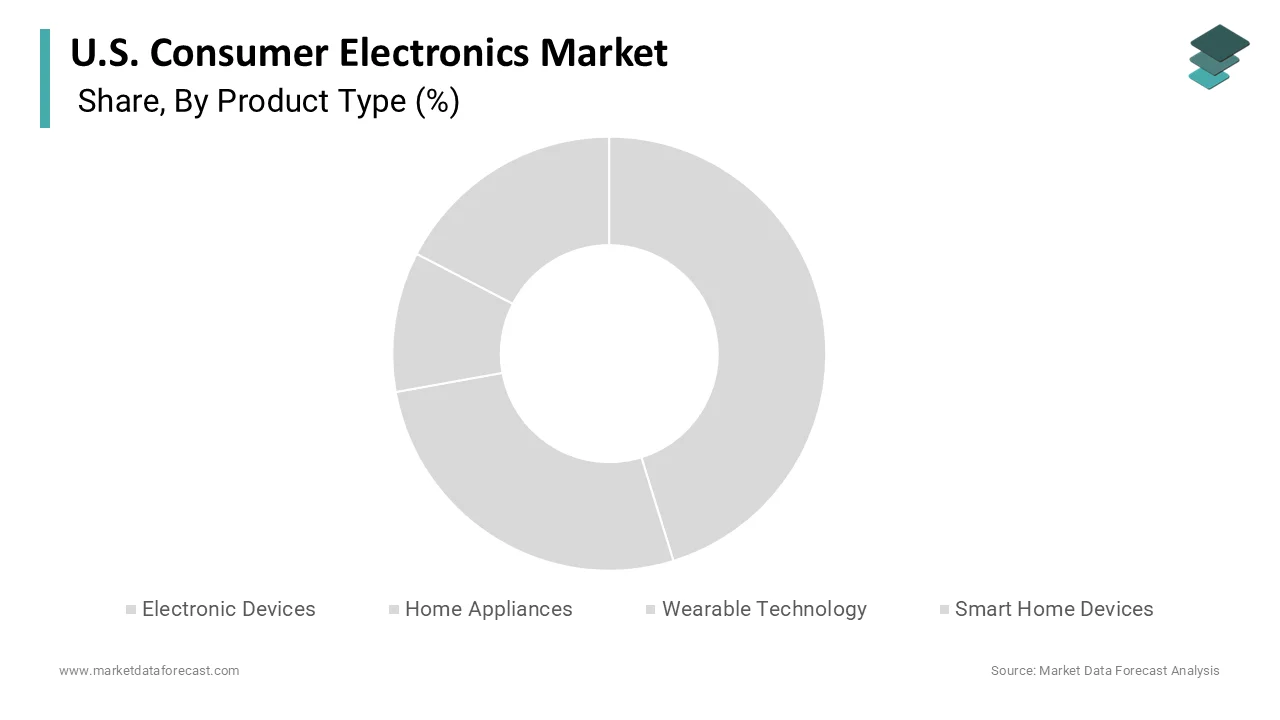
On the other hand, the wearable technology segment represents the fastest-growing category within the United States consumer electronics market and is expected to witness a CAGR of 13.3% during the forecast period. The increasing focus on personal health monitoring and preventive care significantly drives the exceptional growth of wearable technology. According to the Centers for Disease Control and Prevention, chronic diseases such as heart disease and diabetes affect millions of Americans, prompting individuals to seek tools for managing their well-being. As per industry data, smartwatches and fitness trackers now offer clinical-grade features such as electrocardiogram monitoring, blood oxygen saturation tracking, and sleep analysis. The Food and Drug Administration has cleared several wearable devices for medical use, validating their accuracy and encouraging adoption among older adults. Furthermore, the integration of wearables with telehealth platforms allows healthcare providers to monitor patients remotely, improving outcomes and reducing hospital visits. According to the American Heart Association, regular physical activity monitoring is linked to improved cardiovascular health, driving consumers to adopt fitness-focused devices. The gamification of health metrics through apps and social sharing also enhances user engagement and retention. This convergence of medical utility and lifestyle management positions wearable technology as a critical tool for modern health maintenance. Consequently, the demand for proactive health solutions ensures that wearables remain the fastest-growing segment in the consumer electronics market.
By Distribution Channel Insights
The offline segment led the market by capturing 54.9% of the U.S. market share in 2025. The growth of the offline segment in the U.S. market is attributed to the ability to physically interact with products and receive immediate possession. According to the National Retail Federation, over 70% of consumers prefer to see and touch electronics before purchasing to assess build quality, screen resolution, and ergonomics. As per industry data, high-value items such as televisions, laptops, and cameras benefit from in-store demonstrations where staff can explain features and answer questions. The immediate gratification of taking a product home the same day appeals to consumers who need replacements urgently or wish to avoid shipping delays. Furthermore, the presence of knowledgeable sales associates helps guide complex purchasing decisions, reducing the risk of buyer remorse. The Consumer Technology Association notes that trade-in programs and bundle deals are often more accessible in physical stores, enhancing value propositions.
Additionally, the opportunity to test compatibility with existing devices ensures that customers make informed choices. This tactile engagement,t combined with instant fulfillment,nt creates a compelling value proposition that online channels struggle to replicate. Consequently, the sensory and logistical advantages of offline retail ensure its continued leadership in the consumer electronics market.
However, the online retail store segment is anticipated to showcase a CAGR of 15.1% during the forecast period in the U.S. market owing to the convenience, price transparency, and extensive selection. The unparalleled convenience of shopping from home and the ability to easily compare prices significantly drive expansion in the online retail segment. According to the U.S. Census Bureau, e-commerce sales for electronics and appliances have grown consistently as consumers value the time savings of digital shopping. As per industry data, online platforms offer vast selections that exceed physical inventory limits, allowing consumers to find niche or specialized products easily. The transparency of pricing enables shoppers to use comparison tools and browser extensions to find the best deals, driving traffic to competitive retailers. Furthermore, the availability of detailed customer reviews and ratings helps buyers make informed decisions without relying on sales staff. The Consumer Technology Association notes that mobile commerce has accelerated this trend with apps enabling quick purchases and order tracking. The elimination of travel costs and parking fees further enhances the economic appeal of online shopping. Additionally, the rise of subscription services and automated replenishment for accessories adds to the convenience factor. This combination of ease, selection, and cost efficiency creates powerful growth momentum for online retail channels.
COUNTRY LEVEL ANALYSIS
U.S. Consumer Electronics Market Analysis
The U.S. occupied 26.1% of the global market share in 2025 and is anticipated to continue its dominance in the worldwide market throughout the forecast period. The substantial purchasing power of American consumers and the robust digital infrastructure significantly propel the United States market dominance. According to the Bureau of Economic Analysis, personal consumption expenditures on durable goods, including electronics, remain high, reflecting strong consumer confidence and financial capacity. As per the Federal Communications Commission, widespread access to high-speed broadband and fifth-generation networks enables the full utilization of connected devices and streaming services. The presence of major technology headquarters and innovation hubs fosters a dynamic ecosystem where new products are launched and marketed aggressively. The Consumer Technology Association notes that American consumers are among the earliest adopters of new technologies such as virtual reality headsets and smart home systems. Furthermore, the extensive retail network comprising both physical and online channels ensures broad product availability across urban and rural areas. The integration of electronics into daily life for work, education, and entertainment creates consistent demand across diverse demographics. This combination of economic strength, technological readiness, and cultural enthusiasm ensures that the United States remains the largest and most influential market for consumer electronics globally.
COMPETITIVE LANSDCAPE
The United States consumer electronics market features intense competition among global technology giants,nts specialized manufacturers, retailers, and emerging innovators. Established players leverage strong brand recognition, extensive distribution networks,s and robust ecosystems to maintain leadership while challengers differentiate through niche features and competitive pricing. Competition centers on technological innovation, with companies investing billions in artificial intelligence connectivity and display technologies to enhance user experience. Pricing strategies vary significantly,ntly with premium brands emphasizing quality and ecosystem lock-in while value-oriented competitors focus on affordability and specifications. The rapid pace of product cycles requires continuous innovation to prevent obsolescence and sustain consumer interest. Supply chain efficiency and component sourcing remain critical factors influencing profitability and market availability. Strategic collaborations with software developers and content creators enhance the value proposition of hardware devices. Regulatory compliance regarding data privacy and environmental standards serves as a key differentiator, ensuring consumer trust. This dynamic environment fosters continuous improvement in product functionality and design, benefiting consumers through greater choice and advanced technological capabilities.
KEY MARKET PLAYERS
Some of the companies that are playing a dominating role in the U.S. Consumer Electronics Market include
- Apple Inc.
- Samsung Electronics Co., Ltd.
- Sony Group Corporation
- LG Electronics Inc.
- Panasonic Holdings Corporation
- Dell Technologies Inc.
- HP Inc.
- Microsoft Corporation
- Lenovo Group Limited
- Intel Corporation
- Canon Inc.
- Bose Corporation
Top Leading Players in the U.S. Market
- Apple Inc maintains a dominant position in the United States consumer electronics market through its integrated ecosystem of iPhones,nes Macs, iPads,s and wearables. The company leverages proprietary silicon and software to deliver seamless user experiences that foster strong brand loyalty. Apple recently strengthened its market position by introducing advanced artificial intelligence features across its device line, up enhancing productivity and creativity. The company actively expands its services segment, ent including cloud storage and streaming, to create recurring revenue streams. Apple also invests heavily in sustainability initiatives,s aiming for carbon neutrality in its supply chain. These strategic moves reinforce its premium brand image while driving continuous innovation and customer retention in the highly competitive U.S. technology landscape.
- Samsung Electronics Co Ltd contributes significantly to the U.S. market with a diverse portfolio spanning smartphones, televisions, home appliances,s and wearable devices. The company utilizes vertical integration to control component production, ensuring quality and supply chain stability. Samsung recently strengthened its position by launching foldable smartphone models and advanced QLED televisions that cater to premium consumer segments. The company focuses on smart home integration, connecting appliances through its SmartThings platform for enhanced convenience. Samsung also partners with major U.S. carriers and retailers to ensure broad distribution and visibility. These efforts demonstrate its commitment to innovation and connectivity while maintaining a strong presence across multiple consumer electronics categories in the United States.
- Sony Group Corporation plays a pivotal role in the U.S. consumer electronics market with its renowned audiovisual products,g aming consoles, a imaging sensors. The company is recognized for high-fidelity audio equipment and professional-grade cameras used by creators and enthusiasts. Sony recently strengthened its market position by expanding its PlayStation ecosystem with virtual reality hardware and exclusive content titles. The company invests in noise-cancelling technology and spatial audio features to differentiate its headphone and speaker offerings. Sony also collaborates with content providers to enhance the entertainment value of its devices. Through sustained innovation in imaging and audio technologies, Sony reinforces its leadership in providing premium entertainment experiences to consumers in the United States.
TOP STRATEGIES USED BY KEY MARKET PARTICIPANTS
Key players in the United States consumer electronics market employ strategic approaches to maintain competitive advantages and drive growth. Companies prioritize ecosystem integration by connecting devices through cloud services and software platforms to enhance user stickiness. Strategic partnerships with content providers and telecommunications companies facilitate bundled offerings and broader market reach. Manufacturers invest heavily in research and development to incorporate artificial intelligence and machine learning into products for personalized experiences. Sustainability initiatives focus on using recycled materials and improving energy efficiency to appeal to environmentally conscious consumers. Direct-to-consumer sales channels are expanded to capture higher margins and gather valuable customer data. These coordinated strategies enable participants to navigate rapid technological changes while delivering innovative and connected solutions to diverse consumer segments effectively.
MARKET SEGMENTATION
This research report on the U.S. consumer electronics market is segmented and sub-segmented into the following categories.
By Product Type
- Electronic Devices
- Home Appliances
- Wearable Technology
- Smart Home Devices
- Others
By Distribution Channel
- Offline Stores
- Online Retail Stores
By Country
- California
- Washington
- Oregon
- New York
- Rest of the United States
Related Reports
Access the study in MULTIPLE FORMATS
Purchase options starting from
$ 1200
Didn’t find what you’re looking for?
TALK TO OUR ANALYST TEAM
Need something within your budget?
NO WORRIES! WE GOT YOU COVERED!
Call us on: +1 888 702 9696 (U.S Toll Free)
Write to us: sales@marketdataforecast.com