- Product Description Description
- Table of Contents TOC
- List of Table & Figure LOT
- Get Free Sample PDF Sample PDF
Market Size, 2025
$10.75 BnMarket Estimate, 2026
$11.61 BnMarket Forecast, 2034
$21.42 BnCAGR, 2026–2034
7.96%U.S. Data Center Construction Market Report Summary
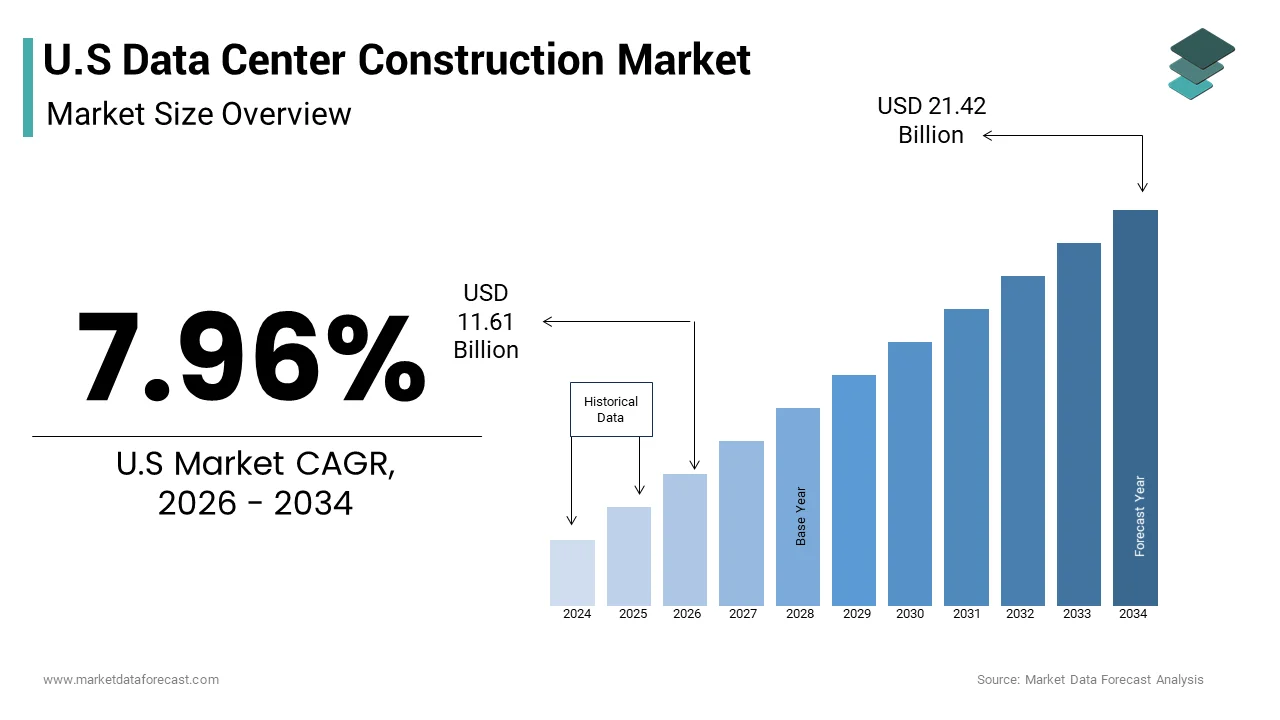
The U.S. data center construction market was valued at USD 10.75 billion in 2025, is estimated to reach USD 11.61 billion in 2026, and is projected to reach USD 21.42 billion by 2034, growing at a CAGR of 7.96% during the forecast period from 2026 to 2034. The growth of the U.S. data center construction market is driven by the rapid expansion of cloud computing, rising adoption of artificial intelligence (AI), increasing demand for hyperscale infrastructure, and the continuous growth of digital transformation initiatives across industries. The rising need for secure data storage, edge computing capabilities, and high-performance computing facilities is further accelerating investments in modern data center construction across the United States.
Key Market Trends
- Rising investments in hyperscale data centers by major cloud service providers to support growing AI workloads and enterprise cloud adoption.
- Increasing adoption of energy-efficient and sustainable construction practices, including renewable energy integration and advanced cooling technologies.
- Growing demand for tier III and tier IV data centers due to the need for high reliability, redundancy, and operational continuity.
- Expansion of edge data center infrastructure to support low-latency applications, IoT deployments, and 5G network growth.
- Increasing focus on modular and prefabricated data center construction methods to reduce deployment time and operational costs.
Segmental Insights
- Based on type, the hyperscale data centers segment accounted for the largest share of the U.S. data center construction market in 2025. The segment’s dominance is attributed to the aggressive expansion strategies of leading cloud providers and technology companies investing heavily in large-scale computing infrastructure to meet growing digital service demand.
- Based on construction type, the new construction segment captured the leading share of the U.S. data center construction market in 2025. The growth of this segment is driven by rising greenfield investments, increasing land acquisitions for large-scale campuses, and the need for technologically advanced facilities capable of supporting AI-driven workloads.
- Based on data center tier, the tier III data centers segment dominated the market in 2025. The segment held a significant market share due to its balance between reliability, operational efficiency, and cost-effectiveness, making it a preferred choice for enterprises and colocation providers.
- Based on end user, the IT and telecommunications segment led the U.S. data center construction market in 2025. The dominance of this segment is fueled by growing internet traffic, cloud migration trends, rising mobile data consumption, and increasing investments in digital connectivity infrastructure.
Regional Insights
The United States is expected to maintain its position as the global leader in data center infrastructure development over the forecast period. The market growth is supported by strong investments from hyperscale cloud providers, favorable technological ecosystems, and increasing enterprise demand for digital infrastructure. Major data center hubs such as Virginia, Texas, California, Arizona, and Ohio continue to attract large-scale investments due to favorable energy availability, connectivity infrastructure, and business-friendly regulations. The growing deployment of AI applications, machine learning workloads, and high-density computing environments is further strengthening the country’s leadership in the global data center construction landscape.
Competitive Landscape
The U.S. data center construction market is highly competitive, with major cloud service providers, colocation operators, and construction companies focusing on expanding capacity, improving energy efficiency, and accelerating project deployment timelines. Companies are increasingly investing in sustainable infrastructure, advanced cooling systems, and modular construction technologies to enhance operational performance and reduce environmental impact. Strategic partnerships, mergers, and expansion projects are further intensifying competition in the market.
Prominent players in the U.S. data center construction market include Amazon Web Services, Microsoft, Turner Construction Company, Google, DPR Construction, Equinix, Digital Realty, Holder Construction, IBM, Alibaba Cloud, NTT Communications, and CyrusOne.
U.S. Data Center Construction Market Size
The U.S data center construction market size was valued at USD 10.75 billion in 2025 and is anticipated to reach USD 11.61 billion in 2026 to reach USD 21.42 billion by 2034, growing at a CAGR of 7.96% during the forecast period from 2026 to 2034.
Data center construction represents the specialized engineering and building sector dedicated to creating physical infrastructure for housing computer systems and associated components such as telecommunications and storage systems. This U.S. market is critical to the digital economy facilitating cloud computing artificial intelligence and big data analytics. The construction process involves complex integration of power cooling security and network connectivity systems within highly secure facilities. As per data from the U.S. Census Bureau, the seasonally adjusted annual rate for non-residential construction spending reached $728.2 billion in January 2026, reflecting the national priority on digital readiness. The proliferation of internet connected devices has created an unprecedented demand for data processing capacity. According to the International Energy Agency, global electricity demand from data centers reached 415 terawatt hours in 2024, with the U.S. accounting for a substantial portion of this load driving the need for energy efficient construction designs. The Federal Reserve Bank of St Louis notes that investment in intellectual property products including software and research and development has surged necessitating robust physical hardware support. Furthermore the Department of Energy emphasizes the importance of grid modernization to support these high density energy loads. The market is characterized by rapid technological evolution requiring construction firms to adapt to new standards for liquid cooling and high voltage power distribution. This sector is not merely about erecting buildings but about engineering resilient ecosystems that ensure continuous uptime and data integrity in an increasingly digital dependent society.
MARKET DRIVERS
Exponential Growth in Artificial Intelligence and High Performance Computing Workloads
The exponential growth in artificial intelligence and high performance computing workloads that require specialized physical infrastructure is one of the major factors driving the growth of the U.S. data center construction market. Traditional data centers are being retrofitted or replaced to accommodate high density racks that generate significantly more heat and consume more power than standard servers. According to the National Science Foundation federal investment in AI research and development has increased substantially leading to a surge in private sector adoption and infrastructure build out. As per the data from the Semiconductor Industry Association, the demand for advanced chips used in AI applications is outpacing supply necessitating expanded facility capacity to house these processors. The shift towards generative AI models requires massive computational power which translates directly into construction projects focused on high efficiency power distribution and advanced cooling systems. Construction firms are increasingly tasked with building facilities capable of supporting power densities exceeding 50 kilowatts per rack compared to the traditional 5 to 10 kilowatts. This technological shift demands reinforced flooring enhanced electrical substations and innovative thermal management solutions such as direct to chip liquid cooling. The urgency to deploy AI capabilities drives faster construction timelines and higher capital expenditure. Companies across industries from healthcare to finance are investing in dedicated AI clusters further fuelling the demand for specialized construction services. This trend ensures a sustained pipeline of projects focused on next generation infrastructure.
Expansion of Cloud Computing Services and Digital Transformation Initiatives
The widespread expansion of cloud computing services and ongoing digital transformation initiatives across various economic sectors is further contributing to the expansion of the data center construction market in the U.S. Enterprises are migrating legacy systems to cloud platforms to enhance scalability flexibility and operational efficiency which requires extensive physical data center capacity. According to the Bureau of Economic Analysis, real gross domestic product increased at an annual rate of 2.0% in the first quarter of 2026, indicating a strong commitment to digital infrastructure. As per the Cloud Security Alliance, 90% of organizations now use some form of cloud service, driving the need for hyperscale data centers. These massive facilities require vast amounts of land and sophisticated construction techniques to ensure reliability and security. The rise of edge computing also contributes to this demand as companies build smaller localized data centers to reduce latency for real time applications. The Department of Commerce highlights that digital services are a growing component of U.S. exports reinforcing the strategic importance of robust domestic infrastructure. Construction projects are increasingly focused on modular designs that allow for rapid deployment and scalability. The competition among cloud service providers to offer low latency and high availability services leads to continuous expansion and upgrades of physical facilities. This structural shift in how businesses operate ensures long term demand for data center construction services across the country.
MARKET RESTRAINTS
Power Availability Constraints and Grid Infrastructure Limitations
The limited availability of reliable power and the constraints of existing grid infrastructure that can delay or halt projects is majorly impeding the U.S. data center construction market growth. Data centers are extremely energy intensive facilities requiring consistent and high volume electricity supply which many regional grids struggle to provide. According to the North American Electric Reliability Corporation several regions in the U.S. are experiencing tight reserve margins making it difficult to approve new large scale loads without significant grid upgrades. As per the Electric Power Research Institute, data centers are projected to consume up to 9% of U.S. electricity generation annually by 2030, posing challenges for utility providers. Construction timelines are often extended due to the lengthy process of securing power purchase agreements and building necessary substations. In markets like Northern Virginia and Silicon Valley wait times for power connections can exceed several years forcing developers to seek alternative locations. The cost of upgrading grid infrastructure is substantial and often falls on the developer or local municipality creating financial barriers. Additionally the intermittency of renewable energy sources requires complex backup systems which add to construction complexity and cost. These power related bottlenecks limit the speed at which new facilities can be brought online. Until grid capacity expands and interconnection processes streamline power availability will remain a critical constraint on market growth.
Stringent Environmental Regulations and Sustainability Compliance Requirements
The stringent environmental regulations and increasing pressure to meet sustainability compliance requirements that add complexity and cost to projects is further negatively affecting the U.S. market growth. Local and state governments are implementing stricter codes regarding water usage carbon emissions and energy efficiency for new constructions. According to the Environmental Protection Agency new guidelines for industrial water discharge affect data centers that rely on evaporative cooling systems which consume significant amounts of water. Data from the U.S. Green Building Council indicates that achieving LEED certification or other sustainability standards requires additional investment in materials and technologies increasing upfront construction costs. Many jurisdictions are imposing moratoriums on new data center developments until comprehensive environmental impact assessments are completed. The push for net zero operations forces constructors to integrate renewable energy sources and advanced energy recovery systems which are technically challenging and expensive. Compliance with varying local regulations across different states creates a fragmented regulatory landscape that complicates planning and execution. Failure to meet these standards can result in fines permits revocation or community opposition. The need to balance rapid deployment with environmental stewardship slows down project approvals and increases development risks. These regulatory hurdles require careful navigation and often lead to redesigns or cancellations of proposed facilities.
MARKET OPPORTUNITIES
Integration of Advanced Liquid Cooling Technologies
The integration of advanced liquid cooling technologies that offer superior efficiency for high density computing environments is a promising opportunity for the U.S. data center construction market. As processor power increases traditional air cooling becomes insufficient creating a demand for innovative thermal management solutions during the construction phase. According to the Department of Energy liquid cooling can reduce energy consumption for cooling by up to 90% compared to air based systems presenting a compelling value proposition for operators. Data from the Open Compute Project shows a growing adoption of open source hardware designs that support liquid cooling encouraging standardized construction practices. Construction firms that specialize in installing direct to chip or immersion cooling systems can differentiate themselves in a competitive market. These technologies require specialized plumbing containment and maintenance access which creates new niches for mechanical and electrical contractors. The transition to liquid cooling also allows for higher rack densities enabling more computing power in smaller footprints which is valuable in urban areas with limited space. Early adopters of these construction techniques can establish themselves as leaders in next generation data center development. Furthermore government incentives for energy efficient infrastructure support the adoption of these technologies. This technological shift opens new revenue streams for construction companies willing to invest in training and equipment.
Development of Edge Data Centers in Underserved Regions
The development of edge data centers in underserved regions to support low latency applications and local data processing is another prominent opportunity for the U.S. data center construction market. The proliferation of Internet of Things devices and 5G networks requires computing resources closer to the end user driving demand for smaller decentralized facilities. According to the Federal Communications Commission the expansion of 5G coverage across rural and suburban areas creates a need for local data infrastructure to handle increased traffic. Data from the Telecommunications Industry Association indicates that edge computing will account for a significant portion of future data processing needs. Construction companies can capitalize on this trend by building modular prefabricated data centers that can be deployed quickly in diverse locations. These facilities require less land and power than hyperscale centers making them viable in areas with limited infrastructure. Partnerships with telecommunications providers and local utilities can facilitate site acquisition and power connectivity. The ability to deliver rapid construction solutions for edge nodes positions firms to capture a growing segment of the market. Additionally federal broadband initiatives provide funding for infrastructure development in rural areas supporting this expansion. This geographic diversification reduces reliance on saturated major markets and opens new growth avenues.
MARKET CHALLENGES
Supply Chain Volatility for Critical Construction Materials
A major challenge confronting the U.S. data center construction market is the volatility in the supply chain for critical construction materials such as steel copper and electrical components which impacts project timelines and budgets. Global disruptions and trade policies have led to fluctuating prices and shortages of essential items required for data center builds. According to the Bureau of Labor Statistics the producer price index for construction materials has experienced significant variability causing cost overruns for developers. Data from the Associated General Contractors of America indicates that nearly all construction firms report difficulties in obtaining electrical equipment and switchgear leading to delays. The long lead times for generators transformers and chillers force planners to order months or years in advance reducing flexibility. Unexpected price spikes can erode profit margins and strain contractual agreements between owners and contractors. The reliance on imported components exposes the industry to geopolitical risks and logistics bottlenecks. Mitigating these risks requires sophisticated procurement strategies and contingency planning which add administrative burden. The uncertainty in material availability complicates scheduling and resource allocation. Until supply chains stabilize and domestic manufacturing capacity increases this volatility will remain a persistent challenge for the industry.
Skilled Labor Shortages in Specialized Construction Trades
The U.S. data center construction market faces significant challenges due to skilled labor shortages in specialized trades such as electrical engineering mechanical installation and commissioning. The complexity of data center systems requires highly trained technicians who are in short supply across the country. According to the National Center for Construction Education and Research the construction industry faces a widening gap between job openings and qualified workers particularly in technical roles. As per the Bureau of Labor Statistics, employment of electrical power line installers and repairers is projected to grow 7% from 2024 to 2034, which is faster than the average for all occupations. The specialized nature of data center work requires knowledge of high voltage systems precision cooling and network infrastructure which limits the pool of eligible candidates. Competition for talent among construction firms drives up wages and increases project costs. Training new workers takes time and resources delaying project starts and completion. The aging workforce exacerbates the issue as experienced professionals retire without adequate replacements. Addressing this shortage requires investment in vocational training and apprenticeship programs which take years to yield results. The lack of skilled labor poses a risk to quality and safety if inexperienced workers are employed. This human capital constraint limits the industry's capacity to execute the growing pipeline of projects efficiently.
REPORT COVERAGE
| REPORT METRIC | DETAILS |
| Market Size Available | 2025 to 2034 |
| Base Year | 2025 |
| Forecast Period | 2026 to 2034 |
| CAGR | % |
| Segments Covered | By Type, Construction, Data Center Tier, End-User, and By Country |
| Various Analyses Covered | Global, Regional, and Country Level Analysis, Segment-Level Analysis; DROC, PESTLE Analysis; Porter’s Five Forces Analysis; Competitive Landscape; Analyst Overview of Investment Opportunities. |
| Regions Covered | California, Washington, Oregon, New York & Rest of the United States |
| Market Leaders Profiled | Amazon Web Services (US), Microsoft (US), Turner Construction Company, Google (US), DPR Construction, Equinix (US), Digital Realty (US), Holder Construction, IBM (US), Alibaba Cloud (CN), NTT Communications (JP), CyrusOne (US) |
SEGMENTAL ANALYSIS
By Type Insights
The hyperscale data centers segment accounted for the leading share of the U.S. data center construction market in 2025. The growth of the hyperscale data centers segment in the U.S. market is attributed to the explosive growth in cloud computing services and the need for massive storage capacity for big data. Large technology companies such as Amazon Microsoft and Google require vast facilities to support their global cloud infrastructure and artificial intelligence initiatives. According to the Synergy Research Group, the United States accounted for 54% of total worldwide hyperscale capacity at the end of 2024, hosting the largest number of these facilities. Data from the International Data Corporation indicates that worldwide spending on cloud services continues to grow at a double digit rate driving the need for expanded physical infrastructure. These facilities are designed to support hundreds of thousands of servers requiring significant land area and power capacity. The economies of scale achieved by hyperscale operators allow them to invest heavily in custom built facilities optimized for efficiency and performance. The concentration of digital services in the cloud necessitates continuous expansion of these mega facilities to handle increasing data volumes. This trend is further accelerated by the adoption of Internet of Things devices which generate vast amounts of data requiring centralized processing and storage. The strategic importance of cloud infrastructure for national competitiveness ensures sustained investment in hyperscale construction projects across key U.S. markets.
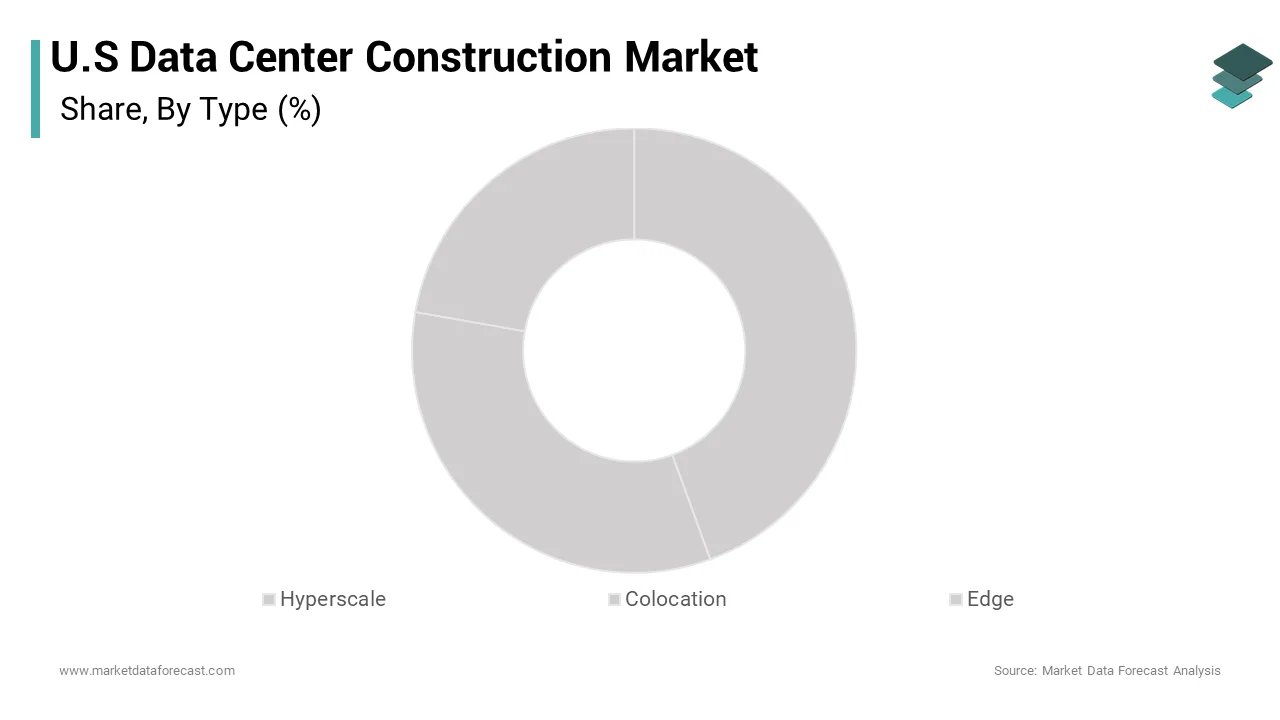
However, the edge data centers segment is predicted to showcase the fastest CAGR in the U.S. market during the forecast period owing to the rapid expansion of 5G networks and the critical need for low latency in real time applications. As 5G technology rolls out across the country it enables new use cases such as autonomous vehicles augmented reality and industrial automation which require data processing closer to the end user. According to the Federal Communications Commission the deployment of 5G infrastructure is accelerating with coverage expanding to urban and rural areas alike. Data from the GSM Association indicates that 5G connections will account for a significant portion of mobile connections by 2025 necessitating a distributed network of edge facilities. These smaller data centers reduce the distance data must travel minimizing latency and improving performance for time sensitive applications. The construction of edge facilities involves deploying modular units in diverse locations including cell towers retail spaces and industrial parks. This decentralization of infrastructure creates a new wave of construction opportunities distinct from traditional hyperscale projects. Telecommunications providers and content delivery networks are investing heavily in edge infrastructure to support the growing demand for high speed connectivity. The strategic placement of edge data centers ensures that users experience seamless and responsive digital services. This shift towards distributed computing drives the rapid growth of the edge segment in the construction market.
By Construction Insights
The new construction segment captured the largest share of the U.S. data center construction market in 2025. The growth of the new construction segment in the U.S. market is driven by the extensive greenfield development required for hyperscale facilities which demand large plots of land and specialized infrastructure. Major technology companies prefer to build custom designed data centers from the ground up to optimize layout power distribution and cooling systems for their specific needs. According to the Commercial Real Estate Services industry reports greenfield sites in key markets such as Northern Virginia Texas and Oregon are in high demand for new data center campuses. According to the U.S. Census Bureau, total construction spending during January 2026 was estimated at a seasonally adjusted annual rate of $2,190.4 billion, representing a 1.0% increase above the January 2025 estimate. These new builds allow for the integration of the latest technologies and sustainability features from the outset ensuring long term operational efficiency. The availability of land with access to reliable power and fiber optic connectivity is crucial for these projects. Developers often work closely with utility providers to secure necessary infrastructure before breaking ground. The scale of these projects requires significant capital investment and long planning horizons. The preference for purpose built facilities over retrofitted ones ensures that new construction remains the dominant segment. This trend is supported by the continuous entry of new players into the cloud market who require dedicated infrastructure.
However, the expansion segment is estimated to record a promising CAGR in the U.S. market during the forecast period owing to the rising need to upgrade existing facilities to support high density artificial intelligence workloads. Many older data centers were not designed to handle the power and cooling requirements of modern AI servers necessitating significant retrofits and additions. According to the Uptime Institute many legacy facilities are undergoing expansions to increase power capacity and install advanced cooling systems. Data from industry surveys indicates that a majority of data center operators plan to expand their existing sites rather than build new ones due to power availability constraints. These expansion projects often involve adding new halls or upgrading electrical and mechanical systems to support higher rack densities. The cost and time required for expansion are generally lower than for new construction making it an attractive option for operators facing tight deadlines. The scarcity of power in major markets further encourages operators to maximize the efficiency of their existing footprints. Expansion allows companies to leverage existing permits and infrastructure connections speeding up the deployment process. This trend is particularly evident in mature markets where land and power are limited. The focus on optimizing existing assets drives the rapid growth of the expansion segment.
By Data Center Tier Insights
The tier III data centers segment dominated the market with the largest share of the U.S. market in 2025. Tier III facilities provide concurrent maintainability meaning that any component can be removed or replaced without disrupting operations which is sufficient for most business critical applications. According to the Uptime Institute, Tier III infrastructure is the standard for most commercial data centers, as it provides 99.982% availability which meets the requirements of most service level agreements. Data from industry benchmarks shows that Tier III facilities account for the majority of new constructions due to their favorable cost to performance ratio. These facilities do not require the redundant components of Tier IV systems which significantly reduces construction and operational costs. The ability to perform maintenance without downtime ensures high availability while keeping capital expenditure manageable. Most cloud providers and enterprises find Tier III standards adequate for their workload requirements. The widespread acceptance of Tier III as the industry standard simplifies the design and construction process. This segment appeals to a broad range of customers from financial institutions to healthcare providers. The proven track record of Tier III facilities in delivering reliable service reinforces their market leadership.
However, the tier IV data centers segment is predicted to witness a prominent CAGR in the U.S. market during the forecast period due to the growing demand for mission critical applications that require zero downtime and fault tolerance. Industries such as finance healthcare and government require the highest level of reliability to prevent catastrophic failures and data loss. According to the Uptime Institute, Tier IV facilities provide fully fault tolerant infrastructure with 99.995% availability, ensuring continuous operation even during equipment failure. Data from financial sector reports indicates that the cost of downtime for major banks can exceed millions of dollars per hour driving investment in Tier IV infrastructure. These facilities feature redundant components for every system including power cooling and network connectivity. The construction of Tier IV data centers involves rigorous testing and certification processes to verify fault tolerance. Although more expensive to build and operate Tier IV facilities offer unparalleled reliability. The rise of real time trading platforms and critical healthcare systems necessitates this level of assurance. The strategic importance of uninterrupted service drives the rapid adoption of Tier IV standards. This segment is growing as more organizations recognize the value of absolute reliability.
By End User Insights
The IT and Telecommunications segment led the market by holding the leading share of the U.S. data center construction market in 2025. The growth of the IT and telecommunications segment in the U.S, market is attributed to the aggressive expansion of cloud service providers and their substantial infrastructure investments. Companies like Amazon Web Services Microsoft Azure and Google Cloud are continuously building new facilities to support their growing customer base and service offerings. According to the Synergy Research Group, Amazon, Microsoft, and Google in aggregate account for 59% of all hyperscale data center capacity. Data from financial reports shows that these companies are expanding their global footprint with a significant focus on the U.S. market. The need to support diverse services such as storage computing and networking drives the demand for large scale facilities. The competitive landscape among cloud providers fuels a race to expand capacity and improve performance. This sector accounts for the majority of hyperscale construction projects. The continuous innovation in cloud technologies requires regular upgrades and new builds. The strategic importance of cloud infrastructure for digital transformation ensures sustained demand. The dominance of this sector is further reinforced by the migration of enterprise workloads to the cloud. This trend drives the majority of construction activity in the market.
On the other side, the BFSI segment is the fastest growing end user segment in the U.S. data center construction market and is predicted to register a healthy CAGR in the U.S. market during the forecast period owing to the rapid digital transformation and fintech innovation that require secure and high performance infrastructure. Banks and financial institutions are migrating core systems to private and hybrid clouds to improve agility and customer experience. According to the Deloitte Center for Financial Services financial institutions are increasing their technology budgets to support digital initiatives. Data from industry surveys shows that a significant percentage of banks are planning to expand their data center capacity in the next few years. The rise of digital banking mobile payments and blockchain technologies necessitates robust and scalable infrastructure. These applications require low latency and high security which drive investment in specialized data center facilities. The need to process large volumes of transactions in real time further increases demand. The competitive pressure to offer innovative financial services accelerates infrastructure upgrades. The focus on customer centric digital experiences drives continuous investment. This sector is growing as financial institutions prioritize technology as a key differentiator.
U.S Country Analysis
The U.S. is anticipated to reinforce its status as the world’s leading hub for data center innovation and capacity over the next few years. The country serves as the primary hub for cloud computing and digital innovation attracting significant capital from technology giants and investors. According to the Bureau of Economic Analysis, the digital economy contributed approximately 10% to the national GDP in recent periods, reinforcing the strategic importance of data infrastructure. The market status is characterized by intense competition and rapid innovation with major clusters in Northern Virginia Texas and California. The presence of leading technology companies and telecommunications providers drives continuous demand for new facilities. According to the International Energy Agency, data centers in the United States reached an estimated 183 terawatt hours of demand in 2024, representing more than 4% of overall national electricity consumption. The mature nature of the market means that growth is driven by technological upgrades and expansion rather than initial adoption. The U.S. also leads in the adoption of sustainable construction practices and advanced cooling technologies. This leadership position ensures that the U.S. market remains the benchmark for the global industry. The robust regulatory framework and skilled workforce support sustained growth and innovation.
COMPETITIVE LANDSCAPE
The competition in the U.S. data center construction market is intense and characterized by the presence of large national general contractors and specialized regional firms vying for lucrative contracts. Major players differentiate themselves through technical expertise in mission critical systems and proven track records with hyperscale clients. Speed of delivery and ability to manage complex supply chains are critical factors influencing client selection. Price competitiveness remains important but is often secondary to reliability and schedule adherence given the high cost of delayed operations. Innovation in construction methods such as modularization and digital twins serves as a key differentiator for market leaders. The shortage of skilled labor creates a competitive environment for talent acquisition and retention. Strategic alliances with equipment manufacturers and utilities provide advantages in securing resources and permits. Client relationships and repeat business are essential for sustaining growth in this specialized sector. Firms must continuously adapt to technological advancements and sustainability requirements to maintain their competitive edge. This dynamic landscape requires operational excellence and strategic foresight to succeed.
KEY MARKET PLAYERS
A few of the market players dominating the U.S data center construction market are
- Amazon Web Services (US)
- Turner Construction Company
- DPR Construction
- Holder Construction
- Microsoft (US)
- Google (US)
- Equinix (US)
- Digital Realty (US)
- IBM (US)
- Alibaba Cloud (CN)
- NTT Communications (JP)
- CyrusOne (US)
Top Players in the U.S. Data Center Construction Market
- Turner Construction Company serves as a leading general contractor in the U.S. data center construction sector delivering complex hyperscale and colocation facilities. The company leverages its extensive experience to manage large scale projects with precision and efficiency for major technology clients. Recent strategic actions include expanding its specialized data center division to handle high density power and cooling requirements associated with artificial intelligence workloads. Turner has invested in advanced building information modeling tools to enhance project visualization and coordination. The company actively partners with equipment manufacturers to streamline supply chain logistics and reduce lead times. By focusing on sustainable construction practices and modular techniques Turner strengthens its reputation for delivering high quality infrastructure. These efforts ensure reliable project execution and client satisfaction in a rapidly evolving market landscape.
- DPR Construction contributes significantly to the U.S. market by specializing in technically complex data center projects that require innovative engineering solutions. The company focuses on building mission critical facilities for cloud service providers and enterprise clients with an emphasis on speed and sustainability. Recent initiatives involve adopting prefabricated construction methods to accelerate project timelines and improve safety standards on site. DPR has expanded its self perform capabilities in electrical and mechanical trades to maintain greater control over quality and scheduling. The company also prioritizes green building certifications by integrating energy efficient systems into its designs. By fostering strong relationships with technology leaders DPR secures repeat business and long term partnerships. These strategies enhance its competitive position and demonstrate commitment to excellence in data center delivery.
- Holder Construction plays a vital role in the U.S. data center construction industry by delivering large scale hyperscale campuses for top tier technology companies. The firm is known for its ability to execute massive projects with strict deadlines and rigorous quality standards. Recent actions include establishing dedicated regional teams in key markets such as Atlanta and Dallas to improve local responsiveness and resource allocation. Holder has invested in digital twin technology to optimize facility performance and operational efficiency post construction. The company emphasizes safety and workforce development through comprehensive training programs for its employees. By maintaining a strong focus on client collaboration and technical expertise Holder ensures successful project outcomes. This approach solidifies its status as a trusted partner for critical infrastructure development across the nation.
Top Strategies Used by Key Market Participants
Key players in the U.S. data center construction market primarily focus on adopting modular and prefabricated construction techniques to accelerate project delivery and enhance quality control. Companies are investing in advanced digital tools such as building information modeling to improve design accuracy and coordination. Strategic partnerships with technology providers enable early engagement in project planning and optimization. Emphasis on sustainability drives the integration of energy efficient systems and renewable energy sources. Expanding self perform capabilities in critical trades allows firms to manage labor shortages and maintain schedule integrity. Developing specialized teams for high density and liquid cooling projects addresses emerging technological demands. These strategies enable firms to meet tight deadlines and complex requirements effectively.
MARKET SEGMENTATION
This research report on the U.S data center construction market is segmented and sub-segmented into the following categories.
By Type
- Hyperscale
- Colocation
- Edge
By End-User
- IT and Telecommunications
- BFSI
- Government
By Data Center Tyre
- Tier I
- Tier II
- Tier III
- Tier IV
By Construction
- New Construction
- Renovation
- Expansion
By Country
- California
- Washington
- Oregon
- New York
- Rest of the United States