- Product Description Description
- Table of Contents TOC
- List of Table & Figure LOT
- Get Free Sample PDF Sample PDF
Market Size, 2025
$126.48 BnMarket Estimate, 2026
$134.98 BnMarket Forecast, 2034
$226.54 BnCAGR, 2026–2034
6.69%U.S. Data Center Market Size
The U.S. Data Center Market was valued at USD 126.48 billion in 2025, is estimated to reach USD 134.98 billion in 2026, and is projected to reach USD 226.54 billion by 2034, growing at a CAGR of 6.69% from 2026 to 2034.
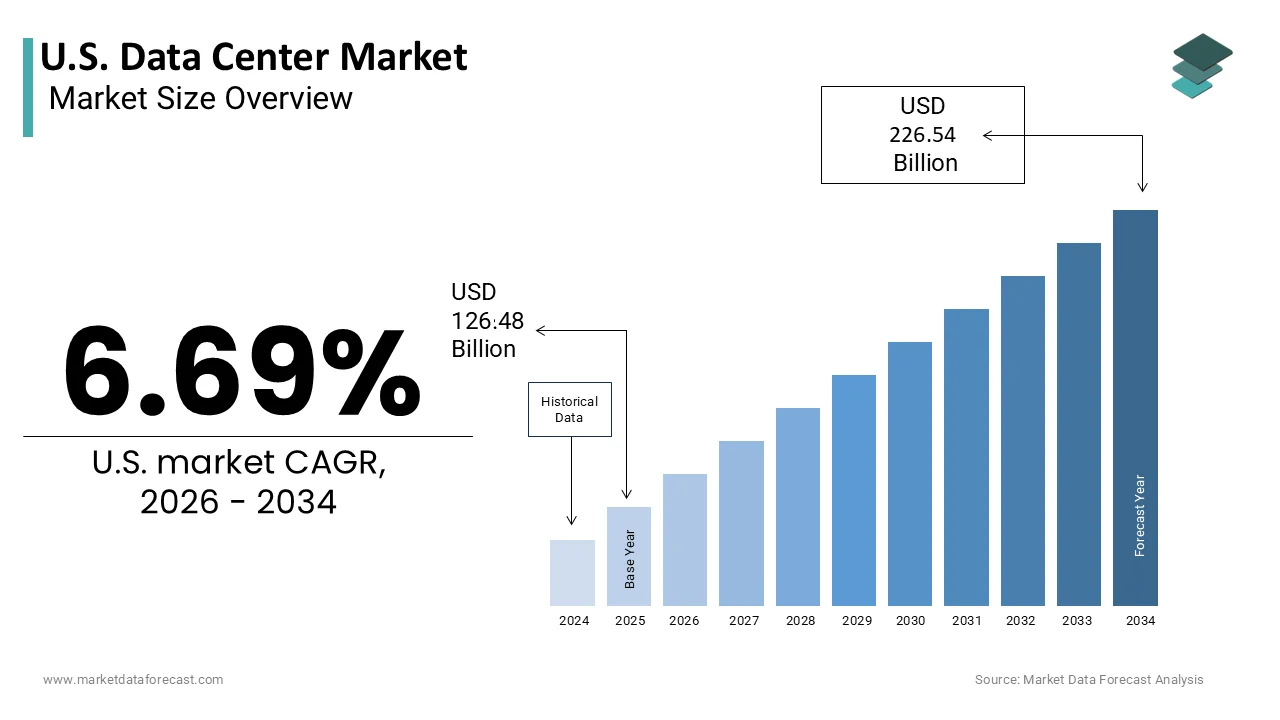
The U.S. stands as the definitive focus of this analysis and represents a mature and highly sophisticated infrastructure ecosystem that serves as a global benchmark for digital innovation. The U.S. data center market comprises facilities dedicated to housing computer systems and associated components such as telecommunications and storage systems. These critical infrastructure assets support the digital economy by providing secure environments for data processing, storage, and distribution. The sector has evolved from simple server rooms to complex hyperscale campuses that power cloud computing, artificial intelligence, and enterprise applications. According to the U.S. Energy Information Administration, data centers and related technology infrastructure consumed approximately 4% of total electricity in the country, a figure that is projected to rise significantly due to increased digitalization. The physical footprint of these facilities is expanding rapidly, with Northern Virginia remaining the largest market globally. As per the Census Bureau, construction spending on non-residential structures, including data centers,s has seen double-digit growth in recent years, reflecting robust investment activity. The reliance on digital services has become ubiquitous, with the Bureau of Economic Analysis indicating that the digital economy accounts for over 10% of gross domestic product. This economic dependency drives the continuous expansion of capacity to handle escalating data volumes. Furthermore, the integration of advanced cooling technologies and renewable energy sources is reshaping facility design standards. Industry participants are increasingly focusing on sustainability metrics to align with corporate environmental goals. The strategic importance of these facilities is underscored by their role in national security and economic stability, prompting significant private and public sector investment in resilient and scalable infrastructure across various geographic regions.
MARKET DRIVERS
Surging Demand for Artificial Intelligence and High-Performance Computing
The rapid adoption of artificial intelligence and high-performance computing is driving the growth of the U.S. data center market. AI workloads require substantially more processing power and energy density compared to traditional computing tasks, which is demanding for specialized infrastructure upgrades. According to Stanford University’s AI Index, annual investment in artificial intelligence technologies in the U.S. reached $67.2 billion, which is roughly 8.7 times the amount invested in the next highest country, driving demand for capable hardware environments. Graphics processing units and tensor processing units used in AI applications generate intense heat, requiring advanced cooling solutions such as liquid immersion or direct-to-chip cooling systems. This technological shift forces operators to retrofit existing facilities or build new ones designed specifically for high-density racks. As per the Semiconductor Industry Association, worldwide semiconductor sales increased 23.2% year over year in mid-2024, reflecting the hardware boom. Enterprises across healthcare, finance, and manufacturing sectors are deploying AI models to enhance operational efficiency, further straining existing capacity. The need for low-latency processing also drives the development of edge data centers located closer to end users. This decentralization complements large hyperscale facilities by handling real-time data processing tasks. The convergence of big data analytics and machine learning creates a sustained demand for scalable compute resources. Consequently, data center providers are prioritizing investments in high-performance infrastructure to capture this lucrative segment, ensuring they can meet the rigorous technical requirements of modern AI applications while maintaining service reliability and uptime standards for critical business operations.
Expansion of Cloud Computing Services and Digital Transformation Initiatives
The widespread migration of enterprise workloads to cloud platforms continues to drive substantial growth in the U.S. data center market. Organizations are increasingly adopting hybrid and multi-cloud strategies to optimize costs and enhance flexibility, leading to increased demand for colocation and interconnection services. According to Synergy Research Group, enterprise spending on cloud infrastructure services reached $79 billion in a single quarter of 2024, fueling the need for expansive data center capacity. Hyperscale cloud providers such as Amazon Web Services, Microsoft Azure, and Google Cloud are continuously expanding their footprints to support this demand. The Bureau of Labor Statistics notes that employment in computer and information technology occupations is projected to grow much faster than the average for all occupations, indicating sustained digital activity. Digital transformation initiatives compel companies to move legacy systems to the cloud, requiring robust and secure data center environments. The proliferation of Internet of Things devices generates vast amounts of data that must be stored and processed, further amplifying storage needs. As per the International Data Corporation, the global datasphere is expected to grow to 175 zettabytes by 2025, with a significant portion residing in U.S. facilities. This data explosion necessitates continuous expansion of storage capacity and network bandwidth. Additionally, regulatory requirements for data sovereignty and security encourage domestic storage solutions. The shift toward software as a service models also contributes to steady demand, as businesses rely on third-party providers for essential applications. This structural change in IT consumption ensures long-term growth for data center operators who provide the foundational infrastructure for the digital economy.
MARKET RESTRAINTS
Stringent Power Availability and Grid Capacity Constraints
The availability of reliable and sufficient electrical power is impeding the expansion of the U.S. data center market. Data centers are energy-intensive facilities, and their expansion often outpaces the capacity of local utility grids to supply electricity. According to the North American Electric Reliability Corporation, high-risk areas for energy shortfalls have expanded, with several regions facing tight reserve margins during peak demand periods. Utility companies in key markets such as Northern Virginia and Silicon Valley have reported delays in providing power connections due to infrastructure limitations. The Federal Energy Regulatory Commission indicates that interconnection queues for new generation resources are lengthy, slowing down the addition of new power supplies needed for data centers. This bottleneck forces operators to seek locations in less established markets with available grid capacity, potentially increasing latency for end users. The rising cost of electricity also impacts operational expenses, as data centers consume massive amounts of power for both computing and cooling. As per the U.S. Energy Information Administration, the average commercial electricity price in the U.S. was approximately 12.8 cents per kilowatt-hour in early 2024, adding uncertainty to long-term budgeting. Furthermore, the transition to renewable energy sources requires significant grid upgrades to handle intermittent supply, complicating power procurement strategies. Operators must invest in backup generation systems and energy storage solutions to ensure uninterrupted service, which increases capital expenditures. These power constraints limit the speed at which new facilities can be commissioned and may restrict growth in high-demand regions, forcing a redistribution of investment to areas with more robust energy infrastructure.
Complex Regulatory Landscape and Environmental Compliance Requirements
Navigating the complex regulatory environment surrounding environmental compliance and land use is further hampering the U.S. market expansion. Local and state governments are implementing stricter regulations regarding water usage, carbon emissions, and noise pollution associated with data center operations. According to the Environmental Protection Agency, the Greenhouse Gas Reporting Program requires large facilities to report annual emissions, pushing operators to adopt cleaner energy sources and improve efficiency metrics. Many jurisdictions are imposing moratoriums or stringent review processes for new data center constructions due to concerns over resource consumption. According to the Council on Environmental Quality, federal projects must undergo rigorous environmental impact assessments, which can delay project timelines significantly. Water scarcity issues in states like Arizona and Texas have led to restrictions on water-cooled systems, which are forcing operators to invest in more expensive air-cooled or closed-loop alternatives. As per the National Conference of State Legislatures, several states have introduced legislation offering tax incentives tied to green building certifications or specific energy efficiency targets, increasing transparency but also administrative burdens. Zoning laws in residential areas often oppose data center developments due to perceived negative impacts on community aesthetics and property values. These regulatory hurdles increase the cost and time required to bring new facilities online. Compliance with varying state and local rules requires specialized legal and consulting resources, adding to operational overhead. The uncertainty surrounding future regulatory changes makes long-term planning difficult, as operators must anticipate potential shifts in environmental standards that could render existing infrastructure non-compliant or economically unviable.
MARKET OPPORTUNITIES
Adoption of Liquid Cooling Technologies for High-Density Workloads
The emergence of liquid cooling technologies is a promising opportunity for the U.S. data center market. As processor densities increase due to artificial intelligence and high-performance computing, traditional air cooling methods become insufficient and energy inefficient. Liquid cooling solutions, including direct-to-chip and immersion cooling, offer superior heat dissipation capabilities, allowing for higher rack densities and reduced energy consumption. According to the Department of Energy, advanced cooling technologies can reduce a data center's total energy use by 30% to 40% and cooling energy by up to 90%. This technology enables data centers to support next-generation hardware that would otherwise overheat in conventional environments. Major hardware manufacturers are designing servers specifically for liquid cooling, creating a standardized ecosystem that facilitates broader adoption. As per the U.S. Department of Energy, the COOLERCHIPS program is providing $40 million in funding to accelerate the development of high-performance cooling for data centers. Operators who invest in liquid cooling infrastructure can differentiate themselves by offering high-density hosting services that appeal to AI and gaming clients. Furthermore, the reduction in fan noise and physical footprint allows for more flexible facility designs in urban areas. The potential for waste heat recovery from liquid-cooled systems also opens avenues for district heating partnerships, enhancing sustainability profiles. This technological shift not only addresses immediate cooling challenges but also positions early adopters as leaders in energy-efficient computing. The growing emphasis on environmental, social, and governance criteria makes liquid cooling an attractive option for enterprises seeking to reduce their carbon footprints while maintaining high performance capabilities.
Growth of Edge Data Centers Supporting 5G and IoT Applications
The proliferation of fifth-generation wireless networks and the Internet of Things creates a substantial opportunity for the U.S. data center market. Edge computing involves processing data closer to the source of generation, reducing latency and bandwidth usage for real-time applications. According to GSMA Intelligence, 5G is expected to reach 400 million connections in the U.S. by 2030, driving demand for localized processing infrastructure. Industries such as autonomous vehicles, smart manufacturing, and telemedicine require ultra-low latency connections that only edge facilities can provide. This decentralization trend allows data center operators to expand into secondary and tertiary markets where land and power costs are lower. As per the Telecommunications Industry Association, investment in edge infrastructure is accelerating as telecom providers partner with data center firms to colocate equipment at cell towers and central offices. The ability to process data locally also enhances security and privacy by keeping sensitive information within specific geographic boundaries. This feature is particularly appealing to healthcare and financial institutions subject to strict data residency regulations. Furthermore, edge data centers enable new business models such as content delivery networks that stream high-definition video with minimal buffering. The modular nature of edge facilities allows for rapid deployment and scalability, reducing time to market for new services. Operators who strategically position edge nodes in high traffic areas can capture value from the growing ecosystem of connected devices and applications, diversifying their revenue streams beyond traditional hyperscale hosting.
MARKET CHALLENGES
Supply Chain Disruptions for Critical Infrastructure Components
Persistent supply chain disruptions for critical components such as transformers, switchgear, and generators pose a significant challenge to the timely development of data centers in the U.S. The lead times for large power transformers have extended significantly, in some cases reaching two years or more, delaying project completions and increasing costs. According to the Edison Electric Institute, the lead time for some power transformers is now as long as 120 weeks, outstripping domestic manufacturing capacity. Semiconductor shortages also affect the availability of servers and networking equipment, impacting the ability of data centers to commission new halls efficiently. The Bureau of Labor Statistics reports that producer price indices for electrical equipment, such as transformers and switchgear,r have increased by over 25% since 2021, which reflects inflationary pressures. These delays force operators to renegotiate contracts with tenants and manage cash flow challenges associated with stalled projects. Dependence on international suppliers for key materials exposes the industry to geopolitical risks and trade policy fluctuations. As per the Department of Commerce, section 232 tariffs and other trade measures have influenced the cost and availability of essential electrical steel. The lack of skilled labor in the construction and electrical trades further exacerbates these issues, as specialized workers are needed to install complex infrastructure. Project managers must navigate these uncertainties by securing early commitments from suppliers and exploring alternative sourcing strategies. However, the limited number of qualified vendors for high-voltage equipment restricts flexibility. This supply chain fragility threatens the industry's ability to meet the rapidly growing demand for data center capacity, potentially leading to service shortages in key markets.
Cybersecurity Threats and Physical Security Vulnerabilities
The increasing sophistication of cyberattacks and the need for robust physical security present ongoing challenges for data center operators in the U.S. Data centers house critical information for thousands of clients, making them prime targets for ransomware, distributed denial of service attacks, and data breaches. According to the Federal Bureau of Investigation, reported losses from cybercrime reached $12.5 billion in 2023, highlighting the escalating threat landscape. Operators must invest heavily in advanced cybersecurity measures, including artificial intelligence-driven threat detection and zero-trust architecture, to protect client data. Physical security is equally important, as facilities must safeguard against unauthorized access, sabotage, and natural disasters. The Department of Homeland Security emphasizes the need for resilience in critical infrastructure, requiring regular audits and compliance with strict security standards. Implementing comprehensive security protocols increases operational complexity and costs, as operators must balance accessibility for maintenance with stringent access controls. The shortage of cybersecurity professionals further complicates defense efforts, as skilled experts are in high demand across all sectors. As per CyberSeek, there are over 460,000 unfilled cybersecurity jobs in the U.S., limiting the talent pool for data center security teams. Additionally, the integration of Internet of Things devices for facility management introduces new vulnerabilities that must be managed. Any security incident can result in severe reputational damage and legal liabilities, eroding customer trust. Maintaining a proactive security posture requires continuous investment and adaptation to emerging threats, posing a persistent challenge for industry participants striving to ensure uninterrupted and secure service delivery.
REPORT COVERAGE
| REPORT METRIC | DETAILS |
| Market Size Available | 2025 to 2034 |
| Base Year | 2025 |
| Forecast Period | 2026 to 2034 |
| Segments Covered | By Data Center Size,Tier Standard, End User Industry, and Region. |
| Various Analyses Covered | Global, Regional and Country-Level Analysis, Segment-Level Analysis, Drivers, Restraints, Opportunities, Challenges; PESTLE Analysis; Porter’s Five Forces Analysis, Competitive Landscape, Analyst Overview of Investment Opportunities |
| Countries Covered | California, Washington, Oregon, New York, United States |
| Market Leaders Profiled | Amazon Web Services, Inc., Microsoft Corporation, Google LLC, Meta Platforms, Inc., Apple Inc., Equinix, Inc., Digital Realty Trust, Inc., CyrusOne Inc., NTT Global Data Centers Americas, Inc., QTS Realty Trust, LLC, Dell Technologies Inc., Hewlett-Packard Enterprise Company, Cisco Systems, Inc., IBM Corporation, Oracle Corporation |
SEGMENTAL ANALYSIS
By Data Center Size Insights
The mega data center segment dominated the market in 2025 and is likely to maintain its dominant share of total U.S. capacity over the next few years as hyperscale cloud providers continue to consolidate workloads for efficiency. These facilities typically exceed 100,000 square feet and are designed to support massive computational loads for global digital services. According to Synergy Research Group, hyperscale operators currently account for 41% of global data center capacity, with the U.S. housing more of these sites than any other country. The primary driver for this dominance is the economic efficiency achieved through economies of scale, which allows providers to reduce the cost per unit of computing power significantly. As per the U.S. Energy Information Administration, large-scale facilities can implement advanced energy management systems that lower power usage effectiveness ratios toward the 1.1 mark. Cloud giants such as Amazon Web Services and Microsoft Azure continue to expand these campuses to support artificial intelligence training and big data analytics. The Bureau of Economic Analysis notes that investment in intellectual property products, including software and data centers,s has become a major component of gross domestic product growth. This financial momentum supports the construction of mega facilities that require substantial capital expenditure but offer long-term operational advantages. Furthermore, the need for low-latency interconnection between servers within a single campus favors centralized mega structures over distributed, smaller sites. The ability to deploy thousands of servers in a coordinated manner enables rapid scaling of services to meet fluctuating consumer demand. This structural advantage ensures that mega data centers remain the backbone of the national digital infrastructure, supporting the majority of internet traffic and enterprise applications.
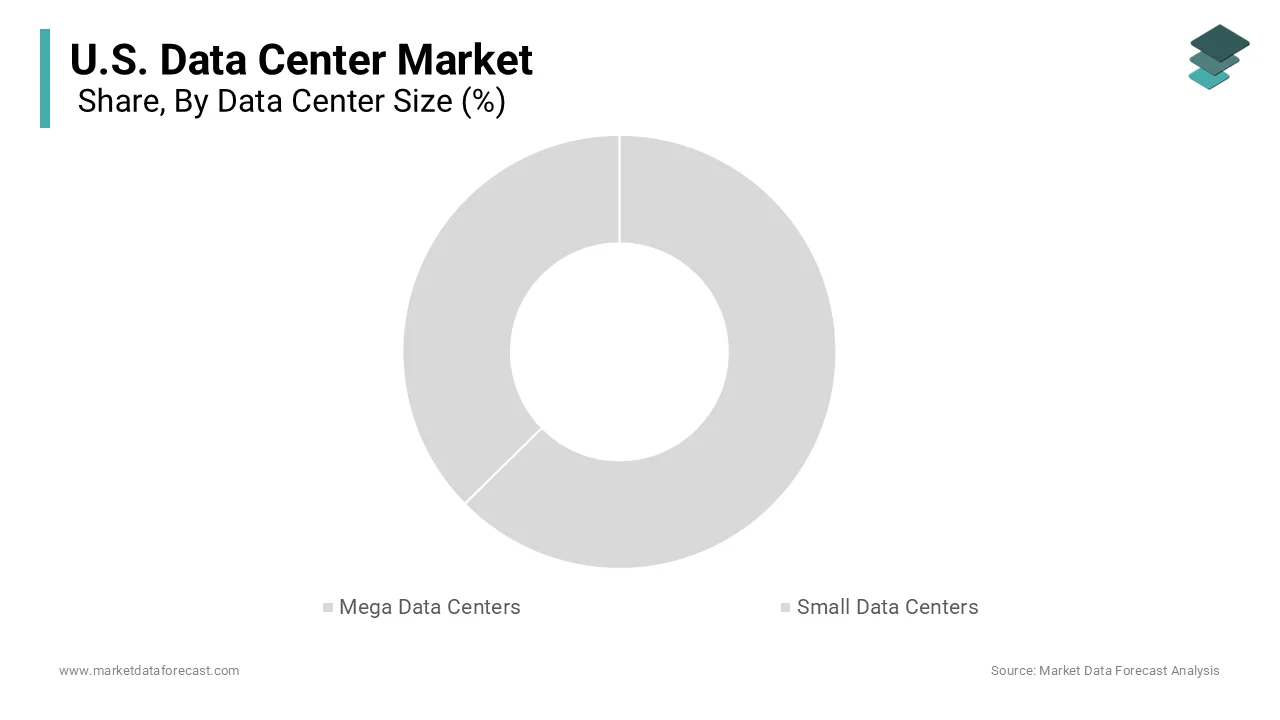
However, the small data center segment is on the rise and is projected to register the fastest CAGR in the U.S. market during the next few years as localized processing becomes essential for 5G and low-latency AI applications. These facilities typically occupy less than 10,000 square feet and are located closer to end users to minimize latency. According to International Data Corporation, edge computing spending is expected to grow by 15.4% in 2024, reaching $232 billion globally, which directly fuels the expansion of small localized facilities. The primary factor driving this growth is the adoption of fifth-generation wireless networks, which require localized processing capabilities to support real-time applications such as autonomous vehicles and smart cities. As per the Telecommunications Industry Association, telecom operators are deploying thousands of small edge nodes to handle data traffic locally, reducing the burden on core networks. The rise of Internet of Things devices also contributes to this trend, as sensors generate vast amounts of data that must be processed immediately for actionable insights. The Department of Transportation highlights that smart infrastructure projects rely on edge computing to manage traffic flow and safety systems efficiently. Small data centers offer the flexibility to be deployed in urban environments where space is limited, but demand for connectivity is high. Modular construction techniques allow for rapid installation and scalability, making them ideal for temporary or evolving needs. Enterprises in retail and healthcare are increasingly adopting small edge facilities to enhance customer experiences through personalized services. This decentralization of computing resources represents a strategic shift in infrastructure design, enabling faster response times and improved reliability for critical applications. The agility of small data centers makes them indispensable in the evolving digital landscape.
By Tier Standard Insights
The Tier 3 data center segment led the market and is likely to remain the standard for enterprise-grade colocation and cloud services over the next few years due to its optimal balance of reliability and deployment cost. These facilities offer concurrent maintainability, allowing for any component to be removed or replaced without disrupting operations, which appeals to a broad range of enterprise clients. According to the Uptime Institute, Tier 3 is the most common certification among data centers globally, providing a balance of 99.982% availability. The primary driver for this dominance is the requirement for high uptime, which meets the service level agreements of most financial, healthcare, and technology companies. As per the Ponemon Institute, the cost of an unplanned data center outage has reached an average of $9,000 per minute, motivating organizations to invest in Tier 3 infrastructure to mitigate financial risks. The redundancy built into Tier 3 designs, including dual power paths and multiple cooling systems, ensures continuous operation during maintenance or minor failures. The Federal Financial Institutions Examination Council recommends robust infrastructure standards for banks, which often align with Tier 3 specifications. This regulatory alignment drives adoption in the financial sector, a major consumer of data center services. Furthermore, colocation providers favor Tier 3 designs because they can serve diverse customers with varying reliability needs without the excessive costs associated with Tier 4 fault tolerance. The scalability of Tier 3 facilities allows businesses to expand their IT footprint as needed while maintaining consistent performance. This versatility makes Tier 3 the preferred choice for enterprises seeking a reliable yet economically viable solution for their digital infrastructure needs.
On the other side, the Tier 4 data center segment is expected to see increased investment over the next few years from sectors that prioritize zero-downtime reliability for critical national and financial operations. Tier 4 facilities provide the highest level of reliability with 99.995% uptime, ensuring that systems remain operational even during unexpected equipment failures or natural disasters. According to the Uptime Institute, Tier 4 design certifications have seen steady growth as mission-critical workloads move to more resilient platforms. The primary factor driving this growth is the adoption of cloud services by government agencies and healthcare providers who cannot tolerate any service interruption. As per the Department of Health and Human Services, electronic health records must be accessible at all times to ensure patient safety, necessitating Tier 4 infrastructure for hosting sensitive medical data. The financial sector also contributes to this trend, as high-frequency trading platforms require absolute consistency and zero downtime to maintain market integrity. The Securities and Exchange Commission emphasizes the importance of resilient technology systems for market stability, encouraging investments in top-tier facilities. Additionally, the rise of artificial intelligence applications in critical infrastructure management requires uninterrupted power and cooling to prevent data corruption and model degradation. Tier 4 data centers offer fully redundant components and multiple active distribution paths, providing the highest level of protection against disruptions. Although the initial capital expenditure is higher, the long-term benefits of guaranteed availability justify the investment for organizations where downtime poses severe legal or safety consequences. This segment is expanding as more industries recognize the value of ultimate reliability.
By End User Industry Insights
The IT and ITES segment held the leading share of the U.S. data center market in 2025 and is likely to remain the largest consumer of data center capacity over the next few years as the shift toward software-defined services and cloud computing continues. This segment includes cloud service providers, software companies, and telecommunications firms that require extensive computing and storage resources. According to the Bureau of Labor Statistics, employment in the information sector continues to be a high-productivity driver of the U.S. economy, underscoring its dependence on robust data center capabilities. The primary driver for this dominance is the widespread migration of enterprise applications to the cloud, which requires scalable and secure hosting environments. As per Gartner, global end-user spending on public cloud services grew by 20.4% to reach $678 billion in 2024, with a significant portion allocated to U.S.-based infrastructure. Software as a service models rely on continuous availability and high performance, necessitating investments in state-of-the-art data centers. The National Science Foundation reports that research and development in computer science are accelerating, leading to increased demand for high-performance computing resources. Cybersecurity firms also contribute to this demand, as they require isolated environments to test and monitor threats without risking client networks. The integration of artificial intelligence into IT services further amplifies the need for specialized hardware and cooling systems. IT companies are constantly upgrading their infrastructure to support faster processing speeds and larger data volumes. This continuous cycle of innovation and expansion ensures that the IT and ITES sector remains the primary consumer of data center services, driving construction and modernization efforts across the country.
However, the E-Commerce segment is expected to be the fastest-growing end-user segment for data center services over the next few years as digital retail transactions reach record levels. According to the U.S. Department of Commerce, e-commerce sales grew by 7.5% in 2023, accounting for 15.4% of all retail sales, which creates a massive demand for backend infrastructure to support websites, payment gateways, and logistics systems. The primary factor driving this growth is the need for real-time inventory management and personalized customer experiences, which require powerful data processing capabilities. As per Adobe Analytics, online spending during major sales events has reached over $12 billion in a single day, stressing server capacities and necessitating scalable cloud solutions. Retailers are investing heavily in data analytics to understand consumer behavior, which involves storing and processing vast amounts of transactional data. The Federal Trade Commission emphasizes the importance of data security for consumer protection, prompting e-commerce companies to adopt secure hosting environments with advanced encryption standards. Furthermore, the integration of augmented reality and virtual try-on features requires high bandwidth and low-latency connections, driving the adoption of edge data centers. Supply chain optimization tools also rely on continuous data flows from warehouses and delivery vehicles, necessitating robust connectivity. As traditional brick-and-mortar stores continue to shift online, the reliance on digital infrastructure intensifies. This sector's rapid expansion is supported by innovations in mobile commerce and social media shopping, which generate additional data traffic. The need for seamless user experiences and secure transactions ensures that e-commerce remains a key driver of data center growth.
COUNTRY LEVEL ANALYSIS
U.S.
The U.S. is likely to continue its reign as the world’s most significant data center hub for the next few years due to its leading role in AI development and high concentration of hyperscale providers. The country accounts for approximately 40% of the world's total data center capacity, a dominant position supported by a mature ecosystem of technology providers, robust regulatory frameworks, and abundant energy resources. The market status is characterized by intense competition among hyperscale providers and a growing presence of edge computing facilities. According to the U.S. Energy Information Administration, the country’s diverse energy mix and large-scale grid infrastructure support the high power demands of data centers, although transitions to renewable sources are accelerating. The primary driving factor for this market leadership is the concentration of major technology companies such as Amazon, Microsoft, and Google, which continuously invest in expanding their infrastructure. As per the Bureau of Economic Analysis, digital investments contribute significantly to national productivity, reinforcing the strategic importance of data centers. The presence of advanced fiber optic networks ensures high-speed connectivity across regions, facilitating efficient data transfer. Furthermore, favorable tax incentives in states like Virginia and Texas attract significant foreign and domestic investment. The National Security Agency highlights the critical role of data centers in national defense and intelligence operations, ensuring sustained government support for infrastructure resilience. Consumer demand for digital services remains high, driven by a tech-savvy population with widespread broadband access. According to the Federal Communications Commission, broadband deployment initiatives are reaching more households, creating new opportunities for data center expansion. This combination of technological innovation, economic strength, and regulatory support cements the U.S. position as the central hub of the global digital economy.
COMPETITIVE LANDSCAPE
The competitive landscape of the U.S. data center market is characterized by intense rivalry among established real estate investment trusts and specialized infrastructure providers. Major players compete based on location, reliability, and service quality to attract hyperscale cloud providers and enterprise clients. The market sees frequent mergers and acquisitions as companies seek to expand their geographic footprint and consolidate resources. Innovation in energy efficiency and sustainability practices serves as a key differentiator since customers increasingly prioritize environmental responsibility. Providers also compete on connectivity options, offering robust interconnection ecosystems that facilitate seamless data exchange between networks. The rise of edge computing has introduced new competitors who focus on localized facilities to support low-latency applications. Pricing pressure remains evident as larger operators leverage economies of scale to offer competitive rates. Regulatory compliance and security standards further influence competitive dynamics, requiring continuous investment in protective measures. The ability to adapt to rapid technological change,s such as artificial intelligence and high-performance computing, determines long-term success. Companies must balance capital expenditure with operational efficiency to maintain profitability while meeting the escalating demands for data storage and processing power in an increasingly digital economy.
KEY MARKET PLAYERS
Some of the companies that are playing a dominating role in the U.S. Data Center Market include
- Amazon Web Services, Inc.
- Microsoft Corporation
- Google LLC
- Meta Platforms, Inc.
- Apple Inc.
- Equinix, Inc.
- Digital Realty Trust, Inc.
- CyrusOne Inc.
- NTT Global Data Centers Americas, Inc.
- QTS Realty Trust, LLC
- Dell Technologies Inc.
- Hewlett-Packard Enterprise Company
- Cisco Systems, Inc.
- IBM Corporation
- Oracle Corporation
TOP LEADING PLAYERS IN THE MARKET
- Equinix Inc operates as a global leader in digital infrastructure with a significant footprint across the U.S. The company specializes in interconnection and colocation services that enable businesses to exchange data securely and efficiently. Equinix has recently focused on expanding its platform edge capabilities to support artificial intelligence workloads and hybrid cloud environments. By investing in advanced cooling technologies and renewable energy sources, the company enhances sustainability while meeting the high power demands of modern computing. Strategic partnerships with major cloud providers allow Equinix to offer seamless connectivity options for enterprise clients. These initiatives strengthen its position by providing critical infrastructure for digital transformation efforts across various industries, including finance, e-healthcare, re,, and technology. The continuous expansion of its metro data centers ensures low-latency access for users in key urban areas. This approach supports the growing need for real-time data processing and secure information exchange in an increasingly connected world.
- Digital Realty Trust Inc is a prominent provider of data center solutions in the U.S., offering colocation and managed services. The company leverages its extensive network of facilities to support hyperscale cloud providers and enterprise customers. Recent actions include the acquisition of strategic assets to expand capacity in high-demand markets such as Northern Virginia and Silicon Valley. Digital Realty has also invested in sustainable design practices to reduce carbon footprints and improve energy efficiency. The development of its Service Delivery Platform facilitates automated interconnection services, which simplifies network management for clients. By focusing on high-performance infrastructure, the company addresses the needs of data-intensive applications like machine learning and big data analytics. These efforts enhance customer retention and attract new business by ensuring reliable and scalable operations. The integration of physical and digital infrastructure creates a robust ecosystem that supports the evolving requirements of the digital economy.
- CyrusOne Inc serves as a key player in the U.S. data center market by providing flexible and scalable colocation solutions. The company focuses on delivering high-quality service to enterprise and hyperscale clients through its network of strategically located facilities. CyrusOne has recently emphasized operational excellence by implementing advanced monitoring systems and predictive maintenance tools. The expansion into secondary markets allows the company to capture growth opportunities outside traditional hubs while maintaining high standards of reliability. Investments in power infrastructure ensure that facilities can support increasing density requirements driven by artificial intelligence and high-performance computing. CyrusOne also prioritizes sustainability by sourcing renewable energy and optimizing water usage in cooling systems. These strategies help the company meet environmental goals while reducing operational costs. By offering customized solutions and responsive support, CyrusOne strengthens its relationships with clients who require dependable infrastructure for mission-critical applications. The focus on agility and customer-centric services differentiates the company in a competitive landscape.
TOP STRATEGIES USED BY KEY MARKET PARTICIPANTS
Key players in the U.S. data center market employ several strategic initiatives to maintain competitiveness and drive growth. Sustainability is a primary focus where companies invest in renewable energy sources and advanced cooling technologies to reduce carbon footprints. This approach aligns with corporate environmental goals and regulatory requirements. Expansion into secondary markets allows operators to tap into emerging demand while avoiding saturation in primary hubs. Partnerships with cloud providers and telecommunications firms enhance connectivity options and create integrated ecosystems for clients. Investment in artificial intelligence-driven operations improves efficiency through predictive maintenance and automated management systems. Companies also prioritize modular construction techniques to accelerate deployment times and reduce capital expenditures. These strategies collectively aim to enhance service reliability while addressing the increasing power and space demands of modern digital infrastructure. By adapting to technological advancements and shifting consumer preferences, industry participants ensure long-term viability and growth in a dynamic market environment.
MARKET SEGMENTATION
This research report on the U.S. data center market is segmented and sub-segmented into the following categories.
By Data Center Size
- Mega Data Centers
- Small Data Centers
By Tier Standard
- Tier 3
- Tier 4
By End User Industry
- IT and ITES
- E-Commerce
By Country
- Virginia
- Texas
- California
- New York
- Rest of the United States