- Product Description Description
- Table of Contents TOC
- List of Table & Figure LOT
- Get Free Sample PDF Sample PDF
Market Size, 2025
$124 BnMarket Estimate, 2026
$142.98 BnMarket Forecast, 2034
$446.91 BnCAGR, 2026–2034
15.31%U.S. Digital Advertising Market Size, Growth, Trends & Forecast (2026–2034)
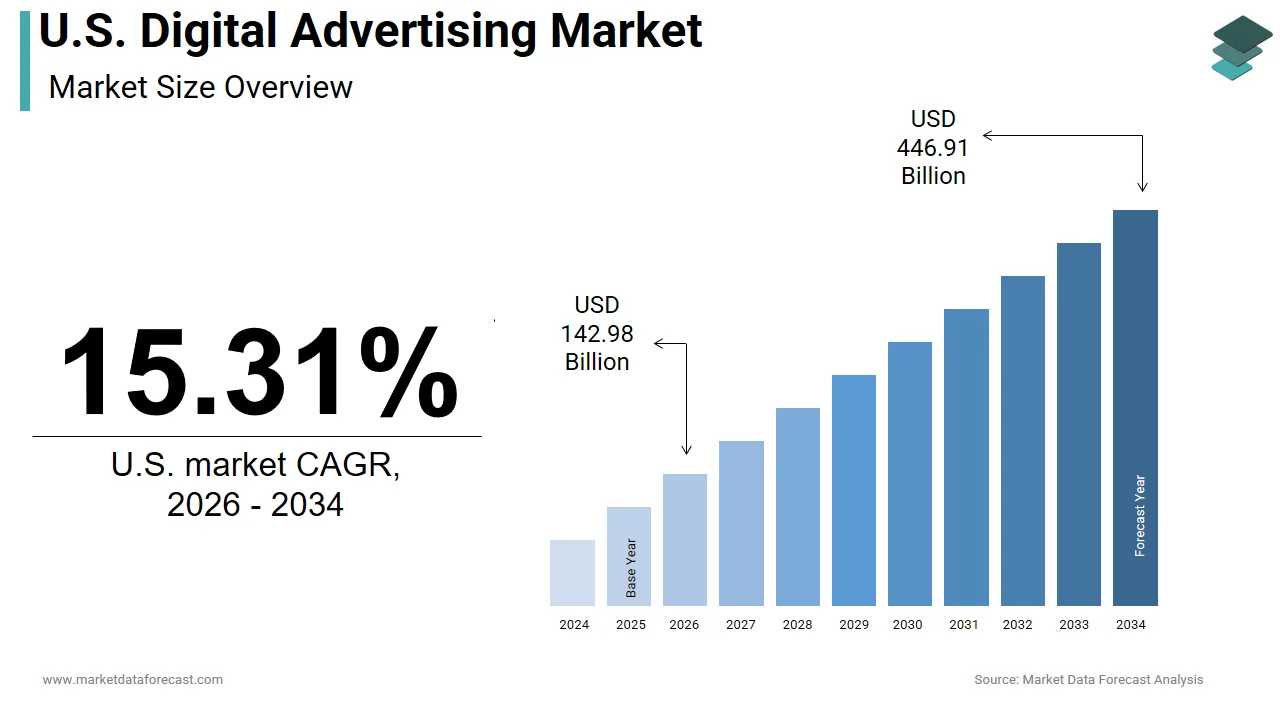
The U.S. digital advertising market was valued at USD 124.00 billion in 2025, is estimated to reach USD 142.98 billion in 2026, and is projected to expand up to USD 446.91 billion by 2034, growing at a compound annual growth rate (CAGR) of 15.31% from 2026 to 2034. Driven by ubiquitous smartphone penetration, connected television (CTV) migration, retail media networks, and AI-powered real-time bidding, the digital marketing ecosystem continues to reshape commercial reach.
Key Executive Metrics (At-a-Glance)
- 2025 Base Valuation: USD 124.00 Billion
- 2026 Current Valuation: USD 142.98 Billion
- 2034 Forecast Valuation: USD 446.91 Billion
- Compound Annual Growth Rate (CAGR): 15.31% (2026–2034)
- Dominant Channel Segment: Mobile Advertising (32.3% share in 2025)
- Fastest-Growing Channel Segment: Connected TV (CTV)
- Dominant Type Segment: Search Advertising
- Fastest-Growing Type Segment: Social Media Advertising (CAGR of 8.5%)
- Dominant End-User Segment: Retail Sector
- Fastest-Growing End-User Segment: Healthcare and Pharmaceuticals (CAGR of 8.4%)
Core Market Drivers
- Smartphone Penetration: Constant user engagement and mobile-optimized ad inventories ensuring precise location and behavioral targeting.
- Connected TV (CTV) Growth: Audience migration from linear broadcast to streaming platforms, converting passive viewing into interactive, data-rich video ad inventory.
Primary Market Restraints & Challenges
- Privacy Regulations & Cookie Deprecation: Stringent compliance laws (e.g., CCPA) and third-party cookie phase-outs restricting targeting precision and attribution tracking.
- Ad Fraud & Channel Fragmentation: Bot traffic, invalid impressions, and fragmented walled gardens complicating cross-channel measurement and campaign ROI.
U.S. Digital Advertising Market Segmentation Breakdown
| Segment Category | Leading Sub-Segment (2025 Base) | Fastest-Growing Sub-Segment (Forecast Period) |
|---|---|---|
| By Channel | Mobile (32.3% share in 2025; driven by high daily usage and app integration) | Connected TV (CTV) (Driven by cord-cutting and ad-supported streaming tiers) |
| By Type | Search Advertising (High commercial intent and robust ROI) | Social Media Advertising (CAGR of 8.5%; propelled by short-form video and influencer marketing) |
| By End-User | Retail (Fueled by e-commerce expansion and retail media networks) | Healthcare and Pharmaceuticals (CAGR of 8.4%; driven by telehealth and digital health engagement) |
Major Industry Players Profiled
Top industry leaders shaping the U.S. landscape include Alphabet Inc. (Google), Meta Platforms Inc., Amazon.com Inc., Adobe Inc., Microsoft Corp., Publicis Groupe SA, and GroupM.
U.S. Digital Advertising Market Size
The U.S. digital advertising market was valued at USD 124 billion in 2025, is estimated to reach USD 142.98 billion in 2026, and is projected to reach USD 446.91 billion by 2034, growing at a CAGR of 15.31% from 2026 to 2034.
The digital advertising is the ecosystem, where commercial messages are delivered through internet connected devices, including smartphones, tablets, desktops, and emerging smart interfaces. This domain has evolved from simple banner displays to complex algorithmic exchanges that leverage artificial intelligence for real time bidding and personalized consumer engagement. The fundamental shift in media consumption habits defines the current landscape as traditional broadcast mediums cede influence to on demand streaming and social platforms. Furthermore, data from the Bureau of Labor Statistics indicates that the average American spends approximately 7 hours daily consuming digital media, which amplifies the depth of attention available for monetization. This widespread connectivity ensures that digital advertisements can be delivered with minimal latency and high fidelity across diverse geographic regions. The definition of this market now extends beyond visual ads to include audio streams and interactive commerce features that blur the line between content and advertisement.
MARKET DRIVERS
Ubiquitous Smartphone Penetration Drives Sustained Engagement and Inventory Expansion
The pervasive adoption of smartphones for the expansion by ensuring constant connectivity and immediate access to commercial content is surging the growth of the United States digital advertising market. Mobile devices have become the central hub for consumer interaction with brands enabling advertisers to deliver targeted messages based on location behavior and personal preferences. This high level of device ownership guarantees a vast and addressable audience for digital campaigns, across various sectors, including retail finance and entertainment. The convenience of mobile access means that consumers engage with digital content throughout the day during commutes breaks and leisure time which increases the frequency of ad impressions. The ability to track user interactions on smartphones allows for precise measurement of campaign effectiveness, which encourages higher investment from marketers seeking accountable results. Furthermore, the integration of augmented reality and near field communication technologies into mobile platforms opens new avenues for interactive advertising that enhances user experience and drives conversion.
Shift Toward Connected Television Transforms Traditional Viewing Into Measurable Ad Inventory
The migration of audiences from linear broadcast television to connected television platforms, as it converts passive viewing into data rich interactive experiences is greatly influencing the growth of the United States digital advertising market. Connected television allows advertisers to apply digital targeting methodologies to long form video content which was previously limited by broad demographic buys and lack of performance tracking. This enables brands to deliver personalized advertisements to specific household profiles, thereby increasing relevance and reducing waste in media spending. The ability to measure view through rates and attribution models for connected television campaigns provides marketers with insights that were unavailable in traditional television buying. Additionally, the rise of ad supported tiers in major streaming services such as Netflix and Disney Plus has expanded the supply of premium video inventory, which attracts brand safety conscious advertisers.
MARKET RESTRAINTS
Privacy Regulations and Data Restrictions Limit Targeting Precision and Measurement
The implementation of stringent privacy laws and the deprecation of third-party cookies on the ability of advertisers to target audiences and measure campaign performance accurately is limiting the growth of the United States digital advertising market. Regulatory frameworks, such as the California Consumer Privacy Act and evolving federal discussions around data protection require companies to obtain explicit consent for data collection, which reduces the volume of available user information. The phase out of third party cookies by major browsers like Chrome and Safari disrupts the established mechanisms for cross site tracking and retargeting, which forces marketers to rely on less granular first party data. This shift increases the complexity of audience segmentation and raises the cost of acquiring customers through digital channels. Consequently, advertisers face challenges in proving return on investment and optimizing bids in real time auctions. The uncertainty surrounding compliance requirements also creates legal risks for companies that may face substantial fines for mishandling consumer data.
Ad Fraud and Invalid Traffic Erode Trust and Diminish Return on Investment
The prevalence of ad fraud and invalid traffic constitutes by diverting budgets away from genuine human audiences and undermining confidence in digital channels is also one of the major factor degrading the growth of the United States digital advertising market. Fraudulent activities, such as bot traffic click injection and domain spoofing generate fake impressions and clicks that inflate performance metrics without delivering actual consumer engagement. The financial loss discourages some advertisers from increasing their digital spend and prompts others to demand greater transparency and verification from media partners. The complexity of the programmatic supply chain makes it difficult to identify and eliminate fraudulent sources entirely as bad actors continuously evolve their tactics to bypass detection systems. The lack of standardized definitions for invalid traffic across different platforms further complicates efforts to combat this issue effectively. Advertisers must invest in additional third-party verification tools and manual audits to protect their budgets which increases operational costs and reduces overall efficiency.
MARKET OPPORTUNITIES
Integration of Artificial Intelligence Enhances Personalization and Operational Efficiency
The adoption of artificial intelligence and machine learning technologies by enabling hyper personalized content delivery and automated optimization of campaign parameters is ascribed to bolster new opportunities for the growth of the United States digital advertising market. AI algorithms analyze vast amounts of consumer data in real time to predict user behavior and serve the most relevant advertisements at the optimal moment. In the context of digital advertising, this technology allows for dynamic creative optimization, where ad elements, such as images copy and calls to action are automatically adjusted to match individual user preferences. This level of customization improves click through rates and conversion probabilities, while reducing the manual effort required for campaign management. The ability of AI to process unstructured data from social media reviews and search queries provides deeper insights into consumer sentiment which informs more effective messaging strategies. Furthermore, predictive analytics help advertisers allocate budgets more efficiently by identifying high value audience segments and forecasting performance trends. The integration of natural language processing also facilitates the creation of conversational advertising experiences through chatbots and voice assistants. These advancements enable brands to build stronger relationships with consumers and achieve superior returns on their advertising investments.
Expansion of Retail Media Networks Unlocks First Party Data and Closed Loop Attribution
The rapid growth of retail media networks for advertisers to leverage first party purchase data and achieve closed loop attribution for their digital campaigns is also to level up the growth of the United States digital advertising market. Retailers, such as Amazon Walmart and Target have developed sophisticated advertising platforms that allow brands to target shoppers based on their actual buying history and browsing behavior within these ecosystems. The availability of detailed transaction data enables precise measurement of sales lift and return on ad spend which addresses the measurement challenges posed by privacy restrictions. Retail media networks also provide access to exclusive inventory such as product listing ads and sponsored search results that capture high intent traffic. The expansion of these networks beyond online stores into physical retail locations through digital screens and mobile apps further extends their reach and impact. Brands benefit from the trust and credibility associated with major retailers which enhances the effectiveness of their advertisements.
MARKET CHALLENGES
Fragmentation of Media Channels Complicates Audience Reach and Budget Allocation
The increasing fragmentation of media channels for advertisers, as it disperses audience attention across numerous platforms and formats is one of the major challenges for the growth of the United States digital advertising market. Consumers, now divide their time among social media networks streaming services gaming environments and niche content sites which makes it difficult for brands to achieve comprehensive reach with a single campaign. The fragmentation increases the operational burden on marketing teams, who must tailor content and bidding strategies for each unique platform while ensuring consistent brand messaging. The lack of unified measurement standards across different walled gardens, such as Meta, Google, and Amazon that further complicates the assessment of cross channel performance and attribution. Advertisers often struggle to determine the optimal mix of channels to maximize return on investment leading to inefficient budget allocation and missed opportunities. The rise of new and ephemeral platforms adds another layer of uncertainty as brands must constantly evaluate emerging trends and decide whether to invest in unproven venues. This dynamic environment demands greater agility and data integration capabilities from advertisers to navigate the dispersed landscape effectively. The inability to coordinate efforts across fragmented channels can result in message fatigue or inconsistent customer experiences that dilute brand equity.
Skill Gap and Talent Shortage Hinder Adoption of Advanced Advertising Technologies
The shortage of skilled professionals capable of managing advanced digital advertising technologies and data analytics, as it limits the ability of companies to fully leverage new tools and strategies is also to hinder the growth of the United States digital advertising market. The rapid evolution of programmatic advertising artificial intelligence and privacy compliant measurement requires specialized knowledge that is in short supply within the current workforce. The talent gap forces companies to rely on external agencies or consultants, which increases costs and reduces control over campaign execution. The complexity of modern advertising stacks demands proficiency in data science coding and strategic planning, which are not traditionally part of marketing curricula. Educational institutions and training programs have struggled to keep pace with the speed of technological change resulting in a pipeline of graduates who are not fully prepared for the demands of the role. The competition for qualified talent drives up salaries and turnover rates which destabilizes marketing teams and disrupts long term planning.
REPORT COVERAGE
| REPORT METRIC | DETAILS |
| Market Size Available | 2025 to 2034 |
| Base Year | 2025 |
| Forecast Period | 2026 to 2034 |
| Segments Covered | By Channel, Type, End-User, and Country. |
| Various Analyses Covered | Global, Regional, and Country-Level Analysis, Segment-Level Analysis, Drivers, Restraints, Opportunities, Challenges; PESTLE Analysis; Porter’s Five Forces Analysis, Competitive Landscape, Analyst Overview of Investment Opportunities |
| Countries Covered | New York, Massachusetts, Pennsylvania, Illinois, Ohio, Michigan, Texas, Florida, Georgia, California, Washington, Colorado. |
| Market Leaders Profiled | Adobe Inc., Alphabet Inc., Amazon.com Inc., Apollo Asset Management Inc., BuzzFeed Inc., Dentsu Group Inc., Disruptive Advertising Inc., Dotlogics Design, Focus Media Information Technology Co. Ltd., GroupM, Hulu LLC, InterActiveCorp, LinkedIn Corp., Meta Platforms Inc., Microsoft Corp., Publicis Groupe SA, SXM Media, The Interpublic Group of Companies Inc., X Corp., WebFX, and Others. |
SEGMENTAL ANALYSIS
By Channel Insights
The mobile advertising segment was the largest by holding 32.3% of the United States digital advertising market share in 2025 due to the ubiquitous presence of smartphones and the extensive time users spend on mobile applications. The convenience and portability of mobile devices allow for continuous engagement throughout the day, which creates numerous opportunities for ad impressions. The integration of mobile commerce features, such as one click purchasing and digital wallets reduces friction in the customer journey thereby increasing conversion rates for advertisers. Additionally, the proliferation of 5G networks enhances the speed and quality of mobile ad delivery enabling richer media formats, such as high definition video and augmented reality experiences. These technological advancements combined with habitual user behavior solidify the position of mobile as the primary channel for digital advertising investment. Brands prioritize mobile platforms because they offer precise location based targeting capabilities that drive foot traffic to physical stores and enhance local marketing efforts.
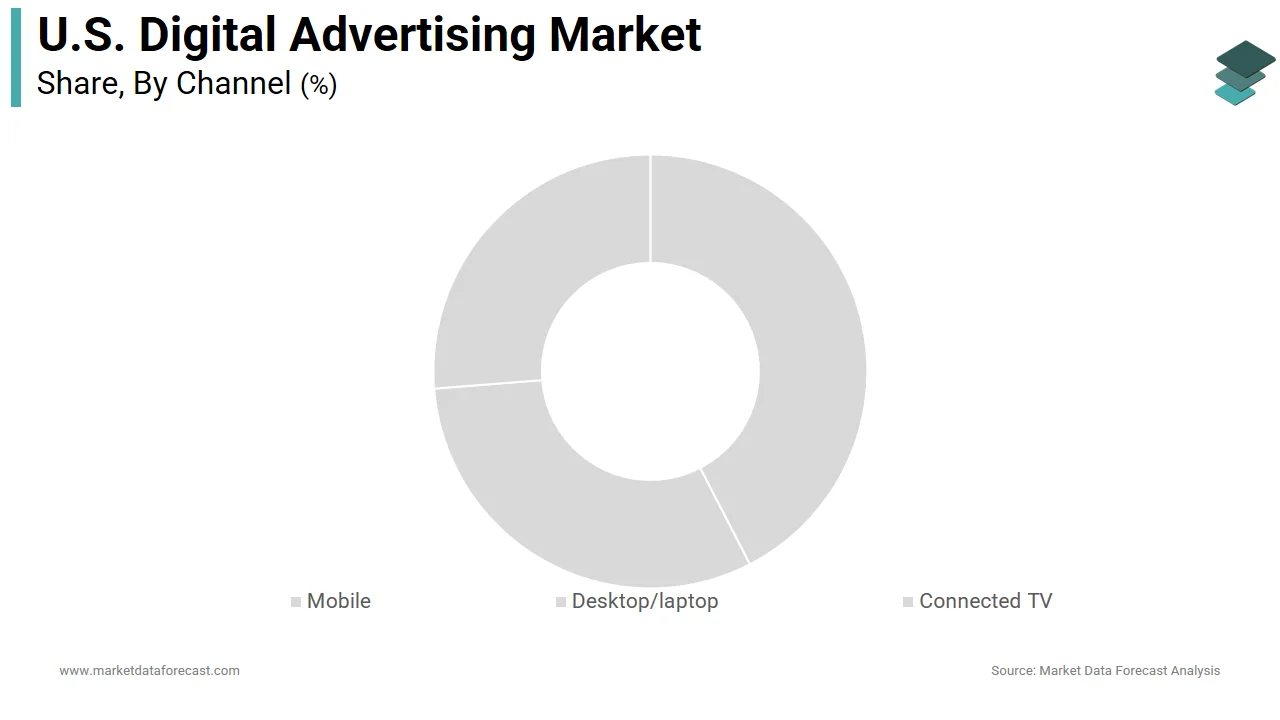
The connected TV is the fastest growing segment in the United States digital advertising market driven by the widespread adoption of streaming services and the introduction of ad supported subscription tiers. As consumers increasingly cut the cord with traditional cable providers they migrate to over-the-top platforms that offer flexible viewing options and lower costs. The launch of ad supported plans by major streaming giants, such as Netflix, Disney Plus, and Max, has significantly expanded the inventory of premium video content available for programmatic buying. The growth of the segment is also fueled by the ability of connected TV to combine the broad reach of television with the targeting precision of digital media. Advertisers can leverage household level data to deliver relevant messages to specific demographics while measuring performance through view through rates and attribution models. The shift in consumer preference toward on demand content ensures that connected TV will continue to capture a larger share of video advertising budgets in the coming years.
By Type Insights
The search advertising segment was the largest by holding a dominant share of the United States digital advertising market with high commercial intent, who are actively seeking information or solutions. As per a study, ads generate an average return on investment of 200% for businesses in the United States highlighting their efficiency in capturing demand. The foundational role of search in the consumer journey ensures that advertisers prioritize search engine marketing to maintain visibility at decision making moments. The ability to bid on specific keywords allows brands to target users at various stages of the purchase funnel from awareness to consideration and conversion. Furthermore, the integration of shopping ads and local inventory ads within search results enhances the relevance and utility of these advertisements for users.
The social media advertising segment is lucratively growing at an anticipated CAGR of 8.5% from 2026 to 2034 with the popularity of short form video content and the rise of influencer marketing. Platforms, such as TikTok, Instagram Reels, and YouTube Shorts, have captured significant user attention particularly among younger demographics, who are highly influential in shaping trends. The immersive nature of short form videos allows brands to create authentic and entertaining advertisements that resonate with users and encourage sharing. The ability of social platforms to integrate shopping features directly into video posts reduces friction in the purchase process and drives immediate sales. Additionally, the algorithmic discovery mechanisms of these platforms expose users to new brands and products based on their interests and behaviors.
By End-User Insights
The retail sector segment held a dominant share of the United States digital advertising market due to the high volume of transactional data available and the continued growth of e-commerce. Retailers leverage digital advertising to drive online sales and attract customers to physical stores through targeted promotions and personalized offers. The digital shift necessitates substantial investment in online advertising to capture consumer attention in a competitive world. The availability of detailed purchase history and browsing behavior allows retailers to create highly effective retargeting campaigns that convert interested shoppers into buyers. Furthermore, the seasonal nature of retail sales, such as holidays and back to school periods creates spikes in Digital Video Advertising demand as brands compete for visibility. The integration of omnichannel strategies enables retailers to coordinate messaging across digital and physical touchpoints which enhances brand consistency and customer loyalty.
The healthcare and pharmaceuticals sector is expected to register a fastest CAGR of 8.4% during the forecast period with the increasing adoption of digital health solutions and patient engagement initiatives. The expansion of telehealth services and health monitoring apps has created new channels for reaching patients and promoting health related products. Pharmaceutical companies and healthcare providers are leveraging digital advertising to educate patients about treatments manage chronic conditions and promote wellness programs. The ability to target specific patient populations based on health interests and behaviors that allows for more effective communication and improved health outcomes. The growth of the segment is fueled with the need to comply with regulatory requirements while still engaging consumers in meaningful ways. The use of compliant data sources and privacy safe targeting methods enables healthcare advertisers to reach audiences without violating sensitive information protections. Additionally, the rise of health conscious consumers who actively seek information online creates a receptive audience for digital health advertisements.
COMPETITIVE LANDSCAPE
The competition in the United States digital advertising market is characterized by intense rivalry among technology giants specialized agencies and emerging retail media networks. Established players leverage their vast data repositories and advanced algorithmic capabilities to maintain dominance while newer entrants disrupt traditional models with innovative formats and niche targeting. The landscape is fragmented yet consolidated at the top with a few key entities controlling significant inventory and audience access. Competitive dynamics are shaped by the continuous evolution of consumer privacy regulations which force companies to differentiate through transparency and trust. Advertisers demand greater accountability and measurable outcomes which drives providers to invest heavily in attribution technologies and cross channel measurement solutions. The rise of retail media networks adds another layer of complexity as retailers compete with traditional platforms for advertising budgets using proprietary purchase data. This environment fosters rapid innovation in ad tech infrastructure and creative formats as companies strive to capture attention in an increasingly crowded digital space.
KEY MARKET PLAYERS
Some of the companies that are playing a dominating role in the U.S. digital advertising market include
- Adobe Inc.
- Alphabet Inc.
- Amazon.com Inc.
- Apollo Asset Management Inc.
- BuzzFeed Inc.
- Dentsu Group Inc.
- Disruptive Advertising Inc.
- Dotlogics Design
- Focus Media Information Technology Co. Ltd.
- GroupM
- Hulu LLC
- InterActiveCorp
- LinkedIn Corp.
- Meta Platforms Inc.
- Microsoft Corp.
- Publicis Groupe SA
- SXM Media
- The Interpublic Group of Companies Inc.
- X Corp.
- WebFX
TOP PLAYERS IN THE MARKET
- Alphabet Inc maintains a dominant position through its Google search engine and YouTube video platform which serve as primary channels for digital advertising. The company leverages advanced artificial intelligence to enhance ad targeting and measurement capabilities across its extensive network. Recent initiatives include the integration of generative AI tools into Google Ads to help advertisers create more engaging content efficiently. Alphabet continues to invest heavily in privacy safe technologies such as the Privacy Sandbox to address evolving regulatory requirements while maintaining ad effectiveness. Its focus on connected television growth through YouTube TV and partnerships with streaming services expands its reach beyond traditional search and display formats.
- Meta Platforms Inc operates leading social media networks including Facebook and Instagram which are central to digital advertising strategies for brands seeking audience engagement. The company has shifted its focus toward artificial intelligence driven ad recommendations to improve performance for advertisers amidst privacy changes. Recent efforts include the expansion of Reels inventory and the development of advanced messaging ads that facilitate direct customer interactions. Meta is also investing in augmented reality advertising features that allow users to visualize products before purchasing. Its commitment to building a metaverse ecosystem opens new avenues for immersive brand experiences and interactive advertisements.
- Amazon Com Inc has emerged as a powerful force in digital advertising by leveraging its vast e commerce platform and rich first party purchase data. The company offers advertisers the ability to target consumers based on actual shopping behavior which drives high conversion rates and measurable return on investment. Recent actions include the expansion of its demand side platform and the integration of advertising opportunities into Prime Video content. Amazon continues to enhance its retail media network by providing advanced attribution models that link ad exposure to offline and online sales. Its focus on sponsored product listings and display ads within the shopping journey ensures that brands capture high intent traffic.
TOP STRATEGIES USED BY KEY MARKET PARTICIPANTS
Key players in the United States digital advertising market primarily focus on integrating artificial intelligence to enhance targeting precision and automate campaign optimization. Companies are heavily investing in generative AI tools that assist advertisers in creating dynamic content and improving operational efficiency. Another major strategy involves the development of privacy centric solutions such as clean rooms and alternative identifiers to navigate the deprecation of third party cookies. Firms are also expanding their connected television offerings to capture shifting viewer attention from linear broadcast to streaming platforms. Strategic acquisitions of data analytics and measurement firms enable providers to offer comprehensive attribution services that prove return on investment. Additionally key participants are building closed loop ecosystems where advertising commerce and content converge to provide seamless user experiences.
MARKET SEGMENTATION
This research report on the U.S. digital advertising market has been segmented and sub-segmented into the following categories.
By Channel
- Mobile
- Desktop/laptop
- Connected TV
By Type
- Search advertising
- Social media advertising
- Banner advertising
- Others
By End-user
- Retail
- Media and entertainment
- BFSI
- Healthcare and pharmaceuticals
- Others
By Country
- New York
- Texas
- Florida
- Georgia
- California
- Rest of U.S.