- Product Description Description
- Table of Contents TOC
- List of Table & Figure LOT
- Get Free Sample PDF Sample PDF
Market Size, 2025
$13.38 BnMarket Estimate, 2026
$13.87 BnMarket Forecast, 2034
$18.48 BnCAGR, 2026–2034
3.65%U.S. Enterprise Resource Planning Market Report Summary
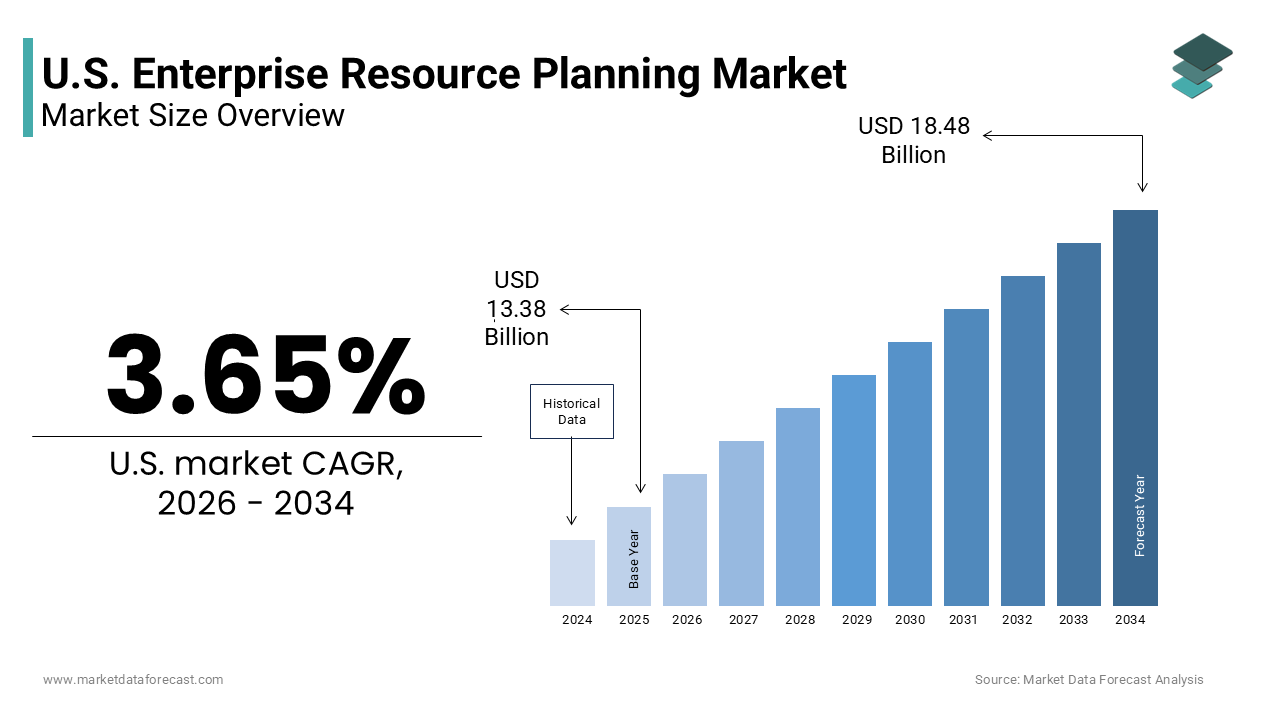
The U.S. enterprise resource planning (ERP) market was valued at USD 13.38 billion in 2025, is estimated to reach USD 13.87 billion in 2026, and is projected to reach USD 18.48 billion by 2034, growing at a CAGR of 3.65% during the forecast period from 2026 to 2034. The growth of the U.S. ERP market is driven by increasing adoption of cloud-based solutions, demand for operational efficiency, and the rising need for real-time business data integration. Additionally, the expansion of digital transformation initiatives, regulatory compliance requirements, and AI-driven enterprise applications is further accelerating market growth.
Key Market Trends
- Rapid shift toward cloud-based ERP solutions for scalability and cost efficiency
- Increasing integration of artificial intelligence and machine learning for predictive analytics
- Growing demand for real-time data visibility and automation across business functions
- Rising adoption of ERP among small and medium-sized enterprises (SMEs)
- Strong focus on cybersecurity, compliance, and data privacy within ERP systems
Segmental Insights
- Based on enterprise type, the large enterprises segment was the largest and held a significant share of the U.S. ERP market in 2025. The segment’s dominance is attributed to the need for centralized data management, complex operations handling, and regulatory compliance across multiple business units.
- Based on deployment, the cloud segment accounted for 45.3% of the U.S. ERP market share in 2025. This is driven by the flexibility, scalability, reduced infrastructure costs, and support for remote work environments offered by cloud-based ERP systems.
- Based on business function, the financial management segment was the largest, supported by the critical requirement for accurate financial reporting, compliance, and real-time analytics across organizations.
Regional Insights
The U.S. ERP market shows strong adoption across major regions such as California, New York, Washington, and other states, supported by high digital adoption, strong enterprise IT spending, and widespread use of cloud infrastructure. The country remains a leading market due to advanced technological capabilities, high enterprise software penetration, and increasing investments in digital transformation initiatives.
Competitive Landscape
The U.S. ERP market is highly competitive, characterized by the presence of global technology leaders and emerging cloud-native providers. Companies are focusing on AI integration, cloud innovation, and industry-specific solutions to strengthen their market position. Prominent players in the U.S. ERP market include SAP SE, Oracle Corporation, Microsoft Corporation, Infor, Workday, Inc., Epicor Software Corporation, Sage Group plc, IFS AB, and NetSuite Inc.
U.S. Enterprise Resource Planning Market Size
The U.S. enterprise resource planning market size was valued at USD 13.38 billion in 2025 and is anticipated to reach USD 13.87 billion in 2026 from USD 18.48 billion by 2034, growing at a CAGR of 3.65% during the forecast period from 2026 to 2034.
The enterprise resource planning is integrated software suites that manage core business processes, including finance, human resources, supply chain management, and customer relationship management through a unified system. This technological infrastructure serves as the digital backbone for organizations enabling real time data flow and operational visibility across departments. The definition has expanded beyond traditional on premise installations to include cloud based solutions that offer scalability and remote accessibility. As per the Bureau of Labor Statistics approximately 85% of establishments in the United States with 50 or more employees utilize some form of enterprise software to coordinate operations indicating deep institutional reliance on these systems. The widespread adoption of high speed internet, which the Federal Communications Commission states is accessible to 92% of urban households facilitates the seamless operation of cloud based ERP platforms. This connectivity ensures that distributed workforces can access critical business information without latency issues. These systems are essential for maintaining regulatory compliance optimizing inventory levels and enhancing decision making processes through advanced reporting capabilities.
MARKET DRIVERS
Accelerated Cloud Computing Adoption and Scalability Needs
The rapid migration toward cloud computing infrastructure by offering organizations enhanced scalability flexibility and cost efficiency is a major factor propelling the growth of the United States enterprise resource planning market. Traditional on-premise ERP systems require significant capital expenditure for hardware maintenance and IT staff whereas cloud based solutions operate on a subscription model that reduces upfront costs. Companies prefer cloud ERP because it allows them to scale resources up or down based on fluctuating demand without the need for physical infrastructure upgrades. The ability to access real time data from any location supports remote work models which have become standard in many industries. Furthermore, cloud providers offer regular updates and security patches ensuring that systems remain current with the latest technological advancements and compliance requirements. This continuous improvement cycle eliminates the burden on internal IT teams to manage software versions. The integration of cloud ERP with other software as a service-applications creates a cohesive ecosystem that enhances overall operational efficiency.
Regulatory Compliance and Financial Transparency Requirements
The stringent regulatory compliance requirements and the need for financial transparency drive the adoption of advanced enterprise resource planning systems is also escalating the growth of the united States enterprise resource planning market. Organizations must adhere to complex regulations, such as the Sarbanes Oxley Act General Data Protection Regulation and industry specific standards which mandate accurate record keeping and reporting. Modern ERP platforms offer automated compliance features that track transactions monitor access and generate audit trails reducing the risk of non compliance and associated penalties. Data from Deloitte suggests that 75% of CFOs consider regulatory compliance a top priority when selecting financial software solutions. The ability to consolidate financial data from multiple subsidiaries and regions into a single view enables faster and more accurate reporting to stakeholders and regulatory bodies. Additionally, ERP systems facilitate tax compliance by automatically calculating liabilities based on current laws and jurisdictions. The integration of real time analytics allows finance teams to identify discrepancies and anomalies promptly thereby enhancing financial integrity. These capabilities are crucial for publicly traded companies and those operating in highly regulated sectors such as healthcare and finance.
MARKET RESTRAINTS
High Implementation Costs and Resource Intensity
The substantial costs associated with implementing enterprise resource planning systems for many organizations, particularly small and medium sized enterprises is restricting the growth of the United enterprise resource planning market. Implementation involves not only software licensing fees but also expenses for hardware customization training and consulting services, which can accumulate rapidly. Additionally, the process often takes longer than anticipated with 56% of projects exceeding their initial timeline leading to increased labor costs and operational disruptions. Data from McKinsey and Company indicates that large scale IT transformations including ERP deployments often fail to deliver expected returns due to budget overruns and scope creep. The need for specialized IT personnel to manage and maintain the system further adds to the total cost of ownership. Many organizations struggle to justify the high upfront investment especially when the return on investment may take several years to materialize. Furthermore, the complexity of integrating new ERP systems with existing legacy applications requires extensive technical expertise and resources. These financial and logistical barriers discourage some companies from upgrading their systems or adopting new technologies.
Resistance to Change and Cultural Barriers
The employee resistance to change and organizational cultural barriers to the successful adoption and utilization of enterprise resource planning systems is another attribute declining the growth of the United States enterprise resource planning market. Implementing a new ERP system often requires changes to established workflows and processes which can cause discomfort and anxiety among staff members. Employees may perceive the new system as a threat to their job security or feel overwhelmed by the learning curve associated with new software interfaces. The lack of adequate training and communication exacerbates these issues leading to frustration and decreased productivity during the transition period. Furthermore, siloed departmental structures can hinder the cross functional collaboration required for effective ERP integration. Managers may be reluctant to share data or modify processes that have historically worked for their specific teams. This cultural inertia slows down the implementation process and limits the potential benefits of the system.
MARKET OPPORTUNITIES
Integration of Artificial Intelligence and Machine Learning
The integration of artificial intelligence and machine learning technologies by enabling predictive analytics and intelligent automation is one of the major opportunities for the United States enterprise resource planning market to expand in coming years. AI powered ERP systems can analyze vast amounts of data to identify patterns forecast demand and optimize inventory levels with greater accuracy than traditional methods. As per International Data Corporation spending on artificial intelligence solutions is expected to reach 154 billion dollars in the United States by 2025 driving innovation in enterprise software. Machine learning algorithms can automate routine tasks, such as invoice processing and expense reporting freeing up employees to focus on strategic activities. This technology enables proactive decision making by providing real time insights into supply chain disruptions financial risks and customer behavior. The use of natural language processing allows users to interact with the system through voice commands or chatbots enhancing usability and accessibility. Furthermore AI driven anomaly detection helps identify fraudulent activities and compliance violations promptly. These capabilities enhance operational efficiency reduce costs and improve customer satisfaction. Organizations that leverage these advanced features can gain a competitive advantage by responding faster to market changes and optimizing resource allocation.
Expansion into Small and Medium Sized Enterprises
The expansion of enterprise resource planning solutions into the small and medium sized enterprise sector is additionally to fuel the growth of the United States enterprise resource planning markets. Historically ERP systems were predominantly adopted by large corporations due to their complexity and cost but the emergence of cloud based and modular solutions has made them accessible to smaller businesses. As per the Small Business Administration there are approximately 33.2 million small businesses in the United States representing a vast untapped market for ERP providers. These businesses increasingly recognize the need for integrated systems to manage growth streamline operations and compete with larger entities. Vendors are responding by offering scalable and affordable packages that cater to the specific needs of SMEs without requiring extensive IT infrastructure. The availability of industry specific templates and pre-configured modules reduces implementation time and complexity. Furthermore, the rise of remote work has increased the demand for cloud based solutions that allow SMEs to manage distributed teams effectively. By targeting this segment vendors can diversify their revenue streams and reduce dependence on large enterprise clients. The potential for long term relationships with growing businesses also provides opportunities for upselling additional modules and services as these companies expand.
MARKET CHALLENGES
Cybersecurity Threats and Data Privacy Concerns
The increasing frequency and sophistication of cybersecurity threats pose a major challenge for the expansion of the United States enterprise resource planning market. ERP platforms are attractive targets for cybercriminals seeking to exploit vulnerabilities to steal information or disrupt operations. A successful attack on an ERP system can result in significant financial losses reputational damage and legal liabilities. Data from IBM indicates that the average cost of a data breach in the United States is 4.88 million dollars emphasizing the high stakes involved. Ensuring robust security measures such as encryption multi factor authentication and regular security audits is essential but adds complexity and cost to ERP implementations. Furthermore, the shift to cloud based ERP introduces new security considerations related to data sovereignty and third party access. Organizations must trust vendors to maintain high security standards, which can be difficult to verify. Compliance with data privacy regulations such as the California Consumer Privacy Act requires careful management of user data within ERP systems. The constant evolution of cyber threats necessitates ongoing vigilance and investment in security technologies.
Complexity of Integration with Legacy Systems
The complexity of integrating modern enterprise resource planning systems with existing legacy infrastructure for many organizations is also to inhibit the growth of the United States enterprise resource planning market. Many companies operate with outdated software and hardware that were not designed to communicate with contemporary cloud based or modular ERP platforms. The incompatibility can lead to data silos inconsistent information and operational inefficiencies. Data from Gartner suggests that integration issues are among the top reasons for ERP project failures causing delays and budget overruns. Developing custom interfaces and middleware to bridge the gap between old and new systems requires specialized skills and significant time investment. Furthermore, legacy systems may lack the necessary application programming interfaces to support seamless data exchange. The risk of data loss or corruption during migration is another concern that complicates the integration process. Organizations must carefully plan and execute integration strategies to minimize disruptions to business operations. The lack of standardized protocols across different legacy systems further exacerbates the challenge. These technical hurdles can deter organizations from upgrading their ERP systems or limit the functionality they can achieve.
REPORT COVERAGE
| REPORT METRIC | DETAILS |
| Market Size Available | 2025 to 2034 |
| Base Year | 2025 |
| Forecast Period | 2026 to 2034 |
| CAGR | 3.65% |
| Segments Covered | By Enterprise Type, Deployment, Business Function, End-user and Country |
| Various Analyses Covered | Regional & Country Level Analysis, Segment-Level Analysis, DROC, PESTLE Analysis, Porter’s Five Forces Analysis, Competitive Landscape, Analyst Overview on Investment Opportunities |
| Countries Covered | The market is segmented by region into California, Washington, Oregon, New York, and the rest of the United States. |
| Market Leaders Profiled | SAP SE, Oracle Corporation, Microsoft Corporation, Infor, Workday, Epicor, Sage Group, IFS AB, and NetSuite, which are focusing on cloud-based ERP solutions and digital transformation initiatives. |
SEGMENTAL ANALYSIS
By Enterprise Type Insights
The large enterprises segment was accounted in holding a dominant share of the United States enterprise resource planning market due to their complex operational structures and the need for centralized data management. These organizations manage vast supply chains diverse product portfolios and extensive workforces which require robust integrated systems to maintain efficiency and visibility. The complexity of managing multiple subsidiaries in different jurisdictions requires ERP systems that can handle varied tax laws currency conversions and regulatory compliance standards seamlessly. The scale of transactions processed by these entities demands high performance computing and secure data storage which legacy or smaller systems cannot support. Furthermore, large enterprises have the financial resources to invest in customizations and integrations with specialized industry software such as customer relationship management and advanced analytics tools. The need for real time decision making at the executive level drives the adoption of ERP platforms that offer detailed dashboards and predictive insights.
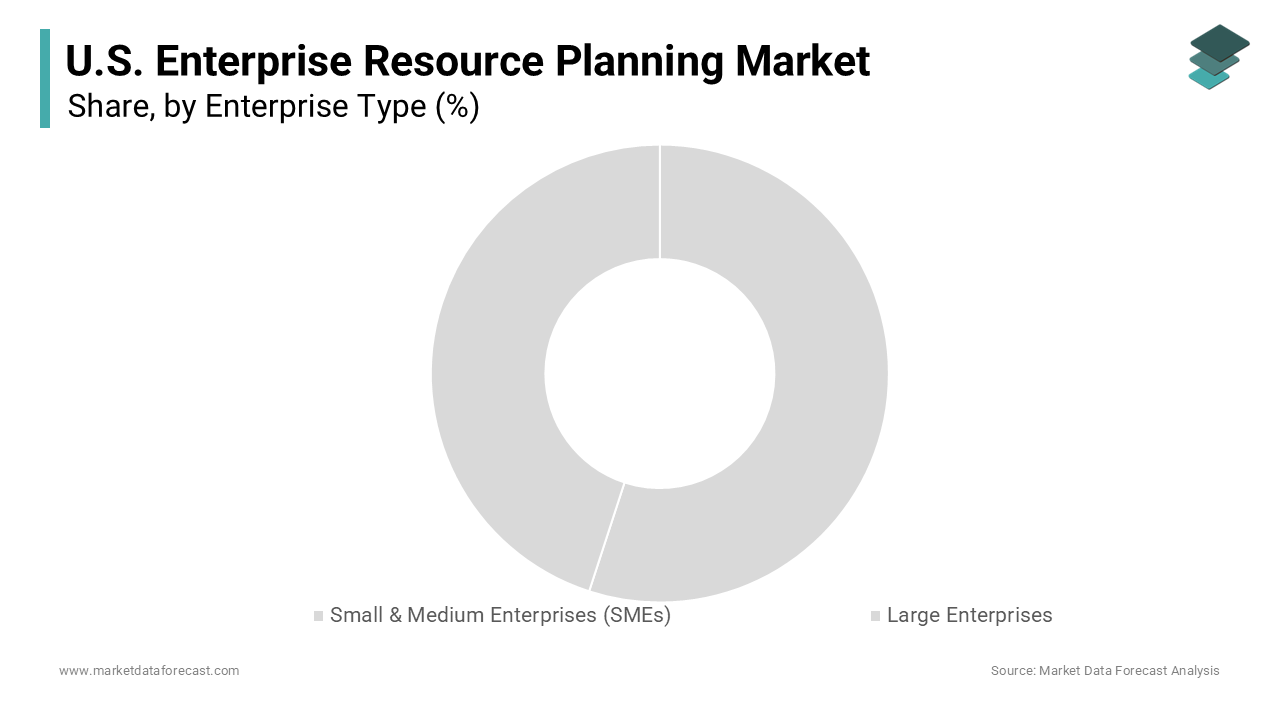
The small and medium enterprises segment is likely to grow at an anticipated CAGR of 11.2% during the forecast period with the availability of cloud based and affordable subscription models that lower entry barriers. Historically, SMEs were excluded from ERP adoption due to high upfront costs and complexity but software as a service models have democratized access to these powerful tools. Cloud based ERP solutions eliminate the need for expensive on premise hardware and reduce implementation time from months to weeks. The modular nature of modern ERP platforms allows SMEs to start with core functionalities such as accounting and inventory management and add modules as they grow. This scalability aligns with the dynamic nature of small businesses, which often experience rapid changes in size and scope. Furthermore, the reduced need for specialized IT staff lowers ongoing maintenance costs making ERP financially viable for smaller organizations. The ease of access via web browsers and mobile devices also supports remote work capabilities, which are increasingly important for SMEs.
By Deployment Insights
The cloud deployment segment was accounted in holding 45.3% of the United States enterprise resource planning market share in 2025 due to its inherent scalability and the reduction of infrastructure maintenance burdens for organizations. Companies prefer cloud-based ERP because it allows them to adjust computing resources and storage capacity dynamically based on fluctuating business needs without investing in physical servers. The elimination of on-premise hardware reduces capital expenditure and shifts costs to a predictable operational expense model, which is attractive to finance teams. The arrangement allows internal IT teams to focus on strategic initiatives rather than routine maintenance tasks. Furthermore, cloud platforms offer high availability and disaster recovery capabilities that are often too costly for individual companies to replicate on premise. The ability to access the system from any location with internet connectivity supports remote and hybrid work models, which have become standard in many industries. Regular automatic updates ensure that users always have access to the latest features and security patches without disruptive manual installations.
The hybrid deployment segment is esteemed to witness a fastest CAGR of 9.2% from 2026 to 2034 with the a balanced approach that addresses security concerns, while leveraging cloud flexibility. Many organizations particularly in regulated industries, such as healthcare and finance prefer to keep sensitive data on premise while utilizing the cloud for less critical functions and scalability. The model allows companies to maintain control over proprietary information and comply with strict data sovereignty regulations, while benefiting from the cost efficiency and innovation of cloud services. Hybrid ERP systems enable businesses to run core financial and operational modules on secure local servers, while using cloud based analytics and collaboration tools. This phased approach reduces the complexity and risk of transitioning entirely to the cloud. Furthermore, it allows organizations to leverage existing investments in on premise infrastructure while gradually expanding into the cloud. The ability to customize security protocols for different parts of the system provides an added layer of protection against cyber threats.
By Business Function Insights
The financial management segment was the largest by capturing 34.5% of the United States enterprise resource planning market share in 2025 with the core function required for regulatory compliance and accurate financial reporting. Organizations must adhere to strict accounting standards. ERP platforms automate complex accounting processes, such as general ledger management accounts payable and receivable and tax calculations ensuring accuracy and consistency. The ability to generate real time financial statements and audit trails simplifies interactions with regulators and auditors reducing the time and cost associated with compliance activities. Furthermore, integrated financial modules provide a consolidated view of organizational performance enabling better budgeting and forecasting. The centralization of financial data eliminates discrepancies between departments and ensures that decision makers have access to reliable information.
The supply chain management segment is attributed to grow at an anticipated CAGR of 10.8% from 2026 to 2034 with the urgent need for resilience against global disruptions and demand volatility. Recent events such as pandemics geopolitical tensions and natural disasters have exposed vulnerabilities in traditional supply chains prompting organizations to invest in advanced SCM modules. ERP based SCM solutions provide real time visibility into inventory levels supplier performance and logistics status enabling proactive risk management. Advanced analytics and predictive modeling help organizations anticipate demand fluctuations and optimize inventory levels reducing stockouts and excess inventory. The integration of supplier portals facilitates better collaboration and communication ensuring timely deliveries and quality control. Furthermore, the ability to track shipments in real time improves customer satisfaction by providing accurate delivery estimates. These capabilities are essential for maintaining competitiveness in a volatile global market.
COMPETITIVE LANDSCAPE
The competition in the United States ERP market is intense and characterized by the rivalry between established global giants and emerging cloud native specialists. Major vendors compete on the breadth of functionality integration capabilities and the sophistication of artificial intelligence features embedded within their platforms. The shift toward subscription based models has lowered barriers to entry allowing smaller players to offer affordable solutions to small and medium sized enterprises. Differentiation often comes from industry specific customization and the ability to provide seamless connectivity with other business applications such as customer relationship management and human resources systems. Customer retention is a key battleground as switching costs remain high due to the complexity of data migration and process reengineering. Vendors invest heavily in ecosystem development by partnering with third party developers and consultants to extend platform capabilities. Price competition is moderate as buyers prioritize value and long term support over initial cost savings. Innovation in user interface design and mobile accessibility also drives competitive dynamics as organizations seek to improve employee productivity and engagement. This dynamic environment encourages continuous improvement and strategic alliances to capture market share.
KEY MARKET PLAYERS
A few of the major companies in the U.S. ERP market include
- SAP SE
- Oracle Corporation
- Microsoft Corporation
- Infor
- Workday, Inc.
- Epicor Software Corporation
- Sage Group plc
- IFS AB
- NetSuite Inc.
Top Players in the US ERP Market
SAP SE
SAP SE maintains a strong presence in the United States enterprise resource planning market by providing comprehensive cloud based solutions tailored for large enterprises and complex industries. The company focuses on integrating artificial intelligence and machine learning into its S/4HANA platform to enhance predictive analytics and automate business processes. Recent actions include the expansion of its industry cloud offerings which provide specialized functionalities for sectors such as manufacturing retail and healthcare. SAP has also strengthened its position by investing heavily in sustainability management tools that help organizations track and reduce their carbon footprint. These initiatives allow the company to address evolving regulatory requirements and corporate social responsibility goals. The continuous enhancement of its user experience and integration capabilities solidifies its role as a leading provider of mission critical business software in the competitive US landscape.
Oracle Corporation
Oracle Corporation contributes significantly to the United States ERP market through its robust cloud infrastructure and integrated application suite known as Fusion Cloud ERP. The company leverages its database expertise to offer high performance and secure data management solutions that appeal to financial services and healthcare sectors. Recent strategies involve the deep integration of generative artificial intelligence into its ERP modules to streamline workflows and improve decision making accuracy. Oracle has also expanded its autonomous database capabilities which reduce manual maintenance tasks and enhance system reliability for enterprise customers. The company actively promotes its net suite for small and medium sized businesses providing scalable cloud ERP options that support rapid growth.
Microsoft Corporation
Microsoft Corporation plays a pivotal role in the United States ERP market by offering Dynamics 365 a flexible and modular cloud based solution that integrates seamlessly with its productivity tools. The company emphasizes low code development and artificial intelligence to empower businesses to customize applications without extensive technical expertise. Recent actions include the enhancement of its copilot features which assist users in generating insights and automating routine tasks within the ERP environment. Microsoft has also strengthened its position by expanding partnerships with independent software vendors to broaden the ecosystem of available industry specific solutions. The integration of Teams and Office 365 with Dynamics 365 facilitates better collaboration and data sharing across departments. This unified approach reduces friction and improves user adoption rates among employees familiar with Microsoft products.
Top Strategies Used by Key Market Participants
Key players in the United States ERP market primarily focus on integrating artificial intelligence and machine learning to enhance automation and predictive analytics capabilities. Companies are increasingly adopting cloud native architectures to offer scalable and flexible solutions that reduce infrastructure costs for clients. Strategic acquisitions of niche software providers enable vendors to expand their industry specific functionalities and address specialized business needs. Partnerships with technology firms and consulting agencies help accelerate implementation timelines and improve customer support services. Emphasis on user experience design ensures that interfaces are intuitive and accessible thereby increasing adoption rates among employees. Providers are also prioritizing sustainability features to help organizations meet environmental regulatory requirements and corporate social responsibility goals. Continuous investment in cybersecurity measures builds trust and protects sensitive business data from emerging threats. These strategies enable vendors to differentiate their offerings and maintain competitive advantage in a rapidly evolving digital landscape.
MARKET SEGMENTATION
This research report on the U.S. ERP market has been segmented based on the following categories.
By Enterprise Type
- Small & Medium Enterprises (SMEs)
- Large Enterprises
By Deployment
- Cloud
- On-premise
- Hybrid
By Business Function
- Financial Management
- Human Capital Management
- Supply Chain Management
- Customer Management
- Inventory & Work Order Management
- Others
By End-user
- Manufacturing
- BFSI
- IT & Telecom
- Retail and Consumer Goods
- Healthcare & Life Sciences
- Transportation & Logistics
- Government
- Others (Aerospace & Defense)
By Country
- California
- Washington
- Oregon
- New York
- Rest of the United States