- Product Description Description
- Table of Contents TOC
- List of Table & Figure LOT
- Get Free Sample PDF Sample PDF
Market Size, 2025
$36.01 BnMarket Estimate, 2026
$37.99 BnMarket Forecast, 2034
$58.39 BnCAGR, 2026–2034
5.52%U.S. Facial Skincare Market Size, Growth, Trends & Forecast (2026–2034)
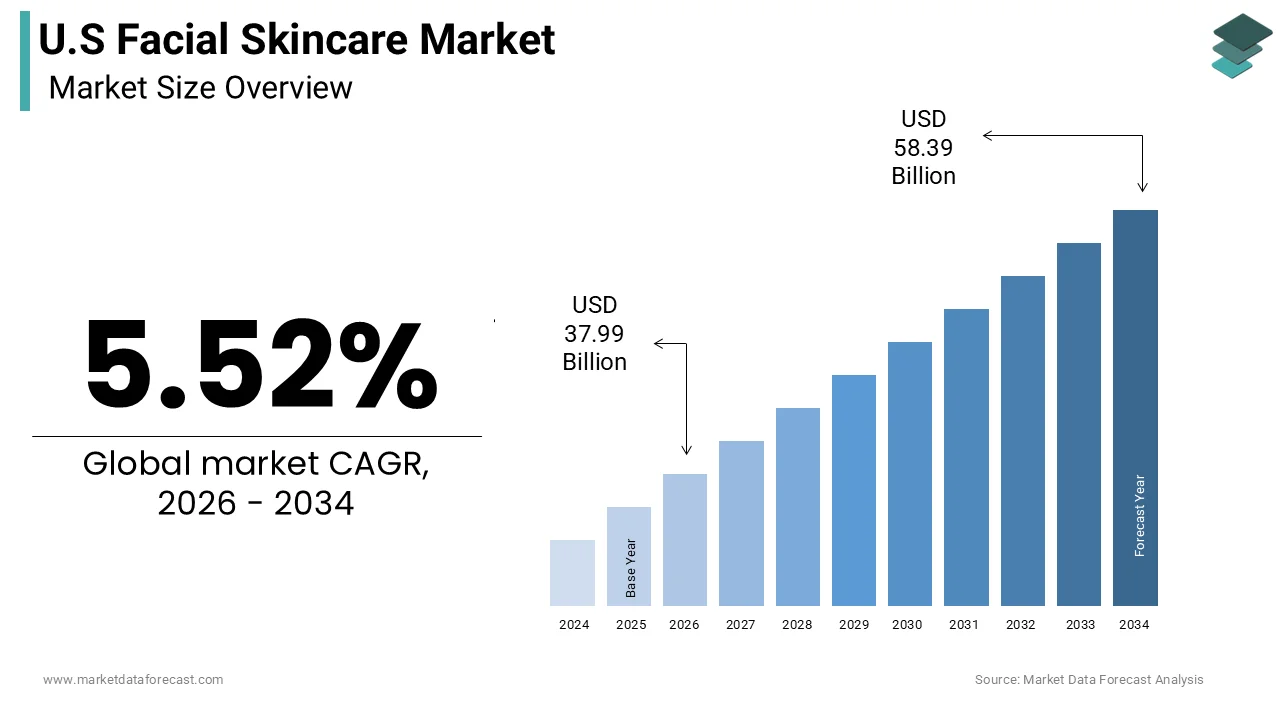
The U.S. facial skincare market size was calculated to be USD 36.01 billion in 2025, is anticipated to reach USD 37.99 billion in 2026, and is projected to be worth USD 58.39 billion by 2034, registering a compound annual growth rate (CAGR) of 5.52% during the forecast period from 2026 to 2034. Driven by the rising prevalence of chronic skin conditions, clean beauty preferences, and digital health integrations, the market continues steady expansion.
Key Executive Metrics (At-a-Glance)
- 2025 Base Valuation: USD 36.01 Billion
- 2026 Current Valuation: USD 37.99 Billion
- 2034 Forecast Valuation: USD 58.39 Billion
- Compound Annual Growth Rate (CAGR): 5.52% (2026–2034)
- Dominant Product Type Segment: Facial creams and moisturizers segment (holding 51.2% market share in 2025)
- Fastest-Growing Product Type Segment: Serums and masks segment (holding 7.8% during the forecast period)
- Dominant Gender Segment: Female segment (holding a significant share in 2025)
- Fastest-Growing Gender Segment: Male segment (growing at a CAGR of 6.5% during the forecast period)
- Dominant Distribution Channel Segment: Pharmacies and drugstores segment (holding 40.2% market share in 2025)
- Fastest-Growing Distribution Channel Segment: Online retail segment (growing at a CAGR of 9.2% from 2026 to 2034)
Core Market Drivers
- Prevalence of Skin Conditions: High incidence of acne and rosacea, alongside an aging demographic, fueling demand for targeted, clinical-grade skincare.
- Clean & Sustainable Beauty Preferences: Consumer shifts toward transparent labeling, sustainable sourcing, and vegan/cruelty-free product lines.
Primary Market Restraints & Challenges
- Regulatory Compliance & Supply Chain Volatility: Stricter cosmetic oversight (MoCRA) and raw material price spikes increasing operational burdens.
U.S. Facial Skincare Market Segmentation Breakdown
| Segment Category | Leading Sub-Segment (Base Year) | Fastest-Growing Sub-Segment |
|---|---|---|
| By Product Type | Facial Creams & Moisturizers (51.2% share in 2025) | Serums & Masks (7.8% forecast share) |
| By Gender | Female (Significant share in 2025) | Male (CAGR of 6.5%) |
| By Distribution Channel | Pharmacies & Drugstores (40.2% share in 2025) | Online Retail (CAGR of 9.2%) |
Major Industry Players Profiled
Key market leaders shaping the U.S. facial skincare industry include L'Oréal USA, Estée Lauder Companies, Procter & Gamble Beauty, Johnson & Johnson Consumer Health (Kenvue), Unilever, Coty Inc., Shiseido Americas, Beiersdorf AG, Colgate-Palmolive Company, Mary Kay Inc., Nu Skin Enterprises, The Honest Company, e.l.f. Beauty, Neutrogena, and Clinique.
 Download Free Sample Report
U.S Facial Skincare Market Size
The U.S facial skincare market size was calculated to be USD 36.01 billion in 2025 and is anticipated to be worth USD 58.39 billion by 2034, from USD 37.99 billion in 2026, growing at a CAGR of 5.52% during the forecast period.
The facial skincare is a dermatological science that intersects with daily consumer rituals. Furthermore, data from the Skin Cancer Foundation reveals that only 43% of men and 27% of women regularly apply sunscreen to their faces, highlighting a significant gap between awareness and habitual practice. Consumer behavior is increasingly influenced by digital media, where influencers and dermatologists share routine advice. The rise of telehealth has also made professional skincare advice more accessible, with teledermatology visits increasing by over 150% since 2020, as per the study.
MARKET DRIVERS
Rising Prevalence Of Skin Conditions Drives Demand For Specialized Treatments
The increasing incidence of dermatological issues is greatly influencing the growth of the United States facial skincare market. Environmental factors, such as pollution and ultraviolet radiation, combined with lifestyle stressors, contribute to a higher burden of skin conditions among the population. According to the American Academy of Dermatology, acne affects up to 50 million Americans annually, making it the most common skin condition in the country. This widespread prevalence creates a sustained demand for effective over-the-counter and prescription-grade facial treatments. Additionally, rosacea impacts approximately 16 million people in the United States, as per the National Rosacea Society, necessitating specialized, gentle skincare solutions that reduce redness and inflammation. The aging population further amplifies this trend, with the Census Bureau projecting that by 2030, one in five residents will be retirement age. Clinical studies indicate that consistent use of targeted skincare can mitigate visible signs of aging and manage chronic conditions effectively. Consequently, consumers are moving beyond basic cleansing to invest in regimen-based approaches that address specific physiological needs. The medicalization of skincare means that products are often evaluated through a clinical lens, driving innovation in ingredient efficacy.
Growing Consumer Preference For Clean And Sustainable Beauty Products
The consumer values toward transparency and environmental responsibility are fuelling the growth of the United States facial skincare market. Modern buyers are increasingly scrutinizing ingredient lists and corporate sustainability practices before making purchase decisions. This sentiment has propelled the clean beauty movement from a niche segment to a mainstream expectation. Brands are responding by eliminating parabens, sulfates, and synthetic fragrances, while opting for biodegradable packaging and ethically sourced ingredients. The millennial and Generation Z demographics, who collectively hold significant purchasing power, are particularly vocal about these preferences. They favor brands that demonstrate genuine commitment to social and environmental causes rather than superficial marketing claims. This driver compels established companies to reformulate existing products and launch new lines that align with these ethical standards. The demand for vegan and cruelty-free certifications has also surged, with Leaping Bunny-certified brands seeing a 25% increase in retail distribution. This trend encourages innovation in plant-based actives and green chemistry, ensuring that product efficacy does not come at the expense of planetary health.
MARKET RESTRAINTS
Stringent Regulatory Compliance Increases Operational Costs For Manufacturers
The complex regulatory environment for companies is hindering the growth of the United States facial skincare market. Unlike pharmaceuticals, cosmetics are not subject to premarket approval by the Food and Drug Administration, yet they must adhere to strict labeling and safety standards. The introduction of the Modernization of Cosmetics Regulation Act has intensified scrutiny, requiring manufacturers to maintain detailed safety substantiation and adverse event reporting. These entities often lack the resources to conduct extensive toxicological testing or hire specialized legal counsel. This patchwork of federal and state regulations creates logistical challenges for national distribution. Companies must constantly reformulate products to meet varying regional requirements, which is leading to supply chain disruptions and increased inventory complexity. The cost of reformulation and retesting can delay product launches by several months,
hs impacting revenue projections. Additionally, the risk of non-compliance penalties discourages innovation as firms may hesitate to introduce novel ingredients due to uncertain regulatory status. This restraint disproportionately affects emerging brands that rely on agility and unique formulations to compete.
Supply Chain Volatility Impacts Ingredient Availability And Pricing
The substantial risks from global supply chain instability, which affects the availability and cost of key raw materials, are also impeding the growth of the United States facial skincare market. Many active ingredients, such as hyaluronic acid, niacinamide, and various botanical extracts, are sourced from international suppliers, primarily in Asia and Europe. Disruptions caused by geopolitical tensions, trade disputes, or natural disasters can lead to sudden shortages. According to the Institute for Supply Management, the price volatility index for chemical raw materials rose by 18% in the last two years ref, reflecting this instability. Such fluctuations force manufacturers to absorb higher costs or pass them on to consumers, potentially reducing demand. The reliance on specific geographic regions for rare botanicals also poses a risk as climate change affects crop yields. These shortages compel brands to seek alternative suppliers, which may vary in quality consistency, affecting product performance. Uncertainty makes inventory management difficult, leading to either stockouts that frustrate customers or excess inventory that ties up capital. Small brands are particularly vulnerable as they lack the bargaining power to secure priority shipping or bulk pricing.
MARKET OPPORTUNITIES
Expansion Into Personalized Skincare Through Artificial Intelligence Integration
The integration of artificial intelligence and diagnostic technology is ascribed to creating new opportunities for the growth of the United States facial skincare market. Consumers are increasingly seeking personalized solutions that address their unique skin profiles rather than relying on one-size-fits-all products. Advanced algorithms can analyze skin conditions through smartphone cameras or in-store devices, providing tailored product recommendations. Several leading brands have already launched AI-driven platforms that assess factors, such as hydration levels, wrinkle dept,h and pigmentation. This technology enables the creation of custom-formulated serums and moisturizers mixed on demand. This opportunity allows brands to differentiate themselves in a saturated market by offering superior customer experiences. It also fosters deeper engagement as users track their skin progress over time through connected apps. The collection of anonymized data further aids research and development, helping companies identify emerging trends and unmet needs.
Growth Of Telemedicine And Virtual Dermatological Consultations
The rapid expansion of telehealth services is bridging the gap between clinical expertise and consumer access, which is another factor to boost the growth of the United States facial skincare market. Virtual consultations allow individuals to receive professional advice and prescriptions without visiting a physical clinic, making skincare management more convenient and accessible. This trend enables skincare brands to partner with healthcare providers to offer integrated services, where diagnosis leads directly to product recommendations. Such collaborations enhance credibility and trust as consumers perceive these products as medically endorsed. The convenience factor appeals to busy professionals and residents in rural areas who may lack access to specialized dermatologists. Insurance coverage for telehealth visits has also expanded, with many plans now covering virtual skin checks, reducing out-of-pocket costs for patients. This accessibility drives demand for prescription-strength topical treatments that were previously difficult to obtain. Brands that integrate seamlessly with telehealth platforms can capture a larger share of the medical skincare segment. Furthermore, the data generated from these consultations provides valuable insights into common skin concerns across different demographics. This information can guide product development and targeted marketing campaigns.
MARKET CHALLENGES
Counterfeit Products Undermine Brand Integrity And Consumer Safety
The proliferation of counterfeit products is a major barrier to the growth of the United States facial skincare market. Illicit manufacturers replicate popular items, selling them through unauthorized online marketplaces and third-party sellers at discounted prices. These fake products often contain harmful substances such as heavy metals, bacteria, or unapproved additives that can cause severe allergic reactions or infections. Instances of contaminated skincare leading to hospitalizations have been documented by the Food and Drug Administration, eroding consumer trust in online shopping channels. Authentic brands suffer reputational damage when customers mistakenly attribute adverse effects to their genuine products. Combating this issue requires significant investment in authentication technologies such as holographic seals and blockchain tracking systems. Consumers often struggle to distinguish between real and fake items, especially when packaging replicas are highly sophisticated.
Ingredient Sourcing, Ethical Concerns, and Sustainability Claims Scrutiny
The increasing scrutiny regarding the ethical sourcing of ingredients and the validity of sustainability claims is also impeding the growth of the United States facial skincare market. Consumers and advocacy groups are demanding greater transparency about the origin of raw materials and the labor practices involved in their harvesting. Issues, such as deforestation for palm oil or unfair wages for mica miners, have drawn negative attention to major beauty brands. Greenwashing or making misleading environmental claims has also become a focal point for regulatory bodies and consumer watchdogs. The Federal Trade Commission has updated its Green Guides to provide stricter definitions for terms like eco-friendly and natural, requiring substantiation for such labels. Brands face the challenge of verifying their entire supply chain to ensure compliance with these evolving standards. Failure to do so can result in fines and significant public relations crises. The complexity of global supply networks makes full traceability difficult and expensive to achieve. Small brands may lack the resources to conduct thorough audits, while large corporations face pressure to divest from problematic suppliers.
REPORT COVERAGE
| REPORT METRIC | DETAILS |
| Market Size Available | 2025 to 2034 |
| Base Year | 2025 |
| Forecast Period | 2026 to 2034 |
| CAGR | 5.52% |
| Segments Covered | By Product Type, Gender, Distribution Channel, And Region |
| Various Analyses Covered | Global, Regional & Country Level Analysis; Segment-Level Analysis; DROC, PESTLE Analysis; Porter’s Five Forces Analysis; Competitive Landscape; Analyst Overview of Investment Opportunities |
| Regions Covered | New York, Massachusetts, Pennsylvania, Illinois, Ohio, Michigan, Texas, Florida, Georgia, California, Washington, Colorado. |
| Market Leaders Profiled | L'Oréal USA, Estée Lauder Companies, Procter & Gamble Beauty, Johnson & Johnson Consumer Health (Kenvue), Unilever, Coty Inc., Shiseido Americas, Beiersdorf AG, Colgate-Palmolive Company, Mary Kay Inc., Nu Skin Enterprises, The Honest Company, e.l.f. Beauty, Neutrogena, Clinique |
SEGMENTAL ANALYSIS
By Product Type Insights
The facial creams and moisturizers segment accounted in holding 51.2% of the United States facial skincare market share in 2025 due to their status as essential daily care items. The integration into daily hygiene rituals for a vast majority of the population is also fuelling the growth of the segment. Unlike specialized treatments, such as serums or masks, which are often used intermittently, moisturizers are applied at least once, not twice daily, by consumers. According to the American Academy of Dermatology, nearly 60% of adults in the United States report using a facial moisturizer every day, establishing it as a staple product. This high frequency of use translates into rapid product turnover and consistent repurchase cycles. The physiological need for hydration is universal, as environmental factors like heating, air conditioning, and wind strip moisture from the skin barrier. Dermatologists consistently recommend moisturizing as a critical step to maintain skin health and prevent conditions such as eczema or excessive dryness.
The serums and masks segment was the largest by holding 7.8% during the forecast period, with their formulation with high concentrations of active ingredients that deliver visible and measurable results in a shorter timeframe compared to traditional creams. Serums are designed with smaller molecular structures, allowing deeper penetration into the skin layers to target specific issues such as hyperpigmentation, fine lines, and acne scars. According to a study published in the Journal of Cosmetic Dermatology, topical serums containing vitamin C can reduce the appearance of dark spots by up to 30% within eight weeks of consistent use. This efficacy drives consumer willingness to pay premium prices for these specialized products. The rise of ingredient-savvy consumers who research components like retinoic acid, l-glycolic acid, and peptides has shifted demand toward products that offer clinical-grade performance at home. Mask,s particularly sheet masks, and clay masks provide an immediate sensory experience and instant gratification, which aligns with the desire for quick fixes and self-care rituals. The perceived value of these intensive treatments encourages trial and repeat purchases as consumers seek to replicate professional facial results in their own homes.
By Gender Insights
The female segment accounted for a significant share of the United States facial skincare market in 2025. The deeply ingrained cultural expectation for women to maintain a polished appearance, which translates into more elaborate and consistent skincare routines. Women are more likely to adopt multi-step regimens, involving cleansing, toning, treating, and moisturizing, whereas men often prefer simpler one- or two-step processes. This higher product usage directly correlates with greater expenditure per capita. Furthermore, women are more likely to seek professional advice from dermatologists and aestheticians who recommend specialized products for specific concerns such as hormonal acne or melasma. This medical endorsement reinforces the habit of regular product use. The social aspect of skincare also plays a role as women frequently discuss products and share recommendations with peers, creating community-driven demand. Retail environments are also designed to appeal to female shoppers with interactive displays and testers that encourage exploration and impulse buying.
The male segment is likely to witness the fastest CAGR of 6.5% during the forecast period, with societal attitudes that increasingly accept and encourage men to engage in personal grooming and self-care. Traditional stereotypes that associate skincare with femininity are diminishing as public figures and influencers normalize male beauty routines. Younger generations, particularly Millennials and Generation Z, are more open to experimenting with skincare products, viewing them as essential components of overall hygiene and health. The rise of metrosexuality and the influence of social media platforms where male grooming tips are widely shared have educated men on the benefits of proper skin maintenance. Men are becoming more aware of issues such as razor burn, ingrown hairs, and sun damage, prompting them to seek specialized solutions. Brands are responding by launching lines specifically formulated for male skin, which is typically thicker and oilier than female skin. These products are marketed with straightforward language and packaging that appeals to male preferences for functionality and simplicity.
By Distribution Channel Insights
The pharmacies and drugstores segment was the largest by holding 40.2% of the United States facial skincare market share in 2025. The growth of the segment is majorly driven by the widespread presence and the high level of consumer trust associated with these establishments. According to the National Association of Chain Drug Stores, there are over 40000 pharmacy locations in the United States, ensuring that skincare products are within reach for the majority of the population. This proximity facilitates impulse purchases and routine replenishment of essential items. Consumers often perceive pharmacies as credible sources for health and wellness products, which extends to skincare items, particularly those marketed for sensitive skin or specific conditions like acne. Additionally, pharmacies often carry exclusive or professional brands that are not available in general retail stores, attracting customers seeking higher efficacy solutions. The integration of health services such as vaccinations and health screenings into pharmacy visits increases foot traffic, providing opportunities for skincare product exposure. Loyalty programs offered by major pharmacy chains further incentivize repeat purchases by offering discounts and rewards.
The online retail segment is likely to grow at the fastest CAGR of 9.2% from 2026 to 2034. The growth of the segment is majorly attributed to the unparalleled convenience it offers, along with access to an extensive variety of products that may not be available in physical stores. Consumers can browse and purchase skincare items at any time from anywhere, eliminating the need to visit multiple stores. Online platforms allow shoppers to compare prices, read detailed ingredient lists, and access customer reviews, which aids in informed decision-making. This transparency is particularly valuable for skincare products where efficacy and suitability are highly individual. The ability to filter products by skin type concern or ingredient preference simplifies the search process, saving time and effort. Furthermore, online retailers often offer subscription services that automate replenishment, ensuring that consumers never run out of essential items. Data from McKinsey shows that 35% of online skincare buyers utilize subscription models, highlighting the appeal of convenience. The vast selection available online includes niche indie brands and international products that are not distributed through traditional retail channels. This diversity attracts enthusiasts who are eager to experiment with new and unique formulations.
COMPETITION OVERVIEW
The competition in the United States facial skincare market is intense and characterized by a mix of established multinational corporations and agile independent brands. Large companies leverage their extensive resources to dominate through broad distribution networks and heavy marketing spending. They continuously innovate to maintain relevance and protect their market positions against newer entrants. Independent brands often differentiate themselves by focusing on niche segments such as clean beauty or specific skin conditions. These smaller entities utilize digital channels to build direct relationships with consumers and foster community loyalty. The barrier to entry has lowered due to the rise of e-commerce platforms, allowing new players to launch with minimal overhead. This dynamic environment forces all participants to prioritize speed and agility in product development. Price competition is prevalent in the mass market segment, while premium brands compete on brand heritage and scientific efficacy. Retailers play a crucial role by curating assortments that balance popular staples with emerging trends. Private label offerings from major retailers further intensify pressure on branded manufacturers. Consumer loyalty is increasingly fluid as shoppers experiment with new products influenced by social media trends. Companies must therefore maintain constant engagement through educational content and transparent communication.
KEY MARKET PLAYERS
A few major players of the U.S facial skincare market include
- L'Oréal USA
- Estée Lauder Companies
- Procter & Gamble Beauty
- Johnson & Johnson Consumer Health (Kenvue)
- Unilever
- Coty Inc.
- Shiseido Americas
- Beiersdorf AG
- Colgate-Palmolive Company
- Mary Kay Inc.
- Nu Skin Enterprises
- The Honest Company
- E.l.f. Beauty
- Neutrogena
- Clinique
Top Strategies Used by Key Market Participants
Key players in the United States facial skincare market employ several strategic initiatives to maintain competitiveness and drive growth. Product innovation remains a primary strategy, with companies investing heavily in research and development to create advanced formulations. Brands frequently introduce items featuring novel ingredients such as probiotics and plant-based actives to meet evolving consumer preferences. Digital transformation is another critical approach as firms enhance their online presence through e-commerce platforms and social media engagement. Companies utilize artificial intelligence and augmented reality tools to offer personalized skincare recommendations and virtual try-on experiences. Strategic acquisitions allow larger corporations to expand their portfolios by integrating niche brands with unique value propositions. Sustainability initiatives are increasingly prominent with firms adopting eco-friendly packaging and ethical sourcing practices to appeal to environmentally conscious buyers. Collaborations with dermatologists and influencers help build credibility and reach targeted audiences effectively.
Leading Players in the United States Facial Skincare Market
- The Estee Lauder Companies Inc maintains a formidable presence in the United States facial skincare sector through its diverse portfolio of prestige brands. The corporation leverages strong relationships with department stores and specialty retailers to distribute high-end products such as Clinique and La Mer. Recent strategic initiatives include significant investments in digital transformation and personalized customer experiences to enhance brand loyalty. The company has expanded its e-commerce capabilities by integrating artificial intelligence tools for virtual skin analysis. This technological adoption allows consumers to receive tailored product recommendations, thereby increasing conversion rates. Furthermore, The Estee Lauder Companies Inc focuses on sustainability by introducing eco-friendly packaging across its major lines. These efforts align with growing consumer demand for responsible beauty solutions. The firm also engages in targeted marketing campaigns featuring influential dermatologists to build credibility.
- L'Oréal USA serves as a dominant force in the facial skincare market by offering a wide range of products across mass and luxury segments. The company utilizes its extensive research and development capabilities to introduce scientifically backed formulations that address diverse skin concerns. Brands such as La Roche Posay and CeraVe have gained substantial traction due to their dermatologist-recommended status. L'Oréal USA has recently strengthened its position by acquiring niche skincare brands that cater to specific consumer needs. This strategy expands its portfolio and allows entry into emerging categories such as microbiome-friendly skincare. The corporation also prioritizes digital innovation by enhancing its online platforms with interactive features. These tools help consumers understand ingredient benefits and select appropriate products. Additionally, L'Oréal USA commits to sustainability goals by reducing plastic usage and sourcing raw materials responsibly. These initiatives resonate with environmentally conscious buyers and enhance brand image. The company collaborates with healthcare professionals to promote skin health education. The The The
- Procter and Gamble Company holds a significant position in the United States facial skincare market through its well-known mass market brands. The company focuses on delivering accessible and effective skincare solutions to a broad consumer base. Brands such as Olay are central to its strategy, emphasizing anti-aging benefits and affordability. Procter and Gamble has recently invested heavily in research to develop advanced ingredients such as niacinamide and peptides. These innovations help compete with premium brands by offering similar efficacy at lower price points. The corporation has also enhanced its digital presence by launching direct-to-consumer platforms. These channels provide personalized shopping experiences and subscription options for regular users. Procter and Gamble actively engages in sustainability efforts by using recycled materials in packaging. This approach appeals to eco-aware consumers and strengthens brand loyalty. The company collaborates with retailers to optimize shelf space and visibility.
MARKET SEGMENTATION
This research report on the U.S facial skincare market has been segmented and sub-segmented based on product type, gender, distribution channel, and region.
By Product Type
- Facial Creams
- Skin-Whitening & Anti-ageing
- Serums & Masks
- Others
By Gender
- Male
- Female
By Distribution Channel
- Pharmacies
- Hypermarkets/ Supermarkets
- Online
By Region
- New York
- Texas
- Florida
- Georgia
- California
- Rest of U.S.