- Product Description Description
- Table of Contents TOC
- List of Table & Figure LOT
- Get Free Sample PDF Sample PDF
Market Size, 2025
$25.88 BnMarket Estimate, 2026
$27.99 BnMarket Forecast, 2034
$49.16 BnCAGR, 2026–2034
8.13%U.S. Financial Services Market Report Summary
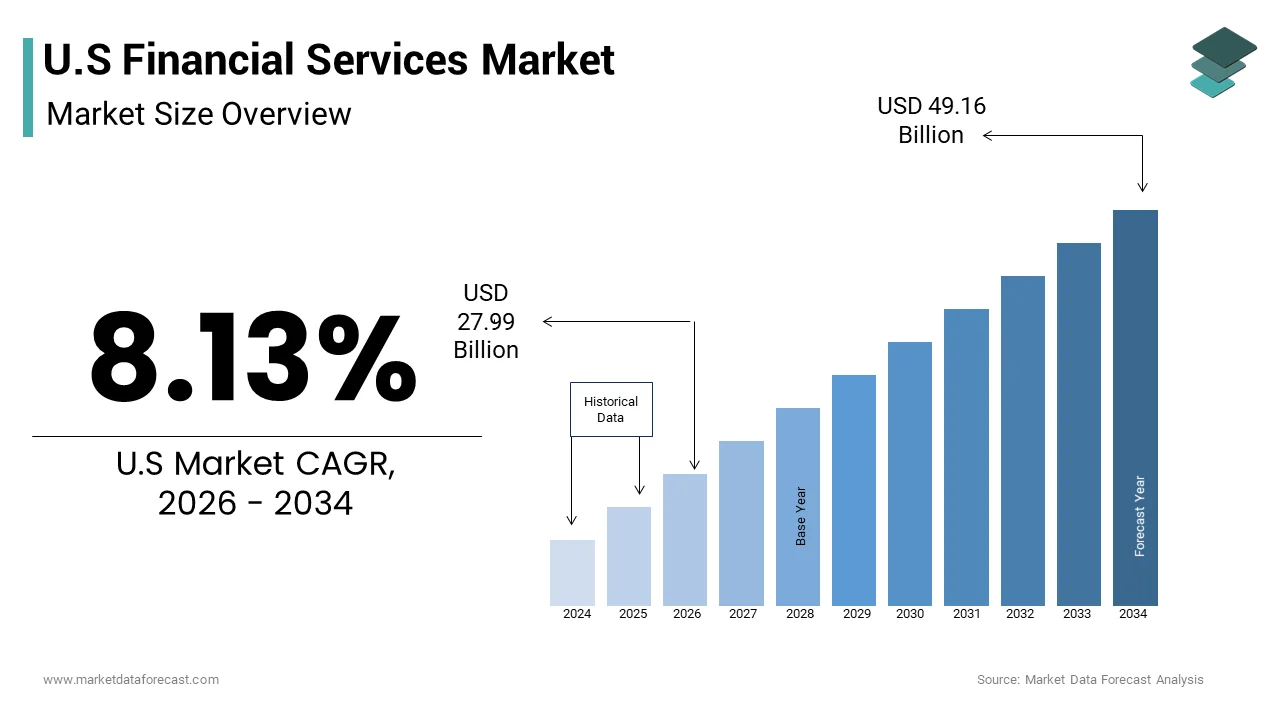
The United States financial services market was valued at USD 25.88 billion in 2025 and is anticipated to reach USD 27.99 billion in 2026 and USD 49.16 billion by 2034, growing at a CAGR of 8.13% during the forecast period from 2026 to 2034. The growth of the U.S. financial services market is driven by increasing digital transformation across banking and financial institutions, rising adoption of cloud-based financial technologies, and growing demand for secure and personalized financial solutions. The expansion of digital banking, fintech innovation, and AI-powered financial analytics is further accelerating market growth. In addition, increasing investments in cybersecurity, regulatory compliance technologies, and automation solutions are enhancing operational efficiency and customer experience across the financial ecosystem.
Key Market Trends
- Rising adoption of digital banking platforms and fintech solutions to improve customer engagement and financial accessibility.
- Increasing integration of artificial intelligence, machine learning, and predictive analytics for fraud detection, risk management, and personalized financial services.
- Growing demand for cloud computing, cybersecurity, and automation technologies within financial institutions to strengthen operational resilience.
- Expansion of mobile banking applications, digital wallets, and contactless payment solutions among consumers and enterprises.
- Strong focus on regulatory compliance, data protection, and secure transaction infrastructure amid evolving financial regulations.
Segmental Insights
- Based on end-user, the large enterprises segment was the largest and held 37.3% of the United States financial services market share in 2025. The dominance of this segment is attributed to the high adoption of advanced financial technologies, large-scale transaction processing requirements, and increasing investments in digital transformation initiatives among major enterprises.
- Based on deployment, the on-premises deployment segment accounted for 47.3% of the United States financial services market share in 2025. The segment’s leadership is driven by the growing preference for enhanced data security, regulatory compliance, and greater control over critical financial infrastructure and sensitive customer information.
- Based on application, the banking segment held a prominent share of the United States financial services market in 2025. The increasing adoption of digital banking solutions, AI-driven customer support systems, and secure online transaction platforms is significantly contributing to segment growth.
Regional Insights
The U.S. financial services market is witnessing substantial growth across major financial and technology hubs, supported by advanced digital infrastructure, high fintech adoption, and increasing investments in innovation-driven banking services. Major cities such as New York City, San Francisco, and Chicago remain key contributors due to the strong presence of financial institutions, fintech startups, and technology service providers. The rising demand for digital payment ecosystems, automated banking services, and cloud-enabled financial operations continues to support nationwide market expansion.
Competitive Landscape
The U.S. financial services market is highly competitive, with major companies focusing on digital innovation, cloud integration, cybersecurity solutions, and AI-driven financial platforms to strengthen their market position. Leading players are increasingly investing in fintech partnerships, automation technologies, and data analytics capabilities to improve customer experience and operational efficiency. The growing emphasis on open banking, embedded finance, and personalized digital services is also creating new growth opportunities across the industry.
Prominent players in the U.S. financial services market include Accenture PLC, Alkami Technology Inc., Bank of America Corporation, JPMorgan Chase & Co., Avaloq Group AG, Wells Fargo and Company, Fidelity National Information Services Inc., Finastra, Fiserv Inc., Infosys Ltd., IBM, Mambu BV, Microsoft Corp., NCR Voyix Corp., Oracle Corp., Salesforce Inc., SAP SE, ServiceNow Inc., SS&C Technologies Holdings Inc., Tata Consultancy Services Ltd., and Temenos AG.
 Download Free Sample Report
U.S Financial Services Market Size
The U.S financial services market size was value at USD 25.88 billion in 2025 and is anticipated to reach USD 27.99 billion in 2026 to reach USD 49.16 billion by 2034, growing at a CAGR of 8.13% during the forecast period from 2026 to 2034.
Current Market Definition and Scenario Analysis
The financial services are economic activities, including banking insurance asset management and investment services that facilitate the flow of capital within the economy. The definition extends beyond traditional brick and mortar institutions to include fintech companies and digital platforms that leverage technology to deliver financial solutions. As per the Federal Reserve Board, total household wealth in the United States reached approximately 156 trillion dollars in the fourth quarter of 2023 reflecting the substantial volume of assets under management and the depth of financial engagement among consumers. Furthermore, data from the Bureau of Labor Statistics indicates that the finance and insurance sector employs over 8.9 million individuals which underscores its critical role in job creation and economic output. The widespread adoption of digital banking tools is evident as the Federal Deposit Insurance Corporation reports that 97% of insured banks offer online banking services ensuring broad accessibility for the population. High levels of financial literacy and consumer confidence drive the demand for diverse financial products ranging from mortgages to retirement planning. The integration of advanced analytics and artificial intelligence into service delivery models enhances personalization and efficiency. Regulatory frameworks established by agencies such as the Securities and Exchange Commission ensure market integrity and protect investor interests.
MARKET DRIVERS
Rapid Digital Transformation and Fintech Integration
The rapid adoption of digital technologies and the integration of fintech solutions by enhancing customer experience and operational efficiency is majorly driving the growth of the United States financial services market. Consumers increasingly prefer convenient and accessible financial services that can be managed through smartphones and web platforms reducing the reliance on physical branches. As per the study, 85% of Americans own a smartphone which provides the necessary hardware infrastructure for mobile banking and digital payment applications. This high penetration rate enables financial institutions to reach a broader audience and offer personalized services based on user behavior and preferences. The rise of neobanks and digital only financial institutions has intensified competition forcing traditional banks to innovate and upgrade their technological capabilities. Artificial intelligence and machine learning algorithms are utilized to detect fraud streamline loan approvals and provide financial advice at scale. Furthermore, the implementation of application programming interfaces allows for seamless integration between different financial services creating a cohesive ecosystem for users. These technological advancements reduce transaction costs and improve speed making financial services more attractive to tech savvy consumers.
Increasing Demand for Wealth Management and Retirement Planning
The growing demand for wealth management and retirement planning services, as the population ages and seeks financial security for the future is another factor boosting the growth of the United States financial services market. The baby boomer generation is entering retirement in large numbers creating a significant need for professional advice on asset allocation income generation and estate planning. This anxiety translates into increased assets under management for financial advisory firms and insurance companies offering annuities and life insurance products. Data from the Investment Company Institute shows that total net assets of regulated open end funds and exchange traded funds in the United States exceeded 30 trillion dollars in 2023 highlighting the substantial volume of invested capital. The shift from defined benefit pension plans to defined contribution plans such as 401(k)s places the responsibility of investment decisions on individuals thereby increasing the demand for advisory services. Financial advisors utilize sophisticated tools to model retirement scenarios and optimize tax strategies for clients. Furthermore, the accumulation of wealth among younger generations through technology and entrepreneurship creates a new segment of high net worth individuals requiring specialized services.
MARKET RESTRAINTS
Stringent Regulatory Compliance and Operational Costs
The stringent regulatory compliance requirements by increasing operational costs and limiting flexibility for institutions is restricting the growth of the United States financial services market. Financial firms must adhere to a complex web of federal and state regulations, including the Dodd Frank Act Bank Secrecy Act and various consumer protection laws designed to ensure stability and prevent fraud. The Currency banks spend an estimated 27 billion dollars annually on compliance activities, which represents a substantial portion of their operating expenses, as per the study. This financial burden reduces profitability and limits the resources available for innovation and customer service improvements. The complexity of these regulations requires specialized legal and compliance staff further increasing labor costs. Additionally, frequent changes in regulatory guidelines necessitate continuous monitoring and system updates which can disrupt business operations. Smaller institutions often struggle to keep pace with these demands leading to consolidation, as they merge with larger entities that can absorb compliance costs more effectively.
Cybersecurity Threats and Data Privacy Concerns
The escalating frequency and sophistication of cybersecurity threats by undermining consumer trust and imposing heavy security costs is also degrading the growth of the United States financial services market. Financial institutions are prime targets for cybercriminals seeking to steal sensitive personal and financial data leading to significant financial losses and reputational damage. The breaches expose millions of customers to identity theft and fraud causing long term harm to their financial well-being. However, no system is entirely immune to attacks and the constant evolution of threat vectors requires ongoing vigilance and adaptation. Consumer confidence is fragile and even a single high-profile breach can lead to mass account closures and loss of business. Furthermore, stringent data privacy laws such as the California Consumer Privacy Act impose additional obligations on how data is collected stored and shared. These security challenges divert resources from strategic initiatives and create a persistent liability for financial service providers.
MARKET OPPORTUNITIES
Expansion of Embedded Finance and Open Banking
The expansion of embedded finance and open banking by integrating financial services into non-financial platforms and ecosystems is setting up new opportunities for the growth of the United States financial services market. Embedded finance allows consumers to access banking lending and insurance products seamlessly within retail e-commerce and software applications enhancing convenience and engagement. Open banking regulations and standards enable third party developers to build applications and services around financial institutions using secure application programming interfaces. This collaboration fosters innovation and creates new revenue streams for banks through data sharing and partnership fees. Data from Plaid indicates that over 200 million consumer accounts are connected through its network facilitating instant verification and payment initiation. Retailers can offer buy now pay later options directly at checkout while software platforms can provide integrated payroll and expense management solutions. These integrations increase customer stickiness and provide valuable data insights for personalized marketing. Furthermore, open banking empowers consumers to share their financial data with trusted third parties to access better rates and services. Financial institutions that embrace these partnerships can expand their reach and enhance customer value propositions.
Growth in Sustainable and ESG Investing
The growing interest in environmental social and governance investing, as investors increasingly prioritize sustainability in their portfolios is additionally to escalate new opportunities for the expansion of the United States financial services market. Consumers and institutional investors are demanding financial products that align with their values and contribute to positive social and environmental outcomes. The trend drives the creation of green bonds sustainability linked loans and ESG focused mutual funds and exchange traded funds. Financial institutions are developing specialized advisory services to help clients navigate the complex landscape of sustainable investments and measure their impact. The net inflows into sustainable funds remained robust, despite volatility indicating strong investor commitment. Regulatory bodies are also introducing disclosure requirements for climate related risks which encourages transparency and standardization in ESG reporting. Banks are incorporating ESG criteria into their lending decisions supporting projects such as renewable energy and affordable housing. This shift not only attracts capital but also enhances brand reputation and customer loyalty. Furthermore, the transition to a low carbon economy creates new financing opportunities in emerging sectors.
MARKET CHALLENGES
Rising Interest Rates and Credit Risk Exposure
The rising interest rates by increasing borrowing costs and elevating credit risk exposure for lenders and borrowers alike is also a challenge for the growth of the United States financial services market. The Federal Reserve's monetary policy tightening to combat inflation has led to higher rates on loans mortgages and credit cards which dampens consumer spending and business investment. As per the Federal Reserve Bank of New York, household debt reached 17.29 trillion dollars in the fourth quarter of 2023 with delinquency rates beginning to rise particularly in auto loans and credit cards. Higher interest expenses reduce the disposable income of borrowers making it harder for them to meet repayment obligations. For financial institutions, this translates into higher provisions for loan losses and reduced profitability. Additionally, rising rates decrease the value of fixed income securities held in bank portfolios leading to unrealized losses and capital erosion. The uncertainty surrounding future rate movements complicates asset liability management and strategic planning. Banks must balance the need to maintain net interest margins with the risk of defaulting loans. Furthermore, higher rates can slow down mortgage refinancing and home sales impacting the revenue of mortgage lenders and related services.
Talent Shortage and Skills Gap in Technology
The shortage of skilled professionals with expertise in technology and data analytics, as institutions strive to modernize their operations is also to decline the growth of the United States financial services market. The rapid digitization of financial services requires a workforce proficient in artificial intelligence, cloud computing, cybersecurity, and data science, which is in short supply. As per the Bureau of Labor Statistics, employment in computer and mathematical occupations is projected to grow much faster than the average for all occupations yet employers struggle to fill these roles. The competition for tech talent is intense with technology companies offering higher salaries and more flexible work arrangements attracting potential candidates away from traditional financial institutions. This skills gap hinders the ability of banks and insurance companies to implement advanced technologies and innovate effectively. Existing employees often require extensive retraining to adapt to new systems and processes which consumes time and resources. Furthermore the aging workforce in traditional banking roles creates a knowledge vacuum as experienced professionals retire without adequate successors. The inability to attract and retain qualified personnel slows down project timelines and increases operational risks.
REPORT COVERAGE
| REPORT METRIC | DETAILS |
| Market Size Available | 2025 to 2034 |
| Base Year | 2025 |
| Forecast Period | 2026 to 2034 |
| CAGR | 8.13% |
| Segments Covered | By End-User, Deployment, Application, and By Country |
| Various Analyses Covered | Global, Regional, and Country Level Analysis, Segment-Level Analysis; DROC, PESTLE Analysis; Porter’s Five Forces Analysis; Competitive Landscape; Analyst Overview of Investment Opportunities. |
| Regions Covered | California, Washington, Oregon, New York & Rest of the United States |
| Market Leaders Profiled | Accenture PLC, Alkami Technology Inc., Bank of America Corporation, JPMorgan Chase and Co, Avaloq Group AG, Wells Fargo and Company, Fidelity National Information Services Inc., Finastra, Fiserv Inc., Infosys Ltd., International Business Machines Corp., Mambu BV, Microsoft Corp., NCR Voyix Corp., Oracle Corp., Perfect Ltd., Salesforce Inc., SAP SE, SBS, ServiceNow Inc., SS and C Technologies Holdings Inc., Tata Consultancy Services Ltd., Temenos AG |
SEGMENTAL ANALYSIS
By End-User Insights
The large enterprises segment was the largest by holding 37.3% of the United States financial services market share in 2025 due to their complex operational structures and stringent regulatory compliance requirements that necessitate sophisticated financial solutions. These organizations manage vast volumes of transactions across multiple jurisdictions requiring robust banking insurance and investment services to maintain liquidity and mitigate risk. As per the Federal Reserve Board, large commercial banks hold over 10 trillion dollars in assets reflecting the significant concentration of financial activity within major corporate entities. The need for comprehensive treasury management foreign exchange hedging and trade finance solutions drives substantial demand for specialized financial products. Data from the Association for Financial Professionals indicates that 85% of large corporations utilize advanced cash management systems to optimize working capital and reduce operational costs. Furthermore, large enterprises are subject to rigorous reporting standards such as Sarbanes Oxley, which require precise financial tracking and auditing capabilities provided by integrated financial service platforms. The scale of their operations allows them to negotiate favorable terms with financial institutions leading to deeper relationships and higher service utilization. Additionally, the complexity of mergers and acquisitions among large firms generates significant demand for investment banking advisory and financing services.
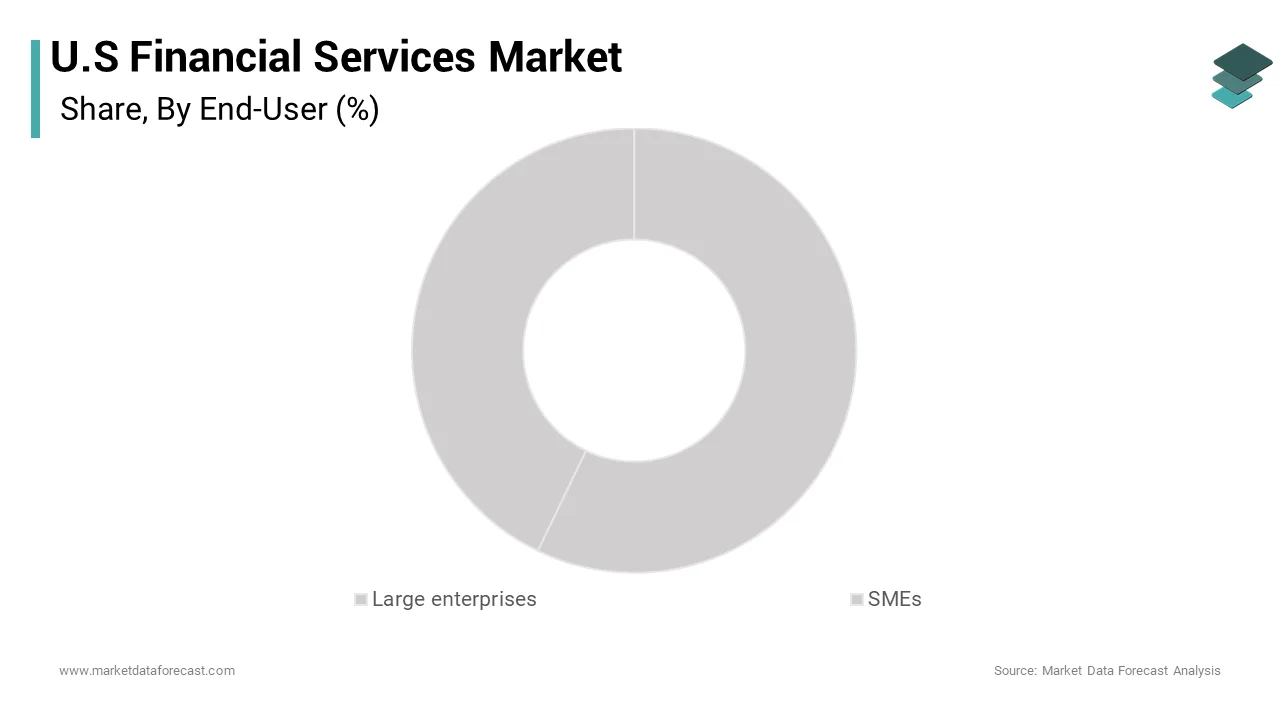
The small and medium enterprises represent the fastest growing segment in the United States financial services market driven by the rapid adoption of digital banking and fintech solutions that simplify financial management. Historically underserved by traditional banks SMEs now have access to affordable and efficient financial tools through online platforms and mobile applications. As per the Small Business Administration there are approximately 33.2 million small businesses in the United States many of which are increasingly digitizing their financial operations. Fintech companies offer streamlined lending processes automated accounting and seamless payment processing which reduce administrative burdens and improve cash flow visibility. The availability of real time data analytics enables SME owners to make informed financial decisions and forecast future needs accurately. Furthermore, the integration of banking services with e commerce platforms allows for automatic reconciliation and inventory management enhancing operational efficiency. The lower entry barriers and transparent pricing models of fintech providers attract SMEs seeking alternatives to traditional banking fees. Government initiatives promoting financial inclusion and access to capital for small businesses further accelerate this trend.
By Deployment Insights
The on-premises deployment segment was the largest by accounting for 47.3% of the United States financial services market share in 2025 due to heightened data security concerns and strict regulatory compliance requirements. Financial institutions handle sensitive customer information and transaction data, which makes them prime targets for cyberattacks prompting many to prefer local control over their IT infrastructure. The ability to physically secure servers and manage access protocols internally provides a layer of assurance that cloud providers may not fully match for some institutions. Legacy systems that are deeply integrated into core banking operations are also difficult and costly to migrate to the cloud, further sustaining on premises usage. Furthermore, certain regulatory frameworks mandate that specific types of financial data remain within physical boundaries or under direct institutional control. The perceived risk of third-party data breaches in cloud environments discourages full migration for critical applications. Institutions invest heavily in internal cybersecurity teams and hardware to protect these on premises assets.
The cloud based deployment segment is lucratively growing at an anticipated CAGR of 6.4% during the forecast period with the need for scalability and cost efficiency in an evolving digital landscape. Financial institutions are increasingly adopting cloud solutions to handle fluctuating workloads and reduce the capital expenditure associated with maintaining physical data centers. As per International Data Corporation, spending on cloud services in the financial sector is expected to grow at a compound annual growth rate of 22% through 2026. Cloud platforms allow banks and insurance companies to scale resources up or down instantly based on demand optimizing operational costs. The subscription-based model of cloud services converts fixed costs into variable expenses providing greater financial flexibility. Furthermore, cloud providers offer advanced tools for data analytics artificial intelligence and machine learning which enhance service offerings without requiring significant internal development. The ability to deploy new applications and features rapidly enables institutions to respond quickly to customer needs and competitive pressures. These economic and operational benefits make cloud based deployment an attractive option for financial services firms seeking modernization and efficiency.
By Application Insights
The banking segment was accounted in holding a prominent share of the United States financial services market in 2025 due to its fundamental role in financial intermediation and credit provision for individuals and businesses. Banks serve as the primary channel for deposits loans and payment processing forming the backbone of the economy. The demand for mortgages auto loans and personal credit remains robust driven by consumer spending and housing market activity. Furthermore, banks facilitate everyday transactions through checking and savings accounts which are essential for household financial management. The widespread branch network and digital banking platforms ensure broad accessibility for customers across the country. Banks also play a critical role in facilitating business operations through commercial lending and treasury services. The trust and stability associated with established banking institutions encourage customers to maintain long term relationships.
The payment gateways segment is expected to grow at an anticipated CAGR of 12.2% during the forecast period with the explosive growth of e-commerce and the shift toward digital transactions. Consumers increasingly prefer online shopping and contactless payments, which require secure and efficient payment processing infrastructure. The e-commerce sales reached 1.1 trillion dollars in 2023, representing a significant portion of total retail sales. This surge in online activity necessitates robust payment gateway solutions to handle high volumes of transactions securely. Data from Statista indicates that the number of digital payment users in the United States is projected to reach 250 million by 2025. Payment gateways facilitate seamless checkout experiences reducing cart abandonment and improving conversion rates for merchants. The integration of mobile wallets and buy now pay later options further expands the functionality of payment platforms. Furthermore, the rise of subscription based services and recurring billing models increases the demand for reliable payment processing. These trends ensure that payment gateways experience rapid growth as they become essential components of the digital economy.
COMPETITIVE LANDSCAPE
The competition in the United States financial services market is intense and characterized by rivalry among traditional banks credit unions insurance companies and emerging fintech startups. Established institutions leverage their scale brand recognition and extensive branch networks to retain customers while fintech firms disrupt the landscape with innovative digital solutions and lower fees. Price competition is fierce in areas such as mortgages personal loans and deposit accounts forcing providers to optimize costs and improve service quality. Differentiation often comes from superior technology integration personalized customer experiences and specialized industry expertise. Regulatory compliance creates barriers to entry but also levels the playing field by enforcing strict standards on all participants. Mergers and acquisitions are common strategies used to expand capabilities and reach new customer segments. Customer loyalty is increasingly fragile as digital tools make switching providers easier. Consequently, firms must continuously innovate and invest in technology to maintain relevance. The rise of open banking and embedded finance further blurs industry boundaries creating new competitive dynamics.
KEY MARKET PLAYERS
A few of the market players that are dominating the U.S financial services market are
- Accenture PLC
- Alkami Technology Inc.
- Bank of America Corporation
- JPMorgan Chase and Co
- Avaloq Group AG
- Wells Fargo and Company
- Fidelity National Information Services Inc.
- Finastra
- Fiserv Inc.
- Infosys Ltd.
- International Business Machines Corp.
- Mambu BV
- Microsoft Corp.
- NCR Voyix Corp.
- Oracle Corp.
- Perfect Ltd.
- Salesforce Inc.
- SAP SE
- SBS
- ServiceNow Inc.
- SS and C Technologies Holdings Inc.
- Tata Consultancy Services Ltd.
- Temenos AG
Top Players in the Market
- JPMorgan Chase and Co serves as a cornerstone of the United States financial services sector by providing comprehensive banking investment and asset management solutions. The company leverages its extensive branch network and robust digital platforms to serve millions of consumers and businesses nationwide. Recent actions include significant investments in artificial intelligence and machine learning to enhance fraud detection and personalize customer experiences. The firm has also expanded its wealth management capabilities through strategic hires and technology upgrades to capture high net worth clients. Its commitment to innovation ensures that it remains competitive in a rapidly evolving digital landscape while delivering consistent value to shareholders and customers alike.
- Bank of America Corporation plays a pivotal role in the US financial services market by offering diverse consumer commercial and investment banking services. The company prioritizes digital transformation to improve accessibility and convenience for its vast customer base. Recent initiatives involve enhancing its mobile banking application with advanced features such as personalized financial insights and seamless payment options. Bank of America has also strengthened its position by expanding its sustainable finance offerings to support environmental social and governance goals. The institution focuses on building long term relationships through tailored advisory services and competitive lending products. These efforts reinforce its reputation as a leading provider of integrated financial solutions that meet the dynamic needs of modern clients.
- Wells Fargo and Company contributes significantly to the United States financial services market through its widespread retail banking and mortgage lending operations. The company has undertaken extensive restructuring efforts to improve compliance and restore customer trust following past regulatory challenges. Recent actions include investing heavily in cybersecurity and data privacy measures to protect client information. Wells Fargo has also streamlined its product offerings to enhance user experience and reduce complexity for consumers. The bank focuses on supporting small businesses and community development through targeted lending programs. These strategic moves help the company regain momentum and strengthen its competitive position in the domestic financial landscape.
Top Strategies Used By Key Market Participants
Key players in the United States financial services market primarily focus on digital transformation to enhance customer experience and operational efficiency. Companies are increasingly adopting artificial intelligence and machine learning to automate processes and provide personalized financial advice. Strategic partnerships with fintech firms enable traditional institutions to innovate rapidly and offer new services such as real time payments. Investment in cybersecurity is paramount to protect sensitive data and maintain consumer trust amidst rising cyber threats. Institutions are also expanding their wealth management and advisory services to capture higher margins and deepen client relationships. Sustainability initiatives including green bonds and ESG focused investments are becoming central to corporate strategies. These approaches allow firms to differentiate themselves and adapt to changing regulatory and consumer demands effectively.
MARKET SEGMENTATION
This research report on the U.S financial sevices market is segmented and sub-segmented into the following categories.
By End-user
- Large enterprises
- SMEs
By Deployment
- On-premises
- Cloud-based
By Application
- Banking
- Payment gateways
- Insurance
- Wealth management
- Others
By Country
- California
- Washington
- Oregon
- New York
- Rest of the United States