U.S. Freight Brokerage Market Size, Share, Trends & Growth Forecast Report By Mode (Full Truckload (FTL) and Less Than Truckload (LTL)), By Trailer Type (Dry Van Trailers and Refrigerated Trailers), By Service Type (Traditional Brokerage and Digital Freight Matching Platforms), and By Country (California, Texas, Florida & Rest of the United States) – Industry Analysis and Forecast, 2026 to 2034
U.S. Freight Brokerage Market Summary
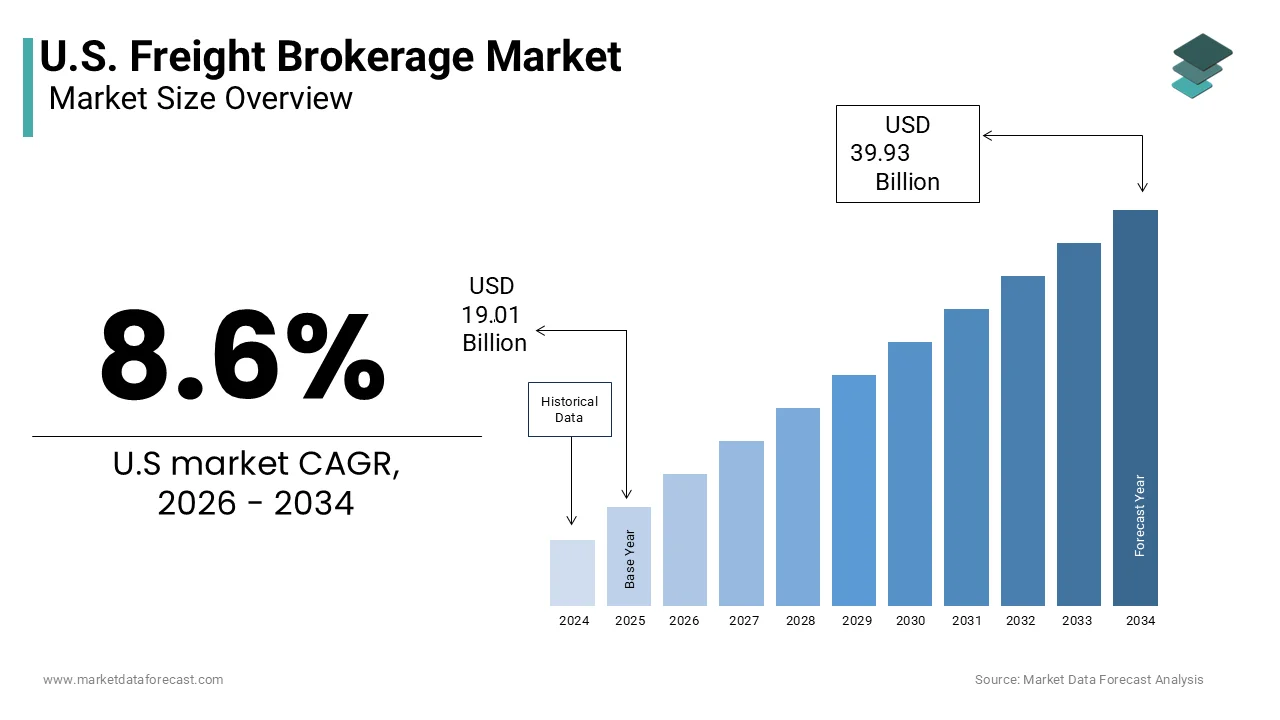
The U.S. freight brokerage market was valued at USD 19.01 billion in 2025 and is projected to reach USD 39.93 billion by 2034, growing at a CAGR of 8.6% from 2026 to 2034, driven by digital freight matching, carrier fragmentation, and managed transportation adoption.
Market Snapshot
- 2025 Market Size: USD 19.01 billion
- 2026 Estimate: USD 20.64 billion
- 2034 Forecast: USD 39.93 billion
- CAGR (2026–2034): 8.6%
- Base Year: 2025
- Forecast Period: 2026–2034
The U.S. freight brokerage market functions as the capacity-balancing layer of the national logistics ecosystem, connecting fragmented carrier supply with concentrated shipper demand across truckload, LTL, and intermodal freight. Asset-light by design, brokers derive value from technology-enabled matching, pricing intelligence, compliance management, and financial intermediation, making them indispensable in an increasingly volatile freight environment.
Quick Growth Drivers
- Structural imbalance between fragmented carrier capacity and enterprise shipper demand
- Rapid adoption of digital freight matching platforms
- Algorithmic rate discovery and real-time pricing transparency
- Shipper preference for asset-light, flexible transportation sourcing
- Growth of e-commerce, regional DC networks, and omnichannel fulfillment
Principal Restraints
- Persistent trust deficit between small carriers and large institutional shippers
- Rising regulatory, insurance, and legal compliance costs
- Escalation in cargo claim litigation and broker liability exposure
- Margin pressure from price-first digital freight marketplaces
High-Value Opportunities
- Integration of carbon accounting and green freight scoring
- Expansion into managed transportation services (MTS)
- Development of end-to-end control tower and visibility platforms
- Monetization of emissions reporting and ESG-aligned procurement
Key Market Challenges
- Shortage of skilled logistics talent in carrier management and exception handling
- Algorithm-driven rate volatility compressing brokerage margins
- Declining carrier loyalty in digital-only freight ecosystems
- Balancing automation efficiency with relationship-based service value
Fastest-Growing Segments
- Digital Freight Matching Platforms: CAGR 22.6%
- Less-Than-Truckload (LTL) Brokerage: CAGR 14.3%
- Refrigerated Freight Brokerage: CAGR 18.2%
- Managed Transportation & Control Towers
Regional Leadership & Dynamics
- California: E-commerce, port-driven freight flows
- Texas: Central capacity aggregation and energy-linked freight
- Florida: Retail, food, and temperature-sensitive freight
- Rest of U.S.: Regional manufacturing and distribution hubs
What Wins Commercially
- Hybrid brokerage models combining human expertise + algorithms
- Deep, compliant carrier networks with fast payment cycles
- Advanced pricing intelligence and lane forecasting
- ESG-ready freight reporting and carbon transparency
- Scalable digital portals with exception-driven human escalation
Top Strategic Ask for Executives
Build defensible brokerage platforms that go beyond rate competition by integrating managed transportation, carbon intelligence, and carrier trust mechanisms while preserving margin discipline in algorithm-driven markets.
Leading Players
Some of the companies that are playing a dominating role in the U.S. freight brokerage market include
C.H. Robinson Worldwide, Total Quality Logistics, XPO Logistics, Echo Global Logistics, Coyote Logistics, J.B. Hunt Integrated Capacity Solutions, Mode Transportation, Landstar System, Uber Freight, Schneider National, ArcBest Corporation, Hub Group, GlobalTranz Enterprises, Worldwide Express, and Allen Lund Company.
U.S. Freight Brokerage Market Size
The U.S. freight brokerage market was valued at USD 19.01 billion in 2025 and is estimated to reach USD 20.64 billion in 2026, and is projected to reach USD 39.93 billion by 2034, growing at a CAGR of 8.6% from 2026 to 2034.
The freight brokerage is the intermediary layer within the logistics ecosystem, connecting shippers requiring transportation services with carriers possessing available capacity. The complexity of supply chain networks necessitates specialized expertise in rate negotiation compliance and route optimization, which brokers provide. According to the American Trucking Associations, there are over 900000 for-hire motor carriers in the country, the vast majority of which are small fleets or owner operators relying on brokers to secure consistent loads. The digital transformation of this sector is accelerating with technology platforms enabling real-time visibility and automated matching. Regulatory frameworks governed by the Federal Motor Carrier Safety Administration ensure that safety and financial responsibility standards are met.
MARKET DRIVERS
Expansion of E-Commerce and Omnichannel Retail Logistics
Expansion of e-commerce and omnichannel retail logistics by increasing the volume and complexity of shipments is boosting the growth of the United States freight brokerage market. Consumers increasingly expect rapid delivery times and flexible shipping options, forcing retailers to adopt sophisticated distribution strategies. This surge in online shopping generates a high frequency of less-than-truckload shipments that require coordinated logistics solutions. Brokers play a vital role in managing these fragmented shipments by consolidating loads and optimizing routes for efficiency. As per the National Retail Federation, over 80% of retailers now offer same-day or next-day delivery options, necessitating agile transportation networks. The need for last-mile connectivity and reverse logistics further amplifies the demand for brokerage services. Traditional asset-based carriers often lack the flexibility to handle such volatile demand patterns, making brokers essential partners. The integration of online and offline sales channels requires seamless inventory movement between warehouses, stores, and customers. Brokers leverage their extensive carrier networks to ensure timely deliveries during peak seasons such as holidays. This operational agility supports the growth of direct-to-consumer business models.
Growth of Just-in-Time Manufacturing and Supply Chain Optimization
The growth of just-in-time manufacturing and supply chain optimization is greatly influencing the growth of the United States freight brokerage market. Manufacturers aim to minimize inventory holding costs by receiving raw materials and components exactly when needed for production. This approach requires precise and reliable transportation schedules, which brokers facilitate through their access to diverse carrier capacities. The manufacturing output remains a key component of the US economy, driving consistent demand for logistical support. Brokers provide the flexibility to adjust shipping volumes in response to fluctuating production rates and market demands. The ability to source capacity quickly prevents production delays and ensures continuity in operations. Complex supply chains involving multiple tiers of suppliers benefit from the coordination expertise of brokers. They manage the intricacies of cross-border shipments regulatory compliance, and documentationn, reducing administrative burdens for manufacturers. The trend towards nearshoring and reshoring also increases the need for domestic freight coordination. Brokers help companies navigate the transition by identifying reliable domestic carriers.
MARKET RESTRAINTS
Volatility in Fuel Prices and Operational Costs
The volatility in fuel prices and operational costs is one of the major factors hindering the growth of the United States freight brokerage market. Fuel constitutes a major portion of transportation expenses and fluctuations, directly impacting carrier rates and broker margins. The diesel prices have experienced substantial variability in recent years, driven by geopolitical tensions and supply chain disruptions. These unpredictable cost increases force carriers to raise rates, which brokers must pass on to shippers,s potentially reducing demand. The fuel surcharges are a component of pricing, but frequent changes create uncertainty for both shippers and carriers. Brokers operate on thin margins, and sudden spikes in fuel costs can erode profitability if contracts are not adjusted promptly. The inability to accurately forecast fuel expenses complicates long-term planning and budgeting for logistics projects. Small and medium-sized brokers are particularly vulnerable to these fluctuations as they lack the financial reserves to absorb cost shocks. Shippers may seek to bypass brokers to negotiate directly with carriers in an effort to control costs. This pressure intensifies competition and compresses margins further. The volatility also affects carrier availability as some operators may reduce capacity during periods of low profitability.
Regulatory Compliance and Administrative Burdens
The regulatory compliance and administrative burdens on operational efficiency are also impeding the growth of the United States freight brokerage market. Brokers must adhere to strict federal and state regulations governing transportation safety insurance and financial responsibility. This requirement creates a barrier to entry and increases operational costs for new and existing firms. As per the Department of Transportation, ongoing changes in hours of service rules, es electronic logging device mandates, and emissions standards add layers of complexity to compliance. Brokers must verify that carriers meet these standards to avoid liability and penalties. The administrative workload associated with monitoring carrier credentials, insurance coverage,e and safety ratings is substantial. Non-compliance can result in hefty fines, legal issues,s and reputational damage. The need for dedicated compliance staff and software systems increases overhead expenses. Small brokers may struggle to keep pace with evolving regulatory requirements,s limiting their scalability. Additionally, varying state-level regulations regarding taxes and permits create a fragmented compliance landscape. This regulatory environment demands constant vigilance and adaptation from market participants.
MARKET OPPORTUNITIES
Integration of Artificial Intelligence and Digital Platforms
The integration of artificial intelligence and digital platforms by enhancing efficiency and transparency is expected to bolster the growth of the United States freight brokerage market in the coming years. Advanced algorithms can analyze vast amounts of data to predict demand, optimize routes, and match shipments with carriers in real time. AI-driven logistics solutions can reduce transportation costs by up to 15% through improved asset utilization. Digital freight platforms enable automated booking, tracking, and payment processes, ng reducing manual errors and administrative delays. The adoption of digital tools is accelerating as shippers seek greater visibility and control over their supply chains. Brokers who invest in technology can offer superior service levels, including real-time status updates and predictive analytics. This technological edge differentiates them from traditional competitors and attracts tech-savvy customers. The use of machine learning helps in forecasting capacity shortages and price fluctuations, allowing for proactive decision-making. Automation of routine tasks frees up human resources to focus on complex problem-solving and customer relationships. The integration of blockchain technology can further enhance security and trust in transactions. These innovations enable brokers to scale operations efficiently without proportional increases in headcount.
Expansion into Specialized and Temperature-Controlled Logistics
The expansion into specialized and temperature-controlled logistics is expected to promote new opportunities for the growth of the United States freight brokerage market. The demand for transporting perishable goods, pharmaceuticals, and high-value items requires precise handling and monitoring. The grocery industry relies heavily on cold chain logistics to ensure product freshness and safety. Brokers specializing in refrigerated transport can command higher margins due to the complexity and regulatory requirements involved. As per the Pharmaceutical Research and Manufacturers of America, the biopharma sector requires strict temperature controls during transit to maintain drug efficacy. This niche market demands specialized equipment and certified carriers,s which brokers can source through their networks. Brokers who develop expertise in this segment can build strong relationships with high-value clients. The ability to provide end-to-end visibility and compliance documentation adds value for shippers. Investing in IoT sensors and monitoring technologies enhances service quality and reliability.
MARKET CHALLENGES
Carrier Capacity Constraints and Driver Shortages
The carrier capacity constraints and driver shortages, by limiting availability and increasing cost, are one of the major challenges for the growth of the United States freight brokerage market. The trucking industry faces a persistent shortage of qualified drivers, which restricts the number of available trucks. Brokers struggle to secure reliable carriers for their clients,s resulting in delayed shipments and dissatisfied customers. The imbalance between supply and demand drives up ffreight ratess squeezing broker margins. Shippers may experience service failures if brokers cannot find adequate capacity. The shortage also affects the quality of service as carriers may prioritize higher-paying direct contracts over brokered loads. Brokers must invest more time and resources in carrier relationship management to secure capacity. The unpredictability of availability complicates the planning and execution of logistics operations. This structural issue requires long-term solutions, such as improved working conditions and training programs.
Cybersecurity Threats and Data Privacy Risks
The cybersecurity threats and data privacy risks, as digitalization increases, are also inhibiting the growth of the United States freight brokerage market. Brokers handle sensitive information, including shipment details, customer data,a and financial transactions,by making them attractive targets for cyberattacks. The ransomware attacks on the transportation sector have increased significantly in recent years, disrupting operations and causing financial losses. The smalland medium-sizedd brokers often lack robust security infrastructure, making them vulnerable to breaches. A successful attack can lead to data theft,t serviceinterruptionso, ns and reputational damage. The cost of recovering from a cyberincidentd, ent including ransoms and systemrepairsp, airs can be prohibitive. Clients are increasingly demanding assurances regarding data protection and compliance with privacy regulations. Brokers must invest in advanced cybersecurity measures such asencryptiony, multi-factor authentication, and employee training. The complexity of securing digital platforms and third-party integrations adds to the technical burden. Regulatory requirements for data privacy are becoming stricter,r requiring continuous adaptation. Failure to protect data can result in legal liabilities and loss of customer trust. The evolving nature of cyber threats requires constant vigilance and updates to security protocols.
REPORT COVERAGE
| REPORT METRIC | DETAILS |
| Market Size Available | 2025 to 2034 |
| Base Year | 2025 |
| Forecast Period | 2026 to 2034 |
| Segments Covered | By Mode, Trailer Type, Service Type, and Region. |
| Various Analyses Covered | Global, Regional, and Country-Level Analysis, Segment-Level Analysis, Drivers, Restraints, Opportunities, Challenges; PESTLE Analysis; Porter’s Five Forces Analysis, Competitive Landscape, Analyst Overview of Investment Opportunities |
| Countries Covered | New York, Massachusetts, Pennsylvania, Illinois, Ohio, Michigan, Texas, Florida, Georgia, California, Washington, Colorado. |
| Market Leaders Profiled | C.H. Robinson Worldwide, Total Quality Logistics (TQL), XPO Logistics, Echo Global Logistics, Coyote Logistics (UPS), J.B. Hunt Integrated Capacity Solutions, Mode Transportation, Landstar System, Uber Freight, Schneider National, ArcBest Corporation, Hub Group, GlobalTranz Enterprises, Worldwide Express, Allen Lund Company |
SEGMENTAL ANALYSIS
By Service Insights
The full truckload services segment accounted in holding 32.1% of the United States freight brokerage market share in 2025, with the transportation of goods that occupy the entire capacity of atrailere,r making it the most efficient mode for large volume shipments. Efficiencin long-haulul transportation and cost per mile drives the domination of Full Truckload services. FTL shipments eliminate the need for multiple stops and handling associated with less than truckload logistics, resulting in faster transit times and reduced risk of damage. The full truckload movements account for the majority of tonnage moved across interstate highways due to their direct point-to-point nature. Shippers prefer FTL for consistent high-volume lanes because it provides predictable pricing and scheduling. Brokers facilitate these movements by matching large shippers with carriers capable of dedicated runs. The simplicity of FTL transactions reduces administrative overhead and complexity for both parties. The reliability of FTL services is critical for just-in-time manufacturing processes that require the timely delivery of raw materials. The economies of scale achieved in FTL transport lower the cost per unit for shippers moving substantial quantities.
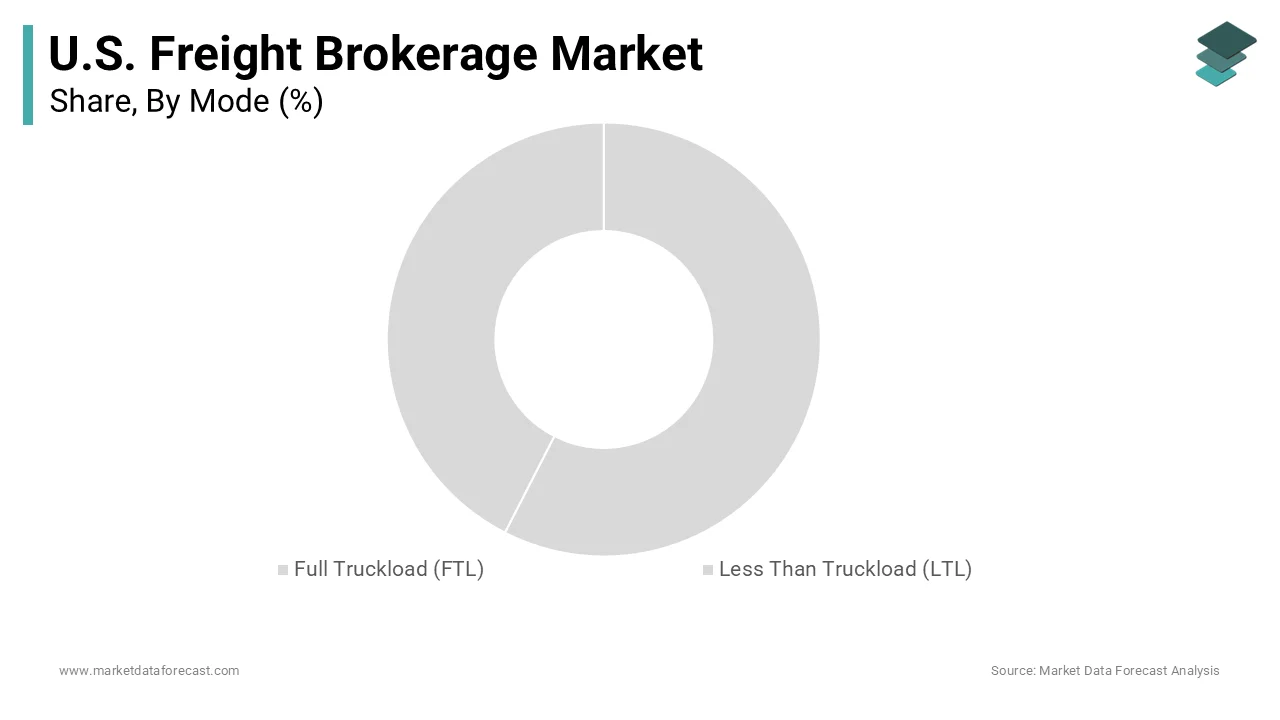
The less-than-truckload segment is expected to grow at a faster CAGR of 8.5% from 2026 to 2034.The rise inf e-commerce and small batch shipments is majorly bolstering the growth of the segment. Online retailers and small businesses often ship smaller quantities that do not justify the cost of a full truck. The e-commerce sales continue to grow, increasing the volume of smaller parcels and pallets entering the freight network. The small enterprises rely on LTL to manage inventory and fulfill orders cost-effectively. LTL allows these shippers to pay only for the space they use, making it an economical choice ffor low-volumemovements. Brokers aggregate these smaller shipments to optimize trailer utilization and reduce costs for individual clients. The flexibility of LTL services supports the dynamic nature of online retail, where order sizes vary frequently. The ability to ship frequently in smaller batches helps businesses maintain lean inventory levels. Digital platforms have made booking LTL shipments easier and more transparent,t attracting new users.
By Equipment Type Insights
The dry van equipment segment was the largest by holding 50.4% of the United States freight brokerage market share in 2025. Versatility in transporting general freight and consumer goods drives the domination of Dry Van equipment in the United States freight brokerage market. Dry vans can accommodate a wide variety of products, includingelectronics clothing furniturernit,ure and packfoodsged f,oods making them the most commonly used trailer type. The sheer volume of consumer goods produced and consumed in the US necessitates a large fleet of versatile trailers. The standardized design of dry vans allows for easy loading and unloading at most facilities, ensuring compatibility with existing infrastructure. Brokers find it easier to source dry van capacity due to the large number of carriers operating this equipment. The flexibility to handle both palletized aand floor-loadedcargo adds to their appeal. Shippers prefer dry vans for their security and protection against weather elements.
The refrigerated equipment segment is likely to register the fastest CAGR of 7.2% from 2026 to 2034. Increasing demand for perishable goods and fresh food is amplifying the growth of the United States freight brokerage market. Consumers are increasingly prioritizing fresh and healthy diets, leading to higher consumption of fruit, vegetables ,es and dairy products. The sales of fresh produce and perishable items have growsteadilyad,,ily requiring reliable cold chain logistics. The production and distribution of perishable agricultural products rely heavily on refrigerated transport to maintain quality and safety. Shippers require reefer trailers to ensure that goods remain within specific temperature ranges during transit. Brokers specialize in sourcing certified carriers with proper equipment to meet these stringent requirements. The expansion of online grocery shopping further boosts demand for refrigerated delivery services. The ability to transport perishables over long distances without spoilage expands market reach for producers.
By End-User Industry Insights
The manufacturing and automotive industry segment was the largest by capturing 35.4% of the United States freight brokerage market share in 2025. Manufacturers rely on precise delivery schedules to minimize inventory costs and maintain production efficiency. Manufacturing firms prioritize lean inventory strategies that depend on reliable transportation. Brokers facilitate the coordination of multiple suppliers and assembly plants,, ensuringg timely delivery of parts. The automotive industry in particular relies on intricate networks of tiered suppliers moving components across state lines. Brokers provide the flexibility to adjust capacity in response to production fluctuations. The ability to manage cross-border shipments with Mexico and Canada adds complexity that brokers handle effectively. The specialization of automotive logistics requires expertise in handling heavy and oversized loads. This dependency on precise logistics sustains the high demand for brokerage services.
The retail and e-commerce industry segment is expected to witness the fastest CAGR of 9.5% from 2026 to 2034. Expansion of online shopping and direct-to-consumer models is gearing up the growth of the segment. Consumers increasingly prefer the convenience of home delivery, leading to a surge in parcel and LTL shipments. The retailers are investing heavily in logistics infrastructure to support omnichannel strategies. Brokers facilitate the movement of goods from distribution centers to last-mile carriers. The need for fast and reliable delivery forces retailers to partner with flexible logistics providers. The fragmentation of shipments into smaller units increases the complexity of transportation. Brokers aggregate these shipments to optimize efficiency and reduce costs. The growth of subscription services and meal kits further boosts demand for specialized delivery. The ability to handle returns and reverse logistics adds value to brokerage services. The dynamic nature of retail demand requires agile transportation solutions.
COMPETITIVE LANDSCAPE
The competition in the United States freight brokerage market is characterized by intense rivalry among large third-party logistics providers and thousands of smaller independent brokers. Major players compete based on technology capabilities, carrier network size,e and customer service quality. The market features a fragmented landscape where digital freight forwarders are disrupting traditional models with automated platforms. Companies differentiate themselves by offering specialized services, such as temperature-controlled transport or expedited shipping. Strategic partnerships with technology firms enhance operational efficiency and data analytics capabilities. Price competitiveness remains a key factor, particularly in spot market transactions where margins are thin. Large brokers leverage economies of scale to offer lower rates and broader coverage. Smaller firms focus on niche markets and personalized service to retain clients.
KEY MARKET PLAYERS
Some of the companies that are playing a dominating role in the U.S. freight brokerage market include
- C.H. Robinson Worldwide
- Total Quality Logistics (TQL)
- XPO Logistics
- Echo Global Logistics
- Coyote Logistics (UPS)
- J.B. Hunt Integrated Capacity Solutions
- Mode Transportation
- Landstar System
- Uber Freight
- Schneider National
- ArcBest Corporation
- Hub Group
- GlobalTranz Enterprises
- Worldwide Express
- Allen Lund Company
TOP LEADING PLAYERS IN THE MARKET
- C.H. Robinson Worldwide Inc stands as a dominant force in the United States freight brokerage market by leveraging its vast global network and advanced technology platform. The company connects shippers with carriers to facilitate the efficient movement of goods across various modes of transportation. Recent actions include significant investments in artificial intelligence and machine learning to enhance predictive analytics and optimize load matching. C.H. Robinson has expanded its managed services offerings to provide end-to-end supply chain solutions for large enterprise clients. The firm actively collaborates with technology partners to integrate real-time visibility tools into its proprietary Navisphere platform. These initiatives strengthen its position as a leader in logistics innovation. The company continues to diversify its service portfolio to address evolving market needs.
- TQL Total Quality Logistics contributes significantly to the market through its robust carrier network and dedicated account management model. The company specializes in providing reliable transportation solutions for a wide range of industries, including retail, manufacturing,g and automotive. Recent developments involve the expansion of its technology infrastructure to support faster transaction processing and improved communication. TQL has invested heavily in training programs to develop skilled logistics professionals who build strong relationships with clients and carriers. The firm emphasizes transparency andresponsivenesse, ss which enhances customer satisfaction and retention. TQL actively participates in community initiatives and sustainability efforts to bolster its corporate reputation.
- XPO Inc plays a crucial role in the United States freight brokerage market by offeringcomprehensive truckloadd and truck brokerage services. The company utilizes its extensive asset-based network to provide flexible and scalable logistics solutions. Recent actions include the spin-off of its employee-owned less-than-truckload business to focus on higher growth opportunities. XPO has integrated advanced digital tools to streamline booking and tracking processes for brokerage customers. The firm prioritizes sustainability by optimizing routes and reducing carbon emissions through efficient load planning. XPO collaborates with key industry stakeholders to develop innovative supply chain strategies. The company invests in workforce development to ensure high standards of service delivery.
TOP STRATEGIES USED BY KEY MARKET PARTICIPANTS
Key players in the United States freight brokerage market primarily employ strategies focused on digital transformation and network expansion to maintain a competitive advantage. Companies invest heavily in technology platforms that utilize artificial intelligence for automated load matching and predictive analytics. Strategic acquisitions are common tactics used to broaden service offerings and enter new geographic markets. Firms prioritize building strong relationships with carriers to ensure consistent capacity availability during peak seasons.Customer-centricc approaches, such as dedicated account management and transparent pricing,g enhance client retention. Providers also focus on sustainability initiatives by optimizing routes to reduce carbon footprints. Integrationof real-timee visibility tools allows shippers to track shipments accurately. Training and development programs for employees improve service quality and operational efficiency.
MARKET SEGMENTATION
This research report on the U.S. freight brokerage market has been segmented and sub-segmented into the following categories.
By Mode
- Full Truckload (FTL)
- Less Than Truckload (LTL)
By Trailer Type
- Dry Van Trailers
- Refrigerated Trailers
By Service Type
- Traditional Brokerage
- Digital Freight Matching Platforms
By Country
- California
- Texas
- Florida
- Rest of the United States
Frequently Asked Questions
1. What factors are driving the growth of the United States Freight Brokerage Market?
Key drivers include rapid e-commerce expansion, manufacturing sector recovery, and nearshoring trends that demand flexible, on-demand freight connections throughout the U.S. logistics network.
2. Which service segments dominate the United States Freight Brokerage Market?
The Full Truckload (FTL) and Less-than-Truckload (LTL) segments dominate, with FTL supporting large shipments and LTL catering to smaller, consolidated loads for cost efficiency.
3. How is digitalization impacting the United States Freight Brokerage Market?
Digital freight platforms are transforming operations by automating load matching, providing real-time visibility, optimizing pricing, and enhancing efficiency for brokers and shippers alike.
4. What industries rely most on the United States Freight Brokerage Market?
Industries such as retail, automotive, construction, and manufacturing heavily depend on freight brokers to maintain just-in-time deliveries and supply chain efficiency.
5. How is sustainability influencing the United States Freight Brokerage Market?
Freight brokers are adopting green logistics strategies—including reduced idle time, route optimization, and alternative-fuel fleets—to minimize environmental impact.
6. Who are the major players in the United States Freight Brokerage Market?
Top companies include C.H. Robinson, Echo Global Logistics, Convoy, Total Quality Logistics, and Uber Freight, which lead in technology and service innovation.
7. What challenges does the United States Freight Brokerage Market face?
Key challenges include market fragmentation, driver shortages, regulatory compliance costs, and rising operational competition from digital startups.
8. What role does technology play in the United States Freight Brokerage Market?
Technology drives predictive analytics, AI-based matchmaking, route efficiency, and blockchain-based transparency to streamline operations and reduce manual errors.
9. How do FTL and LTL segments differ in the United States Freight Brokerage Market?
FTL is used for full-load shipments requiring dedicated trucks, while LTL consolidates multiple small shipments, offering flexible and cost-effective transport options.
10. How does the e-commerce boom affect the United States Freight Brokerage Market?
E-commerce growth fuels market demand by requiring more frequent deliveries, smaller shipment sizes, and flexible brokerage networks able to handle surges in volume.
Related Reports
Access the study in MULTIPLE FORMATS
Purchase options starting from
$ 1200
Didn’t find what you’re looking for?
TALK TO OUR ANALYST TEAM
Need something within your budget?
NO WORRIES! WE GOT YOU COVERED!
Call us on: +1 888 702 9696 (U.S Toll Free)
Write to us: sales@marketdataforecast.com