- Product Description Description
- Table of Contents TOC
- List of Table & Figure LOT
- Get Free Sample PDF Sample PDF
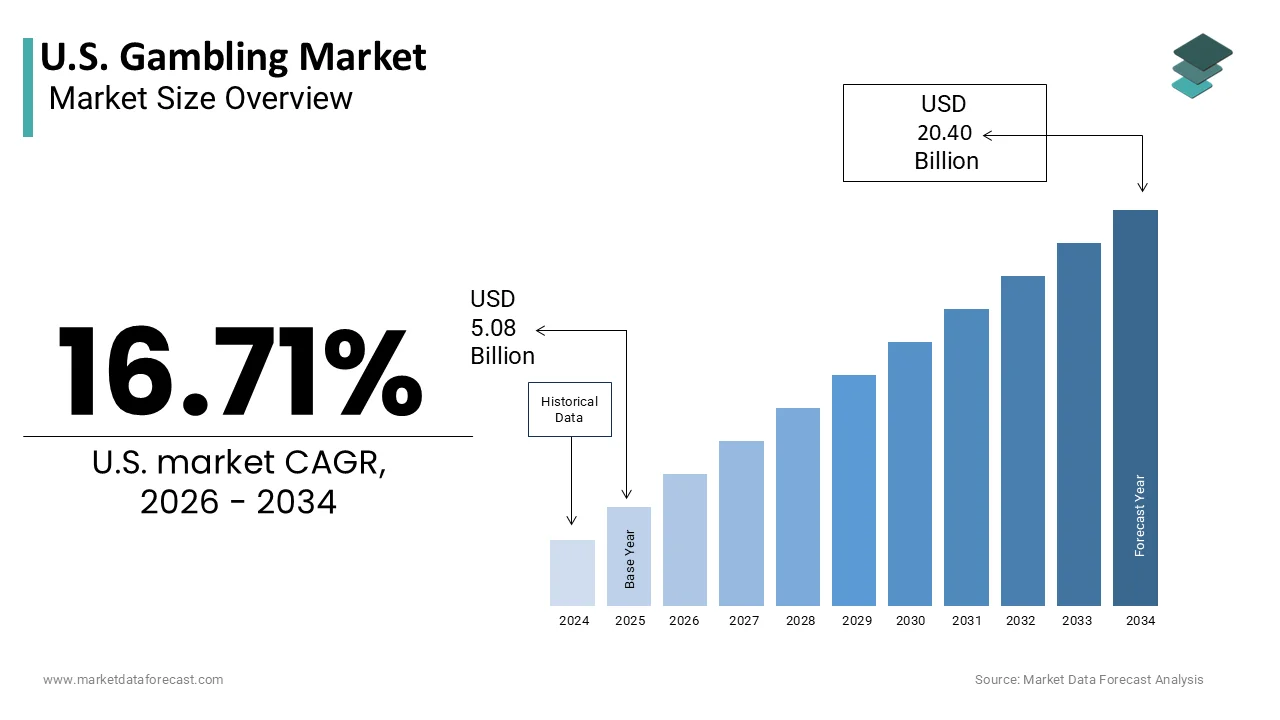
Market Size, 2025
$5.08 BnMarket Estimate, 2026
$5.93 BnMarket Forecast, 2034
$20.40 BnCAGR, 2026–2034
16.71%U.S. Gambling Market Size
The U.S. Gambling Market was valued at USD 5.08 billion in 2025, is estimated to reach USD 5.93 billion in 2026, and is projected to reach USD 20.40 billion by 2034, growing at a CAGR of 16.71% from 2026 to 2034.
Gambling is a wagering activity, including commercial casinos, tribal gaming, lotteries, sports betting, and online interactive gaming platforms. This sector has undergone a profound transformation following the 2018 Supreme Court decision that allowed individual states to legalize sports betting, thereby shifting the landscape from a largely prohibited environment to a regulated industry. The definition now extends beyond physical venues to include digital ecosystems where mobile applications facilitate real-time wagering on sporting events and casino-style games. As per the American Gaming Association, 38 states and the District of Columbia have legalized some form of sports betting or online gaming, which illustrates the rapid legislative adoption across the nation. The widespread availability of high-speed internet, which the Federal Communications Commission states is accessible to over 90% of the population, enables seamless access to online betting platforms. Consumer behavior has shifted toward digital engagement, with younger demographics preferring mobile interfaces over traditional brick-and-mortar establishments. The market operates under a complex regulatory framework where state laws dictate permissible activities, licensing requirements, and tax structures. This fragmented legal environment creates distinct regional markets while national operators strive for standardization.
MARKET DRIVERS
Legislative Liberalization and State-Level Legalization
The progressive liberalization of gambling laws at the state level serves to unlock new revenue streams and expand legal access to wagering, propelling the growth of the United States gambling market. Since the repeal of the Professional and Amateur Sports Protection Act, numerous states have enacted legislation to permit sports betting and online casino games by creating a favorable regulatory environment for operators. The legislative shift allows operators to enter previously restricted areas and offer compliant services to millions of potential customers. Data from the National Conference of State Legislatures shows that more than 30 states have introduced bills to expand gambling options, indicating continued momentum in policy reform. The ability of states to capture tax revenue from gambling activities provides a strong fiscal incentive for lawmakers to support legalization efforts. Furthermore, the establishment of clear regulatory frameworks reduces uncertainty for investors and encourages capital investment in infrastructure and technology. The normalization of gambling through legal channels also reduces stigma and increases consumer confidence in participating in regulated markets.
Technological Advancements and Mobile Accessibility
The rapid advancement of technology and the ubiquity of mobile devices, by enhancing convenience and user experience, is another factor boosting the growth of the United States gambling market. Mobile applications allow consumers to place bets instantly from anywhere using smartphones and tablets, which removes the geographical barriers associated with physical casinos. As per Statista, the number of smartphone users in the United States exceeded 300 million in 2023, providing a massive hardware base for mobile gambling platforms. The integration of secure payment gateway,s biometric authenticati, on and real-time data analytics enables seamless and safe transactions which are critical for user trust. Live streaming technologies allow users to watch events and bet simultaneously, which increases engagement and time spent on platforms. Furthermore, the use of artificial intelligence helps operators personalize offers and detect problematic gambling behavior, which improves customer retention and responsible gaming standards. The development of intuitive user interfaces and gamification elements makes online gambling more appealing to younger demographics who are accustomed to digital interactions. These technological innovations lower the barrier to entry and create a sticky ecosystem for users.
MARKET RESTRAINTS
Regulatory Fragmentation and Compliance Complexity
The fragmented regulatory landscape across different states, by creating complex compliance burdens for operators,s is restricting the growth of the United States gambling market. Each state has its own unique set of laws regarding licensing,g taxation, permitted games, and advertising standards, which require operators to customize their strategies for each jurisdiction. This lack of uniformity prevents the creation of a seamless national system and forces companies to maintain separate compliance teams for each state. Furthermore, conflicting rules regarding interstate compacts and data sharing hinder the efficiency of operations and innovation. The uncertainty surrounding future legislative changes in pending states creates risk for long-term investment planning. Operators must constantly monitor regulatory updates and adjust their platforms to remain compliant, which diverts resources from product development and marketing. This regulatory friction slows down expansion and increases the cost of doing business.
Social Stigma and Responsible Gambling Concerns
The persistent social stigma and concerns regarding problem gambling, by influencing public opinion and regulatory scrutiare is also hampering the growth of the United States gambling market. Despite legalization, many communities view gambling as a moral hazard that can lead to addiction, financial ruin, and family breakdown. As per the National Council on Problem Gambling, approximately 2 million adults in the United States meet the criteria for severe gambling problems, with the societal impact of widespread access. This reality prompts advocacy groups and policymakers to demand stricter regulations such as deposit limits, mandatory self-exclusion programs, and advertising restrictions. Operators face pressure to implement robust responsible gaming tools,s which can increase operational costs and potentially reduce revenue from high-risk users. Negative media coverage of gambling-related harms can damage brand reputation and erode consumer trust. Furthermore, some states hesitate to expand gambling offerings due to fear of exacerbating social issues. The need to balance profit with social responsibility creates a delicate operational environment. Companies must invest heavily in education and support initiatives to mitigate these risks.
MARKET OPPORTUNITIES
Expansion of Online Casino and Interactive Gaming
The expansion of online casino and interactive gaming, as more states consider legalizing digital versions of table games and slots, is setting up new opportunities for the growth of the United States gambling market. While sports betting has gained widespread acceptance, online casino games generate significantly higher revenue per user due to their continuous nature and house edge. States like Pennsylvania and Michigan have already launched successful online casinos, providing a blueprint for others to follow. The high-margin profile of digital slots and live dealer games attracts operators seeking profitable growth beyond sports betting. Furthermore, the integration of social features and tournaments enhances user engagement and retention. As legislators observe the tax benefits generated by early adopters, the likelihood of broader legalization increases. Operators can leverage existing sports betting customer bases to cross-sell casino products, which lowers acquisition costs. The development of immersive technologies such as virtual reality also opens new avenues for interactive entertainment.
Integration of Esports and Novel Betting Markets
The integration of esports and novel betting to attract younger people and diversify revenue sources is also intended to enhance the growth of the United States gambling market. Esports has grown into a global phenomenon with millions of fans who are eager to engage with their favorite teams and players through wagering. The young and tech-savvy demographic is a valuable target audience for operators seeking to build long-term customer relationships. Operators can offer bets on match outcomes, player performance, a nd in-game events, which creates frequent betting opportunities. Furthermore, the expansion into non-sports events, such as political elections and entertainment awards, broadens the appeal of betting platforms. The use of micro betting allows users to wager on small discrete moments within a game, which increases engagement and volume. Partnerships with esports leagues and streaming platforms provide visibility and credibility for betting brands.
MARKET CHALLENGES
Customer Acquisition Costs and Market Saturation
The high customer acquisition costs and increasing saturation, as competition intensifies, which is to pose as a major challenge for the growth of the United States gambling market. The reliance on aggressive bonuses and free bets to attract new customers erodes margins and creates a cycle of promotional dependency. The saturation of advertising channels, including televisio,n rad,, io and digital platforms, leads to diminishing returns on marketing spend. Furthermore, the lack of differentiation among competing apps results in low brand loyalty as users switch platforms for better odds or promotions. Retaining customers becomes increasingly expensive as operators must continuously offer incentives to prevent churn. The pressure to deliver short-term growth often conflicts with long-term sustainability goals. Operators must find innovative ways to engage users without relying solely on costly acquisitions.
Cybersecurity Threats and Data Privacy Risks
The escalating threat of cybersecurity breaches and data privacy violations, by undermining user trust and exposing operators to liabili,, ty is additionaimpedingpede the growth of the United States gambling market. Online gambling platforms handle sensitive personal and financial information, making them attractive targets for cybercriminals seeking to steal data or disrupt services. A successful attack can result in significant financial losses, regulatory fines, and reputational damage that deter customers from using the platform. Compliance with strict data protection regulations, such as the California Consumer Privacy Act, requires a robust security infrastructure and ongoing monitoring. The complexity of integrating third-party vendors and payment processors expands the attack surface and increases risk exposure. Operators must invest heavily in encryption, multi-factor authentication, and incident response capabilities to protect user data. Furthermore, the rise of sophisticated phishing attacks and account takeover attempts requires constant vigilance and user education.
REPORT COVERAGE
| REPORT METRIC | DETAILS |
| Market Size Available | 2025 to 2034 |
| Base Year | 2025 |
| Forecast Period | 2026 to 2034 |
| Segments Covered | By Game Type, Gender, Age Group, and Region. |
| Various Analyses Covered | Global, Regional and Country-Level Analysis, Segment-Level Analysis, Drivers, Restraints, Opportunities, Challenges; PESTLE Analysis; Porter’s Five Forces Analysis, Competitive Landscape, Analyst Overview of Investment Opportunities |
| Countries Covered | California, Washington, Oregon, New York, United States |
| Market Leaders Profiled | Las Vegas Sands Corporation, MGM Resorts International, Caesars Entertainment, Inc., Wynn Resorts, Limited, Penn Entertainment, Inc., DraftKings Inc., Flutter Entertainment plc (), Bally’s Corporation, Boyd Gaming Corporation, Rush Street Interactive, Inc., Churchill Downs Incorporated, Golden Entertainment, Inc. |
SEGMENTAL ANALYSIS
By Game Type Insights
The Lottery segment was the largest by holding a significant share of the United States gambling market in 2025 due to its universal accessibility, widespread availabilit,y anstate-sanctioneded monopoly structure. Unlike casino gaming or sports betting, which are restricted to specific jurisdictions or age groups, lotteries are available in 45 states plus the District of Columbia and the US Virgin Islands,s making them the most geographically pervasive form of legal gambling. The low barrier to entry,y with ticket prices often starting at one or two dollars, allows individuals from all socioeconomic backgrounds to participate without significant financial risk. The proceeds from lottery sales are frequently earmarked for public benefits such as education infrastructure and senior services, which generate broad public support and political stability for the industry. Furthermore, the simplicity of lottery games requires no skill or strategic knowledge, making them appealing to casual participants, who may be intimidated by complex casino games or sports analytics.
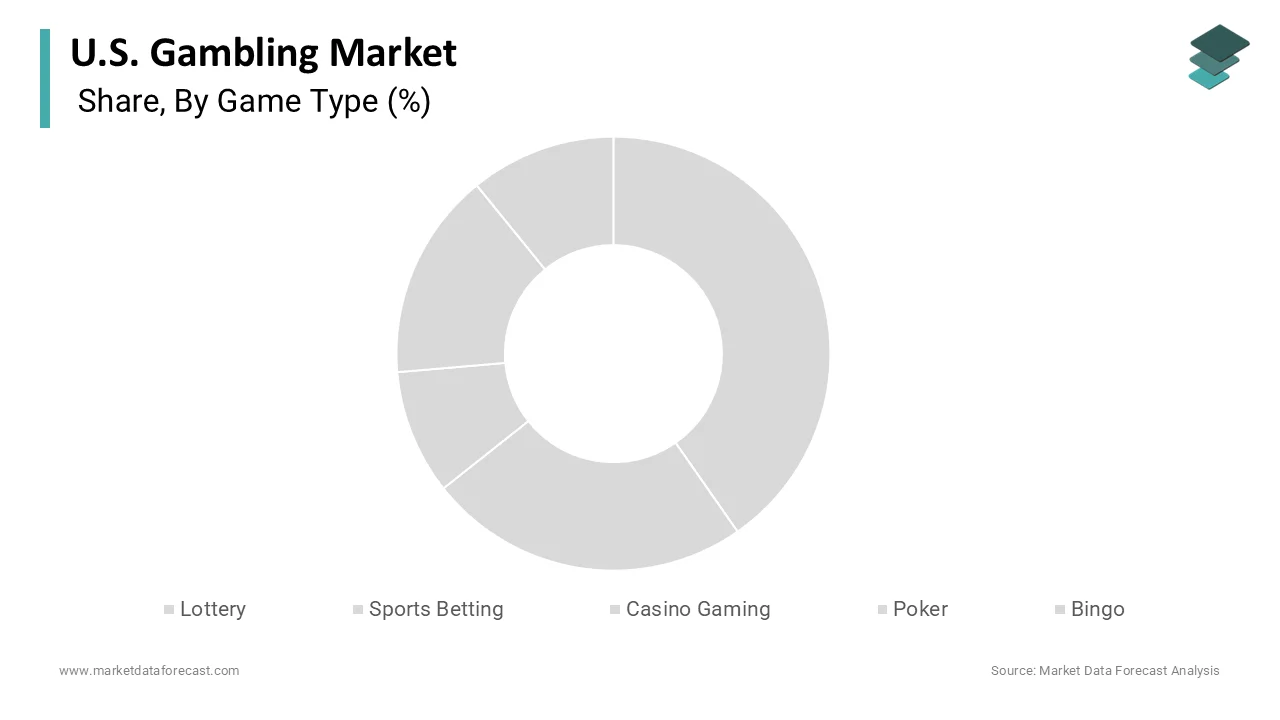
The sports betting segment is likely to witness the fastest CAGR of 7.3% from 2026 to 2034, with the rapid legislative expansion following the 2018 Supreme Court decision and the widespread adoption of mobile betting platforms. The convenience of placing bets from smartphones that allows users to engage with live events in real time, which increases the frequency and volume of wagers. The integration of live streaming and in-play betting features enhances the user experience and keeps customers engaged throughout the duration of games. Furthermore, the normalization of sports betting through partnerships with professional leagues and teams has reduced stigma and increased mainstream acceptance. The ability to offer personalized promotions and bonuses through mobile apps attracts new users and retains existing ones.
By Gender Insights
The male segment holds the leading position in the United States gambling market primarily due to higher participation rates in high-frequency and high-value gambling activities such as sports betting and poker. Men are statistically more likely to engage in skill-based or strategy-oriented gambling forms, which often involve larger wagers and longer session durations. As per the University of Nevada Las Vegas Center for Gaming Research, male respondents constitute approximately 60% of the sports betting population in regulated states,s reflecting a strong gender disparity in this rapidly growing segment. The cultural association between masculinity and sports fandom drives men to view betting as an extension of their interest in athletic competition. Data from the American Gaming Association shows that men are twice as likely as women to identify as sports bettors,s indicating a deeply ingrained behavioral pattern. The tendency for men to chase losses or high-variance outcomes also contributes to higher overall spend volumes. Marketing campaigns by operators often target male demographics through sports partnerships and celebrity endorsements, which reinforces this participation gap. The social aspect of betting pools and fantasy leagues further encourages male engagement through peer interaction and competition.
The female segment is expected to witness the fastest CAGR of 9.1% from 2026 to 2034, with increasing engagement in online casino games, bingo, and social gaming platforms. Women are increasingly drawn to these forms of gambling due to their accessibility, ease of play, and entertainment value, which align with preferred leisure activities. The convenience of playing from home allows women to integrate gambling into their daily routines without the need to travel to physical venues. Data from the UK Gambling Commission, which often serves as a leading indicator for US trends, shows that women account for a majority of players in online bingo and soft games, suggesting a similar trajectory. The social elements of online bingo and community features in casino apps foster a sense of connection and belonging, which appeals to female users. Operators are designing user interfaces and marketing campaigns that resonate with women by emphasizing fun, relaxation, and social interaction rather than just financial gain. The reduction of stigma associated with online gambling has also encouraged more women to participate openly.
By Age Group Insights
The25-to 40-year-olds age group segment was the largest by holding 34.4% of the United States gambling market share in 2025 due to their combination of high disposable income and digital nativity, which facilitates frequent and convenient participation. Individuals in this demographic are typically established in their careers and have the financial resources to engage in discretionary spending such as gambling. The median weekly earnings for workers in this age bracket are significantly higher than those of younger cohorts, enabling greater wagering capacity. Furthermore, this group grew up with the internet and mobile technology, making them comfortable with online betting platforms and digital transactions. Their familiarity with apps and digital wallets reduces friction in the deposit and withdrawal process, which encourages regular play. The highly responsive to digital marketing and promotional offers, which operators leverage to drive acquisition and retention. The social aspect of betting among peers in this age group further amplifies participation through shared experiences and competitions.
The below 25-year-old age group segment is likely to grow at the fastest CAGR of 7.3% during the forecast period, with the widespread adoption of esports and skill-based gaming formats that align with their digital interests. Younger consumers are less interested in traditional casino games and more attracted to competitive gaming and interactive betting experiences that reflect their hobbies. The gamification of betting through leaderboards, challenges, and social sharing appeals to the competitive nature of younger users. Furthermore, the emergence of skill-based slot machines and arcade-style gambling games provides a bridge between video gaming and traditional wagering. These formats require user input and strategy, which differentiates them from pure chance games and resonates with a generation raised on interactive media. The seamless integration of betting into gaming platforms and social apps reduces barriers to entry and encourages experimentation.
COMPETITIVE LANDSCAPE
The competition in the United States gambling market is intense and characterized by rapid expansion and high customer acquisition costs. Major operators compete fiercely for dominance in newly legalized states through aggressive marketing and promotional offers. Differentiation is often achieved through superior technology, user experience, and exclusive partnerships with sports leagues. The market features a mix of pure-play digital natives and established land-based casino operators transitioning to online platforms. Price competition is evident in the form of sign-up bonuses and odds enhancements, which impact profitability. Regulatory compliance varies by state, creating operational complexities for national brands. Customer loyalty remains low as users frequently switch platforms for better incentives. Innovation in live betting and interactive features drives engagement and retention.
KEY MARKET PLAYERS
Some of the companies that are playing a dominant role in the U.S. Gambling Market include
- Las Vegas Sands Corporation
- MGM Resorts International
- Caesars Entertainment, Inc.
- Wynn Resorts, Limited
- Penn Entertainment, Inc.
- DraftKings Inc.
- Flutter Entertainment plc (FanDuel)
- Bally’s Corporation
- Boyd Gaming Corporation
- Rush Street Interactive, Inc.
- Churchill Downs Incorporated
- Golden Entertainment, Inc.
TOP LEADING PLAYERS IN THE MARKET
- DraftKings Inc is a leading digital sports entertainment and gaming company that has established a strong presence in the United States gambling market. The company offers daily fantasy sports, sports betting, and online casino games through its user-friendly mobile application. Recent actions include expanding its retail footprint by partnering with major casino operators and launching proprietary kiosks in key states. DraftKings has also invested heavily in technology to enhance live betting capabilities and personalize user experiences. The company focuses on strategic marketing partnerships with professional sports leagues to increase brand visibility and customer acquisition. These initiatives strengthen its competitive position and allow it to capitalize on the growing demand for digital wagering services across multiple states.
- FanDuel Group operates as a dominant force in the United States gambling sector, providing comprehensive sports betting and online gaming solutions. Owned by Flutter Entertainment, the company leverages global expertise to optimize its domestic operations and expand market reach. Recent strategies involve enhancing its single wallet functionality, which allows seamless movement of funds between sportsbook and casino products. FanDuel has also prioritized responsible gaming tools to build trust and ensure regulatory compliance in new jurisdictions. The company continues to invest in original content and data analytics to improve odds accuracy and user engagement. These efforts help the company attract new users while solidifying loyalty among existing customers in an increasingly competitive landscape.
- MGM Resorts International is a prominent hospitality and entertainment company that has successfully integrated digital gambling into its traditional casino business model. Through its partnership with Enta, the company operates BetMGM, which is a leading online sportsbook and casino platform in the United States. Recent actions include leveraging its extensive network of physical casinos to promote digital sign-ups and offer exclusive in-person perks. MGM has also expanded its iGaming offerings in states where online casino games are legal, driving higher revenue per user. The company focuses on cross-promoting its hotel and entertainment services with betting incentives to create a holistic customer experience.
TOP STRATEGIES USED BY KEY MARKET PARTICIPANTS
Key players in the United States gambling market primarily focus on aggressive customer acquisition through high-value bonuses and extensive advertising campaigns. Companies are increasingly investing in mobile technology to provide seamless user experiences and real-time betting options. Strategic partnerships with professional sports leagues and media outlets enhance brand credibility and reach wider audiences. Operators are also expanding into online casino games in regulated states to diversify revenue streams beyond sports betting. Integration of advanced data analytics helps personalize promotions and improve risk management effectively. Responsible gaming initiatives are prioritized to maintain regulatory compliance and build consumer trust.
MARKET SEGMENTATION
This research report on the U.S. gambling market is segmented and sub-segmented into the following categories.
By Game Type
- Lottery
- Sports Betting
- Casino Gaming
- Poker
- Bingo
- Others
By Gender
- Male
- Female
By Age Group
- Below 25 Years
- 25 to 40 Years
- 41 to 60 Years
- Above 60 Years
By Country
- Nevada
- New Jersey
- Pennsylvania
- New York
- Rest of the United States