U.S Healthcare Outsourcing Market Size, Share, Trends & Growth Forecast Report - Segmented By Type of Source, Technology, and By Country (California, Washington, Oregon, New York & Rest of the United States) – Industry Analysis and Forecast, 2026 to 2034
Market Size, 2025
$69.32 BnMarket Estimate, 2026
$72.01 BnMarket Forecast, 2034
$97.64 BnCAGR, 2026–2034
3.88%U.S. Healthcare Outsourcing Market Report Summary
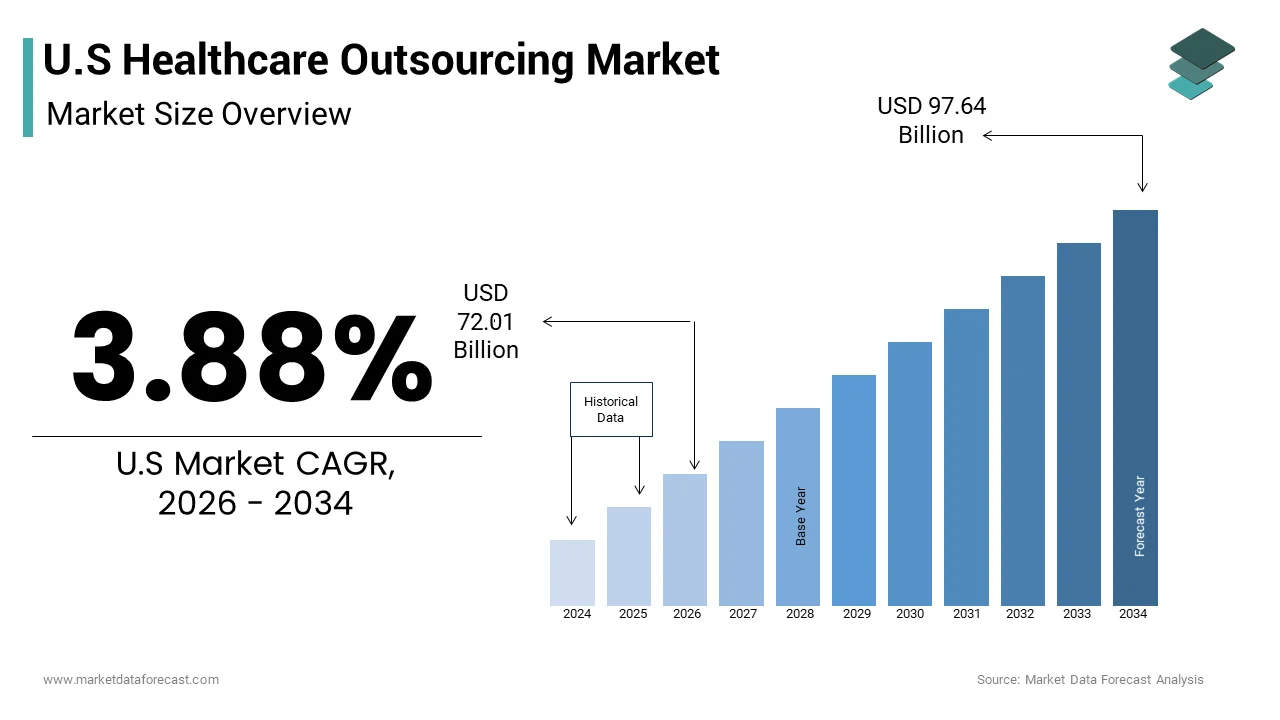
The U.S. healthcare outsourcing market was valued at USD 69.32 billion in 2025, is estimated to reach USD 72.01 billion in 2026, and is projected to reach USD 97.64 billion by 2034, registering a CAGR of 3.88% during the forecast period from 2026 to 2034. The U.S. healthcare outsourcing market is witnessing steady growth as healthcare organizations increasingly outsource non-core functions to improve operational efficiency, reduce administrative costs, and enhance patient care. Rising demand for specialized services such as revenue cycle management, medical billing, claims processing, clinical research, and healthcare IT support is accelerating market expansion. The growing adoption of digital health technologies, stricter regulatory compliance requirements, and the need for scalable service models are encouraging healthcare providers and payers to partner with experienced outsourcing firms. Furthermore, the increasing focus on value-based healthcare, data analytics, and automation is creating long-term growth opportunities for outsourcing service providers across the United States.
Key Market Trends
- Healthcare organizations are expanding outsourcing partnerships to streamline administrative processes and improve operational efficiency.
- Artificial intelligence, robotic process automation, and advanced analytics are transforming outsourced healthcare workflows and decision-making.
- Demand for outsourced revenue cycle management, medical coding, and claims administration continues to increase across healthcare systems.
- Growing emphasis on regulatory compliance, cybersecurity, and patient data protection is driving investments in specialized outsourcing services.
- Cloud-based healthcare platforms and digital transformation initiatives are enabling more flexible, scalable, and cost-effective outsourcing solutions.
Segmental Insights
Based on type of service, the healthcare payer and provider segment accounted for 44.6% of the U.S. healthcare outsourcing market share in 2025. The segment maintains its leadership due to rising demand for outsourced administrative support, claims management, member services, and operational functions that enable healthcare organizations to improve efficiency while focusing on patient-centered care.
Based on technology, the chromatography segment held 52.1% of the U.S. healthcare outsourcing market share in 2025. Its dominance is attributed to the extensive use of chromatography technologies in pharmaceutical research, clinical diagnostics, biotechnology applications, and laboratory testing, where outsourcing helps improve analytical accuracy, regulatory compliance, and operational productivity.
Regional Insights
The United States remains the largest and most advanced healthcare outsourcing market, supported by its sophisticated healthcare infrastructure, increasing healthcare expenditure, and widespread adoption of digital health solutions. Healthcare providers, insurers, pharmaceutical companies, and life sciences organizations continue to outsource specialized services to improve operational performance, manage rising costs, and address workforce shortages. Strong regulatory oversight, continuous technological innovation, and increasing investments in healthcare IT and clinical research further strengthen market growth. As demand for efficient, technology-driven healthcare services continues to rise, the United States is expected to maintain its leadership in the global healthcare outsourcing industry throughout the forecast period.
Competitive Landscape
The U.S. healthcare outsourcing market is highly competitive, with leading healthcare technology companies, business process outsourcing providers, and clinical research organizations competing through innovation, service diversification, and digital transformation capabilities. Market participants are investing in artificial intelligence, cloud computing, automation, advanced analytics, and secure data management platforms to deliver more efficient and compliant outsourcing solutions. Strategic acquisitions, partnerships with healthcare providers, and expansion of end-to-end service portfolios are strengthening competitive positioning across the industry. Companies are also emphasizing regulatory expertise, cybersecurity, and personalized client solutions to address evolving healthcare requirements. As healthcare organizations continue to prioritize cost optimization, operational excellence, and improved patient outcomes, outsourcing providers are expanding their capabilities to deliver scalable, technology-enabled services across the healthcare ecosystem.
Prominent players in the U.S. healthcare outsourcing market include Cognizant Technology Solutions Corporation, Optum Inc., IQVIA Holdings Inc., Parexel International Corporation, McKesson Corporation, Axiom BPM Services Pvt. Ltd., and Infinit Healthcare.
U.S Healthcare Outsourcing Market Size
The U.S healthcare outsourcing market size was valued at USD 69.32 billion in 2025 and is anticipated to reach USD 72.01 billion in 2026 to reach USD 97.64 billion by 2034, growing at a CAGR of 3.88% during the forecast period from 2026 to 2034.
Market Introduction and Definition
The healthcare outsourcing is a strategic operational shift, wherein healthcare providers and payers delegate non-core and specialized clinical functions to third party service providers. As per the Centers for Medicare and Medicaid Services, national health expenditure in the United States reached 4.5 trillion dollars in 2025. The complexity of regulatory compliance further necessitates external expertise. The American Hospital Association states that hospitals spend an average of 18% of their operating budget on administrative costs, which includes billing and compliance activities. This high administrative burden compels institutions to seek external partners who can streamline processes through economies of scale and specialized technology. Additionally, the shortage of skilled healthcare professionals exacerbates the need for outsourcing.
MARKET DRIVERS
Escalating Administrative Burden And Revenue Cycle Complexity
The escalating administrative burden and increasing complexity of revenue cycle management is majorly bolstering the growth of the United States healthcare outsourcing market. Healthcare providers face intricate billing codes frequent regulatory changes and stringent payer requirements that demand specialized expertise and continuous monitoring. This financial strain prompts healthcare organizations to outsource billing and coding functions to specialized vendors, who possess the necessary technology and skilled personnel to minimize claim denials and accelerate reimbursement cycles. Outsourcing firms utilize advanced artificial intelligence and machine learning algorithms to automate coding processes ensuring higher accuracy and compliance with current standards. The American Medical Association notes that physicians spend approximately 16 hours per week on paperwork and administrative tasks which detracts from patient care time. Furthermore, the transition to value-based care models requires sophisticated data analytics and reporting capabilities that many smaller practices lack. Outsourcing partners offer these analytical services enabling providers to track performance metrics and meet quality benchmarks. The ability to scale administrative operations flexibly according to patient volume fluctuations also makes outsourcing an attractive option.
Severe Shortage Of Skilled Healthcare Professionals
The severe shortage of skilled healthcare professionals is prompting the growth of the United States healthcare outsourcing market. The demand for qualified medical staff, including nurses physicians and allied health professionals far exceeds the available supply leading to staffing crises in many healthcare facilities. As per the American Nurses Association the United States faces a projected shortage of over 200000 registered nurses by 2030 due to an aging workforce and increased healthcare needs. This scarcity forces hospitals and clinics to seek external staffing solutions to maintain adequate patient to staff ratios and ensure continuity of care. Outsourcing agencies provide access to a global pool of trained professionals who can be deployed quickly to fill temporary or permanent vacancies. The Association of American Medical Colleges highlights that the physician shortage could reach 124000 by 2034, particularly in primary care and rural areas. These entities handle the complex logistics of credentialing licensing and relocation allowing healthcare facilities to focus on clinical operations. Outsourcing helps alleviate this pressure by providing supplemental staff who can share the workload. The flexibility and scalability offered by outsourcing firms make them indispensable partners in managing workforce challenges.
MARKET RESTRAINTS
Stringent Data Privacy And Security Regulations
The stringent data privacy and security regulations is impeding the growth of the United States healthcare outsourcing market. Healthcare organizations must comply with the Health Insurance Portability and Accountability Act, which imposes rigorous standards for the protection of patient health information. Any breach of data security can result in substantial fines legal liabilities and reputational damage. According to the Department of Health and Human Services, there were over 700 reported healthcare data breaches affecting 500 or more individuals in 2025. Outsourcing involves sharing sensitive patient data with third party vendors, which increases the potential attack surface for cyber threats. Many healthcare providers are hesitant to outsource critical functions due to concerns about vendor compliance and data integrity. The Office for Civil Rights has imposed millions of dollars in penalties for HIPAA violations involving business associates emphasizing the strict enforcement of privacy laws. Ensuring that outsourcing partners adhere to these regulations requires extensive due diligence continuous monitoring and robust contractual agreements. This regulatory complexity adds to the operational costs and administrative burden of outsourcing arrangements. Smaller vendors may struggle to implement the necessary security measures making it difficult for healthcare organizations to find qualified partners.
High Initial Transition And Integration Costs
The high initial transition and integration costs is additionally hampering the growth of the United States healthcare outsourcing market. Establishing an outsourcing partnership requires significant upfront investment in technology infrastructure process reengineering and staff training. Healthcare organizations must integrate their existing systems with those of the vendor to ensure seamless data flow and operational continuity. The average cost of implementing a new revenue cycle management system can exceed 1 million dollars for mid-sized hospitals. These costs include software licensing hardware upgrades and consulting fees, which can be prohibitive for smaller practices and rural hospitals. Additionally, the transition period often involves temporary disruptions in workflow and productivity as staff adapt to new processes and technologies. The learning curve associated with new systems can lead to initial errors and delays in billing or patient care. Furthermore. long term contracts with outsourcing vendors may limit flexibility and lock organizations into specific service levels that may not evolve with changing needs. The financial risk associated with failed implementations or unsatisfactory vendor performance further deters potential clients. Many healthcare providers prefer to maintain control over their operations rather than incur the high costs and risks of transitioning to an outsourced model.
MARKET OPPORTUNITIES
Expansion Into Value Based Care Analytics
The expansion into value-based care analytics is certainly to fuel the expansion of the United States healthcare healthcare outsourcing market. As the healthcare system shifts from fee for service to value based reimbursement, models providers require advanced data analytics to monitor patient outcomes and manage population health. Outsourcing firms can offer specialized analytical services that help healthcare organizations track performance metrics identify risk factors and optimize care pathways. External vendors possess the technological expertise and computational power to process large volumes of clinical and financial data generating actionable insights for providers. These services enable healthcare organizations to improve quality of care reduce readmission rates and achieve better financial outcomes. The ability to predict patient trends and manage chronic conditions proactively is crucial for success in value-based arrangements. Outsourcing partners can also facilitate interoperability between different healthcare systems ensuring comprehensive data aggregation. This capability allows for more accurate risk adjustment and care coordination. As value based care continues to expand, the need for sophisticated analytics will grow creating a lucrative market for outsourcing providers.
Adoption Of Artificial Intelligence And Automation Technologies
The adoption of artificial intelligence and automation technologies is another factor to elevate the growth of the United States healthcare outsourcing market. Outsourcing vendors are increasingly integrating AI driven solutions to enhance efficiency accuracy and speed in various healthcare processes. These technologies can automate repetitive tasks, such as claims processing coding, and appointment scheduling, reducing manual errors, and operational costs. Outsourcing firms leverage these advancements to offer superior services that are faster and more reliable than traditional manual methods. Machine learning algorithms can analyze historical data to predict claim denials and suggest corrective actions before submission. Natural language processing tools can extract relevant information from unstructured clinical notes facilitating accurate coding and documentation. The scalability of AI powered solutions allows outsourcing providers to handle large volumes of transactions efficiently meeting the demands of growing healthcare organizations. Furthermore, automation frees up human workers to focus on complex tasks that require critical thinking and empathy. This synergy between technology and human expertise enhances the overall value proposition of outsourcing services.
MARKET CHALLENGES
Cybersecurity Threats And Vulnerability Risks
The cybersecurity threats and vulnerability risks are one of the major challenges for the growth of the United States healthcare outsourcing market. The increasing reliance on digital platforms and third-party vendors exposes healthcare organizations to heightened risks of cyberattacks and data breaches. Ransomware attacks on healthcare providers have surged in recent years disrupting operations and compromising patient safety. Outsourcing arrangements often involve the transfer of sensitive data across multiple networks increasing the potential entry points for attackers. Ensuring robust cybersecurity measures across all vendor touchpoints is complex and resource intensive. Many outsourcing partners may not have the same level of security infrastructure as the healthcare organizations they serve creating vulnerabilities. The interconnected nature of healthcare systems means that a breach in one vendor can compromise the entire network. Additionally, the rapid evolution of cyber threats requires continuous updates and monitoring which can be challenging to maintain in outsourced environments. The potential for significant financial loss and reputational damage makes cybersecurity a critical concern for healthcare leaders. Organizations must conduct thorough risk assessments and enforce strict security protocols with their vendors.
Regulatory Compliance And Legal Liabilities
The regulatory compliance and legal liabilities are also to inhibit the growth of the United States healthcare outsourcing market. Healthcare providers remain ultimately responsible for the actions of their outsourcing partners meaning any compliance failures by vendors can result in severe penalties for the hiring organization. The complex web of federal and state regulations including HIPAA the False Claims Act and Stark Law requires constant vigilance and expertise. Outsourcing firms must navigate these regulations, while delivering services, which can be difficult given the varying interpretations of legal requirements. Discrepancies in coding or billing practices by vendors can lead to audits and investigations that disrupt healthcare operations. Additionally, contractual disputes regarding service levels and liability allocation can arise complicating the management of outsourcing relationships. The lack of standardized compliance frameworks across different vendors adds to the complexity. Healthcare organizations must invest significant resources in monitoring vendor activities and conducting regular audits to ensure adherence to regulations. This ongoing oversight requirement can diminish the cost savings expected from outsourcing. Furthermore, changes in regulatory policies can necessitate rapid adjustments to outsourcing contracts and processes creating operational instability.
REPORT COVERAGE
| REPORT METRIC | DETAILS |
| Market Size Available | 2025 to 2034 |
| Base Year | 2025 |
| Forecast Period | 2026 to 2034 |
| CAGR | 3.88% |
| Segments Covered | By Type of Source, Technology, By Country |
| Various Analyses Covered | Global, Regional, and Country Level Analysis, Segment-Level Analysis; DROC, PESTLE Analysis; Porter’s Five Forces Analysis; Competitive Landscape; Analyst Overview of Investment Opportunities. |
| Regions Covered | California, Washington, Oregon, New York & Rest of the United States |
| Market Leaders Profiled | Cognizant Technology Solutions Corporation, Optum Inc, IQVIA Holdings Inc, Parexel International Corporation, McKesson Corporation, Axiom Bpm Services Pvt. Ltd, Infinit Healthcare. |
SEGMENT ANALYSIS
By Type of Service Insights
The healthcare payer and provider segment was accounted in holding 44.6% of the United States healthcare outsourcing market share in 2025 due to the immense operational complexity and financial pressure faced by insurance companies and healthcare delivery institutions. The sheer volume of transactions processed by payers and providers necessitates external support to maintain efficiency and accuracy. The transition to value based care models has further increased the administrative burden requiring sophisticated data analytics and reporting capabilities that many organizations lack internally. Outsourcing allows these entities to leverage specialized expertise and technology without significant capital investment. Payers outsource claims adjudication and member services to reduce operational costs and improve service quality. Providers outsource billing and coding to minimize claim denials and accelerate revenue collection. The integration of advanced technologies such as artificial intelligence in outsourced services further enhances the appeal of this segment. The continuous regulatory changes and compliance requirements also make outsourcing an attractive option for managing risk.
The pharmaceutical segment is swiftly emerging at a fastest CAGR of 6.5% during the forecast period owing to the increasing complexity of drug development and the need for cost effective clinical trial management. Pharmaceutical companies are increasingly outsourcing various functions including research and development clinical trials manufacturing and regulatory affairs to specialized service providers. The global pharmaceutical industry faces intense pressure to bring new drugs to market quickly and efficiently, while managing rising development costs. Outsourcing allows pharmaceutical companies to access specialized expertise and infrastructure without the need for significant capital investment. Clinical research organizations play a crucial role in this segment by managing the complex logistics of clinical trials including patient recruitment data collection and regulatory submissions. The shift towards personalized medicine and biologics further increases the complexity of drug development requiring specialized knowledge and technologies. Outsourcing partners offer the flexibility and scalability needed to manage these complex projects effectively.
By Technology Insights
The chromatography was the dominant segment by holding 52.1% of the United States healthcare outsourcing market share in 2025 due to its role in drug purification and analysis. Chromatography is a widely used technique for separating and analyzing complex mixtures making it indispensable in the development and manufacturing of pharmaceuticals. The high purity requirements for modern drugs necessitate advanced chromatographic methods to ensure safety and efficacy. Outsourcing laboratories utilize various chromatographic techniques including high performance liquid chromatography gas chromatography and thin layer chromatography to meet these stringent standards. The widespread adoption of chromatography in quality control and research and development drives its dominance in the outsourcing market. Pharmaceutical companies rely on contract laboratories to perform routine testing and validation using chromatographic methods. The versatility of chromatography allows it to be applied to a wide range of substances including small molecules proteins and nucleic acids. This broad applicability ensures a consistent demand for chromatographic services. Outsourcing providers invest in state of the art chromatographic equipment and skilled personnel to deliver accurate and timely results. The ability to handle high sample volumes and complex analyses makes chromatography a cornerstone of healthcare outsourcing.
The monoclonal antibodies technology segment is esteemed to grow at fastest CAGR of 6.3% from 2026 to 2034 with the increasing demand for biologic drugs and targeted therapies. Monoclonal antibodies are engineered proteins that mimic the immune system's ability to fight off harmful pathogens and are used to treat a variety of conditions including cancer autoimmune diseases and infectious diseases. The complexity of monoclonal antibody production requires specialized expertise and infrastructure which many pharmaceutical companies lack. The surge in approvals drives the demand for outsourcing services related to antibody development manufacturing and testing. Contract development and manufacturing organizations offer specialized services for monoclonal antibody production including cell culture purification and formulation. The high cost and technical challenges associated with monoclonal antibody development make outsourcing an attractive option for pharmaceutical companies. Outsourcing partners provide the scalability and flexibility needed to manage the complex production processes involved in monoclonal antibody manufacturing.
COMPETITIVE LANDSCAPE
The competition in the United States healthcare outsourcing market is characterized by the presence of several large multinational corporations and specialized niche providers. Major players compete by offering comprehensive end to end solutions that cover various aspects of healthcare operations from billing to clinical research. The market sees intense rivalry as firms attempt to differentiate themselves through technological innovation and superior service quality. Customer retention is a key focus area with providers leveraging long term contracts and personalized service models to maintain client relationships. Technology plays a pivotal role in competition as companies invest in advanced analytics artificial intelligence and cloud computing to enhance efficiency. Pricing strategies vary with some firms positioning themselves as premium providers while others compete on cost effectiveness. Strategic partnerships with healthcare systems and pharmaceutical companies are increasingly used to gain competitive advantage and secure stable revenue streams. The entry of technology giants into the healthcare space further intensifies competition by introducing disruptive business models. Regulatory compliance and data security remain critical differentiators as clients seek trustworthy partners.
KEY MARKET PLAYERS
A few of the market players that are dominating the U.S healthcare outsourcing market are
- Cognizant Technology Solutions Corporation
- Optum Inc
- IQVIA Holdings Inc
- Parexel International Corporation
- McKesson Corporation
- Axiom Bpm Services Pvt. Ltd
- Infinit Healthcare
Top Players In The Market
- Cognizant Technology Solutions Corporation is a leading provider of healthcare outsourcing services focusing on digital transformation and operational efficiency. The company offers comprehensive solutions including revenue cycle management clinical data management and IT infrastructure support. Cognizant leverages advanced artificial intelligence and automation technologies to streamline healthcare processes and reduce costs for clients. Recent actions include the expansion of its life sciences division to support complex clinical trials and drug development processes. The company actively invests in upskilling its workforce to handle specialized healthcare tasks ensuring high quality service delivery. Cognizant partners with major healthcare providers and payers to implement cloud-based solutions that enhance data accessibility and security. Its commitment to innovation and customer centric solutions strengthens its position in the market. The organization continuously updates its technology stack to meet evolving regulatory requirements and industry standards.
- Optum Inc plays a pivotal role in the United States healthcare outsourcing market by providing integrated health services technology and pharmacy care solutions. The company supports healthcare providers and payers with revenue cycle management population health analytics and clinical services. Optum utilizes big data and predictive analytics to improve patient outcomes and reduce healthcare costs. Recent actions include the acquisition of specialized healthcare IT firms to enhance its digital capabilities and expand service offerings. The company focuses on creating seamless care experiences through interconnected platforms that facilitate data sharing and coordination. Optum collaborates with employers and government agencies to deliver value-based care models that emphasize prevention and wellness. Its robust infrastructure and extensive network enable efficient processing of claims and member services. Optum continues to innovate by integrating artificial intelligence into its operations improving accuracy and speed.
- IQVIA Holdings Inc is a prominent player in the healthcare outsourcing market specializing in clinical research and real world evidence solutions. The company provides end to end services for pharmaceutical and biotechnology companies including clinical trial management data analytics and regulatory consulting. IQVIA leverages its vast database of healthcare information to generate insights that accelerate drug development and commercialization. Recent actions include the expansion of its decentralized clinical trial capabilities allowing for remote patient monitoring and data collection. The company invests heavily in technology platforms that integrate artificial intelligence and machine learning to optimize trial design and execution. IQVIA partners with global health organizations to improve access to medicines and enhance public health outcomes. Its expertise in regulatory affairs ensures compliance with international standards facilitating faster approvals. These contributions strengthen its position as a trusted partner for life sciences companies seeking to navigate the complexities of healthcare development and delivery.
Top Strategies Used By Key Market Participants
Key players in the United States healthcare outsourcing market primarily employ strategies such as strategic acquisitions technological integration and service diversification to strengthen their positions. Companies frequently acquire specialized firms to expand their capabilities in areas like clinical research data analytics and cybersecurity. The integration of artificial intelligence and automation tools is a critical strategy for improving operational efficiency and reducing costs for clients. Providers focus on developing proprietary platforms that facilitate seamless data exchange and real time monitoring. Geographic expansion into emerging markets allows firms to access cost effective talent pools and new customer segments. Partnerships with technology companies enable the adoption of cutting edge solutions such as blockchain for secure data management. Additionally, firms invest in training programs to ensure their workforce possesses the necessary skills for complex healthcare tasks. These combined strategies ensure sustained growth and competitiveness in the dynamic outsourcing landscape.
MARKET SEGMENTATION
This research report on the U.S healthcare outsourcing market is segmented and sub-segmented into the following categories.
By Type of Source
- Healthcare Payer
- Provider
- Pharmaceutical
By Technology
- Chromatography
- Monoclonal Antibodies Technology
By Country
- California
- Washington
- Oregon
- New York
- Rest of the United States
Frequently Asked Questions
What is driving the growth of the U.S. healthcare outsourcing market?
Rising healthcare costs, increasing administrative burdens, and the need for operational efficiency are driving market growth.
What does the U.S. healthcare outsourcing market encompass?
The market encompasses outsourced services such as medical billing, revenue cycle management, claims processing, IT services, transcription, and customer support.
Which outsourcing service segment generates the highest revenue in the U.S. healthcare outsourcing market?
Revenue cycle management services generate the highest revenue due to the growing need for efficient financial and billing operations.
Why are healthcare providers increasingly outsourcing business processes?
Healthcare providers outsource to reduce costs, improve service quality, and focus more on patient care.
Who are the key end users in the U.S. healthcare outsourcing market?
Hospitals, physician practices, healthcare payers, diagnostic laboratories, and healthcare networks are the key end users.
How does healthcare outsourcing improve operational performance?
It enhances efficiency, reduces administrative workloads, and enables access to specialized expertise and technologies.
What factors are increasing demand for healthcare outsourcing services in the United States?
Growing patient volumes, regulatory compliance requirements, and digital transformation initiatives are increasing demand.
What challenges are affecting the U.S. healthcare outsourcing market?
Data security concerns, regulatory complexities, and vendor management issues can impact market growth.
How is technology transforming the U.S. healthcare outsourcing industry?
Artificial intelligence, automation, cloud computing, and advanced analytics are improving service delivery and operational efficiency.
What is the future outlook for the U.S. healthcare outsourcing market?
The market is expected to expand steadily as healthcare organizations seek cost-effective solutions and focus on delivering better patient outcomes.
Access the study in MULTIPLE FORMATS
Purchase options starting from
$ 2000
Didn’t find what you’re looking for?
TALK TO OUR ANALYST TEAM
Need something within your budget?
NO WORRIES! WE GOT YOU COVERED!
Call us on: +1 888 702 9696 (U.S Toll Free)
Write to us: sales@marketdataforecast.com