- Product Description Description
- Table of Contents TOC
- List of Table & Figure LOT
- Get Free Sample PDF Sample PDF
Market Size, 2025
$482.15 BnMarket Estimate, 2026
$516.48 BnMarket Forecast, 2034
$895.40 BnCAGR, 2026–2034
7.12%U.S. IT Services Market Report Summary
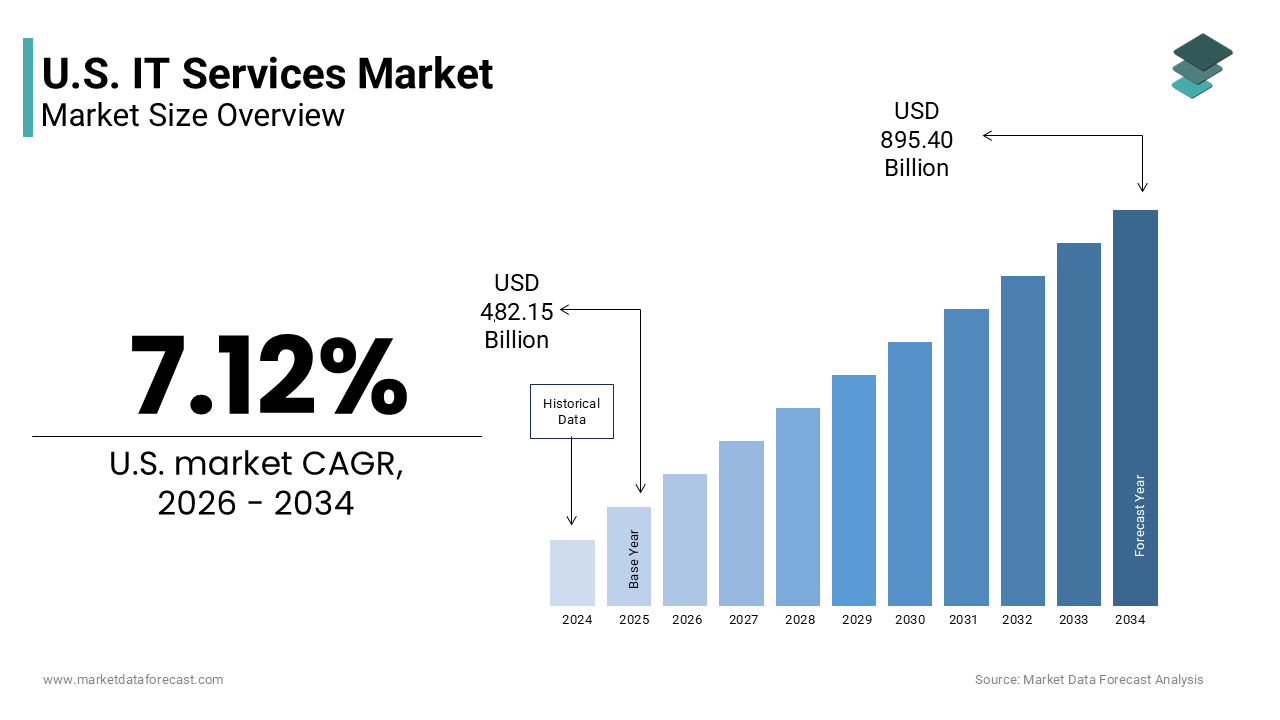
The U.S. IT services market was valued at USD 482.15 billion in 2025, is estimated to reach USD 516.48 billion in 2026, and is projected to reach USD 895.40 billion by 2034, growing at a CAGR of 7.12% during the forecast period from 2026 to 2034. The growth of the U.S. IT services market is driven by the accelerating pace of digital transformation, rising cloud adoption, increasing cybersecurity concerns, and growing investments in artificial intelligence and data analytics. The rapid shift toward remote work environments, automation technologies, and enterprise modernization initiatives is further fueling market expansion.
Key Market Trends
- Rising adoption of cloud computing and hybrid IT infrastructure solutions across enterprises
- Increasing demand for cybersecurity services due to the growing frequency of cyberattacks and ransomware incidents
- Growing integration of artificial intelligence, machine learning, and automation technologies into enterprise operations
- Expansion of managed services and outsourcing models to improve operational efficiency and reduce costs
- Increasing deployment of IoT-enabled systems and advanced data analytics platforms across industries
Segmental Insights
- Based on deployment model, the onshore delivery segment was the largest and held a significant share of the U.S. IT services market in 2025. The segment’s dominance is attributed to the need for regulatory compliance, enhanced data security, and seamless real-time collaboration between clients and service providers.
- Based on engagement model, the managed services segment accounted for the largest share of the U.S. IT services market in 2025. This dominance is driven by the growing need for proactive IT management, predictable operational costs, and continuous monitoring of enterprise systems and cybersecurity infrastructure.
- Based on end-user industry, the BFSI segment was the largest contributor to the U.S. IT services market in 2025. The segment growth is supported by the rapid digitization of banking services, increasing cybersecurity investments, and the adoption of AI-driven fraud detection and risk management solutions.
Regional Insights
The U.S. IT services market is witnessing strong growth across major regions such as California, Washington, Oregon, New York, and the rest of the United States, supported by the presence of leading technology companies, advanced digital infrastructure, and strong enterprise IT spending. The country continues to lead globally in cloud computing innovation, AI research, and enterprise software adoption, making it a key hub for IT services expansion.
Competitive Landscape
The U.S. IT services market is highly competitive and characterized by the presence of global consulting firms, cloud service providers, and specialized technology companies competing through innovation, digital transformation expertise, and strategic partnerships. Companies are increasingly focusing on AI-driven solutions, cloud modernization, cybersecurity enhancements, and industry-specific IT services to strengthen their market position. Prominent players in the U.S. IT services market include International Business Machines Corporation (IBM), Accenture PLC, Cognizant Technology Solutions Corporation, Tata Consultancy Services (TCS), Infosys Limited, Wipro Limited, HCL Technologies Limited, DXC Technology Company, Capgemini SE, Fujitsu Limited, NTT DATA Group Corporation, Oracle Corporation, Microsoft Corporation, Amazon Web Services (AWS), and Cisco Systems, Inc.
 Download Free Sample Report
U.S. IT Services Market Size
The U.S. IT services market size was valued at USD 482.15 billion in 2025 and is anticipated to reach USD 516.48 billion in 2026 from USD 895.40 billion by 2034, growing at a CAGR of 7.12% during the forecast period from 2026 to 2034.
IT services constitutes a comprehensive ecosystem of consulting, implementation, and management solutions designed to optimize technological infrastructure for enterprises across diverse sectors. This industry encompasses cloud computing, cybersecurity, data analytics, and digital transformation initiatives that enable organizations to enhance operational efficiency and maintain competitive advantage. The rapid adoption of remote work models has fundamentally altered the demand landscape, necessitating robust virtual collaboration tools and secure network architectures. According to the Bureau of Labor Statistics, 35% of employed persons in the U.S. worked at home on days they worked in 2023. Furthermore, according to the Bureau of Economic Analysis, investment in intellectual property products reached approximately 1.48 trillion dollars in 2023. The proliferation of Internet of Things devices further complicates IT environments, requiring specialized management services to ensure seamless connectivity and data integrity. As per the Federal Communications Commission, 95% of housing units in the U.S. had access to fixed terrestrial broadband at speeds of at least 25/3 Mbps as of the most recent annual reporting. Enterprises increasingly rely on third-party providers to navigate complex regulatory landscapes and implement advanced technologies, such as artificial intelligence. The integration of automation tools reduces manual workload and minimizes human error in critical business processes. This market is characterized by continuous innovation driven by the need for scalability and resilience in the face of evolving cyber threats. Organizations prioritize strategic partnerships with IT service providers to accelerate digital maturity and achieve long-term sustainability in a rapidly changing technological environment.
MARKET DRIVERS
Accelerating Digital Transformation Initiatives Drive Demand For Cloud Migration Services
The urgent need for digital transformation is majorly driving the growth of the U.S. IT services market. Businesses recognize that modernizing IT infrastructure is essential for agility, scalability, and cost efficiency in a competitive landscape. According to the National Institute of Standards and Technology, approximately 40% of medium-sized enterprises have adopted cloud computing solutions to enhance operational flexibility. This shift enables companies to access advanced computing resources on demand without significant upfront investment. According to the Census Bureau, e-commerce sales reached 1.12 trillion dollars in 2023. To support this volume, businesses require robust cloud architectures that can handle fluctuating traffic and ensure high availability. IT service providers facilitate this transition by offering specialized migration strategies, security assessments, and ongoing management services. As per the International Data Corporation, spending on cloud services is projected to grow by 18% annually. The ability to integrate disparate systems into a unified cloud environment improves data accessibility and decision-making speed. Furthermore, remote work trends necessitate secure access to corporate applications from various locations, which cloud solutions effectively provide. Consequently, the strategic imperative to modernize operations fuels sustained demand for comprehensive IT services that enable seamless digital transformation and operational resilience.
Increasing Frequency of Cyberattacks Necessitates Advanced Security Solutions
The escalating frequency and sophistication of cyberattacks is further boosting the U.S. IT services market expansion. Digital expansion increases the attack surface for malicious actors, making robust security protocols essential for protecting sensitive data and maintaining business continuity. According to the Federal Bureau of Investigation, the Internet Crime Complaint Center received over 880,000 complaints in 2023, with reported losses exceeding 12.5 billion dollars. These statistics underscore the urgent need for proactive threat detection and response capabilities. According to the Cybersecurity and Infrastructure Security Agency, 1,189 ransomware incidents were reported in the U.S. during 2023 across critical infrastructure sectors. IT service providers offer managed security services, including vulnerability assessments, penetration testing, and incident response planning, to mitigate these risks. As per the Ponemon Institute, the average cost of a data breach in the U.S. reached 9.48 million dollars in 2023. The implementation of zero-trust architecture and multi-factor authentication requires specialized expertise that many internal IT teams lack. Consequently, organizations outsource these functions to experienced providers who can deploy cutting-edge technologies and monitor threats in real-time. This reliance on external expertise drives significant growth in the cybersecurity segment of the IT services market, as businesses strive to safeguard their digital assets against evolving threats.
MARKET RESTRAINTS
High Costs Associated With Advanced Technology Implementation Restrict Small Business Adoption
The substantial financial burden associated with implementing advanced IT solutions is hampering the growth of the U.S. IT services market. While large corporations can absorb the costs of digital transformation, smaller businesses often struggle to allocate sufficient budgets for comprehensive IT services. According to the Small Business Administration, approximately 30% of small businesses cite high technology costs as a significant barrier to growth and competitiveness. The initial investment for cloud migration, cybersecurity infrastructure, and software licensing can be prohibitive for organizations with limited capital reserves. According to the Bureau of Labor Statistics, businesses with fewer than 50 employees spend roughly 7% of their total expenditures on technology and professional services. Furthermore, ongoing maintenance and subscription fees add to the total cost of ownership, creating long-term financial pressure. As per the National Federation of Independent Business, 23% of small business owners cited inflation and rising costs as their single most important problem in late 2023, which limits capital for technology investment. The complexity of integrating new systems with existing workflows also requires specialized consulting, which increases overall expenses. Consequently, budget constraints prevent many smaller entities from leveraging advanced IT services that could enhance efficiency and security. This financial disparity creates a market gap where a significant portion of businesses remain reliant on outdated technologies, hindering broader market penetration and slowing overall industry growth potential.
Shortage of Skilled IT Professionals Limits Service Delivery Capacity And Innovation
The acute shortage of qualified IT professionals is impeding the expansion of the U.S. IT services market. The demand for specialized skills in areas such as artificial intelligence, cloud architecture, and cybersecurity far exceeds the available supply of trained personnel. According to the CompTIA Tech Jobs Report, there were 239,000 net new tech jobs added to the U.S. economy in 2023. This scarcity drives up labor costs and extends recruitment timelines, making it difficult for service providers to scale their operations effectively. As per the Bureau of Labor Statistics, employment in computer and information technology occupations is projected to grow by 15% from 2022 to 2032. According to the Information Technology Industry Council, 50% of hiring managers reported difficulty in finding candidates with the necessary technical skills for emerging technologies in 2023. The turnover rate in the IT sector is also higher than the national average, further exacerbating staffing challenges. Consequently, service providers may face delays in project delivery and reduced quality of output due to resource constraints. This talent shortage forces companies to invest heavily in training and retention programs, which increases operational costs. Until the workforce pipeline expands to meet industry needs, the lack of skilled professionals will continue to constrain the growth and effectiveness of the IT services market.
MARKET OPPORTUNITIES
Expansion of Artificial Intelligence and Machine Learning Offers New Service Avenues
The rapid advancement of artificial intelligence and machine learning technologies is a notable opportunity for the U.S. IT services market. Organizations are increasingly seeking to leverage AI for automation, predictive analytics, and customer engagement, driving demand for specialized implementation and management services. According to the National Science Foundation, federal investment in AI research and development reached 2.5 billion dollars in 2023. IT service providers can capitalize on this trend by offering AI-driven solutions that optimize business processes and enhance decision-making capabilities. According to the McKinsey Global Institute, AI adoption could potentially create up to 400 billion dollars in annual value for the U.S. economy. Service firms that develop expertise in natural language processing, computer vision, and robotic process automation can differentiate themselves in a crowded market. As per the World Economic Forum, 85% of companies plan to accelerate their digital transformation efforts by integrating AI technologies into their core operations. This shift requires comprehensive support, including data preparation, model training, and ethical governance, which IT service providers are well positioned to deliver. Furthermore, the integration of AI with existing enterprise systems opens opportunities for continuous monitoring and optimization services. By positioning themselves as strategic partners in AI adoption, IT service companies can capture a growing segment of the market and drive long-term revenue growth through innovative solution offerings.
Growth of Internet of Things Ecosystems Drives Demand for Integrated Management Services
The expanding ecosystem of Internet of Things devices offers a substantial opportunity for the U.S. IT services market. As more connected devices are deployed across industries, such as manufacturing, healthcare, and logistics, the need for seamless connectivity and data processing becomes critical. According to the Federal Communications Commission, the number of connected IoT devices in the U.S. is estimated at 470 million as of 2023. IT service providers can offer solutions that ensure device security, data integrity, and real-time monitoring, which are essential for operational efficiency. As per the International Data Corporation, spending on IoT solutions is expected to grow by 14% annually. Service firms that specialize in edge computing and network optimization can help organizations handle the massive volumes of data generated by IoT sensors. According to the Manufacturing Institute, 20% of manufacturers have reported significant productivity improvements through the adoption of smart factory initiatives. Furthermore, the integration of IoT with cloud platforms enables advanced analytics that provide actionable insights for business leaders. IT service providers can develop customized dashboards and reporting tools that simplify complex data sets for end-users. By addressing the unique challenges of IoT deployment and management, service companies can establish themselves as essential partners in the digital transformation journey of various industries.
MARKET CHALLENGES
Complexity of Regulatory Compliance Creates Operational Burdens for Service Providers
The intricate and evolving regulatory landscape governing data privacy and security is primarily challenging the growth of the U.S. IT services market. Organizations must adhere to numerous federal and state laws, such as the California Consumer Privacy Act and the Health Insurance Portability and Accountability Act, which mandate rigorous data protection standards. According to the Federal Trade Commission, enforcement actions related to data privacy have increased by 30% in recent years. IT service providers must ensure that their solutions and practices comply with these regulations to avoid severe penalties and reputational damage. According to the International Association of Privacy Professionals, the average spending for privacy compliance has increased by 25% for large tech firms. The variability of laws across different states further complicates operations for providers serving national clients. As per the Government Accountability Office, inconsistent state-level privacy laws create uncertainty and increase the complexity of implementing uniform security protocols. Service providers must continuously update their systems and training programs to align with new requirements that divert resources from innovation and growth. Furthermore, the liability associated with data breaches involving client information adds another layer of risk. Navigating this complex regulatory environment requires significant investment in compliance infrastructure and expertise. Until a standardized federal framework is established, the burden of multifaceted compliance will remain a persistent challenge for IT service providers operating in the U.S.
Rapid Pace of Technological Obsolescence Requires Continuous Investment And Adaptation
The rapid pace of technological change and obsolescence is further challenging the growth of the U.S. IT services market. Service providers must constantly update their offerings to remain relevant and competitive, which strains financial and operational resources. According to the Semiconductor Industry Association, the lifecycle of many hardware components has shortened to less than two years. This accelerated cycle forces IT service firms to invest heavily in research and development to stay ahead of emerging trends. As per the Bureau of Economic Analysis, business investment in equipment and software grows by 5% annually. According to the Technology Industry Association, 60% of IT leaders report difficulty in keeping pace with the speed of innovation. The need to retrain staff on new technologies also adds to operational costs and disrupts workflow efficiency. Furthermore, clients expect immediate access to the latest solutions, creating pressure on providers to deliver cutting-edge services without adequate lead time. This dynamic environment increases the risk of investing in technologies that may quickly become obsolete. Consequently, IT service companies must balance innovation with stability, ensuring that they can deliver reliable services while adapting to constant change. The inability to keep up with technological advancements can result in loss of market share and diminished customer trust.
REPORT COVERAGE
| REPORT METRIC | DETAILS |
| Market Size Available | 2025 to 2034 |
| Base Year | 2025 |
| Forecast Period | 2026 to 2034 |
| CAGR | 7.12% |
| Segments Covered | By Deployment Model, Engagement Mode, Service Type, Organization Size, End-User Industry, and Region |
| Various Analyses Covered | Global, Regional & Country Level Analysis; Segment-Level Analysis; DROC, PESTLE Analysis; Porter’s Five Forces Analysis; Competitive Landscape; Analyst Overview of Investment Opportunities |
| Regions Covered | California, Washington, Oregon, New York, and the rest of the United States. |
| Market Leaders Profiled | International Business Machines Corporation (IBM), Accenture PLC, Cognizant Technology Solutions Corporation, Tata Consultancy Services (TCS), Infosys Limited, Wipro Limited, HCL Technologies Limited, DXC Technology Company, Capgemini SE, Fujitsu Limited, NTT DATA Group Corporation, Oracle Corporation, Microsoft Corporation, Amazon Web Services (AWS), and Cisco Systems, Inc. |
SEGMENTAL ANALYSIS
By Deployment Model Insights
The onshore segment dominated the market by accounting for the largest share of the U.S. IT services market in 2025 due to the critical need for data sovereignty, regulatory compliance, and seamless communication. Organizations prioritize keeping sensitive data within national borders to adhere to strict federal and state privacy laws, such as the Health Insurance Portability and Accountability Act and the California Consumer Privacy Act. According to the Federal Trade Commission, enforcement of data privacy regulations has intensified, leading 70% of enterprises to prefer onshore providers to mitigate legal risks associated with cross-border data transfers. This preference ensures that customer information remains subject to U.S. jurisdiction, providing greater security and trust. Furthermore, the elimination of time zone differences facilitates real-time collaboration between clients and service providers, which is essential for agile development and immediate issue resolution. According to the Bureau of Labor Statistics, effective communication reduces project delays by up to 25% as teams can interact during overlapping business hours without the latency inherent in offshore arrangements. The cultural alignment and shared language also minimize misunderstandings and enhance the quality of deliverables. As per the Project Management Institute, projects managed with onshore teams report a 30% higher satisfaction rate. Additionally, the proximity allows for face-to-face meetings, which are crucial for building strong strategic partnerships and handling complex transformations. These factors collectively sustain the leadership of the onshore model, particularly in highly regulated industries, such as healthcare and finance, where compliance and responsiveness are paramount.
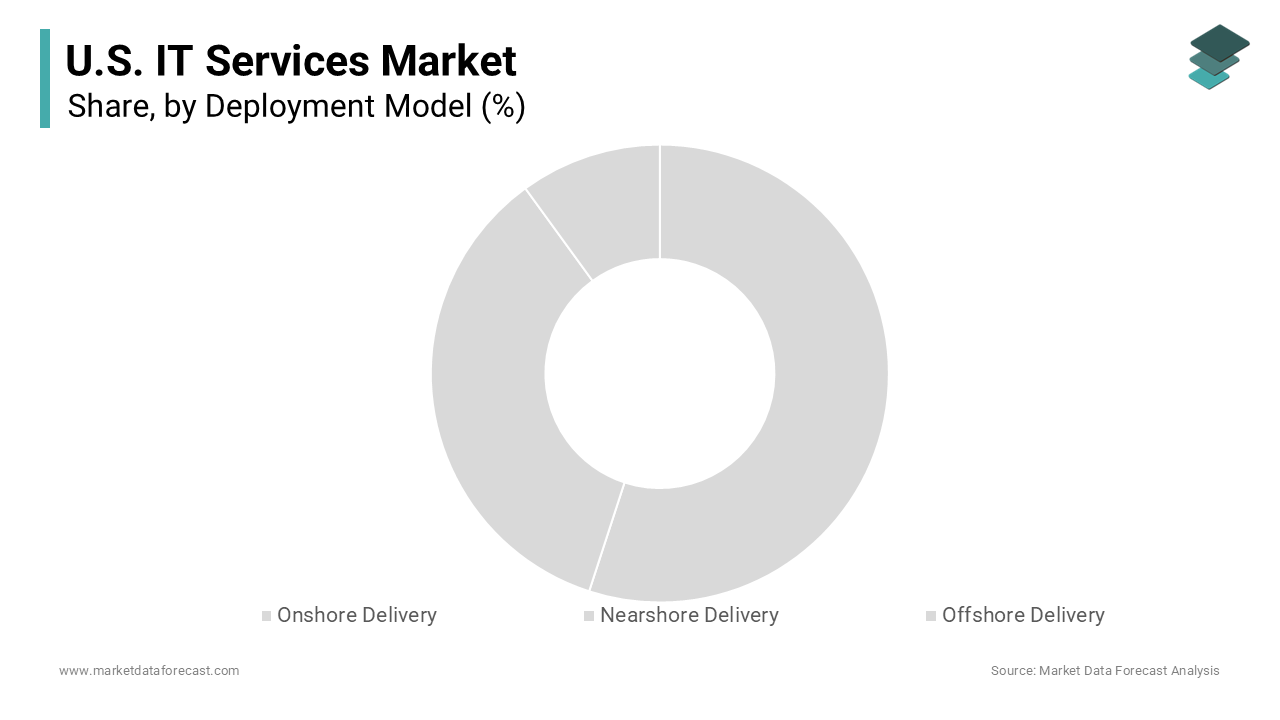
On the other hand, the nearshore deployment model is emerging as the fastest-growing segment within the U.S. IT services market and is expected to exhibit a CAGR of 13.3% during the forecast period owing to the desire to balance cost efficiency with geographic proximity and cultural compatibility. Companies seek alternatives to high-cost onshore labor, while avoiding the significant time zone challenges and cultural barriers associated with offshore locations in Asia. According to the Inter-American Development Bank, nearshore destinations in Latin America have increased their IT export revenues by 15% annually. The shared or overlapping time zones with the U.S. enable real-time collaboration similar to onshore models but at a lower cost. According to the World Bank, the cost of IT labor in nearshore countries is approximately 40% lower than in the U.S. Furthermore, the North American Free Trade Agreement and its successor, the U.S.-Mexico-Canada Agreement, facilitate easier movement of professionals and data across borders. As per the Software Alliance, these trade frameworks reduce administrative burdens and enhance legal certainty for U.S. companies outsourcing to neighboring regions. The growing pool of STEM graduates in Latin America also ensures a steady supply of qualified talent. These economic and operational advantages drive the accelerated adoption of nearshore services as organizations optimize their global delivery strategies.
By Engagement Model Insights
The managed services segment commanded for the highest share of the U.S. IT services market in 2025. The dominance of managed services segment in the U.S. market can be credited to the increasing complexity of IT infrastructure and the need for predictable operational costs. Organizations are shifting from break-fix approaches to proactive management, where service providers assume responsibility for monitoring, maintaining, and optimizing IT systems. According to CompTIA, approximately 65% of small and medium-sized businesses rely on managed service providers to handle their cybersecurity and network management needs. This reliance stems from the inability of internal teams to keep pace with evolving threats and technological advancements. According to the Ponemon Institute, organizations using managed security services experience 50% fewer successful cyberattacks compared to those managing security in-house. The subscription-based pricing model of managed services provides budget certainty, allowing companies to forecast IT expenses accurately without unexpected spikes from emergency repairs. As per the International Data Corporation, spending on managed cloud services is expected to grow by 18% annually. The ability to access specialized skills without the burden of hiring and training full-time employees further drives adoption. Managed service providers offer scalable solutions that adjust to business fluctuations, ensuring optimal performance during peak periods. These benefits make managed services the preferred choice for organizations seeking to enhance efficiency, reduce risk, and focus on core business objectives.
However, the staff augmentation segment is on the rise and is estimated to witness a CAGR of 15.1% during the forecast period in the U.S. market owing to the acute shortage of specialized IT talent and the need for workforce flexibility. Companies increasingly use staff augmentation to fill temporary skill gaps and accelerate project delivery without the long-term commitment of permanent hires. According to the CompTIA Tech Jobs Report, the U.S. faces a deficit of over 800,000 IT professionals. This scarcity forces organizations to look outward for immediate resources to maintain productivity. According to the Society for Human Resource Management, the average time to hire an IT professional exceeds 45 days. Staff augmentation allows businesses to scale their teams up or down rapidly in response to project demands, reducing overhead costs associated with idle employees. As per the Freelancers Union, nearly 40% of the U.S. workforce now participates in some form of freelance or contract work. This approach enables companies to access niche expertise in areas such as artificial intelligence and blockchain for specific durations. The agility provided by staff augmentation supports innovation and faster time-to-market, making it an attractive option for dynamic technology projects. Consequently, the demand for flexible talent solutions continues to surge, driving rapid growth in this segment.
By End-User Industry Insights
The BFSI segment dominated the market by capturing the leading share of the U.S. IT services market in 2025. The growth of the BFSI segment in the U.S. market is attributed to the critical need for digital transformation, regulatory compliance, and cybersecurity. Financial institutions are heavily investing in technology to enhance customer experience, streamline operations, and protect sensitive data from sophisticated cyber threats. According to the Federal Reserve System, banks spent over 120 billion dollars on technology in 2023. The shift toward digital banking and mobile payments requires a robust IT infrastructure to handle high transaction volumes securely. According to the American Bankers Association, 54% of customers use mobile apps as their top option for managing bank accounts. Furthermore, stringent regulations, such as the Gramm-Leach-Bliley Act, mandate rigorous data protection measures, driving demand for advanced security solutions. As per the Financial Services Information Sharing and Analysis Center, cyberattacks on financial institutions increased by 20% annually. The adoption of artificial intelligence for fraud detection and risk management also contributes to high IT spending. These factors ensure that the BFSI sector remains the largest consumer of IT services as institutions strive to maintain competitiveness and trust in a digital-first economy.
On the other side, the healthcare segment is projected to grow at a CAGR of 15.7% during the forecast period in the U.S. market owing to the rapid adoption of telehealth, electronic health records, and data analytics. The pandemic accelerated the digitization of healthcare services, creating a sustained demand for IT solutions that support remote patient monitoring and virtual consultations. According to the Office of the National Coordinator for Health Information Technology, over 96% of hospitals have adopted certified electronic health record technology. The expansion of telehealth has increased the need for secure video conferencing platforms and interoperable data systems. According to the Centers for Medicare and Medicaid Services, telehealth utilization stabilized at levels 38 times higher than pre-pandemic rates. Furthermore, the increasing prevalence of chronic diseases drives demand for population health management tools that leverage big data to improve outcomes. As per the Healthcare Information and Management Systems Society, healthcare organizations are investing heavily in cloud computing to store and analyze large volumes of patient data securely. The focus on value-based care also necessitates advanced analytics to track performance and reduce costs. These technological imperatives fuel rapid growth in IT spending within the healthcare sector as providers seek to enhance efficiency and patient care.
COUNTRY ANALYSIS
The U.S. is expected to sustain its trajectory as the primary hub for IT services innovation and consumption for the next few years. This dominant position is supported by a robust digital infrastructure, high levels of enterprise technology adoption, and a strong culture of innovation. The market status in the region is characterized by intense competition among global technology giants and specialized service providers, who continuously innovate to meet evolving client needs. A primary driving factor for this leadership is the widespread presence of headquarters for major technology companies, which fosters a vibrant ecosystem of research and development. According to the Department of Commerce, the U.S. leads the world in venture capital investment for technology startups, exceeding 150 billion dollars annually. This funding fuels the creation of cutting-edge solutions that drive demand for implementation and management services. Furthermore, the high concentration of Fortune 500 companies creates a substantial base of large enterprises with complex IT requirements. According to the Bureau of Economic Analysis, business investment in intellectual property products, including software and IT services, grew by 8% in 2023. The availability of a highly skilled workforce despite shortages also supports market growth. As per the National Science Foundation, the U.S. produces over 80,000 computer science graduates annually, providing a steady stream of talent. These structural advantages ensure that the U.S. remains the central hub for IT services innovation and consumption.
COMPETITIVE LANDSCAPE
The competition in the U.S. IT services market is intense and characterized by a mix of global consulting giants specialized technology firms and emerging digital natives. Major players compete on the basis of technical expertise innovation capabilities and industry specific knowledge. The market is fragmented with numerous providers offering varying levels of service from basic infrastructure management to complex digital transformation initiatives. Differentiation is achieved through unique proprietary platforms artificial intelligence driven insights and seamless integration with cloud ecosystems. Price competitiveness remains a factor particularly for standardized services but value addition through strategic consulting often dictates winner selection. Strategic mergers and acquisitions are frequent as larger firms aim to acquire niche capabilities and expand their service portfolios. The rise of low code and no code platforms also empowers clients to handle some tasks internally increasing pressure on traditional service models. Regulatory compliance requirements further influence competitive dynamics as providers must demonstrate robust security and data privacy standards. Ultimately success depends on the ability to deliver scalable secure and innovative solutions that address the specific business challenges of diverse enterprise clients in a rapidly changing digital environment.
KEY MARKET PLAYERS
A few of the major companies in the U.S. IT services market include
- International Business Machines Corporation (IBM)
- Accenture PLC
- Cognizant Technology Solutions Corporation
- Tata Consultancy Services (TCS)
- Infosys Limited
- Wipro Limited
- HCL Technologies Limited
- DXC Technology Company
- Capgemini SE
- Fujitsu Limited
- NTT DATA Group Corporation
- Oracle Corporation
- Microsoft Corporation
- Amazon Web Services (AWS)
- Cisco Systems, Inc.
Top Players in the US Market
International Business Machines Corporation
International Business Machines Corporation remains a pivotal force in the U.S. IT services market by focusing on hybrid cloud solutions and artificial intelligence integration. The company leverages its extensive expertise to help enterprises modernize legacy systems and adopt secure cloud architectures. Recent actions to strengthen its market position include the strategic acquisition of specialized AI firms to enhance its watsonx platform capabilities. IBM continues to invest heavily in quantum computing research which promises to revolutionize complex problem solving for industries such as finance and healthcare. The company also emphasizes sustainability by offering green IT consulting services that help clients reduce their carbon footprint. By combining deep industry knowledge with cutting edge technology IBM enables organizations to achieve digital transformation while maintaining robust security and operational efficiency. These initiatives solidify its reputation as a trusted partner for critical enterprise infrastructure and innovation.
Accenture plc
Accenture plc plays a dominant role in the U.S. IT services market through its comprehensive digital transformation and consulting offerings. The company assists clients across various industries in adopting cloud technologies automation and advanced analytics to drive business growth. Recent actions to strengthen its market position include significant investments in data and artificial intelligence practices to support generative AI adoption for enterprise customers. Accenture has expanded its network of innovation hubs to collaborate with technology partners and develop scalable solutions. The firm also focuses on upskilling its workforce to meet the evolving demands of digital projects. By integrating strategy with technical execution Accenture helps organizations navigate complex technological landscapes and achieve measurable outcomes. Its ability to deliver end to end services from strategy to implementation ensures sustained relevance and leadership in the competitive IT services sector.
Cognizant Technology Solutions Corporation
Cognizant Technology Solutions Corporation contributes significantly to the U.S. IT services market by providing tailored digital engineering and modernization services. The company specializes in helping businesses update their core systems and integrate new technologies to improve agility and customer experience. Recent actions to strengthen its market position include the expansion of its cloud and cybersecurity offerings to address growing enterprise needs. Cognizant has formed strategic partnerships with major cloud providers to deliver optimized migration and management services. The company also invests in industry specific solutions for healthcare financial services and manufacturing sectors. By focusing on high value digital services Cognizant enables clients to innovate rapidly and operate efficiently. Its commitment to delivering measurable business impact through technology adoption reinforces its standing as a key player in the dynamic US IT services landscape.
Top Strategies Used by Key Market Participants
Key players in the U.S. IT services market primarily employ strategic acquisitions and organic innovation to maintain competitive advantages. Companies invest heavily in artificial intelligence and cloud computing capabilities to offer advanced digital transformation solutions. This technological focus enables providers to automate processes and enhance decision making for clients. Firms also prioritize talent development through extensive training programs to address the skilled labor shortage. Strategic partnerships with technology vendors help create integrated ecosystems that deliver comprehensive value. Additionally companies expand their industry specific expertise to provide tailored solutions for sectors like healthcare and finance. Customer centric approaches such as agile delivery models and continuous support further differentiate market leaders. These multifaceted strategies ensure sustained growth and resilience in a rapidly evolving technological landscape where adaptability and expertise are paramount for success.
MARKET SEGMENTATION
This research report on the U.S. IT services market has been segmented based on the following categories.
By Deployment Model
- Onshore Delivery
- Nearshore Delivery
- Offshore Delivery
By Engagement Model
- Project-based / Fixed Price
- Staff Augmentation / Time-and-Material
- Managed Services / Outcome-based
By Service Type
- IT Consulting and Implementation
- Application Development and Maintenance (ADM)
- Infrastructure Services
- Managed Services
- IT Outsourcing (ITO)
- Business Process Outsourcing (BPO)
- Cloud and Platform Services
- Cybersecurity Services
- Digital Transformation and Emerging Tech (AI, IoT, Blockchain)
By Organization Size
- Large Enterprises
- Small and Medium Enterprises (SMEs)
By End-User Industry
- Banking, Financial Services and Insurance (BFSI)
- Manufacturing
- Government and Public Sector
- Healthcare and Life Sciences
- Retail and Consumer Goods
- Telecom and Media
- Transportation and Logistics
- Energy and Utilities
- Other End-User Industries
By Country
- California
- Washington
- Oregon
- New York
- Rest of the United States