U.S. Lead Acid Battery Market Size, Share, Trends & Growth Forecast Report By Type, By Application, and By Country (California, Washington, Oregon, New York & Rest of the United States) – Industry Analysis and Forecast, 2026 to 2034
Market Size, 2025
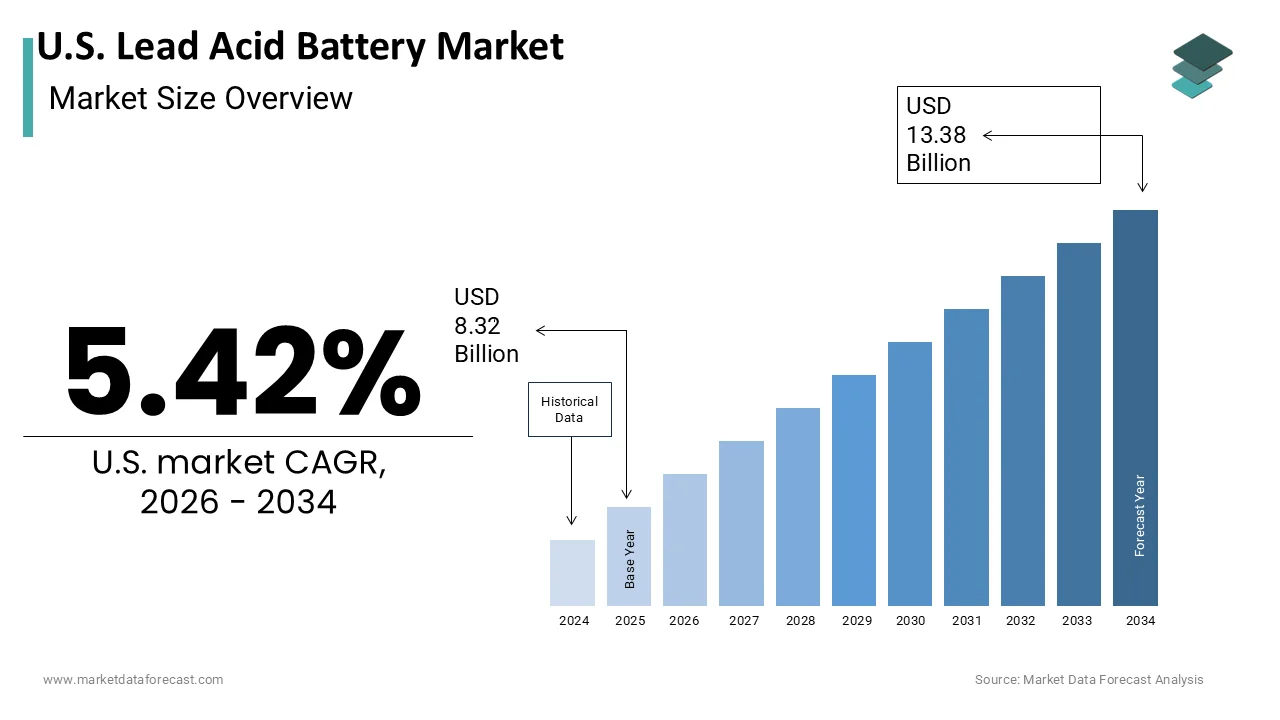
$8.32 BnMarket Estimate, 2026
$8.77 BnMarket Forecast, 2034
$13.38 BnCAGR, 2026–2034
5.42%U.S. Lead Acid Battery Market Size
The U.S. Lead Acid Battery Market was valued at USD 8.32 billion in 2025, is estimated to reach USD 8.77 billion in 2026, and is projected to reach USD 13.38 billion by 2034, growing at a CAGR of 5.42% from 2026 to 2034.
A lead-acid battery is a cost-effective, rechargeable energy storage device invented in 1859, which uses lead plates and sulfuric acid to generate power through reversible chemical reactions. These batteries remain indispensable due to their reliability, cost-effectiveness, and high recyclability, which align with circular economy principles. The technology is predominantly utilized for starting, lighting, ng and ignition functions in internal combustion engine vehicles as well as for backup power in data centers and healthcare facilities. As per the Environmental Protection Agency, lead acid batteries represent the most recycled consumer product in the United States, with a recycling rate exceeding 99 percent. This robust recovery infrastructure ensures a steady supply of secondary lea,d, reducing dependence on virgin raw materials. The Battery Council International states that the domestic industry supports thousands of jobs across manufacturing, collection, and recycling sectors. Regulatory frameworks such as the Resource Conservation and Recovery Act mandate strict handling and disposal protocols, also ensuring environmental safety. The Federal Highway Administration notes that the vast majority of the over 280 million registered vehicles in the country rely on lead-acid batteries for operation. Despite the emergence of lithium-ion alternatives, the established supply chain and proven performance of lead acid technology sustain its relevance. The Department of Energy acknowledges that lead-acid batteries continue to play a vital role in grid stability and uninterruptible power supply systems. This market operates within a mature yet evolving landscape where technological advancements in absorbed glass mat and enhanced flooded designs extend product life and efficiency.
MARKET DRIVERS
Sustained Demand from the Automotive Replacement Sector
The automotive replacement sector is fuelling the growth of the United States lead-acid battery market. This is due to the extensive vehicle parc and the inevitable degradation of battery performance over time. Lead-acid batteries typically have a service life of three to five years, necessitating regular replacement to ensure vehicle reliability. According to the Bureau of Transportation Statistics, there are approximately 290 million registered vehicles in the United States, creating a massive installed base that requires consistent maintenance. According to sources, the average age of vehicles on American roads has reached a record high of 12.8 years, signaling prolonged maintenance cycles for older vehicles. Older vehicles often place greater strain on electrical systems and require more frequent battery replacements compared to newer models. This trend amplifies the demand for replacement units as consumers prioritize vehicle longevity amid economic uncertainties that may delay new car purchases. According to motorist tracking data from the American Automobile Association (AAA), electrical system failures and dead batteries represent the leading causes of national roadside assistance service calls. Retailers and service centers maintain substantial inventories of lead-acid batteries to meet this steady demand. Furthermore, the complexity of modern vehicle electronics increases the power requirements even in traditional internal combustion engines. Start-stopp technologies, which are increasingly common to improve fuel efficiency,y also utilize advanced lead acid variants such as absorbed glass mat batteries. These factors collectively ensure a resilient and recurring revenue stream for manufacturers and distributors within the replacement market segment.
Critical Role in Uninterruptible Power Supply and Data Center Infrastructure
The expansion of data centers and the digital economy drives significant demand for lead acid batteries in uninterruptible power supply applications, which propels the United States lead acid battery market forward. As cloud computing, artificial intelligence, and big data analytics grow, the need for reliable backup power becomes paramount to prevent data loss and service interruptions. According to the International Energy Agency, electricity consumption by data centers globally is rising sharply, ly with the United States hosting a substantial portion of this infrastructure. The Uptime Institute reports that tier III and IV data centers require redundant power systems where lead acid batteries provide immediate power during outages until generators start. Valve-regulated lead-acid batteries are preferred in these settings due to their low maintenance requirements and proven reliability under standby conditions. The Department of Commerce notes that the construction of new data center facilities has accelerated in regions like Northern Virginia and Texas, reflecting increased digitalization. Each facility requires thousands of battery units to ensure seamless operation, making this a high-volume application segment. Additionally, telecommunications providers rely on similar backup systems to maintain network connectivity during power failures. The Federal Communications Commission emphasizes the importance of network resiliency,e which further mandates robust backup power solutions. Lithium-ion batteries are gaining traction in some new installations. However, the cost advantage and safety profile of lead-acid technology ensure its continued dominance in existing and many new data center projects.
MARKET RESTRAINTS
Stringent Environmental Regulations on Lead Emissions and Disposal
Stringent environmental regulations governing lead emissions and disposal practices are a major restraint on the US lead-acid battery market. This increases operational compliance costs. The Environmental Protection Agency enforces rigorous standards under the Clean Air Act and the Resource Conservation and Recovery Act to minimize lead exposure and environmental contamination. Compliance with these regulations requires manufacturers and recyclers to invest heavily in advanced filtration systems, waste management protocols,s and employee safety measures. According to the Occupational Safety and Health Administration, workplaces handling lead must adhere to strict permissible exposure limits, which necessitate continuous monitoring and protective equipment. These compliance requirements raise production costs, which can erode profit margins, ns particularly for smaller operators who lack economies of scale. The Centers for Disease Control and Prevention highlights that lead exposure remains a public health concern, ern driving ongoing regulatory scrutiny and potential tightening of standards. Any violation can result in substantial fines and operational shutdowns, creating financial uncertainty for industry participants. Additionally, transportation regulations for hazardous materials add logistical complexities and costs to the distribution network. The Department of Transportation mandates specific labeling and handling procedures for shipping spent bat, which increases administrative burdens. Public perception regarding the toxicity of lead also poses reputational risks,l risks prompting some end users to seek alternative chemistries despite the higher cost. These regulatory and societal pressures constrain market growth by imposing barriers to entry and increasing the total cost of lead-acid battery systems.
Competition from Advanced Lithium-Ion Battery Technologies
The growing competitiveness of lithium-ion battery technologies is hindering the expansion of the U.S. lead-acid battery market. This is driven by evolving performance expectations. Lithium-ion batteries offer higher energy density, longer cycle life, and faster charging capabilities,s making them increasingly attractive for automotive and industrial applications. According to the Department of Energy, the cost of lithium-ion battery packs has decreased by approximately 90 percent over the past decade, enhancing their economic viability. In the automotive sector, our original equipment manufacturers are increasingly adopting lithium-ion batteries for start-stop systems and mild hybrid vehicles to meet stricter fuel economy standards. The Union of Concerned Scientists notes that electrification trends are accelerating, with more vehicles incorporating high-voltage lithium-based systems. This shift reduces the addressable market for traditional lead-acid batteries in new vehicle production. In industrial applications, such as forklifts and renewable energy storage,e lithium-ion solutions are gaining share due to their lower total cost of ownership over time, despite higher upfront costs. The National Renewable Energy Laboratory indicates that lithium-ion batteries are becoming the preferred choice for new stationary storage installations due to their efficiency and scalability. As manufacturing capacity for lithium-ion batteries expands in the United States, driven by federal incentives,s the price gap continues to narrow. This technological substitution threatens the long-term dominance of lead acid batteries in key growth segments, ts forcing incumbent players to defend their market position against superior-performing alternatives.
MARKET OPPORTUNITIES
Advancements in Enhanced Flooded and Absorbent Glass Mat Technologies
Technological advancements in enhanced flooded and absorbent glass mat battery designs offer a significant opportunity for the US lead-acid battery market. These advancements make way to retain relevance in modern applications. Moreover, these advanced variants offer improved performance, durability, and charge acceptance compared to conventional flooded batteries,s making them suitable for vehicles with start-stop systems and regenerative braking. According to lead-acid battery manufacturing standards and industry performance data, absorbent glass mat batteries can last up to three times longer than traditional flooded batteries under high stress conditions. This extended lifespan appeals to consumers seeking reduced maintenance and replacement frequency. Automotive manufacturers are increasingly specifying these advanced lead-acid technologies to meet fuel efficiency targets without the high cost of full hybridization. Automotive engineering analyses highlight that micro-hybrid vehicles, which rely on absorbent glass mat batteries to support start-stop technology and regenerative braking, represent a dominant and growing segment of the new vehicle market. Additionally, improvements in grid alloys and separator materials have enhanced the thermal stability and vibration resistance of these batteries. Industrial users such as telecommunications companies are also adopting valve-regulated lead-acid batteries with enhanced designs for better reliability in remote locations. The Federal Communications Commission mandates network reliability, which drives upgrades to backup power systems using these advanced technologies. Manufacturers can bridge the gap between conventional lead-acid and lithium-ion technologies by offering cost-effective solutions. By doing so, they can capture value in niche applications where safety and cost are prioritized over maximum energy density.
Expansion of Recycling Infrastructure and Circular Economy Initiatives
Expanding recycling infrastructure and circular economy initiatives provide a promising prospect for the US lead-acid battery market. These efforts will drive greater sustainability while reducing raw material costs. The closed-loop recycling system for lead-acid batteries is highly efficient, allowing manufacturers to source a significant portion of their lead from recycled batteries rather than mined ore. According to the Environmental Protection Agency and industry sustainability studies, approximately 80 to 85 percent of the lead used in new domestic batteries comes from recycled sources, operating within a closed-loop system that stabilizes supply chains against geopolitical and mining disruptions. Investing in advanced recycling technologies enables companies to recover lead and plastic with higher purity and lower environmental impact. The Institute of Scrap Recycling Industries (now the Recycled Materials Association) states that the scrap battery recycling industry contributes billions of dollars to the US economy while supporting environmental goals. Regulatory incentives for sustainable practices encourage automakers and industrial users to partner with manufacturers who demonstrate strong environmental stewardship. Corporate sustainability reports increasingly highlight recycling rates as key performance indicators driving demand for responsibly sourced batteries. Additionally, the development of second-life applications for used batteries in less demanding stationary storage roles extends their utility. The Department of Energy supports research into optimizing battery reuse and recycling processes to maximize resource efficiency. By leveraging these circular economy principles, manufacturers can reduce production costs, mitigate regulatory risks, and appeal to environmentally conscious consumers. This strategic focus on sustainability not only strengthens brand reputation but also ensures long-term viability in a resource-constrained world.
MARKET CHALLENGES
Volatility in Raw Material Prices and Supply Chain Disruptions
Volatility in raw material prices, particularly lead and sulfuric acid, poses a major challenge to the US lead acid battery market. This impacts production costs and profitability. Lead prices are subject to global commodity market fluctuations influenced by mining output,t trade policies, and currency exchange rates. According to the United States Geological Survey, ey the price of lead can vary significantly year over year, ear affecting the cost structure of battery manufacturers. Since raw materials constitute a large portion of total production costs, sudden price spikes can squeeze margins if companies cannot pass these costs onto customers. Supply chain disruptions caused by geopolitical tensions or logistical bottlenecks further exacerbate this issue. The United States Geological Survey and federal critical material strategies note that reliance on imported lead concentrates or foreign recycled materials can introduce upstream supply chain vulnerabilities. Additionally, the cost of polypropylene for battery casings is linked to oil prices, adding another layer of variability. Manufacturers must employ sophisticated hedging strategies along-term contracts to manage these risks, which requires financial expertise and capital. Small and medium-sized enterprises may struggle to absorb these costs, leading to market consolidation. Furthermore, inventory management becomes complex as companies balance the need for stock against the risk of holding depreciating assets. These financial pressures challenge the stability of the industry and can lead to inconsistent pricing for end use, rs affecting demand elasticity and market predictability.
Labor Shortages and Safety Compliance in Manufacturing and Recycling
Labor shortages and stringent safety compliance requirements in manufacturing and recycling facilities slow down the expansion of the United States lead-acid battery market. The industry faces difficulties in attracting and retaining skilled workers due to the perceived hazards associated with lead handling and heavy industrial environments. According to the Bureau of Labor Statistics, the manufacturing sector has experienced a persistent labor gap,s which affects production capacity and operational efficiency. Safety regulations mandated by the Occupational Safety and Health Administration require extensive training, ng protective equipment, ent and medical monitoring for employees exposed to lead. These compliance measures increase operational costs and administrative burdens for companies. The Occupational Safety and Health Administration mandates and enforces rigorous medical surveillance and biological monitoring to prevent occupational lead poisoning, which necessitates dedicated workplace medical resources. Any lapse in safety protocols can result in severe legal consequences and reputational damage. Additionally, aligning the aging workforce in traditional manufacturing roles creates a knowledge gap as experienced workers retire. Recruiting younger generations to these roles requires significant investment in workplace culture and safety branding. Automation offers a potential solution but requires substantial capital investment and technical expertise to implement effectively. The National Association of Manufacturers highlights that workforce development is a top concern for industrial leaders. The market will face constraints on its ability to scale production and maintain consistent quality standards. This will continue until labor and safety challenges are adequately addressed.
REPORT COVERAGE
| REPORT METRIC | DETAILS |
| Market Size Available | 2025 to 2034 |
| Base Year | 2025 |
| Forecast Period | 2026 to 2034 |
| Segments Covered | By Type, Application Region. |
| Various Analyses Covered | Global, Regional and Country-Level Analysis, Segment-Level Analysis, Drivers, Restraints, Opportunities, Challenges; PESTLE Analysis; Porter’s Five Forces Analysis, Competitive Landscape, Analyst Overview of Investment Opportunities |
| Countries Covered | California, Washington, Oregon, New York, the rest of the United States |
| Market Leaders Profiled | Clarios, EnerSys, East Penn Manufacturing Company, Exide Technologies, GS Yuasa Corporation, C&D Technologies, Inc., Trojan Battery Company, Crown Battery Manufacturing Company, NorthStar Battery Company, Concorde Battery Corporation, Power Sonic Corporation, Amara Raja Energy & Mobility Limited |
SEGMENTAL ANALYSIS
By Type Insights
In 2025, the flooded lead acid batteries segment dominated the United States market and accounted for a 57.9% share. This dominance of the segment was driven by its entrenched role in the automotive starter, lighting, and ignition sector. The widespread adoption of internal combustion engine vehicles necessitates a consistent demand for cost-effective and reliable power sources. According to the Bureau of Transportation Statistics, there are over 280 million registered vehicles in the United States,s the majority of which utilize flooded lead-acid batteries for initial engine cranking. The economic advantage of flooded batteries makes them the preferred choice for original equipment manufacturers and replacement markets alike. The Society of Automotive Engineers notes that despite technological advancements in alternative chemistries, flooded lead acid remains the standard for conventional vehicles due to its proven track record and low upfront cost. Additionally,y the extensive recycling infrastructure for flooded batteries ensures a steady supply of raw materials, which keeps production costs manageable. The Environmental Protection Agency reports that the recycling rate for these batteries exceeds 99 per, cent creaticlosed-loop loop system that supports sustainable manufacturing practices. This established ecosystem reduces dependency on virgin lead mining and stabilizes supply chains. Furthermore, the simplicity of flooded battery technology allows for easy maintenance and replacement by consumers and service technicians. Various sources confirm that electrical system servicing and battery replacement remain among the most frequent automotive services and emergency roadside assistance calls executed nationwide. This high frequency of service, combined with the large vehicle parc, sustains the dominance of the flooded segment in the US market.
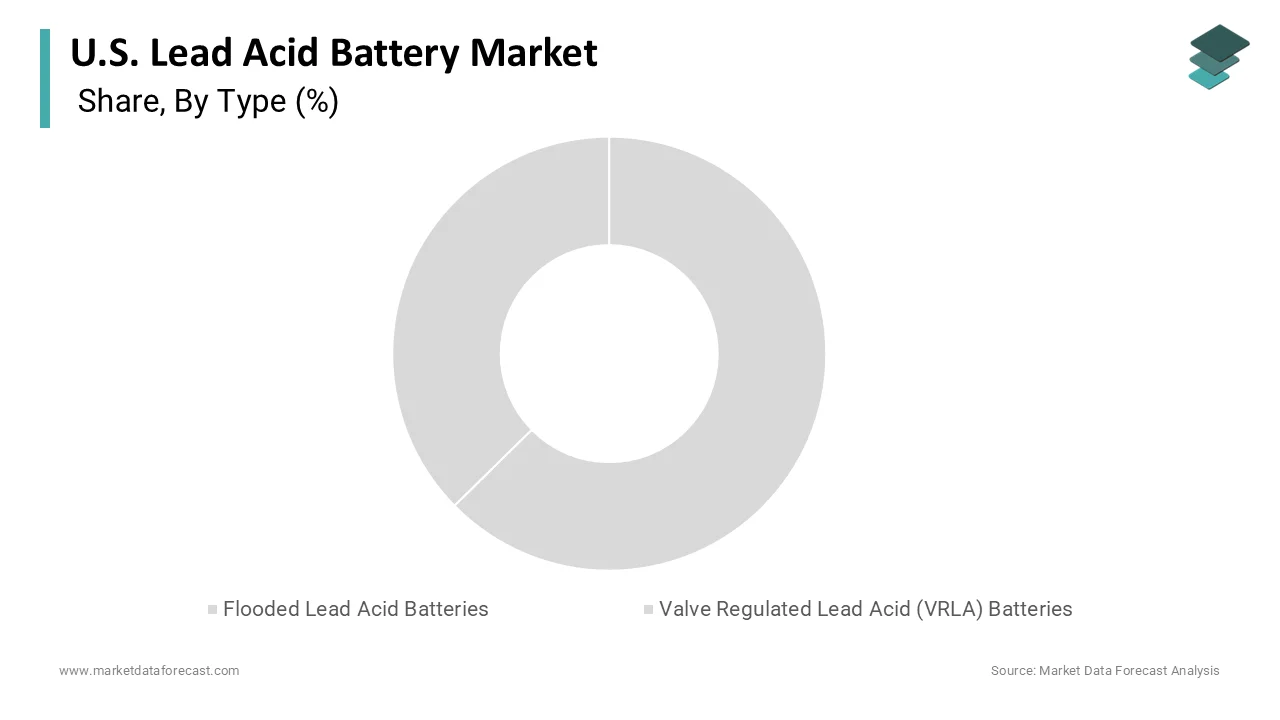
The valve-regulated lead-acid segment is estimated to register the fastest CAGR of 4.5% from 2026 to 2034 due to increasing demand for maintenance-free and high-performance energy storage solutions. This segment includes absorbed glass mat and gel batteries, which offer superior vibration resistance and longer service life compared to traditional flooded types. According to the Battery Council International, the adoption of valve-regulated lead-acid batteries is accelerating in applications such as start-stop vehicles, telecommunication,s and uninterruptible power supplies. Industrial building codes and structural infrastructure standards, such as the National Electrical Code (NFPA 70) and Telcordia reliability baselines, enforce strict emergency backup requirements for telecom exchanges and critical network infrastructure, driving massive deployment of maintenance-free VRLA batteries to secure uptime during localized power grid drops. These batteries provide consistent performance in standby applications without the need for regular water topping or maintenance. Additionally, the rise of micro hybrid vehicles equipped with start-stop technology requires batteries that can handle frequent cycling and rapid recharging. The Society of Automotive Engineers highlights that absorbed glass mat batteries are increasingly specified by automakers to meet fuel efficiency standards. Their ability to recover charge quickly during regenerative braking makes them ideal for modern vehicle architectures. Furthermore, the growing construction of data centers in the United States,s as noted by the Department of Commerce, increases demand for reliable backup power systems. Valve-regulated lead-acid batteries offer a balance of safety, cost,t and performance that appeals to facility managers. This combination of automotive innovation and infrastructure development propels the rapid expansion of the valve-regulated segment.
By Application Insights
The starting lighting and ignition application segment led the US lead acid battery market and captured a substantial share in 2025. This leading position of the segment was attributed to the sheer volume of conventional vehicles on American roads. Every internal combustion engine vehicle requires a battery to start the engine and power electrical accessories when the alternator is not running. According to the Federal Highway Administration, the number of vehicle miles traveled in the United States continues to rise, indicating high utilization rates and subsequent wear on automotive batteries. The average lifespan of a lead-acid battery in this application is three to five years, creating a consistent replacement cycle. The Bureau of Labor Statistics consumer expenditure surveys indicate that automotive maintenance and repair costs remain a significant household expense, ensuring steady demand for replacement batteries. According to aftermarket tracking data from the Auto Care Association (ACA), battery replacement represents one of the highest-volume services performed across independent workshops and automotive networks annually. This robust aftermarket activity sustains the leading position of the starting, lighting, and ignition segment. Furthermore, the complexity of modern vehicle electronics increases the load on batteries even in non-hybrid vehicles. Features such as advanced infotainment systems, safety sensors, and connectivity modules require a stable power supply, which lead-acid batteries provide reliably. The Society of Automotive Engineers emphasizes that, despite the growth of electric vehicles, the vast majority of the current fleet relies on internal combustion engines. This legacy fleet ensures that starting, lighting, and ignition applications will remain the primary driver of lead-acid battery consumption in the near term.
The stationary application segment is anticipated to witness the fastest CAGR of 5.7% during the forecast period, due to the expansion of data centers and telecommunications infrastructure. In addition, the need for uninterrupted power supply systems is becoming critical as digitalization accelerates. These systems are essential for maintaining operational continuity. According to the Uptime Institute, the data center investments in the United States are reaching record levels, els with facilities requiring robust backup power solutions to prevent data loss. Valve-regulated lead-acid batteries are widely used in these uninterruptible power supply systems due to their reliability and cost-effectiveness. The Department of Commerce notes that the information technology sector is one of the fastest-growing components of the US economy, further fueling demand for stationary storage. Additionally,y the telecommunications industry relies on stationary batteries to keep cell towers operational during power outages. The Federal Communications Commission has implemented stricter resilience standards for communication networks, prompting providers to upgrade their backup power infrastructure. This regulatory push drives the replacement of older batteries with newer, high-capacity units. Furthermore, the integration of renewable energy sources such as solar and wind into the grid creates opportunities for stationary storage to manage intermittency. While lithium-ion batteries are gaining share in some renewable applications, lead acid remains competitive for short-duration backup needs. The Energy Information Administration reports increasing installations of distributed energy resources, which often pair with stationary battery systems. This convergence of digital infrastructure growth and grid modernization initiatives accelerates the expansion of the stationary application segment.
COUNTRY LEVEL ANALYSIS
United States Lead Acid Battery Market Analysis
The United States was the top performer in the North American lead acid battery market and occupied a 81.6% share in 2025. This position of the U.S. market was propelled by its dominant industrial and automotive base. The market status within the country is characterized by a mature yet resilient industry supported by a comprehensive recycling infrastructure and stringent environmental regulations. As per the Environmental Protection Agency,y the United States achieves a lead acid battery recycling rate of over 99 percent, which is among the highest globally. This efficient recovery system ensures a stable supply of secondary lead, reducing reliance on imported raw materials and lowering production costs. The Battery Council International states that the domestic industry supports a significant number of jobs in manufacturing, collection, and recycling sectors, contributing to local economies. Regulatory frameworks such as the Resource Conservation and Recovery Act mandate safe handling and disposal practices, ensuring environmental protection while sustaining industry operations. The Federal Highway Administration reports that the vast vehicle parc in the United States drives consistent demand for replacement batteries in the automotive sector. Additionally, the rapid expansion of data centers and telecommunications networks, ks as noted by the Department of Commerce,rce creates robust demand for stationary power applications. Technological advancements in valve-regulated lead-acid batteries are enabling the industry to meet the performance requirements of modern applications such as start-stop vehicles. The Department of Energy acknowledges the role of lead-acid batteries in grid stability and backup power systems. This combination of regulatory support, established infrastructure,e and diverse application demand ensures the United States remains a pivotal market for lead acid battery technologies globally.
COMPETITIVE LANDSCAPE
The competition in the United States lead-acid battery market is characterized by a consolidated landscape dominated by a few major manufacturers who leverage economies of scale and established distribution networks. These leading entities compete primarily on product reliability, cost efficiency, and sustainability credentials rather than just price. The market faces pressure from alternative battery technologies such as lithium-ion, which prompts incumbent players to innovate and improve the performance of lead-acid variants. Regulatory compliance regarding environmental protection and safety standards serves as a significant barrier to entry, ensuring that only well-capitalized firms can operate effectively. Companies differentiate themselves through advanced recycling capabilities, which lower production costs and enhance brand reputation among environmentally conscious stakeholders. The automotive sector remains the primary battleground with manufacturers striving to meet the evolving power requirements of modern vehicles, including start-stop systems. Industrial applications such as data centers and telecommunications provide additional competitive avenues where reliability and service support are paramount. Labor availability and skilled workforce retention also influence competitive dynamics as automation becomes increasingly vital. Overall, the market requires continuous investment in technology and sustainability to maintain relevance and profitability amidst shifting energy storage trends.
KEY MARKET PLAYERS
Some of the companies that are playing a dominating role in the U.S. lead-acid battery market include
- Clarios
- EnerSys
- East Penn Manufacturing Company
- Exide Technologies
- GS Yuasa Corporation
- C&D Technologies, Inc.
- Trojan Battery Company
- Crown Battery Manufacturing Company
- NorthStar Battery Company
- Concorde Battery Corporation
- Power Sonic Corporation
- Amara Raja Energy & Mobility Limited
TOP LEADING MARKET PLAYERS
- Clarios International LLC stands as a global leader in energy storage solutions with a significant footprint in the United States lead-acid battery sector. The company manufactures and distributes advanced battery technologies for automotive, industrial, and specialty applications. Clarios focuses heavily on innovation in developing enhanced flooded and absorbed glass mat batteries that meet the rigorous demands of modern vehicles. Recently, the company has invested substantially in sustainable manufacturing practices,s aiming to reduce its carbon footprint and water usage. By leveraging a robust recycling network, Clarios ensures a circular supply chain that minimizes waste and raw material costs. The corporation actively collaborates with original equipment manufacturers to design custom power solutions for next-generation vehicles. These strategic initiatives reinforce its market position by aligning product development with environmental sustainability and technological advancement while maintaining high production standards and reliable distribution channels across the nation.
- East Penn Manufacturing Co., Inc. operates as a prominent independent manufacturer of lead-acid batteries in the United States, known for its vertical integration and quality control. The company produces a wide range of flooded and valve-regulated lead-acid batteries under the Deka brand, serving automotive, commercial, and industrial sectors. East Penn maintains strict oversight over every stage of production from lead refining to battery assembly, which ensures consistent product performance. Recent efforts include expanding its recycling capabilities to recover more materials internally,t hereby thereby dreducing ependency on external suppliers. The firm also invests in research and development to improve battery life and charge acceptance for start-stop applications. By prioritizing domestic manufacturing and workforce training, East Penn strengthens its reputation for reliability and service. This approach allows the company to respond quickly to market changes and customer needs while upholding high environmental and safety standards in its operations.
- Exide Technologies is a key participant in the US lead-acid battery market, providing comprehensive energy storage solutions for transportation and industrial applications. The company offers a diverse portfolio, including conventional flooded and advanced absorbed glass mat batteries designed for various vehicle types and backup power systems. Exide has recently focused on optimizing its manufacturing footprint to enhance efficiency and reduce operational costs. The organization emphasizes sustainability by improving its recycling processes and reducing emissions at production facilities. Exide actively engages with customers to provide tailored solutions for specific power requirements, such as those found in telecommunications and data centers. By investing in digital tools for inventory management and customer service, eExide improves supply chain responsiveness. These actions help the company maintain a competitive edge by delivering high-quality products while adapting to evolving regulatory standards and market demands for cleaner and more efficient energy storage technologies.
TOP STRATEGIES USED BY KEY MARKET PARTICIPANTS
Key players in the United States lead-acid battery market primarily focus on vertical integration to control costs and ensure supply chain stability. Companies invest heavily in recycling infrastructure to recover lead and plastic, creating a closed-loop system that reduces raw material expenses. Product innovation is another critical strategy, with firms developing advanced flooded and absorbed glass mat batteries to meet the demands of start-stop vehicles and modern electronics. Sustainability initiatives are increasingly important as manufacturers adopt cleaner production methods to comply with environmental regulations and appeal to eco-conscious consumers. Strategic partnerships with original equipment manufacturers allow companies to secure long-term contracts and integrate their technologies into new vehicle designs. Additionally, firms expand their distribution networks to improve market reach and customer service. Automation in manufacturing processes is employed to enhance efficiency and reduce labor costs. These strategies collectively help participants maintain competitiveness in a mature market by balancing cost efficiency with technological advancement and environmental responsibility.
MARKET SEGMENTATION
This research report on the U.S. lead acid battery market is segmented and sub-segmented into the following categories.
By Type
- Flooded Lead Acid Batteries
- Valve Regulated Lead Acid (VRLA) Batteries
- Absorbent Glass Mat (AGM) Batteries
- Gel Batteries
By Application
- Starting, Lighting, and Ignition (SLI)
- Stationary
- Motive
By Country
- California
- Washington
- Oregon
- New York
- Rest of the United States
Related Reports
Access the study in MULTIPLE FORMATS
Purchase options starting from
$ 1200
Didn’t find what you’re looking for?
TALK TO OUR ANALYST TEAM
Need something within your budget?
NO WORRIES! WE GOT YOU COVERED!
Call us on: +1 888 702 9696 (U.S Toll Free)
Write to us: sales@marketdataforecast.com