- Product Description Description
- Table of Contents TOC
- List of Table & Figure LOT
- Get Free Sample PDF Sample PDF
Market Size, 2025
$52.12 BnMarket Estimate, 2026
$53.09 BnMarket Forecast, 2034
$61.57 BnCAGR, 2026–2034
1.87%U.S. Lubricants Market Report Summary
The U.S. lubricants market was valued at USD 52.12 billion in 2025, is estimated to reach USD 53.09 billion in 2026, and is projected to reach USD 61.57 billion by 2034, growing at a CAGR of 1.87% during the forecast period from 2026 to 2034. The growth of the U.S. lubricants market is driven by the expansion of the automotive fleet, increasing industrial manufacturing activity, and rising infrastructure development projects across the country. The growing demand for engine oils, hydraulic fluids, gear oils, and specialty lubricants in automotive, industrial, marine, and aerospace applications is further supporting market growth. Additionally, advancements in synthetic lubricant technologies and the increasing adoption of high-performance and energy-efficient lubricants are contributing to market expansion.
Key Market Trends
- Rising demand for high-performance synthetic lubricants with superior thermal stability and fuel efficiency
- Increasing focus on bio-based and environmentally sustainable lubricant formulations
- Growing adoption of electric vehicle-specific lubricants and cooling fluids
- Expansion of predictive maintenance technologies and smart industrial lubrication systems
- Strong emphasis on energy efficiency, reduced emissions, and extended equipment life cycles
Segmental Insights
- Based on base oil, the mineral oil segment held the largest share of the U.S. lubricants market in 2025. The segment’s dominance is attributed to the cost-effectiveness, widespread availability, and established manufacturing infrastructure supporting conventional lubricant production.
- Based on application, the automotive & transportation segment accounted for the largest share of the U.S. lubricants market in 2025. The dominance of this segment is driven by the large vehicle population, increasing vehicle miles traveled, and recurring demand for engine oils, transmission fluids, and gear oils.
- The synthetic oil segment is anticipated to witness notable growth during the forecast period owing to the rising adoption of fuel-efficient vehicles, stringent emission regulations, and growing consumer preference for advanced engine protection solutions.
- The industrial segment is also projected to experience considerable growth due to the increasing deployment of automation technologies, manufacturing equipment, and heavy machinery requiring advanced lubrication systems.
Regional Insights
The U.S. lubricants market is witnessing stable growth across California, Washington, Oregon, New York, and the rest of the United States, supported by the strong automotive sector, industrial manufacturing activity, and ongoing investments in infrastructure and energy projects. California remains one of the major regional markets due to its large automotive population, industrial operations, and increasing adoption of environmentally friendly lubricant solutions.
Competitive Landscape
The U.S. lubricants market is highly competitive and characterized by the presence of major integrated oil companies, specialized lubricant manufacturers, and premium synthetic lubricant brands competing through product innovation, technological advancements, sustainability initiatives, and strategic partnerships. Companies are increasingly focusing on synthetic lubricant development, electric vehicle fluid technologies, eco-friendly formulations, and advanced industrial lubrication solutions to strengthen their market presence and customer base. Prominent players in the U.S. lubricants market include Exxon Mobil Corporation, Shell plc, BP p.l.c. (Castrol), Chevron Corporation, Valvoline, Phillips 66 Company, TotalEnergies, FUCHS, AMSOIL Inc., CITGO Petroleum Lubricants, Idemitsu Lubricants America, Quaker Chemical Corporation, Petro-Canada Lubricants, Motul USA, Pennzoil, Lucas Oil Products Inc., Calumet Inc., Gulf Oil International, BASF SE, and ENEOS Corporation.
U.S. Lubricants Market Size
The U.S. lubricants market size was valued at USD 52.12 billion in 2025 and is anticipated to reach USD 53.09 billion in 2026 from USD 61.57 billion by 2034, growing at a CAGR of 1.87% during the forecast period from 2026 to 2034.

The lubricants are fluid formulations designed to reduce friction wear and heat in mechanical systems across industrial automotive and marine applications. These essential products include engine oils hydraulic fluids gear oils and greases that ensure the operational longevity and efficiency of machinery. As per the Federal Highway Administration, there are over 283 million registered vehicles in the United States creating a substantial baseline demand for automotive lubricants. The industrial sector further contributes to this demand with the Bureau of Labor Statistics reporting that manufacturing output remains a component of the national economy requiring continuous maintenance of heavy equipment. The Energy Information Administration notes that the United States produces approximately 12 million barrels of crude oil per day providing a robust supply chain for base oil production, which is the primary ingredient in lubricant formulation. Additionally, the prevalence of extreme weather conditions across different regions necessitates specialized lubricant properties to maintain performance standards. According to the National Oceanic and Atmospheric Administration temperature variations significantly impact viscosity requirements driving the need for advanced synthetic formulations. The transition towards higher efficiency engines and stricter emission standards also influences product development. The Environmental Protection Agency mandates rigorous emission controls which require low viscosity and high stability lubricants to optimize fuel economy. This complex interplay between vehicle population industrial activity and regulatory frameworks defines the operational landscape of the United States lubricants market ensuring sustained relevance in maintaining mechanical integrity and operational efficiency.
MARKET DRIVERS
Expansion of the Automotive Fleet and Increased Vehicle Miles Traveled
The continuous expansion of the automotive fleet and the subsequent increase in vehicle miles traveled is amplifying the growth of the United States lubricants market. As more vehicles enter the road network, the cumulative demand for engine oils transmission fluids and other automotive lubricants rises proportionally. As per the Federal Highway Administration, the total number of vehicle miles traveled in the United States exceeded 3.2 trillion miles in recent annual assessments indicating high utilization rates of personal and commercial vehicles. This extensive usage accelerates the degradation of lubricants necessitating frequent replacement to ensure engine protection and performance. Older vehicles often consume more oil and require more frequent changes compared to newer models, thereby sustaining demand for conventional and semi synthetic lubricants. Furthermore, the growth of the commercial trucking sector contributes significantly to this trend. These engines demand high performance lubricants capable of withstanding high temperatures and loads. The sheer volume of miles driven by both passenger and commercial vehicles ensures a steady and recurring revenue stream for lubricant manufacturers.
Industrial Manufacturing Activity and Infrastructure Development
The robust industrial manufacturing activity and ongoing infrastructure development is another attribute promoting the growth of the United States lubricants market. Manufacturing facilities rely heavily on hydraulic systems gears and bearings that require specialized lubricants to operate efficiently and minimize downtime. The industrial production in the United States has shown resilience with manufacturing output contributing substantially to the gross domestic product. The construction sector also plays a vital role with the Census Bureau reporting billions of dollars in new construction spending annually. Heavy machinery used in construction, such as excavators bulldozers and cranes operates in harsh environments by requiring high quality hydraulic and gear oils to prevent equipment failure. The Department of Labor notes that employment in construction and manufacturing sectors remains strong indicating active utilization of industrial equipment. Infrastructure bills passed by Congress have allocated hundreds of billions of dollars for road bridge and utility improvements further stimulating the use of heavy machinery. These projects require reliable lubrication solutions to ensure project timelines are met without mechanical interruptions. Additionally, the energy sector including oil and gas extraction relies on specialized lubricants for drilling rigs and processing equipment. The domestic energy production remains high supporting demand for industrial grade lubricants. The combination of manufacturing output construction activity and energy exploration creates a multifaceted demand profile for industrial lubricants.
MARKET RESTRAINTS
Transition to Electric Vehicles and Reduced Engine Oil Demand
The rapid transition to electric vehicles by reducing the demand for traditional engine oils is hindering the growth of the United States lubricants market. Electric vehicles do not have internal combustion engines, which eliminates the need for regular engine oil changes one of the largest revenue streams for lubricant manufacturers. As per the Environmental Protection Agency, sales of electric vehicles in the United States have grown exponentially with millions of units now on the road. This shift threatens the long-term viability of conventional automotive lubricant segments. The International Energy Agency projects that electric vehicle adoption will continue to accelerate driven by government incentives and consumer preference for sustainable transportation. While electric vehicles still require lubricants for transmissions and bearings the volume required is significantly lower than that of internal combustion engines. The Society of Automotive Engineers notes that electric powertrains have fewer moving parts and operate at lower temperatures reducing the frequency and quantity of lubricant replacements. This structural change in vehicle technology forces lubricant companies to rethink their product portfolios and business models. The decline in engine oil demand cannot be fully offset by the niche requirements of electric vehicle fluids in the short term.
Stringent Environmental Regulations and Sustainability Mandates
The strict environmental regulations and sustainability mandates by imposing compliance costs and limiting product formulations is another factor impeding the growth of the United States lubricants market. Government agencies enforce rigorous standards on the chemical composition of lubricants to minimize environmental impact and toxicity. Regulations, such as the Toxic Substances Control Act require extensive testing and reporting for chemical substances used in lubricant formulations. Compliance with these regulations increases research and development expenses for manufacturers, who must reformulate products to meet safety standards. Additionally, the push for biodegradable and eco-friendly lubricants limits the use of certain high performance additives that may be harmful to the environment. These regulatory burdens can delay product launches and increase prices for end consumers. Smaller manufacturers may struggle to meet these compliance requirements leading to market consolidation. The constant evolution of environmental laws creates uncertainty for long term planning and product development.
MARKET OPPORTUNITIES
Development of High Performance Synthetic Lubricants
The development and adoption of high-performance synthetic lubricants to capture value in premium products is majorly to escalate the growth of the United States lubricants market. Synthetic lubricants offer superior thermal stability oxidation resistance and wear protection compared to conventional mineral oils by making them ideal for modern high efficiency engines and industrial machinery. The trend towards lower viscosity engine oils to improve fuel economy favors synthetic formulations, which can maintain film strength at thinner consistencies. The Energy Information Administration notes that improving fuel efficiency is a key goal for both consumers and regulators driving demand for advanced lubricants that reduce friction. Industrial sectors, such as aerospace and wind energy also require specialized synthetic lubricants that can withstand extreme temperatures and loads. Synthetic lubricants extend equipment life and reduce maintenance frequency offering long term cost savings for industrial users. The high performance lubricants can enhance productivity and reduce downtime. Lubricant manufacturers are innovating with bio-based synthetics to meet sustainability goals, while maintaining performance.
Expansion into Renewable Energy and Specialty Applications
The expansion into renewable energy sectors and specialty applications to diversify its revenue streams is another attribute to bolster the growth of the United States lubricants market. As the country shifts towards clean energy sources new types of machinery and equipment are being deployed that require specialized lubrication solutions. As per the Department of Energy, investments in solar wind and hydroelectric power are increasing creating demand for lubricants that are compatible with these technologies. Wind turbines for example require specific gear oils and greases that can operate reliably in remote and harsh environments for extended periods. Similarly, the growth of data centers powered by renewable energy requires advanced cooling fluids and lubricants for server infrastructure. The Uptime Institute reports that data center capacity in the United States is expanding rapidly necessitating specialized thermal management solutions. Lubricant manufacturers are developing bio based and environmentally acceptable lubricants for use in sensitive ecosystems such as marine and forestry applications.
MARKET CHALLENGES
Volatility in Base Oil Prices and Supply Chain Disruptions
The fluctuations in base oil prices and supply chain disruptions by impacting profitability and production stability is another factor hampering the growth of the United States lubricants market. Base oils derived from crude oil constitute the primary raw material for lubricant formulation by making the industry highly sensitive to energy sector. The crude oil prices have experienced significant volatility due to geopolitical tensions and changes in global supply and demand. These price fluctuations directly affect the cost of production for lubricant manufacturers, who may struggle to pass on increased costs to price sensitive customers. Supply chain hurdles further exacerbate the issue with delays in the delivery of additives and packaging materials. The logistics challenges can lead to inventory shortages and increased lead times. According to the Institute for Supply Management, procurement managers report ongoing challenges in sourcing raw materials consistently. This uncertainty makes financial planning and inventory management difficult for lubricant companies.
Counterfeit Products and Quality Assurance Issues
The prevalence of counterfeit lubricant products and quality assurance issues by undermining consumer trust and brand integrity, which is also to pose as a major challenge for the growth of the United States lubricants market. Counterfeit oils often fail to meet industry specifications leading to equipment damage and safety hazards. The organization actively combats counterfeit products but the issue remains pervasive, particularly in the online. Consumers and businesses may inadvertently purchase substandard lubricants that lack the necessary protective properties resulting in increased wear and premature engine failure. The National Insurance Crime Bureau reports that fraud in the automotive parts sector, including lubricants is a growing concern causing billions of dollars in losses annually. Identifying counterfeit products is difficult for end users, who may not have the technical expertise to verify authenticity. This problem damages the reputation of legitimate brands when customers attribute equipment failures to the product rather than the counterfeit nature of the item. Lubricant manufacturers must invest heavily in anti-counterfeit technologies, such as holographic labels and digital tracking systems. The lack of uniform enforcement across different sales channels allows counterfeiters to operate with impunity.
REPORT COVERAGE
| REPORT METRIC | DETAILS |
| Market Size Available | 2025 to 2034 |
| Base Year | 2025 |
| Forecast Period | 2026 to 2034 |
| CAGR | 1.87% |
| Segments Covered | By Base Oil, Application, and Region. |
| Various Analyses Covered | Global, Regional & Country Level Analysis, Segment-Level Analysis; DROC, PESTLE Analysis, Porter's Five Forces Analysis, Competitive Landscape, Analyst Overview of Investment Opportunities |
| Countries Covered | California, Washington, Oregon, New York, and the rest of the United States. |
| Market Leader Profiled | Exxon Mobil Corporation, Shell plc, BP p.l.c. (Castrol), Chevron Corporation, Valvoline, Phillips 66 Company, TotalEnergies, FUCHS, AMSOIL Inc., CITGO Petroleum Lubricants, Idemitsu Lubricants America, Quaker Chemical Corporation, Petro-Canada Lubricants, Motul USA, Pennzoil, Lucas Oil Products Inc., Calumet Inc., Gulf Oil International, BASF SE, and ENEOS Corporation. |
SEGMENTAL ANALYSIS
By Base Oil Insights
The mineral oil segment was the largest by holding 59.3% of the United States lubricants market share in 2025 due to its cost effectiveness and the established manufacturing infrastructure that supports its production. Derived from crude oil refining mineral oils are significantly cheaper to produce than synthetic alternatives by making them the preferred choice for price sensitive consumers and industrial applications. As per the Energy Information Administration, the United States produces approximately 12 million barrels of crude oil per day ensuring a stable and abundant supply of raw materials for base oil production. The American Petroleum Institute notes that Group I and Group II base oils which are primarily mineral based account for the majority of lubricant volume sold in the country. Many legacy vehicles and older industrial machinery are designed to operate efficiently with mineral oils which meet their performance requirements without the need for advanced synthetic formulations. The Bureau of Labor Statistics reports that maintenance costs are a significant concern for small businesses and individual vehicle owners, who often opt for mineral oils to minimize operational expenses. Furthermore, the widespread distribution network for conventional motor oils ensures easy accessibility for consumers across rural and urban areas. The familiarity and trust in mineral oil technology among mechanics and equipment operators further reinforce its dominance.
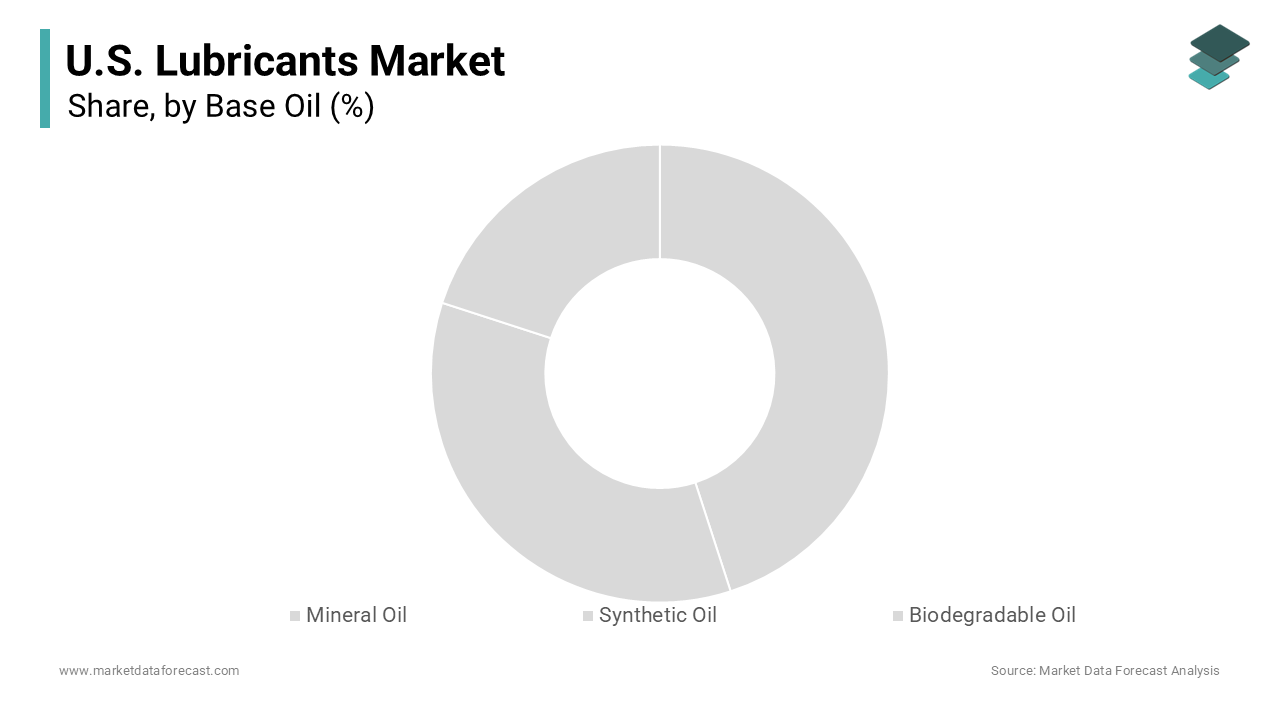
The synthetic oil segment is likely to witness a fastest CAGR of 4.5% from 2026 to 2034 with the increasing demand for high performance lubricants that enhance fuel efficiency and protect modern engines. The stricter fuel economy standards require vehicles to operate with lower viscosity oils that reduce internal friction. Synthetic oils offer superior flow characteristics at low temperatures and stability at high temperatures by making them ideal for meeting these regulatory requirements. Consumers are also becoming more aware of the benefits of synthetic oils, such as extended drain intervals and better engine protection. The rise of turbocharged and direct injection engines, which operate under higher stress conditions that further drives the adoption of synthetic lubricants. These engines require oils that can withstand extreme pressures and temperatures without breaking down.
By Application Insights
The automotive and transportation segment was the largest by accounting for 44.7% of the United States lubricants market share in 2025 due to the high vehicle population and the regular maintenance requirements associated with internal combustion engines. With millions of cars trucks and motorcycles on the road, the demand for engine oils transmission fluids and other automotive lubricants is substantial. As per the Federal Highway Administration, there are over 283 million registered vehicles in the United States each requiring periodic lubricant changes to ensure proper functioning. The high frequency of maintenance creates a steady and recurring demand for automotive lubricants. These commercial vehicles operate under severe conditions requiring frequent oil changes to prevent engine failure and maintain efficiency. Additionally, the prevalence of independent repair shops and quick lube centers that makes it convenient for consumers to access automotive lubricants. The National Institute for Automotive Service Excellence certifies thousands of technicians who recommend and apply lubricants during routine service visits. This extensive network of service providers ensures that automotive lubricants remain easily accessible and widely used.
The Industrial segment is lucratively growing at an anticipated CAGR of 3.8% from 2026 to 2034 with the resilience of the manufacturing sector and the increasing adoption of automation technologies. Modern manufacturing facilities rely on sophisticated machinery, such as robotics conveyors and CNC machines that require precise and reliable lubrication. The investment in automation is increasing as companies seek to improve productivity and reduce labor costs. These automated systems operate at high speeds and loads necessitating advanced industrial lubricants that can withstand extreme conditions. Hydraulic systems gearboxes and bearings in these machines require specialized fluids to minimize friction and wear. The Bureau of Labor Statistics reports that employment in manufacturing remains stable indicating active utilization of industrial equipment. Additionally, the trend towards predictive maintenance involves monitoring lubricant condition to schedule repairs before failures occur. This approach increases the demand for high quality lubricants that provide consistent performance and data integrity. The integration of Internet of Things sensors in machinery allows for real time monitoring of lubrication levels and quality. These technological advancements drive the adoption of premium industrial lubricants.
COMPETITIVE LANDSCAPE
The competition in the United States lubricants market is intense and characterized by the presence of major integrated oil companies specialized lubricant manufacturers and private label brands. Large corporations leverage their vertical integration from base oil production to distribution to maintain cost advantages and quality control. Competition is driven by product performance brand reputation and technical support capabilities. Companies differentiate themselves through innovation in synthetic technologies and eco-friendly formulations that meet strict environmental regulations. The rise of electric vehicles has intensified the race to develop specialized fluids for new powertrain architectures. Private label products compete on price particularly in the consumer automotive segment forcing branded players to emphasize value added services. Strategic alliances with automotive and industrial equipment manufacturers are crucial for securing original equipment approvals and endorsements. Digital platforms and data analytics are increasingly used to enhance customer experience and optimize supply chains. Mergers and acquisitions help firms expand their product portfolios and geographic reach.
KEY MARKET PLAYERS
Some of the promising companies that are playing a dominating role in the U.S. Lubricants Market include
- Exxon Mobil Corporation
- Shell plc
- BP p.l.c. (Castrol)
- Chevron Corporation
- Valvoline
- Phillips 66 Company
- TotalEnergies
- FUCHS
- AMSOIL Inc.
- CITGO Petroleum Lubricants
- Idemitsu Lubricants America
- Quaker Chemical Corporation
- Petro-Canada Lubricants
- Motul USA
- Pennzoil
- Lucas Oil Products Inc.
- Calumet Inc.
- Gulf Oil International
- BASF SE
- ENEOS Corporation
Top Players in the U.S. Lubricants Market
ExxonMobil Corporation
ExxonMobil Corporation is a global leader in the United States lubricants market offering a comprehensive portfolio of synthetic and conventional lubricants under the Mobil brand. The company leverages its integrated supply chain from base oil production to final product distribution to ensure quality and availability. Recent actions include the expansion of its Group III base oil manufacturing capacity to meet the growing demand for high performance synthetic lubricants. ExxonMobil actively collaborates with original equipment manufacturers to develop customized lubricant solutions that enhance engine efficiency and durability. The company invests heavily in research and development to create advanced formulations that meet stringent environmental regulations. These initiatives reinforce its reputation for innovation and reliability in the competitive lubricants landscape.
Chevron Corporation
Chevron Corporation plays a significant role in the United States lubricants market through its premium Havoline and Delo brands which serve automotive and industrial sectors. The company utilizes its proprietary additive technology to deliver superior protection and performance in extreme operating conditions. Recent strategies involve expanding its footprint in the electric vehicle lubricant segment by developing specialized fluids for battery cooling and transmission systems. Chevron partners with major automotive manufacturers to certify its products for use in next generation vehicles. The company also focuses on sustainability by introducing bio based lubricants and enhancing recycling programs for used oils. These efforts position the company as a forward thinking leader capable of adapting to evolving market demands and technological advancements in the lubricants industry.
Phillips 66 Company
Phillips 66 Company is a prominent player in the United States lubricants market known for its high quality base oils and finished lubricant products. The company operates state of the art refineries that produce premium Group II and Group III base stocks essential for modern lubricant formulations. Recent actions include strategic investments in infrastructure to increase production capacity and improve supply chain resilience. Phillips 66 collaborates with additive suppliers to develop innovative lubricant packages that meet specific industry requirements. The company emphasizes sustainability by reducing the carbon footprint of its operations and offering environmentally acceptable lubricants. These initiatives strengthen its competitive position by providing reliable and high-performance lubricant solutions for diverse applications across automotive industrial and marine sectors.
Top Strategies Used by Key Market Participants
Key players in the United States lubricants market primarily focus on product innovation to meet evolving regulatory standards and performance requirements. Companies invest heavily in research and development to create advanced synthetic and bio based lubricants that offer superior efficiency and environmental benefits. Strategic partnerships with original equipment manufacturers ensure product certification and endorsement for new vehicle and machinery technologies. Expansion into electric vehicle lubricants addresses the shifting automotive landscape and captures emerging market opportunities. Digital transformation initiatives including predictive maintenance tools and online platforms enhance customer engagement and service delivery. Sustainability efforts such as recycling programs and carbon footprint reduction align with corporate social responsibility goals. Supply chain optimization ensures consistent product availability and cost competitiveness. Brand differentiation through specialized formulations and technical support strengthens customer loyalty and market presence.
MARKET SEGMENTATION
This research report on the U.S. Lubricants Market has been segmented based on the following categories.
By Base Oil
- Mineral Oil
- Group I
- Group II
- Group III
- Synthetic Oil
- Group IV
- Group V
- Biodegradable Oil
By Application
- Automotive & Transportation
- Engine Oils
- Transmission Fluids
- Gear Oils
- Others
- Industrial
- Hydraulic Fluids
- Metalworking Fluids
- Process Oils
- Greases
- Others
- Marine
- Engine Oils
- Hydraulic Fluids
- Gear Oils
- Others
- Aerospace
- Engine Oils
- Hydraulic Fluids
- Gear Oils
- Others
By Country
- California
- Washington
- Oregon
- New York
- Rest of the United States