- Product Description Description
- Table of Contents TOC
- List of Table & Figure LOT
- Get Free Sample PDF Sample PDF
Market Size, 2025
$21.58 BnMarket Estimate, 2026
$23.42 BnMarket Forecast, 2034
$45.05 BnCAGR, 2026–2034
8.52%U.S. Mobile Game Market Report Summary
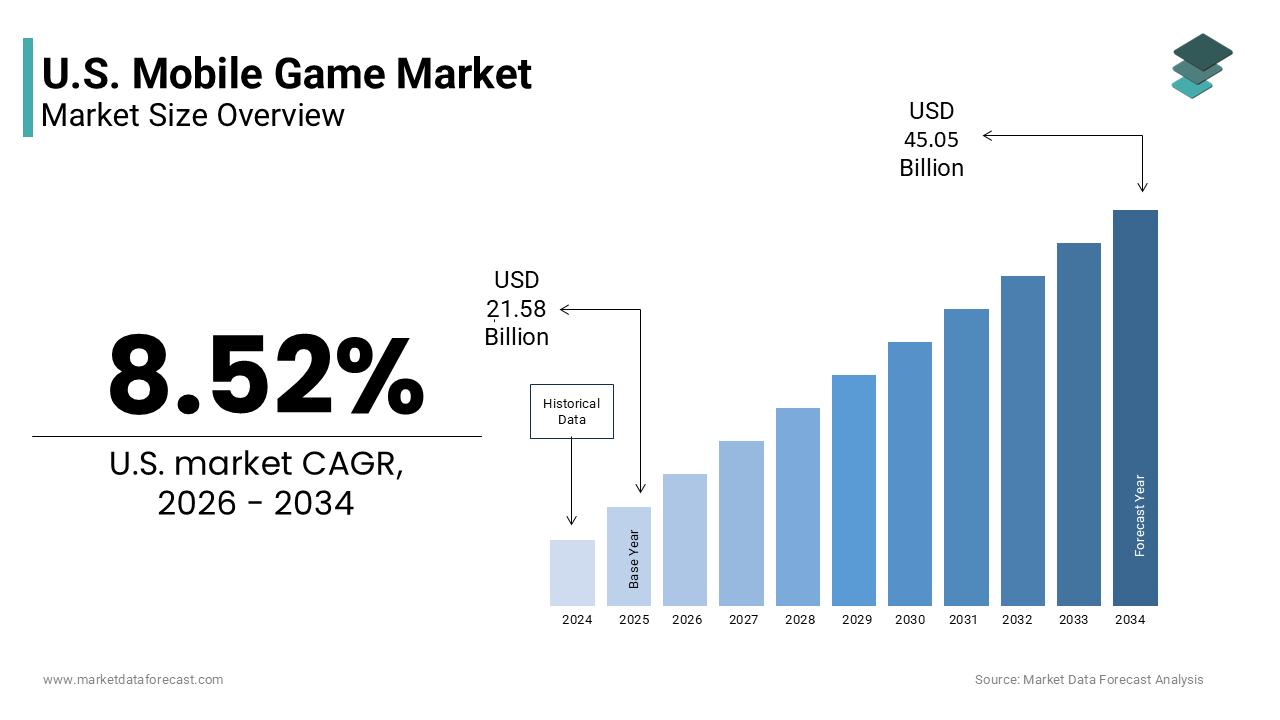
The U.S. mobile game market was valued at USD 21.58 billion in 2025, is estimated to reach USD 23.42 billion in 2026, and is projected to reach USD 45.05 billion by 2034, growing at a CAGR of 8.52% during the forecast period from 2026 to 2034. The growth of the U.S. mobile game market is driven by the widespread penetration of smartphones, advancements in fifth generation network infrastructure, and increasing consumer engagement with digital entertainment platforms. The growing popularity of free-to-play games, esports integration, cloud gaming services, and immersive gaming technologies such as augmented reality is further accelerating market growth. Additionally, the increasing adoption of in-app monetization strategies and social gaming experiences continues to strengthen the market landscape.
Key Market Trends
- Rising adoption of free-to-play mobile gaming models supported by in-app purchases and rewarded advertising
- Increasing integration of augmented reality and cloud gaming technologies to enhance immersive gameplay experiences
- Growing popularity of mobile esports and multiplayer competitive gaming platforms
- Expansion of cross-platform gaming ecosystems connecting mobile, console, and PC players
- Strong focus on live service gaming models, seasonal updates, and community-driven engagement strategies
Segmental Insights
- Based on monetization type, the in-app purchases segment held a significant share of the U.S. mobile game market in 2025. The segment’s dominance is attributed to the rapid adoption of the free-to-play business model, which enables developers to generate revenue through virtual goods, battle passes, and premium in-game content.
- Based on platform, the iOS segment accounted for 34.8% of the U.S. mobile game market share in 2025. The dominance of the segment is driven by the high spending capacity of iOS users, premium gaming ecosystem, and strong consumer trust in Apple’s secure digital payment infrastructure.
- The Android segment is projected to witness strong growth during the forecast period owing to the increasing penetration of affordable smartphones, expanding accessibility of mobile gaming, and rising popularity of cloud gaming services on Android devices.
Regional Insights
The U.S. mobile game market is experiencing strong growth across regions such as California, Washington, Oregon, New York, and the rest of the United States, supported by the high adoption of smartphones, widespread internet connectivity, and increasing consumer spending on digital entertainment. The country continues to remain one of the largest mobile gaming markets globally due to its advanced technology infrastructure, strong gaming culture, and presence of leading game development companies.
Competitive Landscape
The U.S. mobile game market is highly competitive and characterized by the presence of global gaming publishers, mobile-first developers, and digital entertainment platforms competing through innovation, intellectual property expansion, and advanced monetization strategies. Companies are increasingly focusing on live service gaming, cloud gaming integration, augmented reality experiences, and cross-platform compatibility to strengthen user engagement and market positioning. Prominent players in the U.S. mobile game market include Electronic Arts (EA), Activision Blizzard, Take-Two Interactive (Zynga), Scopely, Niantic, Roblox Corporation, Tencent Games, King Digital Entertainment, Supercell, Epic Games, Jam City, Kabam, and Machine Zone.
U.S. Mobile Game Market Size
The U.S. mobile game market size was valued at USD 21.58 billion in 2025 and is anticipated to reach USD 23.42 billion in 2026 from USD 45.05 billion by 2034, growing at a CAGR of 8.52% during the forecast period from 2026 to 2034.
The mobile game is a digital entertainment by the delivery of interactive gaming experiences through smartphones and tablets. The ecosystem encompasses various genres, including puzzle strategy role playing and battle royale games, all accessible via app stores and direct downloads. The proliferation of high speed internet infrastructure is fundamental to this market's vitality. As per the Federal Communications Commission, approximately 92% of Americans have access to fixed broadband service at speeds sufficient for seamless online gaming and content streaming. This ubiquity of mobile devices ensures that gaming is no longer confined to dedicated consoles or personal computers but is an integral part of daily life. Regulatory frameworks regarding digital privacy and data security also play a crucial role in shaping user trust and engagement patterns. The intersection of hardware accessibility and software innovation creates a robust environment for sustained growth and cultural influence within the broader entertainment landscape.
MARKET DRIVERS
Pervasive Smartphone Penetration Enables Ubiquitous Access to Gaming Platforms
The widespread adoption of smartphones across the United States serves as a foundational driver for the mobile game market by ensuring that a vast majority of the population has immediate and constant access to gaming platforms. This ubiquity transforms idle moments into potential gaming sessions, thereby increasing engagement frequency and duration. As per the study, 85% of American adults currently own a smartphone, a figure that has remained consistently high and continues to grow among older demographics. This extensive device ownership means that game developers can reach audiences across all age groups and socioeconomic backgrounds without requiring specialized hardware investments from consumers. The convenience of having a gaming device always at hand encourages spontaneous play, which is particularly beneficial for casual and hyper casual game genres that rely on high volume user acquisition. Furthermore, the regular upgrade cycle of smartphones introduces newer devices with enhanced processing power and graphical capabilities to the market, allowing developers to create more immersive and visually stunning experiences. This hardware evolution keeps the platform relevant and exciting for users who might otherwise lose interest. The seamless integration of gaming apps into the existing mobile operating system ecosystems also simplifies the discovery and installation process by reducing friction for new users. Consequently, the sheer scale of smartphone availability creates a fertile ground for user acquisition and retention, driving the overall expansion of the mobile gaming sector.
Advancement in Fifth Generation Network Infrastructure Enhances Gameplay Experience
The deployment and expansion of fifth generation wireless network technology significantly enhance the mobile gaming experience by providing lower latency and higher data transmission speeds, which are critical for real time multiplayer interactions. The advancement in fifth generation network infrastructure is impacting positively on the growth of the United States mobile game market. This technological improvement allows for more complex and responsive gameplay mechanics that were previously constrained by slower network connections. The infrastructure upgrade enables cloud gaming services to operate more effectively on mobile devices by allowing users to stream high fidelity games without the need for powerful local hardware. The reduced lag times improve competitive gaming experiences, making mobile esports more viable and attractive to both players and spectators. Additionally, faster download speeds reduce the time required to install large game files and updates, improving user convenience and reducing drop off rates during the onboarding process. The reliability of these networks also supports persistent online worlds and social features that require constant connectivity, fostering deeper community engagement. As network coverage expands to rural and suburban areas, the potential user base for data intensive mobile games grows further. This technological backbone is essential for sustaining the growth of sophisticated mobile gaming titles and ensuring that the platform remains competitive with traditional console and PC gaming environments.
MARKET RESTRAINTS
Stringent Data Privacy Regulations Increase Compliance Costs and Operational Complexity
The implementation of stringent data privacy regulations by imposing rigorous compliance requirements that increase operational costs and limit data collection capabilities is limiting the growth of United States mobile game market. Laws, such as the California Consumer Privacy Act and other state level initiatives mandate transparent data handling practices and give users greater control over their personal information. As per the National Conference of State Legislatures, over 15 states have introduced or enacted comprehensive privacy legislation in recent years, creating a fragmented regulatory landscape that developers must navigate. These regulations restrict the ability of game publishers to collect and utilize user data for targeted advertising and personalized marketing campaigns, which are primary revenue drivers for free to play games. The need to implement robust data protection measures and obtain explicit consent from users adds layers of complexity to game development and maintenance. Non-compliance can result in substantial fines and reputational damage, forcing companies to allocate significant resources to legal and technical compliance efforts. Furthermore, changes in operating system policies, such as Apple’s App Tracking Transparency framework, have reduced the effectiveness of user acquisition strategies by limiting access to identifier data. This reduction in tracking capability makes it more difficult and expensive for developers to measure return on investment for advertising spend.
Market Saturation and High User Acquisition Costs Limit Profitability Potential
The high level of market saturation leads to intense competition for user attention by resulting in escalating user acquisition costs that erode profitability margins, which is restraining the growth of the United States mobile game market. As per data from Sensor Tower, the average cost per install for mobile games in the United States has risen significantly, with some genres seeing costs exceed 5 dollars per user. The diminishing returns of traditional advertising channels and the need to bid higher for premium ad inventory. Developers must continuously invest in creative assets and influencer partnerships to capture user interest, which strains budgets particularly for small and mid sized studios. The saturation also leads to shorter user lifecycles, as players frequently switch between new titles, reducing the long term value of each acquired user. Retaining users becomes increasingly difficult, necessitating ongoing content updates and live operations that further add to development costs. The pressure to achieve immediate returns often compromises game quality or leads to aggressive monetization tactics that can alienate players.
MARKET OPPORTUNITIES
Integration of Augmented Reality Technologies Creates Immersive Gaming Experiences
The integration of augmented reality technologies by enabling immersive and interactive experiences that blend digital content with the physical world is certainly to create new opportunities for the growth of the United States mobile game market. This technology enhances user engagement by providing novel gameplay mechanics that leverage the unique capabilities of mobile devices, such as cameras and gyroscopes. The spending on augmented reality and virtual reality in the United States is expected to reach billions of dollars in the coming years, reflecting growing consumer and enterprise interest in these technologies. Augmented reality games encourage physical movement and social interaction, appealing to a broader audience beyond traditional gamers. Successful titles in this space have demonstrated the potential for high user retention and viral marketing effects, as players share their experiences on social media platforms. The advancement in hardware capabilities, including improved sensors and processing power, allows for more stable and realistic augmented reality overlays. Developers can create location based experiences that drive foot traffic to real world venues, opening up new partnership opportunities with retailers and entertainment providers. This convergence of digital and physical realms creates new revenue streams through sponsored locations and branded content.
Expansion into Cloud Gaming Services Removes Hardware Limitations for Users
The expansion of cloud gaming services by removing hardware limitations and allowing users to access high fidelity games on standard smartphones is also enhancing the growth of the United States mobile game market. This model shifts the computational load from the device to remote servers, enabling the streaming of console quality titles without the need for expensive upgrades. As per the Entertainment Software Association, the number of gamers playing via cloud services has grown substantially, with millions of users now accessing games through subscription based platforms. This accessibility broadens the potential audience for premium gaming experiences, including those who may not own dedicated gaming consoles or high end PCs. Cloud gaming also facilitates instant play without lengthy downloads or installations, reducing friction and encouraging trial of new titles. Service providers can offer libraries of games for a monthly fee, creating a recurring revenue model that stabilizes income streams for developers. The integration of cloud gaming with existing mobile ecosystems allows for seamless transitions between devices, enhancing user convenience.
MARKET CHALLENGES
Intellectual Property Infringement and Piracy Undermine Revenue Streams
The intellectual property infringement and piracy by undermining revenue streams and discouraging investment in original content is quiet challenge for the growth of the United States mobile game market. The ease of copying and distributing digital games allows unauthorized versions to circulate on third party platforms, depriving developers of rightful earnings. The intellectual property theft costs the US economy hundreds of billions of dollars annually, with the digital entertainment sector being a prime target. Pirated games often lack security updates and may contain malware, posing risks to users and damaging the reputation of legitimate developers. The prevalence of clone games that mimic successful titles confuses consumers and dilutes brand value, making it difficult for original creators to maintain market share. Combating piracy requires continuous monitoring and legal action, which consumes resources that could otherwise be used for development and marketing. The global nature of the internet complicates enforcement efforts, as infringing content may be hosted in jurisdictions with weak intellectual property laws. This environment creates uncertainty for investors and developers, potentially stifling innovation and risk taking. The loss of revenue from piracy directly impacts the ability of studios to fund future projects and sustain operations.
Retention of Users in a Highly Competitive and Fragmented Landscape
The retaining users in the highly competitive and fragmented that requires continuous innovation and engagement strategies, which is also to impede the growth of the United States mobile game market. With an overwhelming number of choices available, players easily switch to new titles if their current game fails to provide fresh content or rewarding experiences. Developers must invest heavily in live operations, including regular updates events and community management to keep players engaged. The expectation for high quality content is elevated by major titles that set high standards for graphics gameplay and narrative depth. Smaller studios often struggle to match this pace leading to a churn of users toward more polished products. Additionally, the monetization strategies employed by some games such as aggressive microtransactions can lead to player fatigue and dissatisfaction. Balancing revenue generation with user satisfaction is a delicate task that requires careful design and testing. The fragmentation of the market across various genres and demographics means that there is no one size fits all approach to retention. Companies must tailor their strategies to specific user segments while adapting to changing trends and preferences.
REPORT COVERAGE
| REPORT METRIC | DETAILS |
| Market Size Available | 2025 to 2034 |
| Base Year | 2025 |
| Forecast Period | 2026 to 2034 |
| CAGR | 8.52% |
| Segments Covered | By Monetization Type, Platform and Region. |
| Various Analyses Covered | Global, Regional & Country Level Analysis, Segment-Level Analysis; DROC, PESTLE Analysis, Porter's Five Forces Analysis, Competitive Landscape, Analyst Overview of Investment Opportunities |
| Countries Covered | California, Washington, Oregon, New York, and the rest of the United States. |
| Market Leader Profiled | Electronic Arts (EA), Activision Blizzard, Take-Two Interactive (Zynga), Scopely, Niantic, Roblox Corporation, Tencent Games, King Digital Entertainment, Supercell, Epic Games, Jam City, Kabam, and Machine Zone. |
SEGMENTAL ANALYSIS
By Monetization Type Insights
The in-app purchases segment held a significant share of the United States mobile game market in 2025 with the widespread adoption of the free to play business model that lowers entry barriers for users while maximizing lifetime value through microtransactions. This model allows players to access games without upfront costs, thereby expanding the user base significantly, while generating revenue from virtual goods, currency, and battle passes. As per data from Sensor Tower, in-app spending on mobile games in the United States exceeded 20 billion dollars in recent annual assessments, underscoring the immense profitability of this approach. The psychological design of these transactions, often utilizing limited time offers and loot boxes that encourages impulse buying and sustained engagement. Furthermore, the integration of social features and competitive leaderboards motivates players to purchase cosmetic items or performance boosts to enhance their status within the community. The flexibility of in-app purchases allows developers to cater to various spending levels, from small occasional buyers to high spending whales who contribute disproportionately to revenue.
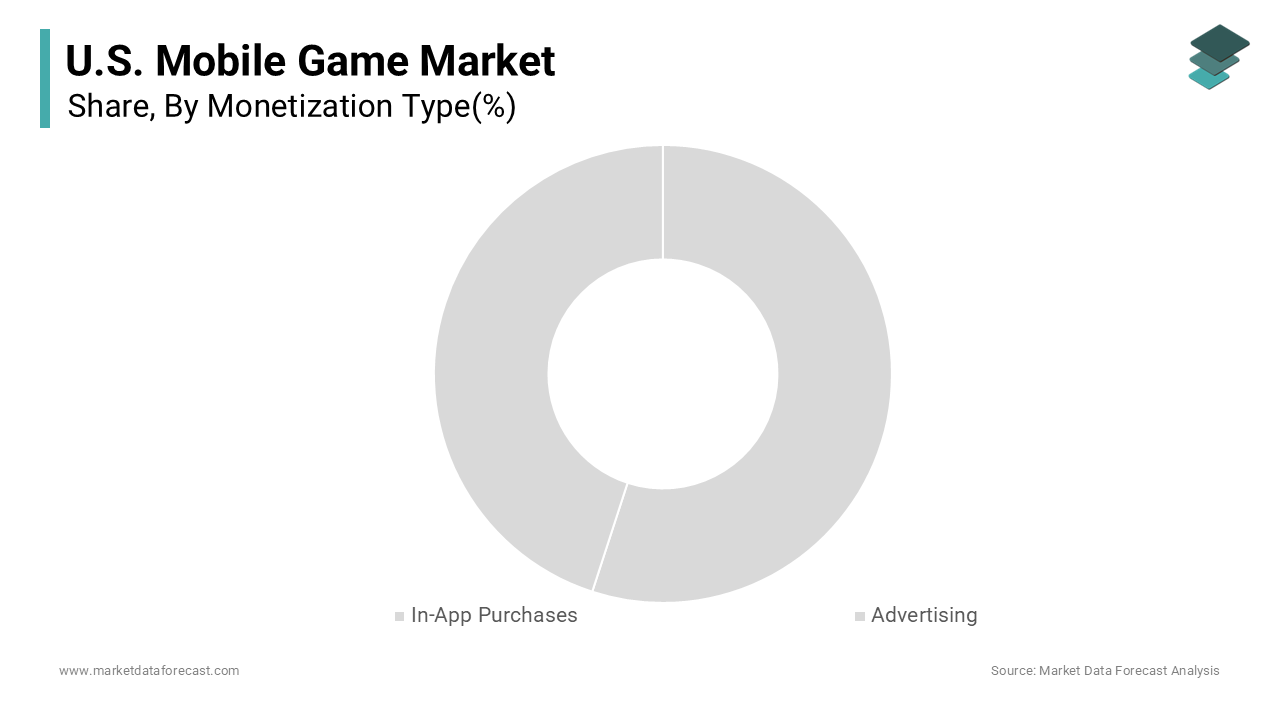
The advertising segment is lucratively to witness a fastest CAGR of 12.4% from 2026 to 2034 with the rise of hyper casual games and the increasing sophistication of ad tech platforms. The need for developers to monetize users, who are unwilling or unable to make in-app purchases, thereby capturing value from the entire user base. The digital ad spending in the gaming sector has seen double digit growth by reflecting the shift toward rewarded video ads and playable ads that offer a non-intrusive user experience. Rewarded videos have become a standard feature by allowing players to voluntarily watch ads in exchange for in game rewards, which results higher engagement rates and better return on investment for advertisers. The advancement of programmatic advertising and artificial intelligence enables more precise targeting and personalization by making ads more relevant and less annoying to users. Additionally, the proliferation of hyper casual games, which rely almost exclusively on ad revenue due to their short lifecycle and low retention rates, has accelerated the adoption of this model. These games attract massive volumes of users quickly, providing a large inventory for ad impressions.
By Platform Insights
The iOS platform segment was accounted in holding 34.8% of the United States mobile game market share in 2025 with the higher spending power of its user base and the streamlined ecosystem provided by Apple. Although, Android devices may have a larger global install base, iOS users in the United States tend to spend significantly more on in-app purchases and premium apps. As per App Annie, now known as data.ai, iOS users in the United States consistently outspend Android users by a ratio of nearly two to one in the gaming category. This disparity is attributed to the demographic profile of iPhone users, who often have higher disposable incomes and are more accustomed to paying for digital content. The strict security and quality control measures of the Apple App Store also foster greater trust among consumers, reducing friction in transaction processes. Furthermore, Apple’s integration of hardware and software ensures optimal performance for high fidelity games, attracting developers who prioritize graphical excellence and smooth gameplay. The presence of exclusive titles and early access releases on iOS further incentivizes users to remain within the ecosystem. The seamless payment system via Apple Pay simplifies the checkout process, encouraging impulse buys.
The android platform segment is significantly to witness a fastest CAGR of 11.2% from 2026 to 2034 with the diverse range of device options and increasing penetration of affordable smartphones. The compound annual growth rate for Android game downloads is robust, reflecting the expanding accessibility of mobile gaming to broader socioeconomic groups. The shipment of mid-range and budget Android smartphones in North America has increased, bringing millions of new users into the mobile gaming ecosystem. The open nature of the Android ecosystem also facilitates innovation in distribution, with alternative app stores and direct downloads gaining traction. Google Play’s continuous improvements in discovery algorithms and security features have enhanced user confidence and engagement. Additionally, the versatility of Android devices, including foldables and tablets, offers new form factors for gaming experiences, attracting developers to optimize their titles for these screens. The growing popularity of cloud gaming on Android devices further expands its potential, allowing users to play high end games without powerful hardware.
COMPETITIVE LANDSCAPE
The competition in the United States mobile game market is intense and characterized by a mix of established giants and agile independent studios vying for user attention and spending. Major publishers leverage their extensive intellectual property portfolios and financial resources to dominate top grossing charts while smaller developers innovate with niche genres and unique gameplay mechanics. User acquisition costs have risen significantly forcing companies to optimize their marketing spend and focus on retention rather than just downloads. The market sees frequent launches of new titles making it challenging for any single game to maintain long term dominance without continuous updates and community engagement. Differentiation is achieved through superior graphics innovative monetization models and strong social features that foster community loyalty. Regulatory scrutiny regarding data privacy and loot boxes adds another layer of complexity requiring companies to adapt their practices constantly. The rise of cloud gaming and cross platform play further blurs the lines between mobile and traditional gaming increasing the stakes for performance and quality.
KEY MARKET PLAYERS
A few of the major companies in the U.S. mobile game market include
- Electronic Arts (EA)
- Activision Blizzard
- Take-Two Interactive (Zynga)
- Scopely
- Niantic
- Roblox Corporation
- Tencent Games
- King Digital Entertainment
- Supercell
- Epic Games
- Jam City
- Kabam
- Machine Zone
Top Players in the US Mobile Game Market
Activision Blizzard Inc
Activision Blizzard Inc maintains a formidable presence in the United States mobile game market through its iconic franchises and strategic integration of console quality experiences on portable devices. The company leverages its extensive intellectual property portfolio to drive user engagement and retention across multiple genres. Recent actions include the successful launch of Call of Duty Mobile which has become a cornerstone of their mobile strategy offering competitive multiplayer experiences that resonate with a broad audience. The acquisition by Microsoft has further strengthened its position by providing access to greater resources and cloud gaming technologies. Activision Blizzard continues to invest in live operations and seasonal content updates to keep players engaged long term. Their focus on cross platform play allows seamless interaction between mobile and console users enhancing the overall ecosystem. This approach not only broadens the player base but also increases monetization opportunities through in app purchases and battle passes. The company remains committed to innovation and community building ensuring its titles remain relevant in a rapidly evolving market landscape.
Electronic Arts Inc
Electronic Arts Inc contributes significantly to the United States mobile game market by adapting its popular sports and simulation franchises for mobile platforms. The company focuses on delivering authentic and high quality gaming experiences that mirror their console counterparts. EA Sports FC Mobile and Apex Legends Mobile are key titles that demonstrate their commitment to bringing premium content to handheld devices. Recent strategies involve leveraging artificial intelligence to personalize user experiences and improve matchmaking efficiency. Electronic Arts actively engages with its community through regular updates events and partnerships with professional leagues. The company emphasizes live service models which generate consistent revenue streams through microtransactions and seasonal passes. Their investment in cloud gaming technology also positions them well for future growth as network infrastructure improves. Electronic Arts continues to explore new genres and innovations ensuring their mobile portfolio remains diverse and appealing to various demographic segments within the United States.
Zynga Inc
Zynga Inc is a pivotal player in the United States mobile game market known for its expertise in social and casual gaming genres. The company specializes in creating accessible and engaging titles that appeal to a wide audience including non traditional gamers. Following its acquisition by Take Two Interactive Zynga has gained access to additional resources and intellectual property which enhances its development capabilities. Recent actions include the expansion of its portfolio through organic growth and strategic partnerships with other developers. Zynga focuses heavily on data analytics to optimize user acquisition and retention strategies. Their games often feature strong social integration allowing players to connect with friends and compete on leaderboards. This social aspect drives viral growth and sustained engagement. Zynga also invests in advertising technologies to maximize revenue from its free to play titles. The company’s ability to identify and capitalize on emerging trends in casual gaming solidifies its position as a leader in the sector.
Top Strategies Used by Key Market Participants
Key players in the United States mobile game market primarily utilize strategies focused on intellectual property leverage and live service optimization to maintain competitive advantage. Companies frequently adapt successful console and PC franchises for mobile platforms to attract established fan bases while minimizing marketing costs. Investment in data analytics is crucial for understanding user behavior and personalizing in game offers to maximize revenue per user. Strategic mergers and acquisitions allow larger entities to consolidate talent and expand their portfolios rapidly. Developers also prioritize cross platform compatibility to enable seamless gameplay across devices enhancing user retention. Community engagement through social media and esports tournaments helps build loyal player bases. Additionally, firms are increasingly adopting hybrid monetization models that combine in app purchases with rewarded advertising to diversify income streams. Continuous content updates and seasonal events keep games fresh and encourage recurring spending. These combined approaches ensure sustained growth and resilience in a highly dynamic and competitive digital entertainment environment.
MARKET SEGMENTATION
This research report on the U.S. mobile game market has been segmented based on the following categories.
By Monetization Type
- In-App Purchases
- Advertising
By Platform
- iOS
- Android
By Country
- California
- Washington
- Oregon
- New York
- Rest of the United States