- Product Description Description
- Table of Contents TOC
- List of Table & Figure LOT
- Get Free Sample PDF Sample PDF
Market Size, 2025
$9,270.00 MnMarket Estimate, 2026
$12.22 BnMarket Forecast, 2034
$111.41 BnCAGR, 2026–2034
31.82%U.S. Online Education Market Report Summary
The U.S. online education market was valued at USD 9,270 million in 2025, is estimated to reach USD 12.22 billion in 2026, and is projected to reach USD 111.41 billion by 2034, growing at a CAGR of 31.82% during the forecast period from 2026 to 2034. The growth of the U.S. online education market is driven by the increasing demand for flexible and self-paced learning, rapid technological advancements, and rising adoption of digital learning platforms across academic and corporate sectors. Additionally, the expansion of artificial intelligence-driven learning systems, virtual classrooms, gamification technologies, and corporate upskilling programs is further accelerating market growth.
Key Market Trends
- Rising adoption of self-paced and mobile-based learning platforms among students and working professionals
- Increasing integration of artificial intelligence and adaptive learning technologies to personalize educational experiences
- Growing demand for corporate upskilling and reskilling programs across industries
- Expansion of gamification and immersive learning technologies to improve learner engagement
- Strong focus on interactive virtual classrooms and collaborative digital learning environments
Segmental Insights
- Based on learning type, the self-paced learning segment was the largest and held a dominant share of the U.S. online education market in 2025. The segment’s dominance is attributed to the flexibility, convenience, and accessibility offered to learners balancing education with professional and personal responsibilities.
- Based on course type, the science, technology, engineering, and mathematics (STEM) segment accounted for 34.2% of the U.S. online education market share in 2025. This dominance is driven by the growing demand for technical skills in software development, cybersecurity, artificial intelligence, and data science across industries.
- Based on end use, the academic institutions and individual learners segment was the largest contributor to the U.S. online education market in 2025. The segment growth is supported by the widespread adoption of online degree programs, professional certifications, and lifelong learning initiatives.
- The enterprises segment is expected to witness strong growth during the forecast period owing to the rising focus on workforce development, employee training, and digital transformation initiatives across organizations.
Regional Insights
The U.S. online education market is witnessing strong growth across regions such as California, Washington, Oregon, New York, and the rest of the United States, supported by the presence of advanced digital infrastructure, high internet penetration, and increasing investments in educational technologies. The country remains a global leader in digital learning innovation due to its strong technology ecosystem, widespread adoption of remote learning, and growing demand for flexible education models.
Competitive Landscape
The U.S. online education market is highly competitive and characterized by the presence of technology companies, digital learning platforms, universities, and enterprise training providers competing through innovation, content quality, and personalized learning experiences. Companies are increasingly focusing on AI-powered learning systems, enterprise learning platforms, virtual classroom solutions, and strategic academic partnerships to strengthen their market positions. Prominent players in the U.S. online education market include Adobe Inc., Cisco Systems Inc., Coursera Inc., Docebo Inc., edX LLC, Oracle Corporation, Pearson Plc, SAP SE, Skillsoft Corporation, Udemy Inc., Blackboard Inc., Chegg Inc., Cornerstone OnDemand Inc., D2L Corporation, Instructure Inc. (Canvas), Khan Academy, LinkedIn Learning, McGraw Hill Education, Pluralsight Inc., Stride Inc., Wiley Education Services, BYJU’S, and Zoom Video Communications Inc.
 Download Free Sample Report
U.S. Online Education Market Size
The U.S. online education market size was valued at USD 9,270 million in 2025 and is anticipated to reach USD 12.22 billion in 2026 from USD 111.41 billion by 2034, growing at a CAGR of 31.82% during the forecast period from 2026 to 2034.
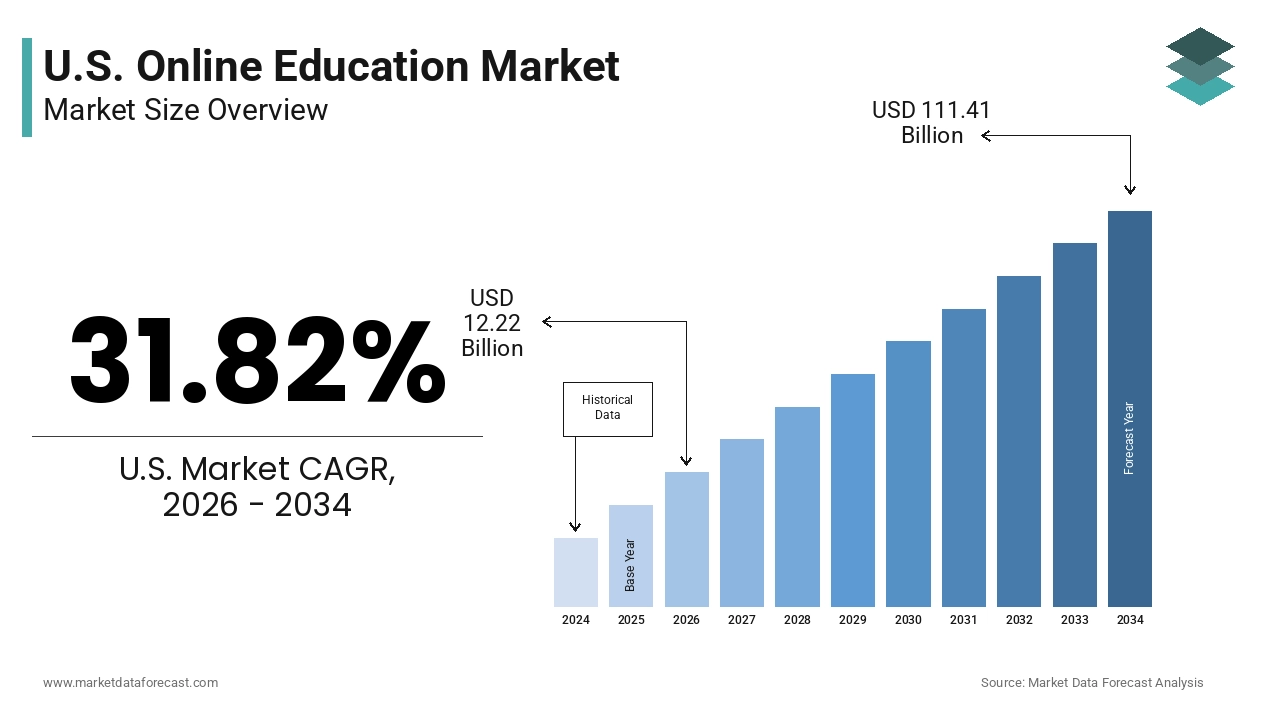
The online education is an ecosystem of digital learning platforms delivering academic courses professional development and skill based training via the internet. The proliferation of high speed internet infrastructure is fundamental to this sector's expansion. Furthermore, according to a study, over 30% of all postsecondary students in the United States were enrolled exclusively in distance education courses in recent years. This significant adoption rate underscores the shift from optional supplementary learning to a primary mode of education. The integration of advanced technologies such as artificial intelligence and adaptive learning algorithms has further personalized the educational experience enhancing engagement and outcomes.
MARKET DRIVERS
Increasing Demand for Flexible and Self Paced Learning Options
The growing preference for flexible and self-paced learning options by accommodating the diverse schedules and lifestyle needs of modern learners is majorly fuelling the growth of the United States online education market. Traditional brick and mortar institutions that often require rigid attendance, which conflicts with the responsibilities of working professionals parents and non-traditional students. Online platforms offer the autonomy to study at any time and from any location, thereby removing logistical barriers to education. The flexibility is particularly for individuals seeking to upskill or reskill, while maintaining full time employment. The rise of the gig economy and remote work has further normalized asynchronous communication and self-directed tasks making online learning a natural extension of professional life. Additionally, the ability to pause rewind and review lecture materials allows learners to grasp complex concepts at their own pace leading to better comprehension and retention. Educational providers are responding by designing modular courses that can be completed in shorter intervals fitting into busy daily routines.
Rapid Technological Advancements Enhance Interactive Learning Experiences
The rapid technological advancements with the quality and interactivity of online education is escalating the growth of the United States online education market. Innovations, such as virtual reality augmented reality and artificial intelligence are transforming passive content consumption into immersive and personalized educational experiences. AI driven adaptive learning platforms analyze student performance in real time to customize content difficulty and provide targeted feedback by ensuring that each learner receives support tailored to their specific needs. Virtual reality simulations allow students in fields, such as healthcare and engineering to practice skills in safe and controlled environments bridging the gap between theoretical knowledge and practical application. High-definition video streaming and interactive whiteboards facilitate seamless communication between instructors and students replicating the dynamics of a physical classroom.
MARKET RESTRAINTS
Digital Divide and Lack of Reliable Internet Access
The digital divide and lack of reliable internet by excluding marginalized communities and limiting equitable access to digital learning resources is hindering the growth of the United States online education market. Despite overall improvements in broadband infrastructure, many rural and low-income households, still lack the high speed connectivity required for seamless online education. The millions of Americans, particularly in rural areas do not have access to broadband speeds that meet the minimum threshold for effective remote learning. This disparity creates a barrier for students, who cannot participate in live virtual classes download large files or stream high quality video content. The lack of adequate devices, such as laptops or tablets that further exacerbates the issue forcing some learners to rely on smartphones, which offer limited functionality for educational tasks. This technological inequality results in lower completion rates and poorer academic outcomes for disadvantaged populations undermining the potential of online education to serve as an equalizer. Schools and institutions struggle to provide consistent support to students facing these connectivity challenges leading to gaps in learning and engagement.
Concerns Regarding Academic Integrity and Credential Recognition
The concerns regarding academic integrity and the recognition of online credentials by affecting the perceived value and credibility of digital qualifications is also degrading the growth of the United States online education market. Cheating and plagiarism are easier to commit in unsupervised online environments raising doubts about the authenticity of student achievements. This perception of lower rigor can lead employers and academic institutions to question the validity of online degrees and certificates compared to traditional counterparts. Although, accreditation bodies have established standards for online programs stigma persists, particularly among older generations and conservative industries. The lack of standardized verification methods across different platforms further complicates the evaluation of candidate qualifications by hiring managers. Additionally, some professional licenses and certifications still require in person training or examinations limiting the utility of fully online programs in certain fields. These concerns deter some individuals from pursuing online education due to fears that their investments will not yield recognized career benefits.
MARKET OPPORTUNITIES
Integration of Gamification Elements to Boost Engagement
The integration of gamification elements by leveraging game design principles to enhance learner motivation and engagement is solely to enhance new opportunities for the growth of the United States online education market. Incorporating features, such as points badges, leaderboards, and progress bars that transforms mundane tasks into interactive and rewarding experiences. The organizations that use gamification in their training programs report higher levels of employee engagement and knowledge retention. This approach appeals to younger generations who are accustomed to interactive digital environments and respond positively to immediate feedback and recognition. Gamified learning platforms can simulate real world scenarios allowing students to apply knowledge in a risk free setting while competing with peers or achieving personal bests. This method is particularly effective in teaching complex subjects such as mathematics and coding where incremental progress and problem solving are key. Furthermore, gamification provides valuable data on learner behavior enabling instructors to identify struggling students and intervene promptly. As technology advances the potential for more sophisticated gamified experiences including virtual quests and collaborative challenges will expand.
Expansion into Corporate Upskilling and Reskilling Programs
The expansion into corporate upskilling and reskilling programs, as businesses increasingly prioritize internal talent development to address skills gaps is also to fuel the growth of the United States online education market. Rapid technological changes and shifting market demands require employees to continuously update their skills to remain competitive. The companies are expected to invest heavily in training initiatives to prepare their workforce for the jobs of the future with a focus on digital literacy and soft skills. Online education platforms are well positioned to deliver scalable and cost effective training solutions that can be customized to specific organizational needs. Partnerships between educational providers and corporations allow for the creation of tailored curricula that align with business goals and industry standards. This B2B model provides a stable revenue stream for online education providers while offering employees convenient access to relevant professional development opportunities. The ability to track progress and measure return on investment through analytics further enhances the appeal of these programs to corporate clients.
MARKET CHALLENGES
High Dropout Rates and Low Completion Metrics
The high dropout rates and low completion metrics by undermining the effectiveness and perceived value of digital courses is significant challenge for the growth of the United States online education market. Unlike traditional classrooms, where physical presence and peer pressure encourage attendance online learners often struggle with self-discipline and motivation. The phenomenon is attributed to factors, such as isolation lack of immediate support and overwhelming course loads. When students fail to complete courses they do not gain the intended skills or credentials leading to wasted resources and dissatisfaction. For providers high dropout rates can damage reputation and reduce customer lifetime value. Addressing this issue requires innovative strategies such as mentorship programs community building and adaptive content that keeps learners engaged. However, implementing these support systems increases operational costs and complexity.
Difficulty in Personalizing Content at Scale
The difficulty in personalizing content at scale by limiting the ability of providers to meet the unique learning needs of diverse student populations is also to degrade the growth of the United States online education market. While technology offers tools for customization creating truly individualized learning paths for millions of users simultaneously is complex and resource intensive. As per the Bill and Melinda Gates Foundation, personalized learning initiatives often face implementation hurdles due to the lack of sophisticated algorithms and comprehensive data analytics capabilities. Developing adaptive content requires significant investment in instructional design and technology infrastructure which may be prohibitive for smaller providers. Furthermore, privacy concerns regarding the collection and use of student data for personalization purposes add another layer of complexity. Balancing the need for detailed user profiles with ethical data practices is a delicate task that requires careful navigation.
REPORT COVERAGE
| REPORT METRIC | DETAILS |
| Market Size Available | 2025 to 2034 |
| Base Year | 2025 |
| Forecast Period | 2026 to 2034 |
| CAGR | 31.82% |
| Segments Covered | By Learning, Course, End Use and Region. |
| Various Analyses Covered | Global, Regional & Country Level Analysis, Segment-Level Analysis; DROC, PESTLE Analysis, Porter's Five Forces Analysis, Competitive Landscape, Analyst Overview of Investment Opportunities |
| Countries Covered | California, Washington, Oregon, New York, and the rest of the United States. |
| Market Leader Profiled | Adobe Inc., Cisco Systems Inc., Coursera Inc., Docebo Inc., edX LLC, Oracle Corporation, Pearson Plc, SAP SE, Skillsoft Corporation, Udemy Inc., Blackboard Inc., Chegg Inc., Cornerstone OnDemand Inc., D2L Corporation, Instructure Inc. (Canvas), Khan Academy, LinkedIn Learning, McGraw Hill Education, Pluralsight Inc., Stride Inc., Wiley Education Services, BYJU’S, and Zoom Video Communications Inc. |
SEGMENTAL ANALYSIS
By Learning Insights
The self-paced learning segment was the largest by holding a dominant share of the United States online education market in 2025 due to its inherent flexibility and ability to accommodate the diverse schedules of modern learners. As per the Babson Survey Research Group, a significant majority of online students cite schedule flexibility as the primary reason for choosing distance education over traditional classroom settings. The asynchronous nature of self paced courses removes geographical and temporal barriers making education accessible to working professionals parents and rural residents. Furthermore, the scalability of self paced content allows providers to serve millions of students simultaneously without the constraints of instructor availability. This model reduces costs for both providers and learners making high quality education more affordable. The proliferation of mobile devices further supports this segment by enabling learning on the go. Students can engage with short modules during commutes or breaks enhancing retention through frequent micro interactions. The ability to pause rewind and review complex topics ensures that learners can master material at their own speed leading to higher satisfaction. Additionally, the vast library of available self paced courses covers niche subjects that may not be feasible for live instruction.
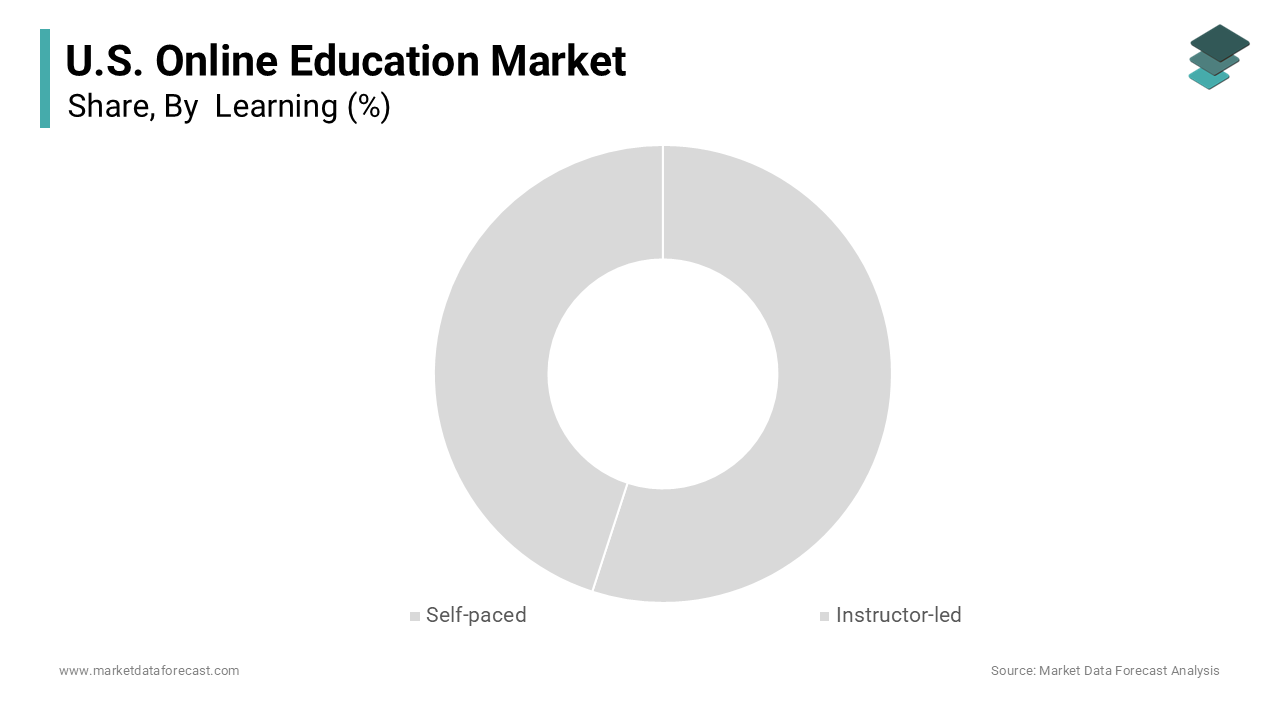
The instructor led online learning segment is expected to grow at an anticipated CAGR of 15.3% from 2026 to 2034 with the demand for interactive and accountable learning experiences. Unlike self-paced models instructor led courses provide real time feedback mentorship and peer interaction, which are for complex skill acquisition and community building. The institutions reporting increased enrollment in synchronous online courses have grown significantly as students seek the structure and engagement of a virtual classroom. The rise of hybrid learning models in higher education has normalized live virtual sessions by making them a preferred option for disciplines requiring discussion and collaboration, such as humanities and business. Technological advancements in video conferencing and collaborative tools have enhanced the quality of these interactions by making them comparable to face to face experiences.
By Course Insights
The science technology engineering and mathematics segment was the largest by holding 34.2% of the United States online education market share in 2025 due to the demand for technical skills in the modern economy. The rapid digitization of industries has created a substantial skills gap in areas, such as software development data science and cybersecurity driving individuals and organizations to seek specialized online training. The employment in computer and information technology occupations is projected to grow much faster than the average for all occupations by adding hundreds of thousands of new jobs. Online platforms offer accessible and up to date curricula that align with industry standards allowing learners to acquire job ready skills efficiently. The modular nature of STEM subjects lends itself well to digital delivery where code simulations and virtual labs can provide hands on experience. Furthermore, the high return on investment for STEM credentials motivates learners to invest in these courses despite higher costs. Corporate partnerships with online providers ensure that content remains relevant to current technological trends. The global shortage of STEM professionals further amplifies the value of these certifications making them a priority for career changers and students alike.
The business management segment is likely to grow with a fastest CAGR of 12.4% from 2026 to 2034 with the need for leadership and strategic skills in a dynamic business environment. As organizations navigate digital transformation and global competition, there is an increasing emphasis on soft skills such as leadership communication and project management which are effectively taught through online formats. The flexibility of online business courses allows mid-level managers to upskill in areas like digital marketing financial analysis and organizational behavior. The rise of entrepreneurship and the gig economy has also driven demand for practical business knowledge among independent contractors and small business owners. Online platforms offer case studies and simulations that provide real world insights into business challenges. Additionally, the networking opportunities provided by cohort based online business programs enhance their appeal.
By End Use Insights
The academic institutions and individual learners segment was accounted in holding a prominent share of the United States online education market in 2025 with the widespread adoption of digital learning in higher education and the growing culture of lifelong learning. Universities and colleges have integrated online courses into their core offerings to expand reach and accommodate non traditional students. Individual learners are increasingly motivated by the need to upskill or reskill in response to changing job market demands. The accessibility of massive open online courses and micro credentials allows individuals to pursue personal and professional development goals affordably. The flexibility of online learning appeals to working adults who balance education with other responsibilities. Furthermore, the recognition of online credentials by employers has increased encouraging more individuals to enroll. The diversity of courses available from basic literacy to advanced doctoral studies ensures broad appeal across demographics.
The enterprises segment is projected to grow at an anticipated CAGR of 14.3% during the forecast period with the urgent need for corporate upskilling and talent retention. Companies are increasingly investing in online learning platforms to train employees efficiently and cost effectively. The organizations spend billions annually on employee development with a significant portion allocated to digital learning solutions. The rapid pace of technological change requires workers to continuously update their skills by making online training an essential tool for maintaining competitiveness. Online platforms offer scalable solutions that can be customized to specific organizational needs and tracked for performance metrics. The shift to remote and hybrid work models has accelerated the adoption of virtual training programs as traditional in person workshops become less feasible. Enterprises value the ability to deliver consistent training to distributed workforces regardless of location. Furthermore, online learning supports employee engagement and retention by offering career development opportunities. The integration of learning management systems with human resources platforms facilitates seamless administration and reporting.
COMPETITIVE LANDSCAPE
The competition in the United States online education market is intense and characterized by a diverse array of providers ranging from established universities to agile technology startups. Major platforms compete on content quality accreditation and technological innovation to attract and retain learners. Differentiation is achieved through specialized niches such as professional certifications or degree programs that offer tangible career benefits. Price competition is significant in the consumer segment prompting providers to offer subscription models and bundled packages for better value. Corporate clients prioritize scalability and customization leading to fierce rivalry among business to business providers. Strategic partnerships with employers and academic institutions are common as companies seek to validate their credentials and expand reach. The barrier to entry for content creation is low resulting in a saturated market where brand recognition and user experience become critical success factors. Continuous investment in artificial intelligence and adaptive learning technologies helps leaders maintain an edge by offering personalized experiences.
KEY MARKET PLAYERS
A few of the major companies in the U.S. online education market include
- Adobe Inc.
- Cisco Systems Inc.
- Coursera Inc.
- Docebo Inc.
- edX LLC
- Oracle Corporation
- Pearson Plc
- SAP SE
- Skillsoft Corporation
- Udemy Inc.
- Blackboard Inc.
- Chegg Inc.
- Cornerstone OnDemand Inc.
- D2L Corporation
- Instructure Inc. (Canvas)
- Khan Academy
- LinkedIn Learning
- McGraw Hill Education
- Pluralsight Inc.
- Stride Inc.
- Wiley Education Services
- BYJU’S
- Zoom Video Communications Inc.
Top Players in the US Online Education Market
Coursera Inc
Coursera Inc stands as a pivotal entity in the United States online education market by partnering with top universities and companies to offer accredited courses and degrees. The platform provides access to high quality content in technology business and data science catering to both individual learners and enterprise clients. Recent actions include the expansion of its generative artificial intelligence offerings which help users navigate learning paths more efficiently. Coursera has also strengthened its enterprise segment by launching tailored solutions for workforce upskilling allowing organizations to close critical skills gaps. The company continues to integrate advanced analytics to track learner progress and demonstrate return on investment for corporate partners. These strategic initiatives reinforce its position as a leader in scalable and credible digital education serving millions of learners globally while maintaining strong relationships with academic and industry partners.
2U Inc
2U Inc contributes significantly to the United States online education market by enabling traditional universities to launch and manage high quality online degree programs. The company provides comprehensive services including marketing student support and technology infrastructure allowing institutions to extend their reach without building internal capabilities. Recent actions involve the integration of edX assets following its acquisition which broadens its content library and global footprint. 2U has focused on enhancing its short form executive education offerings to meet the growing demand for professional development. The company leverages data driven insights to optimize enrollment strategies and improve student retention rates.
Udemy Inc
Udemy Inc plays a crucial role in the United States online education market by offering a vast marketplace of practical skill-based courses taught by expert instructors. The platform caters to individual learners seeking personal development and enterprises looking for employee training solutions. Recent actions include the expansion of its Udemy Business subscription service which provides organizations with curated content libraries for continuous learning. Udemy has invested heavily in artificial intelligence to personalize course recommendations and improve search relevance for users. The company actively recruits new instructors to diversify its content portfolio covering emerging technologies and soft skills. Its flexible pricing model and frequent promotions make education accessible to a broad audience.
Top Strategies Used by Key Market Participants
Key players in the United States online education market primarily focus on strategic acquisitions to expand content libraries and technological capabilities. Companies are increasingly integrating artificial intelligence to personalize learning experiences and improve user engagement through adaptive pathways. Partnerships with accredited universities and industry leaders help providers offer recognized credentials that enhance employability for learners. Expansion into the corporate sector via business to business subscriptions allows firms to secure recurring revenue streams from enterprise clients. Investment in mobile optimization ensures accessibility for learners who prefer studying on smartphones and tablets. Content diversification into high demand fields such as data science and cybersecurity addresses critical skills gaps in the labor market. Providers also emphasize community building features to foster peer interaction and reduce dropout rates.
MARKET SEGMENTATION
This research report on the U.S. online education market has been segmented based on the following categories.
By Learning
- Self-paced
- Instructor-led
By Course
- Science, Technology, Engineering, and Mathematics (STEM)
- Business Management
- Others
By End Use
- Academic Institutions & Individual
- Enterprises
By Country
- California
- Washington
- Oregon
- New York
- Rest of the United States