- Product Description Description
- Table of Contents TOC
- List of Table & Figure LOT
- Get Free Sample PDF Sample PDF
Market Size, 2025
$5.76 BnMarket Estimate, 2026
$6.75 BnMarket Forecast, 2034
$23.88 BnCAGR, 2026–2034
17.11%U.S. Online Gambling Market Report Summary
The U.S. online gambling market was valued at USD 5.76 billion in 2025, is estimated to reach USD 6.75 billion in 2026, and is projected to reach USD 23.88 billion by 2034, growing at a CAGR of 17.11% during the forecast period from 2026 to 2034. The growth of the U.S. online gambling market is driven by the rapid legalization of online betting across multiple states, increasing smartphone penetration, and rising consumer preference for digital entertainment platforms. Additionally, the expansion of mobile betting applications, live casino experiences, secure digital payment systems, and real-time sports wagering technologies is further accelerating market growth.
Key Market Trends
- The rising legalization of sports betting and online casino gaming across various U.S. states
- The increasing popularity of mobile-based gambling platforms, driven by smartphone adoption
- Growing integration of live streaming and in-play betting features to enhance user engagement
- Expansion of online casino and live dealer gaming experiences with immersive technologies
- Strong focus on responsible gaming tools, identity verification, and secure payment systems
Segmental Insights
Based on game type, the sports betting segment was the largest and held a significant share of the U.S. online gambling market in 2025. The segment’s dominance is attributed to the strong popularity of professional sports leagues, increasing state-level legalization, and rising demand for live in-play wagering experiences.
Based on gender, the male segment accounted for the largest share of the U.S. online gambling market in 2025. This dominance is driven by the higher participation of male users in sports betting, poker, and competitive online gaming activities.
Based on age group, the 25–40 years segment was the largest contributor to the U.S. online gambling market in 2025. The growth of this segment is supported by the high digital literacy, increasing disposable income, and strong engagement with mobile entertainment applications among younger adults.
Based on device, the mobile devices segment dominated the market in 2025 owing to the convenience, accessibility, and seamless betting experience offered through smartphones and mobile applications.
Regional Insights
The U.S. online gambling market is witnessing strong growth across regions such as California, Washington, Oregon, New York, and the rest of the United States, supported by the expanding legalization of sports betting, increasing digital payment adoption, and growing consumer participation in online wagering platforms. States with mature regulatory frameworks such as New Jersey, Pennsylvania, and Michigan continue to lead the market due to their strong revenue generation and advanced online gambling ecosystems.
Competitive Landscape
The U.S. online gambling market is highly competitive and characterized by the presence of major sportsbook operators, online casino platforms, and digital gaming technology providers competing through aggressive marketing strategies, promotional offers, and innovative user experiences. Companies are increasingly focusing on mobile-first betting platforms, live betting features, strategic sports partnerships, and AI-driven customer engagement tools to strengthen their market positions. Prominent players in the U.S. online gambling market include DraftKings Inc., FanDuel Group, BetMGM LLC, Caesars Entertainment Inc., Bally’s Corporation, Rush Street Interactive Inc., Flutter Entertainment Plc, Entain Plc, Kindred Group Plc, 888 Holdings Plc, Wynn Resorts Ltd., Golden Nugget Online Gaming, Bet365 Group Ltd., Playtech Plc, Evolution AB, PointsBet Holdings Ltd., Churchill Downs Incorporated, PENN Entertainment Inc., Scientific Games Corporation, and International Game Technology (IGT).
U.S. Online Gambling Market Size
The U.S. online gambling market size was valued at USD 5.76 billion in 2025 and is anticipated to reach USD 6.75 billion in 2026 from USD 23.88 billion by 2034, growing at a CAGR of 17.11% during the forecast period from 2026 to 2034.
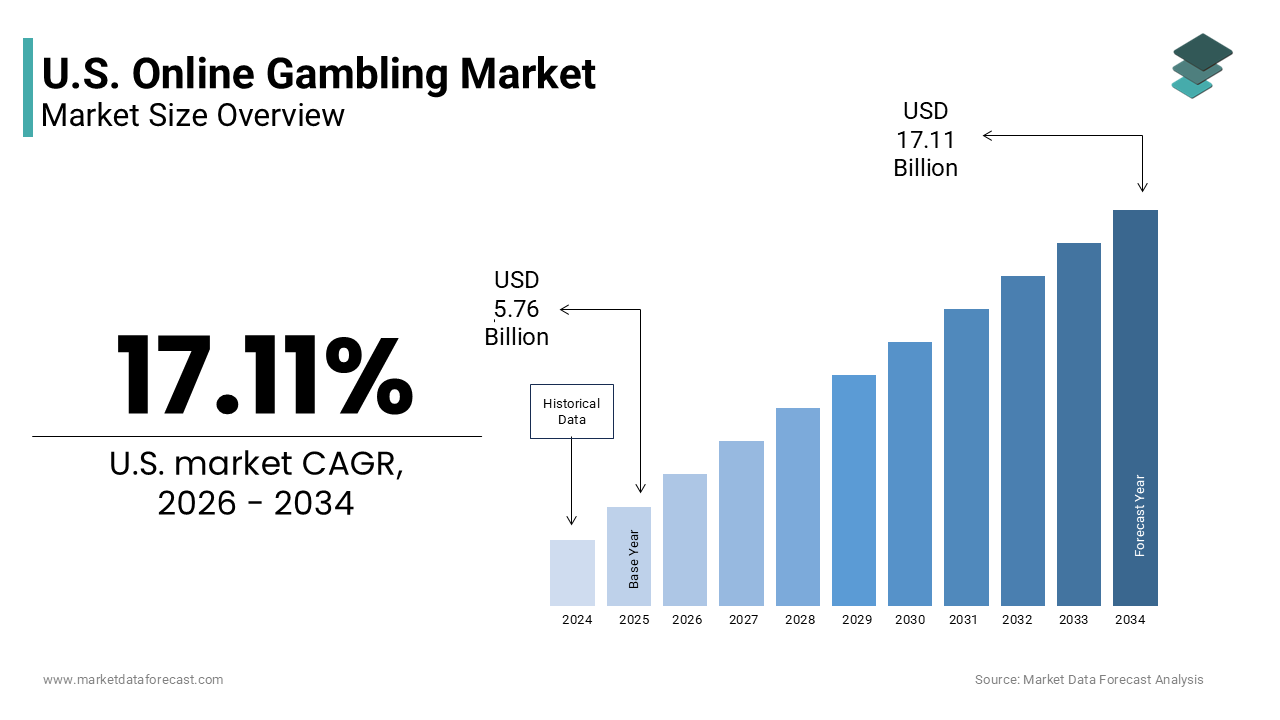
The online gambling is rapidly evolving sector of the digital entertainment industry by encompassing internet based wagering on sports events, casino games, and poker. The sector has experienced significant transformation following the 2018 Supreme Court decision that allowed states to legalize sports betting independently. As per the American Gaming Association, more than 30 states plus the District of Columbia have legalized some form of commercial or tribal sports betting indicating a widespread shift in legislative attitudes. The proliferation of high-speed mobile internet infrastructure supports this growth with the Federal Communications Commission stating that over 90% of Americans have access to broadband services capable of supporting real time data intensive applications. This technological readiness combined with changing social perceptions creates a fertile environment for expansion. The integration of secure payment gateways and advanced identity verification systems further enhances user trust and operational compliance.
MARKET DRIVERS
Progressive State Level Legislative Frameworks Enable Market Expansion
The progressive legalization of online gambling at the state level by creating new jurisdictions, where operators can legally offer services, which is propelling the growth of the United States online gambling market. Each state that passes legislation opens a fresh customer base and generates tax revenue for local governments, which incentivizes further adoption. This patchwork of regulations allows operators to expand their footprint incrementally reducing the risk associated with nationwide launches. States like New Jersey, Pennsylvania, and Michigan, have demonstrated robust revenue generation from online gambling proving the economic viability of these initiatives. For instance, New Jersey consistently reports monthly handle figures exceeding 1 billion dollars showcasing the immense potential of regulated areas. The legislative process often includes provisions for responsible gaming and consumer protection, which helps mitigate public opposition and builds trust in the industry. Additionally, the ability of states to partner with existing land based casinos provides a ready made infrastructure for licensing and oversight. This regulatory clarity encourages investment from major international and domestic operators who seek stable and compliant environments for growth.
High Smartphone Penetration Facilitates Accessible Mobile Betting
The widespread adoption of smartphones and mobile devices by providing users with convenient and immediate access to betting platforms is another factor bolstering the growth of the United States online gambling market. Mobile applications allow individuals to place wagers from virtually anywhere within state borders transforming gambling into an on-demand entertainment option. According to a study, approximately 85% of American adults own a smartphone, which provides a massive installed base for mobile gambling operators. This high level of device ownership ensures that potential customers have the necessary hardware to engage with online betting apps without additional investment. The convenience of mobile betting appeals particularly to younger demographics, who prefer digital interactions over traditional brick and mortar establishments. Operators have optimized their platforms for mobile use offering seamless user interfaces fast loading times and secure transaction capabilities. The integration of biometric authentication such as fingerprint and facial recognition enhances security and simplifies the login process encouraging frequent usage. Furthermore, the availability of high-speed mobile networks, including fifth generation technology ensures that live betting features which require real time data updates function smoothly. This technological ecosystem supports the growth of in play betting where odds change dynamically during events driving higher engagement and wagering volumes.
MARKET RESTRAINTS
Fragmented Regulatory Landscape Increases Operational Complexity
The fragmented regulatory across different states by imposing varying compliance requirements that increase operational costs and complexity is majorly degrading the growth of the United States online gambling market. Each state has its own set of rules regarding licensing taxation geolocation verification and responsible gaming measures forcing operators to customize their platforms for each jurisdiction. The operators must navigate distinct regulatory bodies in each state, which often have differing interpretations of federal and state laws. This lack of uniformity prevents economies of scale and requires significant legal and technical resources to maintain compliance. For example, geolocation technology must be highly precise to ensure bets are only placed within state boundaries adding technical overhead. The uncertainty surrounding future legislation in pending states also makes long term planning difficult for investors and operators. Companies must constantly monitor legislative developments and adjust their operations accordingly, which diverts resources from innovation and marketing. This regulatory fragmentation acts as a barrier to entry for smaller operators who may lack the capital to manage multi state compliance effectively.
Strict Age Verification and Identity Checks Create User Friction
The strict age verification and identity check requirements by creating friction in the user onboarding process is additionally hampering the growth of the United States online gambling market. Regulatory mandates require operators to verify the identity and age of every user to prevent underage gambling and money laundering, which can be a cumbersome and time consuming process. Users often need to submit multiple documents, such as government issued IDs proof of address and social security numbers, which can deter potential customers, who value privacy and convenience. The verification process can take anywhere from a few minutes to several days leading to drop offs during registration. False positives in identity verification systems can also frustrate legitimate users who are incorrectly flagged as suspicious. Furthermore, the need for continuous monitoring of user behavior for signs of problem gambling adds another layer of complexity and potential intrusion. While these measures are essential for regulatory compliance and social responsibility they can negatively impact user experience and acquisition rates. Operators must balance strict adherence to regulations with the need for a seamless user journey, which is a challenging endeavor.
MARKET OPPORTUNITIES
Integration of Live Streaming and In Play Betting Features
The integration of live streaming and in play betting features by enhancing user engagement and increasing wagering frequency is a major factor significantly boosting the growth of the United States online gambling market. In play, betting allows users to place wagers on specific outcomes during a live event, such as the next goal in a soccer match or the next pitch in a baseball game. The live betting accounts for a growing share of total handle, driven by the excitement of real time interaction. Streaming live events directly within betting apps keeps users on the platform longer and provides immediate context for their wagers. This synergy between content and betting creates a more immersive experience that appeals to modern consumers accustomed to interactive media. Operators can leverage data analytics to offer personalized betting suggestions based on live game statistics further enhancing the user experience. The technology required for low latency streaming and real time odds calculation is becoming more accessible allowing more operators to offer these features. Additionally partnerships with sports leagues and media companies can provide exclusive content and data rights creating a competitive advantage.
Expansion into Emerging Markets and New Product Verticals
The expansion into emerging countries and new product verticals, as more states consider legalization and new forms of gambling gain acceptance is another attribute bolster the growth of the United States online gambling market. Several states, currently have bills pending or are studying the potential economic benefits of online casinos and poker, which represent significant untapped revenue streams. The expanding legal gambling options can generate substantial tax revenue for states facing budget deficits by creating a strong incentive for legalization. Online casino games, such as slots and table games, typically have higher profit margins than sports betting offering operators greater profitability. Additionally, the potential for cross selling between sports betting and casino products allows operators to maximize customer lifetime value. Entering new states early provides a first mover advantage allowing brands to establish loyalty before the market becomes saturated. Furthermore, the development of new betting products such as esports wagering and virtual sports can attract younger demographics who may not be interested in traditional sports. Esports betting in particular is growing globally and offers a niche but highly engaged audience.
MARKET CHALLENGES
Problem Gambling and Social Responsibility Concerns
The problem gambling and social responsibility concerns by attracting regulatory scrutiny and public backlash is a major challenge for the growth of the United States online gambling market. The ease of access and continuous availability of online betting platforms can exacerbate addictive behaviors leading to financial and personal harm for vulnerable individuals. As per the National Council on Problem Gambling, approximately 2 million adults in the United States meet the criteria for severe problem gambling with millions more at risk. High profile cases of gambling related harm can lead to negative media coverage and calls for stricter regulations or bans. Operators are under increasing pressure to implement effective responsible gaming tools such as deposit limits self exclusion options and reality checks. Regulatory bodies are also demanding more robust data sharing and intervention strategies to identify at risk players. Failure to adequately address problem gambling can result in hefty fines license revocation and reputational damage. Additionally, there is ongoing debate about the ethical implications of aggressive marketing tactics particularly those targeting young adults. Balancing commercial interests with social responsibility is a complex challenge that requires ongoing investment in research technology and community support.
Intense Competition and Customer Acquisition Costs
The intense competition and high customer acquisition costs by eroding profitability and making it difficult for new entrants to gain traction is another factor to inhibit the growth of the United States online gambling market. The few large operators with substantial marketing budgets, who engage in aggressive promotional campaigns to attract users. These costs include generous sign up bonuses free bets and extensive advertising, across digital and traditional media channels. The saturation of advertising in popular sports leagues and events has led to diminishing returns on marketing spend. Smaller operators struggle to compete with these expenditures leading to market consolidation and reduced diversity. Additionally, customer loyalty is low in the online gambling sector with users frequently switching platforms to take advantage of better promotions. This churn rate forces operators to continuously invest in retention strategies and incentives further increasing operational costs. The pressure to maintain profitability while spending heavily on acquisition creates a challenging financial environment. Operators must find innovative ways to differentiate their offerings and build brand loyalty beyond price competition.
REPORT COVERAGE
| REPORT METRIC | DETAILS |
| Market Size Available | 2025 to 2034 |
| Base Year | 2025 |
| Forecast Period | 2026 to 2034 |
| CAGR | 17.11% |
| Segments Covered | By Game Type, Gender, Age Group, Device, and Region. |
| Various Analyses Covered | Global, Regional & Country Level Analysis, Segment-Level Analysis; DROC, PESTLE Analysis, Porter's Five Forces Analysis, Competitive Landscape, Analyst Overview of Investment Opportunities |
| Countries Covered | California, Washington, Oregon, New York, and the rest of the United States. |
| Market Leader Profiled | DraftKings Inc., FanDuel Group, BetMGM LLC, Caesars Entertainment Inc., Bally’s Corporation, Rush Street Interactive Inc., Flutter Entertainment Plc, Entain Plc, Kindred Group Plc, 888 Holdings Plc, Wynn Resorts Ltd., Golden Nugget Online Gaming, Bet365 Group Ltd., Playtech Plc, Evolution AB, PointsBet Holdings Ltd., Churchill Downs Incorporated, PENN Entertainment Inc., Scientific Games Corporation, and International Game Technology (IGT). |
SEGMENTAL ANALYSIS
By Game Type Insights
The sports betting segment held a significant share of the United States online gambling market in 2025 due to the widespread cultural integration of professional sports and the aggressive legislative expansion following the 2018 Supreme Court ruling. The deep-seated passion for major sports leagues, such as the National Football League, National Basketball Association, and Major League Baseball, which creates a natural audience for wagering. The ability to bet on live events through in play wagering that further enhances engagement by allowing users to place bets throughout the duration of a game rather than just before it starts. Additionally, the proliferation of media partnerships between sports leagues and betting operators has normalized the activity, with odds and betting lines becoming a standard part of sports broadcasts. The social aspect of sports betting, where friends and colleagues discuss picks and outcomes, also drives adoption. The sheer volume of sporting events available year round ensures a consistent stream of betting opportunities.
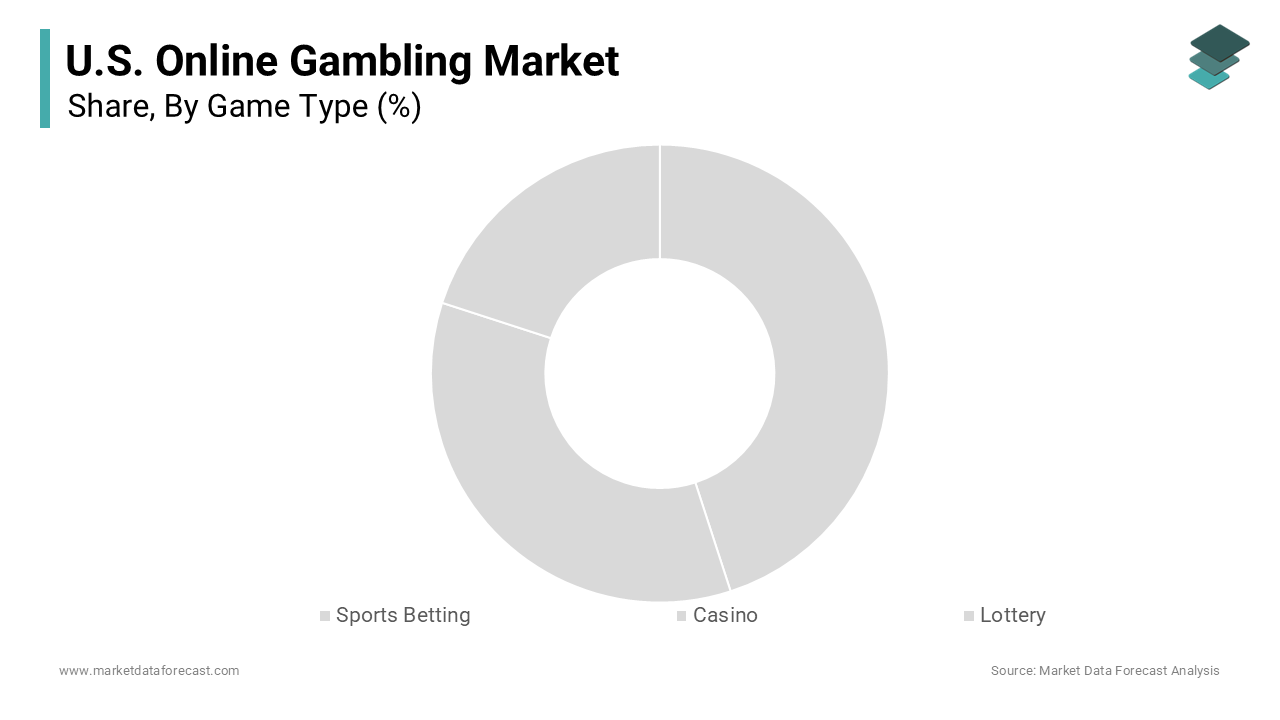
The online casino segment is likely to grow at a fastest CAGR of 6.4% during the forecast period with higher profit margins and increasing state level legalization. Unlike sports betting which relies on external events, online casinos offer a continuous and controlled gaming environment featuring slots table games and live dealer options. States that have legalized online casino games often see significantly higher tax revenues compared to those with only sports betting, incentivizing more jurisdictions to expand their laws. For instance, New Jersey and Pennsylvania have reported that online casino revenue frequently surpasses sports betting revenue, highlighting the lucrative nature of this segment. The development of live dealer technology has bridged the gap between digital and physical casinos, providing an immersive experience that appeals to traditional gamblers. Furthermore, the diverse range of games available online caters to various preferences and risk appetites, attracting a broader demographic. The convenience of accessing casino games from home without the need for travel also contributes to its rapid adoption.
By Gender Insights
The male demographic segment was the largest by accounting for 24.3% of the United States online gambling market share in 2025 with the historically higher participation rates in sports betting and competitive gaming activities. Men are more likely to engage in strategic and skill-based forms of gambling, such as poker and sports wagering, which require analysis and knowledge of statistics. The marketing strategies that often target male audiences through sports media channels and partnerships with professional leagues. The cultural association between masculinity and risk taking also plays a role in higher engagement levels among men. The prevalence of male dominated social groups discussing sports and betting odds further encourages participation. While the gap is narrowing, the entrenched habits and preferences of male users continue to drive the majority of revenue in the online gambling sector. Operators tailor their user interfaces and promotional offers to appeal to this demographic by focusing on competitive leaderboards and high stakes tournaments.
The female segment is likely to grow at a fastest CAGR of 12.4% from 2026 to 2034 w2ith the increased accessibility and targeted marketing efforts. Women are increasingly participating in online casino games particularly slots and bingo, which are perceived as less intimidating and more entertaining than traditional sports betting. The rise of social casino games and free to play apps has served as a gateway for many women to transition into real money gambling. These platforms offer a low risk environment where users can learn the mechanics of games without financial pressure. Furthermore, online gambling provides a convenient and private form of entertainment that fits well with the busy lifestyles of many women. Operators are recognizing this potential and are developing marketing campaigns that highlight fun and social interaction rather than just competition. The introduction of responsible gaming tools also appeals to female users who prioritize safety and control.
By Age Group Insights
The age group of 25 to 40 years segment was accounted in holding a dominant share of the United States online gambling market in 2025 with the high digital literacy disposable income and a strong affinity for mobile technology. The individuals in this age bracket are among the most active users of mobile apps, making them ideal candidates for online betting platforms. They possess the financial stability to engage in regular wagering while still being open to new forms of entertainment. This group is also highly influenced by social media and influencer marketing, which are key channels for user acquisition in the online gambling industry. The integration of gambling into sports viewing experiences appeals strongly to this cohort who are avid consumers of digital sports content. Furthermore, this age group values convenience and speed, preferring the instant gratification offered by online platforms over visiting physical casinos. Their willingness to adopt new technologies such as cryptocurrency payments and live streaming features further solidifies their dominance. Operators focus heavily on this segment by offering personalized promotions and seamless mobile experiences.
The age group above 40 years is lucratively to grow at an anticipated CAGR of 10.3% from 2026 to 2034 with the increasing comfort with digital platforms and the desire for convenient entertainment. Older adults are increasingly adopting smartphones and tablets for daily activities by removing the technological barrier that previously limited their participation. The higher disposable income and more leisure time by allowing for sustained engagement with online gambling platforms. The closure of many land-based casinos during recent years also accelerated the shift to online alternatives for this group who were already familiar with casino games. Online platforms offer the same games they enjoy in a more accessible format, eliminating the need for travel. Furthermore, the perception of online gambling as a safe and regulated form of entertainment has grown among older adults. Operators are responding by designing user friendly interfaces with larger fonts and simpler navigation to cater to this audience.
By Device Insights
The mobile devices segment held a dominant share of the United States online gambling market in 2025 with the unparalleled convenience and accessibility they offer. Smartphones, allow users to place bets from anywhere at any time, integrating gambling seamlessly into daily life. The advanced capabilities of modern smartphones, including high resolution screens and fast processors, provide a high quality gaming experience that rivals desktop computers. The availability of dedicated mobile apps from major operators ensures optimized performance and easy access to accounts. Push notifications keep users engaged by alerting them to upcoming games promotions and bonus offers. The integration of mobile payment systems, such as Apple Pay, and Google Pay, that simplifies deposits and withdrawals, reducing friction in the transaction process. Furthermore, the ubiquity of mobile devices means that operators can reach a wider audience than through desktop alone.
The desktop segment is expected to grow at a fastest CAGR of 11.2% from 2026 to 2034. The desktop computers remain the preferred device for complex online casino games and poker tournaments where precision and screen real estate are important. Professional gamblers often use multiple monitors to track odds and manage multiple games simultaneously, a setup that is difficult to replicate on mobile devices. The stability of wired internet connections on desktops also reduces the risk of disconnections during high stakes moments. Furthermore, some older demographics who are less comfortable with touch interfaces prefer the traditional mouse and keyboard setup. Operators are enhancing their desktop platforms with advanced features, such as customizable dashboards and detailed history logs to cater to this serious segment.
COMPETITIVE LANDSCAPE
The competition in the United States online gambling market is intense and characterized by a handful of dominant operators vying for market share in newly regulated states. Major players like FanDuel DraftKings and BetMGM leverage substantial financial resources to fund aggressive marketing campaigns and offer attractive promotions to acquire customers. Brand recognition and user experience are critical differentiators as operators strive to create seamless and engaging platforms for sports betting and casino games. Price competition is evident in the form of enhanced odds and bonus offers which can erode profit margins. Strategic partnerships with sports leagues and media companies provide competitive advantages in terms of content and data access. Technology plays a pivotal role with operators investing in advanced algorithms for odds setting and risk management. Customer retention is a key focus area as acquisition costs rise leading to increased emphasis on loyalty programs and personalized experiences.
KEY MARKET PLAYERS
A few of the major companies in the U.S. Online Gambling Market include
- DraftKings Inc.
- FanDuel Group
- BetMGM LLC
- Caesars Entertainment Inc.
- Bally’s Corporation
- Rush Street Interactive Inc.
- Flutter Entertainment Plc
- Entain Plc
- Kindred Group Plc
- 888 Holdings Plc
- Wynn Resorts Ltd.
- Golden Nugget Online Gaming
- Bet365 Group Ltd.
- Playtech Plc
- Evolution AB
- PointsBet Holdings Ltd.
- Churchill Downs Incorporated
- PENN Entertainment Inc.
- Scientific Games Corporation
- International Game Technology (IGT)
Top Players in the US Online Gambling Market
FanDuel Group
FanDuel Group stands as a premier operator in the United States online gambling market by offering a comprehensive suite of sports betting and online casino products. The company leverages its strong brand recognition and user friendly interface to attract and retain a large customer base across multiple states. Recent actions include the expansion of its live dealer casino offerings, which provide an immersive experience for players seeking real time interaction. FanDuel has also invested heavily in proprietary technology to enhance odds compilation and risk management capabilities. Strategic partnerships with major sports leagues and media outlets have increased its visibility and credibility among consumers. The company focuses on responsible gaming initiatives to build trust and ensure sustainable growth. Its integration with advanced data analytics allows for personalized marketing and improved customer engagement.
DraftKings Inc
DraftKings Inc is a dominant force in the United States online gambling market known for its innovative daily fantasy sports origins and robust sportsbook platform. The company has successfully transitioned into a full service iGaming provider offering both sports betting and online casino games in regulated jurisdictions. Recent actions include the launch of exclusive content and branded games that differentiate its casino portfolio from competitors. DraftKings has expanded its geographic footprint by entering new states as legislation permits ensuring broad market coverage. The company utilizes aggressive marketing campaigns and promotional offers to acquire new users and drive engagement. Its technology stack supports high volume traffic during peak sporting events ensuring reliability and performance. DraftKings also focuses on cross selling opportunities between its fantasy sports and betting platforms to maximize customer lifetime value.
BetMGM
BetMGM operates as a leading joint venture in the United States online gambling market combining the digital expertise of Entain with the brand power of MGM Resorts. The company offers a wide range of sports betting and casino games leveraging the loyalty program of MGM to drive customer retention. Recent actions include the enhancement of its live sports streaming capabilities which allow users to watch games directly within the app while placing bets. BetMGM has focused on integrating its online and land based operations to provide a seamless omnichannel experience for customers. The company regularly introduces new promotional features and betting markets to keep users engaged. BetMGM invests in customer support and responsible gaming tools to maintain high standards of service.
Top Strategies Used by Key Market Participants
Key players in the United States online gambling market primarily focus on aggressive customer acquisition through lucrative sign up bonuses and free bet offers to attract new users. Companies invest heavily in marketing partnerships with professional sports leagues and teams to enhance brand visibility and credibility. Technological innovation is central to their strategy with operators developing intuitive mobile applications and live streaming features to improve user engagement. Expansion into new states as legalization progresses allows firms to capture early market share and establish brand loyalty. Diversification into online casino games provides additional revenue streams beyond sports betting. Data analytics are utilized to personalize marketing efforts and optimize risk management processes. Responsible gaming initiatives are implemented to ensure regulatory compliance and build consumer trust. Mergers and acquisitions help consolidate market position and acquire specialized technologies or talent.
MARKET SEGMENTATION
This research report on the U.S. online gambling market has been segmented based on the following categories.
By Game Type
- Sports Betting
- Football
- Horse Racing
- Tennis
- Other Game Types
- Casino
- Live Casino
- Baccarat
- Blackjack
- Poker
- Slots
- Other Casino Games
- Lottery
- Bingo
- Other Game Types
By Gender
- Male
- Female
By Age Group
- Below 25 Years
- 25 – 40 Years
- Above 40 Years
By Device
- Desktop
- Mobile
- Other Devices
By Country
- California
- Washington
- Oregon
- New York
- Rest of the United States