- Product Description Description
- Table of Contents TOC
- List of Table & Figure LOT
- Get Free Sample PDF Sample PDF
Market Size, 2025
$207.12 BnMarket Estimate, 2026
$216.18 BnMarket Forecast, 2034
$313.42 BnCAGR, 2026–2034
4.71%U.S. Online Travel Market Report Summary
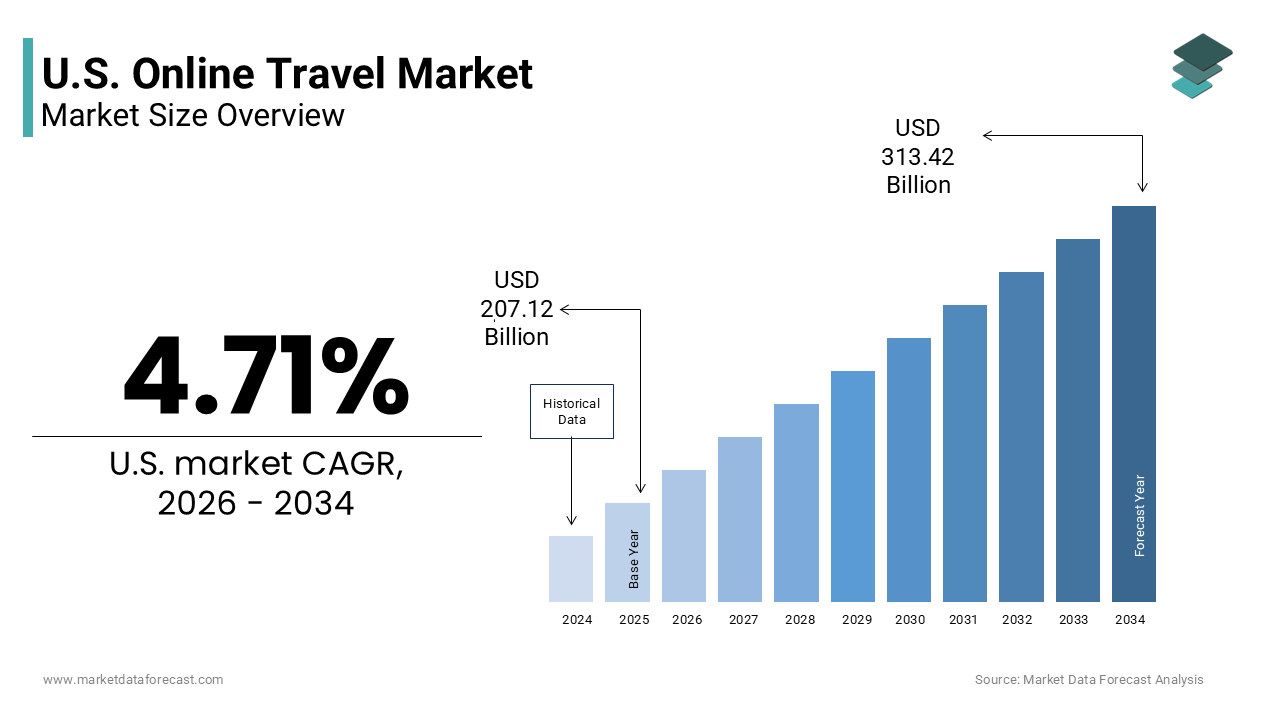
The U.S. online travel market was valued at USD 207.12 billion in 2025, is estimated to reach USD 216.18 billion in 2026, and is projected to reach USD 313.42 billion by 2034, growing at a CAGR of 4.71% during the forecast period from 2026 to 2034. The growth of the U.S. online travel market is driven by the high penetration of smartphones, increasing internet accessibility, and rising consumer preference for digital travel planning and booking platforms. The growing adoption of online travel agencies, mobile-based booking applications, and personalized travel experiences is further accelerating market growth. Additionally, advancements in artificial intelligence, digital payment systems, and real-time travel management solutions are enhancing customer convenience and supporting the expansion of the online travel industry across the United States.
Key Market Trends
- Rising adoption of mobile-first travel booking platforms and applications among tech-savvy consumers
- Increasing integration of artificial intelligence and machine learning for personalized travel recommendations and customer support
- Growing demand for customized and experience-based travel packages tailored to consumer preferences
- Expansion of alternative accommodations and vacation rental platforms across major travel destinations
- Strong focus on contactless payments, digital wallets, and seamless itinerary management solutions
Segmental Insights
- Based on platform type, the mobile/tablet-based segment held a significant share of the U.S. online travel market in 2025. The segment’s dominance is attributed to the widespread use of smartphones, increasing preference for on-the-go travel bookings, and the convenience offered by mobile applications with real-time notifications and digital ticketing features.
- Based on mode of booking, the online travel agencies segment accounted for the largest share of the U.S. online travel market in 2025. The dominance of this segment is driven by the ability of online travel agencies to aggregate extensive travel inventories, provide price comparison tools, and offer bundled travel deals for enhanced consumer convenience.
- The direct travel facilitators segment is expected to witness strong growth during the forecast period owing to the growing focus of airlines, hotels, and travel providers on direct booking channels, exclusive discounts, loyalty programs, and personalized customer experiences.
- Based on service type, the transportation segment dominated the market in 2025 due to the high volume of online flight, rail, and bus ticket bookings, supported by increasing domestic and international travel activity across the United States.
Regional Insights
The U.S. online travel market is witnessing robust growth across California, Washington, Oregon, New York, and the rest of the United States, supported by the high internet penetration, increasing tourism activity, and widespread adoption of digital travel platforms. California remains one of the leading regional markets due to its large travel and tourism ecosystem, strong technology infrastructure, and high consumer spending on leisure and business travel services.
Competitive Landscape
The U.S. online travel market is highly competitive and characterized by the presence of global online travel agencies, travel technology companies, and direct booking platforms competing through advanced digital capabilities, personalized offerings, competitive pricing strategies, and integrated travel services. Companies are increasingly focusing on artificial intelligence-powered travel planning, mobile app enhancements, alternative accommodation offerings, and loyalty program expansion to strengthen their market presence and customer retention. Prominent players in the U.S. online travel market include Booking Holdings Inc., Expedia Group Inc., Airbnb Inc., Trip.com Group, Tripadvisor Inc., Hopper Inc., MakeMyTrip Ltd., Travelzoo, American Express Global Business Travel, BCD Travel, CWT, Despegar.com Corp., eDreams ODIGEO, KAYAK, Priceline, Orbitz, Travelocity, Skyscanner, Agoda, and Vrbo.
U.S. Online Travel Market Size
The U.S. online travel market size was valued at USD 207.12 billion in 2025 and is anticipated to reach USD 216.18 billion in 2026 from USD 313.42 billion by 2034, growing at a CAGR of 4.71% during the forecast period from 2026 to 2034.
The online travel is a sophisticated digital ecosystem, where consumers research plan and book transportation accommodation and leisure activities via internet connected devices. The online travel agencies, meta search engines, and direct supplier websites facilitating a competitive environment for airlines hotels car rental firms and experience providers. The proliferation of high speed mobile connectivity is fundamental to this industry's operation. As per the Federal Communications Commission, approximately 92% of Americans have access to fixed broadband service ensuring that travelers can access real time inventory and pricing information from virtually any location. Furthermore the Pew Research Center indicates that 85% of American adults own a smartphone which serves as the primary device for last minute bookings and itinerary management. This ubiquity of mobile technology has shifted consumer behavior toward on the go decision making and instant confirmation. The integration of secure digital wallets and biometric authentication further streamlines the booking process reducing friction and abandonment rates. Regulatory frameworks regarding data privacy and consumer protection also shape the operational landscape requiring platforms to maintain transparency in pricing and data handling. The convergence of technological accessibility and changing consumer preferences for autonomy and customization defines the current state of the market creating a dynamic environment for innovation and growth.
MARKET DRIVERS
High Smartphone Penetration Facilitates Mobile First Booking Behavior
The widespread adoption of smartphones are enabling consumers to research and book travel services with unprecedented convenience and immediacy is solely accelerating the growth of the United States online travel market. Mobile devices allow travelers to compare prices read reviews and secure reservations, while commuting or during idle moments transforming the planning process into a continuous and flexible activity. As per the study, 85% of American adults currently own a smartphone providing a massive installed base for mobile optimized travel platforms. This high level of device ownership ensures that online travel agencies and suppliers can reach users through dedicated applications and responsive websites without requiring additional hardware investments. The convenience of mobile booking is particularly beneficial for last minute travel decisions where speed and accessibility are paramount. Users can receive instant notifications about price drops flight delays or gate changes enhancing the overall travel experience. Furthermore, the integration of location-based services that allows platforms to offer relevant recommendations for nearby hotels restaurants and attractions increasing engagement and conversion rates. The ability to store digital tickets and boarding passes directly on smartphones also reduces the need for physical documents simplifying the check in process. Consequently, the seamless integration of travel services into the mobile ecosystem drives higher frequency of interactions and fosters loyalty among tech savvy consumers who prioritize efficiency and flexibility in their travel arrangements.
Increasing Consumer Preference for Personalized Travel Experiences
The growing demand for personalized travel experiences by compelling platforms to leverage data analytics and artificial intelligence is another factor boosting the growth of the United States online travel market. Modern travelers seek unique and customized itineraries that reflect their specific interests budgets and travel styles rather than generic package deals. As per the McKinsey Global Institute, companies that excel at personalization generate 40% more revenue from those activities than average players highlighting the economic incentive for tailored services. Online travel platforms utilize machine learning algorithms to analyze past booking history search behavior and social media interactions to recommend relevant destinations accommodations and activities. This level of customization enhances user satisfaction and increases the likelihood of conversion by presenting options that align closely with consumer desires. Additionally, the rise of niche travel segments such as eco-tourism adventure travel and culinary tours requires specialized knowledge and curation that digital platforms can provide efficiently. The ability to dynamically adjust recommendations in real time based on changing preferences or external factors, such as weather that further enhances the value proposition. This shift toward personalization transforms online travel platforms from mere booking engines into trusted travel advisors fostering deeper customer relationships and long-term loyalty.
MARKET RESTRAINTS
Cybersecurity Threats and Data Privacy Concerns
The cybersecurity threats and data privacy concerns by undermining consumer trust and exposing users to financial risks is restricting the growth of the United States online travel market. Online travel transactions involve the exchange of sensitive personal and financial information, including credit card details passport numbers and home addresses, making them attractive targets for cybercriminals. High profile data breaches at major travel companies can lead to identity theft and unauthorized charges causing significant distress and financial loss for victims. These incidents erode consumer confidence in digital platforms leading to hesitation in sharing personal information or completing transactions. Furthermore, stringent data privacy regulations, such as the California Consumer Privacy Act impose compliance burdens on travel providers requiring them to implement robust security measures and transparent data handling practices. Failure to comply can result in hefty fines and legal action damaging brand reputation. The complexity of securing data across multiple devices and networks adds to the operational challenges for travel companies.
Economic Volatility and Inflationary Pressures
The economic volatility and inflationary pressures by reducing disposable income and altering consumer spending priorities is also degrading the growth of the United States online travel market. Rising costs for essential goods and services, such as housing food and energy limit, the amount of money households can allocate to discretionary activities like travel. The consumer price index has shown significant increases in recent years, impacting household budgets and forcing consumers to cut back on non-essential expenditures. Inflation also affects the cost of travel itself with higher prices for airfare accommodation and dining out making trips more expensive and less accessible for budget conscious travelers. Economic uncertainty leads to cautious spending behavior, where individuals prioritize savings over leisure travel resulting in decreased demand for online booking services. Additionally, fluctuating currency exchange rates can impact international travel affordability further dampening demand for cross border trips. Travel providers may struggle to maintain profit margins while keeping prices competitive in an inflationary environment. The unpredictability of economic conditions makes long term planning difficult for both consumers and businesses leading to shorter booking windows and reduced advance purchases.
MARKET OPPORTUNITIES
Integration of Artificial Intelligence for Enhanced Customer Service
The integration of artificial intelligence into online travel platforms by enabling superior customer service and operational efficiency through automation and predictive analytics, which is likely to set up new opportunities for the growth of the United States online travel market. AI powered chatbots and virtual assistants can handle routine inquiries, such as booking modifications, cancellation policies, and destination recommendations by providing instant support to users around the clock. The spending on artificial intelligence solutions in the travel sector is projected to grow substantially reflecting the increasing adoption of these technologies to enhance user experience. These intelligent systems can analyze vast amounts of data to predict traveler needs and proactively offer solutions, such as alternative flights during disruptions or personalized upgrade offers. This level of responsiveness improves customer satisfaction and reduces the workload on human support agents allowing them to focus on complex issues. Furthermore, AI can optimize pricing strategies by analyzing trends and competitor rates in real time ensuring competitive offerings. The ability to provide hyper personalized recommendations based on user behavior and preferences enhances engagement and conversion rates.
Expansion into Sustainable and Eco Friendly Travel Options
The expansion into sustainable and eco-friendly travel options by aligning with the growing environmental consciousness of modern consumers is also to escalate the growth of the United States online travel market. Travelers are increasingly seeking ways to minimize their carbon footprint and support responsible tourism practices driving demand for green hotels eco tours and low emission transportation options. There is a rising global trend toward sustainable travel with many tourists willing to pay a premium for environmentally friendly services. Online travel platforms can capitalize on this trend by curating and promoting sustainable travel packages and partnering with certified eco-friendly providers. Features, such as carbon footprint calculators and offset programs can be integrated into the booking process by allowing users to make informed choices and contribute to environmental conservation. Highlighting sustainable practices, such as energy efficient accommodations and local community support can differentiate platforms and attract socially responsible travelers. Additionally, regulatory incentives and corporate sustainability goals are encouraging businesses to prioritize green travel options further boosting demand.
MARKET CHALLENGES
Intense Competition and Price Transparency
The intense competition and price transparency by compressing profit margins and making it difficult for platforms to differentiate themselves is one of the major challenges for the growth of the United States online travel market. The ease of comparing prices across multiple websites and apps means that consumers can quickly find the lowest fares and rates leading to a race to the bottom in pricing. Online travel agencies must invest heavily in marketing and technology to attract and retain customers in this highly competitive environment. Suppliers, such as airlines and hotels are also increasingly promoting direct bookings, through their own websites offering exclusive deals to bypass intermediary fees. This disintermediation threatens the business model of traditional online travel agencies. However, achieving this differentiation is challenging in a market where price remains the primary decision factor for many consumers.
Complexity of Managing Dynamic Inventory and Pricing
The complexity of managing dynamic inventory and pricing due to the volatile nature of travel supply and demand is additionally to decline the growth of the United States online travel market. Airline seats hotel rooms and car rentals are perishable goods with values that fluctuate rapidly based on factors, such as seasonality events and competitor actions. The effective revenue management requires sophisticated algorithms and real time data analysis to optimize pricing and occupancy levels. Online travel platforms must integrate with multiple supplier systems each with different protocols and update frequencies making it difficult to maintain accurate and consistent inventory information. Discrepancies in availability or pricing can lead to booking errors customer dissatisfaction and financial losses. Furthermore, the need to respond quickly to market changes requires robust technical infrastructure and continuous monitoring which increases operational costs. The rise of last minute booking trends adds another layer of complexity as platforms must adjust prices and availability in real time to capture demand. Failure to manage these dynamics effectively can result in lost revenue opportunities or overbooking situations. Balancing the need for competitive pricing with the goal of maximizing yield is a delicate task that requires constant refinement of strategies and technologies.
REPORT COVERAGE
| REPORT METRIC | DETAILS |
| Market Size Available | 2025 to 2034 |
| Base Year | 2025 |
| Forecast Period | 2026 to 2034 |
| CAGR | 4.71% |
| Segments Covered | By Platform Type, Mode of Booking, Service Type, and Region. |
| Various Analyses Covered | Global, Regional & Country Level Analysis, Segment-Level Analysis; DROC, PESTLE Analysis, Porter's Five Forces Analysis, Competitive Landscape, Analyst Overview of Investment Opportunities |
| Countries Covered | California, Washington, Oregon, New York, and the rest of the United States. |
| Market Leader Profiled | Booking Holdings Inc., Expedia Group Inc., Airbnb Inc., Trip.com Group, Tripadvisor Inc., Hopper Inc., MakeMyTrip Ltd., Travelzoo, American Express Global Business Travel, BCD Travel, CWT, Despegar.com Corp., eDreams ODIGEO, KAYAK, Priceline, Orbitz, Travelocity, Skyscanner, Agoda, and Vrbo. |
SEGMENTAL ANALYSIS
By Platform Type Insights
The mobile and tablet based segment held a significant share of the United States online travel market in 2025 with the ubiquity of smartphones and the consumer preference for on the go booking capabilities. The seamless integration of travel services into daily digital routines by allowing users to research and book trips, during commutes or idle moments. Many American adults own a smartphone, which provides a massive installed base for mobile optimized travel applications. This widespread device ownership ensures that travel platforms can reach users anywhere and at any time removing the geographical constraints associated with desktop computing. The convenience of mobile apps which often feature saved payment methods and personalized recommendations reduces friction in the booking process leading to higher conversion rates. Furthermore, the rise of last minute travel decisions is heavily supported by mobile platforms as travelers can quickly compare prices and secure accommodations, while enroute. Push notifications regarding price drops or flight delays keep users engaged and informed fostering loyalty. The superior user experience provided by native apps including intuitive interfaces and faster load times compared to mobile browsers further encourages adoption.
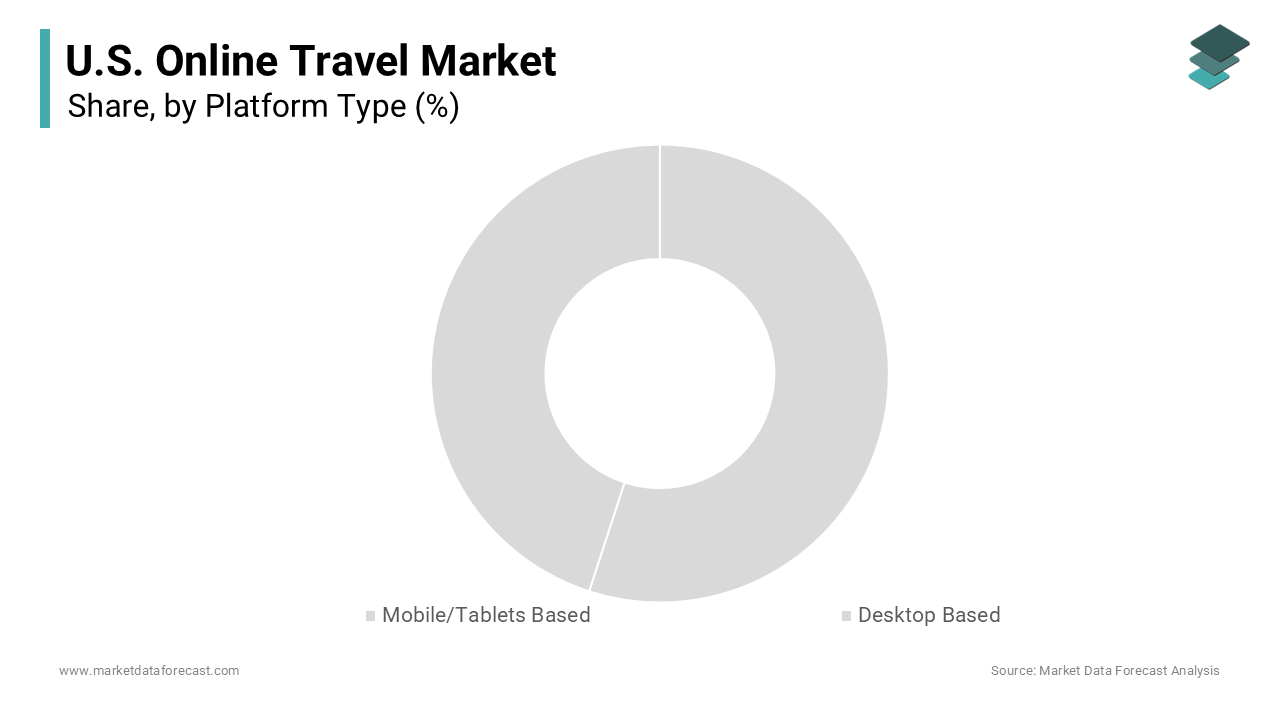
The mobile and tablet-based segment is projected to register a fastest CAGR of 12.3% during the forecast period with the technological advancements and changing consumer behaviors. The increasing sophistication of mobile applications, which now offer features comparable to desktop versions, such as virtual tours and complex itinerary management. As per Statista mobile commerce sales in the United States are expected to account for over 40% of total e commerce sales in the coming years reflecting a broader shift toward mobile first interactions. The improvement in mobile network infrastructure including the rollout of fifth generation technology enables faster loading times and smoother streaming of high resolution content enhancing the user experience. Additionally the integration of augmented reality features in travel apps allows users to visualize destinations and hotels before booking adding a layer of immersion that drives engagement. The growing preference for contactless transactions and digital wallets among younger demographics further accelerates mobile adoption. Travel providers are investing heavily in mobile exclusive deals and loyalty programs to capture this growing audience.
By Mode of Booking Insights
The online travel agencies segment was accounted in holding a dominant share of the United States online travel market in 2025 due to their ability to aggregate vast inventories and offer comprehensive comparison tools that simplify the planning process for consumers. The convenience of viewing multiple options for flights hotels and car rentals on a single platform, which saves time and effort for travelers. These platforms leverage economies of scale to negotiate better rates with suppliers which they pass on to customers in the form of discounts and packages. The availability of user reviews and ratings helps travelers make informed decisions reducing the perceived risk of booking unfamiliar services. Additionally, Online Travel Agencies often bundle services together offering cost savings that are difficult to achieve through direct bookings. Their robust customer support systems and flexible cancellation policies further enhance consumer trust and loyalty. The extensive marketing reach and brand recognition of major agencies also drive traffic and conversions.
The direct travel facilitators segment is likely to grow at an anticipated CAGR of 9.3% from 2026 to 2034 with the supplier strategies to reduce dependency on intermediaries and offer exclusive benefits. Airlines hotel chains and car rental companies are increasingly investing in their direct booking channels to avoid paying commissions to Online Travel Agencies and to build direct relationships with customers. Many hospitality brands are offering best price guarantees and exclusive perks, such as free Wi-Fi or room upgrades to incentivize direct bookings. This strategy appeals to cost conscious travelers, who seek the lowest possible rates and added value. The improvement in user experience on supplier websites and apps including streamlined checkout processes and personalized offers has also contributed to this growth. Loyalty programs play a crucial role as members often receive points or status benefits only when booking directly. The desire for greater control over reservations and easier modification or cancellation processes also drives consumers toward direct channels. Suppliers are leveraging data collected from direct bookings to personalize marketing and improve service quality.
By Service Type Insights
The transportation segment was the largest by occupying 24.5% of the United States online travel market share in 2025 with the high frequency of air and rail travel and the essential nature of mobility in tourism. The sheer volume of domestic and international flights booked online each year, as air travel remains the primary mode of long-distance transportation. Millions of passengers board commercial flights annually in the United States by creating a massive demand for online ticketing services. The complexity of airline pricing and scheduling makes online platforms indispensable for comparing options and finding the best deals. The integration of real time flight information and seat selection tools enhances the utility of online booking systems. Additionally, the rise of low cost carriers has increased the accessibility of air travel further boosting online sales. Rail and bus bookings also contribute to this segment although to a lesser extent. The necessity of securing transportation before other travel components such as accommodation ensures that this segment generates consistent and high revenue. The ability to book multi city itineraries and manage connections online adds to the convenience and appeal.
The vacation packages segment is expected to witness a fastest CAGR of 11.4% from 2026 to 2034 with the desire for convenience and cost savings through bundled offerings. Travelers are increasingly opting for packages that combine flights hotels and activities, as they simplify the planning process and often provide significant discounts compared to booking each component separately. There is a rising trend among leisure travelers to seek all-inclusive experiences that minimize logistical stress and maximize value. Online platforms are responding by offering customizable packages that allow users to tailor their trips to specific preferences while still benefiting from bundle pricing. The popularity of experiential travel where tourists seek unique local activities and guided tours has also boosted this segment. Providers are partnering with local operators to include exclusive experiences in their packages enhancing their appeal. The economic uncertainty has made budget conscious travelers more attracted to the predictable costs of packaged deals. Additionally, the ease of managing a single reservation for multiple services reduces the risk of errors and simplifies customer support.
COMPETITIVE LANDSCAPE
The competition in the United States online travel market is intense and characterized by the presence of large global aggregators specialized niche platforms and direct supplier channels. Major players compete on price inventory breadth and user experience striving to offer the most convenient and cost effective booking solutions. Differentiation is achieved through proprietary technology such as artificial intelligence driven recommendations and seamless mobile interfaces that enhance customer satisfaction. The rise of alternative accommodations has intensified rivalry between traditional hotel focused agencies and home sharing platforms. Direct booking initiatives by airlines and hotel chains pose a significant challenge to intermediaries prompting agencies to add value through bundled packages and loyalty rewards. Price transparency allows consumers to easily compare options forcing companies to maintain competitive rates while managing thin margins. Customer retention is a key focus area with firms investing heavily in loyalty programs and personalized marketing to foster brand allegiance. Regulatory compliance and data security are critical factors influencing consumer trust and operational stability.
KEY MARKET PLAYERS
A few of the major companies in the U.S. Online Travel Market include
- Booking Holdings Inc.
- Expedia Group Inc.
- Airbnb Inc.
- Trip.com Group
- TripAdvisor Inc.
- Hopper Inc.
- MakeMyTrip Ltd.
- Travelzoo
- American Express Global Business Travel
- BCD Travel
- CWT
- Despegar.com Corp.
- eDreams ODIGEO
- KAYAK
- Priceline
- Orbitz
- Travelocity
- Skyscanner
- Agoda
- Vrbo
Top Players in the US Online Travel Market
Booking Holdings Inc
Booking Holdings Inc is a dominant entity in the United States online travel market operating prominent brands such as Priceline and Kayak. The company leverages its extensive global inventory to offer competitive pricing and diverse accommodation options to American travelers. Recent actions include significant investments in artificial intelligence to enhance search algorithms and personalize user experiences across its platforms. Booking Holdings has also expanded its alternative accommodation listings to meet the growing demand for vacation rentals and unique stays. The company focuses on improving mobile app functionality to facilitate seamless last-minute bookings and itinerary management. These initiatives strengthen its market position by providing superior value and convenience to users, while maintaining strong relationships with supply partners.
Expedia Group
Expedia Group contributes significantly to the United States online travel market through its portfolio of well recognized brands including Expedia.com Hotels.com and Vrbo. The company provides a comprehensive range of travel services from flight bookings to car rentals and cruise packages. Recent actions involve the strategic integration of Vrbo into its core platform to create a unified marketplace for both hotel and vacation rental accommodations. Expedia Group has invested heavily in technology to improve site performance and introduce generative artificial intelligence features that assist users in planning complex itineraries. The company emphasizes loyalty programs such as One Key which rewards members across all its brands fostering deeper customer engagement. These efforts enhance the user experience and drive repeat business. The company also prioritizes sustainable travel options aligning with consumer values. These strategic moves solidify its reputation as a leading provider of diverse and reliable travel solutions in the United States.
Airbnb Inc
Airbnb Inc has transformed the United States online travel market by popularizing the home sharing model and offering unique local experiences. The platform connects hosts with travelers seeking authentic and personalized accommodations beyond traditional hotels. Recent actions include the introduction of enhanced verification processes and safety features to build trust among users. Airbnb has also expanded its offerings to include long term stays catering to remote workers and digital nomads. The company leverages machine learning to improve search relevance and match guests with suitable properties based on their preferences. Airbnb actively promotes its Experiences feature allowing travelers to book activities hosted by locals. This diversification adds value to the platform and increases user engagement. The company focuses on community building and host support to ensure high quality standards.
Top Strategies Used by Key Market Participants
Key players in the United States online travel market primarily focus on leveraging artificial intelligence to personalize user experiences and optimize search results for higher conversion rates. Companies are increasingly integrating alternative accommodations such as vacation rentals into their platforms to diversify inventory and appeal to broader consumer preferences. Strategic partnerships with airlines and hotel chains enable direct connectivity ensuring real time availability and competitive pricing for customers. Investment in mobile technology enhances accessibility and facilitates seamless last minute bookings through intuitive applications. Loyalty programs are expanded and integrated across multiple brands to encourage repeat business and increase customer lifetime value. Marketing efforts emphasize sustainable travel options and unique experiences to align with evolving consumer values. Data analytics are utilized to refine targeting strategies and improve operational efficiency.
MARKET SEGMENTATION
This research report on the U.S. Online Travel Market has been segmented based on the following categories.
By Platform Type
- Mobile/Tablets Based
- Desktop Based
By Mode of Booking
- Online Travel Agencies
- Direct Travel Facilitators
By Service Type
- Transportation
- Accommodation
- Vacation Packages
By Country
- California
- Washington
- Oregon
- New York
- Rest of the United States