U.S. Organic Food Market Size, Share, Trends & Growth Forecast Report - Segmented By Category, Product, Distribution Channel, and By Country (California, Washington, Oregon, New York & Rest of the United States) – Industry Analysis and Forecast, 2026 to 2034
Market Size, 2025
$86.63 BnMarket Estimate, 2026
$97.41 BnMarket Forecast, 2034
$224.88 BnCAGR, 2026–2034
12.43%U.S. Organic Food Market Report Summary
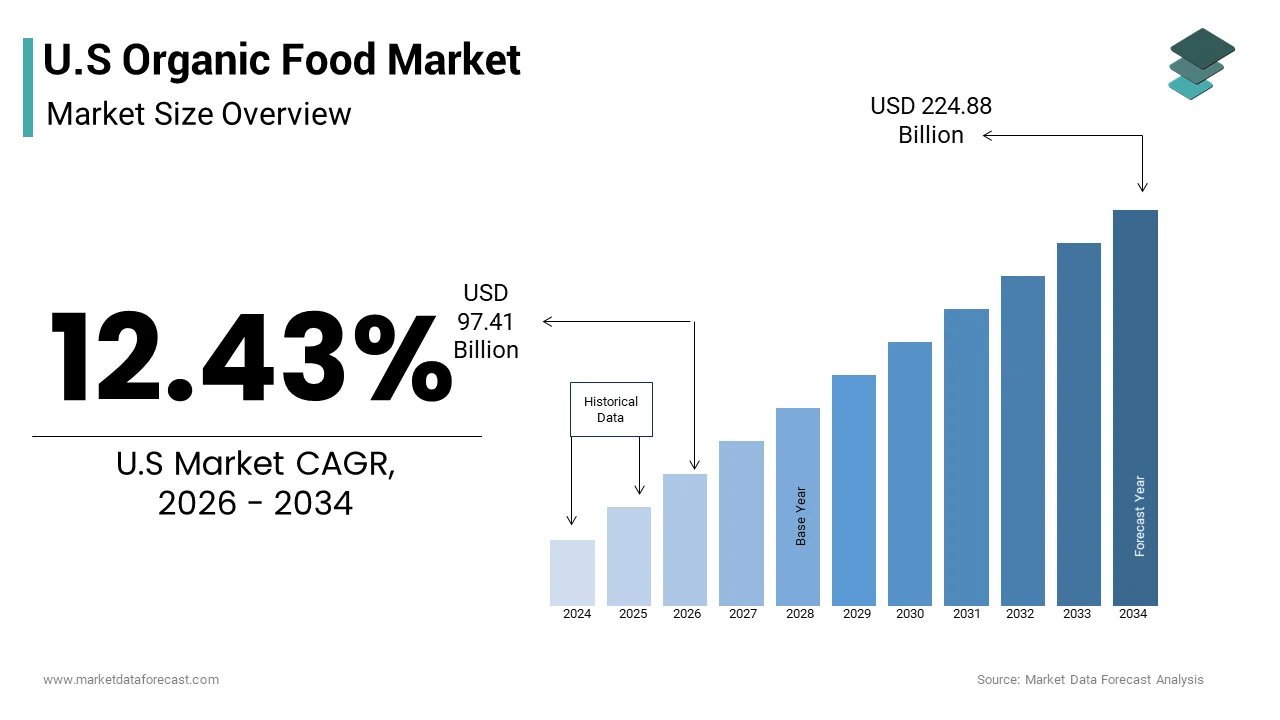
The U.S. organic food market was valued at USD 86.63 billion in 2025, is estimated to reach USD 97.41 billion in 2026, and is projected to reach USD 224.88 billion by 2034, growing at a CAGR of 12.43% during the forecast period from 2026 to 2034. The U.S. organic food market is expanding rapidly as consumers increasingly prioritize health, nutrition, and environmentally responsible food choices. Rising awareness of pesticide-free farming, clean-label products, and sustainable agricultural practices is encouraging greater adoption of certified organic foods across households. The growing demand for minimally processed products, plant-based diets, and naturally sourced ingredients is further accelerating market growth. Retailers are expanding their organic product portfolios while food manufacturers continue to introduce innovative organic offerings across multiple categories. In addition, increasing consumer confidence in organic certifications, improved product availability, and the rapid growth of e-commerce grocery platforms are creating strong long-term opportunities for the market.
Key Market Trends
- Consumers are increasingly choosing certified organic foods that are free from synthetic pesticides, fertilizers, and genetically modified ingredients.
- Demand for clean-label, minimally processed, and plant-based organic products continues to reshape product development strategies.
- Supermarkets are expanding private-label organic product lines to improve affordability and increase consumer accessibility.
- Sustainable farming practices, regenerative agriculture, and environmentally responsible packaging are becoming key competitive differentiators.
- Digital grocery platforms and direct-to-consumer sales channels are improving the availability of organic food products nationwide.
Segmental Insights
Based on category, the fruits and vegetables segment accounted for 36.9% of the U.S. organic food market share in 2025. The segment's leadership is driven by strong consumer preference for fresh produce, increasing awareness of pesticide-free cultivation, and growing demand for nutrient-rich foods that support healthier lifestyles.
Based on product, the unprocessed organic foods segment held the leading share of the U.S. organic food market in 2025. Its dominance is attributed to rising consumer demand for natural, minimally processed food products that retain their original nutritional value and align with clean-eating preferences.
Based on distribution channel, the supermarkets and hypermarkets segment commanded the largest share of the U.S. organic food market in 2025. The segment benefits from extensive product availability, dedicated organic food sections, competitive pricing strategies, and convenient access to a broad selection of certified organic brands.
Regional Insights
The United States remains one of the largest organic food markets globally, supported by strong consumer awareness of healthy eating, a well-established organic farming ecosystem, and expanding retail distribution networks. Growing demand for sustainably produced food, increasing disposable incomes, and supportive organic certification standards continue to strengthen market growth. The widespread presence of supermarkets, specialty organic retailers, farmers' markets, and online grocery platforms has significantly improved consumer access to organic products across the country. As health-conscious purchasing behavior and environmental awareness continue to rise, the United States is expected to maintain its leadership in the global organic food industry throughout the forecast period.
Competitive Landscape
The U.S. organic food market is highly competitive, with multinational food companies, organic food specialists, retailers, and private-label brands competing through product innovation, sustainable sourcing, and premium quality standards. Leading companies are expanding their portfolios with organic fruits and vegetables, dairy products, packaged foods, beverages, and plant-based alternatives to address evolving consumer preferences. Strategic acquisitions, partnerships with certified organic farmers, investments in regenerative agriculture, and expansion of omnichannel distribution networks remain key competitive strategies. Manufacturers are also strengthening traceability, clean-label formulations, eco-friendly packaging, and transparent supply chains to enhance consumer trust. As demand for organic and sustainably produced foods continues to accelerate, market participants are focusing on innovation, certification compliance, and responsible sourcing to strengthen their competitive position.
Prominent players in the U.S. organic food market include General Mills Inc. (U.S.), Danone S.A. (France), Whole Foods Market, Danone North America, Kroger, Dole plc. (Ireland), Organic Valley (U.S.), Organic India Pvt. Ltd. (India), Amy's Kitchen Inc. (U.S.), Arla Foods Amba (Denmark), Eden Foods Inc. (U.S.), Hain Celestial Group Inc. (U.S.), and SunOpta Inc. (U.S.).
U.S. Organic Food Market Size
The U.S organic food market size was valued at USD 86.63 billion in 2025 and is anticipated to reach USD 97.41 billion in 2026 to reach USD 224.88 billion by 2034, growing at a CAGR of 12.43% during the forecast period from 2026 to 2034.
Over the past two decades, organic food has transitioned from a niche offering to a mainstream segment of the American food system. According to the Organic Trade Association, organic products were available in more than 95% of conventional grocery stores nationwide by the end of 2023. Consumer behavior reflects this integration as per the National Health and Nutrition Examination Survey, which indicates that 100% juice is reported by approximately 15.3% of children as a breakfast beverage, and nearly 30% of American children consumed organic food at least once per week in 2022. Further reinforcing this shift, the U.S. Department of Agriculture Pesticide Data Program found in 2021 that 99% of samples tested had residues below the tolerances established by the EPA, while 72% of conventionally grown produce samples contained multiple pesticide residues. This confluence of health awareness, environmental concern, and institutional availability underscores a structural transformation in U.S. food consumption patterns, positioning organic food as a core component of contemporary dietary identity rather than a marginal alternative.
MARKET DRIVERS
The Growing Consumer Awareness of Pesticide Exposure Drives Organic Adoption
American consumers are increasingly selecting organic food to mitigate exposure to synthetic pesticides linked to chronic health risks, which is one of the key factors propelling the U.S. organic food market growth. The U.S. Department of Agriculture Pesticide Data Program reported in 2022 that over 50% of conventional fruit samples contained residues of multiple pesticides with strawberries and spinach showing the highest contamination levels. This data directly influences purchasing decisions, particularly among health conscious and parental demographics. According to a 2023 survey, 68% of respondents chose organic produce specifically to avoid pesticide residues, citing concerns about endocrine disruption and neurodevelopmental effects in children. Supporting this, the Centers for Disease Control and Prevention detected organophosphate metabolites in the urine of approximately 40% of children in the United States during its biomonitoring study, which indicates a significant exposure risk. This biochemical evidence has fueled demand for organic baby food and snacks, with recordable data showing a 22% year over year increase in organic children’s food sales in 2023. Consequently, major retailers including Kroger and Whole Foods have expanded their organic produce sections by an average of 30% since 2021, reflecting a demand shift rooted in toxicological science rather than lifestyle trends alone.
Expansion of Organic Certification Among Midsize Farms Reflects Structural Market Shifts
The significant rise in midsize farms transitioning to certified organic production, which is enhancing domestic supply reliability is further contributing to the U.S. market expansion. According to the U.S. Department of Agriculture Census of Agriculture released in 2023, the number of certified organic farms was 17,321, representing a 4.7% decrease from the previous census, though the number of farms with annual sales between $250,000 and $1,000,000 grew by 18% from 2017 to 2022. These farms are pivotal because they combine sufficient scale to supply regional grocery chains with the agronomic flexibility needed for organic crop rotation and soil management. As per the National Sustainable Agriculture Coalition in 2023, federal cost share programs under the Environmental Quality Incentives Program covered up to 75% of certification expenses, enabling over 2,000 midsize farms to achieve organic status between 2020 and 2023. Additionally, the Agricultural Marketing Service reported a 31% increase in 2022 in contracts between midsize organic farms and food manufacturers for grains and legumes. This structural evolution ensures more consistent product availability and moderates price volatility. According to the projections of the Economic Research Service, these farms will supply nearly 40% of domestic organic produce by 2026, transforming the supply base from fragmented smallholders to a more resilient, commercially integrated network.
MARKET RESTRAINTS
Persistent Price Premiums Limit Broad Consumer Accessibility
Despite rising interest, the organic food market remains constrained by substantial and enduring price premiums that hinder mass adoption, especially among middle and lower income households. According to the U.S. Department of Agriculture Economic Research Service in 2023, organic fresh produce carries an average retail price premium of 82% over conventional equivalents with organic dairy and eggs showing premiums of 65% and 58% respectively. These gaps represent real financial barriers as per the Bureau of Labor Statistics Consumer Expenditure Survey, which calculated in 2022 that average annual expenditures for all consumer units increased by 9.0%, and maintaining a fully organic diet would cost the average American household an additional $1,200 annually. The impact is acute in food insecure communities and according to reports, less than 5% of distributed food items were certified organic due to procurement costs. Even among higher income consumers price sensitivity persists as 53% of occasional organic buyers cited cost as the main reason for inconsistent purchases, per a 2023 survey. While modest reductions in premiums have occurred in categories like milk and apples, structural factors such as lower transitional yields, higher labor demands, and fragmented logistics sustain elevated pricing. Without systemic interventions to reduce production and distribution costs, the market will remain partially exclusionary.
Labor Shortages and Certification Complexity Impede Farm Transition
The acute agricultural labor shortages combined with the administrative and operational burdens of organic certification, particularly affecting small and midsize operations, which is further impeding the organic food market expansion in the U.S. The U.S. Department of Labor documented a 17% decline in available farmworkers between 2019 and 2022 with organic farms, which require more manual labor for weeding, pest scouting, and compost management, bearing the brunt. Simultaneously, maintaining certification demands extensive documentation and as per the Organic Trade Association, farms spend over 200 hours annually on compliance recordkeeping. The mandatory three year transition period further compounds financial strain, as crops grown during this phase must be sold at conventional prices despite incurring organic-level costs. Data from agricultural research programs shows that 34% of farms that began transitioning between 2018 and 2021 abandoned the process, primarily due to labor scarcity and income loss. These intertwined challenges suppress the inflow of new organic suppliers, creating a supply deficit that cannot keep pace with rising consumer demand, thereby constraining overall market growth.
MARKET OPPORTUNITIES
Regenerative Organic Certification Creates Premium Differentiation
The rapid uptake of Regenerative Organic Certification, which enhances USDA organic standards with rigorous criteria for soil health, animal welfare, and social equity is a promising opportunity to the U.S. organic food market. As per the Regenerative Organic Alliance, over 600 farms and brands achieved this certification between 2019 and 2023 with certified acreage growing by 210% in that span. This framework strongly resonates with younger shoppers and according to a 2023 survey, 71% of consumers under 35 were willing to pay a 15% premium for regenerative products, citing climate action as a key driver. Brands like Patagonia Provisions and Maple Hill Creamery have leveraged this label to command price points up to 25% above standard organic items. According to report data, regenerative certified products enjoyed a 43% higher repeat purchase rate than conventional organic goods, signaling deeper brand loyalty. Moreover, Walmart announced in 2023 that it would prioritize regenerative organic suppliers for its private label organic line by 2026. By embedding carbon sequestration and fair labor metrics into its verification, this certification repositions organic food as a holistic environmental and social investment, unlocking new premium segments and corporate partnerships.
Urban Vertical Farming Integrates Organic Principles in Controlled Environments
An innovative opportunity emerges from urban vertical farms adopting organic compliant practices in soil less systems to address traditional constraints of seasonality, transport, and land use. Although the U.S. Department of Agriculture does not currently certify hydroponic or aeroponic systems as organic, many vertical farms use only organic approved nutrients and biological pest controls to meet consumer expectations. According to the Association for Vertical Farming, the number of U.S. commercial vertical farms employing such protocols grew from 23 in 2020 to over 110 by the end of 2023. These operations deliver leafy greens to urban retailers within 24 hours of harvest, drastically cutting emissions and according to reports, an 85% reduction in transportation emissions was observed compared to field grown organic lettuce shipped from California to the East Coast. Consumer perception is favorable and according to a 2023 survey, 64% of urban shoppers viewed vertically farmed produce as as trustworthy as certified organic when transparently labeled. Companies like Plenty and Bowery Farming secured retail partnerships with Albertsons and Walmart, generating over $300 million in combined sales in 2023. As regulatory discussions evolve, this model offers a scalable, climate resilient pathway to expand organic access in metropolitan centers.
MARKET CHALLENGES
Climate Volatility Disrupts Organic Crop Yields and Supply Consistency
The growing climate instability poses a severe challenge to the organic food market, as organic farms, which rely on biological rather than synthetic inputs, exhibit lower short term resilience to extreme weather. The National Oceanic and Atmospheric Administration reported a 42% rise in extreme weather events across major organic growing regions between 2018 and 2023. Organic systems, dependent on cover crops and compost for fertility, struggle to adapt rapidly to droughts or floods. Data from agricultural institutes showed that organic tomato yields in California’s Central Valley fell by 29% during the 2021 drought, compared to a 12% drop in conventional yields. Similarly, records documented a 35% loss in organic corn acreage due to 2022 Midwest floods, disrupting feed supplies for organic livestock and driving up dairy prices. As per the U.S. Department of Agriculture Agricultural Marketing Service, there was a 22% increase in organic produce price volatility from 2020 to 2023, undermining retailer confidence in inventory planning. Without investment in climate adaptive strategies, organic supply chains will remain vulnerable to disruptions that erode market reliability and consumer trust.
Fraudulent Labeling and Certification Gaps Undermine Consumer Trust
Erosion of consumer confidence due to labeling fraud and inconsistent certification oversight is further challenging the U.S. organic food market expansion. As per a 2023 U.S. Department of Agriculture Office of Inspector General investigation, approximately 12% of imported organic grain shipments from Eastern Europe and South America between 2020 and 2022 contained prohibited synthetic pesticides or genetically modified traits, indicating mislabeling or inadequate foreign verification. This fuels skepticism as per a 2023 survey, which revealed that 41% of American organic buyers doubted the authenticity of imported organic products, particularly in categories like olive oil, spices, and frozen berries. The National Organic Program accredits over 100 foreign certifiers but conducts limited on site audits due to resource constraints. In 2022, data indicated that 37 organic brands faced class action lawsuits over alleged misrepresentation, resulting in over $200 million in settlements and reputational harm. Until the certification system implements stronger traceability mechanisms, the integrity of the organic label will remain contested, limiting the market’s ability to scale without reputational risk.
REPORT COVERAGE
| REPORT METRIC | DETAILS |
| Market Size Available | 2025 to 2034 |
| Base Year | 2025 |
| Forecast Period | 2026 to 2034 |
| CAGR | 12.43% |
| Segments Covered | By Category, Product, Distribution Channel, and By Country |
| Various Analyses Covered | Global, Regional, and Country Level Analysis, Segment-Level Analysis; DROC, PESTLE Analysis; Porter’s Five Forces Analysis; Competitive Landscape; Analyst Overview of Investment Opportunities. |
| Regions Covered | California, Washington, Oregon, New York & Rest of the United States |
| Market Leaders Profiled | General Mills Inc. (U.S.), Danone S.A. (France), Whole Foods Market, Danone North America, Kroger, Dole plc. (Ireland), Organic Valley (U.S.), Organic India Pvt. Ltd. (India), Amy's Kitchen, Inc. (U.S.), Arla Foods Amba (Denmark), Eden Foods Inc (U.S.), Hain Celestial Group, Inc. (U.S.), SunOpta Inc (U.S.) |
SEGMENTAL ANALYSIS
By Category Insights
Among these, the fruits and vegetables segment dominated the market by capturing 36.9% of the regional market share in 2025. The growth of the fruits and vegetables segment in the U.S. market is driven by strong consumer prioritization of fresh produce as the entry point into organic consumption, driven by perceptions of immediate health benefits and lower processing. As per the U.S. Department of Agriculture Economic Research Service, over 65% of organic buyers cite fresh produce as their most frequently purchased organic item, reflecting its foundational role in household adoption. Additionally, retail expansion has amplified accessibility as data from the Food Marketing Institute indicates that 92% of conventional supermarkets now feature dedicated organic produce sections, up from 78% in 2018. The segment’s dominance is further reinforced by consistent supply from domestic farms, with the 2022 Census of Agriculture showing that nearly 45% of all certified organic cropland in the U.S. is devoted to fruit and vegetable production. This alignment of consumer preference, retail infrastructure, and domestic supply chain maturity solidifies fruits and vegetables as the cornerstone of the U.S. organic market.
On the other hand, the frozen and processed organic foods segment is expected to exhibit a CAGR of 13.3% during the forecast period in the U.S. market owing to the evolving consumer lifestyles that demand convenience without compromising on clean label principles. According to a 2023 survey, 58% of millennial and Gen Z households now purchase organic frozen meals at least once per month, citing time scarcity and improved product quality as key motivators. Simultaneously, manufacturers have significantly upgraded formulations and as per the Organic Trade Association, over 200 new organic frozen and shelf stable products launched in 2023 alone featured no artificial preservatives and full ingredient transparency. Retailer support has also intensified as Kroger reported a 35% year over year increase in sales of its Simple Truth Organic frozen line in 2023, attributing growth to expanded freezer space and targeted promotions. Moreover, supply chain innovations such as flash freezing at peak harvest preserve nutritional integrity, addressing prior consumer skepticism about processed foods. These converging factors are transforming frozen and processed organic foods from a niche offering into a high velocity growth engine.
By Product Insights
The unprocessed organic foods segment held the leading share of the U.S. organic food market in 2025. This majority position reflects the enduring consumer belief that minimally handled foods offer superior nutritional and safety profiles. As per the National Health and Nutrition Examination Survey, 73% of regular organic consumers prioritize whole, unprocessed items as the core of their diet, viewing them as essential for reducing exposure to additives and industrial processing residues. Retail dynamics further entrench this preference as Whole Foods Market reported in 2023 that unprocessed categories generated 62% of its total organic sales, with produce alone contributing 39%. Additionally, farm to table initiatives have strengthened consumer trust as over 800 farmers markets across the country now exclusively feature certified organic vendors, according to the Agricultural Marketing Service. This direct connection reinforces perceptions of authenticity and freshness, making unprocessed foods the default choice for health conscious shoppers and anchoring their market dominance.
However, the processed organic foods segment is the fastest growing and is predicted to expand at a CAGR of 12.5% during the forecast period owing to the fundamental shift in how American households define convenience, now aligned with clean label expectations. As per records from 2023, sales of organic pantry staples such as pasta sauces, soups, and ready to eat grains grew by 21% year over year, driven by dual income households seeking time efficient yet wholesome meal solutions. Product reformulation has been pivotal and according to survey data, 84% of new organic processed products launched in 2023 contained fewer than five ingredients and avoided refined sugars, directly responding to consumer demand for simplicity. Retailers have amplified visibility as Target expanded its Made By Design Organic line by 40% in 2023, with processed items comprising 70% of new SKUs. Furthermore, private label investment is accelerating as Costco’s Kirkland Signature organic processed foods saw a 28% sales increase in 2023, demonstrating mainstream acceptance. These developments illustrate that processed organic foods are no longer seen as compromises but as intentional, transparent choices within modern dietary routines.
By Distribution Channel Insights
The supermarkets and hypermarkets segment commanded for the largest share of the U.S. organic food market in 2025. The growth of the supermarkets and hypermarkets segment in the U.S> market is attributed to their unparalleled reach, scale, and strategic integration of organic offerings into mainstream shopping journeys. Major chains like Kroger and Albertsons have embedded organic products across departments rather than isolating them, normalizing their purchase. According to the U.S. Department of Agriculture, over 85% of Americans live within 10 miles of a supermarket carrying certified organic items, ensuring geographic accessibility. Private label expansion has further cemented this channel’s lead as Kroger’s Simple Truth brand generated over $2 billion in sales in 2023, with organic items comprising 60% of the portfolio. Additionally, promotional strategies such as weekly organic discounts and loyalty rewards have lowered perceived cost barriers. As per a 2023 study, 61% of occasional organic buyers made their purchases at conventional supermarkets due to convenience and price matching. This combination of ubiquity, affordability, and seamless integration into routine grocery trips solidifies supermarkets and hypermarkets as the primary gateway to organic consumption for the average American household.
The online segment is predicted to showcase the fastest CAGR in the U.S. market during the forecast period owing to the convergence of digital adoption, subscription models, and targeted organic curation. Records from 2023 showed a 33% year over year increase in organic basket size for major online platforms, attributing growth to algorithm driven recommendations and one click reordering of frequently purchased items. Simultaneously, specialized online grocers have refined their value proposition and according to membership surveys, 89% of subscribers joined specifically for access to vetted organic brands at wholesale prices, with average annual spend exceeding $1,200. The pandemic catalyzed lasting behavioral change as according to reports, 47% of consumers who began buying organic online in 2020 continued the habit in 2023, citing time savings and consistent availability. Moreover, last mile logistics have improved as services now offer same day organic delivery from over 15,000 retail partners nationwide. These factors are transforming online retail from a supplementary channel into a primary growth vector for the organic market.
REGIONAL ANALYSIS
The U.S. is anticipated to reinforce its status as the premier global hub for organic food for the next few years. California leads production, contributing over 35% of all certified organic cropland in the country, as per the 2022 U.S. Department of Agriculture Census of Agriculture, with key outputs including lettuce, almonds, and wine grapes. Consumer penetration is broad and deep as per the National Health and Nutrition Examination Survey, which indicates that 61% of American households purchased at least one organic product in 2023, up from 49% in 2018. Regulatory infrastructure further reinforces market stability as the National Organic Program oversees more than 25,000 certified operations, ensuring consistent standards. Retail integration is near universal and as per the Food Marketing Institute, 96% of conventional grocery stores stock organic items across multiple categories. This combination of scale, regulatory rigor, production capacity, and consumer adoption positions the U.S. not merely as a participant but as the defining force shaping global organic food trends, standards, and innovation trajectories.
COMPETITIVE LANDSCAPE
The U.S. organic food market features intense competition among national retailers regional grocers private label brands and specialty producers. Traditional supermarkets like Kroger and Albertsons aggressively expand organic assortments to retain mainstream shoppers while specialty chains such as Whole Foods Market emphasize premium quality and ethical sourcing to maintain differentiation. Simultaneously private label brands are gaining traction by offering affordable organic alternatives that challenge national brands on price and transparency. New entrants including online grocers and direct to consumer farms further intensify rivalry by prioritizing convenience and traceability. This multifaceted competitive landscape drives continuous innovation in product formulation supply chain efficiency and consumer engagement. Companies must balance scale with authenticity as consumers increasingly scrutinize both ingredient integrity and environmental impact. Consequently market participants invest heavily in certification partnerships farmer support programs and digital storytelling to build lasting trust and loyalty in an increasingly crowded and discerning marketplace.
KEY MARKET PLAYERS
A few of the market players that are dominating the U.S organic food market are
- General Mills Inc. (U.S.)
- Danone S.A. (France)
- Whole Foods Market
- Danone North America
- Kroger
- Dole plc. (Ireland)
- Organic Valley (U.S.)
- Organic India Pvt. Ltd. (India)
- Amy's Kitchen, Inc. (U.S.)
- Arla Foods Amba (Denmark)
- Eden Foods Inc (U.S.)
- Hain Celestial Group, Inc. (U.S.)
- SunOpta Inc (U.S.)
Top Players In The Market
- Whole Foods Market remains a cornerstone of the U.S. organic food ecosystem through its rigorous quality standards and extensive certified organic product portfolio. The company operates over five hundred stores nationwide, each adhering to stringent sourcing protocols that prioritize regenerative agriculture and animal welfare. In recent years, it has deepened its commitment by expanding its private label 365 by Whole Foods to include over six hundred organic SKUs. The retailer also launched in store educational campaigns to enhance consumer understanding of organic certification. Its integration with Amazon has enabled same day delivery of organic groceries in major metropolitan areas, significantly broadening accessibility. These initiatives reinforce its role as both a retail leader and a standard setter in the global organic movement.
- Kroger has significantly elevated its presence in the organic sector through its Simple Truth brand, which offers more than two thousand organic and natural products across categories. The company has invested heavily in supply chain transparency, implementing blockchain traceability for select organic produce lines to verify farm origins and handling practices. In 2023, Kroger partnered with midsize organic farms to secure long term contracts, ensuring stable supply and fair pricing. It also redesigned store layouts to integrate organic items into mainstream aisles rather than isolating them, normalizing organic consumption. These actions reflect a strategic shift from niche offering to core grocery strategy, positioning Kroger as a critical bridge between mass retail and organic integrity on a global scale.
- Danone North America has cemented its leadership in the organic dairy and plant based beverage segments through its Horizon Organic and Silk Organic lines. The company has committed to sourcing all dairy from farms implementing regenerative practices by 2025, aligning with evolving consumer expectations around climate impact. In 2023, it launched a nationwide farmer support program providing technical and financial assistance to help conventional dairies transition to organic certification. Danone also reformulated its entire organic yogurt portfolio to eliminate added sugars and use only non GMO fruit. These initiatives demonstrate its dual focus on product purity and agricultural transformation, reinforcing its influence not only in the U.S. but across international organic dairy standards and sustainability frameworks.
Top Strategies Used By The Key Market Participants
Key players in the U.S. organic food market employ several core strategies to reinforce their positions. First they expand private label portfolios with clean label organic offerings to improve margins and control quality. Second they invest in vertical integration by securing direct contracts with certified organic farms to ensure supply stability. Third they enhance digital engagement through personalized online platforms and subscription services that promote repeat organic purchases. Fourth they adopt regenerative organic practices to differentiate products and appeal to climate conscious consumers. Fifth they leverage in store education and transparent labeling to build trust and demystify organic certification. These approaches collectively address cost accessibility authenticity and sustainability concerns that define modern organic consumption.
MARKET SEGMENTATION
This research report on the U.S organic food market is segmented and sub-segmented into the following categories.
By Category
- Fruits & Vegetables
- Dairy
- Meat, Fish, & Poultry
- Frozen & Processed Foods
- Cereals &Grains
- Beverages
- Others
By Product Type
- Processed
- Unprocessed
By Distribution Channel
- Supermarkets/Hypermarkets
- Specialty Store
- Convenient Stores
- Online Retail Stores
- Others
By Country
- California
- Washington
- Oregon
- New York
- Rest of the United States
Frequently Asked Questions
What is the U.S. organic food market?
The U.S. organic food market includes food products produced without synthetic chemicals, pesticides, or genetically modified ingredients.
Why is the U.S. organic food market growing rapidly?
The market is growing due to rising health awareness and increasing consumer demand for natural food products.
What types of organic food products are commonly available in the U.S.?
Common products include organic fruits, vegetables, dairy products, snacks, beverages, and packaged foods.
Which segment dominates the U.S. organic food market?
Organic fruits and vegetables dominate the market due to strong consumer preference for fresh and healthy produce.
Who are the primary consumers in the U.S. organic food market?
Health-conscious consumers, families, and environmentally aware buyers are the main users of organic food products.
How is consumer preference influencing the U.S. organic food market?
Consumers are increasingly choosing clean-label and chemical-free food products for healthier lifestyles.
Why is online grocery shopping supporting the organic food market in the U.S.?
Online platforms improve accessibility and convenience for purchasing organic food products.
What challenges does the U.S. organic food market face?
High product prices and limited organic farming availability can affect market growth.
How is sustainability influencing the U.S. organic food market?
Sustainability trends are increasing demand for environmentally friendly and ethically produced food products.
What is the future outlook for the U.S. organic food market?
The market is expected to grow steadily with rising demand for healthy, natural, and sustainable food choices.
Access the study in MULTIPLE FORMATS
Purchase options starting from
$ 2000
Didn’t find what you’re looking for?
TALK TO OUR ANALYST TEAM
Need something within your budget?
NO WORRIES! WE GOT YOU COVERED!
Call us on: +1 888 702 9696 (U.S Toll Free)
Write to us: sales@marketdataforecast.com