- Product Description Description
- Table of Contents TOC
- List of Table & Figure LOT
- Get Free Sample PDF Sample PDF
Market Size, 2025
$123 BnMarket Estimate, 2026
$137.19 BnMarket Forecast, 2034
$328.69 BnCAGR, 2026–2034
11.54%U.S. Over-The-Top (OTT) Market Report Summary
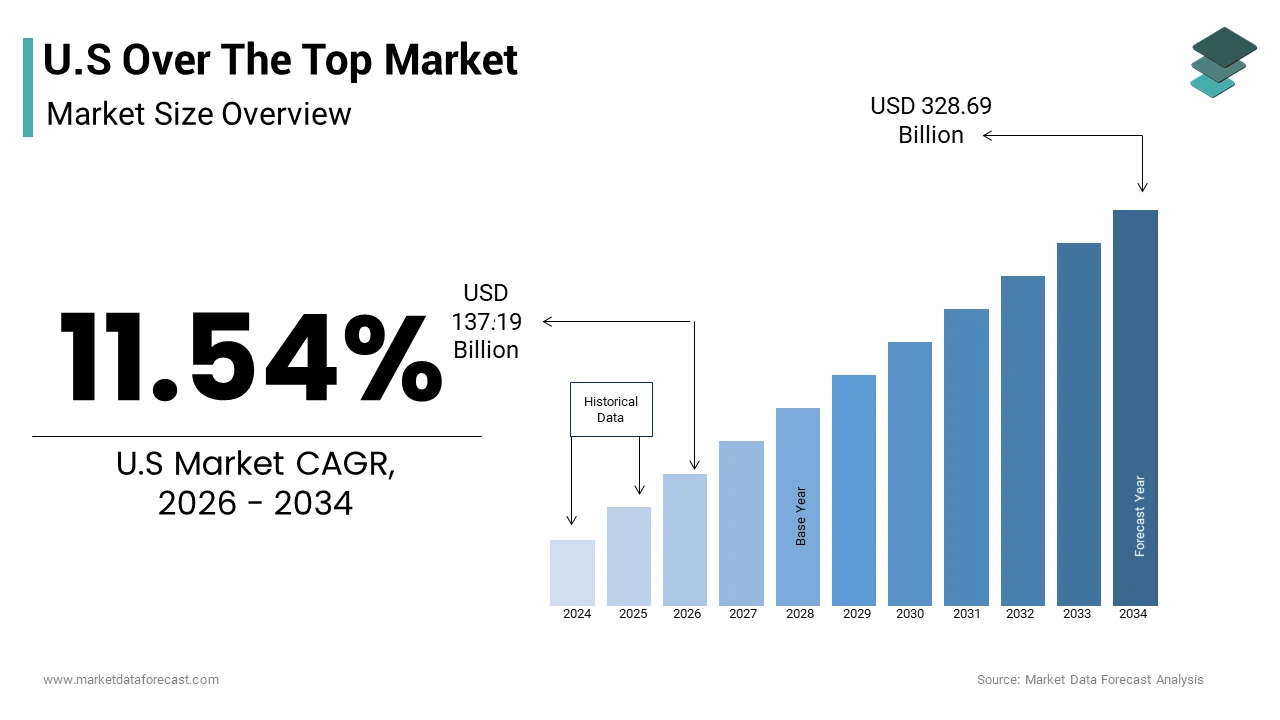
The United States over-the-top (OTT) market was valued at USD 123 billion in 2025 and is anticipated to reach USD 137.19 billion in 2026 and USD 328.69 billion by 2034, growing at a CAGR of 11.54% during the forecast period from 2026 to 2034. The growth of the U.S. OTT market is driven by increasing consumer preference for on-demand digital entertainment, rising internet penetration, and the growing adoption of smart devices and connected TVs. The shift away from traditional cable television services, coupled with the rising popularity of subscription-based streaming platforms, is further accelerating market growth. In addition, advancements in content personalization, AI-driven recommendation engines, and expansion of original content production are enhancing user engagement and platform competitiveness across the OTT ecosystem.
Key Market Trends
- Rising adoption of subscription video-on-demand (SVOD) services driven by growing demand for flexible, ad-free, and personalized entertainment experiences.
- Increasing popularity of smart TVs and connected devices enabling seamless streaming access and high-quality viewing experiences.
- Growing investments in exclusive original content, live sports streaming, and regional programming to attract and retain subscribers.
- Expansion of ad-supported video-on-demand (AVOD) models offering cost-effective streaming alternatives for consumers.
- Strong integration of artificial intelligence and data analytics technologies for personalized recommendations, audience targeting, and content optimization.
Segmental Insights
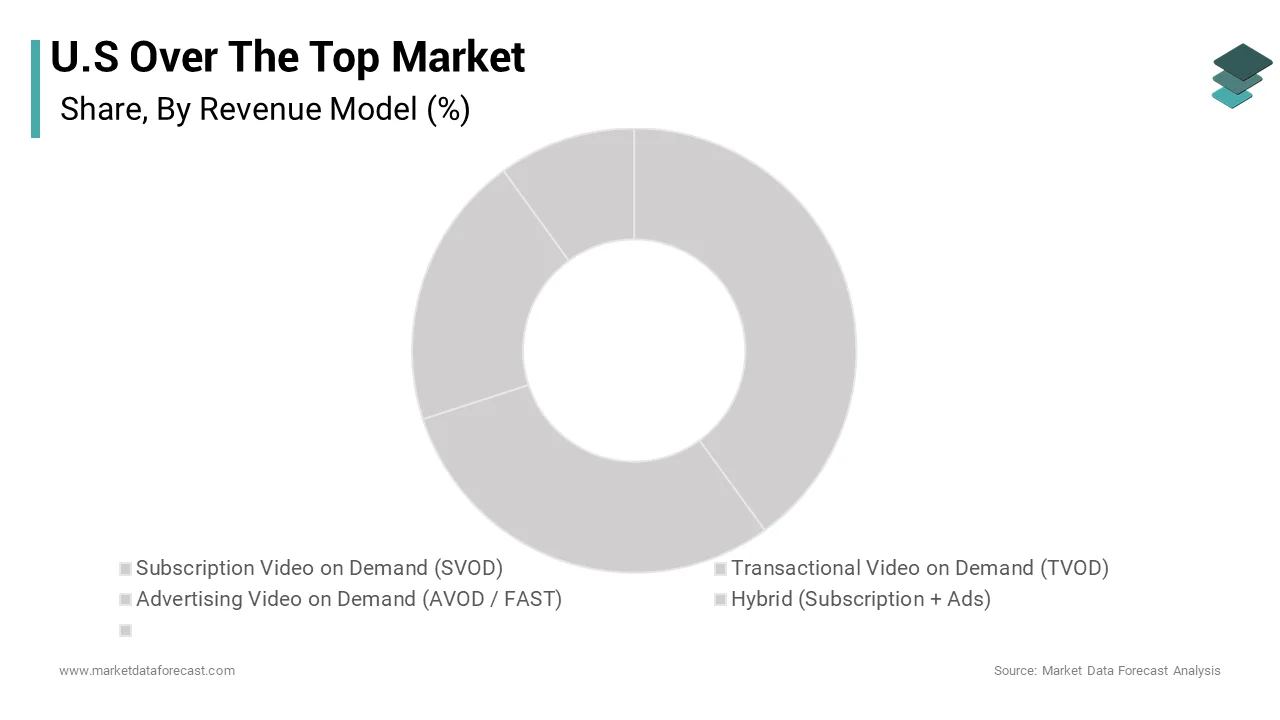
- Based on revenue model, the subscription video-on-demand segment held a dominant share of the United States OTT market in 2025. The dominance of this segment is attributed to increasing consumer willingness to pay for premium, ad-free content, exclusive original productions, and flexible streaming access across multiple devices.
- Based on device, the smart TVs segment accounted for a dominant share of the United States OTT market in 2025. The widespread adoption of internet-enabled televisions, high-definition streaming capabilities, and integrated OTT applications is significantly driving segment growth.
- Based on content genre, the entertainment segment was the largest and held a dominant share of the United States OTT market in 2025. The increasing demand for movies, TV series, reality shows, and celebrity-driven content among diverse consumer demographics continues to strengthen the segment’s market position.
Regional Insights
The U.S. OTT market is witnessing substantial growth across major urban and suburban regions, supported by strong broadband infrastructure, high smartphone usage, and increasing consumer demand for digital entertainment services. Major metropolitan areas such as Los Angeles, New York City, and San Francisco remain key contributors due to their strong media and entertainment ecosystems, advanced digital adoption, and large subscriber bases. The growing popularity of binge-watching culture and multi-device streaming continues to support nationwide market expansion.
Competitive Landscape
The U.S. OTT market is highly competitive, with leading companies focusing on original content development, global expansion strategies, and advanced streaming technologies to strengthen their market presence. Major players are increasingly investing in AI-driven personalization, live sports broadcasting rights, cloud-based streaming infrastructure, and bundled subscription offerings to improve customer retention and engagement. Strategic partnerships with telecom providers, device manufacturers, and advertising companies are also creating new growth opportunities across the OTT industry.
Prominent players in the U.S. OTT market include Netflix Inc., Disney+, Amazon Prime Video, Hulu LLC, Max, Peacock, Paramount+, Apple TV+, Roku Channel, YouTube TV, Sling TV, FuboTV Inc., Pluto TV, Tubi, Discovery+, Crunchyroll LLC, BritBox LLC, Starz, Showtime, BET+, ESPN+, AMC+, Shudder, and Acorn TV.
U.S Over The Top Market Size
The U.S over the top market size was valued at USD 123 billion in 2025 and is anticipated to reach USD 137.19 billion in 2026 to reach USD 328.69 billion by 2034, growing at a CAGR of 11.54% during the forecast period from 2026 to 2034.
MARKET OVERVIEW
The over the top is audio, video and other media content, are delivered via the internet bypassing traditional cable broadcast and satellite television platforms. The proliferation of high speed broadband infrastructure is fundamental to the viability of this industry. As per the Federal Communications Commission, approximately 92% of Americans have access to fixed broadband service at speeds sufficient for high definition streaming ensuring widespread accessibility. Furthermore, 85% of American adults own a smartphone, which serves as a primary device for mobile viewing and content discovery, as per a study. This ubiquity of connected devices has shifted consumer behavior from scheduled programming to on demand entertainment by allowing users to curate their own viewing experiences. The intense competition among legacy media conglomerates and technology giants, who invest heavily in original content production to attract and retain subscribers. Regulatory frameworks regarding net neutrality and data privacy also influence operational strategies requiring providers to maintain transparency and equitable access.
MARKET DRIVERS
Widespread Adoption of High Speed Broadband Infrastructure
The extensive deployment of high-speed broadband infrastructure by enabling seamless delivery of high quality video content without buffering or latency issues is driving the growth of the United States over the top market. Reliable internet connectivity is essential for streaming high definition and ultra-high definition content, which has become the standard expectation for consumers. The technological backbone supports the simultaneous streaming of multiple devices within a single household, catering to the diverse viewing habits of family members. The expansion of fifth generation wireless networks further enhances mobile streaming capabilities, allowing users to access content on smartphones and tablets with consistent performance. Reduced latency and higher bandwidth capacity enable providers to offer immersive experiences such as live sports and interactive features that require real time data transmission. The reliability of these networks encourages consumers to cancel traditional cable subscriptions in favor of flexible and cost effective streaming alternatives. Additionally, the ability to download content for offline viewing relies on robust initial connection speeds improving convenience for travelers and commuters.
Shift in Consumer Preferences Toward On Demand Content
The profound shift in consumer preferences toward on demand content by aligning with modern lifestyles that prioritize flexibility and autonomy is additionally propelling the growth of the United States over the top market. Viewers increasingly reject rigid broadcasting schedules in favor of accessing content whenever and wherever they choose leading to a decline in traditional linear television viewership. The behavioral change is particularly pronounced among younger demographics, who value the ability to binge watch entire seasons and explore diverse libraries of international and niche content. The convenience of personalized recommendations and user friendly interfaces that enhances the discovery process making it easier for consumers to find relevant entertainment. Furthermore, the portability of streaming services allows users to continue watching across multiple devices including smart TVs laptops and mobile phones ensuring continuity of experience. The desire for ad free experiences or controlled ad exposure also drives subscription growth as users seek uninterrupted viewing sessions. This cultural shift toward viewer centric models forces media companies to adapt their distribution strategies and invest in digital platforms.
MARKET RESTRAINTS
Market Saturation and Subscriber Churn Rates
The market saturation and high subscriber churn rates by limiting growth potential and increasing customer acquisition costs is hampering the growth of the United States over the top market. As the number of streaming services proliferates, consumers face subscription fatigue leading them to rotate between platforms rather than maintaining multiple simultaneous subscriptions. This cyclic behavior makes it difficult for providers to predict revenue streams and justify substantial investments in original content production. The abundance of choices means that no single platform can dominate exclusively forcing companies to compete aggressively on price and content exclusivity. Many consumers opt for free ad supported tiers or share accounts to reduce expenses, further impacting profitability. The lack of long-term commitment from users requires constant innovation and fresh content to retain attention, which is resource intensive. Additionally, the fragmentation of content across multiple platforms complicates the user experience as viewers must navigate different apps and interfaces to access their desired shows. This fragmentation can lead to dissatisfaction and a return to bundled cable packages if convenience becomes too compromised.
Rising Content Production and Licensing Costs
The rising content production and licensing costs by compressing profit margins and necessitating higher subscription fees or increased advertising loads is another factor enhancing the growth of the United States over the top market. The competition for exclusive content has driven up the cost of acquiring popular films and television series as well as producing original programming to differentiate platforms. These escalating costs are exacerbated by the need to secure rights for live sports and premium entertainment, which command high prices due to their ability to drive subscriptions. Providers must balance these expenditures with revenue generation often leading to price hikes that may alienate price sensitive consumers. The financial burden of sustaining high quality content pipelines limits the ability of smaller players to compete effectively leading to market consolidation. Additionally, the global nature of content distribution requires localization and compliance with international regulations adding further complexity and expense. The pressure to deliver immediate returns on investment can compromise creative risk taking resulting in formulaic content that fails to engage audiences.
MARKET OPPORTUNITIES
Integration of Advertising Supported Tiers
The integration of advertising supported tiers by expanding the addressable audience to include price sensitive consumers, who are unwilling to pay for premium subscriptions is setting up new opportunities for the growth of the United States over the top market. Ad supported models allow providers to monetize users who prefer lower monthly fees in exchange for viewing commercials creating a dual revenue stream from subscriptions and advertising sales. This model attracts a broader demographic, including younger viewers, who are accustomed to ad supported content on social media and other digital channels. Advanced data analytics enable precise ad targeting based on viewing habits and user profiles increasing the value proposition for advertisers. The ability to offer interactive and shoppable ads further enhances engagement and conversion rates providing new revenue opportunities. Providers can use ad supported tiers to reduce churn by offering a fallback option for subscribers who might otherwise cancel due to price increases. Additionally, the growth of connected television advertising allows brands to reach audiences in a living room context with greater measurability than traditional television.
Expansion into Live Sports and Real Time Events
The expansion into live sports and real time events by attracting dedicated fan bases and reducing churn through exclusive broadcasting rights is also to elevate the growth of the United States over the top market. Live sports remain one of the few content categories that drive habitual viewing and real time engagement by making them a valuable asset for streaming platforms. The sports streaming services are gaining popularity, as fans seek flexibility and additional content, such as behind the scenes footage and multi angle views. Securing rights to major leagues and tournaments allows providers to differentiate themselves and justify premium pricing. The ability to stream live events on multiple devices enhances accessibility for fans who may not be near a television. Interactive features such as real time statistics player tracking and social integration enrich the viewing experience and foster community engagement. Additionally, live events provide unique advertising opportunities including dynamic ad insertion which allows for targeted commercials during breaks. The exclusivity of live sports content creates a barrier to entry for competitors and encourages long term subscriptions.
MARKET CHALLENGES
Password Sharing and Account Security Issues
The password sharing and account security issues by undermining revenue potential and complicating user management strategies is a significant challenge for the growth of the United States over the top market. Many subscribers share their login credentials with friends and family outside their households effectively reducing the number of paid accounts required to serve a larger audience. While some providers have implemented measures to restrict sharing, such as limiting the number of simultaneous streams or verifying household locations these efforts often face consumer backlash and technical workarounds. Balancing enforcement with user convenience is difficult as overly strict policies may drive legitimate customers to cancel subscriptions. Additionally, account sharing poses security risks including unauthorized access and data breaches which can damage brand reputation. The lack of standardized identity verification methods across platforms makes it challenging to detect and prevent fraudulent usage effectively. Providers must invest in sophisticated detection algorithms and customer education campaigns to address this issue without alienating users. The ethical ambiguity surrounding sharing among close relatives further complicates policy implementation.
Fragmentation of Content Across Multiple Platforms
The fragmentation of content across multiple platforms by creating a disjointed user experience and increasing the cost of access for consumers is also attributed to impede the growth of the United States over the top market. As media companies launch their own proprietary, streaming services exclusive content is removed from aggregated platforms forcing viewers to subscribe to multiple services to access their favorite shows and movies. The fragmentation leads to decision fatigue and reduces the overall value proposition of streaming compared to traditional cable bundles. Consumers may resort to pirated content or revert to illegal streaming sites, if legal options become too cumbersome or expensive. The lack of universal search functionality across platforms, further exacerbates the problem making it difficult to discover where specific titles are available. Providers face the challenge of balancing exclusivity with accessibility as retaining content on their own platforms is for differentiation but limits reach. The competitive landscape discourages collaboration on aggregation tools leaving consumers to bear the burden of navigation. This structural inefficiency threatens long term customer satisfaction and retention.
REPORT COVERAGE
| REPORT METRIC | DETAILS |
| Market Size Available | 2025 to 2034 |
| Base Year | 2025 |
| Forecast Period | 2026 to 2034 |
| CAGR | 11.54% |
| Segments Covered | By Revenue Model, Device, Content Genre, and By Country |
| Various Analyses Covered | Global, Regional, and Country Level Analysis, Segment-Level Analysis; DROC, PESTLE Analysis; Porter’s Five Forces Analysis; Competitive Landscape; Analyst Overview of Investment Opportunities. |
| Regions Covered | California, Washington, Oregon, New York & Rest of the United States |
| Market Leaders Profiled | Netflix Inc., Disney+ (The Walt Disney Company), Amazon Prime Video (Amazon.com Inc.), Hulu LLC, Max (Warner Bros. Discovery), Peacock (Comcast Corp.), Paramount+ (Paramount Global), Apple TV+ (Apple Inc.), Roku Channel (Roku Inc.), YouTube TV (Google LLC), Sling TV LLC (Dish Network Corp.), FuboTV Inc., Pluto TV (Paramount Global), Tubi (Fox Corp.), Discovery+ (Warner Bros. Discovery), Crunchyroll LLC (Sony Group), BritBox LLC, Starz (Lions Gate Entertainment), Showtime (Paramount Global), BET+ (Paramount Global), ESPN+ (The Walt Disney Company), AMC+ (AMC Networks), Shudder (AMC Networks), Acorn TV (AMC Networks) |
SEGMENTAL ANALYSIS
By Revenue Model Insights
The subscription video on demand segment was accounted in holding a dominant share of the United States Over The Top market in 2025 with the consumer preference for unlimited access to extensive content libraries for a fixed monthly fee. This model provides predictability in spending and eliminates the friction of individual transactions for each piece of content viewed. The value proposition of binge watching entire series without additional costs, which aligns with modern viewing habits. Major platforms invest heavily in original exclusive content that serves as a key differentiator attracting subscribers, who seek unique narratives and high production values. The convenience of automatic renewal and seamless access across multiple devices that further enhances user retention. Additionally, the ability to create multiple user profiles within a single account allows families to share services efficiently increasing the perceived value. The absence of commercial interruptions in premium tiers appeals to viewers who prioritize an uninterrupted experience. This model has successfully displaced traditional cable television for many consumers by offering greater flexibility and choice. The economies of scale achieved by large subscriber bases allow providers to amortize high content production costs effectively.
The advertising based video on demand segment is expected to witness a fastest CAGR of 20.3% during the forecast period with the introduction of lower cost tiered subscription options by major providers. As economic pressures influence consumer spending, many users are opting for ad supported plans to reduce monthly expenses while maintaining access to popular content. Major streaming services have launched ad supported tiers that attract price sensitive customers who were previously unwilling to pay premium subscription fees. This expansion broadens the total addressable and reduces churn rates by providing a fallback option for budget conscious viewers. Advertisers are increasingly drawn to these platforms due to the ability to target specific demographics with precision using viewer data. The integration of advanced ad technologies such as dynamic ad insertion allows for personalized and relevant commercials that enhance engagement. Furthermore, the growth of free ad supported streaming television services offers entirely free content libraries supported solely by advertisements appealing to cord cutters seeking zero cost entertainment.
By Device Insights
The smart TVs segment held a dominant share of the United States Over The Top market in 2025 due to their large screen size superior audio visual quality and ease of use in living room settings. The integration of streaming applications directly into television operating systems eliminates the need for external devices making access seamless for users of all ages. As per the Consumer Electronics Association, smart TV penetration in United States households has exceeded 80% ensuring that the majority of consumers have direct access to streaming services on their primary display. The communal nature of television viewing encourages family and social gatherings around shared content such as movies and live sports which are best experienced on larger screens. High definition and ultra-high definition capabilities of modern televisions enhance the immersive experience making them the preferred choice for premium content consumption. The availability of voice-controlled remotes and intuitive interfaces simplifies navigation and search functions improving user satisfaction. Additionally, the proliferation of high speed home Wi Fi networks supports stable streaming of high bandwidth content without buffering. Manufacturers continue to innovate with features such as ambient mode and integrated soundbars further enhancing the appeal of smart TVs. The central role of the television in home entertainment culture ensures its continued dominance. Providers optimize their platforms for big screen experiences recognizing that this device drives the highest engagement and viewing duration.
The smartphones and tablets segment is projected to witness a fastest CAGR of 15.3% during the forecast period with the increasing mobility of consumers and improvements in mobile network infrastructure. The convenience of accessing content on the go allows users to watch shows during commutes travel or breaks transforming idle time into entertainment opportunities. The advancement of fifth generation wireless technology that enables faster download speeds and higher quality streaming on mobile devices reducing latency and improving user experience. Streaming providers have optimized their applications for smaller screens with features such as offline downloads and vertical video formats catering to mobile usage patterns. The rise of short form content and social media integration further drives engagement on handheld devices. Younger demographics particularly prefer mobile devices for their portability and personal nature allowing for private viewing experiences. The ability to seamlessly switch between devices using cloud synchronization ensures continuity of viewing regardless of location. Additionally, the affordability of mobile data plans and widespread Wi-Fi availability in public spaces supports increased usage.
By Content Genre Insights
The entertainment genre segment was the largest by holding a dominant share of the United States Over The Top market in 2025 with the universal appeal of scripted series movies and reality shows that cater to diverse audience preferences. The ability of entertainment content to provide escapism and emotional engagement fostering strong connections between viewers and characters. Major platforms invest billions in producing high quality original series and films that generate cultural buzz and drive subscription acquisitions. The binge worthy nature of serialized storytelling encourages prolonged viewing sessions and high retention rates. Additionally, the availability of extensive libraries containing classic and contemporary titles ensures that there is something for every taste and age group. The social aspect of discussing popular shows on social media platforms further amplifies interest and viewership. Entertainment content is also less niche than other genres allowing it to appeal to broad demographics simultaneously. The continuous release of new seasons and episodes keeps subscribers engaged and reduces churn.
The sports genre segment is likely to grow at an anticipated CAGR of 25.3% during the forecast period with the migration of live sporting events from traditional broadcast television to digital platforms. The demand for live sports streaming is surging as fans seek flexibility and additional viewing options, such as multi camera angles and real time statistics. Major leagues and sports organizations are launching direct to consumer streaming services or partnering with existing platforms to broadcast games exclusively online. This shift is motivated by the desire to reach younger audiences who are increasingly cord neutral and prefer digital consumption. The ability to stream live sports on multiple devices allows fans to watch games anywhere enhancing accessibility and engagement. Interactive features such as live betting integration and player tracking data enrich the viewing experience creating new revenue streams. The exclusivity of certain sporting events on streaming platforms drives subscription acquisitions among dedicated fans. The high emotional investment of sports fans leads to strong loyalty and lower churn rates compared to other content types.
COMPETITIVE LANDSCAPE
The competition in the United States Over The Top market is intense and characterized by a mix of legacy media conglomerates technology giants and niche streaming services vying for subscriber attention and spending. Major players compete on content exclusivity pricing models and user experience to differentiate their offerings in a saturated landscape. The proliferation of services has led to subscription fatigue prompting consumers to rotate between platforms rather than maintaining multiple long term subscriptions. Price competition is evident as companies introduce ad supported tiers to appeal to budget conscious viewers while raising prices for premium ad free options. Content investment remains a key battleground with billions spent annually on original productions to attract and retain audiences. Bundling strategies with telecommunications and other services are common to enhance value and reduce churn. Technological innovation in personalization and streaming quality also drives competitive advantage.
KEY MARKET PLAYERS
A few of the market players that are dominating the U.S over the top market are
- Netflix Inc.
- Disney+ (The Walt Disney Company)
- Amazon Prime Video (Amazon.com Inc.)
- Hulu LLC
- Max (Warner Bros. Discovery)
- Peacock (Comcast Corp.)
- Paramount+ (Paramount Global)
- Apple TV+ (Apple Inc.)
- Roku Channel (Roku Inc.)
- YouTube TV (Google LLC)
- Sling TV LLC (Dish Network Corp.)
- FuboTV Inc.
- Pluto TV (Paramount Global)
- Tubi (Fox Corp.)
- Discovery+ (Warner Bros. Discovery)
- Crunchyroll LLC (Sony Group)
- BritBox LLC
- Starz (Lions Gate Entertainment)
- Showtime (Paramount Global)
- BET+ (Paramount Global)
- ESPN+ (The Walt Disney Company)
- AMC+ (AMC Networks)
- Shudder (AMC Networks)
- Acorn TV (AMC Networks)
Top Players In The Market
- Netflix Inc remains a pioneering force in the United States Over The Top market by offering an extensive library of films television series and documentaries. The company leverages sophisticated algorithms to personalize content recommendations enhancing user engagement and retention. Recent actions include the successful rollout of an advertising supported subscription tier which attracts price sensitive consumers and diversifies revenue streams. Netflix has also intensified its crackdown on password sharing to convert unauthorized users into paying subscribers thereby boosting account growth. The platform continues to invest heavily in original local and international content to differentiate its offerings from competitors. Its global infrastructure ensures seamless streaming quality across various devices. These strategic initiatives strengthen its market presence by balancing subscriber growth with profitability while adapting to evolving consumer preferences and competitive pressures in the digital media landscape.
- Amazon.com Inc contributes significantly to the United States Over The Top market through its Prime Video service which is bundled with the broader Amazon Prime membership. This integration provides substantial value to subscribers encouraging loyalty and reducing churn rates across the ecosystem. Recent actions include the introduction of advertisements within the standard Prime Video tier allowing the company to generate additional advertising revenue while keeping subscription prices stable. Amazon has also secured exclusive rights to major live sports events such as Thursday Night Football attracting a wider audience beyond traditional movie and series viewers. The company leverages its technological prowess to enhance streaming quality and user interface experience. Investments in original content production continue to expand its library with critically acclaimed series and films. These efforts solidify its position as a major competitor by leveraging its vast resources and existing customer base to drive engagement and revenue growth in the streaming sector.
- The Walt Disney Company plays a pivotal role in the United States Over The Top market with its flagship streaming service Disney Plus which hosts content from Disney Pixar Marvel Star Wars and National Geographic. The company leverages its powerful intellectual property portfolio to attract families and fans of franchise content. Recent actions include the integration of Hulu content into the Disney Plus platform for bundle subscribers creating a more comprehensive entertainment hub. Disney has also focused on achieving profitability in its streaming division by implementing price increases and introducing ad supported tiers. The company continues to produce high budget original series and films that drive subscriber acquisition and retention. Strategic partnerships with telecommunications providers offer bundled deals that enhance accessibility and value. These initiatives ensure sustained relevance and growth in a crowded market by appealing to diverse demographic segments through trusted and popular entertainment franchises.
Top Strategies Used By Key Market Participants
Key players in the United States Over The Top market primarily focus on diversifying revenue streams by introducing advertising supported subscription tiers to attract price sensitive consumers. Companies are increasingly bundling services with telecommunications or other digital platforms to enhance value propositions and reduce churn rates. Investment in original and exclusive content remains central to differentiation strategies ensuring unique offerings that drive subscriber acquisition. Technological advancements, such as improved recommendation algorithms and enhanced user interfaces are prioritized to improve engagement and retention. Crackdowns on password sharing are implemented to convert unauthorized users into paying subscribers thereby boosting revenue. Live sports rights are acquired to capture broader audiences and increase viewing frequency. International expansion and localization of content help tap into new markets. Data analytics are utilized to understand viewer preferences and optimize content production.
MARKET SEGMENTATION
This research report on the U.S over the top market is segmented and sub-segmented into the following categories.
By Revenue Model
- Subscription Video on Demand (SVOD)
- Transactional Video on Demand (TVOD)
- Advertising Video on Demand (AVOD / FAST)
- Hybrid (Subscription + Ads)
By Device Type
- Smartphones and Tablets
- Smart TVs
- Laptops and Desktops
- Game Consoles
- Set-Top Boxes and Media Streamers
By Content Genre
- Entertainment (Movies and Series)
- Sports
- News and Information
- Kids and Educational
- Documentary and Reality
By Age Group
- <18 Years
- 18-34 Years
- 35-54 Years
- 55+ Years
By Country
- California
- Washington
- Oregon
- New York
- Rest of the United States