- Product Description Description
- Table of Contents TOC
- List of Table & Figure LOT
- Get Free Sample PDF Sample PDF
Market Size, 2025
$44.85 BnMarket Estimate, 2026
$47.10 BnMarket Forecast, 2034
$69.75 BnCAGR, 2026–2034
5.03%U.S. Propane Market Size, Growth, Trends & Forecast (2026–2034)
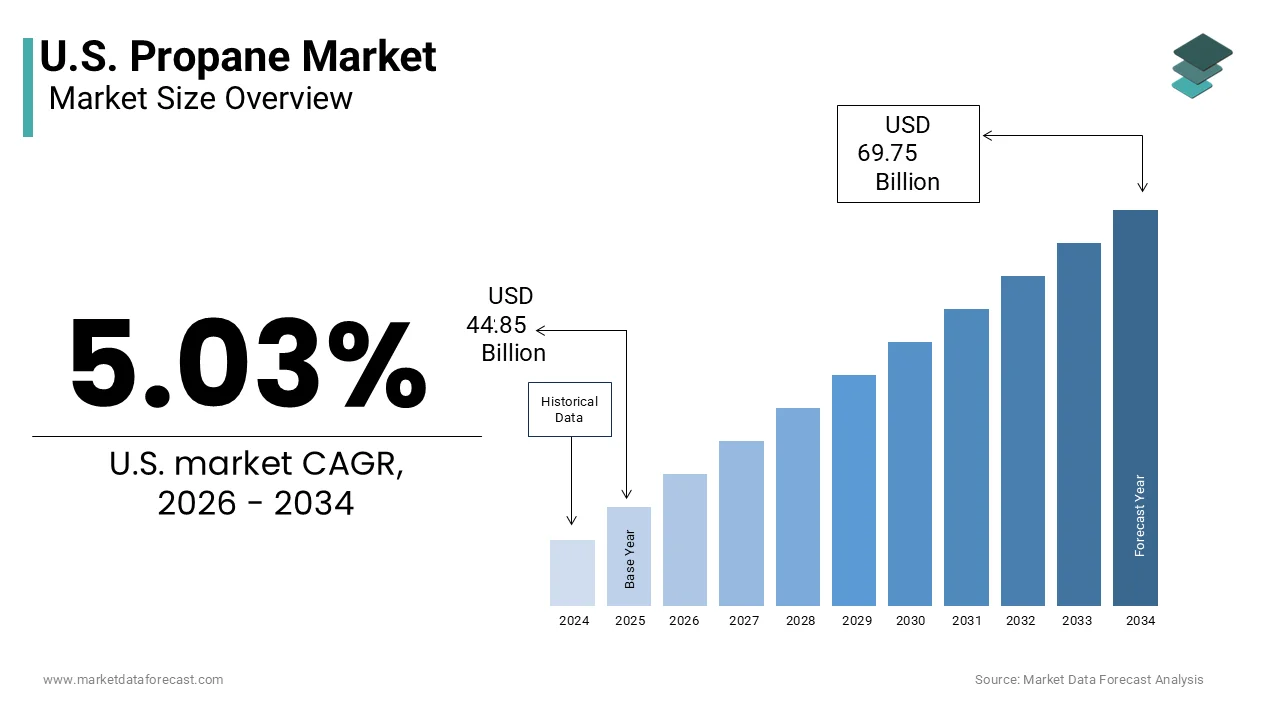
The U.S. propane market was valued at USD 44.85 billion in 2025, is estimated to reach USD 47.1 billion in 2026, and is projected to reach USD 69.75 billion by 2034, growing at a compound annual growth rate (CAGR) of 5.03% from 2026 to 2034. Driven by robust domestic shale gas extraction, rising demand for clean-burning alternative transportation fuels, and strong off-grid residential heating needs, the market continues to expand across the United States.
Key Executive Metrics (At-a-Glance)
- 2025 Base Valuation: USD 44.85 Billion
- 2026 Current Valuation: USD 47.10 Billion
- 2034 Forecast Valuation: USD 69.75 Billion
- Compound Annual Growth Rate (CAGR): 5.03% (2026–2034)
- Top Performing End-Use: Residential Sector (Holds a leading market share of 48.2% in 2025, supported by off-grid rural heating and outdoor living applications).
Core Market Drivers
- Rural Residential Construction: Sustained single-family home development in off-grid rural and suburban areas lacking natural gas utility pipelines.
- Industrial Fleet & Material Handling: Rising adoption of propane-powered forklifts and autogas fleet vehicles due to rapid refueling and operational efficiency.
Primary Market Restraints & Challenges
- Commodity Price Volatility: Direct price dependency on crude oil and natural gas market fluctuations, causing seasonal heating cost spikes.
- Electrification Pressures: Aggressive government policies, building codes, and utility incentives favoring electric heat pumps and decarbonization.
U.S. Propane Market Segmentation Highlights
| Segment Category | Largest Segment | Fastest-Growing / Key Segment |
|---|---|---|
| By Grade | HD 5 Grade | HD 5 Grade (5.2% CAGR) |
| By End-Use | Residential (48.2% share) | Industrial (5.9% CAGR) |
| By Key Regions / States | Midwest & Northeast Hubs | Texas, California, & Pennsylvania |
Major Industry Players Profiled
Key industry leaders dominating the U.S. propane market include AmeriGas Propane (UGI Corporation), Ferrellgas Partners L.P., Suburban Propane Partners L.P., Superior Plus Propane, Chevron Corporation, Valero Energy Corporation, Enterprise Products Partners L.P., MPLX LP, Targa Resources Corp., and CHS Inc.
U.S. Propane Market Size
The U.S. propane market was valued at USD 44.85 billion in 2025, is estimated to reach USD 47.1 billion in 2026, and is projected to reach USD 69.75 billion by 2034, growing at a CAGR of 5.03% from 2026 to 2034.
Propane is a highly flammable, clean-burning hydrocarbon gas that is widely used as a portable fuel source. It serves as a versatile fuel source for residential heating, commercial cooking, industrial processes, and agricultural applications while increasingly gaining traction as an alternative transportation fuel. The market is distinguished by its robust domestic supply chain, which ensures energy independence and price stability relative to global oil markets. According to the U.S. Energy Information Administration, the United States has been a net exporter of propane since 2007, a shift driven heavily by the rapid expansion of domestic shale gas extraction and processing capacity. In 2023, U.S. dry natural gas production averaged approximately 104 billion cubic feet per day, mirroring record levels of overall natural gas processing from which propane and other hydrocarbon gas liquids are extracted. The Environmental Protection Agency recognizes propane as an approved alternative fuel under the Clean Air Act, noting its lower emissions profile of certain criteria pollutants compared to traditional heavy petroleum fuels or coal. According to data supported by the Propane Education and Research Council, millions of American households rely on propane as a primary energy source for residential heating and cooking, alongside a massive domestic market for outdoor consumer applications. The infrastructure supporting this market includes an extensive network of pipelines, storage facilities,s and distribution terminals that facilitate efficient delivery to end users. This established logistical framework, combined with regulatory support for cleaner fuel, positions propane as a stable and essential component of the US energy mix,x catering to diverse economic and environmental needs.
MARKET DRIVERS
Expansion of Residential Construction in Rural Areas
The sustained growth in residential construction, particularly in rural and suburban areas, where natural gas pipelines are inaccessible, is propelling the United States propane market forward. Propane remains the preferred alternative for heating water, cooking, and drying clothes in homes located off the main gas grid due to its reliability and cost-effectiveness. Secondary housing metrics show that single-family home development in outlying and rural communities establishes a steady market for off-grid energy infrastructure. According to the National Association of Home Builders and historical housing data, electricity and natural gas remain the dominant fuels for new home construction, while propane captures a specialized single-digit market share concentrated primarily in off-grid rural regions. This trend is further amplified by the increasing preference for high-efficiency propane furnaces and tankless water heaters, which offer lower operating costs compared to electric alternatives. Department of Energy appliance guides indicate that while propane water heaters and furnaces offer rapid heating cycles, true operating cost differentials compared to electric models vary widely based on regional utility rates and equipment efficiency ratings. Additionally, the rise of remote work has led to migration patterns favoring rural locations where propane infrastructure is already established or easily deployed. Local utilities and propane suppliers often collaborate with builders to install underground tanks and piping systems,s ensuring seamless integration into new developments. This symbiotic relationship between the construction industry and propane suppliers ensures a steady baseline demand that is resilient to short-term economic fluctuations. The continued expansion of housing stock in propane accessible regions thus solidifies the fuel's position as a cornerstone of residential energy consumption.
Industrial Adoption for Forklifts and Fleet Vehicles
The industrial sector's increasing adoption of propane-powered forklifts and fleet vehicles is a significant accelerator of the United States propane market. This is driven by operational efficiency and environmental compliance. Propane-fueled internal combustion engines offer distinct advantages over electric batteries, including faster refueling times, consistent power output, and lower upfront costs. Data tracked by material handling networks shows that propane-powered lift trucks maintain an active market presence in heavy-duty and outdoor logistics due to their rapid refueling capabilities and consistent power delivery. The Occupational Safety and Health Administration sets strict permissible exposure limits for carbon monoxide, requiring industrial facilities that operate indoor propane material handling equipment to maintain proper ventilation and regular engine emissions testing. Major logistics companies such as Amazon and Walmart have integrated propane vehicles into their fleets to meet sustainability goals while maintaining operational productivity. According to the Propane Education and Research Council, there are more than 200,000 propane autogas vehicles actively operating across the United States, representing a growing niche for school district bus fleets and public transit shuttle services. This widespread adoption is supported by a well-developed refueling infrastructure that allows for quick turnaround times essential for high-volume operations. Furthermore, federal and state incentives for alternative fuel vehicles encourage businesses to transition away from traditional fossil fuels. The combination of economic benefits, regulatory compliance,e and operational versatility ensures that the industrial sector remains a robust and growing consumer of propane, reinforcing its market dominance.
MARKET RESTRAINTS
Volatility in Crude Oil and Natural Gas Prices
The inherent volatility in crude oil and natural gas prices is limiting the growth of the United States propane market. This affects both supply stability and consumer affordability. Since propane is a byproduct of natural gas processing and crude oil refining, its pricing is closely linked to fluctuations in these underlying commodities. The U.S. Energy Information Administration documents that spot and retail propane prices experience sharp fluctuations tied directly to seasonal heating spikes, agricultural demand, and global petrochemical benchmarks. During periods of extreme cold or high heating demand,d prices often spike,ke causing financial strain on residential and commercial users who rely on propane for heating. Bureau of Labor Statistics data historically tracks how severe volatility in household energy indexes, including residential heating fuels, directly impacts aggregate consumer purchasing power and corporate operational expenses. This price unpredictability makes long-term planning difficult for consumers and encourages exploration of alternative energy sources with more stable pricing structures, such as electricity or renewable natural gas. Additionally,y geopolitical tensions and supply chain disruptions can exacerbate price volatility, ty leading to sudden shortages or cost surges. Federal Reserve monetary reports emphasize that broad energy price shocks introduce volatility into headline inflation metrics, influencing overall consumer sentiment and economic forecasting. As a result, some consumers may delay investments in propane appliances or switch to competing fuels during periods of high prices. This sensitivity to external market forces limits the market's growth potential and creates uncertainty for stakeholders across the supply chain.
Competition from Electrification and Renewable Energy
The accelerating transition towards electrification and renewable energy sources is a formidable obstacle to the United States propane market. This is happening as consumers and policymakers prioritize decarbonization. Government initiatives and utility programs increasingly promote the adoption of electric heat pumps,s induction cooktops, ps and electric vehicles,les which directly compete with propane applications. According to the International Energy Agency, electric heat pumps represent an expanding share of the global HVAC landscape, with domestic adoptions heavily supported by federal tax credits under the Inflation Reduction Act. Department of Energy decarbonization pathways illustrate scenarios where federal and state building electrification policies could transition millions of residential structures toward electric heat pumps over the coming decade. Additionally, many states have implemented building codes that restrict or ban the use of fossil fuels in new construction, favoring electric designs. The Sierra Club and other environmental advocacy groups actively campaign against propane usage, citing its carbon footprint and contribution to climate change. Utility companies also offer rebates and incentives for customers who electrify their homes,s further discouraging propane adoption. The National Renewable Energy Laboratory reports that the levelized cost of renewable utility-scale electricity generation continues to decline, lowering the structural production costs of grid energy. This regulatory and economic shift towards electrification challenges the long-term viability of propane in key sectors, forcing the industry to adapt or face declining market share in residential and commercial applications.
MARKET OPPORTUNITIES
Growth in Autogas for Transportation Fleets
The expansion of autogas or propane used as a transportation fuel offers a significant opportunity for the United States propane market. This is fuelled by cost savings and environmental benefits. Propane autogas is the third most popular vehicle fuel in the world,d and its adoption is growing in the US, particularly for school buses,s municipal fleets, ts and delivery vehicles. According to the Alternative Fuels Data Center, propane autogas serves as a widely utilized alternative transportation fuel in the United States, with school bus fleets representing the fastest-growing adoption segment. The Clean School Bus Program, administered by the Environmental Protection Agency, allocates up to 5 billion USD in funding to replace older diesel fleets, permitting eligible school districts to apply for both zero-emission electric and low-emission propane buses. This federal support accelerates the transition of public transit and educational transport fleets to prop, and reducesemissions and operational costs. Propane autogas produces significantly lower nitrogen oxide and particulate matter emissions compared to diesel,esel making it an attractive option for cities aiming to improve air quality. According to the Propane Education and Research Council, fleet operators transitioning to propane autogas can lower their total cost of ownership by capitalizing on lower fuel prices and reduced exhaust-system maintenance requirements. Additionally, the infrastructure for refueling propane vehicles is well established and easier to expand compared to electric charging networks. Municipalities and private companies are seeking sustainable yet economical transportation solutions. Consequently, the demand for propane autogas is poised for substantial growth, creating new revenue streams for suppliers.
Integration with Renewable Propane Production
The emergence of renewable propane produced from biological feedstocks creates a pathway for the expansion of the United States propane market. This helps to align with sustainability goals. Renewable propane, also known as bio propane,e is chemically identical to conventional propane but has a significantly lower carbon intensity, ty making it an attractive option for environmentally conscious consumers. According to the World Liquid Gas Association, ion renewable propane is a byproduct of renewable diesel and sustainable aviation fuel production,tion which are expanding rapidly in the United States. The United States Department of Agriculture provides structural grants and financial incentives to expand domestic bio-based fuel production and infrastructure, driving capital investment into the broader agricultural energy sector. Several major propane suppliers have begun blending renewable propane into their distribution network, offering customers a lower carbon footprint option without requiring equipment modifications. The California Air Resources Board includes renewable propane in its Low Carbon Fuel St,andard providing credits that enhance its economic viability. As corporate sustainability commitments increase,tensify demand for low-carbon energy sources grows, creating a niche market for renewable propane. The National Propane Gas Association emphasizes that transitioning to renewable propane provides a drop-in decarbonization pathway, enabling the liquid gas industry to align with tightening emissions standards without requiring new infrastructure investments. This innovation allows propane to compete effectively with electric and other renewable energies by offering a drop-in solution that reduces greenhouse gas emissions. The scalability of renewable propane production ensures long-term growth potential and enhances the market's resilience against decarbonization trends.
MARKET CHALLENGES
Regulatory Pressure and Emissions Standards
Increasingly stringent regulatory pressure and emissions standards create a major hurdle for the United States propane market. This is primarily because governments worldwide are aggressively tightening controls on fossil fuel usage. While propane burns cleaner than coal or oil, it still produces carbon dioxide and other greenhouse gases, es which are subject to evolving environmental regulations. According to U.S. EPA clean air regulations, stringent emission limits on stationary engines and industrial boilers have forced operators to significantly reduce criteria pollutants and hazardous air toxics, driving a market transition toward lower-emitting, electric, or renewable alternatives. State-level policies, such as those in California and New York,k aim to phase out fossil fuel use in buildings and transportation, further restricting propane applications. Government and economic tracking data show that an increasing number of jurisdictions are implementing carbon pricing mechanisms, raising the operational costs of carbon-based fuels like propane relative to zero-emission technologies. These regulatory shifts create uncertainty for investors and consumers who may hesitate to invest in propane infrastructure due to fears of stranded assets. Additionally, compliance with new safety and environmental standards requires costly upgrades to storage and distribution facilities, impacting profit margins. The American Petroleum Institute notes that regulatory complexity varies by state, creating a fragmented landscape that complicates national strategy. As policymakers prioritize net-zero goals, the propane industry faces the challenge of demonstrating its environmental credentials while navigating a tightening regulatory framework. This pressure necessitates continuous adaptation and investment in cleaner technologies to maintain market relevance and compliance.
Infrastructure Limitations in Urban Centers
The limitations of existing infrastructure in densely populated urban centers are a significant challenge for the United States propane market. This hinders its expansion in key demographic areas. Unlike natural gas, which is delivered via underground pipelines, propane requires above-ground storage tanks and regular delivery by truck, which can be logistically challenging in crowded cities. According to the National Fire Protection Association,n strict codes govern the placement of propane tanks near buildings and public spaces, limiting installation options in urban environments. Many apartment complexes and condominiums lack the space or structural capacity to accommodate large propane tanks, making it impractical for residents to use propane for heating or cooking. Modern urban design trends and municipal building policies prioritize all-electric frameworks or pre-existing natural gas grids to optimize square footage, maximize spatial efficiency, and lower localized hazardous fuel storage risks. Additionally, the reliance on truck deliveries exposes the supply chain to traffic congestion and weather-related disruptions, which can affect reliability. These logistical and spatial constraints limit the market's ability to penetrate urban residential and commercial sectors where population density is highest. As cities continue to grow and densify,fy the challenge of integrating propane infrastructure becomes more pronounced, requiring innovative solutions such as community tank systems or virtual pipelines to overcome these barriers.
REPORT COVERAGE
| REPORT METRIC | DETAILS |
| Market Size Available | 2025 to 2034 |
| Base Year | 2025 |
| Forecast Period | 2026 to 2034 |
| Segments Covered | By Grade, End-Use, and Region. |
| Various Analyses Covered | Global, Regional, and Country-Level Analysis, Segment-Level Analysis, Drivers, Restraints, Opportunities, Challenges; PESTLE Analysis; Porter’s Five Forces Analysis, Competitive Landscape, Analyst Overview of Investment Opportunities |
| Countries Covered | New York, Massachusetts, Pennsylvania, Illinois, Ohio, Michigan, Texas, Florida, Georgia, California, Washington, Colorado. |
| Market Leaders Profiled | AmeriGas Propane (UGI Corporation), Ferrellgas Partners L.P., Suburban Propane Partners L.P., Superior Plus Propane, Chevron Corporation, Valero Energy Corporation, Enterprise Products Partners L.P., MPLX LP, Targa Resources Corp., CHS Inc., GROWMARK Inc., CenterPoint Energy, NGL Energy Partners LP |
SEGMENTAL ANALYSIS
By Grade Insights
The HD 5 grade segment led the United States propane market and captured a substantial share in 2025. This leading position was attributed to it being the only grade suitable for use in internal combustion engines as mandated by federal and industry standards. The American Society for Testing and Materials specifies in ASTM D1835 that propane fuel for automotive applications must meet the HD 5 specification, which limits propylene content to no more than 5 percent and ensures low levels of other contaminants. This strict composition is critical because higher olefin content can lead to engine deposits, ts reduced performance,nce and increased emissions. The Propane Education and Research Council shows that hundreds of thousands of on-road vehicles in the U.S., including school buses and delivery fleets, rely strictly on HD-5 grade propane to maintain engine efficiency and ensure manufacturer warranty compliance. The Environmental Protection Agency also recognizes HD 5 propane as a clean alternative fuel that meets stringent emission standards, ards further cementing its necessity in the transportation sector. As the fleepropane-powered vehicles continue too expand due to cost savings and environmental benefits, the demand for HD 5 grade remains robust and non-substitutable. Any deviation from this standard would result in mechanical failures and regulatory non-compliance, making HD 5 the indispensable choice for any application involving engines. This technical requirement creates a locked-in demand base that sustains the segment's leadership regardless of fluctuations in heating or industrial usage patterns.
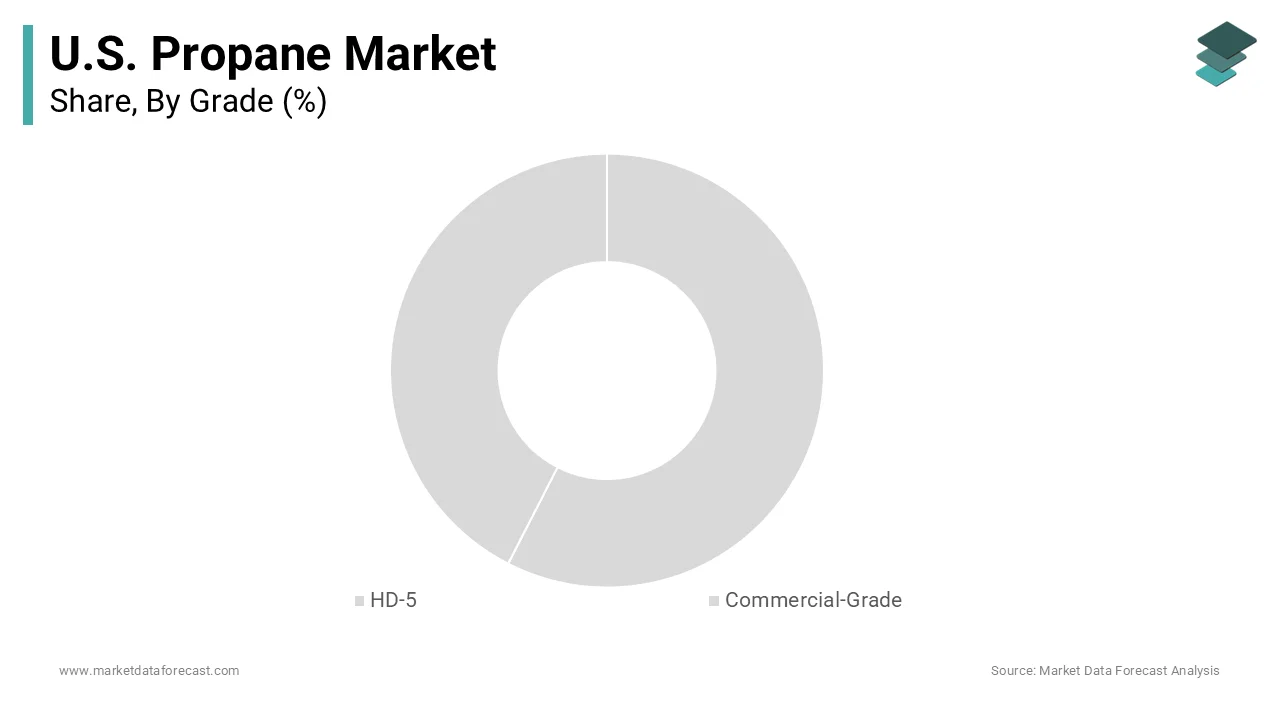
Furthermore, beyond automotive uses, HD 5-grade propane dominates the market due to its universal acceptance and superior performance in residential and commercial heating appliances. Most modern high-efficiency furnaces, water heaters, and cooking ranges are engineered to operate optimally with HD 5 grade fuel, which ensures consistent flame quality and minimal maintenance requirements. According to the National Propane Gas Association, the majority of propane distributed to residential customers in the United States is HD 5 grade because it provides the cleanest burn and highest energy efficiency. The Department of Energy notes that appliances using high-purity propane experience fewer issues with clogged valves and pilots, leading to longer equipment lifespans and lower repair costs for homeowners. This reliability is particularly important in rural areas where propane is the primary heating source for millions of households. The widespread availability of HD 5 grade through established distribution networks ensures that consumers have access to a standardized, high-quality product. Furthermore, many appliance manufacturers explicitly void warranties if lower grades, such as HD 10 or Commercial grade, are used due to the risk of damage from higher propylene and butane content. This manufacturer mandate effectively forces the market toward HD 5 adoption for all new installations and replacements. Consequently,by the sheer volume of residential and commercial heating applications combined with the technical necessity for high-purity fuel, drives the overwhelming dominance of the HD 5 segment in the overall propane market.
The HD 5 segment is also on the rise and is expected to be the fastest-growing segment in the market by witnessing a CAGR of 5.2% during the forecast period due to increasingly stringent environmental and safety regulations that discourage the use of higher olefin fuels. Many states and local jurisdictions are updating building codes and air quality standards that favor the cleanest burning fuels available to reduce particulate matter and volatile organic compound emissions. Industrial workplace safety codes and regional indoor environmental standards heavily regulate fuel specifications for indoor equipment to prevent incomplete combustion risks and limit dangerous emissions from high-propylene fuel blends. This regulatory pressure is forcing industrial and commercial users who previously utilized cheaper commercial-grade propane to switch to HD 5 to ensure compliance and avoid penalties. Stringent stationary source emission limits enacted by the California Air Resources Board have forced operators to prioritize high-purity HD-5 or equivalent clean-burning fuels to meet strict regional particulate and greenhouse gas thresholds. As these regulations spread to other states following California's lead, the demand for HD 5 is accelerating at a faster pace than the overall market. Additionally, insurance companies are beginning to offer better premiums for facilities using HD 5 grade due to its lower risk profile regarding equipment failure and fire hazards. This economic incentive, combined with regulatory mandates, drives a rapid conversion from lower grades to HD 5. The transition is particularly evident in the hospitality and healthcare sector,s where indoor air quality is paramount. Thus, HD 5 is not only maintaining its lead but expanding its share by capturing users from lower-grade segments.
Technological advancements in propane appliances are driving the fastest growth in the HD 5 segment, as modern high-efficiency equipment requires higher-purity fuel to function correctly. New generation condensing furnaces, tankless water heaters and commercial cooking equipment are designed with tighter tolerances and advanced sensors that can be disrupted by the impurities found in HD 10 or commercial-grade propane. Residential building data shows that installations of high-efficiency propane space and water heating systems have risen steadily as homeowners attempt to reduce seasonal energy bills and lower localized carbon footprints. These systems often require fuel with specific combustion characteristics that only HD 5 can provide, ensuring optimal efficiency and preventing premature wear. As older appliances are replaced with these advanced models, the demand for HD 5 grade increases didisproportionately. Furthermorere smart home integration and automated heating systems rely on consistent fuel quality to maintain accurate operation and diagnostics. Any variation in fuel composition can lead to system errors and service calls, which manufacturers aim to avoid by specifying HD 5. This technological lock-in ensures that as the appliance stock turns over, the market share of HD 5 grows rapidly. The synergy between appliance innovation and fuel quality requirements creates a self-reinforcing cycle of demand for HD 5-grade propane.
By End-User Insights
The residential segment dominated the United States propane market and accounted for a 48.2% share in 2025. This dominance of the segment was driven by the vast number of homes located in rural and suburban areas without access to natural gas pipelines. Propane serves as the primary energy source for heating,cookingg, water heating,g, and drying for millions of American householdsAccording to theeo U.S. Census Bureau tracking, approximately 5% of U.S. households, representing nearly 6 million homes, rely on propane as their primary space heating fuel. The Propane Education and Research Council indicates that over 60 million Americans utilize propane across residential and outdoor applications, though industrial sectors drive the highest overall volumetric consumption. The prevalence of propane in rural America is entrenched due to the high cost of extending natural gas infrastructure to low-density areas, making propane tanks a practical and economical solution. Additionally,the reliability of propane delivery services ensures that homeowners have a consistent energy supply even during extreme weather events when electric grids may fail. The National Association of Home Builders indicates that new construction in rural areas continues to favor propane-ready homes due to the lower upfront cost of propane appliances compared to electric heat pumps in cold climates. This established infrastructure and consumer familiarity create a stable and dominant demand base. The seasonal nature of heating demand further amplifies residential consumption during winter months, solidifying its position as the leading end-user segment. The sheer scale of the residential housing stock reliant on propane ensures its continued market leadership.
In addition, the widespread adoption of outdoor living appliances, particularly gas grills and fire pits, significantly contributes to the dominance of the residential sector in the propane market. Propane grilling has become a cultural staple in the United States, with millions of households owning portable or permanent propane grilling units. According to the Hearth Patio and Barbecue Association, there are approximately 70 million gas grills in use in the United Stateses with propane being the preferred fuel source for the majority due to its convenience and portability. The association reports that gas grilling accounts for over 60 percent of all grilling activities, surpassing charcoal in popularity. This high penetration rate ensures a consistent year-round demand for small propane cylinders, which are exchanged or refilled regularly. Additionally,e therend towards outdoor living spaces has expanded beyond grilling to include outdoor heaters, kitchen appliances, and lighting, all powered by propane. The National Retail Federation notes that sales of outdoor living products remain strong as consumers invest in home improvements. The convenience of propane compared to natural gas, which requires ffixed pipingg allows for flexible placement of appliances on decks and patios. This discretionary but habitual use of propane for leisure and entertainment creates a resilient demand stream that complements heating needs. The combination of essential heating and lifestyle applications makes the residential sector the undisputed leader in propane consumption.
The industrial segment is expected to exhibit a noteworthy CAGR of 5.9% from 2026 to 2034, owing to the expanding petrochemical inindustr which uses propane as a key feedstock for producing propylene and other chemicals. The shale gas boom has provided an abundant aaand low-cost supplyf natural gas liquids, including propylene, making the United States a competitive hub for petrochemical production. According to the American Chemistry Council,cil billions of dollars have been invested in new propane dehydrogenation PDH plants across the coucouycountryy which convert propane into propylene, an essential building block for plastics and resins. The US Energy Information Administration reports that industrial consumption of propane for petrochemical feedstock has increased significantly in recent years as new facilities come online. This structural shift in demand is less sensitive to weather fluctuations compared to residential heating, providing a stable growth trajectory. The expansion of export terminals also supports this growth by allowing producers to access global markets while maintaining domestic supply for industrial users. The Department of Commerce highlights that the chemical industry is one of the largest contributors to US manufacturing output,,with propane playing a critical role in its supply chain. As global demand for plastics and synthetic materials rises,ses the US petrochemical sector continues toex,,pand driving sustained growth in industrial propane consumption. This feedstock application represents a fundamental and growing pillar of the propane market.
Moreover, the increasing adoption of propane-powered forklifts and industrial fleet vehicles is another major driver of growth in the industrial segment,,o fering operational advantages over electric and diesel alternatives. Propane-fueled lift trucks provide consistent power, faster refueling time, and lower total cost of ownership, making them ideal for high-throughput warehouses and manufacturing facilities. According to the Material Handling Industry Association, propane remains a leading fuel choice for counterbalance forklifts due to its ability to support multi-shift operations without downtime for battery charging. Major logistics and retail companies are expanding their propane fleets to meet sustainability goals while maintaining productivity. The Propane Education and Research Council notes that the number of propane-powered industrial vehicles continues to grow as businesses seek to reduce carbon emissions compared to diesel. Additionally, advancements in engine technology have improved the efficiency and cleanliness of propane industrialenginese,s further enhancing their appeal. The resilience of the e-commerce sector drives the construction of new distribution centers, which predominantly equip their facilities with propane handling equipment. This operational shift towards propane for material handling ensures that the industrial segment grows at a faster rate than traditional heating sectors.
COUNTRY LEVEL ANALYSIS
U.S. Market Propane Market Analysis
The United States outperformed others in the global propane market and occupied a 31.5% share in 2025. This growth of the US market is supported by a unique position of energy independence,e where domestic production exceedsconsumptioni,n allowing for significant exports. According to the US Energy Information Administration,ion the United States produces over 2 million barrels per day of propane primarily from natural gas processing plants in regions such as the Permian Basin and the Marcellus Shale. This abundance of supply has transformed the US from a net importer to a leading global exporter,rter influencing domestic pricing and availability. The Midwest region serves as a major production hub while the Northeast and Southeast are key consumption centers due to higher residential heating demand. The Department of Transportation oversees the safe transport of propane via ppipelineelin, es raia, nd truc,k ensuring a reliable distribution network across the country. Regulatory frameworks vary by state, with some implementing stricter emissions standards that influence fuel grade preferences. The Propane Education and Research Council works nationally to promote safety and education,n supporting market stability. Economic factors such as natural gas prices directly impact propane costs,ts creating regional price variations based on proximity to production sites. The integration of renewable propane initiatives is also gaining traction nationwide,ide supported by federal incentives. This comprehensive national ecosystem ensures that the US propane market remains robust, diversified,ified and strategically vital to the country's energy security and economic vitality.
COMPETITIVE LANDSCAPE
The competition in the United States propane market is characterized by a mix of large integrated midstream companies, regional distributors, rs and local retailerss creating a fragmented yet interconnected landscape. Major midstream firms compete based on infrastructure capacity, logistical efficiency,cy and export capabilities, while local distributors focus on customer service,ce reliability, and pricing flexibility. The market features high barriers to entryfor large-scalee infrastructure projects due to significant capital requirements and regulatory hurdles. However, the retail segment remains highly competitive with numerous small businesses vying for residential and commercial contracts. Price transparency and availability of alternative fuels such as natural gas and electricity influence competitive dynamics significantly. Companies differentiate themselves through value-added services like equipment leasing, maintenance packagess,s and energy efficiency consultations. Regulatory compliance and safety records also play a crucial role in shaping brand reputation and customer trust. The rise of renewable propane introduces new competitive dimensions as firms seek to innovate and meet sustainability demands. Overall, the market rewards entities that can combine operational excellence with strategic agility and customer focus to thrive in a dynamic environment.
KEY MARKET PLAYERS
Some of the companies that are playing a dominating role in the U.S. propane market include
- AmeriGas Propane (UGI Corporation)
- Ferrellgas Partners L.P.
- Suburban Propane Partners L.P.
- Superior Plus Propane
- Chevron Corporation
- Valero Energy Corporation
- Enterprise Products Partners L.P.
- MPLX LP
- Targa Resources Corp.
- CHS Inc.
- GROWMARK Inc.
- CenterPoint Energy
- NGL Energy Partners LP
TOP LEADING PLAYERS IN THE MARKET
- Enterprise Products Partners L P is a major midstream energy company that plays a critical role in the United States propane market through its extensive infrastructure fo essingstoring ,storage and transporting. The company operates one of the largest natural gas liquid systems in the country, which includes significant propane fractionation and export capabilities. Enterprise has recently focused on expanding its Mont Belvieu complex in Texas to enhance its ability to handle increasing volumes of propane from shale production. The company also invests in pipeline expansions and terminal upgrades to improve logistics efficiency and reliability for customers. By maintaining a robust netwoassetsassetsf asse,ts Enterprise ensures consistent supply and competitive pricing for domestic and international markets. Their strategic investments in storage facilities help stabilize prices during periods of high demand or supply disruptions. These actions strengthen their position as a key enabler of propane distribution and trade across the UnitedStatesa,tes supporting both residential consumers and industrial users with reliable service.
- Energy Transfer LP is a leading midstream energy provider with substantial involvement in the United States propane market through its integrated network of pipelines and processing plants. The companycollects processeso c,esses and transports large volumes of natural gas l,iquiliquisliquidss including propane, from major production basins to key demand centers. Energy Transfer has recently undertaken projects to expand its NGL fractionation capacity and enhance its export terminals along the Gulf Coast. These initiatives allow the company to efficiently move propane from surplus regions to areas with higher consumption or export potential. The company also focuses on optimizing its existing infrastructure to reduce operational costs and improve service reliability for shippers and end users. By leveraging its scale and geographic reach, Energy Transfer supports the stability of the national propane supply chain. Their continuous investment in infrastructure modernization and expansion ensures they remain a pivotal player in facilitating the flow of propane across the councountryyeeting the needs of diverse market segments.
- ONE Gas Inc is a prominent natural gas distribution utility that serves a significant number of customers in the United States. Althoughits primary focus is on piped atu,,ral ,gas it also engages in related energy services. While not a direct propane prod Ucerrr ONE Gas influences the market through its regulatory advocacy and energy efficiency programs that shape consumer fuel choices. The company has recently focused on integrating renewable natural gas andlow-carbonn alternativs,, which impacts the broader liquefied petroleum gas landscape. ONE Gas invests in customer education and safety initiatives that promote responsible energy u,ueusee including propane safety awareness in communities where dual fuel usage is common. Their strategic partnerships with local propane dealers help ensure seamless energy solutions for off-grid customers in their service territories. By maintaining strong community relations and advocating for balanced energy ppolicieses ONE Gas supports a stable environment for all gaseous fuels. Their efforts in sustainability and customer service reinforce their role in the overall energy ecosystem, including the propane sector.
TOP STRATEGIES USED BY KEY MARKET PARTICIPANTS
Key players in the United States propane market primarily employ infrastructure expansion and logistical optimization strategies to mmaintain acompetitive advantage. Companies invest heavily in building and upgrading pipelines, storage terminalss,s and fractionation facilities to enhance supply chain efficiency and reliability. Strategic partnerships with producers and distributors help secure consistent feedstock supplies and expand market reach. Diversification into renewable propane and low-carbon alternatives is becoming increasingly important as companies align with sustainability goals and regulatory requirements. Export capacity expansion is another critical strategy allowing firms to access global markets and balance domestic supply fluctuations. Digital transformation initiatives,s including advanced monitoring and predictive maintenancetechnologiesi, es are adopted to improve operational safety and reduccosts. Customer-centricic approaches, such as flexible pricing models and enhanced service offerings,s help retain residential and commercial clients. These multifaceted strategies enable market participants to navigate volatility while ensuring steady growth and resilience in the evolving energy landscape.
MARKET SEGMENTATION
This research report on the U.S. propane market is segmented and sub-segmented into the following categories.
By Grade
- HD-5
- Commercial-Grade
By End-Use
- Residential
- Industrial
- Commercial
By Country
- California
- Texas
- Florida
- Rest of the United States