- Product Description Description
- Table of Contents TOC
- List of Table & Figure LOT
- Get Free Sample PDF Sample PDF
Market Size, 2025
$77.26 BnMarket Estimate, 2026
$85.26 BnMarket Forecast, 2034
$187.47 BnCAGR, 2026–2034
10.35%U.S. Revenue Cycle Management Market Report Summary
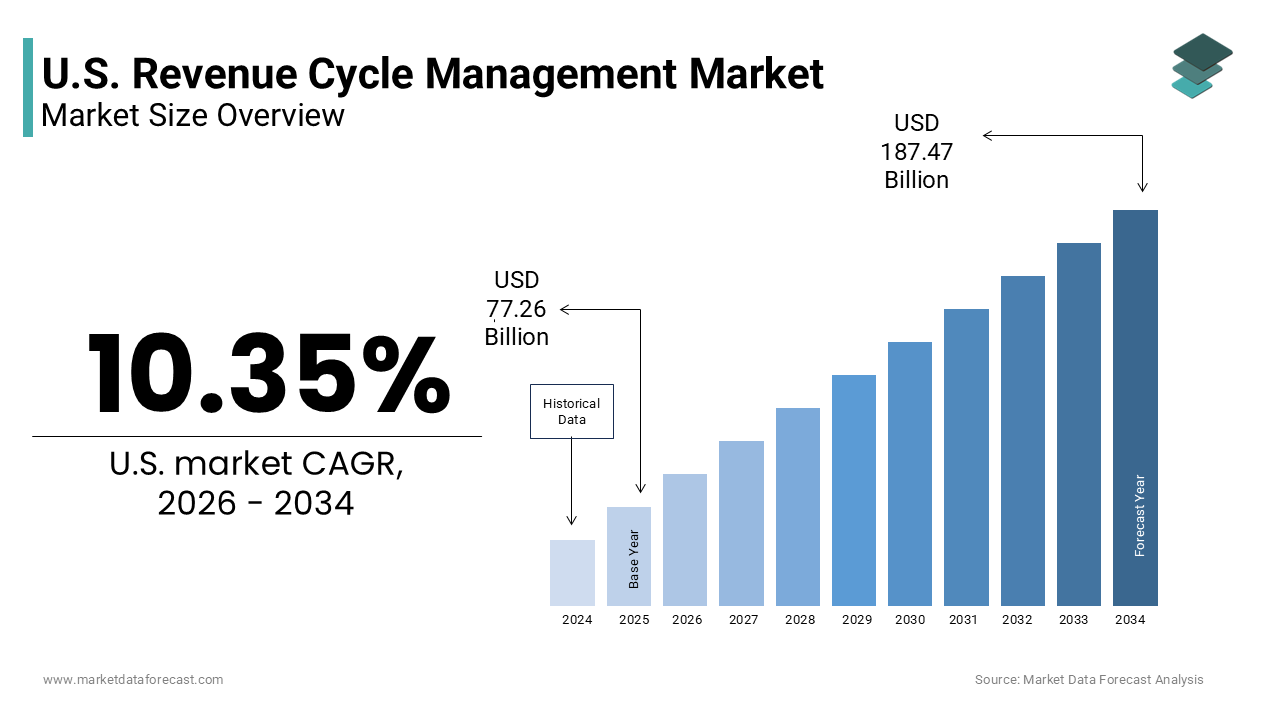
The U.S. revenue cycle management market was valued at USD 77.26 billion in 2025, is estimated to reach USD 85.26 billion in 2026, and is projected to reach USD 187.47 billion by 2034, growing at a CAGR of 10.35% during the forecast period from 2026 to 2034. The growth of the U.S. revenue cycle management market is driven by the increasing complexity of healthcare reimbursement systems, rising patient financial responsibility, and growing adoption of value-based care models. The integration of electronic health records with billing systems, increasing demand for automation in claims processing, and rising focus on reducing claim denials are further accelerating market growth. Moreover, advancements in artificial intelligence, machine learning, predictive analytics, and digital patient payment solutions are supporting the expansion of the U.S. revenue cycle management market.
Key Market Trends
- Rising adoption of artificial intelligence and machine learning technologies to automate billing, coding, and denial management processes.
- Increasing demand for cloud-based revenue cycle management platforms offering scalability and operational flexibility.
- Growing focus on patient-centric financial solutions including digital payment portals and transparent billing systems.
- Expansion of telehealth and remote patient monitoring services requiring specialized reimbursement and billing workflows.
- Strong emphasis on interoperability and seamless integration between electronic health records and financial management systems.
Segmental Insights
Based on structure, the in-house segment dominated the U.S. revenue cycle management market and held a significant share in 2025. The segment’s dominance is attributed to healthcare providers prioritizing direct control over patient financial data, streamlined coordination with clinical workflows, and improved compliance management.
Based on type, the services segment accounted for the largest share of the U.S. revenue cycle management market in 2025. The dominance of this segment is driven by the increasing need for specialized expertise in claims processing, medical coding, billing management, and patient financial counseling.
The software segment is projected to witness the fastest CAGR during the forecast period owing to the growing adoption of AI-powered automation tools, cloud-based platforms, and predictive analytics solutions that improve billing efficiency and reduce administrative costs.
Based on function, the claims and denial management segment held the leading share of the U.S. revenue cycle management market in 2025 due to the increasing volume of denied claims and the growing need for efficient reimbursement optimization strategies.
The clinical documentation improvement segment is expected to register significant growth during the forecast period owing to the increasing importance of accurate clinical documentation in value-based care and reimbursement models.
Regional Insights
The United States dominated the North American revenue cycle management market and accounted for a major share in 2025, supported by increasing healthcare expenditure, rapid digital transformation in healthcare administration, and growing regulatory complexities. California remains a major contributor to the U.S. revenue cycle management market due to its large healthcare infrastructure, high adoption of healthcare IT solutions, and strong presence of leading healthcare technology companies. New York, Washington, and Oregon are also witnessing notable growth driven by increasing investments in healthcare automation, telehealth integration, and patient financial engagement solutions.
Competitive Landscape
The U.S. revenue cycle management market is highly competitive and characterized by the presence of large healthcare IT companies, analytics providers, and specialized revenue cycle management service firms competing through innovation, automation, and integrated financial solutions. Leading companies are focusing on expanding AI-driven analytics capabilities, enhancing interoperability between healthcare systems, improving cybersecurity infrastructure, and strengthening cloud-based service offerings. Strategic partnerships, acquisitions, and investments in patient-centric digital payment technologies are further strengthening market positioning across healthcare providers and payer organizations. Prominent players in the U.S. revenue cycle management market include Cerner Corporation, McKesson Corporation, Optum Inc., Epic Systems Corporation, Allscripts Healthcare Solutions, athenahealth, eClinicalWorks, Experian Health, R1 RCM Inc., Conifer Health Solutions, Change Healthcare, Quest Diagnostics Incorporated, GE HealthCare, Oracle Health, and Veradigm.
U.S. Revenue Cycle Management Market Size
The U.S. revenue cycle management market size was valued at USD 77.26 billion in 2025 and is anticipated to reach USD 85.26 billion in 2026 from USD 187.47 billion by 2034, growing at a CAGR of 10.35% during the forecast period from 2026 to 2034.
The revenue cycle management is the administrative and clinical functions that contribute to the capture management and collection of patient service revenue. This complex ecosystem spans from patient scheduling and registration to final payment collection ensuring that healthcare providers are reimbursed accurately and efficiently for services rendered. The complexity of the US healthcare system is further illustrated by data from the Centers for Medicare and Medicaid Services, which indicates that national health expenditures reached 4.5 trillion dollars in 2022. This massive financial volume necessitates robust systems to handle billing coding and claims processing. Furthermore, the shift towards value based care models requires sophisticated data analytics to track performance metrics and ensure compliance with payer contracts. The fragmentation drives the need for advanced revenue cycle management solutions that can navigate diverse payer rules and reduce denial rates. The integration of electronic health records with billing systems has become essential for streamlining operations and improving cash flow.
MARKET DRIVERS
Increasing Complexity of Payer Regulations and Reimbursement Models
The escalating complexity of payer regulations and the transition to value-based reimbursement models for the adoption of advanced revenue cycle management solutions is driving the growth of the United States revenue cycle management market. Healthcare providers must navigate a labyrinth of changing rules from government programs like Medicare and Medicaid, as well as numerous private insurers. As per the Centers for Medicare and Medicaid Services, the implementation of new payment frameworks, such as the Merit based Incentive Payment System requires detailed reporting and precise coding to avoid penalties. Failure to comply with these evolving standards results in significant financial losses through claim denials and underpayments. Additionally, the shift from fee for service to value based care demands robust data analytics to track quality metrics and patient outcomes. According to Deloitte, over 70% of healthcare executives are prioritizing investments in technology that supports value based contracting. These systems help providers manage risk and ensure accurate reimbursement based on performance rather than volume. The intricate nature of modern reimbursement landscapes forces healthcare organizations to adopt sophisticated revenue cycle management tools to maintain financial viability and regulatory compliance.
Rising Patient Financial Responsibility and Out of Pocket Costs
The growing financial responsibility borne by patients due to high-deductible health plans is also accelerating the growth of the United States revenue cycle management market. As employers shift more healthcare costs to employees, individuals are required to pay larger portions of their medical bills out of pocket. As per the Kaiser Family Foundation the average annual deductible for single coverage in employer sponsored plans exceeded 1,700 dollars in 2023. This trend increases the complexity of patient collections and necessitates more transparent and flexible payment options. Healthcare providers are increasingly adopting patient engagement platforms that offer upfront cost estimates and digital payment portals to improve collection rates. The Medical Group Management Association reports that patient collections now account for a substantial portion of total revenue requiring specialized strategies to manage accounts receivable effectively. Failure to collect patient balances promptly leads to increased bad debt and strained cash flows. Consequently, providers are investing in revenue cycle management solutions that integrate patient communication tools and payment processing capabilities. These technologies enable providers to offer payment plans and financing options that align with patient budgets. According to a survey by TransUnion Healthcare nearly 80% of patients prefer digital payment methods for their medical bills.
MARKET RESTRAINTS
High Implementation Costs and Resource Constraints
The substantial initial investment required for implementing comprehensive revenue cycle management systems, particularly for smaller healthcare providers is restricting the growth of the United States revenue cycle management market. Upfront costs, include software licensing hardware upgrades and extensive training for staff members, who must adapt to new workflows. As per the Healthcare Financial Management Association, small rural hospitals often lack the capital reserves necessary to invest in state of the art revenue cycle technologies. These facilities operate on tighter budgets and may struggle to justify the expense despite the long-term benefits. Additionally, the ongoing maintenance and support costs associated with these systems can be prohibitive for resource constrained organizations. This financial barrier limits the adoption of advanced solutions and perpetuates inefficiencies in billing and collections. Furthermore, the shortage of skilled professionals who can manage and optimize these systems exacerbates the problem. According to the Bureau of Labor Statistics, the healthcare industry faces a persistent shortage of qualified medical records and health information technicians. This labor gap increases the burden on existing staff and slows down the implementation process.
Interoperability Issues and Data Fragmentation
The interoperability challenges and data fragmentation across disparate healthcare systems, significantly hinder the effectiveness of revenue cycle management initiatives, which is also declining the growth of the United States cycle management market. Many healthcare providers utilize multiple electronic health record systems and billing platforms that do not seamlessly communicate with one another. As per the Office of the National Coordinator for Health Information Technology, despite progress in health information exchange data silos remain a persistent obstacle. This lack of integration leads to incomplete patient information errors in coding and delayed claim submissions. The American Health Information Management Association states that poor data quality contributes to higher denial rates and increased administrative workload. When systems cannot share data efficiently providers struggle to obtain a holistic view of the patient financial journey. This fragmentation complicates the coordination of care and billing activities resulting in missed revenue opportunities. Additionally, the varying standards for data exchange between payers and providers create additional friction in the claims processing workflow. These technical barriers force providers to rely on manual interventions which are prone to error and inefficiency. Resolving these interoperability issues is crucial for unlocking the full potential of revenue cycle management technologies.
MARKET OPPORTUNITIES
Integration of Artificial Intelligence and Machine Learning
The integration of artificial intelligence and machine learning into revenue cycle management processes for enhancing efficiency and accuracy is setting up new opportunities for the growth of the United States revenue cycle management market. These technologies enable predictive analytics that can identify potential claim denials before submission allowing providers to correct errors proactively. Machine learning algorithms analyze historical data to optimize coding accuracy and ensure compliance with payer rules. This proactive approach reduces the rate of denied claims and accelerates reimbursement cycles. Additionally, natural language processing tools can extract relevant information from unstructured clinical notes improving the precision of medical coding. This efficiency gain translates into faster cash flow and reduced administrative burdens for healthcare providers. The ability to predict patient payment behaviors also allows for more targeted collection strategies.
Expansion of Telehealth and Remote Patient Monitoring Services
The rapid expansion of telehealth and remote patient monitoring services for revenue cycle management vendors to develop specialized billing solutions is ascribed to bolster new opportunities for the growth of the United States revenue cycle management market. The pandemic accelerated the adoption of virtual care with the Centers for Medicare and Medicaid Services permanently expanding reimbursement policies for telehealth services. The telehealth visits have become a standard component of care delivery requiring distinct coding and billing procedures. Revenue cycle management systems must adapt to handle these new service types ensuring accurate claim submission and reimbursement. The integration of remote patient monitoring data into billing workflows also presents opportunities for automation and improved accuracy. Providers need systems that can seamlessly blend virtual and in person visit data to create comprehensive patient accounts. This convergence requires sophisticated software capable of managing diverse revenue streams and complying with varying payer rules for virtual care. Additionally, the rise of hybrid care models necessitates flexible billing platforms that can handle complex scheduling and payment scenarios.
MARKET CHALLENGES
Cybersecurity Threats and Data Privacy Concerns
The increasing frequency and sophistication of cyberattacks, as these systems handle sensitive patient financial data is one of the major challenges for the growth of the United States revenue cycle management market. Healthcare organizations are prime targets for ransomware attacks, which can disrupt billing operations and compromise confidential information. The healthcare sector experienced the highest number of data breaches of any industry in 2023. These security incidents result in substantial financial losses legal liabilities and reputational damage for providers. Revenue cycle management vendors must invest heavily in cybersecurity measures to protect their platforms and maintain client trust. The complexity of integrating multiple systems and third party vendors further expands the attack surface for potential breaches. Ensuring compliance with the Health Insurance Portability and Accountability Act requires continuous monitoring and updating of security infrastructure. These high stakes necessitate rigorous security standards that can be costly and complex to implement. Providers must balance the need for accessible financial data with stringent protection measures. Failure to adequately secure revenue cycle systems can lead to operational downtime and loss of revenue.
Workforce Shortages and Staff Burnout
The persistent workforce shortages and high levels of staff burnout in the healthcare administrative is another attribute to impede the growth of the United States revenue cycle management market. The demand for skilled medical billers coders and financial counselors exceeds the available supply leading to staffing gaps and increased workloads for existing employees. The shortage of qualified health information professionals is expected to worsen in the coming years. This labor scarcity results in delayed claim submissions increased error rates and slower collection processes. Burnout among administrative staff is exacerbated by the complexity of billing regulations and the pressure to meet financial targets. High turnover disrupts continuity and requires constant training of new hires which further strains resources. The reliance on temporary staffing agencies increases operational costs and may compromise the quality of work. Additionally, the emotional toll of dealing with distressed patients regarding financial matters contributes to job dissatisfaction. Addressing these human capital challenges requires innovative solutions such as automation and improved workplace support systems.
REPORT COVERAGE
| REPORT METRIC | DETAILS |
| Market Size Available | 2025 to 2034 |
| Base Year | 2025 |
| Forecast Period | 2026 to 2034 |
| CAGR | 10.35% |
| Segments Covered | By Structure, Type, Function, End-User and Region. |
| Various Analyses Covered | Global, Regional & Country Level Analysis, Segment-Level Analysis; DROC, PESTLE Analysis, Porter's Five Forces Analysis, Competitive Landscape, Analyst Overview of Investment Opportunities |
| Countries Covered | California, Washington, Oregon, New York, and the rest of the United States. |
| Market Leader Profiled | Cerner Corporation, McKesson Corporation, Optum Inc., Epic Systems Corporation, Allscripts Healthcare Solutions, athenahealth, eClinicalWorks, Experian Health, R1 RCM Inc., Conifer Health Solutions, Change Healthcare, Quest Diagnostics Incorporated, GE HealthCare, Oracle Health, and Veradigm. |
SEGMENTAL ANALYSIS
By Structure Insights
The in-house structure segment held a dominant share of the United States revenue cycle management market share in 2025 with the healthcare providers prioritize direct control over sensitive patient financial data and seamless integration with clinical operations. Maintaining internal teams allows hospitals and physician groups to align billing processes closely with patient care workflows ensuring immediate resolution of discrepancies. The large health systems prefer internal management to safeguard proprietary data and maintain consistent quality standards across their networks. This approach facilitates real time communication between clinical staff and billing specialists, which is for accurate coding and documentation. The Healthcare Financial Management Association notes that organizations with integrated in-house teams experience faster feedback loops regarding claim denials allowing for quicker corrective actions. Direct oversight also enables providers to customize workflows according to specific institutional needs rather than relying on standardized external protocols. The ability to rapidly adapt to changing regulatory requirements without negotiating contract modifications with third party vendors is another significant advantage. In-house teams can implement policy changes immediately ensuring compliance with federal and state mandates.
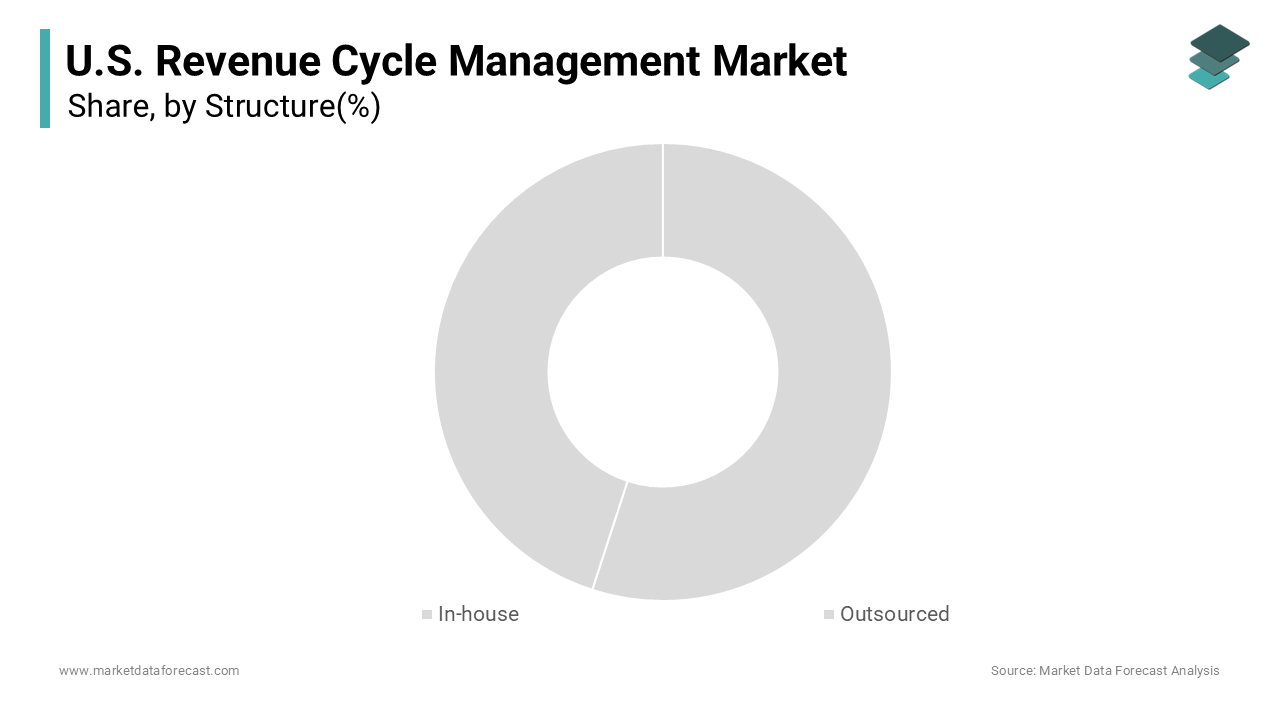
The outsourced segment is esteemed to grow at an anticipated CAGR of 11.2% from 2026 to 2034 with the need for healthcare providers to access specialized expertise and advanced technologies without substantial capital investment. Many small and mid-sized practices lack the resources to hire dedicated coding experts or purchase sophisticated billing software. The outsourcing allows these entities to leverage the scale and expertise of specialized vendors who employ certified coders and data analysts. Third party providers continuously update their technology stacks to comply with changing regulations ensuring that clients remain compliant without additional effort. Outsourcing firms offer predictive analytics and artificial intelligence tools that identify denial trends and optimize claim submission strategies. These technologies are often prohibitively expensive for individual practices to develop independently. The ability to scale services up or down based on patient volume fluctuations provides operational flexibility that in-house teams cannot easily match.
By Type Insights
The services segment was the largest by holding 48.3% of the United States revenue cycle management market share in 2025 due to the labor intensive nature of claims processing medical coding and patient interaction. Despite technological advancements, many aspects of revenue cycle management require human judgment and intervention to resolve complex billing issues and navigate payer nuances. The accurate medical coding requires certified professionals who can interpret clinical documentation and apply appropriate codes a task that automation alone cannot fully replicate. Human expertise is essential for handling denied claims appeals and negotiating with insurance companies to secure rightful reimbursement. The Healthcare Financial Management Association states that manual review and adjustment of claims account for a significant portion of revenue cycle activities particularly for complex procedures and rare diagnoses. Services also include patient financial counseling which requires empathetic communication and personalized problem solving. The complexity of US healthcare regulations means that providers rely on experienced service teams to ensure compliance and avoid audits. These teams provide ongoing monitoring and auditing of billing practices to identify errors and prevent future issues.
The software segment is likely to witness a fastest CAGR of 13.5% from 2026 to 2034 with the rapid adoption of artificial intelligence and automation tools that streamline administrative tasks and reduce manual errors. Healthcare providers are increasingly investing in software solutions that automate eligibility verification claim scrubbing and payment posting. As per Gartner, AI powered revenue cycle software can reduce claim denial rates by up to 20% by identifying errors before submission. These tools use machine learning algorithms to analyze historical data and predict potential issues allowing for proactive corrections. Software platforms also offer real time analytics dashboards that provide visibility into financial performance and operational metrics. The ability to process large volumes of claims quickly and accurately enhances operational efficiency and reduces administrative costs. Cloud based software solutions offer scalability and accessibility allowing providers to manage revenue cycle operations from anywhere.
By Function Insights
The claims and denial management segment was the largest by capturing 34.4% of the United States revenue cycle management market share in 2025 due to the high volume of claim denials and their significant financial impact on healthcare providers. Denials represent a major source of revenue leakage requiring extensive resources to identify appeal and resolve. Managing these denials requires specialized processes and tools to track reasons for rejection and initiate timely appeals. Effective denial management programs help providers recover this lost revenue and prevent future occurrences by addressing root causes. Providers invest heavily in this function to ensure that claims are clean upon submission and that denials are addressed promptly. The complexity of payer rules and frequent changes in policies necessitate continuous monitoring and adaptation of denial management strategies.
The clinical documentation segment is likely to grow at an anticipated CAGR of 14.8% from 2026 to 2034 with the transition to value based care models that link reimbursement to quality metrics and patient outcomes. Accurate clinical documentation is essential for capturing the severity of illness and risk adjustment factors that determine payment levels. As per the American Health Information Management Association, incomplete or inaccurate documentation can lead to undercoding and reduced reimbursement in value based contracts. CDI programs help ensure that medical records reflect the true complexity of patient conditions supporting appropriate coding and billing. The Centers for Medicare and Medicaid Services emphasize the importance of documented quality measures for participation in programs like the Merit based Incentive Payment System. The shift towards population health management also requires detailed clinical data to track patient progress and outcomes. CDI specialists work collaboratively with physicians to clarify documentation and ensure completeness. This collaboration enhances the accuracy of health data used for research and quality improvement initiatives. The growing emphasis on data driven healthcare delivery fuels the demand for CDI services.
By End-User Insights
The hospitals segment was the largest by holding a dominant share of the United States revenue cycle management market in 2025 due to their high transaction volumes and complex service lines that generate substantial billing activity. Hospitals provide a wide range of services from emergency care to specialized surgeries each with distinct coding and billing requirements. The sheer volume of claims processed by hospitals requires scalable and efficient solutions to manage cash flow and minimize denials. The complexity of hospital billing involves multiple departments payers and regulatory frameworks increasing the need for specialized management. The financial stakes are high with hospitals operating on thin margins where even small improvements in collection rates can significantly impact profitability. Revenue cycle management solutions for hospitals must handle these complexities while ensuring compliance with federal regulations.
The physician offices segment is likely to grow at an anticipated CAGR of 12.9% from 2026 to 2034 with the shift of healthcare services from inpatient hospital settings to ambulatory care centers and independent physician practices. An increasing number of procedures are performed in outpatient settings reducing hospital admissions and increasing the volume of physician office visits. This trend expands the addressable market for revenue cycle management solutions tailored to smaller practices. Independent physicians often lack the administrative infrastructure of large hospitals making them reliant on external solutions for billing and collections. The fragmentation of the physician market creates opportunities for vendors offering scalable and affordable solutions. The rise of multi-specialty groups also drives demand for integrated revenue cycle platforms that can handle diverse billing needs. Physicians seek efficiencies to manage rising operational costs and declining reimbursements. Revenue cycle management tools help practices improve cash flow and reduce administrative burdens.
COMPETITIVE LANDSCAPE
The competition in the United States revenue cycle management market is intense and characterized by a mix of large technology conglomerates specialized service providers and emerging fintech innovators. Major players differentiate themselves through the depth of their technological integration and the breadth of their service offerings. Companies like Optum and Oracle Health leverage their extensive ecosystems to provide seamless connections between clinical and financial data creating a competitive advantage in efficiency and accuracy. Specialized firms such as R1 RCM focus on niche expertise and personalized service models to attract mid sized and large health systems seeking tailored solutions. The market sees frequent mergers and acquisitions as larger entities seek to consolidate capabilities and expand their technological reach. Innovation in artificial intelligence and automation serves as a key differentiator with vendors competing to offer the most sophisticated predictive analytics and denial prevention tools. Price sensitivity among smaller practices drives competition in the software as a service segment where affordability and ease of use are paramount. Regulatory compliance and data security remain critical factors influencing vendor selection as providers seek partners who can mitigate risk effectively. The shift towards value based care further intensifies competition as vendors must demonstrate their ability to support complex reimbursement models. Customer retention relies heavily on proven performance metrics such as improved collection rates and reduced days in accounts receivable.
KEY MARKET PLAYERS
A few of the major companies in the U.S. Revenue Cycle Management Market include
- Cerner Corporation
- McKesson Corporation
- Optum Inc.
- Epic Systems Corporation
- Allscripts Healthcare Solutions
- athenahealth
- eClinicalWorks
- Experian Health
- R1 RCM Inc.
- Conifer Health Solutions
- Change Healthcare
- Quest Diagnostics Incorporated
- GE HealthCare
- Oracle Health
- Veradigm
Top Players in the US Revenue Cycle Management Market
Optum Inc
Optum Inc is a leading health services and innovation company that plays a pivotal role in the United States revenue cycle management market. The company offers comprehensive solutions including technology enabled services analytics and consulting to healthcare providers. Optum leverages its vast data assets and artificial intelligence capabilities to streamline billing processes and reduce claim denials. Recent actions include the expansion of its value based care platforms which integrate financial and clinical data to improve overall performance. The company actively invests in machine learning tools that predict payment behaviors and optimize reimbursement strategies. These initiatives help healthcare organizations navigate complex payer regulations and improve cash flow efficiency. Optum continues to strengthen its market position by focusing on interoperability and seamless integration with electronic health records. This holistic approach ensures that providers can manage their financial health effectively while delivering high quality patient care.
R1 RCM Inc
R1 RCM Inc is a prominent provider of revenue cycle management services that transforms the financial experience for hospitals health systems and physician groups. The company utilizes a proven methodology combined with advanced technology to automate administrative tasks and enhance collection rates. R1 RCM focuses on improving patient engagement through digital tools that simplify billing and payment processes. Recent strategic moves include the implementation of robotic process automation to handle repetitive backend operations thereby reducing errors and accelerating claims processing. The company also expands its partnerships with major electronic health record vendors to ensure seamless data exchange and workflow integration. R1 RCM invests heavily in predictive analytics to identify potential denial risks before claims are submitted. These efforts enable healthcare providers to maximize revenue integrity and minimize administrative burdens. By prioritizing customer centric solutions and continuous innovation R1 RCM strengthens its reputation as a trusted partner in healthcare finance. The company remains committed to delivering measurable financial improvements for its clients across the continuum of care.
Cerner Corporation (Oracle Health)
Cerner Corporation now part of Oracle Health is a global leader in health information technology that significantly impacts the United States revenue cycle management landscape. The company provides integrated software solutions that connect clinical and financial data to streamline revenue cycle operations. Oracle Health leverages cloud computing and artificial intelligence to enhance billing accuracy and accelerate reimbursement cycles. Recent actions include the deep integration of revenue cycle tools within its electronic health record platform to provide real time visibility into financial performance. The company focuses on developing automated coding assistants that reduce manual effort and improve compliance with coding standards. Oracle Health also invests in interoperability initiatives to facilitate seamless data sharing between providers and payers. These technological advancements help healthcare organizations reduce administrative costs and improve operational efficiency. The company continues to innovate its platform to address evolving regulatory requirements and market demands ensuring robust support for healthcare financial management.
Top Strategies Used by Key Market Participants
Key players in the United States revenue cycle management market primarily focus on integrating artificial intelligence and machine learning to automate complex billing tasks and enhance accuracy. Companies invest heavily in predictive analytics to identify denial trends and optimize claim submission processes before errors occur. Strategic acquisitions of specialized technology firms allow vendors to expand their service portfolios and offer comprehensive end to end solutions. Partnerships with electronic health record providers ensure seamless data integration and interoperability which reduces manual entry and improves workflow efficiency. Providers emphasize patient centric financial experiences by implementing digital payment portals and transparent pricing tools to boost collection rates. Cloud based platforms are increasingly adopted to offer scalable and flexible solutions that accommodate varying organizational sizes and needs. Continuous investment in cybersecurity measures protects sensitive patient financial data and maintains regulatory compliance with federal standards. Vendors also prioritize training and certification programs for staff to ensure expertise in evolving coding regulations and payer policies.
MARKET SEGMENTATION
This research report on the U.S. Revenue Cycle Management Market has been segmented based on the following categories.
By Structure
- In-house
- Outsourced
By Type
- Services
- Software
By Function
- Claims & Denial Management
- Medical Coding & Billing
- Clinical Documentation Improvement (CDI)
- Insurance
- Others
By End-user
- Hospitals
- Physician’s Office
- Others
By Country
- California
- Washington
- Oregon
- New York
- Rest of the United States