- Product Description Description
- Table of Contents TOC
- List of Table & Figure LOT
- Get Free Sample PDF Sample PDF
Market Size, 2025
$23.43 BnMarket Estimate, 2026
$27.97 BnMarket Forecast, 2034
$98.23 BnCAGR, 2026–2034
19.37%U.S. Ride Hailing Market Report Summary
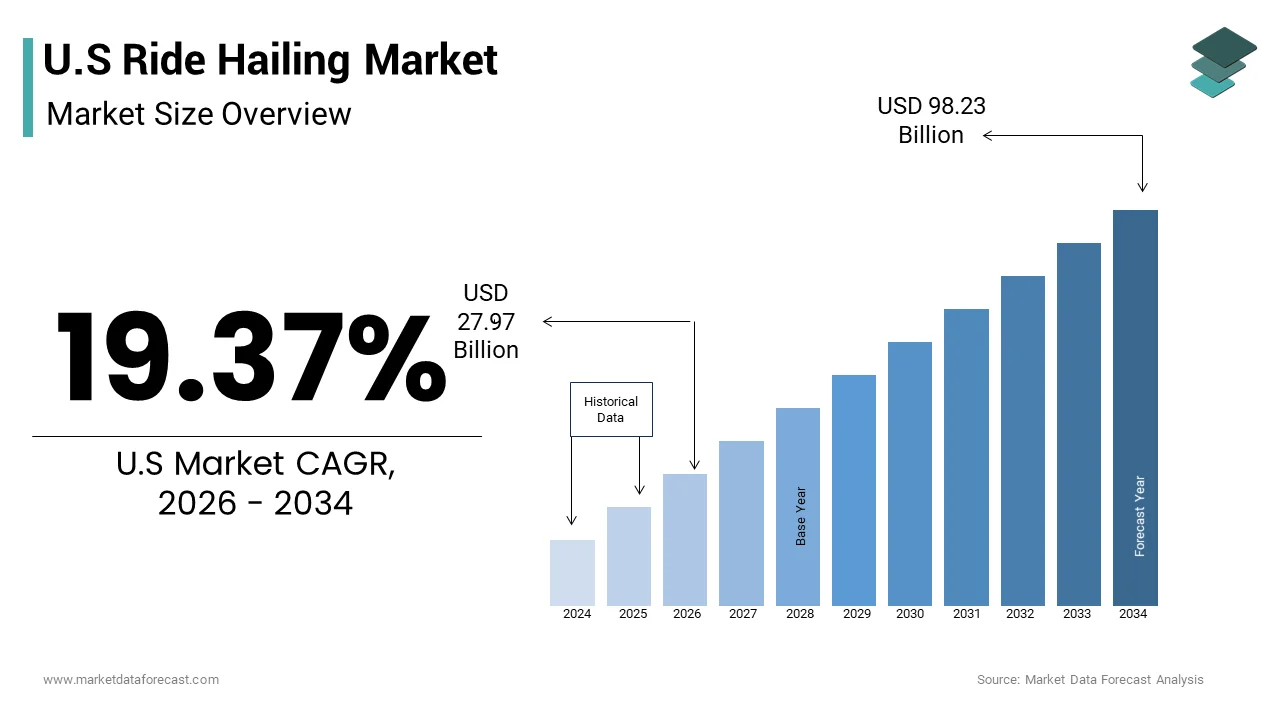
The United States ride hailing market was valued at USD 23.43 billion in 2025 and is anticipated to reach USD 27.97 billion in 2026 and USD 98.23 billion by 2034, growing at a CAGR of 19.37% during the forecast period from 2026 to 2034. The growth of the U.S. ride hailing market is driven by increasing smartphone penetration, rising consumer preference for convenient on-demand mobility services, and the rapid adoption of digital payment platforms. Growing urbanization, traffic congestion, and the shift away from personal vehicle ownership among younger consumers are further accelerating market growth. Additionally, advancements in GPS tracking, AI-based ride matching, and integration of electric and shared mobility solutions are enhancing operational efficiency and customer experience across the ride hailing ecosystem.
Key Market Trends
- Rising adoption of app-based e-hailing services driven by convenience, affordability, and real-time ride tracking capabilities.
- Increasing integration of electric vehicles and sustainable mobility initiatives among ride hailing operators to reduce emissions and operating costs.
- Growing use of AI, machine learning, and predictive analytics for route optimization, demand forecasting, and dynamic pricing strategies.
- Expansion of multimodal transportation services, including bike sharing, scooter rentals, and carpooling options through ride hailing platforms.
- Strong focus on contactless payments, rider safety features, and subscription-based mobility services to improve customer retention and engagement.
Segmental Insights
- Based on service, the e-hailing segment dominated the United States ride hailing market and accounted for a substantial share in 2025. The segment’s dominance is attributed to the increasing popularity of app-based transportation services that offer real-time booking, transparent pricing, and improved convenience for daily commuters and travelers.
- Based on vehicle type, the cars segment led the United States ride hailing market and captured a 60.4% share in 2025. The widespread availability of passenger cars, affordability, and consumer preference for comfortable urban transportation continue to support the segment’s market leadership.
- Based on payment method, the online payment methods segment held the majority share of the United States ride hailing market in 2025. The increasing adoption of digital wallets, mobile banking applications, and contactless payment technologies has significantly contributed to segment growth.
- Based on end-user, the personal end-user segment was the largest and occupied a 62.1% share of the United States ride hailing market in 2025. The growing preference for convenient and cost-effective transportation solutions for daily commuting, leisure travel, and airport transfers is driving demand within this segment.
Regional Insights
The United States emerged as the leading contributor to the North American ride hailing market and accounted for a dominant 90.1% share in 2025. The market growth is supported by strong digital infrastructure, widespread smartphone usage, and high consumer acceptance of app-based mobility solutions. Major metropolitan regions such as New York City, San Francisco, and Los Angeles continue to witness high ride hailing demand due to dense urban populations, increasing traffic congestion, and growing tourism activities.
Competitive Landscape
The U.S. ride hailing market is highly competitive, with major companies focusing on technological innovation, service diversification, and strategic partnerships to strengthen their market position. Leading players are investing in electric vehicle integration, autonomous driving technologies, and AI-powered fleet management systems to improve operational efficiency and customer satisfaction. Expansion into food delivery, micro-mobility, and subscription-based transportation services is also creating new growth opportunities within the industry.
Prominent players in the U.S. ride hailing market include Lyft, Ola, Uber, Careem, Bolt (Taxify), BlaBlaCar, DiDi, Gett, Grab, Lime, Hertz, Juno, and Kabbee.
U.S Ride Hailing Market Size
The U.S ride hailing market size was valued at USD 23.43 billion in 2025 and is anticipated to reach USD 27.97 billion in 2026 to reach USD 98.23 billion by 2034, growing at a CAGR of 19.37% during the forecast period from 2026 to 2034.
Current Market Definition and Scenario
Ride-hailing is an on-demand, app-based transportation service where passengers use their smartphones to request a private car and driver to take them to a specific destination. This market has fundamentally altered mobility patterns by offering an alternative to traditional taxi services and private vehicle ownership through algorithmic matching and dynamic pricing models. The sector is characterized by its reliance on smartphone penetration and high speed mobile connectivity which facilitate seamless transactions and real time tracking. As per a study, approximately 90 percent of American adults own a smartphone, providing the essential hardware infrastructure for widespread adoption of ride-hailing applications. Furthermore the Federal Highway Administration reports that the average American driver spends approximately one hour driving each day, highlighting the potential for time savings and productivity gains offered by hired transport services. The integration of these services into daily routines is further supported by the increasing urbanization of the population with over 80 percent of Americans living in urban areas according to the United States Census Bureau. Regulatory frameworks vary by state and municipality influencing operational costs and driver classification status. The market continues to evolve with the introduction of shared rides and subscription models aiming to enhance affordability and user retention. This dynamic environment reflects a mature yet innovating sector where convenience reliability and cost efficiency drive consumer preference and market expansion.
MARKET DRIVERS
High Smartphone Penetration and Digital Connectivity
The pervasive adoption of smartphones and robust digital connectivity is a major reason for the growth of the United States ride hailing market. This enables instant access to transportation services through user friendly mobile applications. The convenience of booking a ride with a few taps on a screen has replaced traditional methods of hailing cabs or planning public transit routes. As per research, 90 percent of American adults possess a smartphone, which creates a massive installed base of potential users who can access ride-hailing platforms anytime and anywhere. This high level of device ownership ensures that service providers can reach a broad demographic including younger generations who are digital natives and older adults who are increasingly tech savvy. The availability of high speed fourth generation and fifth generation mobile networks allows for real time GPS tracking accurate arrival estimates and seamless payment processing which are critical components of the user experience. Without reliable connectivity the core functionality of ride hailing apps would be compromised leading to frustration and reduced usage. The integration of these applications with other digital services such as maps calendars and payment wallets further enhances their utility and stickiness. Therefore, the technological infrastructure provided by widespread smartphone use and advanced network coverage acts as a primary catalyst for the continued growth and normalization of ride hailing as a standard mode of urban transportation.
Urbanization and Changing Consumer Mobility Preferences
Rapid urbanization and shifting consumer preferences toward accessibility and convenience rather than ownership drive significant demand for ride hailing services in the country, which contributes to the expansion of the United States ride hailing market. As cities become more congested and parking becomes scarcer and more expensive residents are increasingly opting for on demand mobility solutions over private car ownership. As per the United States Census Bureau more than 80 percent of the US population resides in urban areas where traffic density and limited parking infrastructure make driving personally less attractive. Younger demographics particularly millennials and Generation Z exhibit a lower propensity to obtain drivers licenses or purchase vehicles viewing them as financial burdens rather than status symbols. Ride hailing offers a flexible alternative that aligns with the lifestyle of urban dwellers who value spontaneity and efficiency. The ability to summon a vehicle for short trips late night travel or commutes without the hassle of maintenance insurance and depreciation appeals to cost conscious consumers. Additionally the rise of the gig economy and remote work has changed travel patterns with people making fewer predictable commutes but more varied local trips. This shift in behavior supports the utilization of ride hailing for diverse purposes including social outings errands and professional meetings. Thus, the structural trend toward urban living combined with a cultural shift away from car ownership sustains strong demand for flexible and accessible transportation options.
MARKET RESTRAINTS
Regulatory Uncertainty and Driver Classification Issues
Regulatory uncertainty surrounding the employment status of drivers is a significant barrier to the United States ride hailing market. This creates legal ambiguities and potential increases in operational costs. The classification of drivers as independent contractors versus employees remains a contentious issue with implications for benefits minimum wage and labor rights. As per the National Conference of State Legislatures several states have introduced or passed legislation aimed at reclassifying gig workers which could force ride hailing companies to provide healthcare insurance paid leave and other employee benefits. Such changes would substantially increase the cost structure for platforms potentially leading to higher fares for consumers and reduced earnings for drivers. The lack of a uniform federal standard results in a fragmented regulatory landscape where companies must navigate differing rules across various jurisdictions increasing compliance complexity. Legal battles and lobbying efforts consume significant resources and create instability in business planning. For instance California’s Proposition 22 established a third category for app based drivers but similar measures face challenges in other states. This ongoing legislative flux discourages long term investment and expansion strategies. Companies may limit operations in regions with hostile regulatory environments reducing service availability for users. Hence, the unresolved debate over worker classification acts as a major brake on market stability and profitability requiring continuous adaptation to evolving legal frameworks.
Driver Shortages and Retention Challenges
Driver shortages and difficulties in retaining qualified partners serve as a major hurdle for the United States ride hailing market. This limits supply capacity and increases wait times for passengers. The gig nature of the work often leads to high turnover rates as drivers seek more stable and lucrative employment opportunities in other sectors. As per the Bureau of Labor Statistics, the Transportation and Warehousing sector has experienced significant labor fluctuations, with many workers leaving due to burnout, low pay, or better alternatives. During peak demand periods such as holidays or severe weather events the scarcity of available drivers results in surge pricing and prolonged wait times which diminishes user satisfaction and encourages switching to competitors or alternative transport modes. The cost of vehicle maintenance fuel and insurance also impacts driver profitability making the role less attractive during periods of high inflation. Platforms struggle to incentivize drivers to remain active on their apps consistently leading to unpredictable service levels. Recruitment efforts often fail to keep pace with demand growth particularly in suburban and rural areas where driver density is lower. The reliance on a flexible workforce means that supply is elastic but often insufficient to meet spikes in demand. So, the inability to maintain a stable and sufficient pool of drivers constrains market growth and reliability affecting both revenue potential and customer loyalty.
MARKET OPPORTUNITIES
Integration of Electric Vehicles and Sustainability Initiatives
The integration of electric vehicles into ride hailing fleets offers a strong opening for the growth of the United States market. This aligns with environmental sustainability goals and reduces operational costs for drivers. Governments and consumers are increasingly prioritizing green transportation solutions creating incentives for the adoption of zero emission vehicles. As per the Environmental Protection Agency transportation accounts for the largest share of greenhouse gas emissions in the United States prompting federal and state programs to offer tax credits and grants for electric vehicle purchases and charging infrastructure development. Ride hailing companies can leverage these incentives to subsidize the transition for drivers lowering the barrier to entry for electric cars. Electric vehicles typically have lower maintenance and fuel costs compared to internal combustion engines which can improve driver earnings and attractiveness of the platform. Partnerships with automakers and energy providers can facilitate the creation of dedicated charging networks for ride hailing drivers enhancing convenience and efficiency. Marketing campaigns highlighting the eco friendly nature of electric rides can appeal to environmentally conscious consumers willing to pay a premium for sustainable options. Additionally corporate clients seeking to reduce their carbon footprint may prefer green ride hailing services for employee travel. By leading the transition to electrification ride hailing platforms can differentiate themselves comply with emerging regulations and contribute to broader climate goals. This strategic shift not only enhances brand reputation but also future proofs the business model against tightening emissions standards.
Expansion into Multimodal Transportation and Micro Mobility
The expansion into multimodal transportation and micro mobility options offers a substantial prospect for the United States ride hailing market. This provides comprehensive last mile solutions and enhances user convenience. Integrating bikes scooters and public transit information into ride hailing applications allows users to plan and execute seamless journeys using multiple modes of transport. As per the National Association of City Transportation Officials micro mobility trips have surged in urban centers providing a viable solution for short distance travel that complements longer ride hailing trips. By incorporating these options platforms can capture a larger share of the daily mobility budget and increase user engagement frequency. Partnerships with local transit authorities enable real time data sharing and integrated ticketing making it easier for users to combine ride hailing with buses or trains. This holistic approach addresses the first and last mile connectivity gap which is a common barrier to public transit usage. Offering a variety of transport modes allows platforms to cater to different price points and trip durations appealing to a broader demographic. Data collected from multimodal usage can optimize fleet distribution and improve service efficiency. Furthermore bundling subscriptions for various mobility services can enhance customer retention and lifetime value. Ride-hailing companies can evolve into comprehensive Mobility-as-a-Service (MaaS) providers. By doing so, they can solidify their position as essential infrastructure in modern urban ecosystems.
MARKET CHALLENGES
Safety Concerns and Liability Issues
Safety concerns and liability issues are a major challenge to the United States ride hailing market. This impacts consumer trust and exposes companies to legal and reputational risks. Incidents involving driver misconduct accidents or assaults raise serious questions about passenger security and the adequacy of background checks. As per the National Safety Council (NSC), motor vehicle crashes remain a leading cause of injury and death in the United States, with recent data showing over 40,000 fatalities annually across all vehicle types. High profile safety breaches can lead to widespread media scrutiny and regulatory investigations forcing companies to implement stricter vetting processes and monitoring systems. The ambiguity of liability in accidents involving independent contractor drivers complicates insurance claims and legal proceedings. Passengers may hesitate to use services if they perceive them as unsafe particularly during night hours or in isolated areas. Companies must invest heavily in safety features such as in app emergency buttons ride sharing tracking and two way rating systems to mitigate risks. However these measures add to operational costs and may not fully eliminate incidents. Insurance premiums for ride hailing vehicles are often higher than for personal use reflecting the increased risk exposure. Balancing the need for rigorous safety protocols with the flexibility of the gig model is a complex challenge. Therefore, maintaining a safe environment remains a critical hurdle that requires continuous innovation and vigilance to protect both users and the brand integrity.
Price Sensitivity and Competition from Alternative Transport
Price sensitivity and intense competition from alternative transport modes are a significant impediment to the United States ride-hailing market. This limits pricing power and customer loyalty. Consumers often compare ride hailing fares with the cost of public transit taxis and private car ownership making them quick to switch based on price fluctuations. As per the American Public Transportation Association public transit ridership has been recovering with many users returning to buses and trains as cost effective alternatives especially during economic downturns. Surge pricing mechanisms while necessary for balancing supply and demand can alienate price sensitive customers who perceive them as unfair or unpredictable. The presence of multiple ride hailing platforms in most major cities leads to fierce competition where companies engage in price wars and promotional discounts to attract users eroding profit margins. Additionally the rising cost of living and inflation may cause households to cut discretionary spending including frequent use of ride hailing services. The emergence of car sharing services and peer to peer rental platforms further fragments the market offering flexible alternatives for occasional drivers. Retaining customers in such a commoditized environment requires constant innovation and value addition beyond just transportation. Hence, the pressure to keep prices competitive while covering operational costs and ensuring driver earnings creates a delicate balancing act that challenges the long term profitability and sustainability of ride hailing businesses.
REPORT COVERAGE
| REPORT METRIC | DETAILS |
| Market Size Available | 2025 to 2034 |
| Base Year | 2025 |
| Forecast Period | 2026 to 2034 |
| CAGR | 19.37% |
| Segments Covered | By Service, Vehicle, Payment Method, End-User, and By Country |
| Various Analyses Covered | Global, Regional, and Country Level Analysis, Segment-Level Analysis; DROC, PESTLE Analysis; Porter’s Five Forces Analysis; Competitive Landscape; Analyst Overview of Investment Opportunities. |
| Regions Covered | California, Washington, Oregon, New York & Rest of the United States |
| Market Leaders Profiled | Lyft, Ola, Uber, Careem Taxify, BlaBlaCar, DiDi, Gett, Grab, Lime, Herts, Juno, Kabbee. |
SEGMENTAL ANALYSIS
By Service Insights
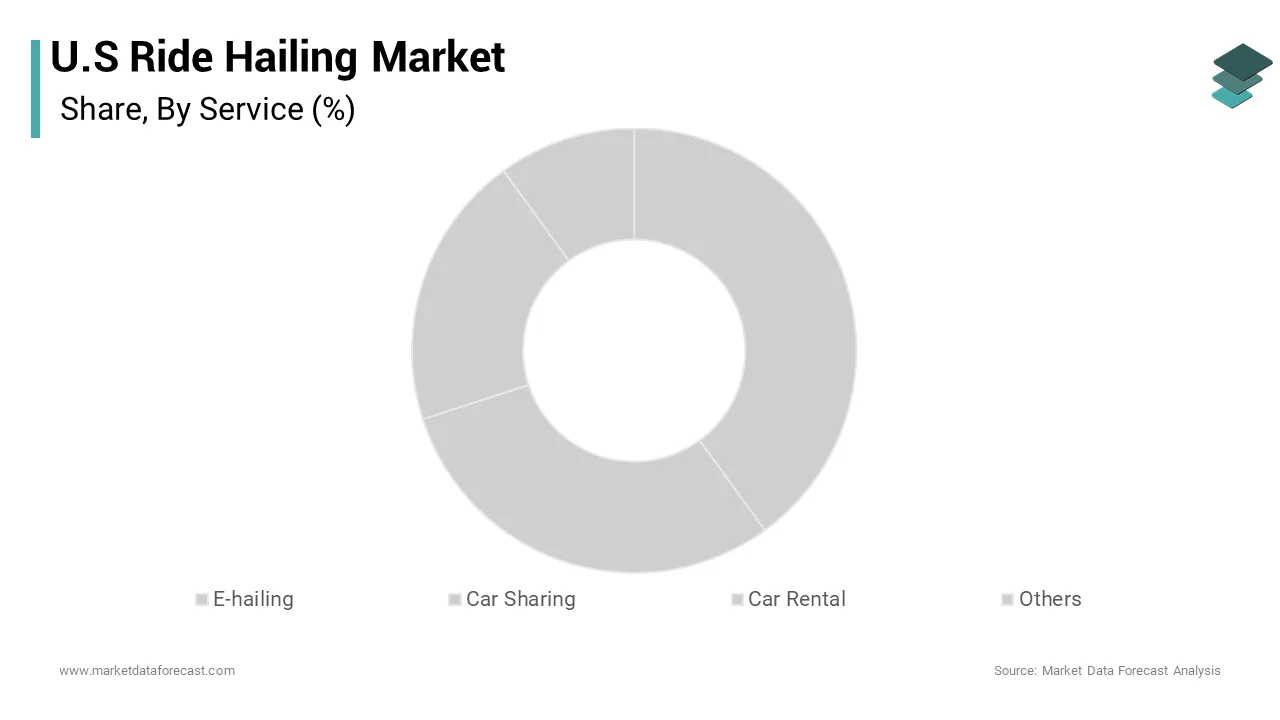
In 2025, the E-hailing segment dominated the United States ride hailing market and accounted for a substantial share. The immediate need for point to point transportation without the responsibilities of vehicle ownership or maintenance drive the dominance of this segment. This segment includes services where a driver transports a passenger from one location to another for a fee calculated based on distance and time. As per sources, approximately 45 percent of American adults have used a ride-hailing service, indicating widespread adoption and reliance on this mode of transport. A key driver for this domination is the unparalleled convenience and accessibility offered by mobile applications which allow users to summon a vehicle within minutes. The integration of real time tracking cashless payments and rating systems enhances user trust and safety making it a preferred choice over traditional taxis. Urban congestion and limited parking availability further incentivize individuals to opt for e-hailing rather than driving personal vehicles. The flexibility of choosing between shared and private rides caters to diverse budgetary needs and privacy preferences. Additionally the extensive network of drivers ensures high availability even during peak hours and in suburban areas. The ability to schedule rides in advance for airport transfers or important meetings adds to the utility. Thus, the combination of ease of use reliability and comprehensive coverage cements e-hailing as the leading service type in the market.
The car sharing segment is expected to exhibit a noteworthy CAGR of 14.2% from 2026 to 2034 due to the desire for flexible vehicle access without long term commitment. Unlike e-hailing car sharing allows users to rent a vehicle for a short period often by the hour or minute giving them the freedom to drive themselves. As per the American Automobile Association (AAA), the cost of owning a new vehicle has risen significantly, with average annual expenses reaching $12,182, prompting consumers to seek alternatives. Car sharing provides a cost effective solution for occasional drivers who need a vehicle for errands weekend trips or specific tasks. The proliferation of dedicated parking spots for shared cars in urban centers enhances convenience and reduces the hassle of finding parking. Advances in mobile technology enable seamless unlocking and locking of vehicles using smartphones eliminating the need for physical keys or counter interactions. Environmental consciousness also drives growth as many car sharing fleets include hybrid or electric vehicles appealing to eco friendly users. The model supports a shift away from private ownership among younger demographics who prioritize access over possession. Furthermore partnerships with residential complexes and universities expand the user base by integrating car sharing into daily living environments. Therefore, the flexibility cost savings and sustainability benefits drive the rapid expansion of the car sharing segment.
By Vehicle Insights
The cars segment led the United States ride hailing market and captured a 60.4% share in 2025. Its versatility, comfort, and capacity to accommodate multiple passengers and luggage are attributed to the leading position of this segment. This segment spearheads because it meets the diverse needs of users ranging from solo commuters to families and groups traveling together. As per the Federal Highway Administration the majority of trips in the United States are made by personal vehicles highlighting the cultural preference for enclosed and protected transportation. Ride hailing cars offer a familiar and safe environment protecting passengers from weather conditions and external hazards which is particularly important in regions with extreme climates. The availability of various car categories such as economy premium and luxury allows users to select options that fit their budget and occasion. Cars are essential for airport transfers shopping trips and longer distances where two wheelers are impractical or unsafe. The perception of higher safety and security in cars compared to other vehicle types encourages usage among women elderly individuals and parents with children. Additionally the integration of child seat options in some services further broadens the appeal to family users. The extensive infrastructure of roads and highways in the United States is designed primarily for four wheeled vehicles ensuring smooth and efficient travel. Hence, the practicality safety and comfort of cars establish them as the predominant vehicle type in the ride hailing ecosystem.
The two wheelers segment is predicted to witness the highest CAGR of 18.7% from 2026 to 2034 owing to the need for agile and cost effective urban mobility. Although smaller in volume compared to cars this segment is expanding rapidly in densely populated cities where traffic congestion makes larger vehicles inefficient. As per the National Highway Traffic Safety Administration (NHTSA), motorcycle and scooter registrations remain a vital part of the transport mix, though growth is increasingly concentrated in electric micro-mobility options for short-distance travel. Two wheeler ride hailing offers a solution for last mile connectivity allowing users to navigate through traffic jams and reach destinations faster than cars. The lower operational costs for drivers including fuel and maintenance translate to cheaper fares for passengers making it an attractive option for budget conscious commuters. The rise of delivery services has also normalized the use of two wheelers for transport increasing familiarity and acceptance among users. Electric scooters and bikes are increasingly being integrated into ride hailing platforms aligning with sustainability goals and reducing carbon emissions. Regulatory changes in certain cities permitting motorized two wheelers for hire further facilitate growth. The convenience of quick pick up and drop off in crowded areas enhances user experience. Thus, the efficiency affordability and environmental benefits of two wheelers drive their accelerated adoption in urban ride hailing markets.
By Payment Method Insights
The online payment methods segment held the majority share of the United States ride hailing market in 2025. This supremacy of the segment is credited to the seamless integration of digital wallets credit cards and debit cards within mobile applications. Also, this segment leads because it offers convenience speed and security eliminating the need for physical cash transactions. As per the Federal Reserve Bank of Boston the use of non cash payments has surged with digital transactions accounting for the majority of consumer purchases reflecting a broader shift toward a cashless society. Ride hailing platforms require users to link a payment method during registration enabling automatic charging at the end of each trip which reduces friction and wait times. The transparency of digital receipts and expense tracking features appeals to business travelers and individuals managing budgets. Security protocols such as encryption and tokenization protect user financial data building trust in the system. The absence of cash handling reduces risks for drivers such as robbery or disputes over change. Additionally online payments facilitate the implementation of surge pricing and promotional discounts automatically ensuring accurate billing. The integration with loyalty programs and reward points further incentivizes users to stick to digital payment methods. So, the efficiency security and enhanced user experience provided by online payments establish them as the preferred transaction method in the ride hailing industry.
The cash payment segment is estimated to register the fastest CAGR of 10.8% over the forecast period. This quick surge of the segment is fueled by the need to include unbanked and underbanked populations in the digital mobility ecosystem. While online payments remain dominant the introduction of cash options expands the addressable market to individuals who do not have access to banking services or prefer using physical currency. As per the Federal Deposit Insurance Corporation (FDIC), approximately 4.2 percent of U.S. households remain unbanked, representing a demographic that faces barriers to accessing standard digital-payment ride-hailing services. Accepting cash allows these users to participate in the gig economy as riders increasing overall usage volumes. It also appeals to tourists and visitors who may not have local bank accounts or credit cards. For some users cash provides a sense of control over spending and privacy regarding financial data. Ride hailing companies have implemented features allowing drivers to accept cash while still tracking the transaction digitally for safety and accountability. This hybrid approach bridges the gap between traditional taxi services and modern app based platforms. The flexibility to choose payment methods enhances customer satisfaction and loyalty among diverse user groups. Therefore, the inclusion of cash payments drives growth by democratizing access to ride hailing services for all socioeconomic segments.
By End-User Insights
The personal end user segment was the largest segment in the United States ride hailing market and occupied a 62.1% share in 2025. This prominence of the segment is supported to the widespread use of these services for daily commuting social activities and personal errands. Individuals constitute the vast majority of users relying on ride hailing for convenience flexibility and cost effectiveness compared to owning a vehicle. As per the Bureau of Transportation Statistics the average American makes several trips per day many of which are for personal purposes such as shopping dining and entertainment. The ease of accessing a ride without the hassles of parking maintenance and insurance makes ride hailing an attractive option for urban dwellers. Younger demographics particularly millennials and Gen Z are heavy users who integrate ride hailing into their lifestyle for spontaneous travel. The ability to share rides with friends or split fares enhances affordability and social interaction. Personal users also value the safety features such as driver verification and real time tracking which provide peace of mind during night travel or in unfamiliar areas. The availability of various vehicle types allows users to choose options that suit their specific needs whether it is a quick solo trip or a family outing. Hence, the high frequency of use and broad demographic appeal establish personal users as the dominant segment in the market.
The commercial end user segment is anticipated to witness the fastest CAGR of 12.5% between 2026 and 2034. This swift expansion of the segment is supported by the increasing adoption of corporate travel policies and business expense management solutions. Companies are increasingly utilizing ride hailing services for employee transportation client meetings and airport transfers due to their efficiency and accountability. As per the Global Business Travel Association corporate travel spending is recovering and shifting toward more flexible and on demand options rather than traditional car rentals or taxis. Ride hailing platforms offer business accounts that allow companies to manage employee rides set spending limits and receive consolidated invoices simplifying expense reporting. The professionalism and reliability of ride hailing services make them suitable for transporting clients and partners enhancing business image. The integration with calendar and email applications enables seamless booking of rides for scheduled meetings. Additionally the ability to track employee location and ensure safe arrival adds a layer of duty of care for employers. The rise of remote work has also led to occasional office visits requiring reliable transport options. Corporate partnerships and bulk discounts further incentivize businesses to adopt ride hailing. Thus, the operational efficiency cost control and enhanced safety features drive the rapid growth of the commercial segment.
COUNTRY ANALYSIS
The United States was the top performer in the North American ride hailing market and accounted for a 90.1% share in 2025. This expansion of the US market is attributed to its advanced digital infrastructure high smartphone penetration and urbanized population. The country’s market status is characterized by a mature and highly competitive landscape dominated by major global players who continuously innovate to capture user attention. As per the United States Census Bureau over 80 percent of the population lives in urban areas creating a dense network of potential users and drivers that facilitates efficient service delivery. The widespread adoption of mobile technology ensures that ride hailing apps are accessible to a broad demographic fostering high engagement rates. Regulatory frameworks vary by state but generally support the growth of the gig economy while addressing labor and safety concerns. The presence of major technology hubs encourages the development of new features such as autonomous vehicles and integrated mobility solutions. High levels of disposable income and a culture of convenience seeking further boost demand for on demand transportation. The United States serves as a testing ground for new business models and technologies influencing global trends in the ride hailing industry. The combination of economic strength technological leadership and favorable demographic trends solidifies the United States position as the dominant force in the regional ride hailing market.
COMPETITIVE LANDSCAPE
The competition in the United States ride hailing market is intense and characterized by the dominance of two major platforms alongside niche players specializing in specific segments such as shared rides or luxury transport. Major competitors vie for both riders and drivers creating a two sided market dynamic where balancing supply and demand is critical. Differentiation is achieved through pricing strategies service quality safety features and additional offerings like food delivery or subscriptions. Price wars and promotional discounts are common tactics to attract new users and retain existing ones impacting profitability. Driver retention is a key battleground with companies offering incentives bonuses and better working conditions to secure adequate supply. Regulatory compliance regarding worker classification and safety standards influences competitive dynamics as firms navigate legal challenges. Technological innovation in app functionality mapping and autonomous driving provides competitive advantages. Partnerships with local businesses and public agencies help expand market presence. Customer loyalty is driven by convenience reliability and brand trust. The market sees continuous entry of new technologies and business models forcing incumbents to adapt rapidly. Success depends on operational efficiency strategic diversification and ability to maintain a robust network of drivers and users.
KEY MARKET PLAYERS
A few of the market players that are dominating the U.S ride hailing market are
- Lyft
- Ola
- Uber
- Careem Taxify
- BlaBlaCar
- DiDi
- Gett
- Grab
- Lime
- Herts
- Juno
- Kabbee
- Via Transportation Inc
Top Players In The Market
- Uber Technologies Inc is a dominant force in the United States ride hailing market offering a comprehensive platform that connects riders with drivers for on demand transportation. The company has expanded its services to include food delivery freight and micro mobility creating a diversified ecosystem. Recent actions include the integration of autonomous vehicle technology through strategic partnerships with leading robotics firms to future proof its operations. Uber has also enhanced its subscription model Uber One to increase customer loyalty and frequency of use across its platforms. The company focuses on improving driver earnings and benefits to address regulatory challenges and retain supply. By leveraging advanced algorithms for dynamic pricing and route optimization Uber ensures efficient service delivery. These initiatives strengthen its market position by providing reliable and versatile mobility solutions to millions of users while adapting to evolving regulatory and competitive landscapes.
- Lyft Inc is a major competitor in the United States ride hailing market known for its focus on community driven transportation and sustainable mobility solutions. The company provides ride sharing bike sharing and scooter services primarily in urban areas across the nation. Recent actions involve expanding its healthcare transportation network to partner with hospitals and insurance providers for non emergency medical trips. Lyft has also invested in electric vehicle initiatives encouraging drivers to switch to zero emission cars through incentives and charging infrastructure support. The company emphasizes safety features such as in app emergency assistance and rider verification to build trust. Lyft collaborates with public transit agencies to integrate multi modal travel options into its app. These efforts enhance its appeal to environmentally conscious users and institutional clients. Lyft is strengthening its presence in the competitive ride-hailing landscape. They are achieving this by prioritizing social responsibility and operational efficiency.
- Via Transportation Inc contributes to the United States ride hailing market by specializing in shared ride services and public transit partnerships that optimize urban mobility. The company focuses on reducing congestion and costs by grouping passengers heading in similar directions using advanced algorithmic routing. Recent actions include securing contracts with multiple city governments to operate on demand public transit systems replacing or supplementing fixed bus routes. Via has expanded its enterprise solutions offering corporate shuttle services for employees of large organizations. The company leverages data analytics to improve route efficiency and reduce wait times for users. Via also integrates with existing public transportation networks allowing seamless transfers and unified payment systems. By focusing on high occupancy vehicles and sustainable urban planning Via differentiates itself from traditional point to point services. These strategies strengthen its market position by addressing municipal transportation challenges and providing cost effective scalable mobility solutions for communities and businesses.
Top Strategies Used By Key Market Participants
Key players in the United States ride hailing market primarily focus on diversifying service offerings to include food delivery grocery logistics and freight transport to maximize platform utility. Companies are increasingly investing in autonomous vehicle technology to reduce long term labor costs and enhance operational efficiency. Strategic partnerships with public transit agencies and healthcare providers expand market reach into specialized sectors. Implementation of subscription models enhances customer retention and increases frequency of usage among loyal users. Emphasis on electrification of fleets aligns with sustainability goals and regulatory requirements reducing environmental impact. Dynamic pricing algorithms optimize supply and demand balance ensuring availability during peak hours. Enhanced safety features and background checks build user trust and comply with regulatory standards. These strategies collectively drive growth and competitiveness by improving service quality and expanding revenue streams.
MARKET SEGMENTATION
This research report on the U.S ride hailing market is segmented and sub-segmented into the following categories.
By Service
- E-hailing
- Car Sharing
- Car Rental
- Others
By Vehicle
- Two Wheeler
- Car
- Others
By Payment Method
- Cash
- Online
By Location
- Urban
- Rural
By End-User
- Personal
- Commercial
By Country
- California
- Washington
- Oregon
- New York
- Rest of the United States