- Product Description Description
- Table of Contents TOC
- List of Table & Figure LOT
- Get Free Sample PDF Sample PDF
Market Size, 2025
$58.39 BnMarket Estimate, 2026
$62.47 BnMarket Forecast, 2034
$107.34 BnCAGR, 2026–2034
7.00%U.S. Truck Market Report Summary
The United States truck market was valued at USD 58.39 billion in 2025 and is anticipated to reach USD 62.47 billion in 2026 and USD 107.34 billion by 2034, growing at a CAGR of 7.00% during the forecast period from 2026 to 2034. The growth of the U.S. truck market is driven by increasing freight transportation demand, expanding e-commerce activities, and rising investments in logistics and supply chain infrastructure. The growing need for commercial vehicles across construction, manufacturing, and retail sectors is further accelerating market expansion. In addition, technological advancements in fleet management, vehicle safety systems, fuel efficiency, and connected truck solutions are supporting the modernization of trucking operations across the country.
Key Market Trends
- Rising demand for heavy-duty trucks driven by increasing freight movement, industrial expansion, and long-haul transportation requirements.
- Growing adoption of advanced driver assistance systems (ADAS), telematics, and connected vehicle technologies to improve fleet efficiency and road safety.
- Increasing investments in electric and alternative fuel truck development to reduce emissions and comply with evolving environmental regulations.
- Expansion of logistics and last-mile delivery services fueled by rapid growth in e-commerce and retail distribution networks.
- Strong focus on fuel-efficient engines, lightweight materials, and automation technologies to reduce operational costs for fleet operators.
Segmental Insights
- Based on class, the class 8 segment was the largest and held 35.4% of the United States truck market share in 2025. The dominance of this segment is attributed to the high demand for heavy-duty trucks in freight transportation, construction activities, and long-distance logistics operations across the country.
- Based on propulsion/fuel, the internal combustion engine trucks segment held a prominent share of the United States truck market in 2025. The widespread availability of fueling infrastructure, strong hauling capacity, and established reliability of diesel-powered trucks continue to support the segment’s market leadership.
- Based on transmission, the automatic transmission trucks segment accounted for 46.1% of the United States truck market share in 2025. The segment growth is driven by improved driving comfort, reduced driver fatigue, better fuel efficiency, and increasing adoption in commercial fleet operations.
- Based on application, the logistics and transportation segment was the largest and occupied a dominant share of the United States truck market in 2025. The rising movement of goods across regional and interstate supply chains, coupled with growing e-commerce deliveries, continues to strengthen demand for trucks in logistics operations.
Regional Insights
The U.S. truck market is experiencing steady growth across major industrial and commercial regions, supported by expanding transportation infrastructure, increasing trade activities, and strong freight demand. Key logistics hubs such as Chicago, Dallas, and Los Angeles play a significant role in driving truck demand due to their large warehousing, manufacturing, and distribution networks. The growing adoption of advanced commercial vehicle technologies and the modernization of fleet operations are further contributing to nationwide market growth.
Competitive Landscape
The U.S. truck market is highly competitive, with major manufacturers focusing on vehicle innovation, electrification, fuel efficiency, and connected fleet technologies to strengthen their market presence. Companies are increasingly investing in autonomous driving technologies, electric truck platforms, and strategic partnerships to meet evolving transportation and sustainability requirements. Expansion of production capabilities and aftermarket service networks is also supporting competitive growth across the industry.
Prominent players in the U.S. truck market include Daimler Truck, Dongfeng Motor, Ford Motor Company, General Motors Company, FAW Group, Foton Motor, Isuzu Motors, PACCAR, Shaanxi Auto, Sinotruk, Volkswagen, and Volvo.
 Download Free Sample Report
U.S Truck Market Size
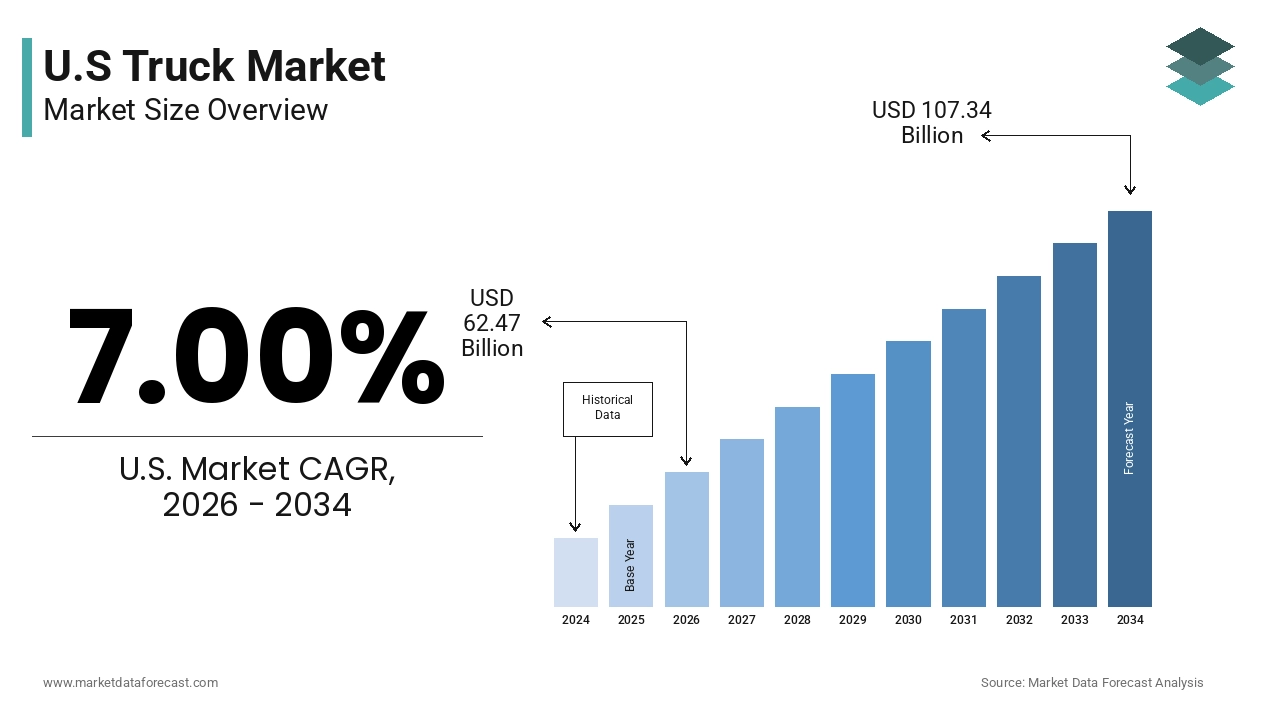
The U.S truck market size was valued at USD 58.39 billion in 2025 and is anticipated to reach USD 62.47 billion in 2026 to reach USD 107.34 billion by 2034, growing at a CAGR of 7.00% during the forecast period from 2026 to 2034.
Current Market Overview and Definition
The trucks are heavy duty commercial vehicles designed for cargo transportation logistics and specialized vocational applications. The diverse range of vehicle classes from pickup trucks used in personal and light commercial contexts to Class 8 semi-trucks that dominate long haul freight. According to the Federal Highway Administration, trucks account for approximately 72% of the total tonnage moved within the United States amplifying their role in economic activity. The industry is undergoing a significant transformation driven by the integration of advanced telematics autonomous driving technologies and alternative powertrains. As per the Bureau of Transportation Statistics the volume of freight transported by trucks has consistently increased reflecting the growth of e commerce and just in time inventory practices. Regulatory frameworks established by the Environmental Protection Agency and the Department of Transportation influence vehicle design and operational standards. The definition of the market extends beyond hardware to include connected services and maintenance solutions that enhance fleet efficiency. The interplay between infrastructure capacity driver availability and technological adoption defines the current operational landscape. Stakeholders are increasingly focusing on sustainability and safety to meet evolving societal expectations and regulatory requirements.
MARKET DRIVERS
Expansion of E-Commerce and Last Mile Delivery Networks
The rapid expansion of e-commerce and the resulting demand for efficient last mile delivery networks serve is majorly propelling the growth of the United States truck market. Consumers increasingly rely on online shopping which necessitates a robust logistics infrastructure capable of handling high volumes of small parcel deliveries. According to the United States Census Bureau, e-commerce sales have grown substantially reaching hundreds of billions of dollars annually, which directly correlates with increased demand for light and medium duty delivery trucks. Logistics companies are expanding their fleets to ensure faster delivery times and broader geographic coverage. The rise of same day and next day delivery options requires a dense network of distribution centers and a larger number of vehicles operating in urban environments. As per the National Retail Federation retailers are investing heavily in supply chain modernization to meet consumer expectations for speed and reliability. This trend drives the procurement of specialized vehicles equipped with advanced routing software and cargo management systems. The shift towards omnichannel retail strategies further amplifies the need for flexible and responsive transportation solutions. Truck manufacturers are responding by developing vehicles with improved fuel efficiency and lower emissions to operate effectively in city centers. The sustained growth of online retail ensures a steady demand for commercial trucks across various weight classes.
Infrastructure Investment and Construction Activity Boosts Demand
The significant infrastructure investment and heightened construction activity across the United States drive demand for heavy duty and vocational trucks is another attribute promoting the growth of the United States truck market. The Bipartisan Infrastructure Law has allocated substantial funds for the renovation of roads bridges and public transit systems which requires extensive material transport and heavy machinery. These projects create a sustained need for reliable and high capacity vehicles capable of navigating challenging terrains and carrying heavy loads. The modernization of energy infrastructure, including renewable energy facilities also contributes to this demand as specialized trucks are required to transport large components such as wind turbine blades. The residential housing sector also contributes to truck demand as new developments require the delivery of building materials and equipment. The correlation between infrastructure spending and truck sales is strong as construction firms prioritize fleet renewal to maintain operational efficiency.
MARKET RESTRAINTS
Chronic Driver Shortage and Labor Constraints
The chronic driver shortage and broader labor constraints by limiting operational capacity and increasing costs is restricting the growth of the United States truck market. The American Trucking Associations estimates that the industry faces a shortfall of tens of thousands of drivers a gap that is projected to widen in the coming years. This scarcity is attributed to an aging workforce and difficulties in attracting younger demographics to the profession due to lifestyle challenges and regulatory restrictions. The turnover rate among large fleet drivers remains high indicating retention issues that exacerbate the shortage. Higher wages and signing bonuses are required to attract talent, which increases operational expenses and reduces profit margins. The Hours of Service regulations imposed by the Federal Motor Carrier Safety Administration further constrain driver availability by limiting driving hours. These labor challenges hinder the ability of logistics providers to meet growing freight demand efficiently. The shortage also affects the resale value and utilization rates of trucks as idle vehicles generate no revenue.
Rising Fuel Costs and Operational Expenses
The rising fuel costs and escalating operational expenses by squeezing profit margins for carriers and owner operators is impeding the growth of the United States truck market. Diesel prices are subject to global geopolitical tensions and supply chain disruptions, which lead to significant volatility. According to the Energy Information Administration, fluctuations in crude oil prices directly impact the cost of diesel fuel, which constitutes a large portion of total operating costs for trucking companies. High fuel expenses force carriers to implement surcharges, which can dampen demand for freight services and reduce competitiveness. The transition to newer more fuel-efficient vehicles requires substantial capital investment, which is difficult for small businesses to afford. Maintenance costs are also rising due to the complexity of modern engines and emission control systems. The financial burden of these expenses discourages fleet expansion and delays the replacement of aging vehicles. Economic uncertainty further complicates budgeting and long-term planning for trucking firms. The pressure to reduce costs, while maintaining service quality creates a challenging environment for market participants.
MARKET OPPORTUNITIES
Adoption of Electric and Alternative Fuel Vehicles
The adoption of electric and alternative fuel vehicles to align with sustainability goals and regulatory mandates is certainly ascribed to create new opportunities for the growth of the United States truck market. Government incentives and corporate commitments to reduce carbon emissions are accelerating the transition away from diesel powered trucks. According to the Environmental Protection Agency, new emissions standards for heavy duty vehicles encourage the development and deployment of zero emission technologies. Major manufacturers are investing billions in the production of battery electric and hydrogen fuel cell trucks for regional and long haul applications. The federal funding for charging and refueling infrastructure is expanding making it more feasible for fleets to operate alternative fuel vehicles. Early adopters benefit from lower total cost of ownership due to reduced fuel and maintenance expenses over the vehicle lifecycle. Partnerships between automakers energy providers and logistics companies are fostering an ecosystem that supports electrification. The technology is particularly viable for last mile delivery and drayage operations where routes are predictable and distances are manageable. This shift offers manufacturers the chance to innovate and capture value in a rapidly evolving segment.
Integration of Autonomous Driving and Telematics Technologies
The integration of autonomous driving and advanced telematics technologies to enhance safety and efficiency is also to set up new opportunities for the expansion of the United States truck market. Autonomous trucks have the potential to address the driver shortage by enabling platooning and eventually fully autonomous operations on highways. The advanced driver assistance systems can significantly reduce accidents caused by human error, which lowers insurance and liability costs. Telematics solutions provide real time data on vehicle performance fuel consumption and driver behavior allowing fleets to optimize operations. The use of electronic logging devices has already improved compliance and safety monitoring. The adoption of artificial intelligence in route planning helps reduce idle time and improve delivery accuracy. Manufacturers are collaborating with technology firms to develop scalable autonomous solutions for specific use cases such as port drayage and line haul. The data generated by connected trucks enables predictive maintenance which reduces downtime and extends vehicle life. Fleet managers can leverage these insights to make informed decisions that enhance productivity.
MARKET CHALLENGES
Supply Chain Disruptions and Component Shortages
The supply chain disruptions and component shortages by delaying production and increasing vehicle prices is key challenging factor for the growth of the United States truck market. The global semiconductor crisis and logistical hurdles have severely impacted the ability of manufacturers to meet demand. The supply chain pressures have led to extended lead times for new trucks forcing buyers to wait months or even years for delivery. The shortage of components, such as microchips, wiring harnesses, and batteries constrains production volumes. The automotive supply chain remains fragile due to geopolitical tensions and raw material scarcity. These disruptions force manufacturers to prioritize high margin models which limits availability for other segments. The uncertainty in supply chains complicates inventory management for dealers and fleets. The increased cost of raw materials and freight is passed on to consumers making trucks less affordable. The reliance on single source suppliers for key components exacerbates the risk of production halts. Manufacturers are attempting to diversify supply sources but this process takes time and investment.
Regulatory Compliance and Environmental Standards
The strict regulatory compliance and evolving environmental standards by increasing development costs and operational complexity is another attribute to degrade the growth of the United States truck market. The Environmental Protection Agency and the California Air Resources Board have implemented stringent emissions limits that require advanced after treatment systems. The complexity of meeting varying state and federal regulations creates administrative burdens for manufacturers and fleet operators. The patchwork of regulations across different jurisdictions complicates interstate commerce and fleet management. The push for zero emission mandates in certain states requires significant investment in new technologies and infrastructure, which may not be mature enough for widespread adoption. The timeline for compliance often outpaces the development of viable alternative fuel solutions creating uncertainty for buyers. Retrofitting existing fleets to meet new standards is costly and technically challenging. The risk of non compliance penalties discourages innovation in some areas. Manufacturers must balance regulatory requirements with affordability and performance.
REPORT COVERAGE
| REPORT METRIC | DETAILS |
| Market Size Available | 2025 to 2034 |
| Base Year | 2025 |
| Forecast Period | 2026 to 2034 |
| CAGR | 6.84% |
| Segments Covered | By Class, Propulsion/Fuel, Transmission, Autonomy Level, Application, and By Country |
| Various Analyses Covered | Global, Regional, and Country Level Analysis, Segment-Level Analysis; DROC, PESTLE Analysis; Porter’s Five Forces Analysis; Competitive Landscape; Analyst Overview of Investment Opportunities. |
| Regions Covered | California, Washington, Oregon, New York & Rest of the United States |
| Market Leaders Profiled | Daimler Truck, Dongfeng Motor, Ford Motor Company, General Motors Company, FAW Group, Foton Motor, Isuzu Motors, PACCAR, Shaanxi Auto, Sinotruk, Volkswagen, Volvo |
SEGMENTAL ANALYSIS
By Class Insights
The class 8 segment was the largest by holding 35.4% of the United States truck market share in 2025 due to their role in long haul freight and heavy duty logistics. The growth of the segment is driven by the immense volume of goods transported across interstate highways, which requires high capacity and durable vehicles. Class 8 trucks account for the majority of ton miles traveled on the national highway system reflecting their indispensability in the supply chain. These vehicles are essential for moving bulk commodities manufactured goods and retail products over long distances efficiently. The growth of e-commerce and just in time inventory practices further amplifies the demand for reliable heavy duty transport. Manufacturers continuously innovate to improve fuel efficiency and driver comfort which enhances operational productivity. The established infrastructure of rest stops repair shops and distribution centers supports the widespread use of Class 8 trucks.

The medium duty truck segment, such as Class 3-Class 6 is expected to register a fastest CAGR of 6.5% during the forecast period with the expansion of last mile delivery services and urban logistics networks. The surge in e-commerce sales has increased the demand for smaller versatile trucks that can navigate city streets and deliver packages directly to consumers. These vehicles offer a balance between cargo capacity and maneuverability making them ideal for regional distribution and service applications. The retailers are investing in localized distribution centers, which require frequent short haul transportation solutions. The rise of food delivery apps and home service industries also contributes to this trend as companies expand their fleets of light and medium duty trucks. Government incentives for cleaner commercial vehicles encourage the adoption of newer models in this class. The flexibility of these trucks allows them to serve diverse sectors including construction utilities and retail. Manufacturers are introducing electric variants in this segment to meet environmental standards and reduce operating costs.
By Propulsion/Fuel Insights
The internal combustion engine trucks segment held a prominent share of the United States truck market in 2025 with their proven reliability extensive refueling infrastructure and lower upfront costs. The dominance of this segment is underpinned by the widespread availability of diesel and gasoline stations across the country which ensures uninterrupted operation for long haul and regional routes. The diesel fuel remains the primary energy source for commercial freight transport due to its high energy density and efficiency. Fleet operators prefer internal combustion engines for their familiarity and ease of maintenance supported by a vast network of service providers. The existing regulatory framework and emission standards have been optimized for conventional engines making compliance straightforward for manufacturers. The initial purchase price of diesel trucks is significantly lower than electric or hydrogen alternatives, which appeals to small businesses and owner operators. The towing capacity and range of internal combustion trucks are well suited for heavy duty applications where charging infrastructure is limited. Technological advancements in engine design have improved fuel economy and reduced emissions extending the viability of this propulsion type.
The battery electric vehicle truck segment is lucratively to grow at a fastest CAGR of 18.2% during the forecast period with the stringent environmental regulations and corporate sustainability goals. This rapid expansion is fueled by federal and state incentives that encourage the adoption of zero emission commercial vehicles. The new emissions standards for heavy duty vehicles mandate significant reductions in nitrogen oxide and greenhouse gas emissions prompting fleets to electrify. Major logistics companies are committing to carbon neutrality targets which accelerates the procurement of electric trucks for last mile and regional deliveries. As per the Department of Energy investments in charging infrastructure are expanding rapidly making it more feasible for fleets to operate electric vehicles. The total cost of ownership for electric trucks is becoming competitive due to lower fuel and maintenance expenses compared to diesel equivalents. Manufacturers are launching a wider range of electric models with improved battery range and payload capacity. Urban areas with strict anti idling laws provide a favorable environment for electric truck deployment. The technological maturity of battery systems and supportive policy frameworks ensure that this segment grows at a robust pace.
By Transmission Insights
The automatic transmission trucks segment was accounted in holding 46.1% of the United States truck market share in 2025 owing to the widespread adoption of automated manual transmissions and traditional automatics in both light and heavy duty vehicles. The reduction in driver fatigue associated with automatic transmissions enhances safety and productivity on long haul routes. Modern automatic systems optimize gear shifting to maximize fuel economy which is a critical factor for fleet operators managing operational costs. The advancements in transmission technology have closed the efficiency gap with manual transmissions, while offering superior drivability. The shortage of skilled drivers who prefer manual transmissions has accelerated the shift towards automatic options. Manufacturers are integrating automatic transmissions with advanced telematics and predictive cruise control systems to further enhance performance. The convenience of automatic shifting allows drivers to focus more on road conditions and navigation.
The automated manual transmission segment is likely to grow at an anticipated CAGR of 7.8% from 2026 to 2034 with the need for optimal fuel efficiency and reduced driver workload in heavy duty applications. The growth of the segment is also fueled by the integration of sophisticated software that controls clutch and gear operations more precisely than human drivers. The automated manual transmissions can improve fuel economy by up to 5% compared to traditional manual systems. Fleet operators are increasingly adopting these systems to reduce training requirements and attract a broader pool of drivers. The ease of operation provided by automated manuals helps address the driver shortage by lowering the barrier to entry for new recruits. The technology is particularly beneficial in stop and go traffic and hilly terrains where consistent shifting is crucial for performance. Manufacturers are refining algorithms to adapt to different driving conditions and load weights enhancing reliability. The durability of automated manual transmissions has improved making them suitable for demanding vocational applications. The combination of cost savings and operational ease ensures that this segment expands rapidly.
By Application Insights
The logistics and transportation application segment was the largest by holding a dominant share of the United States truck market in 2025 with the continuous movement of goods across the national supply chain. The trucks transport the vast majority of freight value and tonnage within the United States ensuring the availability of consumer goods. The growth of e-commerce has intensified the demand for efficient logistics networks that rely heavily on trucking services. The volume of online purchases requires robust last mile and middle mile transportation solutions. The just in time inventory practices adopted by many industries necessitate reliable and timely delivery services which trucks provide. The expansion of distribution centers and warehouses across the country further supports this demand. Logistics companies are investing in fleet modernization to improve efficiency and reduce emissions. The versatility of trucks allows them to handle diverse cargo types from perishable goods to heavy machinery.
The retail and e-commerce application segment is expected to grow at a fastest CAGR of 9.5% from 2026 to 2034 with the explosive expansion of online shopping and direct to consumer delivery models. The changing consumer preferences for convenience and speed, which require agile and responsive transportation solutions is also boosting the growth of the segment. The e-commerce sales have grown significantly outpacing traditional retail growth rates. This trend necessitates a larger fleet of light and medium duty trucks for last mile deliveries in urban and suburban areas. The proliferation of micro fulfillment centers located closer to consumers increases the frequency of short haul truck trips. The rise of grocery delivery services also contributes to this growth as perishable items require specialized transport. Technology integration such as real time tracking and route optimization enhances the efficiency of e commerce logistics. The demand for flexible and scalable delivery solutions drives the adoption of diverse truck types.
COMPETITIVE LANDSCAPE
The competition in the United States truck market is characterized by intense rivalry among legacy automakers and emerging electric vehicle startups who compete on technology performance and total cost of ownership. Competitive intensity is driven by the race to launch affordable electric trucks with sufficient range and payload capacity for commercial use. Innovation in autonomous driving and connectivity features plays a vital role as firms seek to differentiate their offerings and improve fleet efficiency. Regulatory compliance regarding emissions and safety standards serves as a barrier to entry for new competitors without substantial capital. Established players leverage their extensive dealer networks and service infrastructure to maintain customer trust and loyalty. Price competition is escalating as more entrants join the electric segment offering alternative solutions.
KEY MARKET PLAYERS
A few of the market players that are dominating the U.S truck market are
- Daimler Truck
- Dongfeng Motor
- Ford Motor Company
- General Motors Company
- FAW Group
- Foton Motor
- Isuzu Motors
- PACCAR
- Shaanxi Auto
- Sinotruk
- Volkswagen
- Volvo
Top Three Players In The Market
- Ford Motor Company is a dominant force in the United States truck market with its F Series lineup serving as a cornerstone of commercial and personal transportation. The company leverages its extensive manufacturing capabilities to produce a wide range of light and heavy duty trucks. Ford recently strengthened its position by expanding production of the all electric F 150 Lightning to meet growing demand for sustainable commercial vehicles. The company invests heavily in connected vehicle technologies that provide fleet managers with real time data and predictive maintenance insights. Ford also focuses on enhancing dealer networks to support commercial customers with specialized service offerings. These initiatives reinforce its reputation for durability and innovation while addressing the evolving needs of modern logistics and construction industries.
- General Motors Company plays a pivotal role in the US truck market through its Chevrolet and GMC brands which offer diverse solutions for various commercial applications. The company utilizes its Ultium battery platform to develop electric trucks, such as the Silverado EV and BrightDrop vans for last mile delivery. GM strengthens its market position by investing in domestic battery production facilities to secure supply chains and reduce costs. The company recently launched new commercial services that integrate software and hardware to optimize fleet efficiency. GM also prioritizes sustainability by setting ambitious carbon neutrality goals for its operations and products. These efforts demonstrate its commitment to leading the transition towards electrified and intelligent commercial transportation solutions.
- Daimler Truck North America is a leading manufacturer of heavy duty commercial vehicles with brands such as Freightliner and Western Star dominating the long haul and vocational segments. The company focuses on advancing autonomous driving technologies and fuel cell electric vehicles to enhance safety and efficiency. Daimler recently expanded its charging infrastructure partnerships to support the adoption of electric trucks in regional haul applications. The company strengthens its position by investing in digital platforms that connect drivers dispatchers and customers for seamless logistics operations. Daimler also emphasizes driver comfort and safety features to address labor shortages in the industry. These strategic actions enable the company to maintain its leadership in the heavy duty truck sector while innovating for a sustainable future.
Top Strategies Used By Key Market Participants
Key players in the United States truck market primarily employ strategies such as electrification autonomous technology integration and digital connectivity to strengthen their market position. Companies frequently invest in developing battery electric and hydrogen fuel cell trucks to comply with environmental regulations and meet corporate sustainability goals. This approach allows them to capture early adopters and benefit from government incentives. Strategic partnerships with charging infrastructure providers help alleviate range anxiety and support fleet electrification. Digital telematics solutions are another key strategy as companies implement software platforms to provide real time data and predictive maintenance. Additionally, firms expand their service networks to support commercial customers with specialized maintenance and financing options. These combined strategies enable market participants to maintain competitiveness and drive growth in a rapidly evolving industry landscape.
MARKET SEGMENTATION
This research report on the U.S truck market is segmented and sub-segmented into the following categories.
By Class
- Class 3
- Class 4
- Class 5
- Class 6
- Class 7
- Class 8
By Propulsion/Fuel
- Internal Combustion Engine (ICE)
- Diesel
- Gasoline
- Natural Gas
- Battery Electric Vehicle (BEV)
- Hybrid Electric Vehicle (HEV)
- Fuel Cell Electric Vehicle (FCEV)
By Transmission
- Manual Transmission
- Automatic Transmission
- Automated Manual Transmission (AMT)
By Autonomy Level
- Level 0
- Level 1
- Level 2
- Level 3
- Level 4
- Level 5
By Application
- Logistics & transportation
- Construction & infrastructure
- Retail & e-commerce
- Agriculture & Forestry
- Mining
- Others
By Country
- California
- Washington
- Oregon
- New York
- Rest of the United States