- Product Description Description
- Table of Contents TOC
- List of Table & Figure LOT
- Get Free Sample PDF Sample PDF
Market Size, 2025
$196.87 MnMarket Estimate, 2026
$201 MnMarket Forecast, 2034
$237.36 MnCAGR, 2026–2034
2.1%Executive Summary: Global Urea Market
- Market Scope: Comprehensive market evaluation of the global urea sector, analyzing product grades (fertilizer, feed, technical), applications (chemical, agriculture, automotive, medical), and regional performance across Asia-Pacific, North America, Europe, Latin America, and the Middle East & Africa.
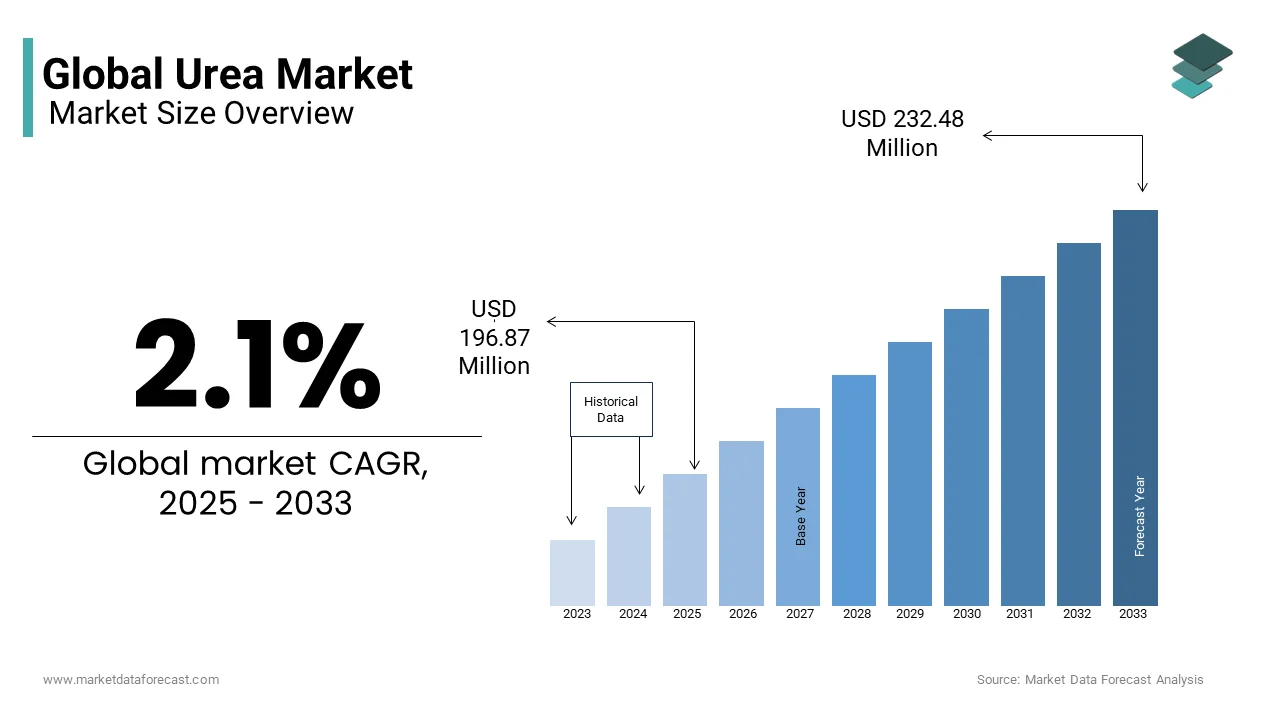
- Market Valuation: Valued at USD 196.87 million in 2025, reaching USD 201 million in 2026, and projected to scale up to USD 237.36 million by 2034, registering a steady CAGR of 2.1% throughout the forecast period from 2026 to 2034.
- Primary Growth Drivers: Escalating global demand for high-concentration nitrogenous fertilizers to enhance crop yields, widespread use of technical-grade urea in automotive emission control (SCR/SNCR technology), and expanding applications in animal feed supplements, cosmetics, and resins.
Key Market Segment Metrics
| Category | Leading Segment (Base Year Position) | Fastest-Growing / High-Impact Segment |
|---|---|---|
| By Grade & Application | Technical Grade (dominates market share due to broad industrial, resin, and automotive applications) & Agriculture Application (highest share driven by 46% nitrogen content) | Automotive & Technical Segments (high-impact growth propelled by tightening diesel emissions standards and expanding SCR adoption) |
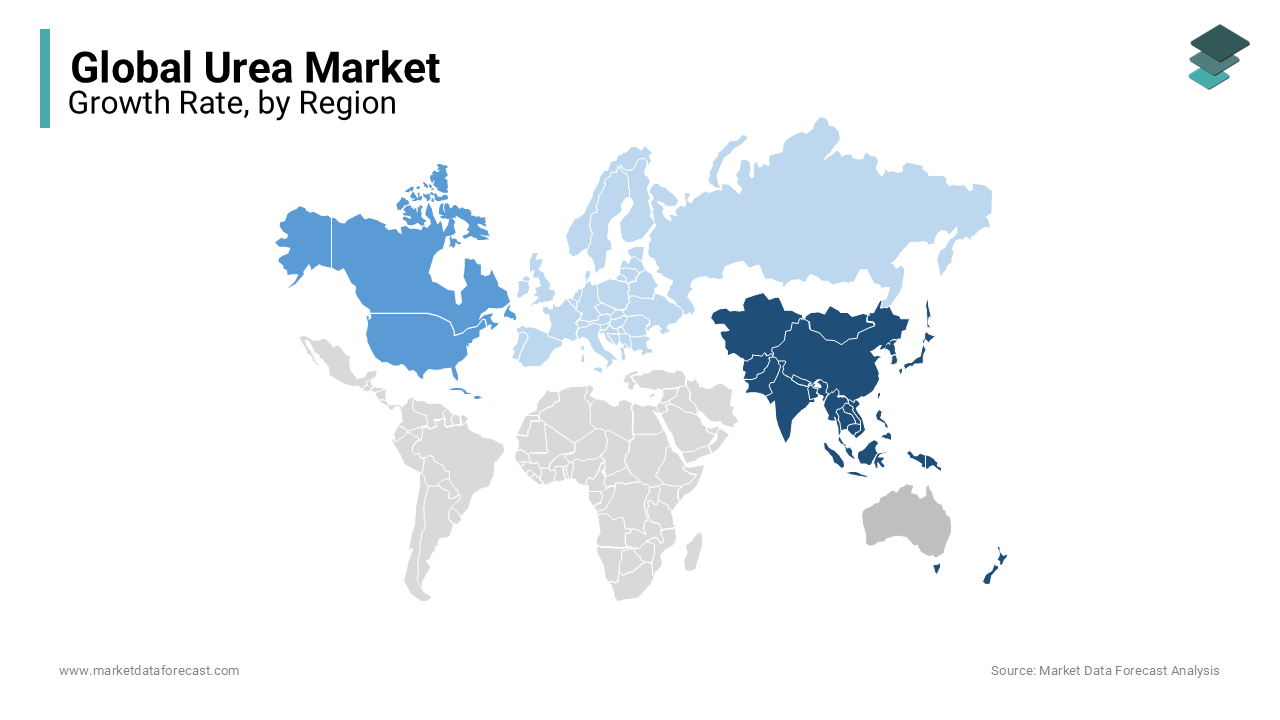
| By Region | Asia-Pacific (leading regional market share, heavily supported by intensive agricultural practices and manufacturing powerhouses like China and India) | North America (experiencing accelerated domestic production growth to reduce import dependency and match economic upswings) |
Major Market Players & Market Structure
Market Structure: Consolidated global marketplace featuring major agrochemical and energy enterprises focusing on production capacity expansions, emission-compliant technical grades, and mitigating nitrogen volatilization losses.
Key Companies: Acron, BASF SE, CF Industries Holdings Inc., China National Petroleum Corporation, EuroChem Group, Industries Qatar, Koch Fertilizer LLC, Notore Chemical Industries PLC, Nutrien Ltd, and OCI NV.
 Download Free Sample Report
Global Urea Market Size
The global urea market was valued at USD 196.87 million in 2025 and is anticipated to reach USD 201 million in 2026 from USD 237.36 million by 2034, growing at a CAGR of 2.1% during the forecast period from 2026 to 2034.
CURRENT SCENARIO OF THE GLOBAL UREA MARKET
According to science, Urea is a valuable source of nitrogen, and it is utilized chiefly in nitrogen-based fertilizers due to its high nitrogen content. Increased demand for Urea as fertilizer from the agriculture industry is likely to drive market growth in the short term. It's also used in modest amounts in multi-component solid fertilizer foliar sprays. Urea is transformed into ammonium bicarbonate when it comes into contact with the soil. To prevent the gas generated by ammonium, Urea is combined with the soil. The health risks associated with Urea are anticipated to stifle market growth. The discovery of urea applications in the preparation of bio-bricks is expected to open up new business prospects in the following years.
MARKET DRIVERS
The increased usage of fertilizers worldwide to boost per-hectare production capacity of the land to meet the rising demand for food and other agricultural-based products is driving up demand for Urea. Due to the significant output of agricultural-based products in these nations, the fastest-growing markets include India, Brazil, Indonesia, and Mexico, rising at a robust CAGR.
Due to its large population and manufacturer-friendly government restrictions, China is one of the most attractive markets for manufacturers.
Urea is a nitrogenous chemical with the molecular formula NH2CONH2. It has two amine groups connected to a carbonyl group. With a nitrogen content of roughly 46%, it is employed in prilled and granular forms in the agricultural business. The utilization of Urea primarily in both selective non-catalytic reduction (SNCR) and selective catalytic reduction (SCR) procedures, intended to limit the emission of toxic gases from automotive engines, is driving up demand for industrial-grade Urea. The agriculture industry has experienced a tremendous expansion in recent years, and this trend is projected to continue in the years ahead. It is primarily due to the growing demand for food and other agricultural goods, due to global population growth. Urea, primarily known as carbamide, is an organic compound commonly used in fertilizer, feed supplements, and as a raw material to prepare plastics and drugs. It's a colorless crystalline product with high nitrogen content, making it one of the market's most highly concentrated nitrogenous fertilizers.
The overall urea market trends are being fueled by increased awareness of the utilization of Urea in beauty products for its exfoliating and moisturizing properties, the rapid adoption of urea fertilizers to reduce pollution, and the widespread use of the product for the treatment of nail diseases.
MARKET RESTRAINTS
Environmental Regulations and Nitrogen Loss Challenges Limiting Solid Urea Utilization
Manufacturers have long struggled to comply with various environmental laws imposed on the use of solid Urea due to the emission of gaseous ammonia, which can be hazardous to the environment and human health. Only after 4-5 days of transformation at room temperature may Urea be used. In the ammoniation process, the majority of the nitrogen is easily volatilized. In most cases, the real utilization rate is only around 30%. When Urea is applied to alkaline soil or soil with a high organic matter concentration, nitrogen loss is accelerated and increased.
Excessive Urea Application and Volatilization Risks Reduce Fertilizer Efficiency
Furthermore, weeds readily eat Urea. Because urea has a high nitrogen content, it should not be used in excess to avoid waste and fertilizer damage. Unfortunately, many farmers in fruit-producing areas use a lot of Urea, which kills trees and has catastrophic implications. Whenever Urea is utilized as a top dressing, we must know how it decomposes in the soil. To provide a fertilizer effect, Urea must be transformed into ammonia nitrogen about seven days after application. Most nitrogen will convert to ammonia gas and volatilize in alkaline circumstances. As a result, Urea cannot be blended or applied with other essential fertilizers such as lime, plant ash, calcium magnesium phosphate, and others.
REPORT COVERAGE
| REPORT METRIC | DETAILS |
| Market Size Available | 2025 to 2034 |
| Base Year | 2025 |
| Forecast Period | 2026 to 2034 |
| CAGR | 2.1% |
| Segments Covered | By Grade, Application, And Region |
| Various Analyses Covered | Global, Regional & Country Level Analysis, Segment-Level Analysis, DROC, PESTLE Analysis, Porter’s Five Forces Analysis, Competitive Landscape, Analyst Overview of Investment Opportunities |
| Regions Covered | North America, Europe, APAC, Latin America, Middle East & Africa |
| Market Leaders Profiled | Acron, BASF SE, CF Industries Holdings Inc., China National Petroleum Corporation, EuroChem Group, Industries Qatar, Koch Fertilizer LLC, Notore Chemical Industries PLC, Nutrien Ltd, OCI NV. |
SEGMENTAL ANALYSIS
By Grade Insights

Based on grade, the technical segment tends to dominate the global urea market. The nitrogen content of technical grade urea must be at least 46% by weight (on a dry basis). Furthermore, as the global automobile fleet grows, the usage of selective catalytic reduction (SCR) technology is expected to rise, increasing technical-grade urea use over the forecast period.
Urea-formaldehyde resins, adhesives, plywood, animal feed, and cloud-seeding agents require technical-grade urea.
By Application Insights
Based on application, the agriculture sector is expected to hold the highest global urea market share. The agriculture industry has experienced a tremendous expansion in recent years, and this trend is projected to continue in the years ahead. It is primarily due to the growing demand for food and other agricultural goods, due to global population growth. Because of its high nitrogen concentration, Urea is the most effective nitrogenous fertilizer (46 percent N). Therefore, it is utilized as a cow feed supplement to replace some protein requirements and applications in crops.
REGIONAL ANALYSIS
Asia Pacific Market Analysis
The Asia Pacific has the largest global urea market share. China is declared one of the leading producers of urea-formaldehyde resin across the world. Urea-formaldehyde resins are utilized as adhesives to bond plywood, particleboard, and other wood products in the construction sector. Moreover, developments in the agricultural industries are taking place in nations like India and China as the population grows. As a result, the demand for nitrogen fertilizers rises, propelling the market forward.
North America Market Analysis
North America is likely to boost production, reducing the region's need for imports. Several projects have been suggested to increase capacity and, as a result, supply in the area. As a result, North American demand for the product is growing faster than the worldwide market. The growing demand can also be ascribed to the region's improving economy.
Europe is anticipated to hold a significant global urea market share. The increasing demand for the agriculture sector in the U.K. drives the market forward in the European region.
COMPETITIVE LANDSCAPE
KEY MARKET PLAYERS
These are some of the market players dominating the global urea market.
- Acron
- BASF SE
- CF Industries Holdings Inc.
- China National Petroleum Corporation
- EuroChem Group
- Industries Qatar
- Koch Fertilizer LLC
- Notore Chemical Industries PLC
- Nutrien Ltd, OCI NV
MARKET SEGMENTATION
This research report on the global urea market is segmented and sub-segmented based on the By Grade, Application, and Region.
By Grade
- Fertilizer
- Feed
- Technical
By Application
- Chemical
- Agriculture
- Automotive
- Medical
By Region
- North America
- Asia Pacific
- Europe
- Latin America
- Middle East & Africa