U.S. Adhesives Market Research Report – Segmented By Resin ( Acrylic, Cyanoacrylate, Epoxy, Polyurethane, Silicone, VAE/EVA, Other Resins), Technology, End User Industry and Country – Industry Analysis From 2024 to 2033
U.S. Adhesives Market Report Summary
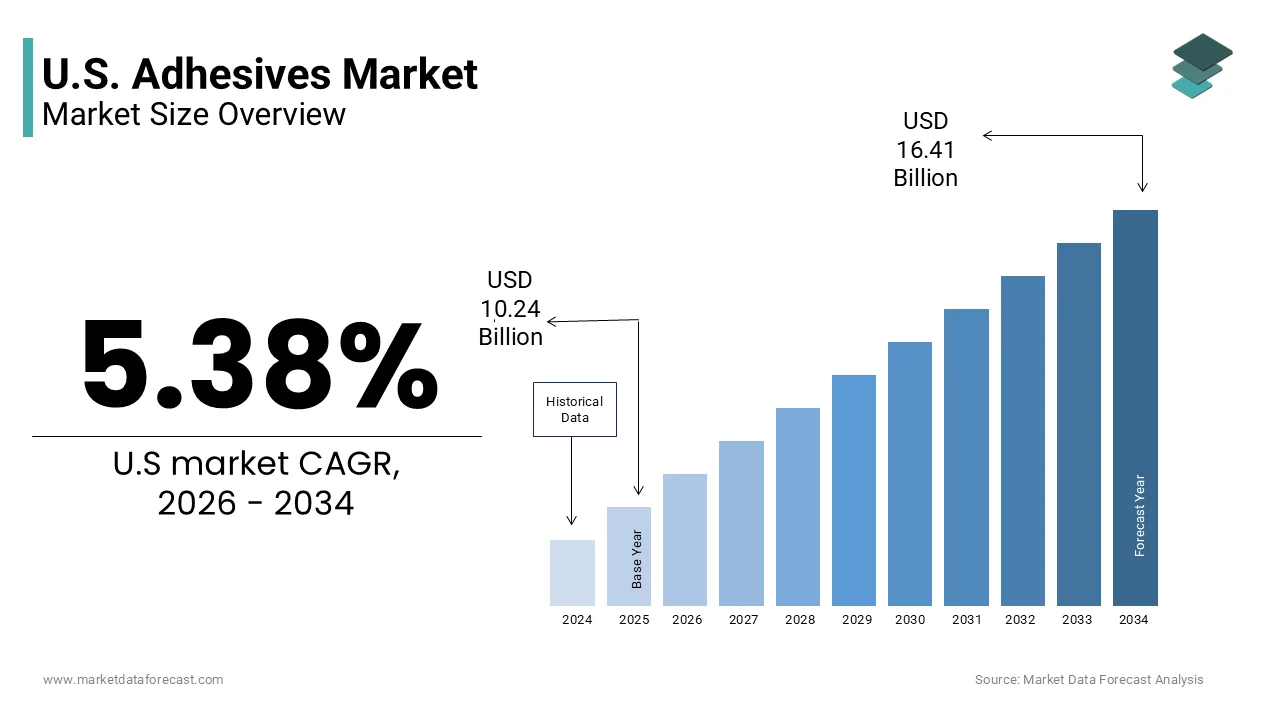
The U.S. adhesives market was valued at USD 10.24 billion in 2025, is estimated to reach USD 10.79 billion in 2026, and is projected to reach USD 16.41 billion by 2034, growing at a CAGR of 5.38% during the forecast period. Market growth is driven by increasing demand from packaging, construction, automotive, healthcare, and industrial manufacturing sectors. Adhesives play a critical role in product assembly, lightweight manufacturing, and material bonding across multiple end use industries. Rising adoption of sustainable adhesive technologies, automation in manufacturing, and growing demand for high performance bonding solutions are further supporting market expansion across the United States.
Key Market Trends
- Growing demand from packaging and industrial manufacturing sectors is driving market growth.
- Increasing adoption of lightweight materials in automotive and construction industries is boosting adhesive consumption.
- Rising focus on sustainable and low VOC adhesive technologies is supporting market expansion.
- Expansion of e commerce packaging activities is enhancing adhesive demand.
- Innovation in hot melt technologies and high performance bonding formulations is influencing market development.
Segmental Insights
- Based on resin, the epoxy resin segment accounted for a significant share of the U.S. adhesives market in 2025. This dominance is attributed to strong bonding strength, chemical resistance, and broad industrial applications.
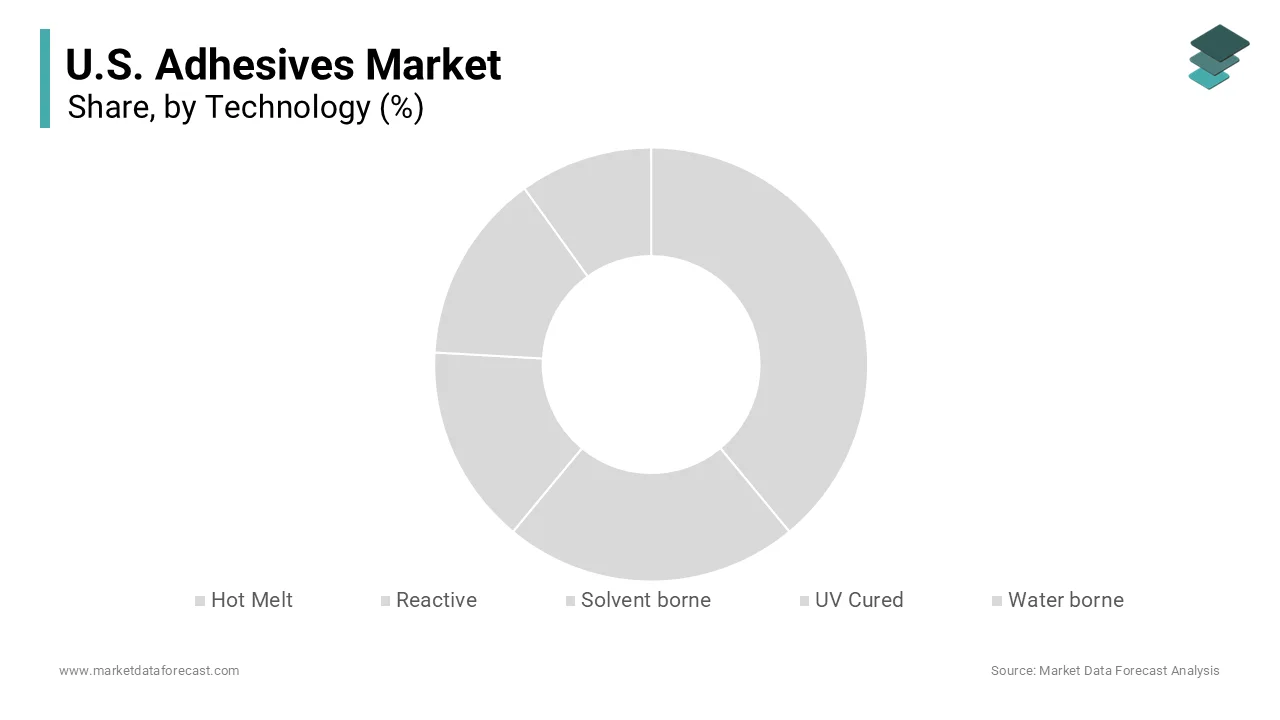
- Based on technology, the hot melt technology segment held 32.6% of the U.S. adhesives market share in 2025, driven by fast curing properties, manufacturing efficiency, and growing packaging applications.
- Based on end user industry, the packaging segment accounted for 52.1% of the U.S. adhesives market share in 2025, supported by rising demand for packaged consumer goods and e commerce distribution activities.
Regional Insights
The U.S. adhesives market is experiencing steady growth across industrial and commercial sectors, supported by manufacturing expansion, packaging innovation, and infrastructure development. The increasing adoption of sustainable adhesive technologies and advanced bonding solutions continues to strengthen market growth.
Competitive Landscape
The U.S. adhesives market is highly competitive, with key players focusing on sustainable formulations, high performance bonding technologies, and expansion of industrial adhesive portfolios to strengthen their market position. Companies are investing in research and development, packaging adhesive technologies, and advanced manufacturing solutions. Prominent players in the U.S. adhesives market include 3M, Avery Dennison Corp., Dow, H.B. Fuller, Illinois Tool Works Inc., American Sealants Inc., Franklin International, deVan Sealants Inc., Huntsman Corporation, Parker Hannifin Corp., Astro Chemical Company Inc., and United Resin Corporation.
U.S. Adhesives Market Size
The U.S. adhesives market size was valued at USD 10.24 billion in 2025, is estimated to reach USD 10.79 billion in 2026, and is projected to reach USD 16.41 billion by 2034, growing at a CAGR of 5.38% from 2026 to 2034.
The adhesives are bonding agents including epoxies, polyurethanes, acrylics, and silicones utilized across industrial manufacturing construction packaging and consumer applications. The definition extends beyond simple joining mechanisms to include structural bonding solutions that enhance product durability weight reduction and design flexibility. Consumer engagement is driven by the do it yourself renovation trends and the increasing prevalence of packaged goods requiring secure sealing. Furthermore, data from the Bureau of Labor Statistics indicates that employment in manufacturing sectors remains stable with over 12 million workers supporting the production of goods that rely heavily on adhesive technologies. The shift toward lightweight vehicles has accelerated the adoption of structural adhesives as alternatives to mechanical fasteners. The regulations regarding volatile organic compounds have reshaped formulation standards pushing manufacturers toward water based and solvent free innovations.
MARKET DRIVERS
Expansion of the Automotive Industry and Lightweighting Trends
The increasing automotive sector with the demand to reduce vehicle weight and improve fuel efficiency is surging the growth of the United States adhesives market. Manufacturers are increasingly replacing traditional mechanical fasteners such as welds and rivets with advanced structural adhesives to bond dissimilar materials like aluminum carbon fiber and high strength steel. According to the Alliance for Automotive Innovation, the average vehicle now contains over 300 pounds of adhesives and sealants reflecting the deep integration of these materials in modern assembly lines. This shift is motivated by stringent corporate average fuel economy standards which mandate improved mileage and reduced emissions. As per data from the Department of Energy, lightweighting vehicles by 10% can improve fuel economy by 6 to 8% creating a strong economic incentive for adhesive adoption. Electric vehicle production further accelerates this trend as battery pack assembly requires precise thermal management and structural integrity provided by specialized adhesives. The rise of autonomous driving technologies also necessitates the bonding of sensitive sensors and cameras where vibration damping is important. Manufacturers invest heavily in research to develop adhesives that cure rapidly and withstand extreme temperatures ensuring production line efficiency. This technological evolution ensures that adhesives remain indispensable in achieving the performance and safety standards required by modern automotive design.
Growth in Construction and Infrastructure Development Activities
The robust activity in the construction and infrastructure sectors, where adhesives are used in flooring, roofing, insulation, and panel bonding is gearing up the growth of the United States adhesives market. Urbanization and population growth necessitate the development of residential and commercial structures, which rely on adhesives for efficient and durable assembly. The total construction spending reached historic highs in recent years with non-residential construction. This expansion creates sustained demand for construction adhesives that offer superior bonding strength and weather resistance compared to traditional methods. As per data from the American Institute of Architects billings indices indicate consistent growth in architectural firm activity signaling future construction projects. Adhesives enable the installation of energy efficient windows and insulated panels which are critical for meeting green building standards. The renovation and retrofitting of existing buildings also contribute to market growth as owners seek to improve aesthetics and functionality without extensive structural changes. Prefabricated construction methods which rely heavily on adhesive bonding for modular components are gaining traction due to their speed and cost effectiveness. Government infrastructure bills allocating billions for road bridge and public facility upgrades further stimulate demand. These projects require high performance adhesives capable of withstanding heavy loads and environmental stressors.
MARKET RESTRAINTS
Stringent Environmental Regulations on Volatile Organic Compounds
The implementation of strict environmental regulations regarding volatile organic compound emissions is hampering the growth of the United States adhesives market. Traditional solvent based adhesives, which offer high performance and rapid curing are being phased out or restricted due to their contribution to air pollution and health hazards. The National Emission Standards for Hazardous Air Pollutors impose rigorous limits on VOC releases from industrial facilities, including adhesive manufacturing plants. Compliance with these regulations requires manufacturers to reformulate products using water based or solid-state technologies, which can be technically challenging and costly. As per data from the Chemical Manufacturers Association the transition to low VOC formulations often results in reduced initial tack and longer curing times affecting production efficiency. Companies must invest heavily in research and development to maintain performance levels while meeting regulatory standards. State level regulations such as those in California often exceed federal requirements creating a complex compliance landscape for national distributors. The higher cost of raw materials for eco-friendly adhesives can also deter price sensitive consumers and industrial buyers. Small and medium sized enterprises may struggle to bear the financial burden of reformulation and testing.
Volatility in Raw Material Prices and Supply Chain Disruptions
The fluctuations in the prices of key raw materials, such as petroleum-based resins, monomers, and polymers, which is hindering the growth of the United States adhesives market. These inputs constitute a major portion of production costs making profitability vulnerable to market volatility. According to the Bureau of Labor Statistics the producer price index for chemical and allied products has experienced substantial swings due to global supply chain constraints and geopolitical tensions. Rising energy costs further inflate manufacturing expenses as adhesive production is energy intensive. The manufacturing sectors have faced persistent delays in sourcing critical components affecting lead times and inventory levels. The dependence on imported raw materials exposes manufacturers to trade policy risks and tariff implications. Inventory management becomes challenging as businesses attempt to balance stock levels against uncertain supply conditions. Smaller producers with limited bargaining power are particularly affected by raw material scarcity. The inability to pass increased costs onto customers due to competitive pricing pressures squeezes profit margins. Supply chain disruptions caused by natural disasters or labor strikes can halt production lines leading to missed delivery deadlines. This economic instability constrains the ability of companies to maintain consistent pricing and product availability.
MARKET OPPORTUNITIES
Adoption of Bio Based and Sustainable Adhesive Formulations
The growing consumer and corporate demand for sustainability to innovate with bio based and renewable materials is certainly ascribed to set up new opportunities for the growth of the United States adhesives market. Shoppers and industrial buyers are increasingly prioritizing products with lower carbon footprints and reduced reliance on fossil fuels. This trend creates a niche for companies that utilize plant based polymers, such as soy starch and lignin to create effective bonding agents. The research into agricultural byproducts for industrial applications is expanding providing new sources for raw materials. Brands can leverage certifications such as USDA BioPreferred to build trust and transparency with buyers. Marketing campaigns that highlight biodegradability and non toxicity resonate strongly with environmentally conscious demographics. Partnerships with green building organizations can amplify brand credibility and reach. The development of recyclable adhesive systems that allow for easier disassembly of products aligns with circular economy principles. This strategic pivot toward green chemistry transforms regulatory pressures into competitive advantages. Embracing sustainability ensures long term relevance and brand loyalty in an evolving regulatory landscape.
Integration of Smart Adhesives with Sensing Capabilities
The emergence of smart adhesives embedded with sensors or responsive materials offers immense potential for enhancing functionality in high tech applications is another attribute to escalate the growth of the United States adhesives market in coming years. These advanced formulations can monitor structural health detect damage or change properties in response to environmental stimuli such as temperature or pH. Brands can leverage this trend by developing adhesives that provide real time data on bond integrity preventing catastrophic failures in critical structures. As per data from the National Aeronautics and Space Administration, research into self-healing polymers is advancing enabling materials that repair micro cracks automatically extending product lifespan. This technology appeals to industries where safety and maintenance costs are paramount. The integration of conductive adhesives for flexible electronics and wearable devices opens new revenue streams in the consumer electronics sector. Direct to consumer applications such as smart bandages that monitor wound healing are also gaining traction. This technological evolution transforms adhesives from passive joining agents into active components of smart systems. The ability to deliver added value through data and responsiveness ensures higher conversion rates in specialized markets.
MARKET CHALLENGES
Technical Complexity in Bonding Dissimilar Materials
The increasing use of diverse and composite materials in manufacturing is significant challenge for the growth of the United States adhesives market. Bonding dissimilar substrates such as plastics metals and composites requires specialized chemistries that can accommodate different thermal expansion rates and surface energies. The complexity of multi material assemblies in automotive and aerospace industries has increased substantially requiring precise adhesive selection. Failure to achieve a reliable bond can lead to product recalls and safety hazards damaging brand reputation. Manufacturers must invest heavily in application engineering support to help customers optimize bonding processes. The lack of standardized testing methods for new material combinations adds uncertainty to performance predictions. Small batch production of specialized adhesives is often less economically viable than mass produced general purpose products. The need for surface preparation treatments such as primers or plasma cleaning adds steps and cost to the manufacturing process. Educating customers on proper application techniques is challenging amidst rapid material innovation. This technical barrier limits the speed at which new adhesives can be commercialized. Companies must balance customization with scalability to meet diverse industrial needs.
Competition from Alternative Joining Technologies
The intense competition from alternative joining technologies, such as mechanical fasteners welding and soldering, which offer established reliability and ease of inspection. The competition from alternative joining technologies is likely to degrade the growth of the United States adhesives market. In many industrial applications, these traditional methods are preferred due to their perceived strength and reversibility. According to the Fabricators and Manufacturers Association, welding remains the dominant joining method in heavy industry due to its robustness and cost effectiveness for thick materials. Adhesives often struggle to compete in applications, where high immediate load bearing capacity is required without lengthy curing times. The difficulty in inspecting bonded joints non-destructively raises concerns about quality control in safety sectors. Some manufacturers hesitate to adopt adhesives due to the lack of skilled labor trained in proper application techniques. The perception that adhesives are weaker than welds persists despite advancements in structural bonding technology. Regulatory standards in certain industries still favor traditional joining methods slowing adoption rates. Companies must invest in education and demonstration to overcome these biases. The need to prove long term durability under varying conditions adds to the validation burden.
REPORT COVERAGE
| REPORT METRIC | DETAILS |
| Market Size Available | 2025 to 2034 |
| Base Year | 2025 |
| Forecast Period | 2026 to 2034 |
| CAGR | 5.38% |
| Segments Covered | By Resin, Technology, End User Industry, and Region. |
| Various Analyses Covered | Global, Regional and Country-Level Analysis, Segment-Level Analysis, Drivers, Restraints, Opportunities, Challenges; PESTLE Analysis; Porter’s Five Forces Analysis, Competitive Landscape, Analyst Overview of Investment Opportunities |
| Countries Covered | California, Washington, Oregon, New York, United States |
| Market Leaders Profiled | 3M, Avery Dennison Corp., Dow, H.B. Fuller, Illinois Tool Works Inc., American Sealants Inc., Franklin International, deVan Sealants Inc., Huntsman Corporation, Parker Hannifin Corp., Astro Chemical Company Inc., and United Resin Corporation |
SEGMENTAL ANALYSIS
By Resin Insights
The epoxy resin segment was accounted in holding a significant share of the United States adhesives market in 2025 with its exceptional mechanical strength chemical resistance and versatility in bonding diverse substrates. Epoxies are indispensable in high performance applications, where structural integrity is paramount, such as aerospace, automotive, and electronics manufacturing. The composites industry, which relies heavily on epoxy matrices has seen consistent growth due to the demand for lightweight and durable materials in transportation sectors. The ability of epoxy adhesives to withstand extreme environmental conditions, including high temperatures and corrosive chemicals without degrading. The epoxy resins account for a significant portion of industrial adhesive consumption due to their superior adhesion to metals ceramics and glass. The construction sector also utilizes epoxies for flooring coatings and concrete repair leveraging their durability and load bearing capacity. The electronics industry depends on epoxies for encapsulating and protecting sensitive components from moisture and physical stress. Manufacturers continue to innovate with faster curing formulations and improved toughness to meet evolving industrial needs.
The polyurethane resin segment is likely to grow at an anticipated CAGR of 6.8% from 2026 to 2034 with the increasing demand for flexible and durable bonding solutions in the automotive construction and footwear industries. The unique ability of polyurethanes to bond dissimilar materials, while maintaining flexibility and impact resistance. The production of polyurethane materials has increased significantly due to their versatility in forming foams elastomers and adhesives. The rise in residential construction has boosted demand for polyurethane adhesives used in subflooring insulation and window installation due to their excellent sealing properties. The automotive sector utilizes polyurethanes for bonding windshields and interior components where vibration damping is crucial. The footwear industry relies on polyurethane adhesives for assembling soles and uppers due to their strong bond and flexibility. Innovations in moisture curing technologies have simplified application processes enhancing user convenience. The development of bio based polyurethanes aligns with sustainability trends attracting eco conscious buyers.
By Technology Insights
The hot melt technology segment was accounted in holding 32.6% of the United States adhesives market share in 2025 with its rapid bonding speed solvent free formulation and ease of application in high volume manufacturing. Hot melt adhesives are widely used in packaging woodworking and product assembly where efficiency and cleanliness are prioritized. The hot melt adhesives account for a substantial share of packaging adhesives due to their ability to seal cartons and cases at high speeds. The elimination of drying or curing time, which significantly accelerates production lines and reduces energy consumption. The woodworking industry extensively uses hot melts for edge banding and assembly due to their strong initial tack and minimal waste. The absence of volatile organic compounds in hot melts aligns with environmental regulations reducing compliance costs for manufacturers. The versatility of hot melt formulations allows them to bond various substrates including plastics papers and fabrics. Advances in polymer technology have improved the heat resistance and flexibility of hot melts expanding their application range. The cost effectiveness of hot melt systems compared to solvent based alternatives further drives adoption. The widespread availability of automated dispensing equipment enhances precision and consistency.
The UV cured technology segment is likely to witness a fastest CAGR of 7.5% from 2026 to 2034 with the demand for instant curing and high precision bonding in electronics and medical device manufacturing. UV cured adhesives offer immediate bond strength upon exposure to ultraviolet light enabling rapid assembly processes. The miniaturization of electronic components has increased the need for precise and fast curing adhesives that do not damage sensitive parts. The ability of UV curing to provide controlled depth of cure and excellent optical clarity, which is essential for display and lens bonding. The healthcare sector utilizes UV cured adhesives for assembling catheters and syringes due to their sterility and biocompatibility. The energy efficiency of UV curing systems reduces operational costs compared to thermal curing methods. Innovations in LED UV sources have lowered equipment costs and expanded application possibilities. The ability to bond heat sensitive substrates without thermal distortion appeals to diverse industries. The growing adoption of automated UV curing lines enhances productivity and consistency.
By End User Industry Insights
The packaging segment was the largest by capturing 52.1% of the United States adhesives market share in 2025 with the explosive growth of e-commerce and the consequent demand for secure and efficient carton sealing and labeling solutions. Adhesives ensure package integrity during transit and handling. The parcel volume has reached record highs reflecting the sustained boom in online shopping. The need for high speed automated packaging lines that rely on reliable adhesive performance to maintain throughput. The use of adhesives in flexible packaging formats such as pouches and films has grown due to their lightweight and protective qualities. Corrugated box manufacturing consumes vast quantities of starch based and synthetic adhesives for board construction and case sealing. The shift toward sustainable packaging materials requires adhesives that can bond recycled papers and bioplastics effectively. Regulatory pressures regarding food safety drive demand for non-toxic adhesives in direct contact applications. The customization of packaging for branding purposes increases the use of label adhesives.
The healthcare segment is expected to grow at an anticipated CAGR of 8.2% from 2026 to 2034 with the aging population and the increasing prevalence of chronic diseases, requiring advanced medical devices and transdermal drug delivery systems. Adhesives are essential for assembling disposable medical products and securing wearable health monitors. According to the Centers for Disease Control and Prevention, the number of individuals aged 65 and older is growing rapidly increasing the demand for healthcare services and products. The approval of new medical devices incorporating advanced adhesive technologies has accelerated. The trend toward remote patient monitoring has boosted demand for adhesives in wearable sensors and patches. Biocompatible and hypoallergenic adhesives are crucial for patient comfort and safety. Innovations in hydrogel adhesives enhance drug delivery efficiency and skin compatibility. The expansion of home healthcare services increases the use of adhesive based diagnostic kits and wound care products. Regulatory standards for medical grade adhesives ensure high quality and reliability.
COMPETITIVE LANDSCAPE
The competitive landscape of the United States adhesives market is characterized by intense rivalry among established multinational corporations and specialized regional manufacturers. Large players leverage extensive distribution networks and brand recognition to maintain dominance while niche firms compete on customization and local service quality. The market is fragmented with numerous independent contractors and suppliers influencing purchasing decisions through recommendations. Price competition is moderate in the premium segment whereas value oriented brands compete aggressively on cost. Regulatory compliance drives innovation as companies strive to meet stringent environmental standards. The rise of smart manufacturing has introduced new competitors from the tech sector adding complexity to the landscape. Supply chain reliability has become a key differentiator following recent global disruptions. Companies must balance product innovation with operational efficiency to sustain profitability. Customer service and technical support play crucial roles in building long term loyalty. The transition to sustainable materials requires significant investment creating barriers for smaller entities. Success depends on adapting to regulatory changes and meeting evolving consumer expectations for performance and sustainability.
KEY MARKET PLAYERS
Some of the companies that are playing a dominating role in the U.S. adhesives market are
- 3M
- Avery Dennison Corp.
- Dow
- H.B. Fuller
- Illinois Tool Works Inc.
- American Sealants Inc.
- Franklin International
- deVan Sealants Inc.
- Huntsman Corporation
- Parker Hannifin Corp.
- Astro Chemical Company Inc.
- United Resin Corporation
Top Players in the Market
- H B Fuller Company is a leading global adhesive manufacturer with a significant presence in the United States market serving diverse industries including hygiene packaging and construction. The company contributes by providing engineered adhesive solutions that enhance product performance and manufacturing efficiency. Recent actions include strategic acquisitions to expand its portfolio in high growth segments such as renewable energy and electronics. H B Fuller has invested heavily in research and development to create sustainable and bio based adhesive formulations. The firm focuses on customer collaboration to develop customized solutions that address specific application challenges. Its extensive distribution network ensures reliable supply to customers across various sectors. These initiatives reinforce its reputation as a trusted partner in the adhesives industry.
- Henkel Corporation operates strongly in the US adhesives market through its Loctite and Technomelt brands offering a wide range of industrial and consumer products. The company drives growth by leveraging digital technologies to optimize supply chains and enhance customer engagement. Recent strategies involve expanding its portfolio of smart adhesives and automated dispensing systems for Industry 4.0 applications. Henkel has committed to sustainability goals by increasing the share of recycled and bio based materials in its products. The firm actively collaborates with automotive and aerospace manufacturers to develop lightweight bonding solutions. Investments in training and technical support services help customers maximize product value.
- 3M Company is a key player in the US adhesives market known for its diverse portfolio of industrial tapes structural adhesives and specialty films. The company contributes by delivering innovative bonding solutions that improve durability and design flexibility across multiple sectors. Recent actions include launching new advanced acrylic adhesives for electric vehicle battery assembly and electronics. 3M has focused on sustainability by developing recyclable adhesive technologies and reducing environmental impact in manufacturing. The firm leverages its strong brand recognition and extensive R&D capabilities to introduce high performance products. Strategic partnerships with industry leaders help drive adoption of new technologies.
Top Strategies Used by Key Market Participants
Key players in the United States adhesives market employ diverse strategies to maintain competitive advantage and drive growth. Product innovation remains central with companies developing sustainable and high performance formulations. Brands focus on digital transformation by integrating smart technologies and automated dispensing systems. Strategic acquisitions help expand product portfolios and enter new market segments effectively. Sustainability initiatives are increasingly important as consumers demand eco friendly and bio based products. Companies leverage data analytics to optimize supply chains and predict demand accurately. Omnichannel distribution ensures seamless access to products for both industrial and consumer clients. Training programs and technical support build brand loyalty and ensure proper application. Marketing campaigns emphasize reliability and efficiency to attract value conscious buyers. These strategies collectively help brands differentiate themselves and capture value in a regulated market.
MARKET SEGMENTATION
This research report on the U.S. adhesives market is segmented and sub-segmented into the following categories.
By Resin
- Acrylic
- Cyanoacrylate
- Epoxy
- Polyurethane
- Silicone
- VAE/EVA
- Other Resins
By Technology
- Hot Melt
- Reactive
- Solvent borne
- UV Cured
- Water borne
By End User Industry
- Aerospace
- Automotive
- Building and Construction
- Footwear and Leather
- Healthcare
- Packaging
- Woodworking and Joinery
- Other End User Industries
By Country
- California
- Washington
- Oregon
- New York
- Rest of the United States
Frequently Asked Questions
What is the U.S. Adhesives Market?
The U.S. Adhesives Market refers to the industry involved in manufacturing and supplying bonding agents that adhere materials together for various end-use industries such as automotive, packaging, construction, healthcare, and aerospace.
Which factors are driving the growth of the U.S. Adhesives Market?
The major growth drivers include rising demand from the packaging industry, increasing construction activities, growth in the automotive sector, and advancements in adhesive technologies like water-borne and hot-melt adhesives.
Which are the major resin types used in the U.S. Adhesives Market?
The primary resins are Acrylic, Epoxy, Polyurethane, Silicone, Cyanoacrylate, and VAE/EVA.
Who are the key market players in the U.S. Adhesives Market?
Major companies include 3M Company, Henkel AG & Co. KGaA, H.B. Fuller Company, Sika AG, Arkema Group, Dow Inc., Avery Dennison Corporation, Ashland Global Holdings Inc., Pidilite Industries Ltd., and RPM International Inc.
What challenges are faced by the U.S. Adhesives Market?
Challenges include fluctuating raw material prices, environmental regulations on solvent-based adhesives, and competition from alternative bonding technologies.
What is the future outlook for the U.S. Adhesives Market?
The market is expected to grow steadily due to innovation in eco-friendly adhesives, increasing demand from packaging and healthcare sectors, and the expansion of construction activities across the country.
Access the study in MULTIPLE FORMATS
Purchase options starting from
$ 1200
Didn’t find what you’re looking for?
TALK TO OUR ANALYST TEAM
Need something within your budget?
NO WORRIES! WE GOT YOU COVERED!
Call us on: +1 888 702 9696 (U.S Toll Free)
Write to us: sales@marketdataforecast.com