- Product Description Description
- Table of Contents TOC
- List of Table & Figure LOT
- Get Free Sample PDF Sample PDF
Market Size, 2025
$16.07 BnMarket Estimate, 2026
$16.62 BnMarket Forecast, 2034
$21.73 BnCAGR, 2026–2034
3.41%U.S. Architectural Paint Market Report Summary
The U.S. architectural paint market was valued at USD 16.07 billion in 2025, is estimated to reach USD 16.62 billion in 2026, and is projected to reach USD 21.73 billion by 2034, growing at a CAGR of 3.41% during the forecast period. Market growth is driven by increasing residential construction activities, rising home renovation and remodeling projects, and growing demand for sustainable and high performance coating solutions. Architectural paints play a crucial role in enhancing aesthetics, durability, and surface protection for residential and commercial buildings. Technological advancements in eco friendly formulations and low VOC products are further supporting market expansion across the United States.
Key Market Trends
- Growing residential renovation and home improvement activities are driving market growth.
- Increasing demand for environmentally friendly and low VOC paint products is boosting market expansion.
- Rising adoption of high performance coatings with enhanced durability is supporting industry development.
- Expansion of sustainable construction practices is increasing demand for advanced paint technologies.
- Innovation in color technologies, stain resistance, and weather protection solutions is influencing market advancement.
Segmental Insights
- Based on technology, the water borne paints segment held a significant share of the U.S. architectural paint market in 2025. This dominance is attributed to stringent environmental regulations, low VOC emissions, ease of application, and growing consumer preference for sustainable coatings.
- Based on resin type, the acrylic resins segment accounted for 60.3% of the U.S. architectural paint market share in 2025, driven by excellent durability, weather resistance, color retention, and versatility across various applications.
- Based on end use, the residential segment held a prominent share of the U.S. architectural paint market in 2025, supported by increasing housing renovation projects and strong demand for interior and exterior decorative coatings.
Regional Insights
- The United States continues to be one of the largest architectural paint markets globally due to strong residential construction activity, growing renovation expenditures, and increasing adoption of environmentally responsible building materials.
Competitive Landscape
The U.S. architectural paint market is highly competitive, with manufacturers focusing on sustainable formulations, advanced coating technologies, and product innovation to strengthen their market position. Companies continue to invest in low emission coatings, premium decorative paints, and enhanced durability solutions to meet evolving consumer and regulatory requirements.
Key companies operating in the U.S. architectural paint market include The Sherwin Williams Company, PPG Industries, Inc., Benjamin Moore & Co., Behr Process Corporation, RPM International Inc., and Masco Corporation.
U.S. Architectural Paint Market Size
The U.S. architectural paint market size was valued at USD 16.07 billion in 2025, and the market size is expected to be worth USD 21.73 billion by 2034 from USD 16.62 billion by 2026. The market is growing at a CAGR of 3.41% during the forecast period.
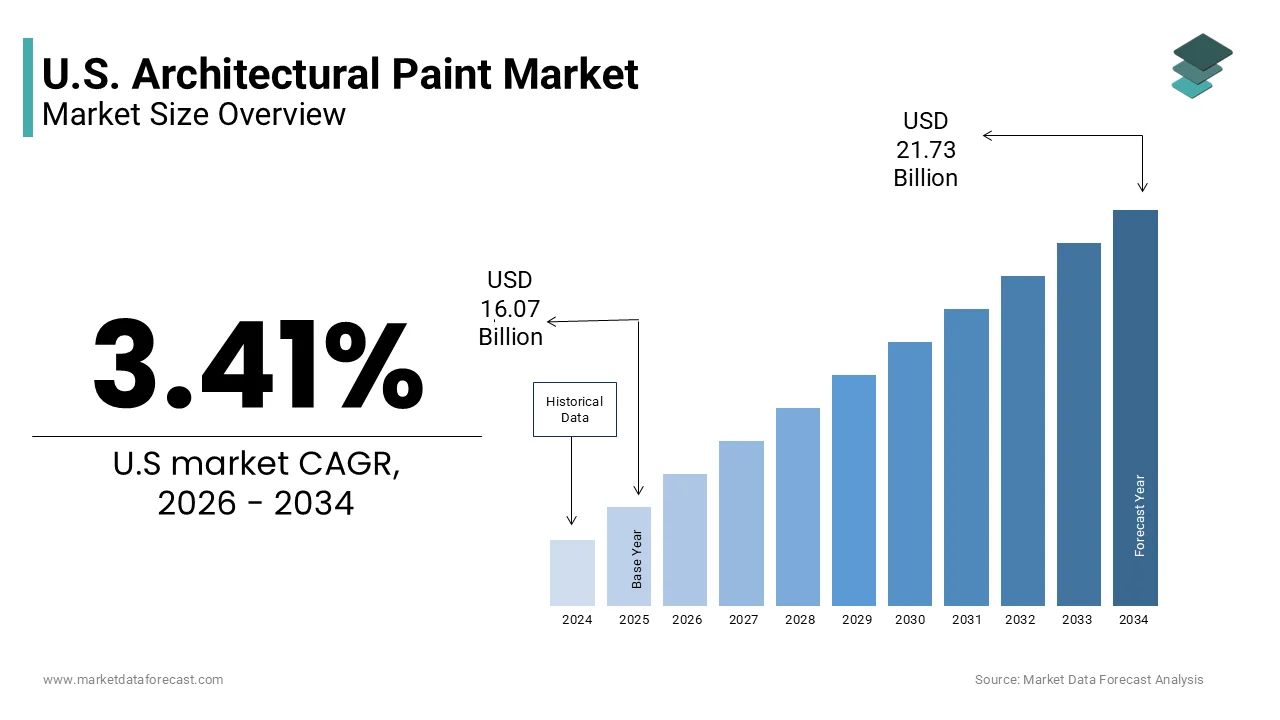
The architectural paint are diverse product portfolio including latex, acrylic, epoxy, and enamel formulations designed for interior and exterior surfaces. As per the Census Bureau, there are approximately 140 million housing units in the United States, with an average age of 38 years, indicating a substantial base for renovation and repainting activities. According to the Environmental Protection Agency, architectural coatings remain a significant source of volatile organic compounds, prompting continuous innovation in low odor and zero emission technologies. Consumer preferences are increasingly shifting towards sustainable and durable products that offer enhanced performance metrics such as mold resistance and washability. The geographic distribution of demand correlates with population growth trends in the Sun Belt states, where new construction activity remains robust. Professional contractors and do it yourself consumers constitute the primary end user segments, each with distinct purchasing behaviors and product requirements. Technological advancements in digital color matching and online retail channels have transformed the consumer experience, enabling greater customization and convenience.
MARKET DRIVERS
Residential Remodeling Activity Sustains Consistent Demand for Interior Coatings
The sustained volume of residential remodeling and renovation projects by generating steady demand for interior coatings regardless of new construction cycles is fuelling the growth of the United States architectural paint market. Homeowners are increasingly investing in property improvements to enhance livability and increase resale value, driven by high mortgage rates that discourage moving. Painting remains one of the most cost effective and impactful renovations, with nearly 60% of remodelers undertaking interior painting projects during major updates. As per industry surveys, the average homeowner repaints interior walls every five to seven years by creating a predictable replacement cycle that supports consistent sales volumes. The trend towards open floor plans and modern aesthetics encourages the use of neutral tones and accent walls, driving consumption of premium paints with superior coverage and finish qualities. Additionally, the rise of remote work has prompted investments in home office spaces that is further stimulating demand for high quality interior finishes. The aging housing inventory in the Northeast and Midwest, requires frequent maintenance to address wear and tear by ensuring a stable baseline for paint consumption. Retailers and manufacturers benefit from this recurring demand by offering specialized products for specific substrates and conditions. The emotional connection to home improvement also drives discretionary spending on premium brands by allowing manufacturers to maintain healthy margins despite competitive pressures.
Commercial Construction Growth Drives Specification of High Performance Exterior Paints
The expansion of the commercial construction sector in healthcare, education, and hospitality facilities that is also boosting the growth of the United States architectural paint market. These sectors require durable and hygienic coatings that can withstand heavy traffic, frequent cleaning, and strict regulatory standards for indoor air quality. According to Dodge Data and Analytics, total commercial construction starts increased by 12% in 2025, with healthcare and educational facilities leading the growth due to federal infrastructure funding and institutional investment. Hospitals and schools prioritize antimicrobial and low volatile organic compound paints to ensure safe environments for patients and students, driving specification of premium functional coatings. The hospitality industry’s recovery post pandemic has spurred renovation of hotels and restaurants, where aesthetic appeal and durability are paramount for customer satisfaction. Exterior paints for commercial buildings must also offer superior weather resistance and color retention to maintain corporate image and reduce maintenance costs. The trend towards adaptive reuse of older industrial buildings into mixed use spaces further amplifies demand for specialized coatings that can adhere to diverse substrates. Architects and facility managers play a crucial role in product selection, favoring brands that offer comprehensive warranties and technical support.
MARKET RESTRAINTS
Volatility in Raw Material Costs Impacts Profit Margins and Pricing Stability
The fluctuations in the prices of key raw materials, such as titanium dioxide, acrylic emulsions, and solvents is declining the growth of the United States architectural paint market. Titanium dioxide, a critical pigment for opacity and brightness, is subject to global supply chain disruptions and energy cost variations, leading to unpredictable pricing trends. According to the US Geological Survey, the price of titanium dioxide increased by 15% in 2025 due to production constraints in major exporting countries and rising energy costs in Europe. These input cost increases squeeze profit margins for manufacturers who often struggle to pass on the full extent of price hikes to price sensitive consumers and contractors. The reliance on petrochemical derivatives for binders and solvents further exposes the industry to crude oil price fluctuations, complicating long term pricing strategies. Smaller manufacturers lack the purchasing power to negotiate favorable contracts or hedge against price swings, putting them at a competitive disadvantage compared to larger integrated firms. This financial pressure can lead to reduced investment in research and development, potentially stifling innovation in product performance and sustainability. Customers may respond to price increases by delaying projects or switching to lower cost alternatives by impacting overall sales volumes.
Stringent Environmental Regulations Increase Compliance and Formulation Costs
The implementation of increasingly stringent environmental regulations regarding volatile organic compound emissions and hazardous air pollutants is another factor slowing down the growth of the United States architectural paint market. Federal and state agencies continue to tighten limits on permissible emission levels, compelling companies to reformulate products with alternative ingredients that often come at a higher cost. According to the Environmental Protection Agency, new national emission standards for architectural coatings were proposed in 2025, requiring further reductions in volatile organic compound content across various product categories. Compliance with these regulations necessitates significant investment in research and development to identify safe and effective substitutes for traditional solvents and additives. The cost of developing and testing new low emission formulations can exceed several million dollars per product line by posing a barrier for smaller manufacturers. The transition to water based and bio-based ingredients also requires modifications to manufacturing processes and equipment, adding to capital expenditure requirements. Inconsistent regulations across different states create complexity for national distributors, who must manage diverse product portfolios to meet local compliance standards. Non-compliance risks severe penalties and reputational damage, forcing companies to prioritize regulatory adherence over cost efficiency. The push for transparency in ingredient disclosure also demands extensive documentation and supply chain tracking, increasing administrative burdens. These regulatory pressures consolidate market power among larger firms with greater resources for compliance, limiting competition from niche players.
MARKET OPPORTUNITIES
Integration of Digital Color Matching Technologies Enhances Consumer Experience
The integration of advanced digital color matching technologies and mobile applications to differentiate their offerings and enhance customer engagement is to create new opportunities for the growth of the United States architectural paint market. Consumers increasingly seek personalized and precise color solutions, driving demand for tools that allow virtual visualization and accurate shade replication. Manufacturers that invest in proprietary color databases and spectrophotometer devices can offer superior accuracy and convenience, fostering brand loyalty among professional painters and do it yourself enthusiasts. The ability to customize colors on demand reduces inventory complexity and waste, aligning with sustainability goals and operational efficiency. The collection of consumer preference data through these digital tools also provides valuable insights for trend forecasting and product development. Companies that lead in digital innovation can establish themselves as technology driven partners rather than mere commodity suppliers. This shift towards digitalization opens new revenue streams through software licensing and data analytics services.
Expansion into Bio Based and Sustainable Product Lines Captures Eco Conscious Market
The growing consumer preference for environmentally friendly and sustainable building materials to expand their product portfolios with bio based and low impact formulations, which is additionally to promote the growth of the United States architectural paint market. Buyers are increasingly aware of the environmental footprint of construction materials, driving demand for paints derived from renewable resources and free from harmful chemicals. Manufacturers that develop paints using plant based resins, natural pigments, and recycled packaging can capture this growing segment of eco conscious consumers and specifiers. The ability to obtain third party certifications, such as Green Seal or Cradle to Cradle enhances brand credibility and appeals to environmentally responsible architects and developers. Corporate sustainability goals also drive demand for green products in commercial projects by creating large scale procurement opportunities. Innovation in bio-based technologies allows for performance parity with traditional paints by addressing previous concerns about durability and coverage.
MARKET CHALLENGES
Labor Shortages in Professional Painting Sector Constrain Application Capacity
The acute shortage of skilled labor in the professional painting and contracting sector that limits the effective application of architectural paints, which hinders the United States architectural paint market. An aging workforce and insufficient, vocational training programs have created a gap in the availability of qualified painters capable of delivering high quality finishes. The shortage leads to extended project timelines and increased labor costs, discouraging some homeowners and businesses from undertaking painting projects. The lack of expertise also impacts the quality of application, potentially resulting in premature failure of paint films and negative perceptions of product performance. High turnover rates in the construction trades result in loss of institutional knowledge, further complicating workforce development efforts. The reliance on subcontractors adds variability to project scheduling and quality control by affecting customer satisfaction. Manufacturers face challenges in promoting advanced application techniques when the workforce lacks the necessary skills to execute them effectively.
Supply Chain Disruptions Affect Product Availability and Lead Times
The persistent vulnerabilities in the global supply chain by affecting the timely availability of raw materials and finished products is also to inhibit the growth of the United States architectural paint market. Geopolitical conflicts and logistics disruptions have disrupted the flow of essential inputs such as resins, pigments, and packaging materials by leading to production delays and inventory shortages. According to logistics data, port congestion and shipping container shortages have intermittently slowed the import of key chemical components, forcing manufacturers to hold higher inventory levels and tie up working capital. These disruptions undermine the reliability of just in time manufacturing models, necessitating a shift towards more resilient but costly supply chain strategies. The dependence on single source suppliers for certain specialty additives creates additional risk exposure, as any interruption can halt entire production lines. Labor shortages in the transportation and warehousing sectors further exacerbate delivery delays, impacting customer satisfaction and project schedules. Retailers and contractors operating on tight deadlines face penalties for late completions due to material unavailability, straining relationships with suppliers. The unpredictability of supply chain conditions complicates production planning and inventory management, leading to inefficiencies and increased operational costs. Companies are increasingly investing in digital supply chain tools to enhance visibility and responsiveness, but these technologies require significant upfront investment.
REPORT COVERAGE
| REPORT METRIC | DETAILS |
| Market Size Available | 2025 to 2034 |
| Base Year | 2025 |
| Forecast Period | 2026 to 2034 |
| CAGR | 3.41% |
| Segments Covered | By Technology, Resin Type, End Use, and Region. |
| Various Analyses Covered | Global, Regional and Country-Level Analysis, Segment-Level Analysis, Drivers, Restraints, Opportunities, Challenges; PESTLE Analysis; Porter’s Five Forces Analysis, Competitive Landscape, Analyst Overview of Investment Opportunities |
| Countries Covered | California, Washington, Oregon, New York, United States |
| Market Leaders Profiled | The Sherwin‑Williams Company, PPG Industries, Inc., Benjamin Moore & Co. Behr Process Corporation, RPM International Inc., and Masco Corporation |
SEGMENTAL ANALYSIS
By Technology Insights
The water borne paints segment held a significant share of the dominate the United States architectural paint market in 2025 by stringent environmental regulations and superior ease of application. The regulatory pressure to reduce volatile organic compound emissions, which has effectively phased out solvent based options for most interior and exterior residential applications. The architectural coatings are a significant source of volatile organic compounds, which is leading to strict limits that favor water based formulations, which use water as the primary carrier. Consumers also prefer water borne paints due to their low odor, quick drying times, and easy cleanup with soap and water, making them ideal for do it yourself projects. The American Coatings Association notes that advancements in acrylic latex technology have significantly improved the durability and washability of water borne paints, matching or exceeding the performance of traditional solvent based products. This technological parity has removed historical barriers to adoption in high traffic areas. Furthermore, green building certifications such as LEED prioritize low emission materials, further incentivizing the specification of water borne systems in commercial and institutional projects.
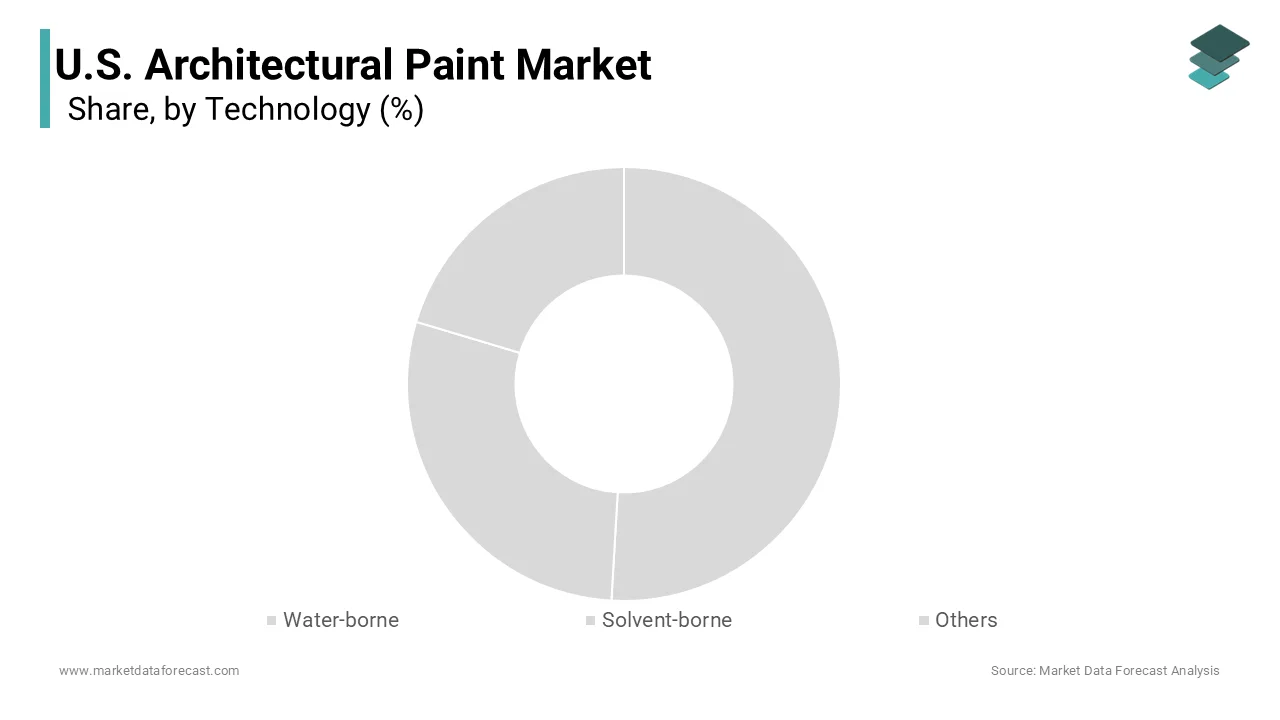
The solvent borne paints segment is swiftly growing at an anticipated CAGR of 3.5% during the forecast period with the their unmatched durability and adhesion properties in extreme conditions. While their overall market share is declining, they remain indispensable for specialized applications such as metal primers, trim coatings, and industrial maintenance where water borne alternatives may fail. According to the National Trust for Historic Preservation, preservation guidelines often mandate the use of traditional oil based paints for authentic restoration of heritage buildings, sustaining demand in this specialized sector. The solvent borne coatings are preferred for steel structures in coastal environments due to their ability to withstand salt spray and humidity without blistering. The development of low volatile organic compound solvent technologies has also allowed these products to meet regulatory standards while maintaining performance, reopening markets that were previously closed. Manufacturers are innovating with hybrid formulations that offer the benefits of solvent based durability with reduced environmental impact.
By Resin Type Insights
The acrylic resins segment was the largest by holding 60.3% of the United States architectural paint market share in 2025 due to their exceptional versatility, durability, and weather resistance. The dominance of acrylics is driven by their ability to form flexible films that resist cracking and peeling, making them ideal for both interior and exterior applications on various substrates including wood, masonry, and drywall. The acrylic latex paints are the standard choice for residential exteriors because they retain color and gloss better than other resin types under ultraviolet exposure. The cost effectiveness of acrylic production compared to premium resins like polyurethane, also contributes to its widespread adoption in mass products. Manufacturers continuously improve acrylic formulations to enhance scrub resistance and stain blocking by meeting the demands of high traffic commercial and residential spaces. The compatibility of acrylics with a wide range of additives and pigments allows for extensive customization of finish and color. Additionally, the shift towards zero volatile organic compound products has been facilitated by advances in acrylic emulsion technology, enabling compliant formulations without sacrificing performance.
The polyurethane resins segment is esteemed to witness a fastest CAGR of 6.2% during the forecast period with the increasing demand for high performance coatings in luxury residential and commercial interiors. The superior abrasion resistance and chemical stability of polyurethane coatings, which make them ideal for flooring, cabinetry, and trim in high end applications. The popularity of open concept living spaces and hard surface flooring has increased the need for durable finishes that can withstand heavy foot traffic and furniture movement. Water based polyurethane dispersions have gained traction due to their low odor and fast curing times, addressing previous concerns about solvent based variants. These advanced formulations offer clarity and non-yellowing properties that enhance the aesthetic appeal of natural wood surfaces. The growth is also fueled by the commercial sector, where hospitals and schools require hygienic and easy to clean surfaces that polyurethane coatings provide. Manufacturers are developing hybrid acrylic polyurethane systems that balance cost and performance, expanding the addressable market. The rising trend towards premium home renovations and smart interior solutions further accelerates the adoption of polyurethane resins.
By End Use Insights
The residential end use segment was the dominant by capturing a prominent share of the United States architectural paint market in 2025 with the continuous activity in home improvement and remodeling, as homeowners seek to update aesthetics and maintain property value. The rise of remote work has also spurred investments in home office renovations, further boosting paint consumption. New housing construction, although cyclical, adds to the baseline demand, particularly in growing regions like the Sun Belt. The emotional aspect of home ownership encourages discretionary spending on premium paints and colors, allowing manufacturers to capture higher margins. Additionally, the aging housing inventory in the Northeast and Midwest requires regular maintenance to protect against weather damage, ensuring steady consumption.
The commercial end use segment is expected to grow at a fastest CAGR of 5.8% from 2026 to 2034 with the robust construction activity in healthcare, education, and hospitality sectors. The increasing emphasis on hygiene and sustainability in public spaces, which drives specification of high performance and low emission coatings. According to the survey, over 70% of new commercial projects specify paints with Green Seal or LEED certification, reflecting a strong commitment to indoor air quality and environmental responsibility. The hospitality industry’s recovery has spurred extensive renovation of hotels and restaurants, where aesthetic appeal and durability are critical for customer experience. Facility managers prioritize coatings that offer easy maintenance and resistance to frequent cleaning, driving demand for premium epoxy and polyurethane blends. The trend towards adaptive reuse of industrial buildings into offices and retail spaces also creates opportunities for specialized coatings that can handle diverse substrates. Corporate sustainability goals further accelerate the adoption of eco-friendly paint solutions in large scale projects. The professional nature of commercial procurement ensures larger volume orders and long term contracts for manufacturers.
COMPETITIVE LANDSCAPE
The competition in the United States architectural paint market is characterized by the presence of established global corporations and strong regional brands vying for dominance in both retail and professional segments. Intense rivalry exists due to the mature nature of the market, prompting firms to differentiate through product quality, brand reputation, and customer service excellence. Major players leverage extensive distribution networks and company owned retail stores to control the customer experience and capture higher margins. The market features high barriers to entry due to significant capital requirements for manufacturing facilities and established brand loyalty among consumers. Price volatility in raw materials adds complexity to competitive dynamics, forcing companies to adopt sophisticated pricing strategies to maintain profitability. Customer loyalty plays a crucial role as homeowners and contractors prioritize consistent performance and color accuracy over minor price differences. Innovation in sustainable and smart coating technologies provides avenues for differentiation beyond traditional metrics. The presence of private label products from large home improvement retailers creates additional pressure, leading branded manufacturers to emphasize superior technical support and warranty offerings.
KEY MARKET PLAYERS
A few of the dominating players in the U.S. architectural paint market include
- The Sherwin‑Williams Company
- PPG Industries, Inc.
- Benjamin Moore & Co.
- Behr Process Corporation
- RPM International Inc.
- Masco Corporation
Top Players in the Market
- The Sherwin Williams Company stands as a dominant force in the United States architectural paint market, leveraging its extensive network of company owned retail stores to deliver superior customer service and product expertise. The firm offers a comprehensive portfolio of premium paints and coatings for residential and commercial applications, known for their durability and color accuracy. Sherwin Williams actively invests in sustainable product development, introducing low volatile organic compound formulations that meet rigorous environmental standards. These initiatives reinforce its reputation for quality and innovation, solidifying its leadership position in the competitive domestic landscape.
- PPG Industries Inc contributes significantly to the US architectural paint sector through its strong brand portfolio including Glidden and Olympic, which are widely recognized for value and performance. The company focuses on delivering innovative coating solutions that address the evolving needs of professional contractors and do it yourself consumers. Recent efforts involve the expansion of its e commerce platforms and digital services, allowing customers to visualize colors and purchase products online with greater convenience. PPG emphasizes sustainability by developing eco-friendly paints that reduce environmental impact while maintaining high performance standards. The firm also enhances its technical support services for commercial clients, ensuring proper application and long-term satisfaction.
- RPM International Inc plays a vital role in the United States architectural paint market through its diverse subsidiary brands, such as Rust Oleum and Zinsser, which specialize in protective and decorative coatings. The company is renowned for its niche products that offer specific functional benefits like rust prevention and mold resistance. Recent actions include the acquisition of specialized coating manufacturers to broaden its product offerings and enter new market segments. RPM focuses on operational efficiency by optimizing its manufacturing processes and reducing waste, aligning with corporate sustainability goals. The firm also strengthens its relationships with independent retailers and professional distributors, ensuring broad market reach.
Top Strategies Used by Key Market Participants
Key players in the United States architectural paint market primarily employ product innovation strategies by developing low volatile organic compound and sustainable formulations to meet regulatory standards and consumer preferences. Companies invest heavily in digital transformation by integrating augmented reality tools and online platforms to enhance customer engagement and simplify color selection. Strategic acquisitions allow firms to expand their brand portfolios and access new distribution channels effectively. Participants also focus on supply chain optimization to ensure consistent product availability and reduce logistical costs amidst global disruptions. Sustainability initiatives are central to corporate strategies, with manufacturers adopting eco-friendly practices and transparent ingredient sourcing to build brand trust. Additionally, companies prioritize professional contractor relationships through specialized training programs and loyalty incentives to secure recurring business.
MARKET SEGMENTATION
This research report on the U.S. architectural paint market is segmented and sub-segmented into the following categories.
By Technology
- Water-borne
- Solvent-borne
- Others
By Resin Type
- Acrylic
- Alkyd
- Epoxy
- Polyester
- Polyurethane
- Other Resin Types
By End Use
- Residential
- Commercial
By Region
- New York
- Massachusetts
- Pennsylvania
- Illinois
- Ohio
- Michigan
- Texas
- Florida
- Georgia
- California
- Washington
- Colorado