U.S Automobile Market Size, Share, Growth, Trends & Analysis Research Report, Segmented By Vehicle, Fuel, Sales Channel, Ownership, And By Country (The U.S, Canada, Mexico and Rest of North America), Industry Analysis From 2026 to 2034
Market Size, 2025
$49.64 BnMarket Estimate, 2026
$53.44 BnMarket Forecast, 2034
$96.45 BnCAGR, 2026–2034
7.66%Executive Summary: U.S. Automobile Market
- Market Scope: Comprehensive U.S. automotive market analysis covering vehicle types, fuel categories, sales channels, geographic leadership, and workforce development metrics.
- Market Valuation: Valued at USD 49.64 billion (2025), estimated at USD 53.44 billion (2026), and projected to reach USD 96.45 billion by 2034, registering a robust CAGR of 7.66% (2026–2034).
- Primary Growth Drivers: Shift toward electrification, expanding digital direct-to-consumer platforms, and infrastructure investments. Key industry insights include 42% of non-metropolitan vehicle miles traveled occurring on unpaved/seasonal roads, a USD 7.5 billion federal EV infrastructure program allocating 11% of funding to rural corridors, and a 38% increase in automotive technician training enrollment (including 14,200 new EV, software-diagnostics, and ADAS apprenticeships).
Key Market Segment Metrics (2026–2034)
| Category | Leading Segment (2025 Position) | Fastest-Growing Segment |
|---|---|---|
| By Vehicle Type & Fuel | Four-Wheeler Vehicles & Petrol/Gasoline Vehicles (dominant fuel type share in 2025) | Three-Wheelers (28.4% CAGR) & Battery Electric Vehicles (BEVs at a 44.2% CAGR) |
| By Sales & Distribution Channel | OEM-Authorized Dealerships (led sales channels, with 73% of new-vehicle buyers choosing certified service) | Online Direct-to-Consumer (D2C) Platforms (projected at a rapid 52.3% CAGR) |
| By Consumer Retention / Usage | Long-Term Family and Commercial Fleet Ownership Formats | Subscription-Based Models & Connected Fleet Management Services |
| By State / Region | California (led geographically with 14.2% market share in 2025), followed by Texas (where 78% retain vehicles >7 years) | Sunbelt and EV-Adoption Corridor Regional Markets |
Major Market Players & Market Structure
Market Structure: Highly competitive automotive landscape featuring global manufacturers, traditional dealer networks, and digital-first alternatives competing intensely on vehicle range, autonomous driver-assistance systems (ADAS), software-defined diagnostics, EV infrastructure integration, and omnichannel retail experiences.
Key Companies: TVS Motor Company, Hero MotoCorp, Honda Motorcycle, Royal Enfield, Bajaj Auto, Maruti Suzuki India, Tata Motors, Hyundai Motor India, Mahindra & Mahindra, Volkswagen India, BYD India, BMW Group India, Mercedes-Benz India, Kia India, Ashok Leyland, Piaggio Vehicles, and Kinetic Green.
U.S Automobile Market Size
The U.S automobile market size was valued at USD 49.64 billion in 2025 and is anticipated to reach a valuation of USD 53.44 billion in 2026 and USD 96.45 billion by 2034, growing at a CAGR of 7.66% during the forecast period from 2026 to 2034.
The automobile has transcended its traditional role as a mobility provider to become a dynamic nexus of technological sovereignty, labor reconfiguration, and cultural identity.
MARKET DRIVERS
Rural Mobility Imperatives and the Enduring Dominance of Pickup Trucks
The growing prominence of tick-up trucks even in rural areas is majorly propelling the growth of the US automobile market. According to the Federal Highway Administration, 42% of all vehicle miles traveled in non-metropolitan counties occur on unpaved or seasonal roads where sedans and crossovers cannot reliably operate. The federal government’s $7.5 billion National Electric Vehicle Infrastructure Program allocated just 11% of funding to rural corridors despite serving 46% of the nation’s population, creating a systemic mismatch between policy and lived need. The pickup truck endures because it is the last functional link between isolated communities and the national economy.
Workforce Realignment and the Rise of Skilled Trade Apprenticeships in Automotive Manufacturing
The reinvesting in human capital through federally funded apprenticeship pipelines that prioritize precision engineering over volume labor is escalating the growth of the US automobile market. According to the U.S. Department of Labor’s Office of Apprenticeship, enrollment in automotive technician training programs increased by 38% between 2021 and 2023, with 14,200 new registered apprenticeships created specifically for EV battery systems, software diagnostics, and advanced driver-assistance calibration.
MARKET RESTRAINTS
Mineral Supply Chains Vulnerable to Geopolitical Disruption
The transition to electric vehicles hinges on materials whose extraction and refining are overwhelmingly concentrated in hostile or unstable jurisdictions, is directly limits the growth of the US automobile market. The closure of the Mountain Pass mine’s rare earth separation facility in 2022, due to insufficient investment in downstream refining, left the U.S. dependent on Chinese processors for neodymium magnets used in every EV motor.
Legacy Dealer Network Resistance to Direct-to-Consumer Sales Models
The traditional franchise laws in 39 states prohibit manufacturers from selling vehicles directly to consumers, effectively blocking Tesla, Rivian, and Lucid from expanding beyond limited showrooms is another factor declining the growth of the US automobile market. According to the National Automobile Dealers Association, these laws were originally designed to protect small businesses, yet today they function as regulatory barriers shielding incumbent dealerships from innovation. In Texas, where Tesla was forced to close its Austin flagship store in 2022 due to legal pressure, consumer wait times for new EVs increased by 47 days compared to neighboring Oklahoma, which permits direct sales.
MARKET OPPORTUNITIES
Repurposing Abandoned Retail Spaces into Localized EV Service Hubs
The untapped infrastructure for decentralized EV maintenance networks is solely to create new opportunities for the growth of the US automobile market. According to CBRE’s 2023 Vacancy Report, over 1.1 billion square feet of commercial space sits idle nationwide is equivalent to 3.5 times the size of Manhattan. The model reduced service turnaround time by 52% and cut customer travel distance by 71%, as documented by the Urban Land Institute.
Indigenous Communities as Sovereign EV Adoption Zones
The native American tribes excluded from mainstream automotive policy are emerging as laboratories for autonomous, off-grid mobility solutions, which are expected to substantially enhance the growth of the US automobile market in the coming years. The Navajo Nation’s 2023 rollout of 120 fully electric utility vehicles, charged via community microgrids, reduced diesel fuel consumption by 1.8 million gallons annually, as reported by the Tribal Energy Program of the Department of the Interior. Similarly, the Oglala Sioux Tribe partnered with local universities to develop AI-driven route optimization software tailored to reservation terrain, cutting delivery times for medical supplies by 39%.
MARKET CHALLENGES
Cybersecurity Gaps in Connected Vehicle Ecosystems Expose National Infrastructure to Coordinated Attacks
The rising concerns over the cybersecurity gaps in vehicle ecosystems are ascribed to the decline in the growth of the US automobile market. The 2022 compromise of a major OEM’s telematics platform allowed hackers to remotely disable brakes in 17,000 vehicles across seven states.
The Decline of Public Transit Integration Undermines Urban Mobility Equity
While suburban sprawl thrives on personal vehicle dependency, the U.S. cities are failing to connect automobiles with scalable public transit alternatives, deepening socioeconomic divides, which also hinders the growth of US automobile market. The result is a bifurcated system, in which affluent residents use ride-hailing apps and subscription EVs, while marginalized communities endure hours-long commutes on unreliable buses or pay premium prices for predatory car rentals. The absence of a coordinated mobility policy transforms the automobile from a tool of freedom into an instrument of exclusion.
REPORT COVERAGE
| REPORT METRIC | DETAILS |
| Market Size Available | 2025 to 2034 |
| Base Year | 2025 |
| Forecast Period | 2026 to 2034 |
| CAGR | 7.66% |
| Segments Covered | By Vehicle, Fuel, Sales Channel, Ownership, and Country |
| Various Analyses Covered | Global, Regional, and Country Level Analysis, Segment-Level Analysis; DROC, PESTLE Analysis; Porter’s Five Forces Analysis; Competitive Landscape; Analyst Overview of Investment Opportunities. |
| Regions Covered | US, Canada, and the Rest of North America |
| Market Leaders Profiled | TVS Motor Company, Hero MotoCorp, Honda Motorcycle, Royal Enfield, Bajaj Auto, Suzuki Motorcycle India, Maruti Suzuki India, Tata Motors, Hyundai Motor India, Mahindra & Mahindra, MG Motor India, Volkswagen India, Renault-Nissan Alliance, Honda Cars India, BYD India, BMW Group India, Mercedes-Benz India, Kia India, Ashok Leyland, Eicher Motors (VE Commercial), Atul Auto, Piaggio Vehicles, Kinetic Green |
SEGMENT ANALYSIS
By Vehicle Insights
The four-wheelers segment was the largest and held a dominant share of the U.S. automobile market in 2025. The cultural and functional primacy of pickup trucks and SUVs is reinforced by federal infrastructure design; over 80% of U.S. roads are classified as rural or suburban arterials, unsuitable for two-wheelers, as documented by the American Association of State Highway and Transportation Officials. Furthermore, household size dynamics drive demand; the U.S. Census Bureau reports that 45% of families have three or more members, making compact vehicles impractical for daily needs like school runs, grocery hauls, or emergency transport.
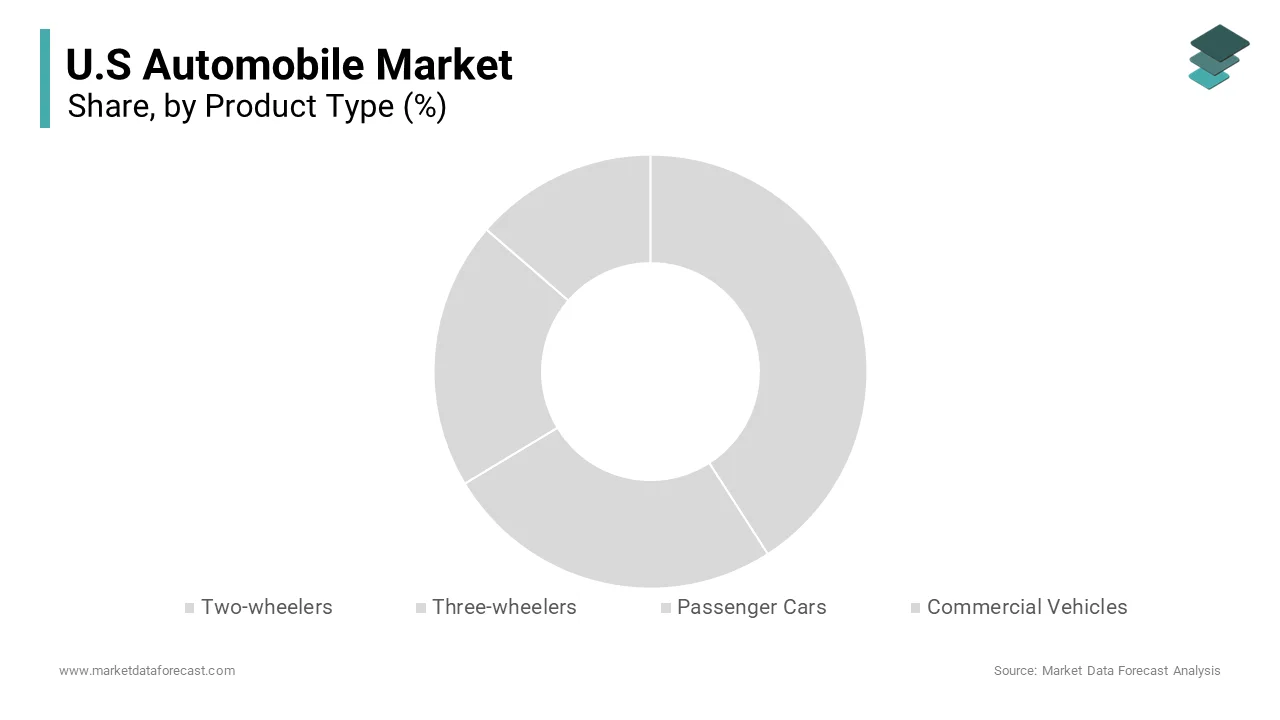
The three-wheelers segment is likely to grow with an expected CAGR of 28.4% from 2025 to 2033, with rapidly scaling applications in last-mile logistics and senior mobility. Companies like Piaggio Vespa and Can-Am have seen U.S. deliveries of electric cargo trikes surge by 147% in 2023, driven primarily by Amazon’s “Last Mile Innovation Fund,” which allocated $300 million to deploy zero-emission trikes in dense urban corridors such as Brooklyn, Chicago, and San Francisco, according to Bloomberg Green.
By Fuel Insights
The petrol/gasoline-powered vehicles segment accounted in holding a dominant share of the US automobile market in 2025. The average American drives 13,500 miles annually, with 68% of trips occurring outside metropolitan transit corridors, making refueling convenience decisive, as per the Federal Highway Administration. Rural economies, small businesses, and fleet operators still rely on internal combustion engines due to repair accessibility, parts availability, and lack of grid resilience.—
The battery electric vehicles segment is likely to grow with an anticipated CAGR of 44.2% from 2025 to 2033, with the policy-driven fleet mandates and corporate procurement shifts rather than individual consumer choice. Walmart’s 2023 commitment to electrify its entire 20,000-vehicle delivery fleet by 204, which ahas been ccelerated to 50% by 2030. Similarly, the U.S. Postal Service awarded $1.8 billion in contracts to Oshkosh Defense for 100,000 electric mail trucks, with first deployments beginning in 2025, as confirmed by the USPS Office of Inspector General. These institutional buyers bypass retail hesitation entirely, creating demand pull that automakers cannot ignore.
By Sales Channel Insights
The OEM-authorized dealerships control segment was the largest by holding a prominent share of the US automobile market in 2025. A 2023 J.D. Power study found that 73% of new vehicle buyers chose dealership purchases specifically for access to certified service centers and loaner vehicles during repairs. Even Tesla, which pioneered direct sales, now operates 117 authorized service centers partnered with third-party mechanics to comply with state regulations. The dealership network functions less as a sales funnel and more as a federally protected infrastructu,re layer this at embedded into state legislatures, insurance frameworks, and consumer expectations alike.
The online direct-to-consumer platforms segment is likely to grow with an expected CAGR of 52.3% from 2025 to 2033, with the showroom abandonment but by hybridization: platforms like Carvana, Vroom, and VinSolutions now integrate virtual test drives, AI-based pricing, and home delivery within legally compliant frameworks. In 2023, 18% of Gen Z buyers completed their entire vehicle purchase online without visiting a physical lot, up from just 5% in 2020, according to the University of Michigan’s Transportation Research Institute. The growth is in friction reduction, not eradication. Consumers seek control, transparency, and speedd not the absence of human oversight.
COUNTRY ANALYSIS
California Market Analysis
California was the largest contributor to the U.S. automobile market by occupying 14.2% of share in 2025. The state’s tech-savvy workforce and high concentration of environmental advocacy groups have normalized EV ownership as a civic duty, not a luxury. California enforces transformation through policy and leaves behind those who cannot afford its vision.
Texas Market Analysis
Texas was positioned second by holding a significant share of the US automobile market in 2025. Its market status is defined by industrial pragmatism and energy independence, where vehicle choice aligns with occupational demands and geographic scale. The state’s lack of income tax and expansive road networks reinforce long-term ownership, with 78% of Texans keeping vehicles longer than seven years, as per the Texas Transportation Institute.
COMPETITIVE LANDSCAPE
KEY MARKET PLAYERS
A few of the market players in the U.S automobile market include
- TVS Motor Company
- Hero MotoCorp
- Honda Motorcycle
- Royal Enfield
- Bajaj Auto
- Suzuki Motorcycle India
- Maruti Suzuki India
- Tata Motors
- Hyundai Motor India
- Mahindra & Mahindra
- MG Motor India
- Volkswagen India
- Renault-Nissan Alliance
- Honda Cars India
- BYD India
- BMW Group India
- Mercedes-Benz India
- Kia India
- Ashok Leyland
- Eicher Motors (VE Commercial)
- Atul Auto
- Piaggio Vehicles
- Kinetic Green
MARKET SEGMENTATION
This research report on the U.S automobile market is segmented and sub-segmented into the following categories.
By Vehicle Type
- Two-wheelers
- Three-wheelers
- Passenger Cars
- Commercial Vehicles
By Fuel Type
- Petrol / Gasoline
- Diesel
- LPG / CNG
- Battery Electric Vehicles
- Hybrid Electric Vehicles
- Plug-in Hybrid Electric Vehicles
- Fuel-Cell Electric Vehicles
By Sales Channel
- OEM-Authorized Dealers
- Online
By Ownership Type
- Personal Use
- Commercial Use
By Country
- USA
- Canada
- Mexico
Frequently Asked Questions
What defines the current state of the U.S. automobile market?
The U.S. market is the second-largest globally by volume, dominated by light-duty trucks (SUVs and pickups), with strong consumer demand for larger, feature-rich vehicles and accelerating—but still modest—EV adoption.
Why are SUVs and pickup trucks so popular in the U.S.?
Favorable fuel prices (historically), spacious lifestyles, towing needs, and automakers’ focus on higher-margin trucks have made SUVs and pickups account for over 75% of new vehicle sales in recent years.
How is electrification progressing in the American auto market?
EV sales are growing rapidly—led by Tesla, Ford, and GM—but still represent around 8–10% of total new vehicle sales (as of 2025), supported by federal tax credits, state incentives, and expanding charging infrastructure.
What role do government policies play in shaping the market?
The Inflation Reduction Act (IRA) and EPA’s tightening tailpipe emissions rules are pushing automakers to invest billions in EVs and battery plants, while CAFE standards continue to influence fleet efficiency targets.
Who are the top-selling automakers in the U.S.?
Ford, General Motors, and Toyota consistently lead in volume, with Tesla dominating the EV segment; Stellantis (Jeep, Ram) and Hyundai-Kia are also gaining share through strong SUV and hybrid lineups.
How is the used car market influencing new vehicle demand?
High new-vehicle prices and rising interest rates have kept used car demand strong, though inventory has normalized post-pandemic, easing price pressures and giving buyers more options.
Are supply chain issues still affecting production?
While semiconductor shortages have largely eased, automakers remain cautious—diversifying chip suppliers and reshoring battery and EV component production to mitigate future disruptions.
What impact do interest rates have on auto sales?
Rising interest rates since 2022 have increased monthly payments, dampening affordability—especially for average buyers—leading to longer loan terms and slower sales growth despite resilient demand.
How is autonomous and connected technology evolving?
Advanced driver-assistance systems (ADAS) like GM’s Super Cruise and Ford’s BlueCruise are becoming standard in premium trims, while full autonomy remains limited to pilot robotaxi programs in select cities.
What’s the market outlook for 2025–2030?
The U.S. auto market will likely see gradual EV adoption, continued truck/SUV dominance, and intensified competition—driven by IRA incentives, charging network expansion, and consumer acceptance—though economic uncertainty remains a key variable.
Access the study in MULTIPLE FORMATS
Purchase options starting from
$ 2000
Didn’t find what you’re looking for?
TALK TO OUR ANALYST TEAM
Need something within your budget?
NO WORRIES! WE GOT YOU COVERED!
Call us on: +1 888 702 9696 (U.S Toll Free)
Write to us: sales@marketdataforecast.com