U.S. Cable Market Size, Share, Trends, and Growth Analysis Report - Segmented By Installation Type (Overhead, Underground, Submarine), Voltage Type, End Use & Region ( New York, Massachusetts, Pennsylvania, Illinois, Ohio, Michigan, Texas, Florida, Georgia, California, Washington, Colorado), Industry Forecast From 2026 to 2034
U.S. Cable Market Size
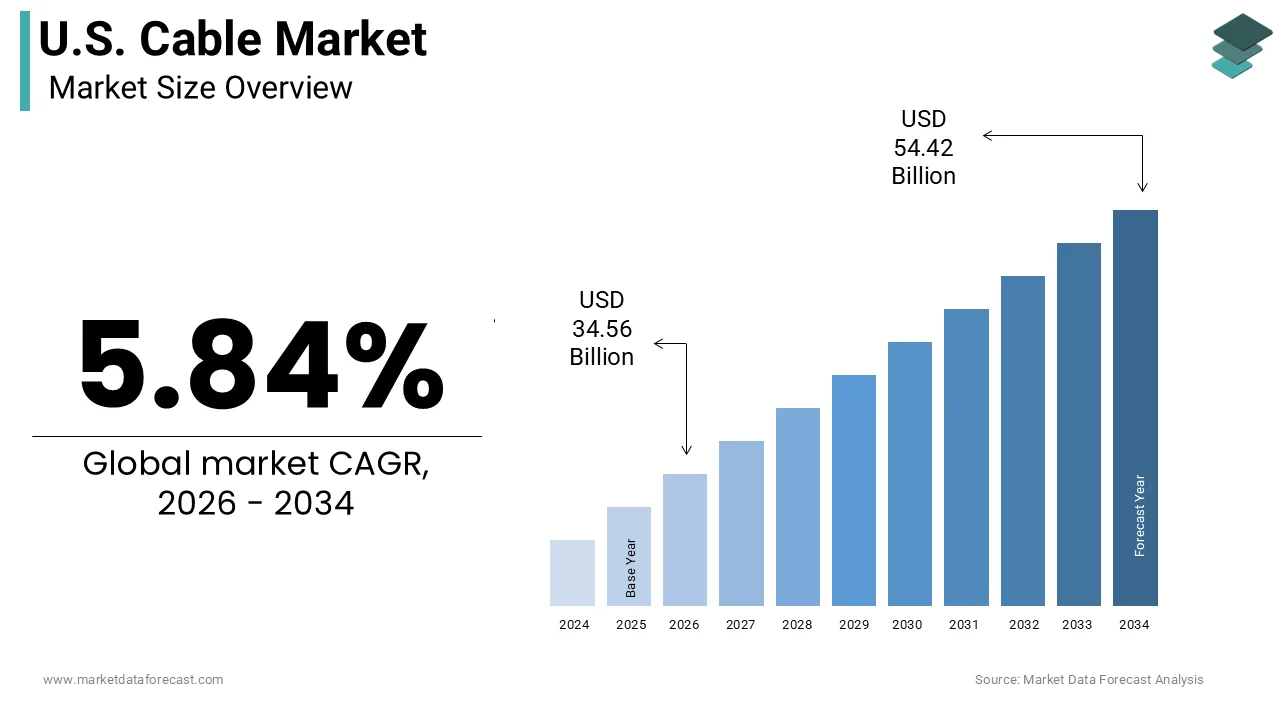
The U.S. cable market size was valued at USD 32.65 billion in 2025 and is anticipated to reach USD 34.56 billion in 2026 and USD 54.42 billion by 2034, growing at a CAGR of 5.84% during the forecast period from 2026 to 2034.
The cable is the infrastructure and service ecosystem dedicated to the transmission of data, video, and voice signals through coaxial and fiber optic networks. The physical network spans millions of miles, connecting households and businesses across diverse geographic terrains. The industry operates within a complex regulatory framework that governs spectrum allocation and network neutrality. Consumer reliance on this infrastructure has intensified due to the proliferation of connected devices. The transition toward hybrid fiber coaxial architectures enables providers to deliver gigabit speeds, enhancing service quality. Infrastructure investment remains critical for maintaining competitive service levels against emerging wireless alternatives. This broader scope reflects the strategic pivot of cable operators toward becoming comprehensive digital service providers.
MARKET DRIVERS
Surging Demand for High-Bandwidth Home Connectivity
The exponential growth in data consumption per household is positively impacting the growth of the United States cable market. Modern digital lifestyles require substantial bandwidth for streaming ultra-high definition content, online gaming, and remote work applications. The video traffic accounted for nearly 60% of all downstream internet traffic in North America during 2025. This dominance of video content necessitates networks capable of handling large data volumes without latency issues. Cable providers have responded by deploying DOCSIS 4.0 technology, which supports multi-gigabit speeds over existing coaxial lines. The average household now consumes over 500 gigabytes of data monthly, a figure that continues to rise as smart home adoption increases. The shift toward telehealth and remote education further amplifies this demand, requiring reliable and high-speed connections. Cable infrastructure offers a cost-effective solution for delivering these speeds compared to full fiber deployment in dense urban areas. The ability to upgrade existing networks allows providers to meet consumer expectations rapidly. This consistent upward trajectory in data usage ensures that cable networks remain essential for modern digital living.
Expansion of Enterprise and Commercial Broadband Services
The increasing digitization of business operations for cable-based enterprise solutions is additionally bolstering the growth of the United States cable market. Small and medium-sized enterprises rely heavily on cable networks for their primary internet connectivity due to favorable cost structures and widespread availability. There are approximately 33 million small businesses in the United States, many of which require robust broadband for cloud computing and customer engagement. Cable providers have developed specialized service tiers that offer symmetric speeds and enhanced security features tailored to commercial needs. The adoption of Internet of Things devices in the retail and logistics sectors further boosts demand for reliable connectivity. Cable networks provide the necessary density and reliability for these applications in urban and suburban environments. Businesses increasingly prioritize service level agreements that guarantee uptime and performance, areas where cable operators have improved significantly. The integration of managed Wi Fi and cybersecurity services adds value to basic connectivity offerings. This diversification allows cable providers to capture higher revenue per enterprise customer. The trend toward hybrid work models also necessitates robust office networks that can support seamless collaboration tools.
MARKET RESTRAINTS
Intense Competition from Fiber Optic Network Expansion
The aggressive rollout of fiber to the premises networks by telecommunications competitors and municipal providers is hindering the growth of the United States cable market. Fiber optic technology offers superior symmetry in upload and download speeds, which appeals to power users and content creators. According to the Fiber Broadband Association, fiber access reached approximately 55% of US homes by the end of 2025, up from 40% in 2022. This rapid expansion erodes the traditional advantage of cable networks in terms of speed and reliability. Telecommunications companies leverage federal funding from the Infrastructure Investment and Jobs Act to accelerate deployment in underserved areas. The availability of billions of dollars in grants incentivizes new entrants to build competing infrastructure. Cable operators face higher costs when attempting to match the pure fiber architecture, as their hybrid systems have inherent physical limitations. Consumers increasingly perceive fiber as the premium option for future-proof connectivity. This shift in consumer preference forces cable providers to engage in price competition, potentially compressing margins. The perception of cable technology as legacy infrastructure may hinder its ability to attract new high-value customers. Operators must invest heavily in marketing and network upgrades to counter the narrative of fiber superiority.
Regulatory Pressures and Net Neutrality Compliance
Evolving regulatory frameworks create operational uncertainties and compliance costs is also hampering the growth of the United States cable market. The reinstatement of net neutrality rules by the Federal Communications Commission imposes strict guidelines on how providers manage network traffic. These regulations prohibit throttling, blocking, or prioritizing certain types of internet traffic, limiting the ability of operators to create tiered service models. Compliance with these mandates necessitates investments in monitoring systems and legal resources. Additionally, state-level regulations vary significantly, creating a fragmented compliance landscape. Some states have enacted their own privacy and data protection laws that affect how cable companies handle customer information. As per the National Conference of State Legislatures, over 20 states introduced comprehensive privacy legislation in 2025, requiring companies to adapt their data handling protocols. These regulatory divergences increase the complexity of operating a national network. Franchise fees and local taxes also impose financial burdens on cable operators, reducing profitability. The uncertainty surrounding future regulatory changes discourages long-term investment planning. Operators must remain agile to adapt to new legal requirements while maintaining service quality. This regulatory environment constrains operational flexibility and increases the cost of doing business.
MARKET OPPORTUNITIES
Integration of Smart Home Ecosystems and Services
The emergence of broadband connectivity with smart home technologies is certainly expected to create new opportunities for the growth of the United States cable market. Cable providers are uniquely positioned to offer integrated solutions that combine internet access with home security, energy management, and automation. According to CEDIA, the smart home market in North America is expected to reach 85 billion USD by 2027, driven by consumer demand for convenience and safety. Cable operators can leverage their existing customer relationships and trusted brand status to cross-sell these services. The installation of professional-grade smart devices requires technical expertise that cable technicians already possess. This service bundle increases customer stickiness and reduces churn rates significantly. The development of proprietary platforms allows providers to control the user experience and gather valuable data on usage patterns. Partnerships with device manufacturers enable the offering of exclusive hardware bundles. The aging population also drives demand for remote monitoring and health-related smart home solutions. Cable networks provide the reliable, low-latency connection required for real-time monitoring applications. Expanding into this ecosystem transforms cable providers from utility suppliers to essential lifestyle partners. This strategic shift opens new revenue streams beyond traditional subscription fees.
Deployment of Advanced DOCSIS 4.0 Technology
The introduction of DOCSIS 4.0 specifications enables cable operators to deliver multi-gigabit speeds, and improved spectral efficiency is also to enhance the growth of the United States cable market. This technological advancement allows providers to maximize the capacity of existing hybrid fiber coaxial networks without the prohibitive costs of full fiber replacement. This capability allows cable companies to compete effectively in markets where fiber deployment is economically challenging. The technology utilizes full duplex capabilities, enabling simultaneous high-speed upload and download transactions. As per Heavy Reading, early deployments of DOCSIS 4.0 in major metropolitan areas demonstrated a 50% improvement in network efficiency. This efficiency gain reduces operational expenses and improves the quality of service for end users. The modular nature of the upgrade allows for phased implementation, minimizing disruption to existing customers. Cable operators can target high-density areas first, where demand for bandwidth is highest. The extended reach of DOCSIS 4.0 also improves service quality in suburban and rural locations. This technological leap extends the lifespan of current infrastructure assets. It provides a clear roadmap for meeting future bandwidth demands while maintaining profitability.
MARKET CHALLENGES
Infrastructure Maintenance and Legacy System Upgrades
The aging physical infrastructure of cable, regarding maintenance and upgrade costs, is one of the challenges for the growth of the United States cable market. Much of the coaxial cable plant was installed decades ago and requires regular refurbishment to prevent signal degradation. According to the American Society of Civil Engineers, the nation's infrastructure grade for communications remains inconsistent, with many local systems showing signs of wear. Replacing outdated amplifiers and nodes involves significant capital expenditure and logistical complexity. Weather events and environmental factors exacerbate the deterioration of outdoor equipment, which is leading to service interruptions. These disruptions damage customer satisfaction and increase operational costs related to repairs and customer support. The transition to digital and IP-based systems requires retrofitting legacy analog components, which can be technically challenging. Skilled labor shortages in the telecommunications sector further complicate maintenance efforts. The demand for telecommunications line installers exceeds the available supply, driving up labor costs. Delaying upgrades risks network obsolescence and loss of competitive advantage. However, accelerating upgrades strains financial resources. Balancing immediate repair needs with long-term modernization goals requires precise strategic planning. The physical vulnerability of aerial cables to storms and accidents remains an inherent risk.
Customer Churn and Subscription Fatigue
The high levels of customer churn and subscription fatigue are also impeding the growth of the United States cable market. Consumers increasingly view broadband as a commodity, switching providers for minor price differences or promotional offers. The bundling of traditional video services with broadband has lost effectiveness as consumers cut the cord in favor of standalone streaming platforms. This unbundling reduces the average revenue per user and diminishes customer loyalty. Price sensitivity has increased due to economic pressures and inflation, making subscribers less willing to pay premium rates. The inflation rates in the communication sector have prompted consumers to scrutinize monthly bills more closely. Cable operators struggle to differentiate their core broadband offerings, leading to price wars that erode margins. The lack of switching costs for consumers facilitates easy migration to competitors. Retaining customers requires continuous investment in loyalty programs and service enhancements, which adds to operational expenses. The perception of poor customer service further exacerbates churn rates. Addressing these issues requires a fundamental shift in customer engagement strategies. Operators must focus on delivering superior value and personalized experiences to reduce attrition.
REPORT COVERAGE
| REPORT METRIC | DETAILS |
| Market Size Available | 2025 to 2034 |
| Base Year | 2025 |
| Forecast Period | 2026 to 2034 |
| CAGR | 5.84% |
| Segments Covered | By Installation Type, Voltage Type, End User, And Region |
| Various Analyses Covered | Global, Regional & Country Level Analysis; Segment-Level Analysis; DROC, PESTLE Analysis; Porter’s Five Forces Analysis; Competitive Landscape; Analyst Overview of Investment Opportunities |
| Regions Covered | New York, Massachusetts, Pennsylvania, Illinois, Ohio, Michigan, Texas, Florida, Georgia, California, Washington, Colorado. |
| Market Leaders Profiled | Prysmian Group, Southwire Company LLC, Nexans, Belden Inc., General Cable Technologies Corporation, CommScope Holding Company Inc., Leviton Manufacturing Co. Inc., LS Cable & System, Encore Wire Corporation, Atkore Inc. |
SEGMENTAL ANALYSIS
By Installation Type Insights
The underground installation segment was the largest by holding a prominent share of the United States cable market in 2025 due to stringent municipal regulations and the ongoing modernization of urban infrastructure. City planners and local governments increasingly mandate underground cabling for new developments to preserve aesthetic appeal and reduce visual clutter. The reliability of underground systems during adverse weather conditions further solidifies their dominance. As per the Department of Energy, underground lines experience 50% fewer outages caused by wind and ice compared to overhead counterparts. This resilience is critical for maintaining continuous service in climate-vulnerable zones. The longevity of underground infrastructure also contributes to its prevalence, with typical lifespans exceeding 40 years. Utility providers prefer this durability to minimize long-term maintenance costs. The concentration of population in urban centers, where space is limited and safety standards are high, drives the continued preference for buried cables. The initial higher installation cost is offset by reduced operational expenses and improved service quality, making it the preferred choice for sustainable urban development.
The submarine cable segment is expected to grow at the fastest CAGR of 23.4% from 2026 to 2034, with the aggressive expansion of offshore wind energy projects. The federal government has set ambitious targets for renewable energy generation, leading to a surge in offshore wind farm developments along the Atlantic and Pacific coasts. According to the Bureau of Ocean Energy Management, the United States has leased areas for offshore wind projects that could generate up to 30 gigawatts of electricity by 2030. Connecting these remote offshore turbines to the onshore grid requires extensive submarine cable networks. These cables must withstand harsh marine environments, driving innovation in materials and installation techniques. The complexity of these projects necessitates specialized engineering solutions, creating a high-value niche within the cable market. The demand for high-voltage direct current submarine cables is particularly strong, as they enable efficient long-distance power transmission with minimal losses. This technological requirement accelerates the adoption of advanced submarine cable systems. The strategic importance of energy independence and carbon reduction goals further fuels this growth trajectory.
By Voltage Type Insights
The low-voltage cables segment was the largest by holding 34.4% of the United States cable market share in 2025 due to their ubiquitous application in residential and commercial construction sectors. These cables are essential for powering lighting, appliances, and general electrical circuits in buildings. The consistent demand from the real estate sector ensures a stable and large market base for low-voltage products. Furthermore, the renovation and retrofitting of existing buildings contribute significantly to consumption. Low-voltage cables are preferred for their ease of installation and compliance with standard building codes. The widespread availability of skilled electricians trained in low-voltage systems facilitates rapid deployment. Safety regulations strictly govern the use of low-voltage wiring in indoor environments, reinforcing its standardized usage. The integration of smart home devices also relies on low-voltage infrastructure for power and data transmission. This convergence of traditional electrical needs with modern technology trends sustains the dominance of low-voltage cables. The sheer volume of endpoints in residential and commercial spaces outweighs the specialized applications of higher voltage categories.
The high voltage cables segment is expected to grow at the fastest CAGR of 11.2% from 2026 to 2034, with the extensive grid modernization initiatives and the integration of renewable energy sources. The aging electrical grid requires significant upgrades to handle increased load and improve reliability. The federal government has allocated 65 billion USD for grid infrastructure improvements under the Infrastructure Investment and Jobs Act. A substantial portion of this funding supports the installation of high-voltage transmission lines to connect remote renewable energy facilities to urban centers. As per the North American Electric Reliability Corporation, the addition of 200 gigawatts of new renewable capacity by 2030 necessitates expanded high-voltage transmission networks. These cables enable efficient long-distance power transport with minimal energy loss. The transition from fossil fuels to wind and solar power requires a more flexible and robust transmission system. High-voltage direct current technology is increasingly deployed for its superior efficiency in bulk power transfer. Utility companies are prioritizing these investments to meet regulatory mandates and consumer demand for clean energy. The complexity of these projects drives demand for specialized high-voltage cable solutions.
By End Use Insights
The IT and Telecommunication segment accounted for a prominent share of the United States cable market in 2025 due to the pervasive demand for broadband connectivity and the expansion of data center infrastructure. Every residential and commercial entity requires reliable cabling for internet access and internal networking. The proliferation of 5G networks further amplifies this demand, requiring dense fiber optic deployments for backhaul and fronthaul connections. Data centers, the backbone of the digital economy, consume vast quantities of high-performance cables for server interconnectivity. These facilities require continuous upgrades to support increasing data traffic and cloud services. The shift toward edge computing also drives the deployment of localized cabling networks. The reliance on digital services for work, education, and entertainment ensures steady demand. Telecommunications providers continuously upgrade their networks to higher capacities, replacing older copper lines with fiber optics. This technological refresh cycle sustains high volume consumption.
The Energy and Power segment is expected to grow at an anticipated CAGR of 9.8% during the forecast period, with the rapid development of renewable energy infrastructure. The transition away from fossil fuels requires extensive cabling for solar farms, wind turbines, and energy storage systems. Wind energy projects, both onshore and offshore, also demand robust cabling solutions for turbine connectivity and grid integration. Energy storage systems, essential for grid stability, require high-performance cables for battery interconnections. The Inflation Reduction Act provides substantial tax credits for renewable energy projects, accelerating their deployment. These incentives stimulate investment in new facilities, directly boosting cable consumption. The technical requirements of renewable energy systems, such as resistance to environmental stressors, drive the adoption of advanced cable technologies. Manufacturers are innovating to meet these specific needs, creating high-value opportunities. The scale of the energy transition is unprecedented, requiring a massive overhaul of existing infrastructure. This comprehensive rebuild ensures that the Energy and Power segment will experience superior growth rates. The commitment to sustainability and energy independence underpins this long-term expansion trajectory.
COMPETITION OVERVIEW
The competition in the United States cable market is characterized by intense rivalry among established global manufacturers and specialized domestic producers. Market participants compete primarily on product quality, technological innovation, and service reliability rather than price alone. The presence of large multinational corporations creates a consolidated environment where scale and broad product portfolios offer significant advantages. However, niche players maintain relevance by focusing on specific applications such as submarine or high-voltage specialty cables. Continuous investment in research and development is essential for companies to introduce superior products that meet evolving industry standards. Regulatory compliance and sustainability initiatives also serve as key differentiators in this competitive landscape. Customers increasingly prefer suppliers who can provide comprehensive solutions, including installation support and maintenance services. The barrier to entry remains high due to substantial capital requirements and strict certification processes.
KEY MARKET PLAYERS
A few major players of the U.S cable market include
- Prysmian Group
- Southwire Company LLC
- Nexans
- Belden Inc
- General Cable Technologies Corporation
- CommScope Holding Company Inc
- Leviton Manufacturing Co. Inc
- LS Cable & System
- Encore Wire Corporation
- Atkore Inc
Leading Players in the US Cable Market
- CommScope Holding Company Inc serves as a critical infrastructure provider with extensive involvement in the United States cable market. The company specializes in developing advanced connectivity solutions for communication networks and data centers. CommScope recently launched its next-generation DOCSIS 4.0 portfolio to support multi-gigabit services for cable operators. This innovation enables service providers to deliver faster internet speeds over existing hybrid fiber coaxial networks. The company also expanded its manufacturing capabilities in North America to reduce supply chain dependencies. Their strategic partnerships with major telecommunications firms facilitate the deployment of cutting-edge network technologies. These efforts strengthen their position as a leading supplier of high-performance cable systems and related hardware components for the domestic market.
- Prysmian Group maintains a robust presence in the United States cable market through its comprehensive product offerings and local manufacturing footprint. The global leader in energy and telecom cable systems operates several production facilities across the country. Prysmian recently completed the expansion of its high-voltage cable plant in South Carolina to meet growing demand. This facility produces advanced underground and submarine power cables for renewable energy projects. The company actively participates in major grid modernization initiatives supported by federal funding. Prysmian also invests heavily in sustainable manufacturing practices to align with environmental regulations. Their technical expertise in complex installation projects provides a competitive advantage in the utility sector.
- Nexans SA plays a significant role in the United States cable market by providing specialized solutions for various industrial and commercial applications. The French multinational has strengthened its domestic operations through targeted investments in local distribution networks. Nexans recently introduced a new line of fire-resistant cables designed for critical infrastructure and high-rise buildings. This product launch addresses stringent safety requirements in urban construction projects. The company also focuses on digitalizing its supply chain to improve delivery times and customer service. Nexans collaborates with engineering firms to develop customized cabling systems for data centers and healthcare facilities. Their commitment to innovation extends to smart cable technologies that enable real-time monitoring of network health. These strategic initiatives enhance their ability to serve diverse sectors while maintaining high-quality standards and strengthening their competitive position in the American marketplace.
Top Strategies Used by Key Market Participants
- Key players in the United States cable market primarily employ product innovation and strategic expansion to maintain competitive advantages. Companies invest heavily in research and development to create advanced cables that support higher bandwidths and greater energy efficiency. Launching next-generation technologies such as DOCSIS 4.0-compatible systems allows providers to meet increasing consumer demands for speed. Manufacturers also focus on expanding local production capacities to mitigate supply chain risks and reduce lead times. Establishing new facilities in key regions ensures quicker response to market needs and lowers transportation costs. Strategic partnerships with technology firms and utility providers facilitate the integration of smart features into cable systems. Additionally, companies prioritize sustainability by adopting eco-friendly materials and manufacturing processes to comply with regulatory standards.
MARKET SEGMENTATION
This research report on the U.S. cable market is segmented and sub-segmented into the following categories.
By Installation Type
- Overhead
- Underground
- Submarine
By Voltage Type
- High
- Medium
- Low
By End Use
- Industrial
- Aerospace and Defense
- Oil and Gas
- Energy and Power
- IT and Telecommunication
- Others
By Region
- New York
- Massachusetts
- Pennsylvania
- Illinois
- Ohio
- Michigan
- Texas
- Florida
- Georgia
- California
- Washington
- Colorado
Frequently Asked Questions
1. What factors are driving the growth of the U.S. cable market?
Key drivers include rising energy infrastructure investments, rapid urbanization, expansion of broadband networks, growth in renewable energy, and modernization of power grids.
2. What are the major challenges in the market?
Volatility in raw material prices, supply chain disruptions, infrastructure aging, and high installation and maintenance costs.
3. How large is the U.S. cable market?
The market is valued in the tens of billions of dollars, with steady growth expected over the next decade due to increasing demand in both power and data transmission segments.
4. Which types of cables are commonly used in the U.S. market?
The major types include power cables, coaxial cables, fiber optic cables, data cables, instrumentation cables, and control cables.
5. Who are the key market players in the U.S. cable industry?
Key players include Southwire Company, LLC, General Cable Technologies Corporation, Prysmian Group, Nexans S.A., Belden Inc., CommScope Holding Company, Inc., and others.
6. Which sectors contribute the most to market demand?
Major demand comes from energy & utilities, construction, telecommunication, manufacturing, transportation, and data centers.
7. How does renewable energy affect cable demand?
The shift toward solar and wind energy is increasing the need for high-voltage power transmission cables, underground cables, and fiber connectivity to support smart grids.
8. What role does government regulation play in the cable market?
Regulations and standards for safety, energy efficiency, and broadband expansion (such as infrastructure funding bills) significantly influence market development.
9. What are the current market trends?
Key trends include the adoption of fiber optic cables, grid modernization, underground cabling, smart city infrastructure, and technological advancements in cable design.
10. What are the opportunities in the U.S. cable market?
Opportunities lie in renewable energy integration, 5G infrastructure rollout, data center expansion, smart grids, and electric vehicle charging networks.
Related Reports
Access the study in MULTIPLE FORMATS
Purchase options starting from
$ 1200
Didn’t find what you’re looking for?
TALK TO OUR ANALYST TEAM
Need something within your budget?
NO WORRIES! WE GOT YOU COVERED!
Call us on: +1 888 702 9696 (U.S Toll Free)
Write to us: sales@marketdataforecast.com