- Product Description Description
- Table of Contents TOC
- List of Table & Figure LOT
- Get Free Sample PDF Sample PDF
U.S. Clinical Trials Market Size
The U.S. clinical trials market size was valued at USD 6.50 billion in 2024 and is anticipated to reach USD 6.99 billion in 2025 from USD 12.56 billion by 2033, growing at a CAGR of 7.83% during the forecast period from 2025 to 2033.
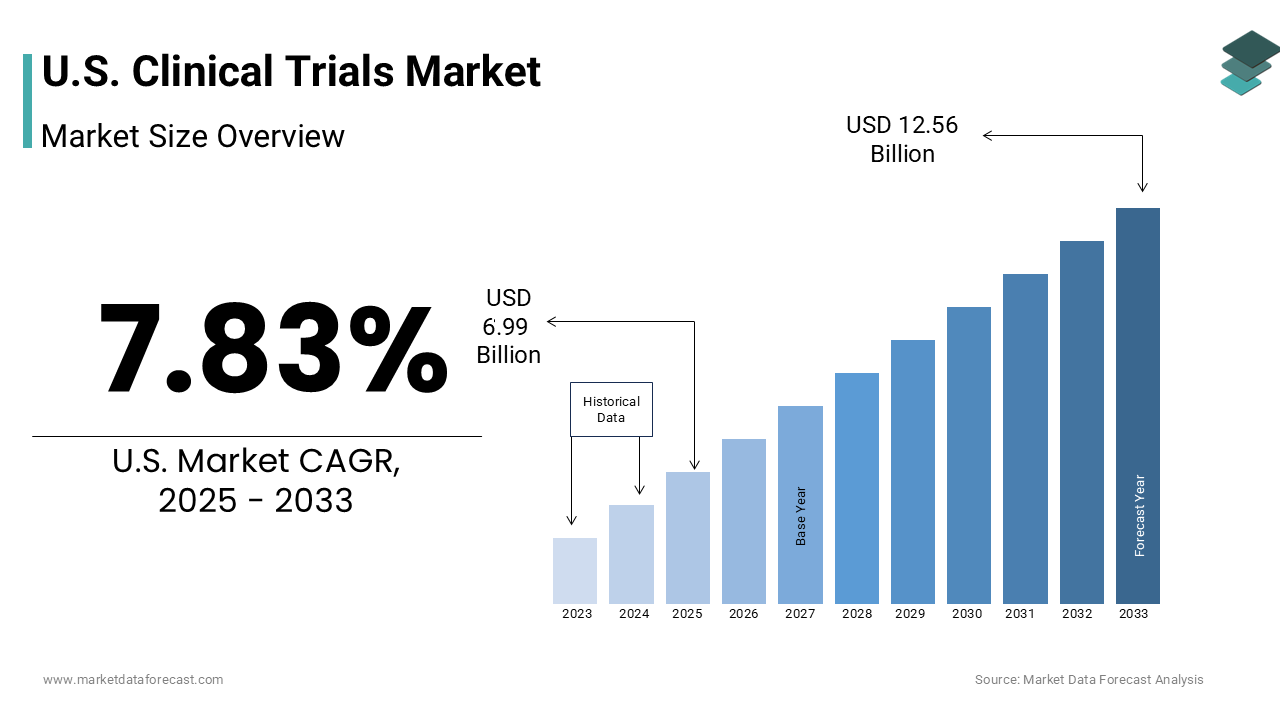
Clinical trials are the most rigorous and high-stakes biological experiments, where human physiology becomes data, and medical progress hinges on ethical precision under immense time pressure. According to the National Institutes of Health, over 400,000 participants enroll in clinical trials annually across more than 350,000 active studies, with nearly 70% focused on oncology, neurology, and autoimmune conditions diseases that collectively account for 68% of U.S. mortality.
MARKET DRIVERS
Accelerated Regulatory Pathways and the Rise of Breakthrough Therapies
The FDA’s expanded use of accelerated approval pathways, particularly the Breakthrough Therapy designation has transformed trial design from linear progression to parallel validation. The rising breakthrough therapies are solely propelling the growth of the U.S. clinical trials market. sFor example, the CAR-T therapy Kymriah received accelerated approval based on a single-arm study of 63 pediatric patients with relapsed leukemia, which is a cohort once deemed too small for regulatory acceptance.
Patient-Centric Recruitment Through Decentralized Trial Models and Digital Engagement
The traditional model of centralized trial sites often inaccessible to rural, elderly, or mobility-limited populations can also enhance the growth of the U.S. clinical trials market. According to the Tufts Center for the Study of Drug Development, DCT participation increased by 310% between 2020 and 2023, with 68% of new oncology and rare disease trials now incorporating at least one decentralized component. The access by linking EHR data from 1.2 million diverse Americans to trial matching algorithms by identifying eligible candidates without requiring them to seek out studies is also gearing up to promote the growth of clinical trials market in the US.
MARKET RESTRAINTS
Chronic Underrepresentation of Diverse Populations Despite Regulatory Mandates
The racial and ethnic disparities in clinical trial enrollment persist at alarming levels, which is hampering the growth of the U.S. clinical trials market. A 2022 analysis in JAMA Network Open found that 73% of trials explicitly exclude individuals with Medicaid or without reliable transportation, effectively barring low-income populations. Institutional bias, language barriers, lack of community outreach, and mistrust stemming from historical abuses like Tuskegee continue to deter participation.
Fragmented Data Infrastructure and Lack of Interoperability Across Sites
The clinical trials remain trapped in siloed, paper-heavy systems incompatible with modern digital health ecosystems. Over 80% of U.S. trial sites still rely on proprietary electronic data capture (EDC) platforms that cannot communicate with hospital EHRs or patient-reported outcome tools by forcing manual re-entry of data, which is a process riddled with errors. Meanwhile, the absence of a unified patient identifier prevents longitudinal tracking across studies, undermining efforts to analyze long-term outcomes or adverse event patterns.
MARKET OPPORTUNITIES
Integration of Real-World Evidence and Longitudinal Health Data into Trial Design
The integration of EHRs, claims databases, and consumer wearables is enabling trials to leverage real-world evidence (RWE) as primary or supplemental endpoints by reducing reliance on costly, artificial trial environments. This attribute is greatly influencing the growth of the U.S. clinical trials market to grow even stronger in the coming years. The FDA has accepted RWE in support of seven drug approvals since 2020, including a Parkinson’s treatment approved based on movement data collected via smartwatches from 1,200 patients tracked over 18 months. Companies like Flatiron Health and IBM Watson Health aggregate de-identified data from over 20 million cancer patients by allowing sponsors to simulate control arms and predict recruitment rates with machine learning models. This transforms trials from isolated experiments into continuous learning loops, where every patient interaction contributes to future protocol refinement.
Expansion into Rare Disease and Pediatric Trials Through Orphan Drug Incentives and Gene Therapy Innovation
The growing incidences of rare diseases and pediatric trials with the launch of innovation in healthcare are positively impacting on the growth of the U.S. clinical trials market. Trials for conditions like spinal muscular atrophy (SMA) and Duchenne muscular dystrophy now enroll fewer than 50 patients nationally. The NIH’s Undiagnosed Diseases Network has identified 89 previously unknown genetic disorders since 2014, each representing a potential trial opportunity.
MARKET CHALLENGES
Ethical Tensions Around Placebo Use in Life-Threatening Conditions
The ethical foundation of randomized placebo-controlled trials is increasingly untenable, which is one of the challenges for the growth of the US clinical trials market. A 2023 editorial in The New England Journal of Medicine condemned a Phase III trial for metastatic pancreatic cancer that used a placebo arm despite available palliative chemotherapy, calling it “scientifically necessary but ethically indefensible.” Similar dilemmas arise in ALS, Huntington’s, and pediatric neurodegenerative disorders, where families refuse enrollment unless all participants receive active treatment.
Workforce Burnout and Systemic Underinvestment in Clinical Research Personnel
The overburdened workforce of coordinators, nurses, data managers, and monitors, where professionals whose compensation lags far behind their responsibilities is inhibiting the growth of the US clinical trials market. According to the Association of Clinical Research Professionals, 61% of clinical trial coordinators report symptoms of severe burnout, with turnover rates exceeding 35% annually, nearly double the healthcare average. Many sites operate with one coordinator managing 15–20 concurrent trials, each requiring hundreds of hours of documentation, patient follow-up, and regulatory compliance.
REPORT COVERAGE
| REPORT METRIC | DETAILS |
| Market Size Available | 2024 to 2033 |
| Base Year | 2024 |
| Forecast Period | 2025 to 2033 |
| Segments Covered | By Phase, Application, and Region. |
| Various Analyses Covered | Global, Regional, & Country Level Analysis; Segment-Level Analysis, Drivers, Restraints, Opportunities, Challenges, PESTLE Analysis, Porter’s Five Forces Analysis, Competitive Landscape, Analyst Overview of Investment Opportunities |
| Regions Covered | North America, Europe, Asia Pacific, Latin America, Middle East, and Africa |
| Key Market Players | IQVIA Holdings Inc., PAREXEL International Corporation, Thermo Fisher Scientific Inc., Charles River Laboratories, ICON plc, Wuxi AppTec, Medpace Holdings Inc., Syneos Health, Laboratory Corporation of America Holdings (LabCorp), and SGS SA, Pfizer, Eli Lilly, Novo Nordisk, AstraZeneca, and Merck & Co. |
SEGMENTAL ANALYSIS
By Phase Insights
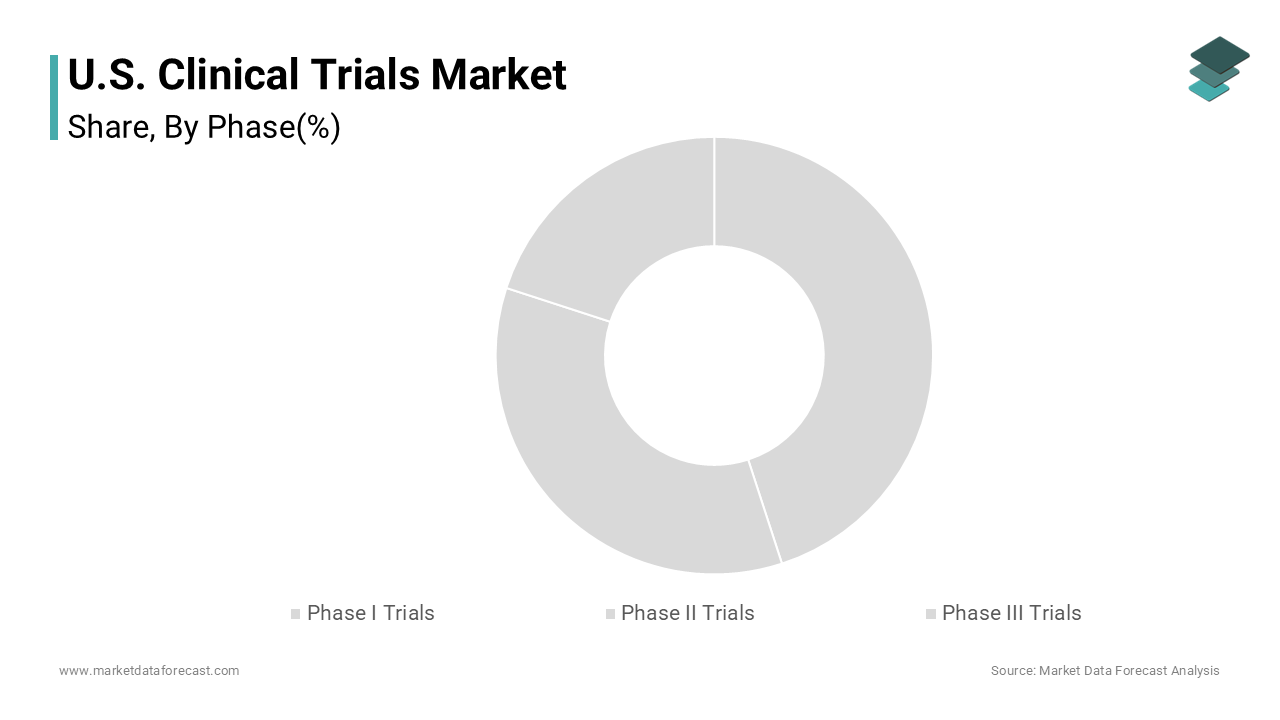
The Phase II segment was accounted in holding 43.2% of the US clinical trials market share in 2024. The growth of the segment is due to the pivotal role as the gatekeeper between early safety assessment and large-scale efficacy validation for complex modalities like biologics, gene therapies, and precision oncology agents. Phase II trials are designed to test therapeutic effect in specific patient subpopulations, often using biomarker-driven enrollment, which has become standard in oncology and autoimmune disease.
The Phase IV segment is likely to grow with an expected CAGR of 12.6% during the forecast period with the regulatory mandates, post-market surveillance demands, and the integration of real-world evidence (RWE) into lifecycle management. The NIH’s All of Us Research Program now links EHR data from over 1.2 million Americans to drug registries by enabling automated detection of rare adverse events such as myocarditis following mRNA vaccines. Additionally, payers like Medicare and private insurers increasingly demand Phase IV outcomes data to determine reimbursement, particularly for high-cost therapies like CAR-T and gene editing treatments.
By Application Insights
The Oncology segment held 47.3% of the US clinical trials market share in 2024 with the staggering burden of cancer nearly 2 million new diagnoses annually and the integration of scientific breakthroughs, regulatory incentives, and patient advocacy. Precision medicine has further intensified activity with tumor sequencing now guiding enrollment in over 58% of new oncology trials, allowing smaller, more targeted cohorts.
The metabolic disorder segment is likely to grow with an expected CAGR of 15.8% during the forecast period with the the epidemic of obesity, type 2 diabetes, and non-alcoholic fatty liver disease (NAFLD) conditions affecting over 130 million U.S. adults. GLP-1 receptor agonists like semaglutide and tirzepatide have revolutionized treatment paradigms, triggering a cascade of follow-on trials targeting weight loss, insulin sensitization, and organ-specific protection. The NIH’s REACH program allocated $900 million in 2023 to fund multi-center trials evaluating combination therapies that target gut microbiome modulation, mitochondrial function, and inflammation simultaneously.
REGIONAL ANALYSIS
New York Clinical Trials Market Analysis
New York was the top performer of the US clinical trials market by accounting for 19.4% of share in 2024. Over 38% of U.S.-based Phase III oncology trials are led by New York sites, and the city hosts the highest density of FDA-inspected clinical research units per capita. The state’s robust Medicaid infrastructure enables access to diverse patient populations, including high proportions of Black and Hispanic participants for equitable trial representation.
California Clinical Trials Market Analysis
California was positioned second by holding 12.3% of the US clinical trials market share in 2024. The state’s unique demographic diversity, including large Latino, Asian, and Indigenous population makes it indispensable for inclusive recruitment for rare genetic disorders and conditions with ethnic disparities like prostate cancer and lupus. California also leads in decentralized trial adoption: 56% of its oncology trials now incorporate remote monitoring, home visits, or telehealth check-ins, supported by state-funded broadband equity programs. The Department of Public Health’s “Trial Equity Initiative” provides grants to community clinics for trial navigation services, reducing barriers for low-income and non-English-speaking participants.
KEY MARKET PLAYERS
A few of the major companies in the U.S. clinical trials market include
- IQVIA Holdings Inc.
- PAREXEL International Corporation
- Thermo Fisher Scientific Inc.
- Charles River Laboratories
- ICON plc
- Wuxi AppTec
- Medpace Holdings Inc.
- Syneos Health
- Laboratory Corporation of America Holdings (LabCorp)
- SGS SA
- Pfizer
- Eli Lilly
- Novo Nordisk
- AstraZeneca
- Merck & Co.
MARKET SEGMENTATION
This research report on the United States clinical trials market has been segmented based on phase, application, and region.
By Phase
- Phase I Trials
- Phase II Trials
- Phase III Trials
By Application
- Oncology
- CNS Disorder
- Cardiology
- Infectious Disease
- Metabolic Disorder
- Renal/Nephrology
- Others
By Country
- The United States