- Product Description Description
- Table of Contents TOC
- List of Table & Figure LOT
- Get Free Sample PDF Sample PDF
U.S. Disposable Face Mask Market Size
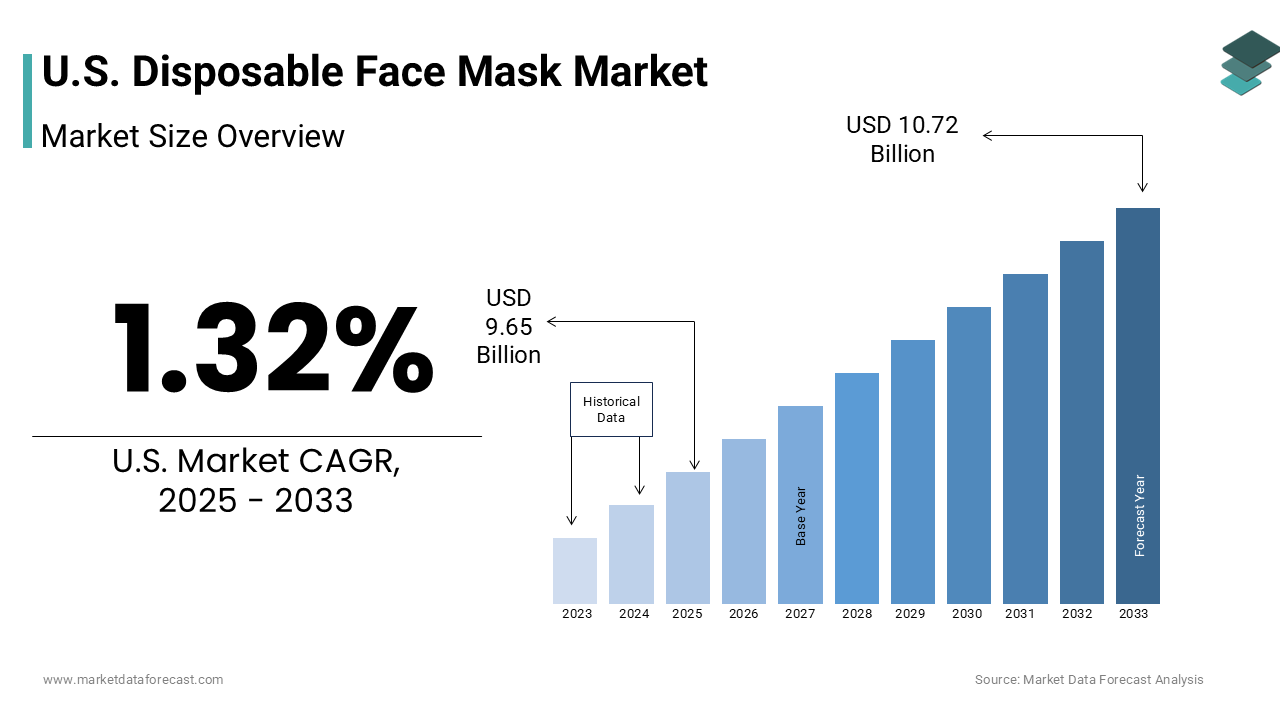
The disposable face mask market size in the United States was valued at USD 9.52 billion in 2024, is estimated to reach USD 9.65 billion in 2025, and is projected to reach USD 10.72 billion by 2033, growing at a CAGR of 1.32% from 2025 to 2033.
Disposable face masks are single-use protective coverings designed primarily for respiratory hygiene, infection control, and particulate filtration, predominantly utilized in healthcare, industrial, and consumer spheres. While pandemic-era mandates have receded, cultural normalization and residual institutional protocols sustain baseline consumption. As per studies, a portion of U.S. adults retained mask-wearing habits during respiratory virus surges, particularly in clinical or crowded transit environments. Concurrently, according to the Occupational Safety and Health Administration, millions of U.S. workers remain under respiratory protection standards in sectors like construction and chemical handling. This behavioral and regulatory inertia, rather than an acute crisis, now defines the market’s operational reality.
MARKET DRIVERS
Institutional Infection Control Protocols
Healthcare facilities continue to enforce mask mandates for staff and visitors regardless of community transmission levels, which enhances the growth of the U.S. disposable face mask market. As per the American Hospital Association, a share of U.S. acute care hospitals maintained universal masking policies for clinical areas in 2023, even after federal emergency declarations expired. This institutional inertia stems from Joint Commission accreditation standards requiring infection prevention measures, including source control via masks. Furthermore, as per sources, there has been a year-over-year increase in healthcare-associated respiratory infections in 2024, which strengthens administrative caution. So, this structural demand absorbs significant disposable masks annually, independent of public health emergencies, due to the large number of hospitals and long-term care facilities nationwide.
Occupational Safety Compliance in High-Risk Sectors
Beyond healthcare, industries governed by OSHA’s respiratory protection standard (29 CFR 1910.134) sustain consistent procurement, which drives the expansion of the U.S. disposable face mask market. As per the Bureau of Labor Statistics, millions of U.S. workers in construction, manufacturing, and hazardous materials handling are subject to mandatory respiratory protection where engineering controls are insufficient. In 2023, OSHA issued more than 2,000 citations related to respiratory protection violations, which reflects rigorous enforcement. Notably, the construction sector alone consumed millions of disposable N95-equivalent masks last year, according to the Associated General Contractors of America. These masks serve dual purposes i.e. compliance with permissible exposure limits for silica, asbestos, and fumes, and as a frontline defense against incidental bioaerosols, which embeds mask usage into operational workflows irrespective of pandemic conditions.
MARKET RESTRAINTS
Consumer Behavioral Regression and Perception Shifts
Post-pandemic, voluntary mask usage among the general public has sharply declined, which constrains the growth of the U.S. disposable face mask market. As per a Kaiser Family Foundation survey in 2023, only a portion of U.S. adults reported regularly wearing masks in indoor public spaces, down from that in 2022.
This regression correlates with diminished perceived personal risk, and the same survey found a percentage of respondents believe their individual infection risk is “low” or “very low.” Retailers like Walgreens and CVS pointed out a drop in over-the-counter mask sales between 2022 and 2023. Hence, discretionary consumption remains minimal due to the absence of institutional mandates, which leaves manufacturers reliant on B2B channels and vulnerable to inventory gluts during demand troughs.
Regulatory Ambiguity and Inconsistent Enforcement
The absence of unified federal masking mandates has fragmented compliance, which is a major restraint affecting the U.S. disposable face mask market. As per sources, by 2024, decisions on masking were being made at the local or facility level. For example, in January 2024, the NYC Department of Health and Mental Hygiene advised masking in healthcare facilities, which is a local recommendation, not a statewide mandate. This jurisdictional inconsistency complicates supply chain planning for distributors serving multi-state clients. Moreover, the Government Accountability Office documented that Inconsistent, local-level mask policies have caused operational difficulties for organizations like national chains and healthcare systems. For example, some California counties maintained masking requirements in healthcare settings while others did not, forcing national and regional systems to navigate different rules. Such fragmentation suppresses bulk procurement confidence.
MARKET OPPORTUNITIES
Integration with Climate and Pollution Mitigation Trends
Rising ambient air pollution and wildfire smoke events are setting up new opportunities for the U.S. disposable face mask market. As per sources, 137 million Americans lived in counties with unhealthy air quality days in 2023, a 22% increase from 2020.
During the Canadian wildfire smoke event in June 2023, N95 mask sales in affected Northeastern states surged 340% within 72 hours, according to research. Public health agencies like the American Lung Association now explicitly recommend N95 masks during code red air quality alerts. This emerging use case decouples mask demand from infectious disease cycles, which creates a seasonal, geography-specific consumption pattern that manufacturers can target via regional distribution partnerships and public awareness campaigns.
Technological Differentiation Through Functional Add-Ons
Innovation in material science enables value-added features like antiviral coatings moisture-wicking linings and biodegradable substrates all of which transform commoditized masks into premium health accessories are giving fresh opportunities for the expansion of the U.S. disposable face mask market. As per studies, The number of patents related to masks and other functional face coverings did increase between 2020 and 2023, particularly in 2021. The surge was spurred by public health needs during the pandemic. Consumer willingness to pay premiums is evident. According to research, a share of U.S. consumers would pay more for masks with verified antimicrobial protection. Startups have already secured FDA-cleared claims for virus-neutralizing masks by capturing niche but high-margin segments. This trajectory allows manufacturers to escape price wars by embedding clinical efficacy and comfort into product design.
MARKET CHALLENGES
Supply Chain Fragility and Raw Material Volatility
Dependence on imported melt-blown polypropylene and nose wire components, primarily from China and Southeast Asia, is hampering the growth of the U.S. disposable face mask market. As per sources, the U.S. does import a significant amount of medical supplies, including masks and filtration media. Geopolitical tensions and export controls have disrupted logistics. According to studies, supply chain disruptions and customs delays did occur, particularly during the peak of the pandemic. Domestic production capacity remains insufficient.
Greenwashing Accusations and Waste Management Backlash
Environmental groups increasingly target disposable mask producers for contributing to plastic pollution, which threatens brand equity and thereby impedes the expansion of the U.S. disposable face mask market. As per research, face masks are among the notable collected plastic items globally, with U.S. volunteers retrieving large number of discarded masks from waterways and beaches. Municipal waste authorities in California and New York estimate mask-related non-recyclable waste added tons to landfills in 2023 alone. Since 2022, the FTC has taken action against companies for misleading consumers about face masks. Thus, a lack of verifiable biodegradation certifications or scalable take-back programs exposes manufacturers to reputational risk and potential litigation under state extended producer responsibility laws under consideration in seven states.
REPORT COVERAGE
| REPORT METRIC | DETAILS |
| Market Size Available | 2024 to 2033 |
| Base Year | 2024 |
| Forecast Period | 2025 to 2033 |
| Segments Covered | By Product, Distribution Channel, Application and Region. |
| Various Analyses Covered | Global, Regional, & Country Level Analysis; Segment-Level Analysis, Drivers, Restraints, Opportunities, Challenges, PESTLE Analysis, Porter’s Five Forces Analysis, Competitive Landscape, Analyst Overview of Investment Opportunities |
| Key Market Players | 3M, Honeywell International, Kimberly-Clark, Moldex-Metric, Owens & Minor, Prestige Ameritech, Alpha Pro Tech, DuPont, Kowa, Uvex Group, SAS Safety, and The Gerson Company. |
SEGMENTAL ANALYSIS
By Product Insights
In 2024, the non-woven masks segment led the U.S. disposable face mask market by occupying a share of 58.4% in 2024. Their optimal balance of filtration efficiency, breathability, and cost-effectiveness and their status as the default selection across clinical and consumer environments drive the growth of the non-woven masks segment. As per sources, a portion of U.S. outpatient clinics and urgent care centers specify non-woven surgical masks as minimum PPE for staff-patient interactions. Their dominance is further entrenched by FDA-cleared performance benchmarks. ASTM Levels 2 and 3 non-woven surgical masks do filter particles 0.1 microns or larger. Under the ASTM F2100 standard, the particle filtration efficiency (PFE) test evaluates a mask's ability to filter sub-micron particles with a size of 0.1 microns. Both Level 2 and Level 3 masks must demonstrate greater than or equal to 98% filtration efficiency for particles at this size. Their structural versatility also permits scalable automation in manufacturing, domestic output rose year-over-year, supporting supply reliability.
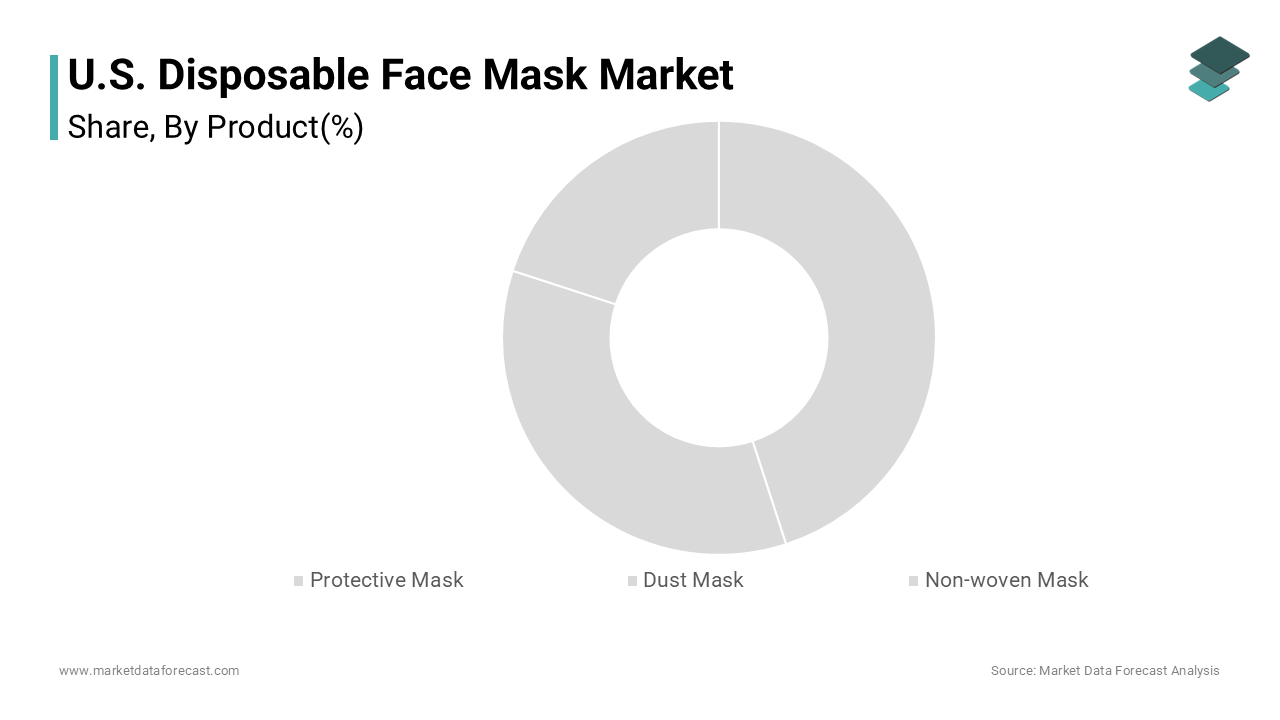
The protective masks segment is predicted to witness the highest CAGR of 11.2% from 2025 to 2033 due to occupational mandates and environmental threats converge. As per research citations for inadequate respiratory protection in construction and manufacturing rose, which compels employers to upgrade from basic dust masks. Simultaneously, the Environmental Protection Agency logged air quality emergency declarations, triggering consumer stockpiling. NielsenIQ recorded a 210% spike in N95 sales during smoke advisories. The Centers for Disease Control and Prevention now explicitly recommends NIOSH-approved respirators for immunocompromised individuals during respiratory virus season, a guideline adopted by 76% of oncology and dialysis centers, per the American Society of Clinical Oncology. This dual institutional-consumer pull is accelerating adoption beyond crisis-response cycles.
By Distribution Channel Insights
The Offline distribution segment dominated the U.S. disposable face mask market and held 67.5% share in 2024. The growth of the offline distribution segment is primarily driven by hospital group purchasing organizations, industrial safety wholesalers, and pharmacy chains, which is supported by contractual procurement models and regulatory traceability requirements. As per studies, a portion of acute care facilities source masks through long-term contracts with distributors, which ensures compliance with FDA Unique Device Identification mandates. Even in retail, brick-and-mortar pharmacies retained aportion of mask sales volume, according to research, as consumers prioritize tactile verification of certifications and immediate availability during health flare-ups or pollution events.
The e-commerce segment is estimated to register the fastest CAGR of 14.8% over the forecast period owing to the factors such as B2B digitization and direct-to-consumer subscription models which reshape procurement. As per studies, online B2B mask sales to small clinics and dental offices grew, fueled by platforms like Medline’s digital storefront that offer real-time inventory and compliance documentation. On the consumer side, Amazon and Walmart.com captured a portion of household mask purchases in 2023, as per sources, driven by algorithmic replenishment prompts and bundled wellness kits. Algorithm-driven auto-replenishment, coupled with AI-powered sizing and filtration recommendation engines, is converting sporadic buyers into recurring subscribers.
By Application Insights
The industrial application segment captured a leading share of 63.5% of the U.S. disposable face mask market share in 2024. The domination of the industrial application segment is majorly attributed to enforceable regulatory frameworks and workforce scale. As per research, millions of U.S. workers are legally required to use respiratory protection where airborne hazards exceed permissible exposure limits. According to studies, a share of respiratory-related citations involved failure to provide NIOSH-certified masks, which compels employers to standardize procurement. In construction alone, millions of masks were consumed in 2023, driven by silica dust regulations under OSHA’s 29 CFR 1926.1153. Unlike discretionary personal use, industrial demand is non-negotiable, contractually embedded, and audited annually, ensuring predictable, volume-heavy absorption.
The personal segment is anticipated to witness the fastest CAGR of 13.1% from 2025 to 2033. Factors such as the evolution of masks from pandemic relics to proactive health accessories tied to air quality and chronic disease management. As per studies, millions of U.S. adults with diagnosed respiratory conditions now include N95 masks in their daily management kits. Retail innovation is amplifying growth. Brands like offer app-connected masks that log filtration efficacy and air quality exposure by attracting tech-savvy demographics. This convergence of environmental anxiety, chronic disease prevalence, and product personalization is transforming masks into wearable health tech.
REGIONAL ANALYSIS
California Disposable Face Mask Market Analysis
California was the top performer in the U.S. disposable face mask market and accounted for 22.5% share in 2024. Regulatory stringency and environmental vulnerability are primarily driving the dominance of the California. The state’s safety authority requires the use of protective masks for outdoor workers during wildfire conditions, which ensures better health protection standards. As per research, California also recorded a higher number of compliance actions related to respiratory safety than any other state.
Texas Disposable Face Mask Market Analysis
Texas was the second-largest in the U.S. disposable face mask market and captured 14.4% share in 2024. The growth of the Texas is propelled by industrial expansion and minimal regulatory rollback. As per sources, the state’s large oil, gas, and construction workforce continues to follow federal respiratory protection standards without state-level relaxation. According to studies, high mask usage in industrial regions such as a petrochemical corridor is influenced by exposure risks from chemical and particulate pollutants. This institutional persistence, paired with booming industrial employment, sustains baseline volume without reliance on consumer sentiment.
COMPETITIVE LANDSCAPE
The U.S. disposable face mask landscape is characterized by a tripartite power structure: industrial safety giants, healthcare distributors, and agile innovators. Competition is no longer price-centric but pivots on regulatory compliance depth, supply chain sovereignty, and technological augmentation. Incumbents leverage institutional procurement inertia, while challengers disrupt through material science and digital traceability. Differentiation now lies in certification breadth, NIOSH, ASTM, FDA, and integration with occupational health platforms. Demand has stabilized post-pandemic, so players now compete on reliability, audit-readiness, and environmental accountability. Consolidation is rising as mid-tier brands falter, leaving dominance to entities capable of navigating OSHA, EPA, and hospital group purchasing complexity simultaneously.
KEY MARKET PLAYERS
A few of the major companies in the global U.S. disposable face mask market include
- 3M
- Honeywell International
- Kimberly-Clark
- Moldex-Metric
- Owens & Minor
- Prestige Ameritech
- Alpha Pro Tech
- DuPont
- Kowa
- Uvex Group
- SAS Safety
- The Gerson Company
Top Players in the Market
3M Company
3M remains deeply entrenched in the U.S. disposable mask ecosystem through its NIOSH-certified N95 portfolio and healthcare-grade surgical masks. The company strengthened its position by expanding production capacity at its facilities by ensuring domestic supply resilience. In the Asia Pacific, 3M collaborates with regional health ministries to standardize respirator protocols and supports hospital infrastructure in India and Vietnam through filtration training programs. Recent investments in antimicrobial coating R&D and partnerships with U.S. university labs signal a pivot toward next-gen infection control, which aligns with CDC guidance updates and industrial safety digitization trends.
Honeywell International Inc.
Honeywell leverages its industrial safety legacy to dominate high-risk occupational segments, supplying N95 and P100 masks compliant with OSHA’s stringent particulate standards. In the Asia Pacific, it operates joint manufacturing ventures in Malaysia and China, serving the ASEAN construction and electronics sectors. It also signed long-term supply agreements with U.S. state emergency management agencies, embedding its products into public health stockpiles. These moves institutionalize its presence beyond cyclical demand, which anchors relevance in both regulated and crisis-response channels.
Cardinal Health, Inc.
Cardinal Health functions as a vital conduit between manufacturers and U.S. clinical facilities, distributing FDA-cleared surgical and procedural masks through its nationwide logistics grid. It strengthened its position by digitizing inventory allocation for rural hospitals and launching a compliance-tracked mask subscription model for outpatient clinics. In Asia Pacific, Cardinal partners with regional distributors in Japan and Australia to supply U.S.-spec masks to American-affiliated medical centers. Its recent integration of blockchain-based provenance tagging for mask batches enhances traceability, a response to hospital procurement mandates requiring auditable supply chains, and thereby deepens institutional reliance beyond price competition.
Top Strategies Used by Key Market Participants
Leading firms deploy vertical integration to secure melt-blown fabric supply amid import volatility, while others pursue certification diversification to access industrial and clinical segments simultaneously. Strategic stockpile contracts with federal and state agencies lock in multi-year revenue streams insulated from consumer fluctuations. Digital transformation is evident in QR-enabled compliance tracking and AI-driven inventory forecasting tailored for hospital group purchasing organizations. Product differentiation through antimicrobial, biodegradable, or comfort-engineered designs targets premium niches. Finally, regional manufacturing expansion within the U.S. and nearshore Asia Pacific hubs mitigates geopolitical risk and accelerates delivery timelines for vital sectors.
MARKET SEGMENTATION
This research report on the U.S. disposable face mask market has been segmented & sub-segmented into the following categories.
By Product
- Protective Mask
- Dust Mask
- Non-woven Mask
By Distribution Channel
- Offline
- Online
By Application
- Industrial
- Personal
By Country
- The United States