- Product Description Description
- Table of Contents TOC
- List of Table & Figure LOT
- Get Free Sample PDF Sample PDF
Market Size, 2025
$60.26 BnMarket Estimate, 2026
$75.60 BnMarket Forecast, 2034
$464.06 BnCAGR, 2026–2034
25.46%Executive Summary: U.S. Electric Vehicle Market
- Market Scope: Comprehensive U.S. electric vehicle market analysis covering vehicle types, national and state-level breakdowns, corporate fleet electrification mandates, charging infrastructure dynamics, and supply chain constraints.
- Market Valuation: Valued at USD 60.26 billion (2025), estimated at USD 75.60 billion in 2026, and projected to reach USD 464.06 billion by 2034, registering a robust CAGR of 25.46% (2026–2034).
- Primary Growth Drivers: Corporate logistics procurement mandates (e.g., fleets ordering over 150,000 electric vans/trucks in 2023), state-level Zero-Emission Vehicle (ZEV) mandates in California, New York, and Washington, rising passenger EV adoption, and extensive commercial fleet commitments by major operators like USPS, Walmart, and FedEx.
Key Market Segment Metrics (2026–2034)
| Category | Leading Segment (2025 Position) | Fastest-Growing Segment |
|---|---|---|
| By Vehicle Type | Passenger Cars (largest segment, anchored by residential charging networks and models like Tesla's Model Y) | Commercial Vehicles (projected to grow at a significant CAGR of 58.7% from 2025 to 2033) |
| By Region / Country | United States / California (capturing 39.3% market share in 2024 as the premier regulatory and adoption hub) | Texas (holding 11.4% share in 2024, driven by long-haul freight and expansive infrastructure) |
Major Market Players & Market Structure
Market Structure: Highly competitive automotive landscape navigating infrastructure disparities, grid strain, foreign mineral dependencies (e.g., lithium and cobalt), and cybersecurity vulnerabilities, while unlocking opportunities in Vehicle-to-Grid (V2G) integration and industrial charging hubs.
Key Companies: Ford Motor Company, BMW Group, General Motors, Daimler AG, Audi AG, Tesla, Inc., Nissan Motor Corporation, Toyota Motor Corporation, Volkswagen, and Chevrolet.
U.S Electric Vehicle Market Size
The U.S electric vehicle market size was valued at USD 60.26 billion in 2025 and is anticipated to reach USD 75.60 billion in 2026 to USD 464.06 billion by 2034, growing at a CAGR of 25.46% during the forecast period from 2026 to 2034
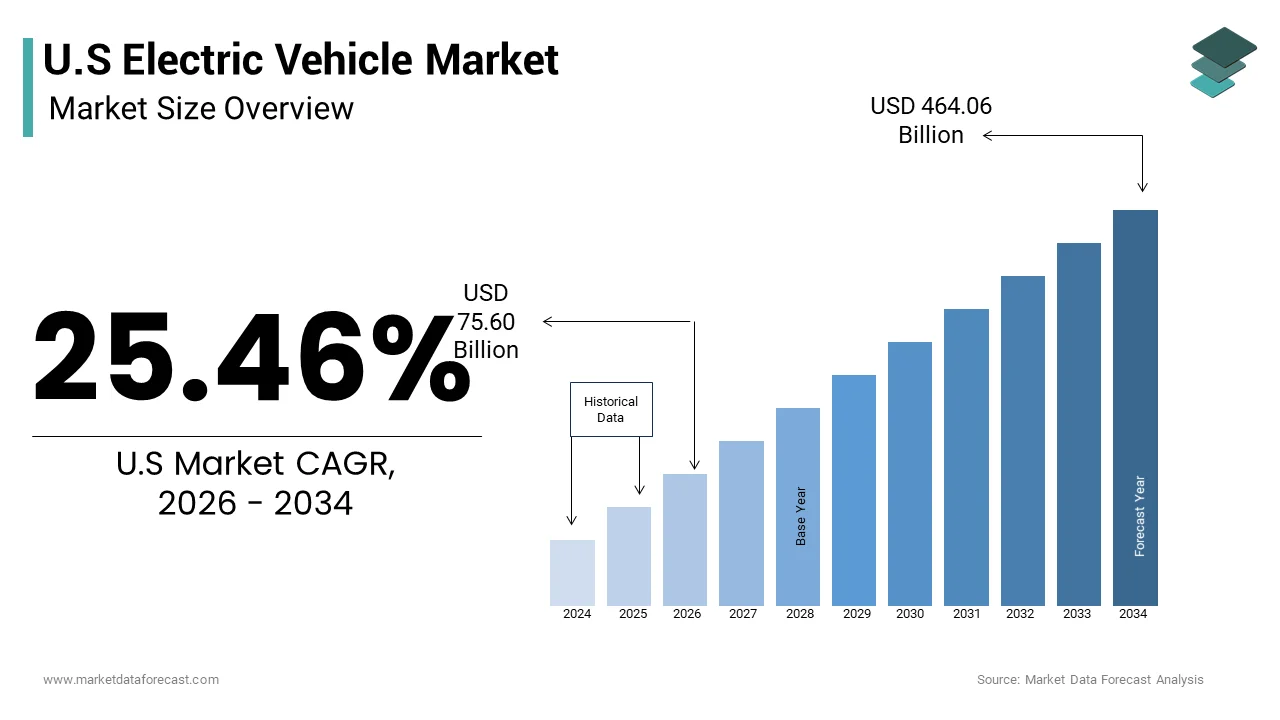
The electric vehicle is a structural reconfiguration of mobility, infrastructure, and industrial identity. According to the U.S. Department of Energy, EVs accounted for 11.2% of all new light-duty vehicle sales in 2023, up from just 4.6% in 2020, yet only 38% of American households live within five miles of a DC fast charger, as mapped by the Department of Transportation’s National Electric Vehicle Infrastructure Program.
MARKET DRIVERS
Corporate Fleet Electrification as a Supply Chain Imperative
The acceleration of EV adoption is orchestrated by corporate logistics and procurement mandates that treat electrification as an operational necessity, which is augmented in propelling the growth of the U.S. electric vehicle market. In 2023 alone, these fleets ordered more than 150,000 electric vans and trucks, surpassing retail EV sales in several months, as documented by the Electrification Coalition’s Fleet Adoption Tracker. These fleets operate on fixed routes, predictable schedules, and centralized charging hubs, making them ideal candidates for electrification long before individual buyers overcome range anxiety.
State-Level Zero-Emission Vehicle Mandates Reshaping Dealer Networks
California, New York, and Washington now enforce Zero Emission Vehicle (ZEV) mandates requiring automakers to sell increasing percentages of EVs or face financial penalties, which is leveraging the growth of TheS. Electric vehicle market. Automakers are responding not by expanding retail offerings, while Ford redirecting F-150 Lightning production to prioritize regions where compliance incentives outweigh federal tax credit delays. These mandates bypass consumer hesitation entirely, forcing manufacturers to build EVs even when demand lags.
MARKET RESTRAINTS
Charging Infrastructure Disparities and Grid Strain in Rural and Low-Income Communities
The EV charging in affluent urban corridors, which is leaving rural and low-income communities behind, is restricting the growth of the U.S. electric vehicle market. Simultaneously, grid operators in areas like Arizona and Texas report transformer overloads caused by clusters of home EV charging during evening peaks, prompting utilities to impose “EV connection moratoriums” in neighborhoods without substation upgrades. The EV transition risks deepening mobility inequality, which is turning clean transportation into a privilege of zip code rather than policy.
Battery Raw Material Dependency and Supply Chain Fragility
The dependence on foreign-sourced minerals is undermining its claim to energy sovereignty, which is quietly inhibiting the growth of the U.S. electric vehicle market. According to the U.S. Geological Survey, 78% of lithium and 62% of cobalt used in U.S.-assembled EV batteries are imported from China, Australia, and the Democratic Republic of Congo, while less than 1% of lithium refining occurs domestically. Even recycling infrastructure lags, as only 5% of end-of-life EV batteries are currently processed domestically, per the ReCell Center’s 2023 Recovery Report.
MARKET OPPORTUNITIES
Vehicle-to-Grid (V2G) Integration as a Distributed Energy Resource
The electric vehicles are evolving from passive consumers into active grid assets through bidirectional charging systems that allow EVs to discharge stored energy back into homes or the grid during peak demand. The growing demand is ascribed to boosting the growth of the U.S. electric vehicle market to some extent. According to the National Renewable Energy Laboratory, pilot programs in California and Vermont demonstrated that a single V2G-enabled EV can provide up to 8 kWh of backup power, enough to sustain a household for six hours during an outage. Meanwhile, Ford’s F-150 Lightning, now sold with Home Power Backup capability, has been integrated into utility demand-response programs in Texas, where owners earn $150/month for allowing their vehicles to feed power back during emergencies.
Industrial-Grade Charging Hubs as Economic Anchors in Declining Regions
The deployment of high-capacity EV charging stations along major freight corridors is becoming a catalyst for regional revitalization in economically distressed communities. Similarly, in Detroit, the city partnered with Electrify America to install 120 charging ports across abandoned auto plants, transforming shuttered industrial sites into mobility innovation zones with training centers for EV technicians. These hubs serve not just passenger vehicles, but delivery fleets, transit buses, and heavy-duty trucks sectors that are rapidly electrifying under federal mandates.
MARKET CHALLENGES
Cybersecurity Vulnerabilities in the Connected EV Ecosystem
GA's growing number of cyber threats, with the penetration of internet connectivity with EEVs, is merely a challenging factor for the growth of the U.S. electric vehicle market. According to the SAE International Cybersecurity Benchmark Report, 89% of EV models tested in 2023 had exploitable vulnerabilities in telematics systems, including unencrypted communication channels, default passwords in firmware, and remote access flaws that could allow hackers to disable brakes, lock doors, or drain batteries remotely. The threat is not theoretical, but a coordinated cyberattack targeting EV charging networks could trigger cascading grid failures, especially during peak demand events. The future of mobility is being wired without armor.
Consumer Perception Gap Between Cost of Ownership and Upfront Price
The persistent consumer resistance from the psychological dissonance between upfront price and long-term savings is expected to slow the growth of the U.S. electric vehicle market. Meanwhile, insurance premiums for EVs remain 18–22% higher than ICE vehicles due to repair complexity and parts scarcity, further eroding perceived value. The car may be cheaper to run, but the story hasn’t been told right.
REPORT COVERAGE
| REPORT METRIC | DETAILS |
| Market Size Available | 2025 to 2034 |
| Base Year | 2025 |
| Forecast Period | 2026 to 2034 |
| CAGR | 25.46% |
| Segments Covered | By Vehicle Type and Country |
| Various Analyses Covered | Global, Regional, and Country Level Analysis, Segment-Level Analysis; DROC, PESTLE Analysis; Porter’s Five Forces Analysis; Competitive Landscape; Analyst Overview of Investment Opportunities. |
| Regions Covered | US, Canada, and the Rest of North America |
| Market Leaders Profiled | Ford Motor Company (Michigan, U.S.), BMW Group (Munich, Germany), General Motors (Michigan, U.S.), Daimler AG (Stuttgart, Germany), Audi AG (Ingolstadt, Germany), Tesla, Inc. (California, U.S.), Nissan Motor Corporation (Yokohoma, Japan), Toyota Motor Corporation (Aichi, Japan), Volkswagen (Wolfsburg, Germany), Chevrolet (Michigan, U.S.) |
SEGMENT ANALYSIS
By Vehicle Insights
The passenger electric cars segment was the largest and held a dominant share of the U.S. EV market in 2024, with the environmental idealism, but in cultural familiarity and infrastructure accessibility, passenger EVs leverage existing residential charging networks and benefit from decades of automotive branding that equates ownership with personal identity. Tesla’s Model Y became the best-selling vehicle in America across all fuel types in Q4 2023, per Cox Automotive data, while Ford Mustang Mach-E and Chevrolet Bolt EV gained traction among middle-income households seeking tech-forward alternatives to gasoline sedans.
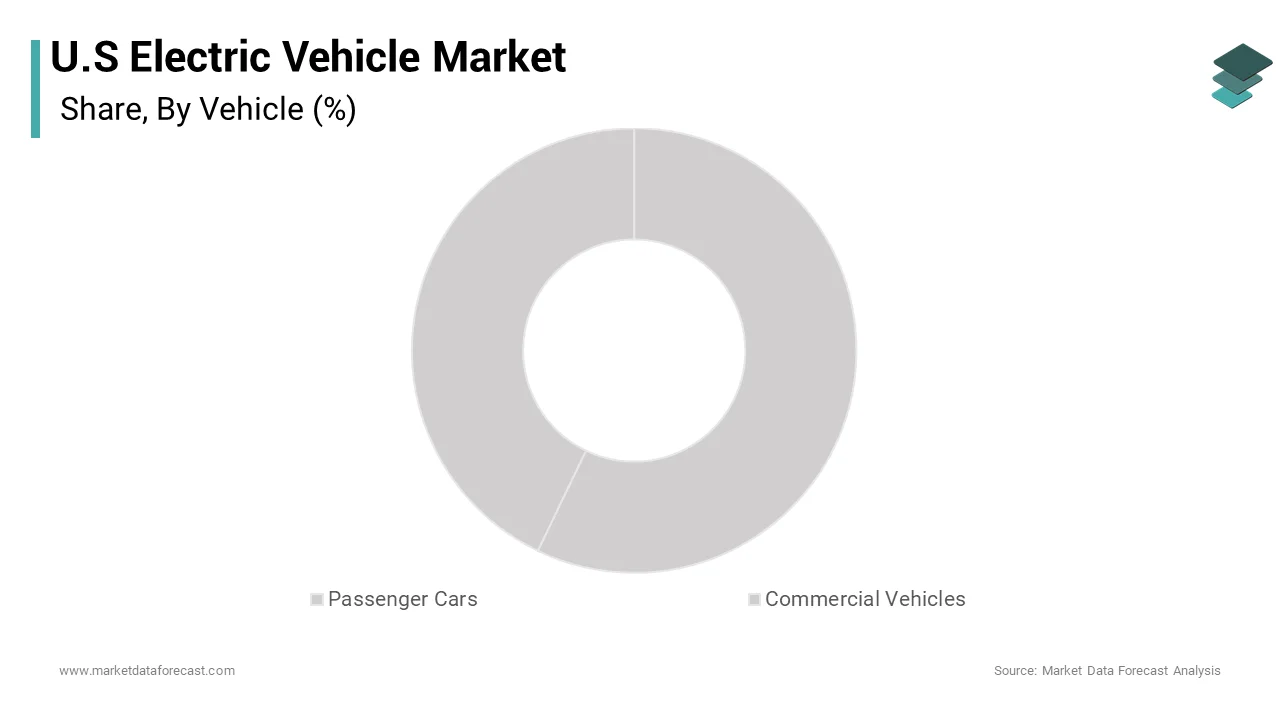
The commercial electric vehicles segment is likely to grow with a significant CAGR of 58.7% from 2025 to 2033. The U.S. Postal Service ordered 10,000 Oshkosh-built electric delivery vans in 2023 alone, which is a program that will replace 16% of its entire fleet by 2026, according to USPS Office of Inspector General reports. Walmart, FedEx, and UPS have collectively committed to over 200,000 EVs by 2030, creating predictable, large-scale demand that automakers prioritize over consumer models. These fleets operate on fixed routes, centralized depots, and predictable usage cycles by making them ideal candidates for electrification long before individual consumers overcome range anxiety. California was the top performer of the U.S. EV market by capturing 39.3% of share in 2024, with the nation’s most populous state and regulatory laboratory, making it the de facto proving ground for electrification policy.
COUNTRY ANALYSIS
Texas Market Analysis
Texas's electric vehicle market was positioned second by accounting for 11.4% of share in 2024. The state’s lack of income tax and expansive road networks make long-haul freight electrification economically viable, which is prompting companies like Lone Star Logistics to retrofit 500 electric semi-trucks for regional hauls, as noted by the Texas Clean Energy Coalition.
COMPETITIVE LANDSCAPE
KEY MARKET PLAYERS
- Ford Motor Company (Michigan, U.S.)
- BMW Group (Munich, Germany)
- General Motors (Michigan, U.S.)
- Daimler AG (Stuttgart, Germany)
- Audi AG (Ingolstadt, Germany)
- Tesla, Inc. (California, U.S.)
- Nissan Motor Corporation (Yokohama, Japan)
- Toyota Motor Corporation (Aichi, Japan)
- Volkswagen (Wolfsburg, Germany)
- Chevrolet (Michigan, U.S.)
MARKET SEGMENTATION
This research report on the U.S electric vehicle market is segmented and sub-segmented into the following categories.
By Vehicle Type
- Passenger Cars
- Commercial Vehicles
By Country
- U.S.A
- Canada
- Mexico
- Rest of North America