- Product Description Description
- Table of Contents TOC
- List of Table & Figure LOT
- Get Free Sample PDF Sample PDF
U.S. Electronic Market Report Summary
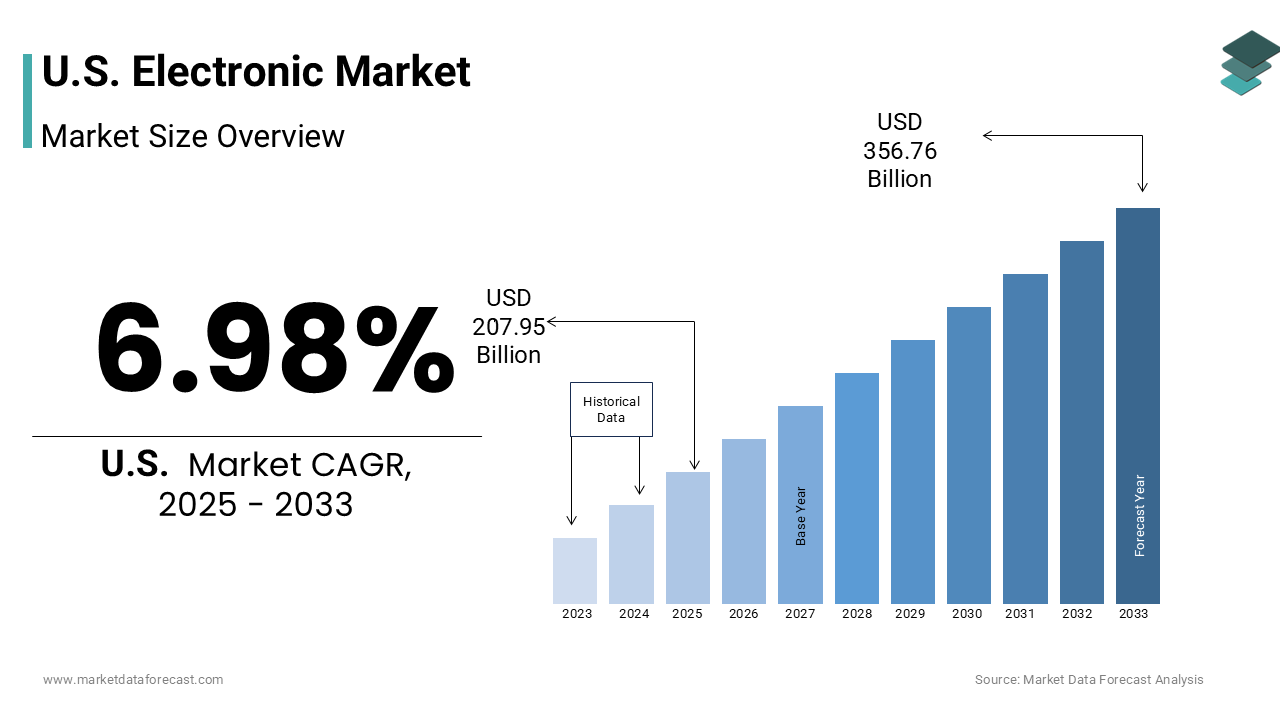
The U.S. electronic market was valued at USD 194.38 billion in 2024, is anticipated to reach USD 207.95 billion in 2025, and is projected to reach USD 356.76 billion by 2033, growing at a CAGR of 6.98% during the forecast period from 2025 to 2033. The growth of the U.S. electronic market is driven by the expansion of consumer electronics demand, technological innovation in semiconductors, and the rising adoption of smart devices and IoT technologies. Furthermore, the growth of 5G infrastructure, automation, and electric vehicles is enhancing the use of advanced electronics across industrial and consumer applications.
Key Market Trends
- Growing adoption of AI-driven electronics in computing, entertainment, and industrial automation.
- Expansion of 5G-enabled consumer devices, driving demand for advanced chips and communication components.
- Rising use of IoT-enabled smart devices across residential and commercial spaces.
- Increasing government incentives supporting domestic semiconductor manufacturing under initiatives like the U.S. CHIPS Act.
- Rapid digitalization of industries leading to higher consumption of high-performance computing and embedded systems.
Segmental Insights
- Based on product type, the computer segment was the largest in the U.S. electronic market, holding 41.3% of the market share in 2024. This dominance is attributed to the growing demand for laptops, desktops, and servers, supported by remote working trends, cloud-based enterprise systems, and advancements in high-speed processors. The ongoing integration of artificial intelligence and data analytics has further increased reliance on powerful computing systems across sectors.
Competitive Landscape
The U.S. electronic market is highly competitive and innovation-driven, with leading companies focusing on miniaturization, energy efficiency, and next-generation computing technologies. Firms are investing heavily in semiconductor R&D, expanding fabrication facilities, and strengthening domestic supply chains to reduce import dependency. Major companies operating in the U.S. electronic market include Apple Inc., Intel Corporation, Qualcomm Technologies Inc., NVIDIA Corporation, Broadcom Inc., ON Semiconductor, Hubbell Incorporated, and Jabil Inc.
U.S. Electronic Market Size
The United States electronic market size was valued at USD 194.38 billion in 2024 and is anticipated to reach USD 207.95 billion in 2025 from USD 356.76 billion by 2033, growing at a CAGR of 6.98% during the forecast period from 2025 to 2033.
The electronic rely on semiconductor based circuitry to process transmit or store information or perform mechanical functions under electrical control. This includes consumer electronics computing hardware telecommunications infrastructure industrial automation systems and embedded electronics integrated into vehicles appliances and medical devices. Regulatory frameworks such as the CHIPS and Science Act further promotes by incentivizing domestic semiconductor production. This ecosystem thrives on continuous reinvention driven by algorithmic advancement material science breakthroughs, and shifting user expectations around connectivity autonomy and personalization.
MARKET DRIVERS
The Pervasive Integration of Artificial Intelligence Into Consumer and Enterprise Devices
The artificial intelligence has ceased to be a peripheral feature and has become the operational core of nearly every new electronic device launched in the United States catalyzing demand across consumer enterprise and industrial segments, which is significantly boosting the growth of US electronic market. Consumer electronics manufacturers have responded with AI powered features such as adaptive battery management real time language translation and context aware user interfaces that increase perceived utility and justify premium pricing.
The Accelerating Deployment of 5G Infrastructure and Device Ecosystems
The nationwide rollout of 5G wireless networks is enabling new device categories, which are enhancing performance expectations and rendering legacy hardware obsolete. The adoption of the advanced 5G infrastructure and device ecosystems in the developed country like US is bolstering the growth of US electronic market.
MARKET RESTRAINTS
Persistent Global Semiconductor Supply Chain Fragility
The supply chain disruptions due to geopolitically sensitive regions is hindering the growth of US electronic market. The problem is exacerbated by the industry’s reliance on just in time inventory models which leave minimal buffer for supply shocks. Geopolitical tensions further compound risk with the Department of Commerce identifying over two hundred electronic components subject to potential export restrictions under current trade frameworks.
Escalating E-Waste Volumes and Regulatory Pressure on Disposal
The accelerating obsolescence cycle of electronic devices has generated unsustainable volumes of electronic waste placing mounting regulatory and reputational pressure on manufacturers and retailers is escalating the growth of US electronic market. The remaining bulk ends up in landfills or informal recycling operations where toxic materials such as lead mercury and cadmium pose documented environmental and public health risks.
MARKET OPPORTUNITIES
Expansion of Edge Computing in Industrial and Smart Infrastructure Applications
The migration of data processing from centralized cloud environments to distributed edge devices is additionally promoting new opportunity for the growth of US electronic market. This shift is particularly pronounced in smart city applications where municipal utilities have installed many edge enabled grid monitoring devices to optimize energy distribution and detect outages in real time. These applications demand specialized electronics including low power processors hardened memory modules and secure boot architectures creating high margin niches for component suppliers.
Strategic Reorientation Toward Circular Electronics and Device as a Service Models
Forward looking electronics firms are capitalizing on sustainability mandates and cost sensitivity by shifting from product ownership to service-based models that retain control over device lifecycles and material recovery. Consumer facing adaptations are emerging with Best Buy and Apple offering certified refurbished devices with full warranties capturing price sensitive segments while ensuring proper recycling of trade ins. Regulatory alignment is accelerating this shift with the Federal Trade Commission proposing new labeling standards in 2024 that require disclosure of repairability and expected service life.
MARKET CHALLENGES
Talent Shortage in Advanced Electronics Design and Embedded Systems Engineering
The specialized engineering talent particularly in fields such as radio frequency design embedded systems architecture and semiconductor validation, which is limiting the growth of US electronic market. Companies are responding with aggressive upskilling programs yet internal training can take 18 to 24 months to yield production ready engineers.
Rising Cybersecurity Vulnerabilities in Consumer and IoT Electronics
The rising cybersecurity vulnerabilities in consumer and IoT electronics is solely degrading the growth of US electronics market. Manufacturers struggle to keep pace as the average time to patch a firmware vulnerability exceeds 90 days, according to the National Institute of Standards and Technology. This lag exposes users to data theft device hijacking and even physical safety risks as demonstrated by recalls of vulnerable medical and automotive electronics.
REPORT COVERAGE
| REPORT METRIC | DETAILS |
| Market Size Available | 2024 to 2033 |
| Base Year | 2024 |
| Forecast Period | 2025 to 2033 |
| Segments Covered | By Product and Region. |
| Various Analyses Covered | Global, Regional, & Country Level Analysis; Segment-Level Analysis, Drivers, Restraints, Opportunities, Challenges, PESTLE Analysis, Porter’s Five Forces Analysis, Competitive Landscape, Analyst Overview of Investment Opportunities |
| Key Market Players | Apple Inc., Intel Corporation, Qualcomm Technologies Inc., NVIDIA Corporation, Broadcom Inc., ON Semiconductor, Hubbell Incorporated, and Jabil Inc. |
SEGMENTAL ANALYSIS
By Product Type Insights
Electronic Devices Segment With Forty One % Market Share
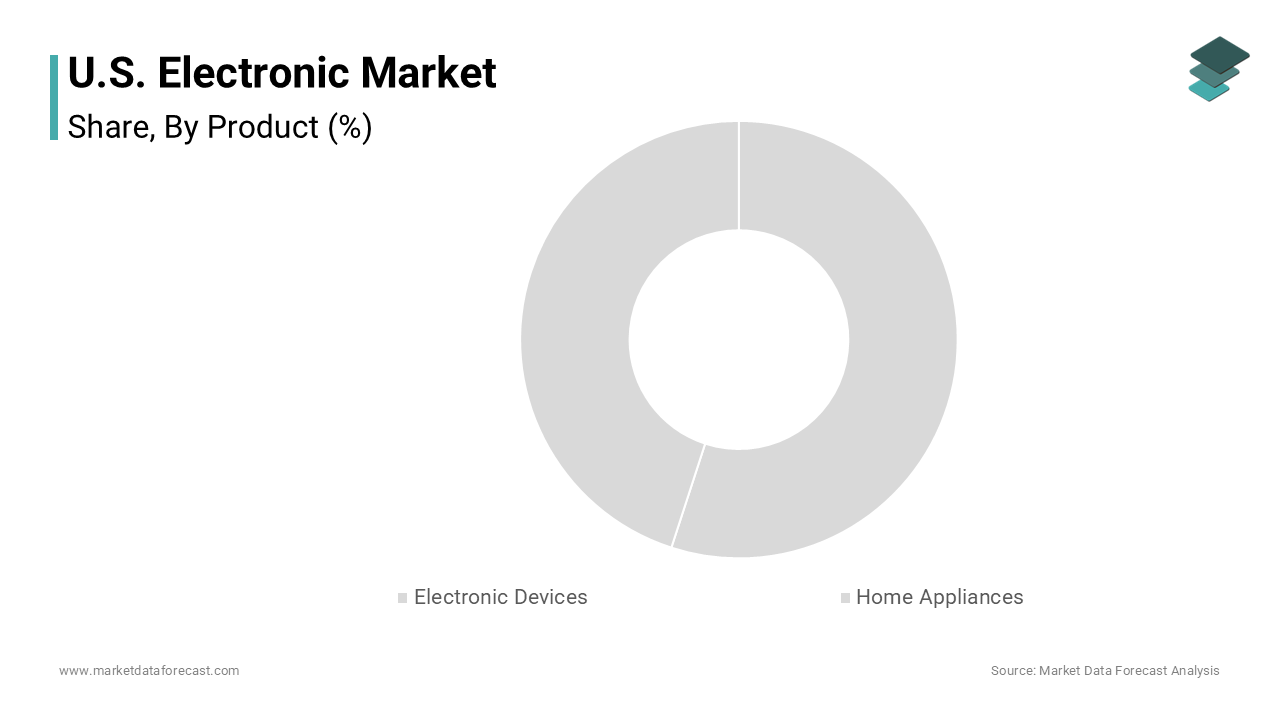
The computer segment was the largest and held 41.3% of the US electronic market share in 2024 from unit volume alone but from sustained functional indispensability across education enterprise and creative domains.
The digital camera and camcorder segment is lucratively growing with a CAGR of 12.4% throughout the forecast period with a renaissance in professional and enthusiast content creation driven by the creator economy and platform monetization.
The refrigerators segment was the largest by capturing 35.4% of the US electronic market share in 2024. As per the Centers for Disease Control and Prevention, the proper refrigeration reduces foodborne illness incidence by 72% with its public health imperative.
The air conditioner segment is esteemed to grow with a CAGR of 18.2% throughout the forecast period with the intensifying climate volatility rising urban heat island effects and regulatory mandates for energy efficiency. Smart features are a key differentiator with 81% of new units featuring Wi Fi connectivity remote scheduling and usage analytics according to the Consumer Technology Association.
COMPETETIVE LANDSCAPE
The competition in the United States electronic market is defined by a tripartite struggle among vertically integrated giants agile niche innovators and private label disruptors each leveraging distinct advantages to capture consumer and enterprise wallet share. Legacy players rely on brand equity ecosystem integration and retail footprint to defend core categories while startups exploit white spaces in AI edge computing and sustainable design to carve defensible niches. Price competition is muted in premium segments where differentiation through silicon architecture software services and sustainability credentials justifies higher margins. Retailers exert growing influence through exclusive product launches data driven shelf allocation and in store experience zones that favor brands investing in co-marketing. Supply chain resilience has become a strategic weapon with companies that control semiconductor design or assembly gaining pricing and delivery advantages.
KEY MARKET PLAYERS
A few of the major companies in the U.S. electronic market include
- Apple Inc.
- Intel Corporation
- Qualcomm Technologies Inc.
- NVIDIA Corporation
- Broadcom Inc.
- ON Semiconductor
- Hubbell Incorporated
- Jabil Inc.
Top Players in the United States Electronic Market
Apple Inc
Apple Inc maintains a formidable presence in the United States electronic market through its vertically integrated ecosystem of hardware software and services. The company continues to invest in silicon design with its M series chips enhancing performance and battery efficiency across MacBooks and iPads. In Asia Pacific Apple operates premium retail stores in twelve countries and partners with local telecom providers to offer installment plans. It recently opened a dedicated R and D center in India to develop region specific features and expanded its trade in program in Japan and South Korea to boost device recycling and customer retention through upgrade incentives.
Samsung Electronics
Samsung Electronics dominates multiple categories including smartphones televisions and home appliances by blending hardware innovation with aggressive marketing. The company leverages its semiconductor division to ensure component security and cost control. In Asia Pacific, Samsung operates manufacturing hubs in Vietnam and India and tailors product features to regional preferences such as dual SIM support and localized voice assistants. It recently launched a series of AI powered refrigerators and washing machines in Southeast Asia and partnered with Indonesian fintech firms to offer zero interest financing for premium electronics.
Dell Technologies
Dell Technologies holds strong influence in the computing and enterprise electronics segment through its direct sales model and customizable product configurations. The company prioritizes sustainability with closed loop recycling and carbon neutral shipping options. It recently inaugurated a customer experience center in Tokyo to showcase AI ready workstations and launched a device as a service program in India targeting mid-sized enterprises seeking flexible IT procurement and lifecycle management.
Top Strategies Used by Key Market Participants
Product differentiation through proprietary silicon and ecosystem lock in remains central as companies embed custom processors and cross device interoperability to reduce churn. Strategic retail expansion includes experiential flagship stores and in store service desks to enhance tactile engagement and technical support. Partnerships with telecom carriers and fintech firms enable installment purchasing and trade in programs that lower entry barriers. Sustainability narratives are amplified through carbon neutral certifications recycled material usage and take back initiatives to align with regulatory and consumer expectations. Enterprise targeting focuses on device as a service models AI ready hardware and cybersecurity hardened endpoints to capture institutional budgets. Component vertical integration secures supply amid global shortages and reduces dependency on third party vendors. Software services and cloud subscriptions are bundled to increase lifetime customer value and recurring revenue.
MARKET SEGMENTATION
This research report on the U.S. electronic market has been segmented based on the following categories.
By Product
- Electronic Devices
- Television
- Computer
- Digital Camera & Camcorders
- Others (Audio & Video Products, Set-Top-Box, etc.)
- Home Appliances
- Refrigerator
- Washing Machine
- Air Conditioner
- Others
By Country
- United States