- Product Description Description
- Table of Contents TOC
- List of Table & Figure LOT
- Get Free Sample PDF Sample PDF
Executive Summary: U.S. Fertilizers Market
- Market Scope: Comprehensive U.S. fertilizers market analysis covering product types, application methods, crop segments, competitive landscapes, and agricultural nutrient demand metrics.
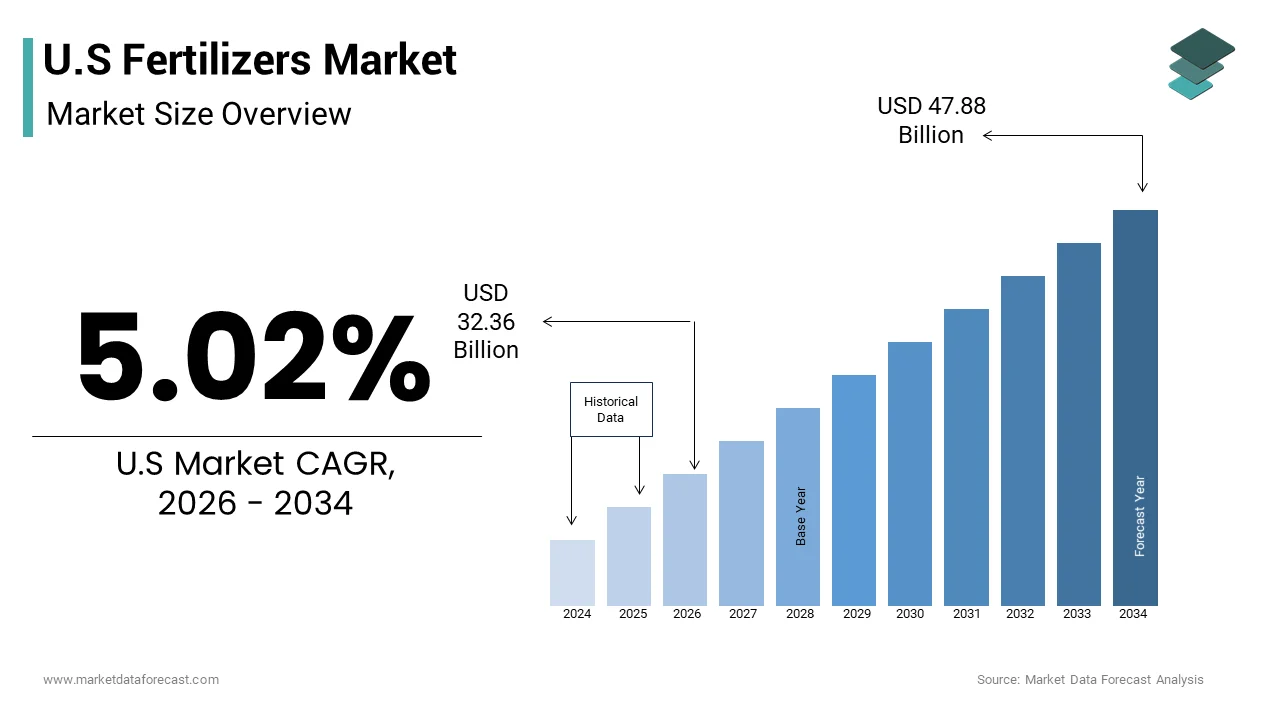
- Market Valuation: Valued at USD 30.81 billion (2025), estimated at USD 32.36 billion (2026), and projected to reach USD 47.88 billion by 2034, registering a steady CAGR of 5.02% (2026–2034).
- Primary Growth Drivers: Massive agricultural nutrient demand, adoption of precision farming, and high crop productivity requirements. Key agricultural highlights include U.S. farmers applying approximately 12.5 million tons of nitrogen, 3.8 million tons of phosphate, and 6.2 million tons of potash annually, nearly 70% of row-crop farmers utilizing precision agriculture technology, and U.S. corn yields exceeding 170 bushels per acre.
Key Market Segment Metrics (2026–2034)
| Category | Leading Segment (2025 Position) | Fastest-Growing Segment |
|---|---|---|
| By Fertilizer Type | Straight Fertilizers (held a significant market share in 2025) | Complex Fertilizers (projected to grow at a 4.5% CAGR from 2026 to 2034) |
| By Application Method | Soil Application (dominated with 43.2% of the U.S. market in 2025) | Fertigation (forecasted to expand at a 6.8% CAGR; improves nutrient-use efficiency by up to 30%) |
| By Crop Type | Field Crops (led segment, supported by over 90 million acres of corn planting) | Horticultural Crops (projected to grow at a steady 5.2% CAGR) |
| By Region / Country | United States National Agricultural Belt (Midwest and high-acreage row-crop regions) | High-Efficiency Precision Agriculture Farming Regions Across the U.S. |
Major Market Players & Market Structure
Market Structure: Highly competitive U.S. agricultural chemical landscape featuring major multinational fertilizer producers and domestic agricultural suppliers competing intensely on nutrient-efficiency technologies, controlled-release fertilizers, precision agriculture integration, low-emission production, bio-based inputs, digital agronomy, and supply-chain infrastructure.
Key Companies: CF Industries Holdings, Haifa Group, ICL Group, Koch Industries, Nutrien, Sociedad Quimica y Minera de Chile, The Andersons, The Mosaic Company, Wilbur-Ellis, and Yara International.
U.S Fertilizers Market Size
The U.S fertilizers market size was valued at USD 30.81 billion in 2025 and is anticipated to reach USD 32.36 billion in 2026 to reach USD 47.88 billion by 2034, growing at a CAGR of 5.02% during the forecast period from 2026 to 2034.
MARKET OVERVIEW
The fertilizer is essential nutrient required to sustain soil fertility and enhance crop productivity, across diverse agricultural sector. As per the United States Department of Agriculture, American farmers applied approximately 12.5 million tons of nitrogen 3.8 million tons of phosphate and 6.2 million tons of potash in the most recent reporting year reflecting the immense scale of nutrient dependency in modern agriculture. The Environmental Protection Agency notes that nutrient management is critical for preventing water quality degradation with agriculture being a primary source of nonpoint source pollution in many watersheds. The regulatory frameworks are increasingly influencing application practices and product formulations. According to the Census of Agriculture, the average age of US farm operators is 58.1 years which impacts the adoption rate of new nutrient management technologies and precision application methods. Furthermore, the Bureau of Labor Statistics indicates that the agricultural sector continues to face labor shortages driving the mechanization of fertilizer application processes. The integration of digital tools for soil testing and variable rate application is transforming traditional practices enabling more efficient use of resources.
MARKET DRIVERS
Rising Global Food Demand and Intensification of Crop Production
The escalating global demand for food driven by population growth and changing dietary patterns is driving the growth of the United States fertilizer market. As the global population approaches 8 billion individuals, the pressure on agricultural systems to produce higher yields per acre intensifies significantly. In the United States, this translates to increased reliance on synthetic fertilizers to maintain high output levels of key export commodities such as corn and soybeans. As per the United States Department of Agriculture, corn yields have consistently exceeded 170 bushels per acre in recent years a feat largely attributed to optimized nutrient management strategies. The intensification of cropping systems including double cropping in southern states further depletes soil nutrients necessitating regular replenishment through fertilizer applications. Additionally, the expansion of biofuel production particularly ethanol from corn creates a sustained domestic demand for high yielding crops. Farmers are compelled to maximize efficiency and output to remain competitive in global markets where price volatility is common. This economic imperative ensures that fertilizer remains a critical input cost that cannot be easily substituted without risking significant yield penalties.
Adoption of Precision Agriculture and Nutrient Management Technologies
The widespread adoption of precision agriculture and advanced nutrient management technologies is accelerating the growth of the United States fertilizer market. Farmers are increasingly utilizing data driven insights to optimize application rates timing and placement thereby reducing waste and environmental impact. According to the American Farm Bureau Federation, nearly 70% of row crop farmers now employ some form of precision agriculture technology including GPS guided variable rate application systems. These technologies allow for the precise delivery of nutrients based on real time soil conditions and crop needs rather than uniform blanket applications. This dual benefit of cost savings and environmental compliance appeals to both economically minded growers and regulators. The integration of soil sensors drone imagery and satellite data enables farmers to identify nutrient deficiencies early and apply targeted treatments. Furthermore, federal programs such as the Environmental Quality Incentives Program provide financial assistance for implementing conservation practices including precision nutrient management. The United States Department of Agriculture highlights that these initiatives help mitigate nutrient runoff into waterways addressing concerns raised by the Environmental Protection Agency. As technology becomes more accessible and user friendly its adoption accelerates creating a demand for specialized fertilizers compatible with precision equipment.
MARKET RESTRAINTS
Stringent Environmental Regulations and Water Quality Concerns
The stringent environmental regulations and growing concerns regarding water quality is hindering the growth of the United States fertilizer market. Regulatory bodies are implementing tighter controls on nutrient runoff to protect aquatic ecosystems and drinking water sources from contamination. The excess nitrogen and phosphorus from agricultural fields are leading causes of eutrophication in lakes rivers and coastal zones, such as the Gulf of Mexico dead zone. This environmental damage has prompted state and federal agencies to enforce stricter nutrient management plans and application limits. States like Iowa and Illinois have introduced voluntary and mandatory measures to limit fertilizer application during certain seasons or near water bodies. These restrictions complicate farming operations and may limit the total volume of fertilizers that can be legally applied. Additionally, the Clean Water Act provisions empower local authorities to regulate nonpoint source pollution adding layers of compliance complexity for farmers. The cost of adhering to these regulations including buffer strip maintenance and cover cropping reduces the budget available for fertilizer purchases. Furthermore, public scrutiny and consumer demand for sustainably produced food pressure farmers to reduce chemical inputs.
Volatility in Raw Material Prices and Supply Chain Disruptions
The volatility in raw material prices and frequent supply chain disruptions is hampering the growth of the United States fertilizer market. Fertilizer production relies heavily on natural gas for nitrogen and mined reserves for phosphorus and potash making it susceptible to global energy and commodity market fluctuations. These price spikes directly translate to higher fertilizer costs for farmers squeezing profit margins and forcing reductions in application rates. Supply chain disruptions exacerbated by port congestion and transportation logistics issues that further hinder the timely availability of fertilizers during planting windows. The United States Department of Agriculture reports that delays in fertilizer delivery can lead to suboptimal application timing negatively impacting crop yields. Additionally, the concentration of potash and phosphate production in a few global regions creates vulnerability to export restrictions and trade policies. For instance, export bans by major producing countries can tighten global supply and drive up prices in the US market. Farmers facing unpredictable costs and availability may opt to delay purchases or switch to lower cost alternatives disrupting market stability.
MARKET OPPORTUNITIES
Growth in Organic and Specialty Fertilizer Segments
The growing demand for organic and specialty fertilizers for innovation and expansion is likely to pose new opportunity for the growth of the United States fertilizer market. Consumer preference for organically grown food is rising driving farmers to adopt certified organic practices that prohibit synthetic fertilizers. This trend creates a strong demand for organic nutrient sources, such as compost manure, bone meal, and plant-based extracts. As per the United States Department of Agriculture, the number of certified organic farms has increased by over 50% in the last decade indicating a structural shift in production methods. Specialty fertilizers, including controlled release and stabilized nitrogen products also offer opportunities by improving nutrient use efficiency and reducing environmental impact. These products allow for precise nutrient delivery matching crop uptake patterns and minimizing losses. The Environmental Protection Agency supports the adoption of such technologies through grants and incentives for sustainable agriculture. Additionally, the development of biostimulants and microbial inoculants enhances soil health and nutrient availability offering complementary solutions to traditional fertilizers. Manufacturers investing in research and development of these niche products can capture premium market segments. The diversification of product portfolios to include organic and specialty options allows companies to mitigate risks associated with conventional fertilizer volatility.
Expansion of Bio Based and Microbial Fertilizer Innovations
The expansion of bio-based and microbial fertilizer innovations by enhancing soil health and reducing dependency on synthetic inputs is additionally to elevate the growth of the United States fertilizer market in coming years. Bio fertilizers containing beneficial microorganisms such as rhizobia and mycorrhizae improve nutrient availability and plant growth through natural biological processes. The use of microbial inoculants has gained traction among farmers seeking to improve soil structure and resilience against climate stress. The fields treated with microbial fertilizers have shown improved nitrogen fixation and phosphorus solubilization leading to yield enhancements comparable to synthetic alternatives. Additionally, the increasing awareness of soil microbiome importance drives adoption of these products among progressive farmers. Companies developing proprietary microbial strains and formulation technologies can differentiate themselves in a crowded market. The integration of bio fertilizers with precision agriculture tools allows for targeted application maximizing efficacy. Furthermore, government programs promoting regenerative agriculture provide financial support for adopting biological inputs. The potential for carbon sequestration through enhanced soil biology also opens avenues for carbon credit markets adding revenue streams for farmers.
MARKET CHALLENGES
Impact of Climate Change on Nutrient Availability and Application
The climate change by altering weather patterns and affecting nutrient availability and application efficiency is to pose as a major challenge for the growth of the United States fertilizer market. Extreme weather events such as heavy rainfall and droughts disrupt planting schedules and nutrient uptake cycles. The increased frequency of intense precipitation events leads to significant nutrient leaching and runoff by reducing the effectiveness of applied fertilizers. The wet springs have delayed planting in key Midwest states forcing farmers to adjust nutrient management strategies under compressed timelines. Drought conditions conversely limit nutrient mobility in the soil preventing crops from accessing applied fertilizers. These climatic variations create uncertainty in predicting optimal application rates and timing increasing the risk of yield loss. Additionally higher temperatures accelerate soil organic matter decomposition releasing nutrients unpredictably and potentially leading to imbalances. The climate induced changes in hydrology exacerbate water quality issues complicating regulatory compliance. Farmers must adapt by adopting resilient practices, such as split applications and cover cropping, which require additional planning and investment. The unpredictability of weather patterns makes it difficult for manufacturers to forecast demand accurately leading to inventory challenges. Furthermore, the need for climate smart agriculture solutions requires continuous innovation in fertilizer formulations.
Resistance to Adopting New Technologies Among Small Scale Farmers
The resistance to adopting new technologies among small scale farmers is another attribute to impede the growth of the United States fertilizer market. While large operations rapidly integrate precision agriculture tools, many smaller farms lag due to financial constraints and lack of technical expertise. Additionally, the complexity of digital platforms and data interpretation requires training that may not be readily available in rural areas. This digital divide limits the ability of smaller operators to optimize fertilizer use efficiently leading to potential over or under application. The United States Department of Agriculture highlights that extension services are often understaffed limiting their capacity to provide personalized technical assistance. Furthermore, awareness about the return on investment for new technologies persists among traditional farmers who rely on established practices. This hesitation slows the overall adoption rate of innovative fertilizer solutions such as stabilized nitrogen and bio-based products. Manufacturers face difficulties in reaching this fragmented customer base with tailored marketing and support.
REPORT COVERAGE
| REPORT METRIC | DETAILS |
| Market Size Available | 2024 to 2033 |
| Base Year | 2024 |
| Forecast Period | 2025 to 2033 |
| CAGR | 5.02% |
| Segments Covered | By Type, Form, Application Mode, Crop Type, and Country |
| Various Analyses Covered | Global, Regional, and Country Level Analysis, Segment-Level Analysis; DROC, PESTLE Analysis; Porter’s Five Forces Analysis; Competitive Landscape; Analyst Overview of Investment Opportunities. |
| Regions Covered | US, Canada, and the Rest of North America |
| Market Leaders Profiled | CF Industries Holdings Inc., Haifa Group, ICL Group Ltd, Koch Industries Inc, Nutrien Ltd, Sociedad Quimica y Minera de Chile SA, The Andersons Inc., The Mosaic Company, Wilbur-Ellis Company LLC, Yara International ASA |
SEGMENT ANALYSIS
By Type Insights
The straight fertilizers segment as accounted in holding a significant share of the United States fertilizer market in 2025 with the extensive cultivation of row crops such as corn and wheat which require high volumes of specific nutrients, particularly nitrogen. The role of nitrogen in maximizing yield for staple crops is escalating the growth of the segment. These single nutrient sources allow farmers to tailor application rates precisely to soil test results and crop growth stages without adding unnecessary phosphorus or potassium. The cost effectiveness and logistical simplicity of straight fertilizers compared to complex blends is also bolstering the growth of the segment. The straight fertilizers often have lower production and transportation costs per unit of nutrient by making them economically attractive for large scale operations. Additionally, the established infrastructure for storing and applying anhydrous ammonia and urea across the Midwest ensures widespread availability and ease of use. Farmers prefer the flexibility to mix nutrients on site or apply them separately based on immediate field needs.
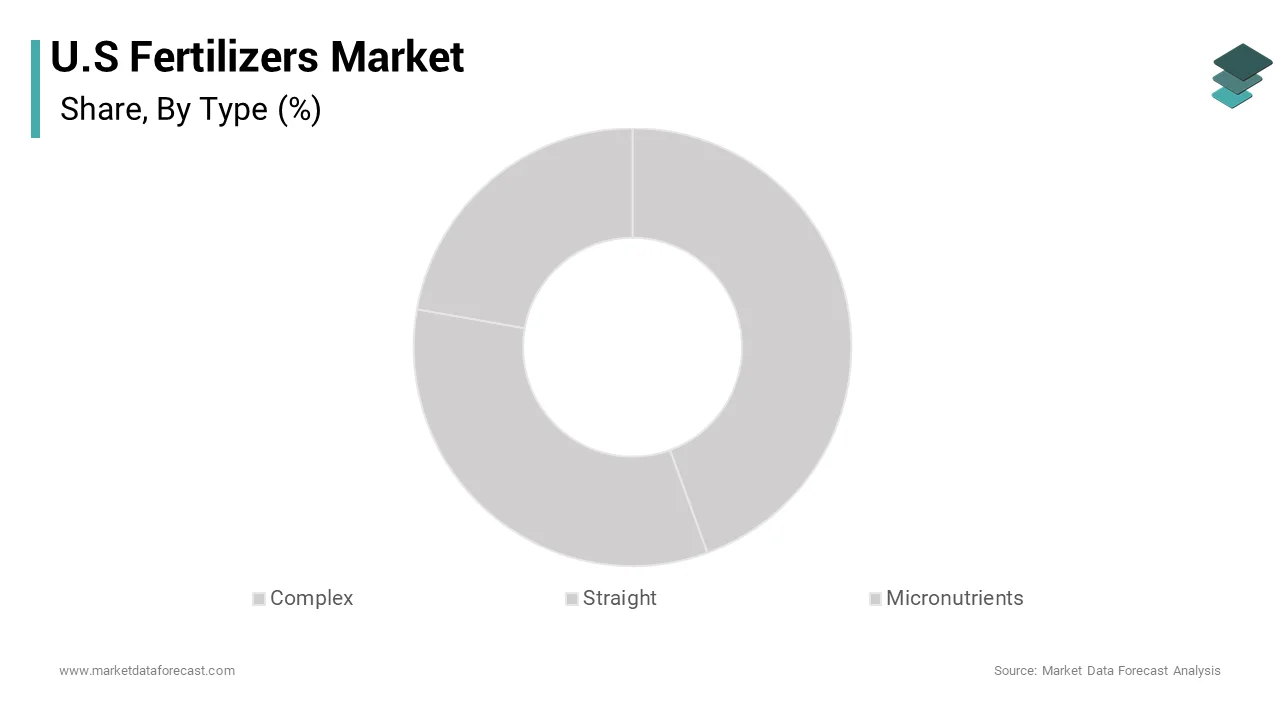
The complex fertilizer segment is expected to grow at a fastest CAGR of 4.5% from 2026 to 2034 owing to the increasing adoption of precision agriculture and the demand for balanced nutrient solutions. The rising popularity of diammonium phosphate and monoammonium phosphate, which provide both nitrogen and phosphorus in a single application. These blended products ensure uniform distribution of nutrients minimizing the risk of segregation and ensuring consistent crop uptake. The shift toward specialty crops and high value horticulture, which require precise nutrient ratios for optimal quality and yield is also escalating the growth of the segment. The growers of fruits vegetables and nuts increasingly rely on customized complex formulations to meet specific physiological needs. These crops are sensitive to nutrient imbalances making pre mixed complex fertilizers a safer and more reliable option. Additionally, the integration of micronutrients into complex blends offers a comprehensive solution that addresses multiple deficiencies simultaneously. The convenience of single pass applications reduces fuel usage and soil compaction aligning with sustainability goals.
By Application Method Insights
The soil application segment was the dominant by holding 43.2% of the United States fertilizer market share in 2025 owing to the traditional and most effective method of delivering nutrients directly to the root zone, where they are most needed for plant uptake. The first major factor sustaining this dominance is the widespread use of broadcast and side dress applications for row crops such as corn soybeans and wheat. These techniques ensure that nutrients are placed in the soil profile, where they can be accessed by developing root systems throughout the growing season. The compatibility of soil application with existing farm machinery and infrastructure is amplifying the growth of the segment. The most tractors and spreaders are designed for soil based nutrient delivery making it the most accessible and cost effective option for farmers. The ability to incorporate fertilizers into the soil during tillage or planting operations streamlines field workflows and reduces the need for additional passes. Furthermore, soil application allows for the use of slow release and stabilized nitrogen products, which minimize volatilization and leaching losses.
The fertigation segment is likely to grow at a fastest CAGR of 6.8% from 2026 to 2034 with the increasing adoption of irrigation systems and the need for precise nutrient delivery in high value crops. The integration of fertilizer application with drip and sprinkler irrigation systems, which allows for simultaneous water and nutrient supply. This method enables farmers to apply nutrients in small frequent doses matching crop demand curves and reducing waste. As per the University of California Cooperative Extension, fertigation has been shown to improve nutrient use efficiency by up to 30% compared to traditional soil applications particularly in orchards and vineyards. The labor savings and operational efficiency offered by automated fertigation systems is also bolstering the growth of the segment. Additionally, fertigation allows for real time adjustments based on weather conditions and crop status enhancing responsiveness to changing environmental factors. The rise of protected agriculture and greenhouse production also boosts demand for fertigation as these controlled environments rely heavily on precise nutrient management.
By Crop Insights
The field crops segment was accounted in occupying a dominant share of the United States fertilizer market in 2025 with the vast acreage dedicated to staple commodities, such as corn, soybeans, wheat, and cotton, which form the backbone of American agriculture. The high nutrient demand of corn, which is the most widely grown crop in the country. According to the United States Department of Agriculture, farmers planted over 90 million acres of corn in the most recent season each requiring substantial amounts of nitrogen phosphorus and potassium to achieve target yields. The intensive nature of corn production necessitates regular and heavy fertilizer applications to replenish soil nutrients depleted by high biomass removal. The established supply chains and extension services for field crops also facilitate easy access to fertilizer products and technical advice. Additionally, the use of hybrid seeds and advanced agronomic practices in field crop production maximizes the return on fertilizer investment.
The horticultural crops segment is significantly to grow at an anticipated CAGR of 5.2% from 2026 to 2034 owing to the increasing consumer demand for fresh fruits vegetables and nuts as well as the expansion of protected agriculture. The rising health consciousness among consumers, which has boosted sales of fresh produce is escalating the growth of the segment. High value crops, such as berries leafy greens and tomatoes require precise and frequent nutrient applications to maintain quality and shelf life. The growers are increasingly adopting specialized fertilizer formulations including water soluble and chelated nutrients to optimize plant health. The greenhouse and vertical farming operations, which rely heavily on controlled nutrient delivery systems. These intensive production methods use hydroponic and aeroponic techniques that require highly soluble and balanced fertilizers.
COMPETITIVE LANDSCAPE
The competition in the United States fertilizer market is characterized by intense rivalry among a few dominant global producers and numerous regional distributors. Major companies compete on the basis of product quality price reliability and technical support services. Innovation in nutrient efficiency and sustainability serves as a primary differentiator as manufacturers seek to meet stringent environmental regulations. Companies invest in advanced technologies, such as controlled release fertilizers and digital agronomy tools to enhance value propositions. Price volatility driven by raw material costs and global trade dynamics influences competitive strategies significantly. Distributors play a crucial role by offering localized expertise and customized solutions to farmers. Strategic alliances and mergers are common tactics used to expand market reach and diversify product portfolios. Customer loyalty is built through consistent performance and comprehensive support services. The entry of new players focusing on organic and bio-based alternatives adds complexity to the competitive landscape.
KEY MARKET PLAYERS
A few of the market players in the U.S Fertilizers market include
- CF Industries Holdings, Inc.
- Haifa Group
- ICL Group Ltd
- Koch Industries Inc.
- Nutrien Ltd.
- Sociedad Quimica y Minera de Chile SA
- The Andersons Inc.
- The Mosaic Company
- Wilbur-Ellis Company LLC
- Yara International ASA
Top Players In The Market
- The Mosaic Company stands as a leading producer of concentrated phosphate and potash crop nutrients in the United States serving farmers globally. The company focuses on helping growers produce better food through superior nutrient solutions and sustainable practices. Recent actions include optimizing its production facilities in Florida to enhance operational efficiency and reduce environmental impact. Mosaic has also invested heavily in digital agriculture tools such as the Crop Nutrition app which provides personalized recommendations for nutrient application. These initiatives help farmers maximize yield while minimizing waste. The company actively engages in sustainability programs aimed at water conservation and soil health improvement. Their commitment to innovation and responsible stewardship ensures long term value creation for stakeholders and the environment.
- CF Industries Holdings Inc is a major manufacturer and distributor of nitrogen fertilizers and other nitrogen products in North America. The company plays an important role in supplying ammonia urea and ammonium nitrate to support high, yielding crop production. Recent strategies, involve expanding its clean energy initiatives, including the production of blue ammonia with carbon capture technology. The company has also upgraded its manufacturing plants to improve energy efficiency and reduce emissions. Their focus on sustainability and operational excellence enhances their competitive edge. The company continues to invest in research and development to create innovative nitrogen solutions that meet evolving agricultural needs and regulatory standards.
- Nutrien Ltd operates as a global provider of crop inputs and services with a significant presence in the United States fertilizer market. The company offers a comprehensive portfolio including potash phosphate and nitrogen products along with retail services through its extensive network. Recent actions include expanding its digital platform Nutrien Ag Solutions which connects farmers with agronomic advice and precision agriculture tools. Nutrien has also focused on enhancing its supply chain resilience by investing in logistics infrastructure and storage facilities. The company prioritizes sustainability by promoting regenerative agriculture practices and offering carbon farming programs to growers. These initiatives help farmers sequester carbon and improve soil health while maintaining productivity. Nutrien’s integrated model allows it to provide end to end solutions from nutrient supply to crop protection.
Top Strategies Used By Key Market Participants
Key players in the United States fertilizer market employ strategic initiatives to maintain competitiveness and drive growth. Manufacturers prioritize vertical integration by controlling raw material sources and production facilities to ensure supply stability and cost efficiency. Companies invest heavily in research and development to create specialized nutrient formulations that enhance crop yield and soil health. Sustainability is a central focus with firms adopting carbon capture technologies and producing low emission fertilizers to meet regulatory demands. Digital transformation is another major strategy as companies develop platforms for precision agriculture and data driven decision making. Partnerships with agricultural retailers and cooperatives expand distribution networks and improve customer access. Manufacturers also emphasize educational programs to help farmers optimize nutrient use and adopt best management practices. Diversification into renewable energy sectors such as green ammonia provides new revenue streams.
MARKET SEGMENTATION
This research report on the U.S. fertilizers market is segmented and sub-segmented into the following categories.
By Type
- Complex
- Straight
- Micronutrients
- Nitrogenous
- Phosphatic
- Potassic
- Secondary Macronutrients
By Form
- Conventional
- Specialty
- CRF
- Liquid Fertilizer
- SRF
- Water Soluble
By Application Mode
- Fertigation
- Foliar
- Soil
By Crop Type
- Field Crops
- Horticultural Crops
- Turf & Ornamental
By Country
- U.S
- Canada
- Mexico